MANDIBULAR 2 PRE MOLARBYO.R.GANESH MURTHI M.Sc.D ENDO
OUT LINE  INTRODUCTION
  EXTERNAL ANATOMY
  INTERNAL ANATOMY
  VARIATIONS
  ANOMALIES
  ENDODONTIC             CORRELATION
INTRODUCTION The term premolar is used to    designate any tooth in the permanent  dentition that replaces a primary  molar.fifth tooth from midline in the  mandible quadrant. They assist canine in shearing and  support corners of the mouth from  sagging.
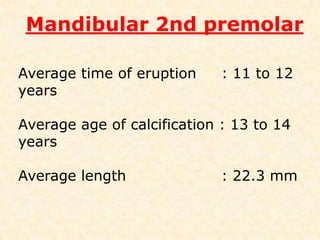
Mandibular 2nd premolarAverage time of eruption     : 11 to 12 yearsAverage age of calcification : 13 to 14 yearsAverage length                   : 22.3 mm
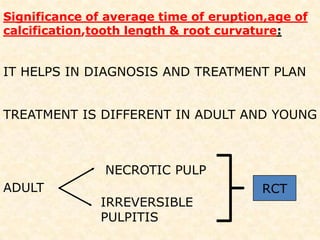
Significance of average time of eruption,ageof calcification,toothlength & root curvature: IT HELPS IN DIAGNOSIS AND TREATMENT PLAN TREATMENT IS DIFFERENT IN ADULT AND YOUNGNECROTIC PULPRCTADULT IRREVERSIBLE PULPITIS
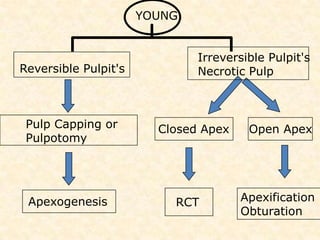
YOUNGIrreversible Pulpit's Necrotic PulpReversible Pulpit'sPulp Capping or PulpotomyClosed ApexOpen ApexApexification ObturationApexogenesisRCT
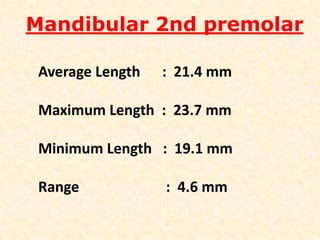
Mandibular 2nd premolarAverage Length      :  21.4 mm Maximum Length  :  23.7 mmMinimum Length   :  19.1 mmRange                        :  4.6 mm
Mandibular 2nd premolarIMPORTANCE                         It helps in the determining the working length and better assumption of the radiographConsideration must be given to the mental foramen which lies in close proximity to the apex. Avoid over instrumentation and overfill.
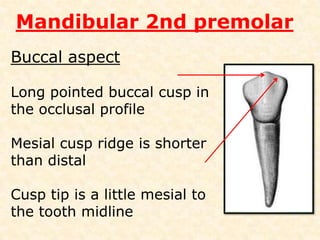
Mandibular 2nd premolarBuccal aspectLong pointed buccal cusp in the occlusal profileMesial cusp ridge is shorter than distal Cusp tip is a little mesial to the tooth midline
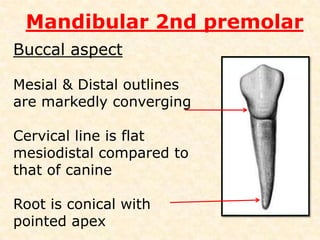
Mandibular 2nd premolarBuccal aspectMesial & Distal outlines are markedly convergingCervical line is flat mesiodistal compared to that of canineRoot is conical with pointed apex
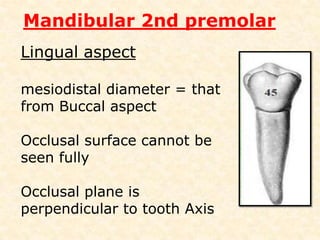
Mandibular 2nd premolarLingual aspectmesiodistal diameter = that from Buccal aspectOcclusal surface cannot be seen fullyOcclusal plane is perpendicular to tooth Axis
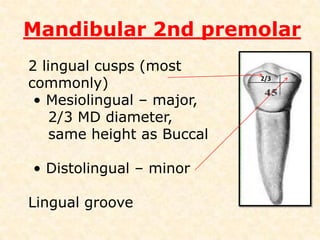
Mandibular 2nd premolar2 lingual cusps (most commonly) • Mesiolingual – major,      2/3 MD diameter,       same height as Buccal • Distolingual – minorLingual groove2/3
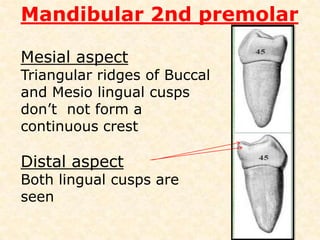
Mandibular 2nd premolarMesial aspectTriangular ridges of Buccal    and Mesio lingual cusps don’t  not form a continuous crestDistal aspectBoth lingual cusps are  seen
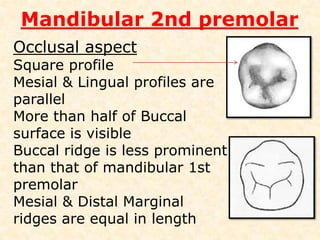
Mandibular 2nd premolarOcclusal aspectSquare profile Mesial & Lingual profiles are parallelMore than half of Buccal surface is visibleBuccal ridge is less prominent than that of mandibular 1st premolarMesial & Distal Marginal ridges are equal in length
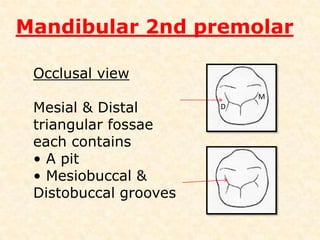
Mandibular 2nd premolarOcclusal viewMesial & Distal triangular fossaeeach contains• A pit• Mesiobuccal & Distobuccal groovesMD
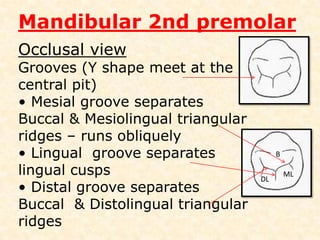
Mandibular 2nd premolarOcclusal viewGrooves (Y shape meet at the central pit)• Mesial groove separates Buccal & Mesiolingual triangular ridges – runs obliquely• Lingual  groove separates lingual cusps• Distal groove separates Buccal  & Distolingual triangular ridgesBMLDL
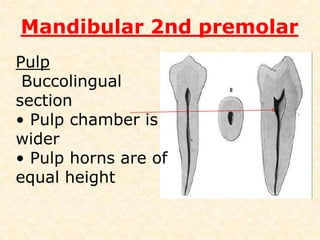
Mandibular 2nd premolarPulp Buccolingual section• Pulp chamber iswider• Pulp horns are ofequal height
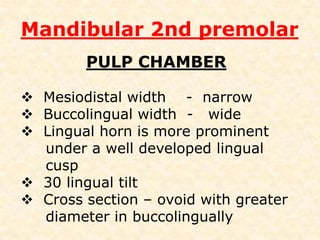
Mandibular 2nd premolarPULP CHAMBER  Mesiodistal width    -  narrow
  Buccolingual width  -   wide
  Lingual horn is more prominent      under a well developed lingual            cusp  30 lingual tilt
  Cross section – ovoid with greater       diameter in buccolingually
Mandibular 2nd premolar
Mandibular 2nd premolarROOTS AND ROOT CANALSThe Mandibular second premolar resembles the first premolar, but the lingual canal is present only occasionally.The root canal is oval in cross-section and rather straight with only a slight distal curvature in some canals
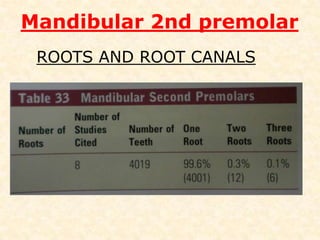
Mandibular 2nd premolarROOTS AND ROOT CANALS
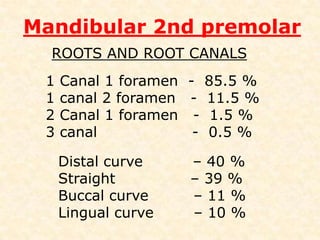
Mandibular 2nd premolarROOTS AND ROOT CANALS1 Canal 1 foramen  -  85.5 %1 canal 2 foramen   -  11.5 %2 Canal 1 foramen   -  1.5 %3 canal                   -  0.5 %Distal curve          – 40 %Straight               – 39 %Buccal curve         – 11 %Lingual curve        – 10 %
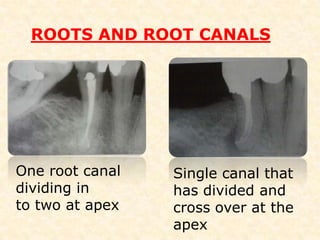
ROOTS AND ROOT CANALSOne root canal dividing in to two at apexSingle canal that has divided and cross over at the apex
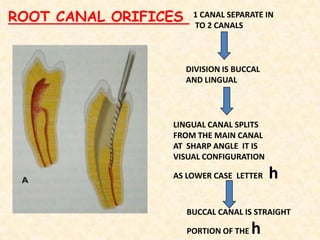
ROOT CANAL ORIFICES 1 CANAL SEPARATE INTO 2 CANALSDIVISION IS BUCCAL AND LINGUALLINGUAL CANAL SPLITSFROM THE MAIN CANALAT  SHARP ANGLE  IT IS VISUAL CONFIGURATION AS LOWER CASE  LETTER   hBUCCAL CANAL IS STRAIGHTPORTION OF THE h
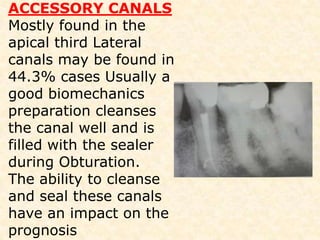
ACCESSORY CANALSMostly found in the apical third Lateral canals may be found in 44.3% cases Usually a good biomechanics preparation cleanses the canal well and is filled with the sealer during Obturation.The ability to cleanse and seal these canals have an impact on the prognosis
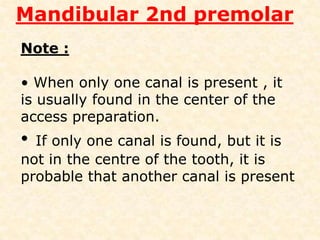
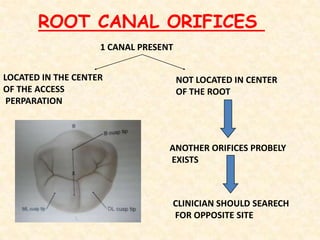
Mandibular 2nd premolarNote :• When only one canal is present , it is usually found in the center of the access preparation. If only one canal is found, but it is not in the centre of the tooth, it is probable that another canal is presentROOT CANAL ORIFICES 1 CANAL PRESENTLOCATED IN THE CENTER OF THE ACCESS PERPARATIONNOT LOCATED IN CENTEROF THE ROOTANOTHER ORIFICES PROBELY EXISTSCLINICIAN SHOULD SEARECH FOR OPPOSITE SITE
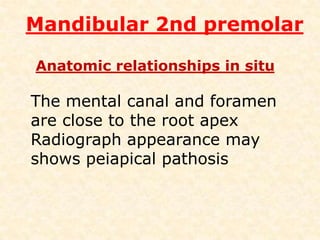
Mandibular 2nd premolarAnatomic relationships in situThe mental canal and foramen are close to the root apex Radiograph appearance may shows peiapical pathosis
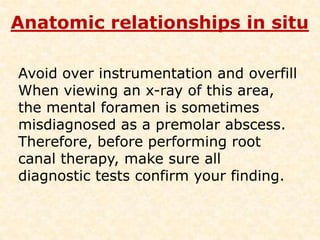
Anatomic relationships in situAvoid over instrumentation and overfill When viewing an x-ray of this area, the mental foramen is sometimes misdiagnosed as a premolar abscess. Therefore, before performing root canal therapy, make sure all diagnostic tests confirm your finding.
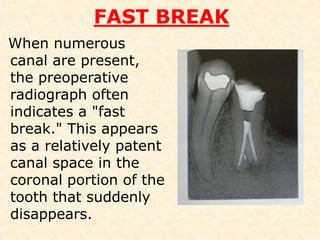
FAST BREAK  When numerous canalare present, the preoperative radiograph often indicates a "fast break." This appears as a relatively patent canal space in the coronal portion of the tooth that suddenly disappears.
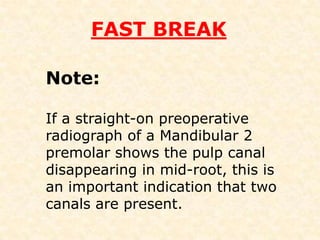
FAST BREAKNote: If a straight-on preoperative radiograph of a Mandibular 2 premolar shows the pulp canal disappearing in mid-root, this is an important indication that two canals are present.
Mandibular 2nd premolarThe mandibular second premolar is similar to the first premolar, with the following differences:  The lingual pulp horn usually is      larger  The root and root canal are more                         often oval than round  The pulp chamber is wider       buccolingually
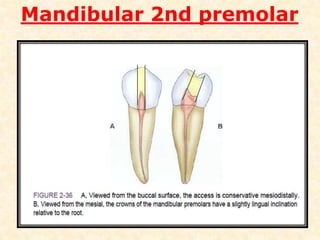
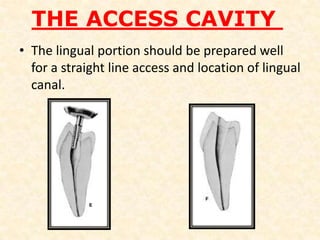
THE ACCESS CAVITY The access cavity form for the Mandibular second premolar varies in at least two ways in its external anatomy.1.The crown typically has a smaller lingual inclination less extension up the buccal cusp incline is required to achieve straight-line access. 2. The lingual half of the tooth is more fully developed; therefore the lingual access extension is typically halfway up the lingual cusp incline.
THE ACCESS CAVITY The Mandibular second premolar can have two lingual cusps, sometimes of equal size. When this occurs, the access preparation is centered mesiodistally on a line connecting the buccal cusp and the lingual groove between the lingual cusp tips.
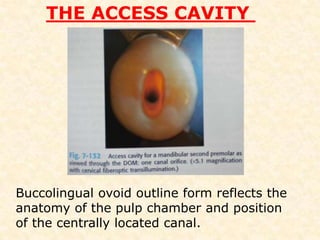
THE ACCESS CAVITY Buccolingual ovoid outline form reflects the anatomy of the pulp chamber and position of the centrally located canal.
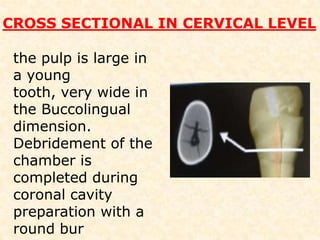
THE ACCESS CAVITY The lingual portion should be prepared well for a straight line access and location of lingual canal.CROSS SECTIONAL IN CERVICAL LEVELthe pulp is large in a youngtooth, very wide in the Buccolingual dimension.Debridement of the chamber is completed during coronal cavity preparation with a round bur
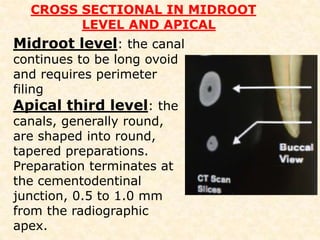
CROSS SECTIONAL IN MIDROOT                             LEVEL AND APICALMidroot level: the canal continues to be long ovoid and requires perimeter filing Apical third level: the canals, generally round, are shaped into round, tapered preparations.Preparation terminates at the cementodentinaljunction, 0.5 to 1.0 mm from the radiographicapex.
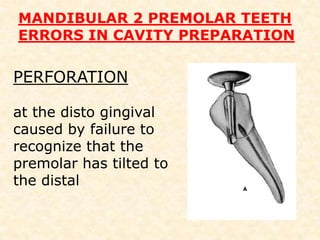
MANDIBULAR 2 PREMOLAR TEETHERRORS IN CAVITY PREPARATIONPERFORATIONat the disto gingival caused by failure to recognize that the premolar has tilted to the distal
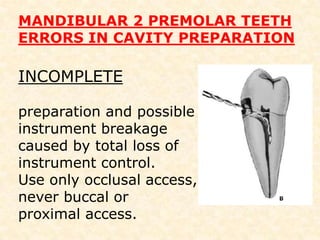
MANDIBULAR 2 PREMOLAR TEETH ERRORS IN CAVITY PREPARATIONINCOMPLETEpreparation and possible instrument breakage caused by total loss of instrument control. Use only occlusal access, never buccal orproximal access.
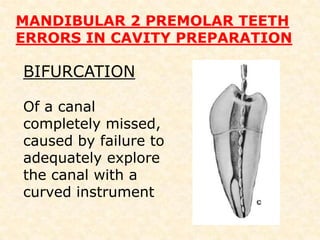
MANDIBULAR 2 PREMOLAR TEETHERRORS IN CAVITY PREPARATIONBIFURCATIONOf a canal completely missed,caused by failure to adequately explore the canal with a curved instrument
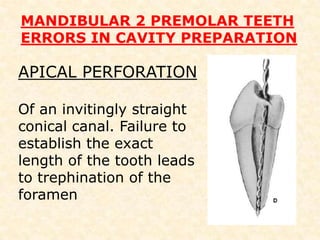
MANDIBULAR 2 PREMOLAR TEETHERRORS IN CAVITY PREPARATIONAPICAL PERFORATIONOf an invitingly straightconical canal. Failure to establish the exact length of the tooth leads to trephination of the foramen
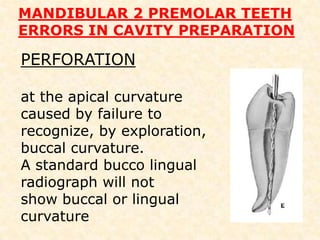
MANDIBULAR 2 PREMOLAR TEETHERRORS IN CAVITY PREPARATIONPERFORATION at the apical curvature caused by failure to recognize, by exploration, buccal curvature.A standard bucco lingual radiograph will notshow buccal or lingual curvature
Mandibular 2nd premolarAnomalies  Dens invaginatus
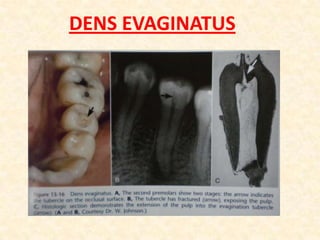
  Dens evaginatus
  Gemination
  Dilaceration DENS INVAGINATUS  Dens invaginatus is a malformation    of teeth probably resulting from an infolding of the dental papilla during tooth development.  Affected teeth show a deep infolding  of enamel and dentine.  Occurs before calcification of the teeth.  Also known as dens in denteTREATMENT OF DENS INVAGINATUSThe treatment modalities depend on the degree of complexity of its anatomy.
They include nonsurgical endodontic treatment, endodontic surgery and  extraction.
In cases in which there is an immature apex, calcium hydroxide is used to stimulate apexificationDENS EVAGINATUSDens evaginatus is a developmental anomaly that manifests as a tubercle emerging from the surface of the affected tooth.
It occurs most frequently in the premolars.
Higher prevalence among people of Mongoloid origin.DENS EVAGINATUS
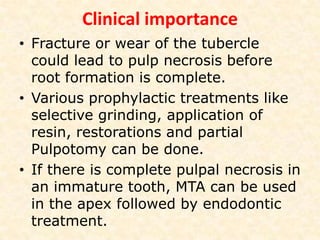
Clinical importanceFracture or wear of the tubercle could lead to pulp necrosis before root formation is complete.
Various prophylactic treatments like selective grinding, application of resin, restorations and partial Pulpotomy can be done.
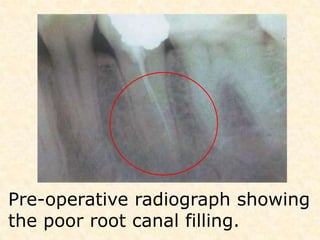
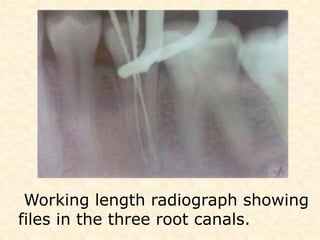
If there is complete pulpal necrosis in an immature tooth, MTA can be used in the apex followed by endodontic treatment.Mandibular second premolar with three root canalsReport of a case

35

  • 1.
    MANDIBULAR 2 PREMOLARBYO.R.GANESH MURTHI M.Sc.D ENDO
  • 2.
    OUT LINE INTRODUCTION
  • 3.
    EXTERNALANATOMY
  • 4.
    INTERNALANATOMY
  • 5.
  • 6.
  • 7.
    ENDODONTIC CORRELATION
  • 8.
    INTRODUCTION The termpremolar is used to designate any tooth in the permanent dentition that replaces a primary molar.fifth tooth from midline in the mandible quadrant. They assist canine in shearing and support corners of the mouth from sagging.
  • 9.
    Mandibular 2nd premolarAveragetime of eruption : 11 to 12 yearsAverage age of calcification : 13 to 14 yearsAverage length : 22.3 mm
  • 10.
    Significance of averagetime of eruption,ageof calcification,toothlength & root curvature: IT HELPS IN DIAGNOSIS AND TREATMENT PLAN TREATMENT IS DIFFERENT IN ADULT AND YOUNGNECROTIC PULPRCTADULT IRREVERSIBLE PULPITIS
  • 11.
    YOUNGIrreversible Pulpit's NecroticPulpReversible Pulpit'sPulp Capping or PulpotomyClosed ApexOpen ApexApexification ObturationApexogenesisRCT
  • 12.
    Mandibular 2nd premolarAverageLength : 21.4 mm Maximum Length : 23.7 mmMinimum Length : 19.1 mmRange : 4.6 mm
  • 13.
    Mandibular 2nd premolarIMPORTANCE It helps in the determining the working length and better assumption of the radiographConsideration must be given to the mental foramen which lies in close proximity to the apex. Avoid over instrumentation and overfill.
  • 14.
    Mandibular 2nd premolarBuccalaspectLong pointed buccal cusp in the occlusal profileMesial cusp ridge is shorter than distal Cusp tip is a little mesial to the tooth midline
  • 15.
    Mandibular 2nd premolarBuccalaspectMesial & Distal outlines are markedly convergingCervical line is flat mesiodistal compared to that of canineRoot is conical with pointed apex
  • 16.
    Mandibular 2nd premolarLingualaspectmesiodistal diameter = that from Buccal aspectOcclusal surface cannot be seen fullyOcclusal plane is perpendicular to tooth Axis
  • 17.
    Mandibular 2nd premolar2lingual cusps (most commonly) • Mesiolingual – major, 2/3 MD diameter, same height as Buccal • Distolingual – minorLingual groove2/3
  • 18.
    Mandibular 2nd premolarMesialaspectTriangular ridges of Buccal and Mesio lingual cusps don’t not form a continuous crestDistal aspectBoth lingual cusps are seen
  • 19.
    Mandibular 2nd premolarOcclusalaspectSquare profile Mesial & Lingual profiles are parallelMore than half of Buccal surface is visibleBuccal ridge is less prominent than that of mandibular 1st premolarMesial & Distal Marginal ridges are equal in length
  • 20.
    Mandibular 2nd premolarOcclusalviewMesial & Distal triangular fossaeeach contains• A pit• Mesiobuccal & Distobuccal groovesMD
  • 21.
    Mandibular 2nd premolarOcclusalviewGrooves (Y shape meet at the central pit)• Mesial groove separates Buccal & Mesiolingual triangular ridges – runs obliquely• Lingual groove separates lingual cusps• Distal groove separates Buccal & Distolingual triangular ridgesBMLDL
  • 22.
    Mandibular 2nd premolarPulpBuccolingual section• Pulp chamber iswider• Pulp horns are ofequal height
  • 23.
    Mandibular 2nd premolarPULPCHAMBER Mesiodistal width - narrow
  • 24.
    Buccolingualwidth - wide
  • 25.
    Lingualhorn is more prominent under a well developed lingual cusp 30 lingual tilt
  • 26.
    Crosssection – ovoid with greater diameter in buccolingually
  • 27.
  • 28.
    Mandibular 2nd premolarROOTSAND ROOT CANALSThe Mandibular second premolar resembles the first premolar, but the lingual canal is present only occasionally.The root canal is oval in cross-section and rather straight with only a slight distal curvature in some canals
  • 29.
  • 30.
    Mandibular 2nd premolarROOTSAND ROOT CANALS1 Canal 1 foramen - 85.5 %1 canal 2 foramen - 11.5 %2 Canal 1 foramen - 1.5 %3 canal - 0.5 %Distal curve – 40 %Straight – 39 %Buccal curve – 11 %Lingual curve – 10 %
  • 31.
    ROOTS AND ROOTCANALSOne root canal dividing in to two at apexSingle canal that has divided and cross over at the apex
  • 32.
    ROOT CANAL ORIFICES1 CANAL SEPARATE INTO 2 CANALSDIVISION IS BUCCAL AND LINGUALLINGUAL CANAL SPLITSFROM THE MAIN CANALAT SHARP ANGLE IT IS VISUAL CONFIGURATION AS LOWER CASE LETTER hBUCCAL CANAL IS STRAIGHTPORTION OF THE h
  • 33.
    ACCESSORY CANALSMostly foundin the apical third Lateral canals may be found in 44.3% cases Usually a good biomechanics preparation cleanses the canal well and is filled with the sealer during Obturation.The ability to cleanse and seal these canals have an impact on the prognosis
  • 34.
    Mandibular 2nd premolarNote:• When only one canal is present , it is usually found in the center of the access preparation. If only one canal is found, but it is not in the centre of the tooth, it is probable that another canal is presentROOT CANAL ORIFICES 1 CANAL PRESENTLOCATED IN THE CENTER OF THE ACCESS PERPARATIONNOT LOCATED IN CENTEROF THE ROOTANOTHER ORIFICES PROBELY EXISTSCLINICIAN SHOULD SEARECH FOR OPPOSITE SITE
  • 35.
    Mandibular 2nd premolarAnatomicrelationships in situThe mental canal and foramen are close to the root apex Radiograph appearance may shows peiapical pathosis
  • 36.
    Anatomic relationships insituAvoid over instrumentation and overfill When viewing an x-ray of this area, the mental foramen is sometimes misdiagnosed as a premolar abscess. Therefore, before performing root canal therapy, make sure all diagnostic tests confirm your finding.
  • 37.
    FAST BREAK When numerous canalare present, the preoperative radiograph often indicates a "fast break." This appears as a relatively patent canal space in the coronal portion of the tooth that suddenly disappears.
  • 38.
    FAST BREAKNote: Ifa straight-on preoperative radiograph of a Mandibular 2 premolar shows the pulp canal disappearing in mid-root, this is an important indication that two canals are present.
  • 39.
    Mandibular 2nd premolarThemandibular second premolar is similar to the first premolar, with the following differences: The lingual pulp horn usually is larger The root and root canal are more often oval than round The pulp chamber is wider buccolingually
  • 40.
    THE ACCESS CAVITYThe access cavity form for the Mandibular second premolar varies in at least two ways in its external anatomy.1.The crown typically has a smaller lingual inclination less extension up the buccal cusp incline is required to achieve straight-line access. 2. The lingual half of the tooth is more fully developed; therefore the lingual access extension is typically halfway up the lingual cusp incline.
  • 41.
    THE ACCESS CAVITYThe Mandibular second premolar can have two lingual cusps, sometimes of equal size. When this occurs, the access preparation is centered mesiodistally on a line connecting the buccal cusp and the lingual groove between the lingual cusp tips.
  • 42.
    THE ACCESS CAVITYBuccolingual ovoid outline form reflects the anatomy of the pulp chamber and position of the centrally located canal.
  • 43.
    THE ACCESS CAVITYThe lingual portion should be prepared well for a straight line access and location of lingual canal.CROSS SECTIONAL IN CERVICAL LEVELthe pulp is large in a youngtooth, very wide in the Buccolingual dimension.Debridement of the chamber is completed during coronal cavity preparation with a round bur
  • 44.
    CROSS SECTIONAL INMIDROOT LEVEL AND APICALMidroot level: the canal continues to be long ovoid and requires perimeter filing Apical third level: the canals, generally round, are shaped into round, tapered preparations.Preparation terminates at the cementodentinaljunction, 0.5 to 1.0 mm from the radiographicapex.
  • 45.
    MANDIBULAR 2 PREMOLARTEETHERRORS IN CAVITY PREPARATIONPERFORATIONat the disto gingival caused by failure to recognize that the premolar has tilted to the distal
  • 46.
    MANDIBULAR 2 PREMOLARTEETH ERRORS IN CAVITY PREPARATIONINCOMPLETEpreparation and possible instrument breakage caused by total loss of instrument control. Use only occlusal access, never buccal orproximal access.
  • 47.
    MANDIBULAR 2 PREMOLARTEETHERRORS IN CAVITY PREPARATIONBIFURCATIONOf a canal completely missed,caused by failure to adequately explore the canal with a curved instrument
  • 48.
    MANDIBULAR 2 PREMOLARTEETHERRORS IN CAVITY PREPARATIONAPICAL PERFORATIONOf an invitingly straightconical canal. Failure to establish the exact length of the tooth leads to trephination of the foramen
  • 49.
    MANDIBULAR 2 PREMOLARTEETHERRORS IN CAVITY PREPARATIONPERFORATION at the apical curvature caused by failure to recognize, by exploration, buccal curvature.A standard bucco lingual radiograph will notshow buccal or lingual curvature
  • 50.
  • 51.
    Densevaginatus
  • 52.
  • 53.
    DilacerationDENS INVAGINATUS Dens invaginatus is a malformation of teeth probably resulting from an infolding of the dental papilla during tooth development. Affected teeth show a deep infolding of enamel and dentine. Occurs before calcification of the teeth. Also known as dens in denteTREATMENT OF DENS INVAGINATUSThe treatment modalities depend on the degree of complexity of its anatomy.
  • 54.
    They include nonsurgicalendodontic treatment, endodontic surgery and extraction.
  • 55.
    In cases inwhich there is an immature apex, calcium hydroxide is used to stimulate apexificationDENS EVAGINATUSDens evaginatus is a developmental anomaly that manifests as a tubercle emerging from the surface of the affected tooth.
  • 56.
    It occurs mostfrequently in the premolars.
  • 57.
    Higher prevalence amongpeople of Mongoloid origin.DENS EVAGINATUS
  • 58.
    Clinical importanceFracture orwear of the tubercle could lead to pulp necrosis before root formation is complete.
  • 59.
    Various prophylactic treatmentslike selective grinding, application of resin, restorations and partial Pulpotomy can be done.
  • 60.
    If there iscomplete pulpal necrosis in an immature tooth, MTA can be used in the apex followed by endodontic treatment.Mandibular second premolar with three root canalsReport of a case