Academic research
 Ideas and theories.
 Primary and secondary sources.
 Formulate hypotheses.
 Evaluate and draw conclusions.
 Present findings.
 Reference materials.
 You must research about any aspect of our
designated cases of study which raises
interesting questions about them.
 Each one of you will choose a different
topic/case of study/field of research, and
share the outcomes with your classmates in
preparation for the exam.
 Hypothesis
 Thesis
 Facts
 Quotes
 Summaries
 Primary research
 Secondary research
 References
 Citations
 A supposition or proposed explanation
made on the basis of limited evidence as a
starting point for further investigation.
 A proposition made as a basis for reasoning,
without any assumption of its truth.
 A statement or theory that is put forward as
a premise to be maintained or proved.
 A proposition that is maintained by
argument.
 A dissertation advancing an original point of
view as a result of research.
Hypothesis:
 Segregation exists in UK’s educational system from the very earliest
stages of schooling, based on the levels of wealth of the students’
families.
Research:
 National curriculum.
 Eton College curriculum.
 Other private, independent and non-state school’s curriculums.
 Annual fees in private, independent and non-state schools.
 Other related elements for research.
 Bibliography.
Thesis:
 Will be demonstrated by our research. So far we do not know
whether there is segregation or not, and whether that segregation
is based on the purchase power of the students’ families.
 Your research must be a sustained piece of work
of between about 1500-2000 words.
 It will be presented as a word document, in both
versions printed and digital. It will be checked for
plagiarism.
 First draft should include: topic, hypothesis
(title), structure (bullet points) and list of
resources to be used in your research ().
1) Determine your research topic (and thesis).
 Your topic can be aroused from a sense of
curiosity, hunch and interest over a particular
issue that you think that needs to be filled in the
gap of knowledge.
Choose a straightforward topic. Keep your topic
and research simple. Do not overcomplicate it.
2) Understand the difference between primary and
secondary research.
 Primary research means doing original research, meaning
that this knowledge doesn't appear in any other paper.You
might be reading through original treaties, newspaper
articles, or authentic letters from authors or statesmen.You
might be conducting scientific, medical or engineering
experiments.
 Secondary research means reading other experts' published
papers to learn something new about your topic, to survey
what others have said and written about it, to reach a
conclusion about your ideas on the topic.
3) Determine your scope and time line.
 Your academic research will lead to a written report ("research paper” such as a class
assignment, a work task, or even a published article).
 Determine in advance how much total time you have for this work, and make a rough
work schedule. A work schedule must include the following major steps:
1. Finding and reading sources.
2. Collecting notes from sources.
3. Preparing a rough draft.
4. Revising the draft and incorporating source material and citations.
5. Preparing a final draft in the required format.
 The research scope means knowing how much of your broad subject you will deal
with.You must limit your reading and study to a particular focused aspect of the
subject.This requires thinking about what specifically you want to cover.Your
academic research scope should not be too broad (in that it covered more than the
required areas) and not too narrow (in that it does not meet the substantial
requirement of a research scope).
4) Write a research question.
 This is a question that will guide you in your reading. It will turn into
a thesis statement later.
 This question reminds you of what you want to find and read, what
you are considering.
 It is not about a fact ("When did the French first arrive in Britain?“
1066 AD), but about an idea or opinion ("What did the French arrival
in Britain do to the structure of the existing legal system?).
 The research questions should be the basis in which your hypothesis
stands.
5) Learn how to find useful sources.
 This is the heart of the research. With the internet, there is more
useful and useless information available than ever in the history of
human inquiry.
 There is also relevant material which is NOT available on the
internet.You will be required to use a certain number and type of
resources.These would include: books, magazines or journals,
encyclopaedias (NOT Wikipedia),reference books, newspapers,
letters, interviews, etc.
 You will need an academic (school or university) library.They do
contain information and sources not generally or easily available on
the internet, and reference librarians who can help you. Find your
nearest library and determine how to get access privileges.
6) Collect some possible sources.
 Begin locating material to read: chapters,
paragraphs, sections, sentences that cover
your topic.
 Remember that you can't read everything on
the topic.You also can't include every word you
read in your paper.This is background reading
for you to learn about your question.
7) Begin reading in detail.
 Focus on your research question and find
information that illuminates it, explains,
describes, analyzes, contrasts, or gives expert
opinion and viewpoints on it.
 You are seeking to form your own judgment,
based on what you read from your sources.
8) Find a method to take notes on what you read.
 This is more than merely copying, highlighting, or cutting/pasting. If you do only
this, you will end up with a pile of bits and pieces, and will still have to wade through
them to find useful, relevant, and specific quotes.
 Take notes of these:
 facts that are not common knowledge.
 quotes from experts that state a concept in a unique, unusual, or startling way.
 summaries of longer explanations.
 Learn the difference between a direct quote, paraphrase, and summary.
 Be sure to mark exactly where the note came from in your source.You must know
the exact location: author, title, magazine, book, internet page URL, date, volume
number, etc.
 Be organised: arrange your notes into groups according to their content, for later
organization into sections of your paper.
9) Continue to consider new sources.
 While you are reading, you might find new
information or questions on a topic that you
need to read about.
 You might have to broaden your research to
check on details, possible errors, corroborating
or conflicting evidence, the context of an
article, expert or paper.
10) Evaluate the sources you use.Your source
must be credible in terms of the author,
location of publication, date, publisher, etc.
Evaluating the credibility of a source
11) Keep your research question in mind.
 This is what you will analyze in your paper.Your
source material must help you establish your
thesis on that topic.
 You might change your research question
according to what you are actually finding.
 You also might change your opinion after doing
your reading.
12) Write your tentative thesis.
 This is a single statement of your viewpoint on
your research question.
Elaborating a thesis
13) Begin writing your first draft.
 Start writing what you have learnt about your topic and
thesis.
 First give the background and set the context for this
topic.Then start explaining, describing, state causes
and/or effects, analyse parts of the topic and provide
examples and evidence that support your thesis.
 Some papers might require a first section on literature
review.This is a special section where you discuss what
papers other experts have published on this topic.
14) Begin to add quotes, paraphrases, or summaries into your
writing.
 These should be added into your paragraphs where they will
highlight or help explain what you are saying.
 Be sure to introduce sourced materials in the correct way (see a
standard writing handbook), and mark where your citation will be.
 Note all material taken from sources must be cited.
 Depending on what system you use, your (in text) citation will
contain a name, date, or page number.
 This notation will refer to the list at the end of the paper of
References orWorks Cited.
15) Continue writing your first draft, and then revise it.
 This writing process follows all similar academic writing
steps. Revising means checking the content of your
paper, and making sure the thesis is developed, the
content matches your thesis, there is enough material,
it is in a logical order, nothing off topic is included, and
the writing flows smoothly.
 Editing means checking the writing details such
as paragraph breaks, sentence, structure, punctuation,
spelling, and citation formats.
16) Prepare the final draft.
 Strictly follow the format you are using, by
checking with its handbook or style book.
 This includes: title page, page setup and
numeration, in text citations, reference list,
inclusion of visuals, sections and titles, etc.
1)Think about how reliable you need the information to be.
 If you're writing an academic paper in an academic setting,
you need to be especially strict about sources, focusing
specifically on scholarly article.
 If you are looking for information on how to unclog your
toilet, a comprehensive Internet search might suffice.
 If your research is of an academic nature, it is extremely
important to evaluate sources and make a judgment call as to
whether you should include the information and if so, how it
should be presented.
2) Consider the medium with which you are working.
 Generally, the more that is invested into the creation and publishing of the material,
the more likely you are to find reliable information. For example, printed material has
a higher cost of production than an Internet blog, which anyone can publish for free.
 Academic journals are considered a reliable sources because each article must
undergo a rigorous review process, with many professional reviewers involved. Peer-
review does not necessarily indicate that the other field expert reviewers are in
agreement with the conclusions of the original writer. Peer-reviewers examine
accuracy of factual information, rigor of experimental process, and respond with
questions and critique of any conclusion made.They may disagree with the writer in
question, but they agree that the foundation of the article is based on top-notch
thinking in the field.
 This is not to say that you should completely avoid Internet sources (a blog published
by a distinguished scientist commenting on a study could be useful) nor should you
immediately trust a well-researched publication (material sponsored by large
corporations, for example, can be highly biased).Take everything with a grain of salt.
3) Research the author.
 A source is more credible if written by someone with a degree or other credentials in
the subject of interest. If no author or organization is named, the source will not be
viewed as very credible. However, if the author is presenting original work, evaluate
the merit of the ideas, not the credentials. Credentials have never guaranteed
innovation and the history of science tells us that the big advances in sciences tend to
come from outsiders, not the establishment. Some questions that you should ask
about the author are:
 What is the author’s academic background?Where does the author work?
 If the author is affiliated with a reputable institution or organization, what are its
values and goals? Do they benefit financially by promoting a particular view?
 What is his or her educational background?
 What other works has the author published?
 What experience does the author have? Is s/he an innovator, or a follower and
promoter of the status quo?
 Has this author been cited as a source by other scholars or experts in the field?
4) Check the date.
 Find out when the source was published or revised. In some
subject areas, such as the sciences, having current sources is
essential; but in other fields, like the humanities, including
older material is critical.
 It's also possible that you're looking at an older version of the
source, and an updated one has since been published. Check
with a scholarly database for academic sources (or an online
bookstore for popular sources) to see if a more recent version
is available.
 If so, not only should you find it, but you can also feel more
confident about the source.
5) Investigate the publisher.
 If the publisher is a university press, the source is likely to be
scholarly.
6) Determine the intended audience.
 Scan the preface, table of contents, index, abstract, and the
first few paragraphs of the article or of a few chapters. Is the
tone, depth, and breadth appropriate for your project?
 Using a source that is too specialized for your needs may lead
you to misinterpret the information given, which is just as
hurtful to your own credibility as using an unreliable source.
7) Check the reviews.
 Find reviews for the source. In the US, you can
check Book Review Index, Book Review
Digest, Periodical Abstracts.
 If the book is aimed at a layperson, check reviews
online and see how and why others criticized the
source.
 If there is significant controversy surrounding the
validity of the source, you may wish to avoid using
it, or examine it further with a skeptical eye.
8) Evaluate the source's sources.
 Citing other reliable sources is a sign of
credibility. It is, however, sometimes necessary
to verify that the other sources also show a
pattern of credibility and are used in context.
9) Identify bias.
 If the source's author is known to be financially connected with the
subject, be aware that the source may not fairly represent all views.
Sometimes research is necessary to determine relationships that
indicate the possibility of bias.
 Be conscious of wording that indicates judgement. Conclusions that
describe something as "bad or good" or "right or wrong" should be
examined. It is more appropriate to compare something to an
objective standard than to label it with words that represent abstract
concepts.Take for example, "...these and other despicable acts..." vs.
"...these and other illegal acts...".The latter describes the acts in terms
of the law (an objective source, somewhat) whereas the first example
judges the actions according to the author's own morals and believes
of what is a despicable act.
10) Evaluate Consistency.
 Sources that apply different standards to those
who agree and disagree with them are suspect.
If your source praises one politician for
"changing to meet the needs of his
constituency", but then criticizes an opposing
politician for "changing his position with opinion
polls", it is likely that the source is biased.
11) Investigate the financial or funding sources for
sponsored research.
 Determine the sources of funding for the study
conducted to get an idea of the potential influences
on the study.
 Various sources of funding can sway the
information presented or the way a study is
conducted in order to align with their own agendas.
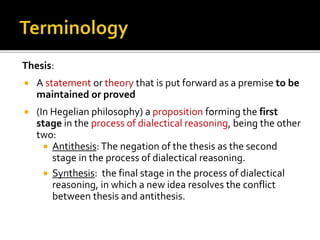
Thesis:
 A statement or theory that is put forward as a premise to be
maintained or proved
 (In Hegelian philosophy) a proposition forming the first
stage in the process of dialectical reasoning, being the other
two:
 Antithesis: The negation of the thesis as the second
stage in the process of dialectical reasoning.
 Synthesis: the final stage in the process of dialectical
reasoning, in which a new idea resolves the conflict
between thesis and antithesis.
1) Determine the assignment or task the
teacher has given.
 Be sure you know the topic, type of essay,
its length and, if given, its format, purpose,
and structure.
2) Focus on the topic to be developed.
 Keep it straightforward.Try to not to
overcomplicate your thesis and research.
 It is better to approach and tackle an easy
subject and develop it rigorously than a very
complicated one and develop it poorly.
3) Consider what your point about the topic
will be.
 You must have a point, or you are not ready
to consider a thesis yet.
4)Think of how to express your point in a
single, complete sentence.
 If you had to state your idea "in a nutshell",
what would you say?
5)Try to write a "scratch" sentence.
 Make sure it is a complete sentence with
subject and verb. It cannot be a question, or
an announcement of your purpose ("In this
essay, I'm going to...").
6) Make sure your sentence states your point.
 Segregation, based on the levels of wealth of
the students’ families, exists in UK’s
educational system from the very earliest
stages of schooling.
7) Make sure your thesis is an arguable point,
that is not a proven fact, a generality or a
purely personal preference.
 A thesis is a statement that others may hold
a different opinion about, and which you will
develop in your essay to prove it right by
providing factual evidence.
8) Avoid at all cost being too vague in your
thesis.
 A very vague, large statement will require
many pages for you to support it
adequately.
9) Make sure your thesis covers its academic
purpose.
 Re-write it if necessary.
10) Make sure you can actually explain your
ideas well enough in your essay to prove
your thesis.
 If not, re-write it.
 The hardest parts of doing research are: choosing the scope of a topic, locating useful sources, choosing what
source material to incorporate, and following the required format.
 The most serious and common error involves plagiarism and not citing the source of materials taken.Your own
thoughts are yours; common knowledge (facts generally known to all) are not cited. But any quote, paraphrase
or piece of source (summary) must be cited.
 You may choose your research topic, but be careful about choosing one too broad or narrow, too controversial
(nothing factual to base your work on), related to personal belief alone (nothing to research), or so recent that
there is no substantive writing on it published yet.
 Plan for enough time to complete this project. Any how-to article claiming you can write a paper in a day or
week, or without any drafts, is simply wrong, unless you plan to cheat. If you cheat, you will be caught, as this
paper will be internally assessed and internally and externally moderated. Do remember that the assessors can
also find the sources (or whole papers) you claim to use on the internet and that is very likely that they know the
materials and sources that you are using for your research.
 Be organised. Find a work space where you can arrange, organise and maintain all your notes, sources, and
drafts until the paper is finished. Always keep a back up copy of your paper.
 It's easy to go to the internet and search for material. It's much harder to determine if it's useful, relevant, and
needed. It's also hard to smoothly add that material to your own writing.
 Research on any aspect of history will force you to rely on the work of professional historians and academics,
unless you have access to the British Library or Library of Congress (many but not all of their materials are found
online), or other national repository.
 A research paper is your point of view of a topic supported by evidence, NOT simply a collection of quotes.
 Occasionally a thesis needs two sentences, but try to get all your idea into one sentence. It might
be a little long, but that's probably okay.
 Be sure to follow up your argumentation throughout the essay, without going off into another
topic.
 Your thesis may appear as the first sentence of your essay (2-3 paragraphs), but usually it is the
last sentence of your introduction.
 In the conclusion, or final sentences, be sure to refer back to the thesis, but use slightly different
words. Don't simply repeat the thesis as stated in the introduction.
 Be sure your thesis is not a question: "Do all Europeans support the Euro?" and not an
announcement: "I'm going to show you why we should recycle our waste."This simple statement
would be better: "We should recycle our waste.“
 Try to include a list of reasons, causes, points, etc. into your thesis that you will develop in your
essay.This is a kind of preview for the reader. "We should recycle our waste to clean up the streets
and give the unemployed some jobs.“
 Look for good sample thesis statements in your textbook, handbook, or writing lab.
 Ask your teacher to review your thesis and be prepared to re-write it several times before you
finish. It's possible you may re-write it even after you finish the essay if you see you actually
ended up writing about something different.
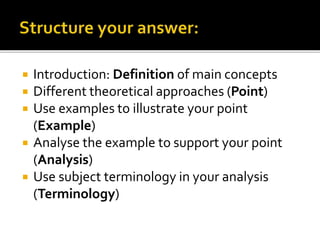
 Introduction: Definition of main concepts
 Different theoretical approaches (Point)
 Use examples to illustrate your point
(Example)
 Analyse the example to support your point
(Analysis)
 Use subject terminology in your analysis
(Terminology)
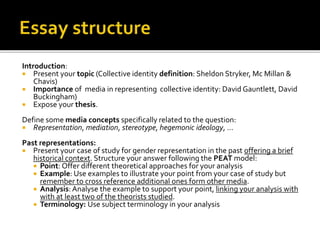
Introduction:
 Present your topic (Collective identity definition: Sheldon Stryker, Mc Millan &
Chavis)
 Importance of media in representing collective identity: David Gauntlett, David
Buckingham)
 Expose your thesis.
Define some media concepts specifically related to the question:
 Representation, mediation, stereotype, hegemonic ideology, …
Past representations:
 Present your case of study for gender representation in the past offering a brief
historical context. Structure your answer following the PEAT model:
 Point: Offer different theoretical approaches for your analysis
 Example: Use examples to illustrate your point from your case of study but
remember to cross reference additional ones form other media.
 Analysis: Analyse the example to support your point, linking your analysis with
with at least two of the theorists studied.
 Terminology: Use subject terminology in your analysis
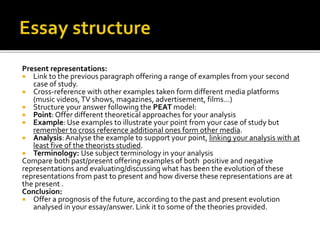
Present representations:
 Link to the previous paragraph offering a range of examples from your second
case of study.
 Cross-reference with other examples taken form different media platforms
(music videos,TV shows, magazines, advertisement, films…)
 Structure your answer following the PEAT model:
 Point: Offer different theoretical approaches for your analysis
 Example: Use examples to illustrate your point from your case of study but
remember to cross reference additional ones form other media.
 Analysis: Analyse the example to support your point, linking your analysis with at
least five of the theorists studied.
 Terminology: Use subject terminology in your analysis
Compare both past/present offering examples of both positive and negative
representations and evaluating/discussing what has been the evolution of these
representations from past to present and how diverse these representations are at
the present .
Conclusion:
 Offer a prognosis of the future, according to the past and present evolution
analysed in your essay/answer. Link it to some of the theories provided.
Thesis:
 A statement or theory that is put forward as a premise to be
maintained or proved
 (In Hegelian philosophy) a proposition forming the first
stage in the process of dialectical reasoning, being the other
two:
 Antithesis: The negation of the thesis as the second
stage in the process of dialectical reasoning.
 Synthesis: the final stage in the process of dialectical
reasoning, in which a new idea resolves the conflict
between thesis and antithesis.
 Remember you MUST refer to 2 media
platforms, 5 examples and 5 theorists in your
answer!
 You must use their quotes and theories to
support your point.
In Media Studies, the quality of written communication will be taken into
account in assessing your work in the two externally assessed units (exams).
 ensure that text is legible and that spelling, punctuation and grammar
are accurate so that meaning is clear.
 select and use a form and style of writing appropriate to purpose and to
complex subject matter.
 organise information clearly and coherently, using specialist vocabulary
when appropriate.
Candidates are required to use accurate spelling, grammar and
punctuation in extended written answers.
In this department Quality ofWritten Communication will be assessed
through AO1 andAO3 in Unit 1 and in Unit 2 through AO2 andAO4 as
appropriate.

Academic research

  • 1.
  • 2.
     Ideas andtheories.  Primary and secondary sources.  Formulate hypotheses.  Evaluate and draw conclusions.  Present findings.  Reference materials.
  • 3.
     You mustresearch about any aspect of our designated cases of study which raises interesting questions about them.  Each one of you will choose a different topic/case of study/field of research, and share the outcomes with your classmates in preparation for the exam.
  • 4.
     Hypothesis  Thesis Facts  Quotes  Summaries  Primary research  Secondary research  References  Citations
  • 5.
     A suppositionor proposed explanation made on the basis of limited evidence as a starting point for further investigation.  A proposition made as a basis for reasoning, without any assumption of its truth.
  • 6.
     A statementor theory that is put forward as a premise to be maintained or proved.  A proposition that is maintained by argument.  A dissertation advancing an original point of view as a result of research.
  • 7.
    Hypothesis:  Segregation existsin UK’s educational system from the very earliest stages of schooling, based on the levels of wealth of the students’ families. Research:  National curriculum.  Eton College curriculum.  Other private, independent and non-state school’s curriculums.  Annual fees in private, independent and non-state schools.  Other related elements for research.  Bibliography. Thesis:  Will be demonstrated by our research. So far we do not know whether there is segregation or not, and whether that segregation is based on the purchase power of the students’ families.
  • 8.
     Your researchmust be a sustained piece of work of between about 1500-2000 words.  It will be presented as a word document, in both versions printed and digital. It will be checked for plagiarism.  First draft should include: topic, hypothesis (title), structure (bullet points) and list of resources to be used in your research ().
  • 9.
    1) Determine yourresearch topic (and thesis).  Your topic can be aroused from a sense of curiosity, hunch and interest over a particular issue that you think that needs to be filled in the gap of knowledge. Choose a straightforward topic. Keep your topic and research simple. Do not overcomplicate it.
  • 10.
    2) Understand thedifference between primary and secondary research.  Primary research means doing original research, meaning that this knowledge doesn't appear in any other paper.You might be reading through original treaties, newspaper articles, or authentic letters from authors or statesmen.You might be conducting scientific, medical or engineering experiments.  Secondary research means reading other experts' published papers to learn something new about your topic, to survey what others have said and written about it, to reach a conclusion about your ideas on the topic.
  • 11.
    3) Determine yourscope and time line.  Your academic research will lead to a written report ("research paper” such as a class assignment, a work task, or even a published article).  Determine in advance how much total time you have for this work, and make a rough work schedule. A work schedule must include the following major steps: 1. Finding and reading sources. 2. Collecting notes from sources. 3. Preparing a rough draft. 4. Revising the draft and incorporating source material and citations. 5. Preparing a final draft in the required format.  The research scope means knowing how much of your broad subject you will deal with.You must limit your reading and study to a particular focused aspect of the subject.This requires thinking about what specifically you want to cover.Your academic research scope should not be too broad (in that it covered more than the required areas) and not too narrow (in that it does not meet the substantial requirement of a research scope).
  • 12.
    4) Write aresearch question.  This is a question that will guide you in your reading. It will turn into a thesis statement later.  This question reminds you of what you want to find and read, what you are considering.  It is not about a fact ("When did the French first arrive in Britain?“ 1066 AD), but about an idea or opinion ("What did the French arrival in Britain do to the structure of the existing legal system?).  The research questions should be the basis in which your hypothesis stands.
  • 13.
    5) Learn howto find useful sources.  This is the heart of the research. With the internet, there is more useful and useless information available than ever in the history of human inquiry.  There is also relevant material which is NOT available on the internet.You will be required to use a certain number and type of resources.These would include: books, magazines or journals, encyclopaedias (NOT Wikipedia),reference books, newspapers, letters, interviews, etc.  You will need an academic (school or university) library.They do contain information and sources not generally or easily available on the internet, and reference librarians who can help you. Find your nearest library and determine how to get access privileges.
  • 14.
    6) Collect somepossible sources.  Begin locating material to read: chapters, paragraphs, sections, sentences that cover your topic.  Remember that you can't read everything on the topic.You also can't include every word you read in your paper.This is background reading for you to learn about your question.
  • 15.
    7) Begin readingin detail.  Focus on your research question and find information that illuminates it, explains, describes, analyzes, contrasts, or gives expert opinion and viewpoints on it.  You are seeking to form your own judgment, based on what you read from your sources.
  • 16.
    8) Find amethod to take notes on what you read.  This is more than merely copying, highlighting, or cutting/pasting. If you do only this, you will end up with a pile of bits and pieces, and will still have to wade through them to find useful, relevant, and specific quotes.  Take notes of these:  facts that are not common knowledge.  quotes from experts that state a concept in a unique, unusual, or startling way.  summaries of longer explanations.  Learn the difference between a direct quote, paraphrase, and summary.  Be sure to mark exactly where the note came from in your source.You must know the exact location: author, title, magazine, book, internet page URL, date, volume number, etc.  Be organised: arrange your notes into groups according to their content, for later organization into sections of your paper.
  • 17.
    9) Continue toconsider new sources.  While you are reading, you might find new information or questions on a topic that you need to read about.  You might have to broaden your research to check on details, possible errors, corroborating or conflicting evidence, the context of an article, expert or paper.
  • 18.
    10) Evaluate thesources you use.Your source must be credible in terms of the author, location of publication, date, publisher, etc. Evaluating the credibility of a source
  • 19.
    11) Keep yourresearch question in mind.  This is what you will analyze in your paper.Your source material must help you establish your thesis on that topic.  You might change your research question according to what you are actually finding.  You also might change your opinion after doing your reading.
  • 20.
    12) Write yourtentative thesis.  This is a single statement of your viewpoint on your research question. Elaborating a thesis
  • 21.
    13) Begin writingyour first draft.  Start writing what you have learnt about your topic and thesis.  First give the background and set the context for this topic.Then start explaining, describing, state causes and/or effects, analyse parts of the topic and provide examples and evidence that support your thesis.  Some papers might require a first section on literature review.This is a special section where you discuss what papers other experts have published on this topic.
  • 22.
    14) Begin toadd quotes, paraphrases, or summaries into your writing.  These should be added into your paragraphs where they will highlight or help explain what you are saying.  Be sure to introduce sourced materials in the correct way (see a standard writing handbook), and mark where your citation will be.  Note all material taken from sources must be cited.  Depending on what system you use, your (in text) citation will contain a name, date, or page number.  This notation will refer to the list at the end of the paper of References orWorks Cited.
  • 23.
    15) Continue writingyour first draft, and then revise it.  This writing process follows all similar academic writing steps. Revising means checking the content of your paper, and making sure the thesis is developed, the content matches your thesis, there is enough material, it is in a logical order, nothing off topic is included, and the writing flows smoothly.  Editing means checking the writing details such as paragraph breaks, sentence, structure, punctuation, spelling, and citation formats.
  • 24.
    16) Prepare thefinal draft.  Strictly follow the format you are using, by checking with its handbook or style book.  This includes: title page, page setup and numeration, in text citations, reference list, inclusion of visuals, sections and titles, etc.
  • 25.
    1)Think about howreliable you need the information to be.  If you're writing an academic paper in an academic setting, you need to be especially strict about sources, focusing specifically on scholarly article.  If you are looking for information on how to unclog your toilet, a comprehensive Internet search might suffice.  If your research is of an academic nature, it is extremely important to evaluate sources and make a judgment call as to whether you should include the information and if so, how it should be presented.
  • 26.
    2) Consider themedium with which you are working.  Generally, the more that is invested into the creation and publishing of the material, the more likely you are to find reliable information. For example, printed material has a higher cost of production than an Internet blog, which anyone can publish for free.  Academic journals are considered a reliable sources because each article must undergo a rigorous review process, with many professional reviewers involved. Peer- review does not necessarily indicate that the other field expert reviewers are in agreement with the conclusions of the original writer. Peer-reviewers examine accuracy of factual information, rigor of experimental process, and respond with questions and critique of any conclusion made.They may disagree with the writer in question, but they agree that the foundation of the article is based on top-notch thinking in the field.  This is not to say that you should completely avoid Internet sources (a blog published by a distinguished scientist commenting on a study could be useful) nor should you immediately trust a well-researched publication (material sponsored by large corporations, for example, can be highly biased).Take everything with a grain of salt.
  • 27.
    3) Research theauthor.  A source is more credible if written by someone with a degree or other credentials in the subject of interest. If no author or organization is named, the source will not be viewed as very credible. However, if the author is presenting original work, evaluate the merit of the ideas, not the credentials. Credentials have never guaranteed innovation and the history of science tells us that the big advances in sciences tend to come from outsiders, not the establishment. Some questions that you should ask about the author are:  What is the author’s academic background?Where does the author work?  If the author is affiliated with a reputable institution or organization, what are its values and goals? Do they benefit financially by promoting a particular view?  What is his or her educational background?  What other works has the author published?  What experience does the author have? Is s/he an innovator, or a follower and promoter of the status quo?  Has this author been cited as a source by other scholars or experts in the field?
  • 28.
    4) Check thedate.  Find out when the source was published or revised. In some subject areas, such as the sciences, having current sources is essential; but in other fields, like the humanities, including older material is critical.  It's also possible that you're looking at an older version of the source, and an updated one has since been published. Check with a scholarly database for academic sources (or an online bookstore for popular sources) to see if a more recent version is available.  If so, not only should you find it, but you can also feel more confident about the source.
  • 29.
    5) Investigate thepublisher.  If the publisher is a university press, the source is likely to be scholarly. 6) Determine the intended audience.  Scan the preface, table of contents, index, abstract, and the first few paragraphs of the article or of a few chapters. Is the tone, depth, and breadth appropriate for your project?  Using a source that is too specialized for your needs may lead you to misinterpret the information given, which is just as hurtful to your own credibility as using an unreliable source.
  • 30.
    7) Check thereviews.  Find reviews for the source. In the US, you can check Book Review Index, Book Review Digest, Periodical Abstracts.  If the book is aimed at a layperson, check reviews online and see how and why others criticized the source.  If there is significant controversy surrounding the validity of the source, you may wish to avoid using it, or examine it further with a skeptical eye.
  • 31.
    8) Evaluate thesource's sources.  Citing other reliable sources is a sign of credibility. It is, however, sometimes necessary to verify that the other sources also show a pattern of credibility and are used in context.
  • 32.
    9) Identify bias. If the source's author is known to be financially connected with the subject, be aware that the source may not fairly represent all views. Sometimes research is necessary to determine relationships that indicate the possibility of bias.  Be conscious of wording that indicates judgement. Conclusions that describe something as "bad or good" or "right or wrong" should be examined. It is more appropriate to compare something to an objective standard than to label it with words that represent abstract concepts.Take for example, "...these and other despicable acts..." vs. "...these and other illegal acts...".The latter describes the acts in terms of the law (an objective source, somewhat) whereas the first example judges the actions according to the author's own morals and believes of what is a despicable act.
  • 33.
    10) Evaluate Consistency. Sources that apply different standards to those who agree and disagree with them are suspect. If your source praises one politician for "changing to meet the needs of his constituency", but then criticizes an opposing politician for "changing his position with opinion polls", it is likely that the source is biased.
  • 34.
    11) Investigate thefinancial or funding sources for sponsored research.  Determine the sources of funding for the study conducted to get an idea of the potential influences on the study.  Various sources of funding can sway the information presented or the way a study is conducted in order to align with their own agendas.
  • 36.
    Thesis:  A statementor theory that is put forward as a premise to be maintained or proved  (In Hegelian philosophy) a proposition forming the first stage in the process of dialectical reasoning, being the other two:  Antithesis: The negation of the thesis as the second stage in the process of dialectical reasoning.  Synthesis: the final stage in the process of dialectical reasoning, in which a new idea resolves the conflict between thesis and antithesis.
  • 37.
    1) Determine theassignment or task the teacher has given.  Be sure you know the topic, type of essay, its length and, if given, its format, purpose, and structure.
  • 38.
    2) Focus onthe topic to be developed.  Keep it straightforward.Try to not to overcomplicate your thesis and research.  It is better to approach and tackle an easy subject and develop it rigorously than a very complicated one and develop it poorly.
  • 39.
    3) Consider whatyour point about the topic will be.  You must have a point, or you are not ready to consider a thesis yet.
  • 40.
    4)Think of howto express your point in a single, complete sentence.  If you had to state your idea "in a nutshell", what would you say?
  • 41.
    5)Try to writea "scratch" sentence.  Make sure it is a complete sentence with subject and verb. It cannot be a question, or an announcement of your purpose ("In this essay, I'm going to...").
  • 42.
    6) Make sureyour sentence states your point.  Segregation, based on the levels of wealth of the students’ families, exists in UK’s educational system from the very earliest stages of schooling.
  • 43.
    7) Make sureyour thesis is an arguable point, that is not a proven fact, a generality or a purely personal preference.  A thesis is a statement that others may hold a different opinion about, and which you will develop in your essay to prove it right by providing factual evidence.
  • 44.
    8) Avoid atall cost being too vague in your thesis.  A very vague, large statement will require many pages for you to support it adequately.
  • 45.
    9) Make sureyour thesis covers its academic purpose.  Re-write it if necessary.
  • 46.
    10) Make sureyou can actually explain your ideas well enough in your essay to prove your thesis.  If not, re-write it.
  • 47.
     The hardestparts of doing research are: choosing the scope of a topic, locating useful sources, choosing what source material to incorporate, and following the required format.  The most serious and common error involves plagiarism and not citing the source of materials taken.Your own thoughts are yours; common knowledge (facts generally known to all) are not cited. But any quote, paraphrase or piece of source (summary) must be cited.  You may choose your research topic, but be careful about choosing one too broad or narrow, too controversial (nothing factual to base your work on), related to personal belief alone (nothing to research), or so recent that there is no substantive writing on it published yet.  Plan for enough time to complete this project. Any how-to article claiming you can write a paper in a day or week, or without any drafts, is simply wrong, unless you plan to cheat. If you cheat, you will be caught, as this paper will be internally assessed and internally and externally moderated. Do remember that the assessors can also find the sources (or whole papers) you claim to use on the internet and that is very likely that they know the materials and sources that you are using for your research.  Be organised. Find a work space where you can arrange, organise and maintain all your notes, sources, and drafts until the paper is finished. Always keep a back up copy of your paper.  It's easy to go to the internet and search for material. It's much harder to determine if it's useful, relevant, and needed. It's also hard to smoothly add that material to your own writing.  Research on any aspect of history will force you to rely on the work of professional historians and academics, unless you have access to the British Library or Library of Congress (many but not all of their materials are found online), or other national repository.  A research paper is your point of view of a topic supported by evidence, NOT simply a collection of quotes.
  • 48.
     Occasionally athesis needs two sentences, but try to get all your idea into one sentence. It might be a little long, but that's probably okay.  Be sure to follow up your argumentation throughout the essay, without going off into another topic.  Your thesis may appear as the first sentence of your essay (2-3 paragraphs), but usually it is the last sentence of your introduction.  In the conclusion, or final sentences, be sure to refer back to the thesis, but use slightly different words. Don't simply repeat the thesis as stated in the introduction.  Be sure your thesis is not a question: "Do all Europeans support the Euro?" and not an announcement: "I'm going to show you why we should recycle our waste."This simple statement would be better: "We should recycle our waste.“  Try to include a list of reasons, causes, points, etc. into your thesis that you will develop in your essay.This is a kind of preview for the reader. "We should recycle our waste to clean up the streets and give the unemployed some jobs.“  Look for good sample thesis statements in your textbook, handbook, or writing lab.  Ask your teacher to review your thesis and be prepared to re-write it several times before you finish. It's possible you may re-write it even after you finish the essay if you see you actually ended up writing about something different.
  • 49.
     Introduction: Definitionof main concepts  Different theoretical approaches (Point)  Use examples to illustrate your point (Example)  Analyse the example to support your point (Analysis)  Use subject terminology in your analysis (Terminology)
  • 50.
    Introduction:  Present yourtopic (Collective identity definition: Sheldon Stryker, Mc Millan & Chavis)  Importance of media in representing collective identity: David Gauntlett, David Buckingham)  Expose your thesis. Define some media concepts specifically related to the question:  Representation, mediation, stereotype, hegemonic ideology, … Past representations:  Present your case of study for gender representation in the past offering a brief historical context. Structure your answer following the PEAT model:  Point: Offer different theoretical approaches for your analysis  Example: Use examples to illustrate your point from your case of study but remember to cross reference additional ones form other media.  Analysis: Analyse the example to support your point, linking your analysis with with at least two of the theorists studied.  Terminology: Use subject terminology in your analysis
  • 51.
    Present representations:  Linkto the previous paragraph offering a range of examples from your second case of study.  Cross-reference with other examples taken form different media platforms (music videos,TV shows, magazines, advertisement, films…)  Structure your answer following the PEAT model:  Point: Offer different theoretical approaches for your analysis  Example: Use examples to illustrate your point from your case of study but remember to cross reference additional ones form other media.  Analysis: Analyse the example to support your point, linking your analysis with at least five of the theorists studied.  Terminology: Use subject terminology in your analysis Compare both past/present offering examples of both positive and negative representations and evaluating/discussing what has been the evolution of these representations from past to present and how diverse these representations are at the present . Conclusion:  Offer a prognosis of the future, according to the past and present evolution analysed in your essay/answer. Link it to some of the theories provided.
  • 52.
    Thesis:  A statementor theory that is put forward as a premise to be maintained or proved  (In Hegelian philosophy) a proposition forming the first stage in the process of dialectical reasoning, being the other two:  Antithesis: The negation of the thesis as the second stage in the process of dialectical reasoning.  Synthesis: the final stage in the process of dialectical reasoning, in which a new idea resolves the conflict between thesis and antithesis.
  • 53.
     Remember youMUST refer to 2 media platforms, 5 examples and 5 theorists in your answer!  You must use their quotes and theories to support your point.
  • 54.
    In Media Studies,the quality of written communication will be taken into account in assessing your work in the two externally assessed units (exams).  ensure that text is legible and that spelling, punctuation and grammar are accurate so that meaning is clear.  select and use a form and style of writing appropriate to purpose and to complex subject matter.  organise information clearly and coherently, using specialist vocabulary when appropriate. Candidates are required to use accurate spelling, grammar and punctuation in extended written answers. In this department Quality ofWritten Communication will be assessed through AO1 andAO3 in Unit 1 and in Unit 2 through AO2 andAO4 as appropriate.