August 7, 2014
1
PLAN YOUR
ASSIGNMENT/
ESSAY
© 2013 Learning Development
August 7, 2014
Back to Study
2
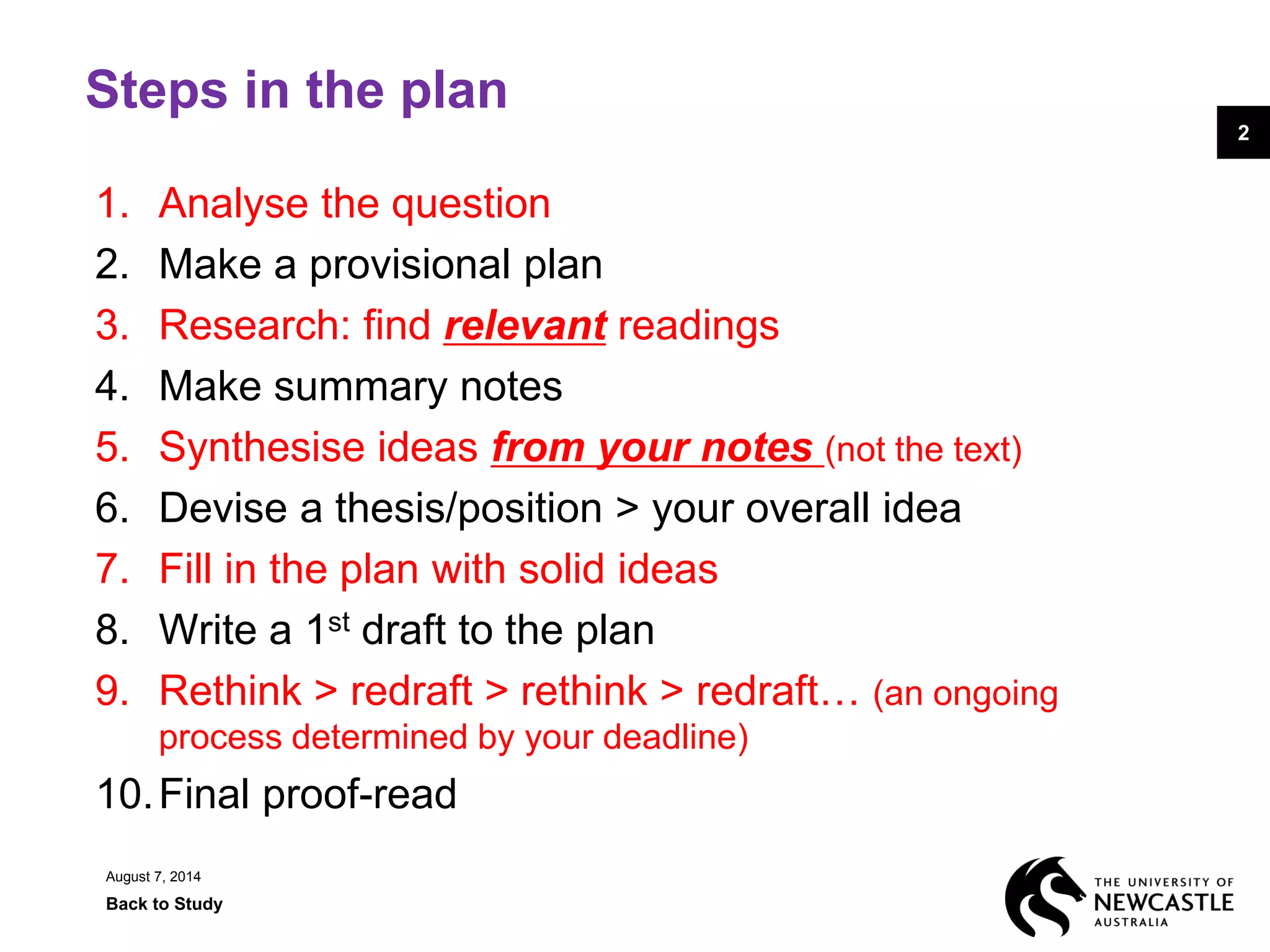
Steps in the plan
1. Analyse the question
2. Make a provisional plan
3. Research: find relevant readings
4. Make summary notes
5. Synthesise ideas from your notes (not the text)
6. Devise a thesis/position > your overall idea
7. Fill in the plan with solid ideas
8. Write a 1st draft to the plan
9. Rethink > redraft > rethink > redraft… (an ongoing
process determined by your deadline)
10.Final proof-read
August 7, 2014
Back to Study
3
August 7, 2014
3A sample question…
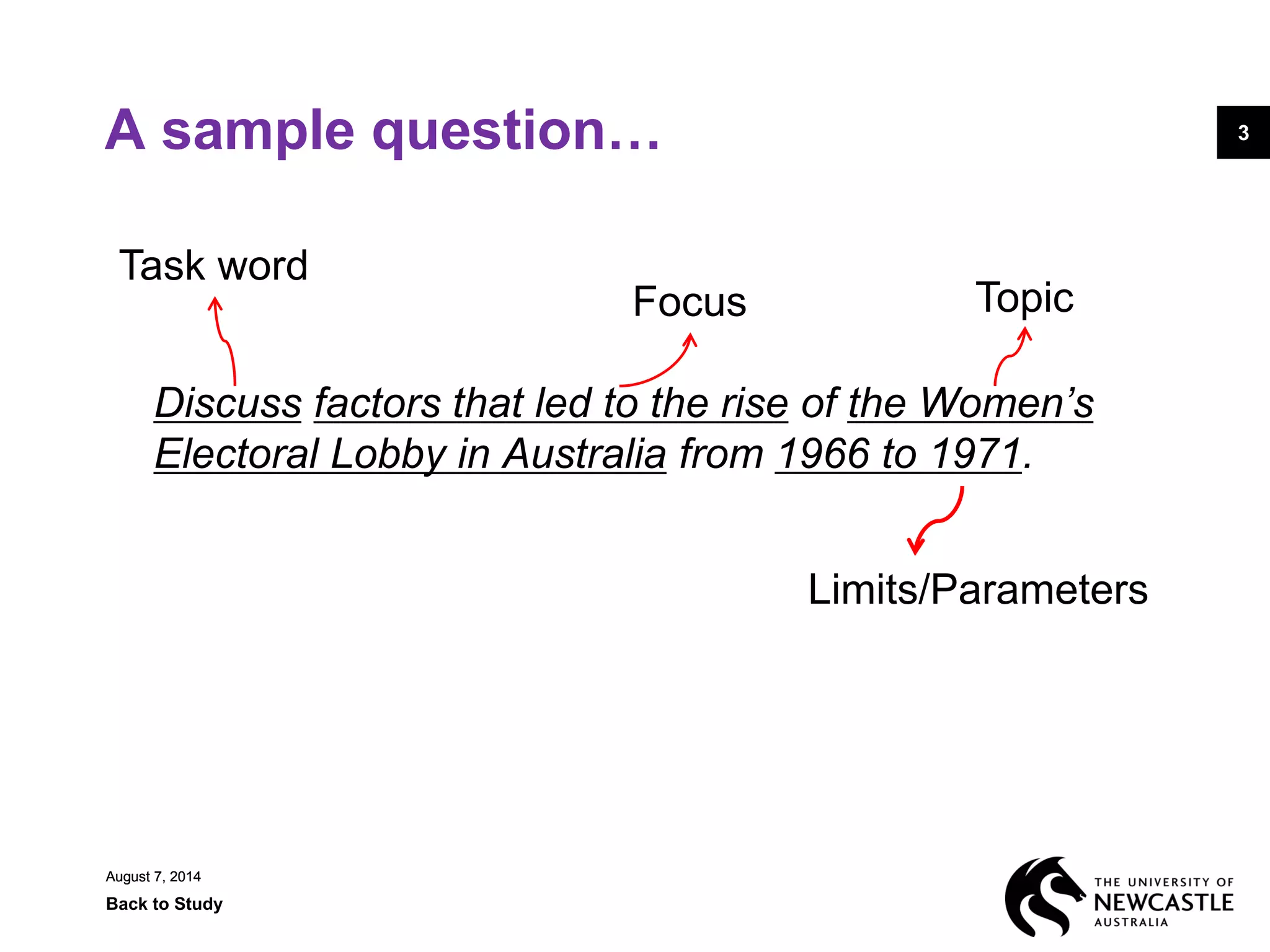
Discuss factors that led to the rise of the Women’s
Electoral Lobby in Australia from 1966 to 1971.
Task word
Topic
Limits/Parameters
Focus
August 7, 2014
Back to Study
4
August 7, 2014
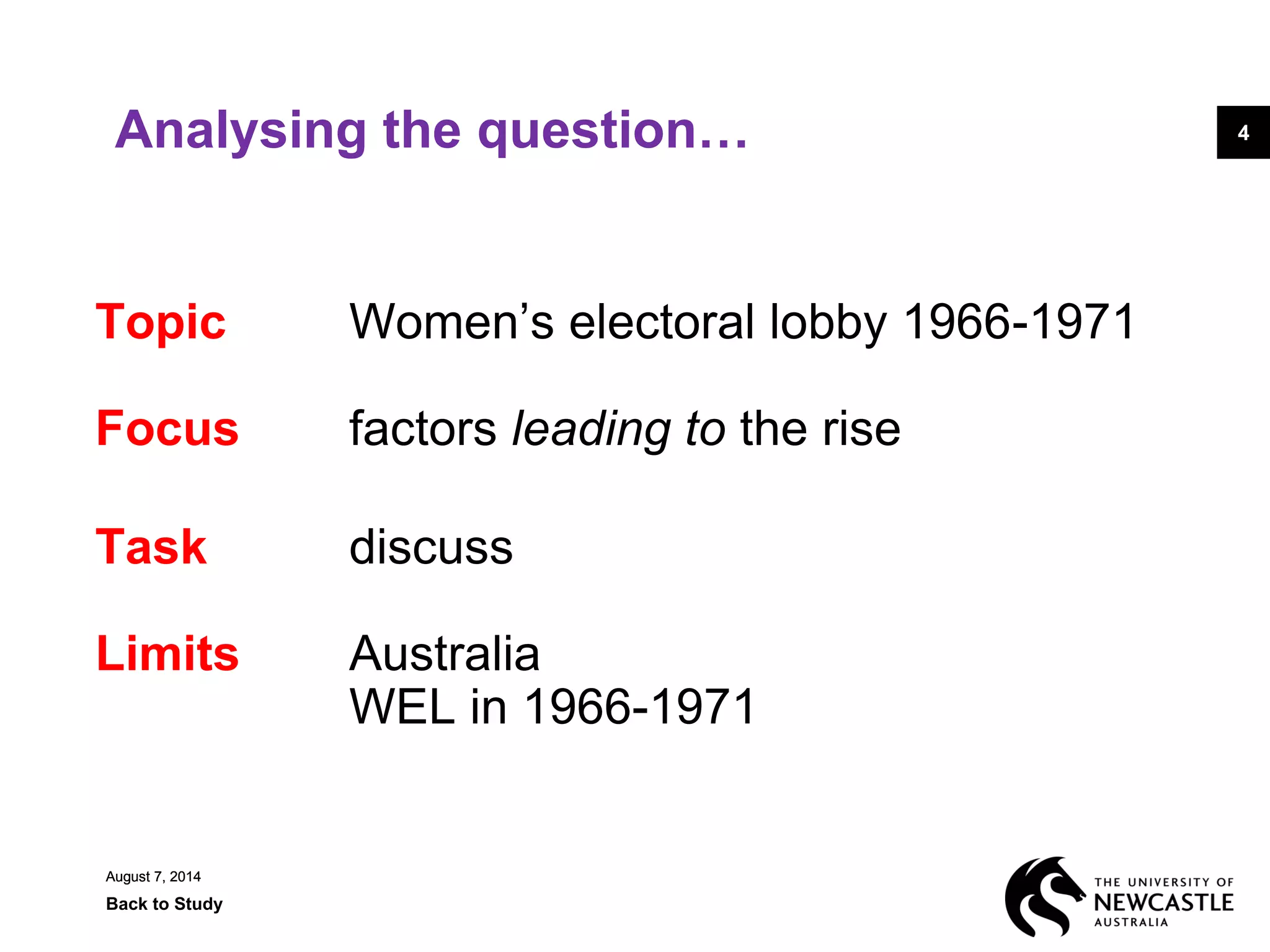
4Analysing the question…
Topic Women’s electoral lobby 1966-1971
Focus factors leading to the rise
Task discuss
Limits Australia
WEL in 1966-1971
August 7, 2014
Back to Study
5
August 7, 2014
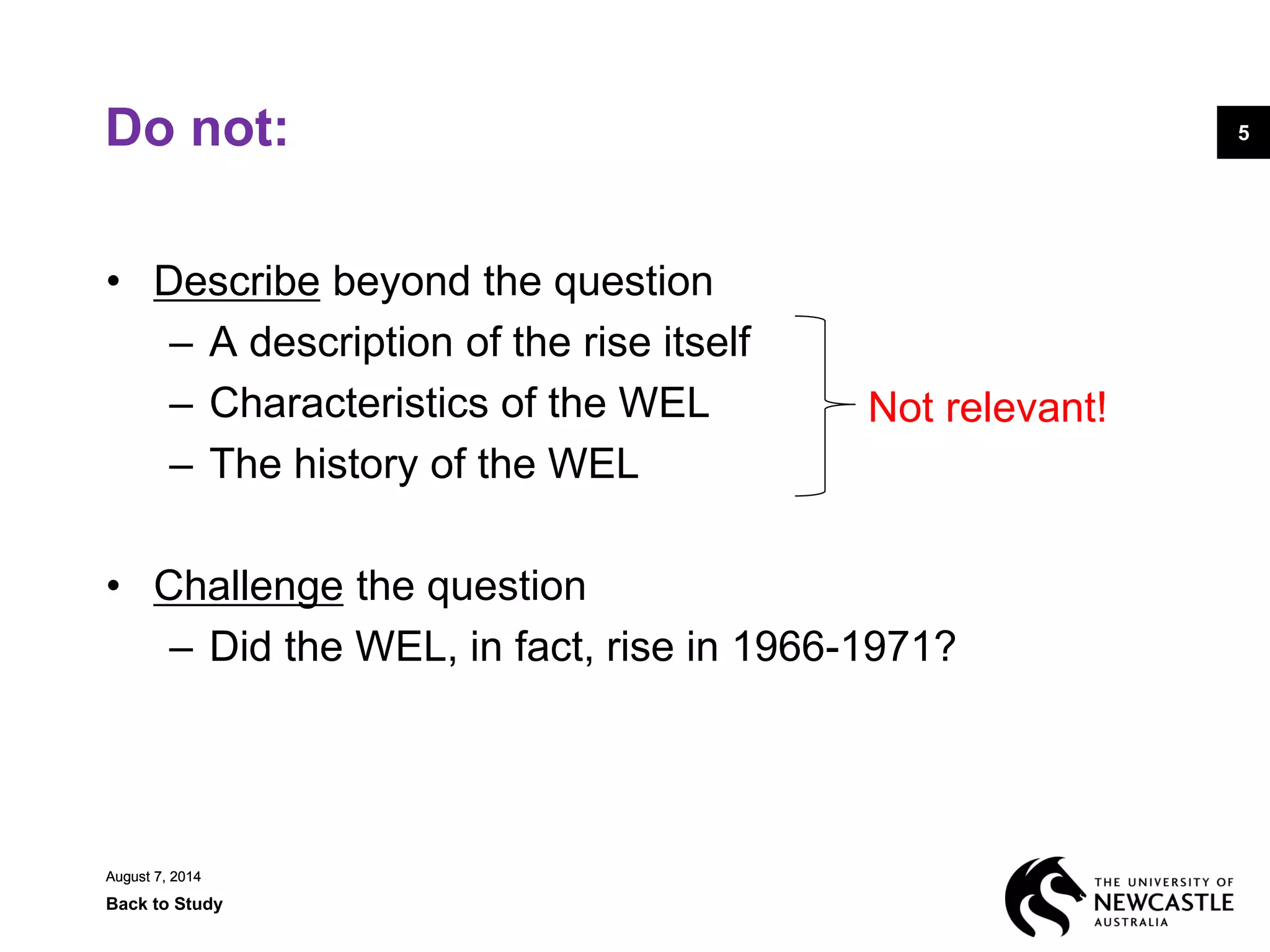
5Do not:
• Describe beyond the question
– A description of the rise itself
– Characteristics of the WEL
– The history of the WEL
• Challenge the question
– Did the WEL, in fact, rise in 1966-1971?
Not relevant!
August 7, 2014
Back to Study
6
August 7, 2014
6
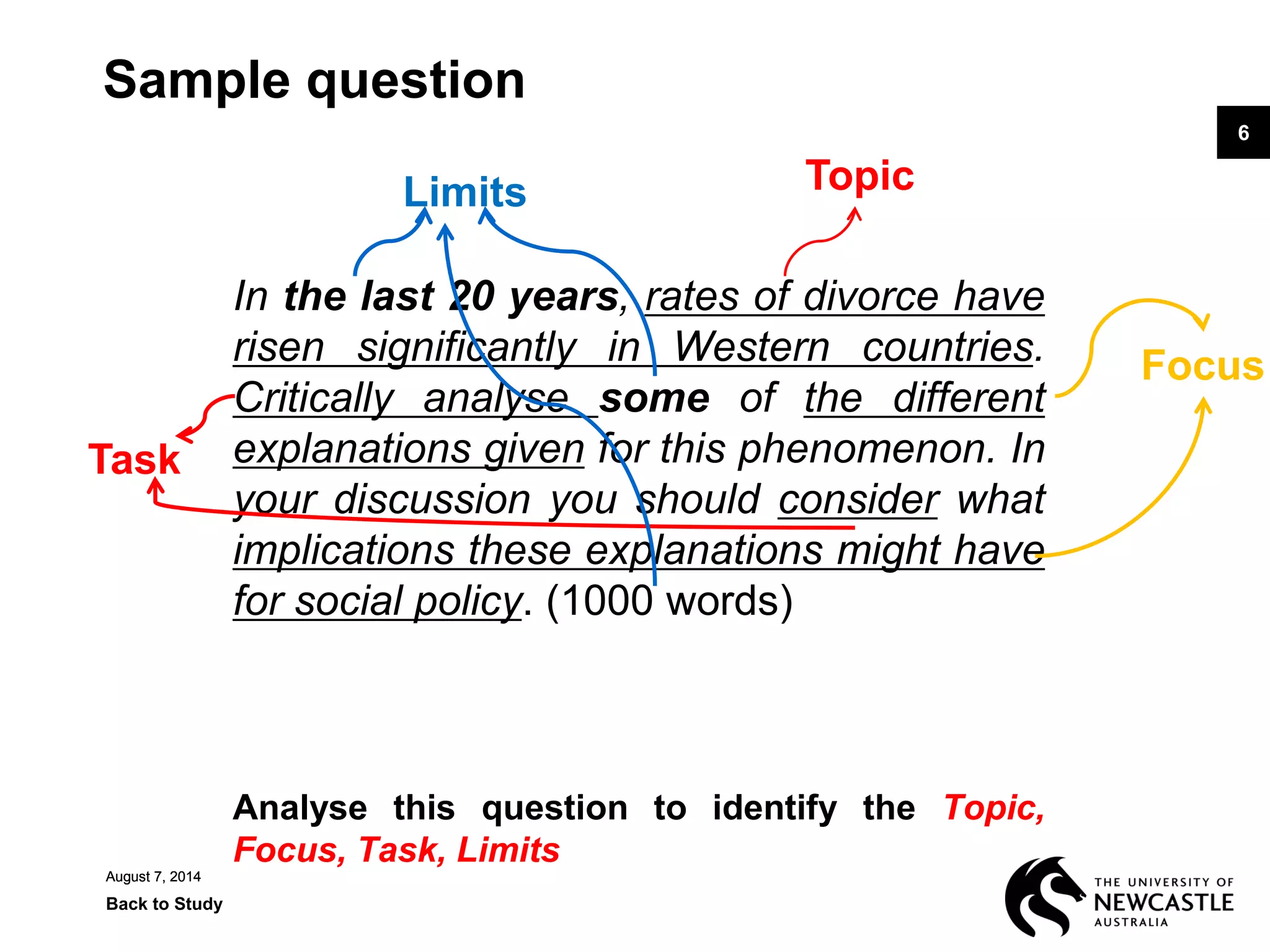
Sample question
In the last 20 years, rates of divorce have
risen significantly in Western countries.
Critically analyse some of the different
explanations given for this phenomenon. In
your discussion you should consider what
implications these explanations might have
for social policy. (1000 words)
Analyse this question to identify the Topic,
Focus, Task, Limits
Task
Topic
Focus
Limits
August 7, 2014
Back to Study
7
August 7, 2014
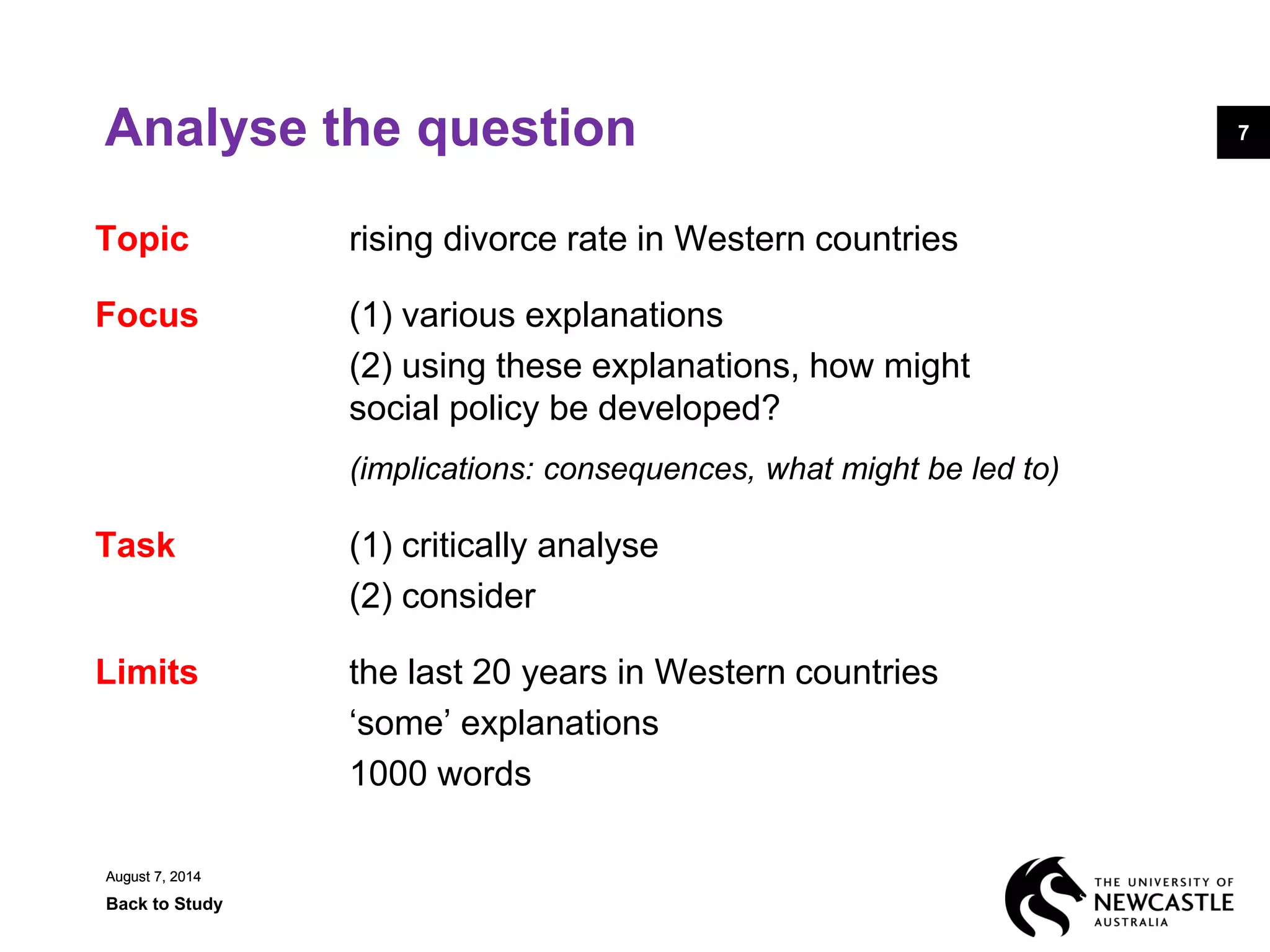
7Analyse the question
Topic rising divorce rate in Western countries
Focus (1) various explanations
(2) using these explanations, how might
social policy be developed?
(implications: consequences, what might be led to)
Task (1) critically analyse
(2) consider
Limits the last 20 years in Western countries
‘some’ explanations
1000 words
August 7, 2014
Back to Study
8The preliminary plan
• Look at the divorce essay example
• What do you notice about this plan?
August 7, 2014
Back to Study
9
9
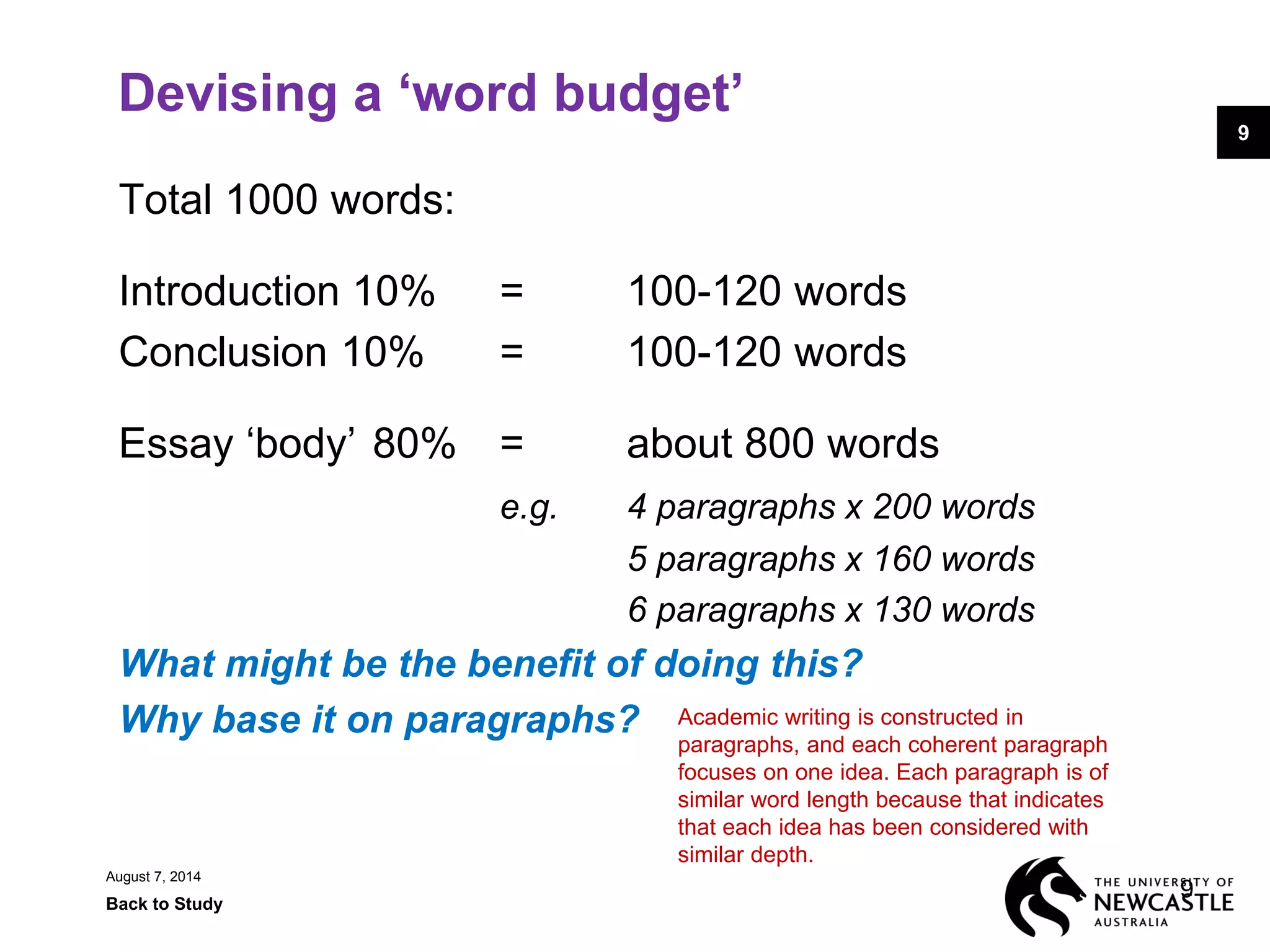
Devising a ‘word budget’
Total 1000 words:
Introduction 10% = 100-120 words
Conclusion 10% = 100-120 words
Essay ‘body’ 80% = about 800 words
e.g. 4 paragraphs x 200 words
5 paragraphs x 160 words
6 paragraphs x 130 words
What might be the benefit of doing this?
Why base it on paragraphs? Academic writing is constructed in
paragraphs, and each coherent paragraph
focuses on one idea. Each paragraph is of
similar word length because that indicates
that each idea has been considered with
similar depth.
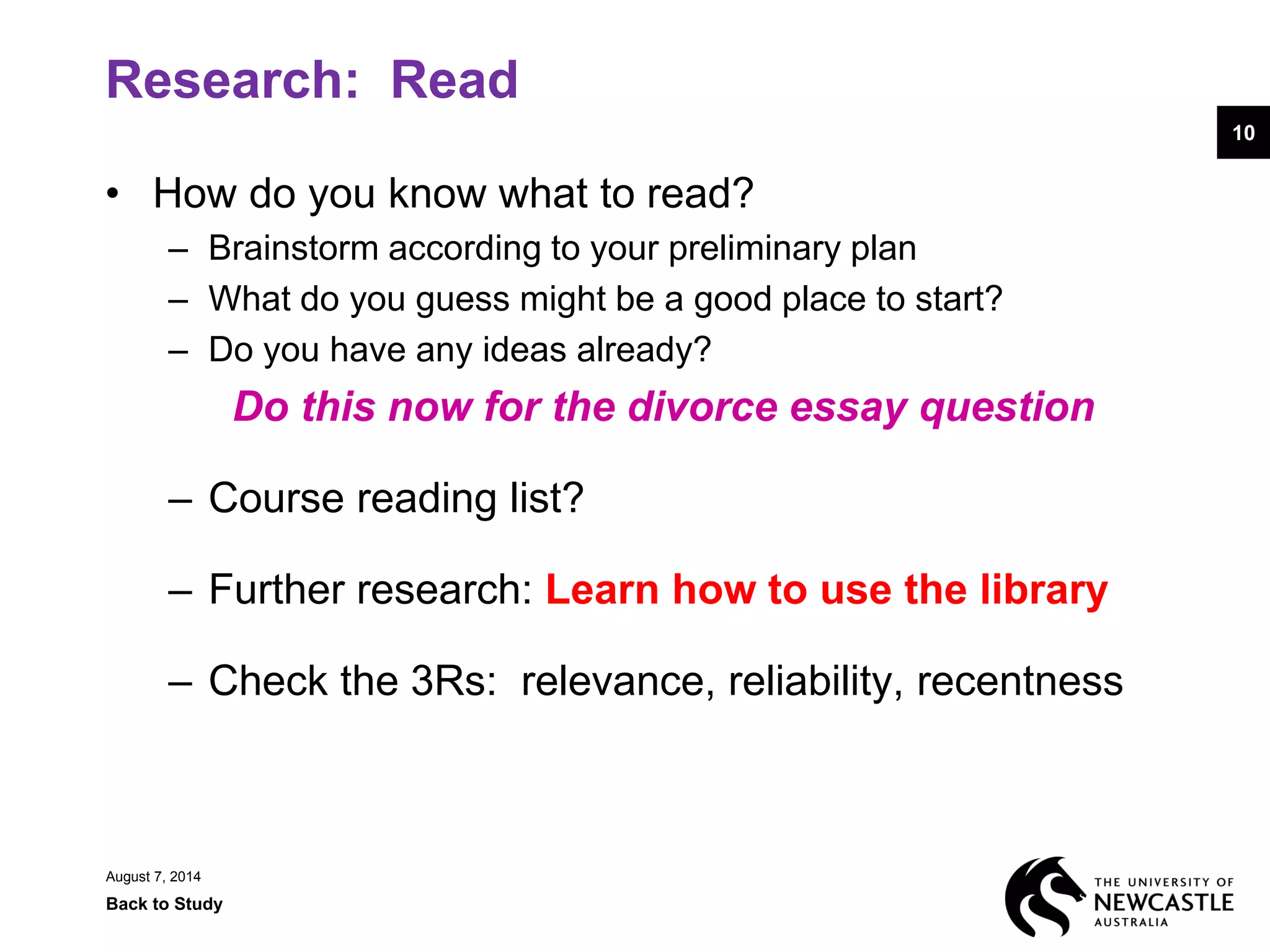
Research: Read
• How do you know what to read?
– Brainstorm according to your preliminary plan
– What do you guess might be a good place to start?
– Do you have any ideas already?
Do this now for the divorce essay question
– Course reading list?
– Further research: Learn how to use the library
– Check the 3Rs: relevance, reliability, recentness
August 7, 2014
Back to Study
10
August 7, 2014
Back to Study
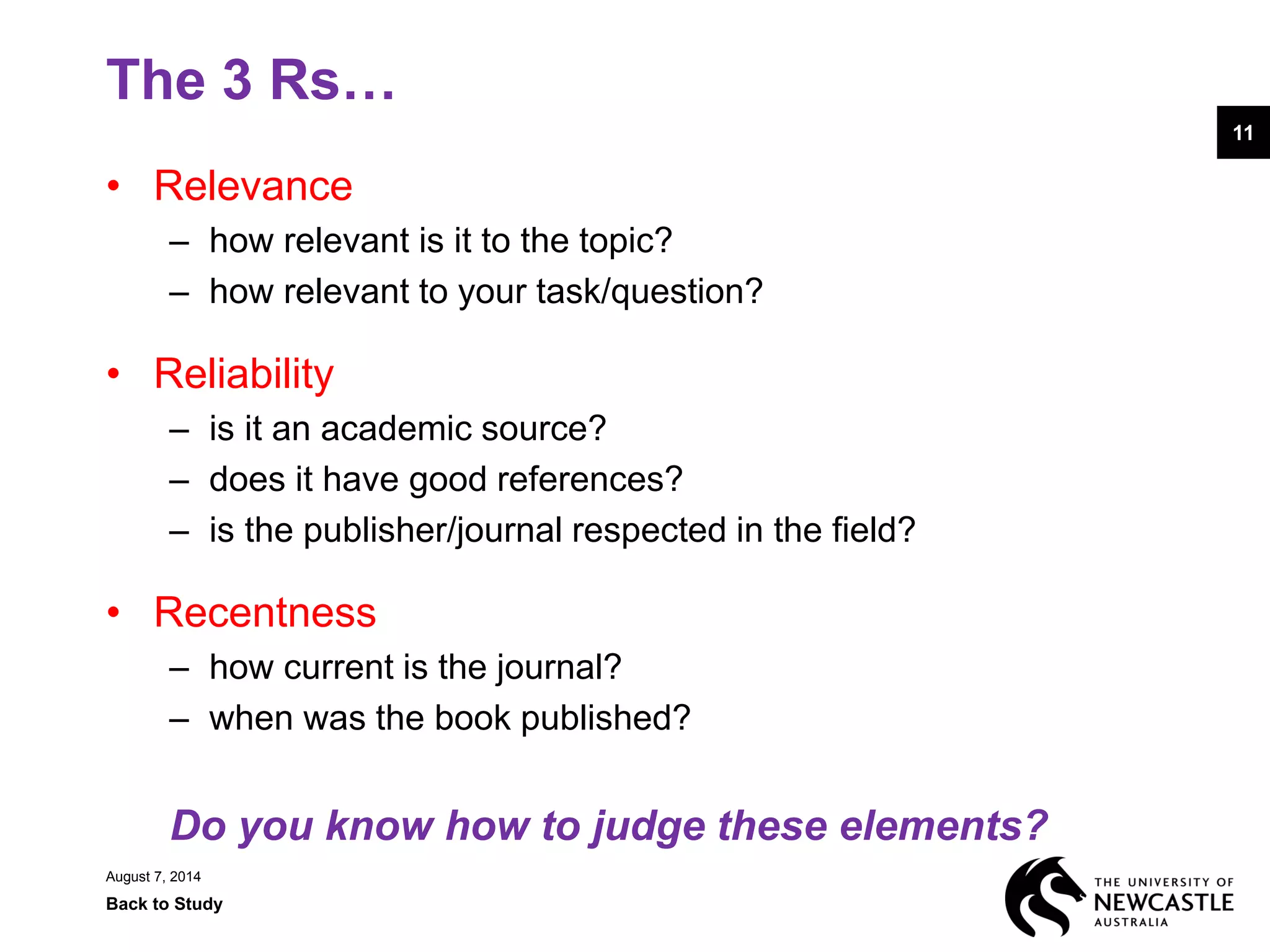
1111
• Relevance
– how relevant is it to the topic?
– how relevant to your task/question?
• Reliability
– is it an academic source?
– does it have good references?
– is the publisher/journal respected in the field?
• Recentness
– how current is the journal?
– when was the book published?
Do you know how to judge these elements?
The 3 Rs…
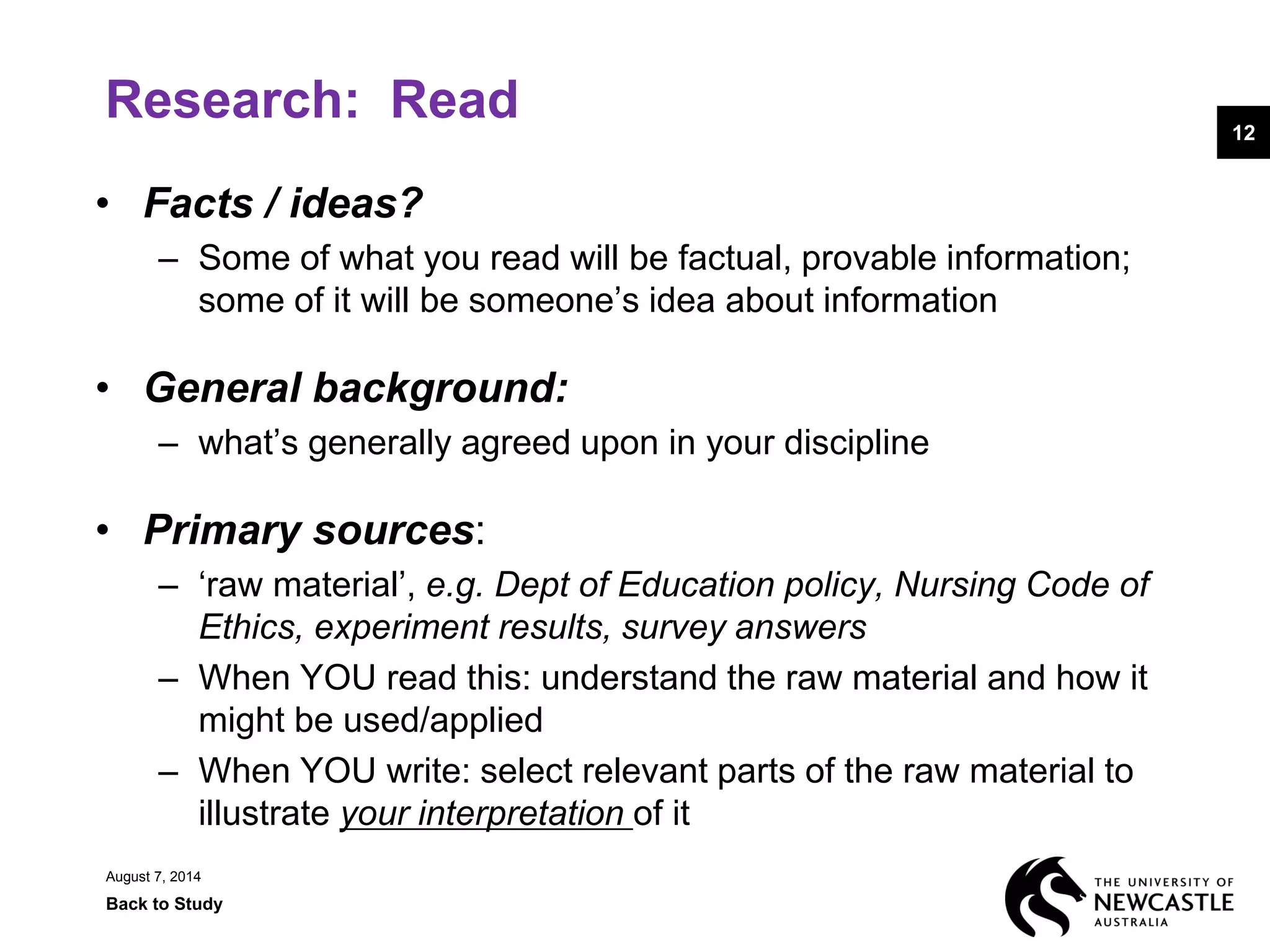
Research: Read
• Facts / ideas?
– Some of what you read will be factual, provable information;
some of it will be someone’s idea about information
• General background:
– what’s generally agreed upon in your discipline
• Primary sources:
– ‘raw material’, e.g. Dept of Education policy, Nursing Code of
Ethics, experiment results, survey answers
– When YOU read this: understand the raw material and how it
might be used/applied
– When YOU write: select relevant parts of the raw material to
illustrate your interpretation of it
August 7, 2014
Back to Study
12
Research: Read
• Secondary sources:
– An interpretation or discussion of raw data by the
researcher
– An academic argument based on other research
or theories (i.e. evidence)
• This argument presents a particular view that
may challenge or extend what’s generally
agreed on
August 7, 2014
Back to Study
13
Research: Read
Secondary sources:
– Much of your reading will be from secondary sources:
• Reading list in your course
– (basic ideas your lecturer wants you to be aware of)
• Extra readings you will find in the library
– (check out the library workshops)
 Most writers propose one overall idea, then select and
discuss relevant evidence to show why they hold that idea
 When you write an essay, you are practising this skill
August 7, 2014
Back to Study
14
August 7, 2014
Back to Study
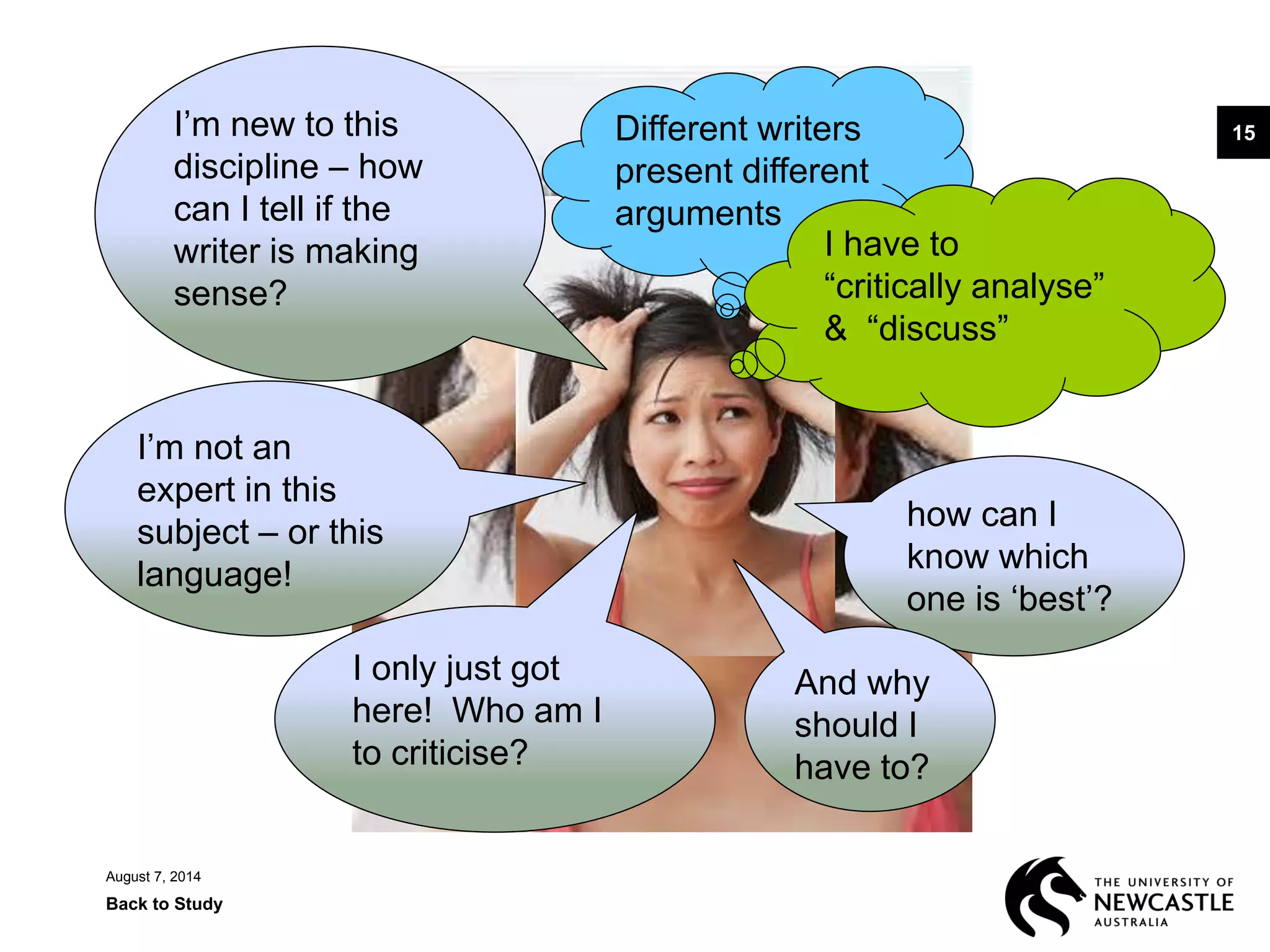
15Different writers
present different
arguments
how can I
know which
one is ‘best’?
And why
should I
have to?
I only just got
here! Who am I
to criticise?
I’m not an
expert in this
subject – or this
language!
I’m new to this
discipline – how
can I tell if the
writer is making
sense?
I have to
“critically analyse”
& “discuss”
“Critically analyse”… (who? me?)
• Don’t panic:
– You are not expected to be an expert in the research
• But you ARE expected to think about the argument proposed:
– Does it seem logical to you? Why or why not?
• Engage with the ideas:
– What does source A say about the issue/subject?
– What does source B say?
– Do they agree? How? If they don’t, why not?
– Which is more convincing? Why?
WHAT = identifies ideas = descriptive
HOW & WHY = engagement with ideas = critical
August 7, 2014
Back to Study
16
August 7, 2014
Back to Study
17
August 7, 2014
1717
3 steps of good note-making
1. Read 1x
2. Read 2x
3. Make notes from highlighted sections
A Reading & Note-making strategy:
• STEP 1: just read
– DO NOT HIGHLIGHT ANYTHING!
– Read all the way through
– You won’t understand it all – that’s OK!
– You are getting orientated to the language
– Notice ‘signpost’ language
August 7, 2014
Back to Study
18
A Reading & Note-making strategy:
• STEP 2: read again
– Read with your purpose in mind:
• EITHER to comprehend all main ideas about a topic
• OR to understand the author’s perspective as a whole
• OR to extract key points relevant to your assignment task
– Identify line of argument (i.e. what is the sequence of ideas
that support the one overall idea?)
– Highlight key points
August 7, 2014
Back to Study
19
A Reading & Note-making strategy:
• STEP 3: Make notes from your highlighted points
– short points:
• try to write phrases, not sentences
• This is the time for vocab substitution and paraphrasing
– Pattern notes:
• ‘draw’ the ideas of the text
• really helps you process the ideas
– You can combine linear(standard) & pattern note
Helpful handout: note-making template
August 7, 2014
Back to Study
20
August 7, 2014
Back to Study
21
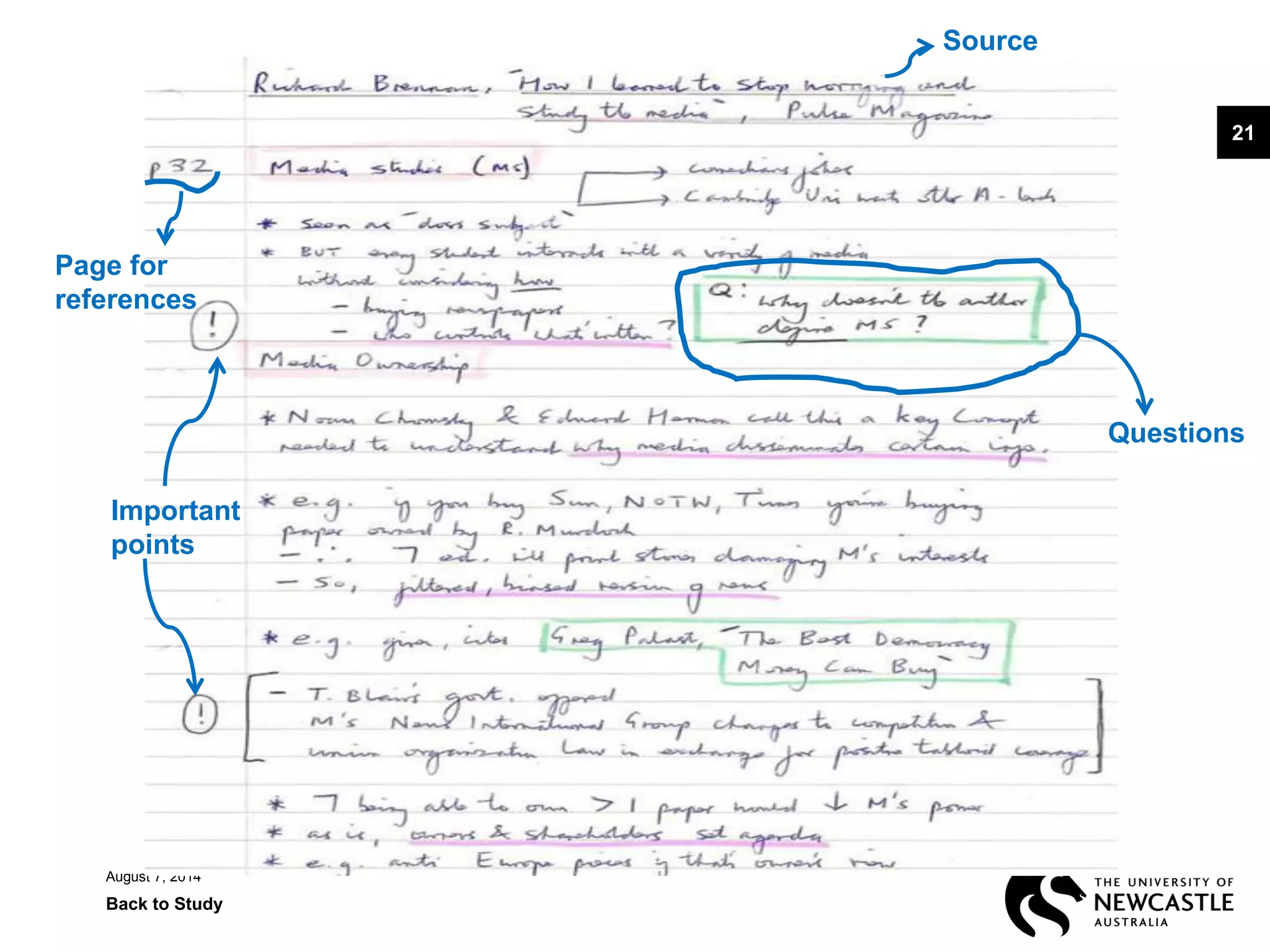
Source
Page for
references
Questions
Important
points
5
August 7, 2014
Back to Study
22
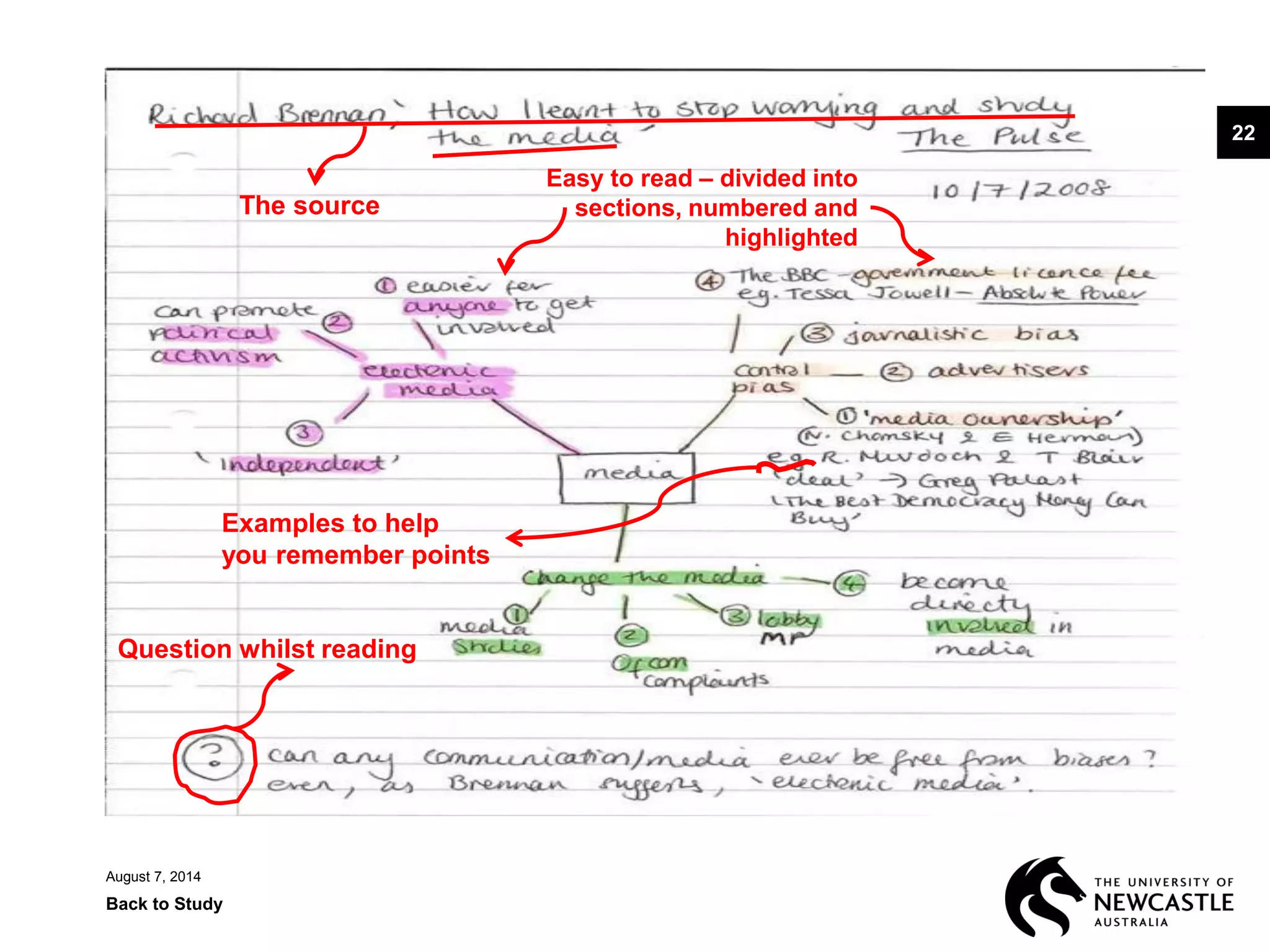
Question whilst reading
Examples to help
you remember points
The source
Easy to read – divided into
sections, numbered and
highlighted
Steps 5, 6, 7
Look at The Essay: Elaborated Plan
What has happened here?
How has it changed from the provisional
plan?
August 7, 2014
Back to Study
23
August 7, 2014
Back to Study
24
August 7, 2014
24From notes to essay
• Put the original texts away
• Write the essay from your notes, NOT from the
original texts
• Writing from notes forces you to make your own
original sentences, leading to
– Better thinking and understanding
– No risk of plagiarism
August 7, 2014
Back to Study
25Write the first draft
• What is your method?
• Do you have “writer’s block”?
• Some solutions:
• Free-writing > write anything, start anywhere
• Free write every day > ‘trains’ you to write
• Write about why you can’t write it > write your
way into it
August 7, 2014
Back to Study
26Plan your time for each step
• Task breakdown (all those steps)
• How much time have you scheduled each week to
work on the assignment?
• See time management resources on LD Blackboard
More help…
• See your Teaching and Learning Coordinator for an
individual consultation
August 7, 2014
Back to Study
27

Planning your assignment or essay

  • 1.
    August 7, 2014 1 PLANYOUR ASSIGNMENT/ ESSAY © 2013 Learning Development
  • 2.
    August 7, 2014 Backto Study 2 Steps in the plan 1. Analyse the question 2. Make a provisional plan 3. Research: find relevant readings 4. Make summary notes 5. Synthesise ideas from your notes (not the text) 6. Devise a thesis/position > your overall idea 7. Fill in the plan with solid ideas 8. Write a 1st draft to the plan 9. Rethink > redraft > rethink > redraft… (an ongoing process determined by your deadline) 10.Final proof-read
  • 3.
    August 7, 2014 Backto Study 3 August 7, 2014 3A sample question… Discuss factors that led to the rise of the Women’s Electoral Lobby in Australia from 1966 to 1971. Task word Topic Limits/Parameters Focus
  • 4.
    August 7, 2014 Backto Study 4 August 7, 2014 4Analysing the question… Topic Women’s electoral lobby 1966-1971 Focus factors leading to the rise Task discuss Limits Australia WEL in 1966-1971
  • 5.
    August 7, 2014 Backto Study 5 August 7, 2014 5Do not: • Describe beyond the question – A description of the rise itself – Characteristics of the WEL – The history of the WEL • Challenge the question – Did the WEL, in fact, rise in 1966-1971? Not relevant!
  • 6.
    August 7, 2014 Backto Study 6 August 7, 2014 6 Sample question In the last 20 years, rates of divorce have risen significantly in Western countries. Critically analyse some of the different explanations given for this phenomenon. In your discussion you should consider what implications these explanations might have for social policy. (1000 words) Analyse this question to identify the Topic, Focus, Task, Limits Task Topic Focus Limits
  • 7.
    August 7, 2014 Backto Study 7 August 7, 2014 7Analyse the question Topic rising divorce rate in Western countries Focus (1) various explanations (2) using these explanations, how might social policy be developed? (implications: consequences, what might be led to) Task (1) critically analyse (2) consider Limits the last 20 years in Western countries ‘some’ explanations 1000 words
  • 8.
    August 7, 2014 Backto Study 8The preliminary plan • Look at the divorce essay example • What do you notice about this plan?
  • 9.
    August 7, 2014 Backto Study 9 9 Devising a ‘word budget’ Total 1000 words: Introduction 10% = 100-120 words Conclusion 10% = 100-120 words Essay ‘body’ 80% = about 800 words e.g. 4 paragraphs x 200 words 5 paragraphs x 160 words 6 paragraphs x 130 words What might be the benefit of doing this? Why base it on paragraphs? Academic writing is constructed in paragraphs, and each coherent paragraph focuses on one idea. Each paragraph is of similar word length because that indicates that each idea has been considered with similar depth.
  • 10.
    Research: Read • Howdo you know what to read? – Brainstorm according to your preliminary plan – What do you guess might be a good place to start? – Do you have any ideas already? Do this now for the divorce essay question – Course reading list? – Further research: Learn how to use the library – Check the 3Rs: relevance, reliability, recentness August 7, 2014 Back to Study 10
  • 11.
    August 7, 2014 Backto Study 1111 • Relevance – how relevant is it to the topic? – how relevant to your task/question? • Reliability – is it an academic source? – does it have good references? – is the publisher/journal respected in the field? • Recentness – how current is the journal? – when was the book published? Do you know how to judge these elements? The 3 Rs…
  • 12.
    Research: Read • Facts/ ideas? – Some of what you read will be factual, provable information; some of it will be someone’s idea about information • General background: – what’s generally agreed upon in your discipline • Primary sources: – ‘raw material’, e.g. Dept of Education policy, Nursing Code of Ethics, experiment results, survey answers – When YOU read this: understand the raw material and how it might be used/applied – When YOU write: select relevant parts of the raw material to illustrate your interpretation of it August 7, 2014 Back to Study 12
  • 13.
    Research: Read • Secondarysources: – An interpretation or discussion of raw data by the researcher – An academic argument based on other research or theories (i.e. evidence) • This argument presents a particular view that may challenge or extend what’s generally agreed on August 7, 2014 Back to Study 13
  • 14.
    Research: Read Secondary sources: –Much of your reading will be from secondary sources: • Reading list in your course – (basic ideas your lecturer wants you to be aware of) • Extra readings you will find in the library – (check out the library workshops)  Most writers propose one overall idea, then select and discuss relevant evidence to show why they hold that idea  When you write an essay, you are practising this skill August 7, 2014 Back to Study 14
  • 15.
    August 7, 2014 Backto Study 15Different writers present different arguments how can I know which one is ‘best’? And why should I have to? I only just got here! Who am I to criticise? I’m not an expert in this subject – or this language! I’m new to this discipline – how can I tell if the writer is making sense? I have to “critically analyse” & “discuss”
  • 16.
    “Critically analyse”… (who?me?) • Don’t panic: – You are not expected to be an expert in the research • But you ARE expected to think about the argument proposed: – Does it seem logical to you? Why or why not? • Engage with the ideas: – What does source A say about the issue/subject? – What does source B say? – Do they agree? How? If they don’t, why not? – Which is more convincing? Why? WHAT = identifies ideas = descriptive HOW & WHY = engagement with ideas = critical August 7, 2014 Back to Study 16
  • 17.
    August 7, 2014 Backto Study 17 August 7, 2014 1717 3 steps of good note-making 1. Read 1x 2. Read 2x 3. Make notes from highlighted sections
  • 18.
    A Reading &Note-making strategy: • STEP 1: just read – DO NOT HIGHLIGHT ANYTHING! – Read all the way through – You won’t understand it all – that’s OK! – You are getting orientated to the language – Notice ‘signpost’ language August 7, 2014 Back to Study 18
  • 19.
    A Reading &Note-making strategy: • STEP 2: read again – Read with your purpose in mind: • EITHER to comprehend all main ideas about a topic • OR to understand the author’s perspective as a whole • OR to extract key points relevant to your assignment task – Identify line of argument (i.e. what is the sequence of ideas that support the one overall idea?) – Highlight key points August 7, 2014 Back to Study 19
  • 20.
    A Reading &Note-making strategy: • STEP 3: Make notes from your highlighted points – short points: • try to write phrases, not sentences • This is the time for vocab substitution and paraphrasing – Pattern notes: • ‘draw’ the ideas of the text • really helps you process the ideas – You can combine linear(standard) & pattern note Helpful handout: note-making template August 7, 2014 Back to Study 20
  • 21.
    August 7, 2014 Backto Study 21 Source Page for references Questions Important points
  • 22.
    5 August 7, 2014 Backto Study 22 Question whilst reading Examples to help you remember points The source Easy to read – divided into sections, numbered and highlighted
  • 23.
    Steps 5, 6,7 Look at The Essay: Elaborated Plan What has happened here? How has it changed from the provisional plan? August 7, 2014 Back to Study 23
  • 24.
    August 7, 2014 Backto Study 24 August 7, 2014 24From notes to essay • Put the original texts away • Write the essay from your notes, NOT from the original texts • Writing from notes forces you to make your own original sentences, leading to – Better thinking and understanding – No risk of plagiarism
  • 25.
    August 7, 2014 Backto Study 25Write the first draft • What is your method? • Do you have “writer’s block”? • Some solutions: • Free-writing > write anything, start anywhere • Free write every day > ‘trains’ you to write • Write about why you can’t write it > write your way into it
  • 26.
    August 7, 2014 Backto Study 26Plan your time for each step • Task breakdown (all those steps) • How much time have you scheduled each week to work on the assignment? • See time management resources on LD Blackboard
  • 27.
    More help… • Seeyour Teaching and Learning Coordinator for an individual consultation August 7, 2014 Back to Study 27