Split (M. Night Shyamalan, Universal Pictures, 2016)
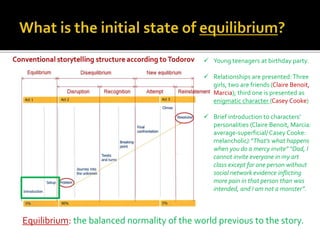
Equilibrium: the balanced normality of the world previous to the story.
 Young teenagers at birthday party.
 Relationships are presented:Three
girls, two are friends (Claire Benoit,
Marcia); third one is presented as
enigmatic character (Casey Cooke)
 Brief introduction to characters’
personalities (Claire Benoit, Marcia:
average-superficial/ Casey Cooke:
melancholic):”That’s what happens
when you do a mercy invite” “Dad, I
cannot invite everyone in my art
class except for one person without
social network evidence inflicting
more pain in that person than was
intended, and I am not a monster”.
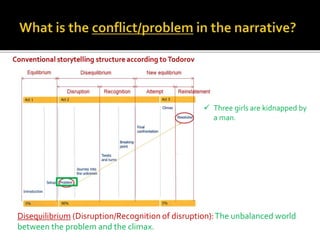
Disequilibrium (Disruption/Recognition of disruption):The unbalanced world
between the problem and the climax.
 Three girls are kidnapped by
a man.
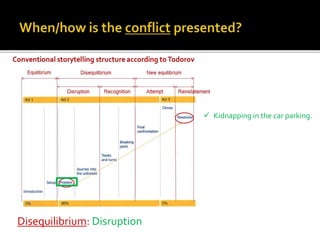
Disequilibrium: Disruption
 Kidnapping in the car parking.
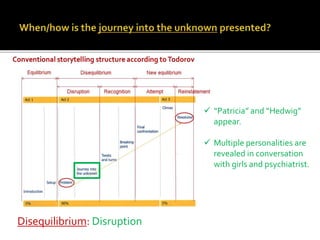
Disequilibrium: Disruption
 “Patricia” and “Hedwig”
appear.
 Multiple personalities are
revealed in conversation
with girls and psychiatrist.
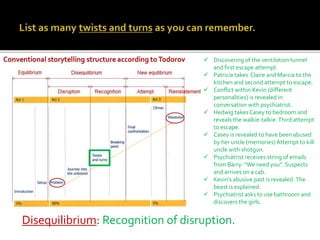
Disequilibrium: Recognition of disruption.
 Discovering of the ventilation tunnel
and first escape attempt.
 Patricia takes Claire and Marcia to the
kitchen and second attempt to escape.
 Conflict within Kevin (different
personalities) is revealed in
conversation with psychiatrist.
 Hedwig takesCasey to bedroom and
reveals the walkie-talkie.Third attempt
to escape.
 Casey is revealed to have been abused
by her uncle (memories) Attempt to kill
uncle with shotgun.
 Psychiatrist receives string of emails
from Barry: “We need you”. Suspects
and arrives on a cab.
 Kevin’s abusive past is revealed.The
beast is explained.
 Psychiatrist asks to use bathroom and
discovers the girls.
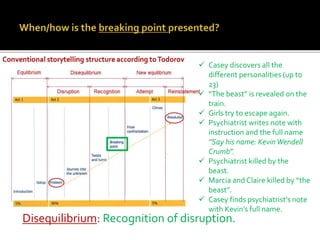
Disequilibrium: Recognition of disruption.
 Casey discovers all the
different personalities (up to
23)
 “The beast” is revealed on the
train.
 Girls try to escape again.
 Psychiatrist writes note with
instruction and the full name
“Say his name: KevinWendell
Crumb”.
 Psychiatrist killed by the
beast.
 Marcia and Claire killed by “the
beast”.
 Casey finds psychiatrist’s note
with Kevin’s full name.
New Equilibrium: Attempt to restore the original equilibrium.
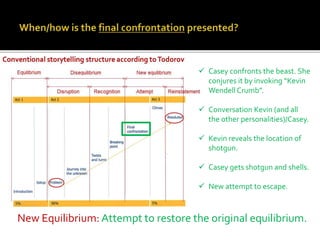
 Casey confronts the beast. She
conjures it by invoking “Kevin
Wendell Crumb”.
 Conversation Kevin (and all
the other personalities)/Casey.
 Kevin reveals the location of
shotgun.
 Casey gets shotgun and shells.
 New attempt to escape.
New Equilibrium: Attempt to restore the original equilibrium.
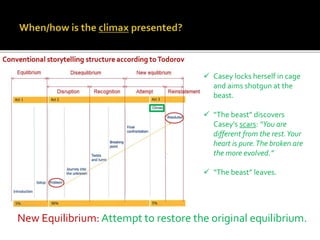
 Casey locks herself in cage
and aims shotgun at the
beast.
 “The beast” discovers
Casey’s scars: “You are
different from the rest.Your
heart is pure.The broken are
the more evolved.”
 “The beast” leaves.
New Equilibrium: Resolution.
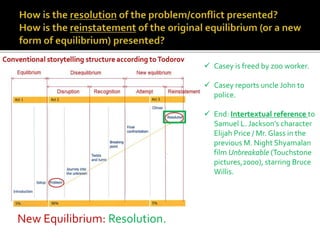
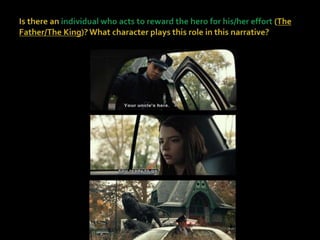
 Casey is freed by zoo worker.
 Casey reports uncle John to
police.
 End: Intertextual reference to
Samuel L. Jackson’s character
Elijah Price / Mr. Glass in the
previous M. Night Shyamalan
film Unbreakable (Touchstone
pictures,2000), starring Bruce
Willis.
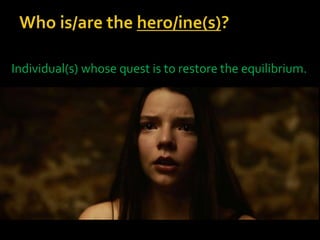
Individual(s) whose quest is to restore the equilibrium.
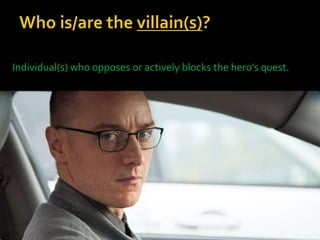
Individual(s) who opposes or actively blocks the hero’s quest.
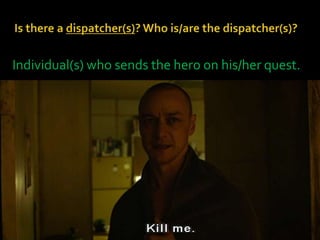
Individual(s) who sends the hero on his/her quest.
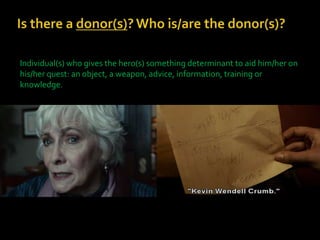
Individual(s) who gives the hero(s) something determinant to aid him/her on
his/her quest: an object, a weapon, advice, information, training or
knowledge.
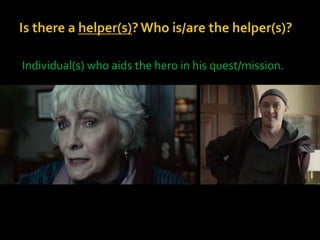
Individual(s) who aids the hero in his quest/mission.
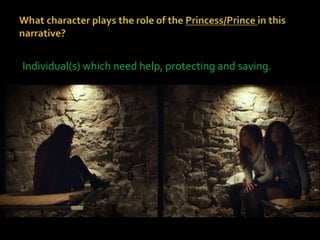
Individual(s) which need help, protecting and saving.
 Sanity/Madness
 Good/Evil
 Purity/Impurity
 Woman/Man
The problems in a
narrative stem from
the conflict
between one force
and another and it is
because of these
conflicts that a
narrative moves
forward.
 Who is Kevin Wendell
Crumb?
 Who is Casey Cooke?
 Who is The Beast?
 Why does Kevin
kidnap the girls?
 How are the girls going
to escape?
• Problems and their
complications (twists
and turns) create
enigmas for the
audience.
• The audience are
engaged by the enigma,
and are naturally curious
as to find out what
actions will be
undertaken and how the
problems will be solved.
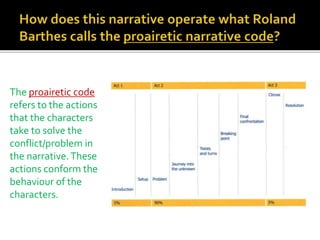
The proairetic code
refers to the actions
that the characters
take to solve the
conflict/problem in
the narrative.These
actions conform the
behaviour of the
characters.
The cultural code designates
any element in a narrative
that refers "to a science or a
body of knowledge“.
In other words, the cultural
codes tend to point to our
shared general knowledge
about the subject matter of
the story.
 What do we know about
dissociative identity disorder
(DID) or multiple personality
disorder (MPD)?
 What do we know about child
abuse and its consequences?
• This code refers to the
connotations within the story
that gives additional meaning
over the basic denotative
meaning of the words and
actions.
• It is by the use of extended
meaning that can be applied
to words, objects and actions
that authors can paint rich
pictures with relatively limited
text.
 Split door
Sign for mind of the abductor/sign
for imprisonment.
 Flowerpot in bathroom
Sign for/of Patricia.
 Cloth
Sign of obsessive compulsive
disorder (cleaning mania)
 Scars-(Casey’s body)
Sign of the suffering and internal
conflict endured by the character.
 Uncle
The beast(abusive/evil)
• The symbolic code refers to
organized systems of semes
(Any element in the narrative
which serves for any purpose as
a representation or sign of an
abstract concept, an idea, an
object, a person, etc.)
• When two connotative
elements are placed in
opposition or brought
together by the narrator, they
form an element of the
Symbolic Code.
 What does The Beast symbolise?:
Symbol of a destructive force of
nature. Evil.As defined by Dennis: “It
represents the highest form of human
evolution.Time for the ordinary to be
over.”
 Where does the beast live?
Zoo
 Why zoo and not a hospital , a wax
museum or a natural history
museum?
 What does Nature/Wilderness-
(Casey’s memories) symbolise?:
Symbol for reality/sanity/survival
 What does Kevin’s house-(Big,
labyrinth, derelict)
Symbol of Kevin’s mind
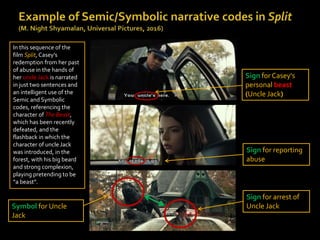
Sign for Casey’s
personal beast
(Uncle Jack)
Sign for reporting
abuse
Sign for arrest of
Uncle Jack
Symbol for Uncle
Jack
In this sequence of the
film Split, Casey’s
redemption from her past
of abuse in the hands of
her uncle Jack is narrated
in just two sentences and
an intelligent use of the
Semic and Symbolic
codes, referencing the
character of The Beast,
which has been recently
defeated, and the
flashback in which the
character of uncle Jack
was introduced, in the
forest, with his big beard
and strong complexion,
playing pretending to be
“a beast”.

Narrative analysis example

  • 1.
    Split (M. NightShyamalan, Universal Pictures, 2016)
  • 2.
    Equilibrium: the balancednormality of the world previous to the story.  Young teenagers at birthday party.  Relationships are presented:Three girls, two are friends (Claire Benoit, Marcia); third one is presented as enigmatic character (Casey Cooke)  Brief introduction to characters’ personalities (Claire Benoit, Marcia: average-superficial/ Casey Cooke: melancholic):”That’s what happens when you do a mercy invite” “Dad, I cannot invite everyone in my art class except for one person without social network evidence inflicting more pain in that person than was intended, and I am not a monster”.
  • 3.
    Disequilibrium (Disruption/Recognition ofdisruption):The unbalanced world between the problem and the climax.  Three girls are kidnapped by a man.
  • 4.
  • 5.
    Disequilibrium: Disruption  “Patricia”and “Hedwig” appear.  Multiple personalities are revealed in conversation with girls and psychiatrist.
  • 6.
    Disequilibrium: Recognition ofdisruption.  Discovering of the ventilation tunnel and first escape attempt.  Patricia takes Claire and Marcia to the kitchen and second attempt to escape.  Conflict within Kevin (different personalities) is revealed in conversation with psychiatrist.  Hedwig takesCasey to bedroom and reveals the walkie-talkie.Third attempt to escape.  Casey is revealed to have been abused by her uncle (memories) Attempt to kill uncle with shotgun.  Psychiatrist receives string of emails from Barry: “We need you”. Suspects and arrives on a cab.  Kevin’s abusive past is revealed.The beast is explained.  Psychiatrist asks to use bathroom and discovers the girls.
  • 7.
    Disequilibrium: Recognition ofdisruption.  Casey discovers all the different personalities (up to 23)  “The beast” is revealed on the train.  Girls try to escape again.  Psychiatrist writes note with instruction and the full name “Say his name: KevinWendell Crumb”.  Psychiatrist killed by the beast.  Marcia and Claire killed by “the beast”.  Casey finds psychiatrist’s note with Kevin’s full name.
  • 8.
    New Equilibrium: Attemptto restore the original equilibrium.  Casey confronts the beast. She conjures it by invoking “Kevin Wendell Crumb”.  Conversation Kevin (and all the other personalities)/Casey.  Kevin reveals the location of shotgun.  Casey gets shotgun and shells.  New attempt to escape.
  • 9.
    New Equilibrium: Attemptto restore the original equilibrium.  Casey locks herself in cage and aims shotgun at the beast.  “The beast” discovers Casey’s scars: “You are different from the rest.Your heart is pure.The broken are the more evolved.”  “The beast” leaves.
  • 10.
    New Equilibrium: Resolution. Casey is freed by zoo worker.  Casey reports uncle John to police.  End: Intertextual reference to Samuel L. Jackson’s character Elijah Price / Mr. Glass in the previous M. Night Shyamalan film Unbreakable (Touchstone pictures,2000), starring Bruce Willis.
  • 11.
    Individual(s) whose questis to restore the equilibrium.
  • 12.
    Individual(s) who opposesor actively blocks the hero’s quest.
  • 13.
    Individual(s) who sendsthe hero on his/her quest.
  • 14.
    Individual(s) who givesthe hero(s) something determinant to aid him/her on his/her quest: an object, a weapon, advice, information, training or knowledge.
  • 15.
    Individual(s) who aidsthe hero in his quest/mission.
  • 16.
    Individual(s) which needhelp, protecting and saving.
  • 19.
     Sanity/Madness  Good/Evil Purity/Impurity  Woman/Man The problems in a narrative stem from the conflict between one force and another and it is because of these conflicts that a narrative moves forward.
  • 20.
     Who isKevin Wendell Crumb?  Who is Casey Cooke?  Who is The Beast?  Why does Kevin kidnap the girls?  How are the girls going to escape? • Problems and their complications (twists and turns) create enigmas for the audience. • The audience are engaged by the enigma, and are naturally curious as to find out what actions will be undertaken and how the problems will be solved.
  • 21.
    The proairetic code refersto the actions that the characters take to solve the conflict/problem in the narrative.These actions conform the behaviour of the characters.
  • 22.
    The cultural codedesignates any element in a narrative that refers "to a science or a body of knowledge“. In other words, the cultural codes tend to point to our shared general knowledge about the subject matter of the story.  What do we know about dissociative identity disorder (DID) or multiple personality disorder (MPD)?  What do we know about child abuse and its consequences?
  • 23.
    • This coderefers to the connotations within the story that gives additional meaning over the basic denotative meaning of the words and actions. • It is by the use of extended meaning that can be applied to words, objects and actions that authors can paint rich pictures with relatively limited text.  Split door Sign for mind of the abductor/sign for imprisonment.  Flowerpot in bathroom Sign for/of Patricia.  Cloth Sign of obsessive compulsive disorder (cleaning mania)  Scars-(Casey’s body) Sign of the suffering and internal conflict endured by the character.  Uncle The beast(abusive/evil)
  • 24.
    • The symboliccode refers to organized systems of semes (Any element in the narrative which serves for any purpose as a representation or sign of an abstract concept, an idea, an object, a person, etc.) • When two connotative elements are placed in opposition or brought together by the narrator, they form an element of the Symbolic Code.  What does The Beast symbolise?: Symbol of a destructive force of nature. Evil.As defined by Dennis: “It represents the highest form of human evolution.Time for the ordinary to be over.”  Where does the beast live? Zoo  Why zoo and not a hospital , a wax museum or a natural history museum?  What does Nature/Wilderness- (Casey’s memories) symbolise?: Symbol for reality/sanity/survival  What does Kevin’s house-(Big, labyrinth, derelict) Symbol of Kevin’s mind
  • 25.
    Sign for Casey’s personalbeast (Uncle Jack) Sign for reporting abuse Sign for arrest of Uncle Jack Symbol for Uncle Jack In this sequence of the film Split, Casey’s redemption from her past of abuse in the hands of her uncle Jack is narrated in just two sentences and an intelligent use of the Semic and Symbolic codes, referencing the character of The Beast, which has been recently defeated, and the flashback in which the character of uncle Jack was introduced, in the forest, with his big beard and strong complexion, playing pretending to be “a beast”.