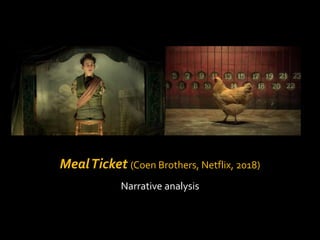
MealTicket (Coen Brothers, Netflix, 2018)
Narrative analysis
1. What is this film about?What is the story?
2. What is the setting of the story?
3. What does the character of the thespian (the one
who tells stories) represent?
4. What does the character of the impresario
represent?
5. What does the chicken represent?
 Answer the worksheet’s questions.
Symbol for the philosophical and literary tradition.
The Thespian Artist is an Englishman (sign for the
Old World=European culture vs. the New
World=America) He recites from memory
Shakespeare, the Old Testament, Shelley and the
Gettysburg Address, all signs for literature, poetry
and politics (art and philosophy)
He appears in the posters as The Wingless Thrush,
as he is just a head (sign for a brain/mind and
symbol for knowledge) with no arms or legs (signs
for the body’s practical functionality), signifying the
apparent lack of practical value of art and
philosophy.
The audience is a sign for the uneducated masses of
the New World and their constant search for instant
gratification without any intellectual effort. The
mass audience is a symbol for the cultural shift
taking place in the transition from modernity to
postmodernity, as well as the current cinema and
theatre audiences and their preference for the
spectacularism of entertainment products such as
blockbuster films and musicals, instead of more
sophisticated and intellectually challenging texts.
The “mathematical” chicken symbolises both the
commercial, profit driven nature of business, always
quantified in mathematical terms instead of being
qualified by its cultural value or relevance, as well as
the shift in the transmission of culture characteristic
of the digital age through the use of algorithms
(such as political propaganda feeds in social media,
films on online audio-visual platforms such as
Netflix, etc.)
It symbolises the “Disneyfication” of the cultural
industries (in Adorno’s, Horkheimer’s and
Hesmondhalgh’s terms).
The impresario symbolises the materialistic
nature of business. He is not interested in the
cultural value of literature, poetry or philosophy,
but on the revenue that a business can return and
its profit margins.
He is portrayed a simple man with simple passions
(alcohol and sex) who is exclusively concerned
with money. He symbolises the ruthlessness and
lack of moral principles of the capitalist logics of
the business world.
The “mathematical” chicken is a symbol for the
mass audience’s preference for mindless
entertainment.
In its show, the chicken picks numbers 22 and 11.
That is an intertextual reference to Chapter and
Verse of The Book of Revelations (22:11): “Let the
one who does wrong continue to do wrong; let the
vile person continue to be vile; let the one who does
right continue to do right; and let the holy person
continue to be holy.”, which ironically provides a
moral to the resolution of the story.
The short film Meal Ticket is story conceived as a
symbolic narrative. Every character and event
bears a deep symbolic meaning. Additionally, the
narrative uses a number of intertextual references
from Romantic poetry (Shelley’s Ozymandias) and
Shakespeare’s Sonnets and dramas (The Merchant
of Venice and The Tempest) ,to mythological
literature (the Old Testament’s Genesis and New
Testament’s Book of Revelations, the first and last
books of the Bible) as well as political texts
(Lincoln’s Gettysburg Address)

Meal Ticket_Narrative analysis task.pptx

  • 1.
    MealTicket (Coen Brothers,Netflix, 2018) Narrative analysis
  • 2.
    1. What isthis film about?What is the story? 2. What is the setting of the story? 3. What does the character of the thespian (the one who tells stories) represent? 4. What does the character of the impresario represent? 5. What does the chicken represent?
  • 3.
     Answer theworksheet’s questions.
  • 4.
    Symbol for thephilosophical and literary tradition. The Thespian Artist is an Englishman (sign for the Old World=European culture vs. the New World=America) He recites from memory Shakespeare, the Old Testament, Shelley and the Gettysburg Address, all signs for literature, poetry and politics (art and philosophy) He appears in the posters as The Wingless Thrush, as he is just a head (sign for a brain/mind and symbol for knowledge) with no arms or legs (signs for the body’s practical functionality), signifying the apparent lack of practical value of art and philosophy. The audience is a sign for the uneducated masses of the New World and their constant search for instant gratification without any intellectual effort. The mass audience is a symbol for the cultural shift taking place in the transition from modernity to postmodernity, as well as the current cinema and theatre audiences and their preference for the spectacularism of entertainment products such as blockbuster films and musicals, instead of more sophisticated and intellectually challenging texts. The “mathematical” chicken symbolises both the commercial, profit driven nature of business, always quantified in mathematical terms instead of being qualified by its cultural value or relevance, as well as the shift in the transmission of culture characteristic of the digital age through the use of algorithms (such as political propaganda feeds in social media, films on online audio-visual platforms such as Netflix, etc.) It symbolises the “Disneyfication” of the cultural industries (in Adorno’s, Horkheimer’s and Hesmondhalgh’s terms). The impresario symbolises the materialistic nature of business. He is not interested in the cultural value of literature, poetry or philosophy, but on the revenue that a business can return and its profit margins. He is portrayed a simple man with simple passions (alcohol and sex) who is exclusively concerned with money. He symbolises the ruthlessness and lack of moral principles of the capitalist logics of the business world. The “mathematical” chicken is a symbol for the mass audience’s preference for mindless entertainment. In its show, the chicken picks numbers 22 and 11. That is an intertextual reference to Chapter and Verse of The Book of Revelations (22:11): “Let the one who does wrong continue to do wrong; let the vile person continue to be vile; let the one who does right continue to do right; and let the holy person continue to be holy.”, which ironically provides a moral to the resolution of the story. The short film Meal Ticket is story conceived as a symbolic narrative. Every character and event bears a deep symbolic meaning. Additionally, the narrative uses a number of intertextual references from Romantic poetry (Shelley’s Ozymandias) and Shakespeare’s Sonnets and dramas (The Merchant of Venice and The Tempest) ,to mythological literature (the Old Testament’s Genesis and New Testament’s Book of Revelations, the first and last books of the Bible) as well as political texts (Lincoln’s Gettysburg Address)