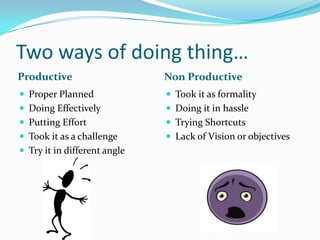
How to conduct Research?MahmoodAslamTwo ways of doing thing…ProductiveNon ProductiveProper PlannedDoing EffectivelyPutting EffortTook it as a challengeTry it in different angleTook it as formalityDoing it in hassleTrying ShortcutsLack of Vision or objectives
Do some thing ProductiveDon’t try to get Rid…
Before Starting Your Research…What would be the research topicFrom where to get the dataMethodology to get data
How to find Topic?Search through the search enginesStudy Journal published Articles of relevant subjectsGo for the latest IssuesDon’t reinvent the wheel
How to collect DataPersonal ExperienceObservationLiteratureQuestionnairesInterviews
Personal ExperienceSelf Experience High ValidityHigh ReliabilityShould not be biased
ObservationWhom to observeMethodOrganizationPolicies & proceduresRulesEmployeesPersonal ObservationAppoint a ObserverUse some Technology
LiteratureResearch ArticlesArticles from Magazines, News Papers, WebsitesBooksCompany’s Records, Resources, archives
QuestionnaireDevelop it by your self or use pre formattedShould be relevantValid and ReliableShould not be time consuming
Pre FormattedMore Reliable and ValidFor examplehttp://www.isr.unich.eduOrhttp://eee.marchall.usc.edu/ceo
InterviewsMore FlexibleLess time consumingModerate validity and reliabilityCan be biased
Getting Data is not an easy task..Don’t have access to research articlesPeople are not willing to cooperateRelevant people  are not availableIrrelevant dataToo much data, Handling ProblemData Interpretation ProblemDon’t LOOSE heart, Try to Manage
Impossible Says!I am Possible…
AnalysisContent AnalysisSummarizing your findings and interpret these according to your own views.Statistical AnalysisBy Mean, Mode, Median and Standard Deviation
Report your FindingsBe careful regarding referencesNever put a word with out reference even figures, tables etchttp://www.computer.orgUse Appropriate FormatVaries from journal to journal, conference to conference Pay deep attention to formatting
Report your FindingsLanguageShould appropriate, Simple and understandableBiased Data Biased data should not be included to avoid conflictAvoid to arise conflicts
Make it productiveTry to get it PublishedSearch for conferenceshttp://www.ieee.org/conferencesearch/Search for call for papershttp://www.computer.org/portal/pages/ieeecs/conferences/cfp.htmlSearch for Journalshttp://www.computer.org/portal/pages/ieeecs/publications/journals.html
Make it Productive… (cont)Modify your paper according to journal/conference proceedingsDon’t loose heart if it is not accepted, try to improve itTry to renew the things and search for the week points and go for their improvementsDon’t make hasty decision, always go for a better option
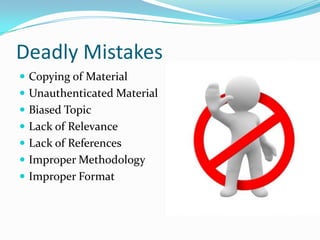
Deadly MistakesCopying of MaterialUnauthenticated MaterialBiased TopicLack of RelevanceLack of ReferencesImproper MethodologyImproper Format
Lessons LearntTake Great care of Valid and Reliable ResourcePut References according to the format given by the JournalsDon’t copy any thingPresent it in according to prescribed formatTry to get it publishModify it according to Requirement
Good Luck!&Thanks
Queries!
How to conduct research

How to conduct research

  • 1.
    How to conductResearch?MahmoodAslamTwo ways of doing thing…ProductiveNon ProductiveProper PlannedDoing EffectivelyPutting EffortTook it as a challengeTry it in different angleTook it as formalityDoing it in hassleTrying ShortcutsLack of Vision or objectives
  • 2.
    Do some thingProductiveDon’t try to get Rid…
  • 3.
    Before Starting YourResearch…What would be the research topicFrom where to get the dataMethodology to get data
  • 4.
    How to findTopic?Search through the search enginesStudy Journal published Articles of relevant subjectsGo for the latest IssuesDon’t reinvent the wheel
  • 5.
    How to collectDataPersonal ExperienceObservationLiteratureQuestionnairesInterviews
  • 6.
    Personal ExperienceSelf ExperienceHigh ValidityHigh ReliabilityShould not be biased
  • 7.
    ObservationWhom to observeMethodOrganizationPolicies& proceduresRulesEmployeesPersonal ObservationAppoint a ObserverUse some Technology
  • 8.
    LiteratureResearch ArticlesArticles fromMagazines, News Papers, WebsitesBooksCompany’s Records, Resources, archives
  • 9.
    QuestionnaireDevelop it byyour self or use pre formattedShould be relevantValid and ReliableShould not be time consuming
  • 10.
    Pre FormattedMore Reliableand ValidFor examplehttp://www.isr.unich.eduOrhttp://eee.marchall.usc.edu/ceo
  • 11.
    InterviewsMore FlexibleLess timeconsumingModerate validity and reliabilityCan be biased
  • 12.
    Getting Data isnot an easy task..Don’t have access to research articlesPeople are not willing to cooperateRelevant people are not availableIrrelevant dataToo much data, Handling ProblemData Interpretation ProblemDon’t LOOSE heart, Try to Manage
  • 13.
  • 14.
    AnalysisContent AnalysisSummarizing yourfindings and interpret these according to your own views.Statistical AnalysisBy Mean, Mode, Median and Standard Deviation
  • 15.
    Report your FindingsBecareful regarding referencesNever put a word with out reference even figures, tables etchttp://www.computer.orgUse Appropriate FormatVaries from journal to journal, conference to conference Pay deep attention to formatting
  • 16.
    Report your FindingsLanguageShouldappropriate, Simple and understandableBiased Data Biased data should not be included to avoid conflictAvoid to arise conflicts
  • 17.
    Make it productiveTryto get it PublishedSearch for conferenceshttp://www.ieee.org/conferencesearch/Search for call for papershttp://www.computer.org/portal/pages/ieeecs/conferences/cfp.htmlSearch for Journalshttp://www.computer.org/portal/pages/ieeecs/publications/journals.html
  • 18.
    Make it Productive…(cont)Modify your paper according to journal/conference proceedingsDon’t loose heart if it is not accepted, try to improve itTry to renew the things and search for the week points and go for their improvementsDon’t make hasty decision, always go for a better option
  • 19.
    Deadly MistakesCopying ofMaterialUnauthenticated MaterialBiased TopicLack of RelevanceLack of ReferencesImproper MethodologyImproper Format
  • 20.
    Lessons LearntTake Greatcare of Valid and Reliable ResourcePut References according to the format given by the JournalsDon’t copy any thingPresent it in according to prescribed formatTry to get it publishModify it according to Requirement
  • 21.
  • 22.

Editor's Notes

  • #9 Difficult to samplesPersonal biasedness