INT306
Database Management Systems
DATABASE DESIGN & THE E-R MODEL
Text book

Database System Concepts
A. Silberschatz, H. F. Korth, S. Sudarshan
Course Instructor

Mr. Sumit Mittu

Assistant Professor and Placement Coordinator, CSE/IT
Lovely Professional University, Punjab (India)

sumit.12735@lpu.co.in sumit.mittu@gmail.com
http://tinyurl.com/askSumit
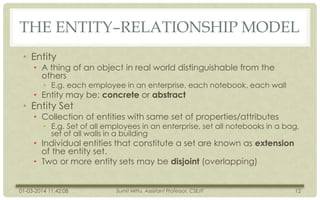
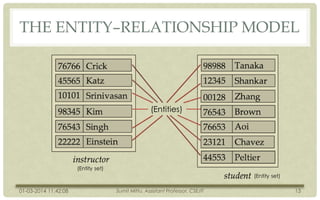
01-03-2014 11:42:06
IN THIS CHAPTER
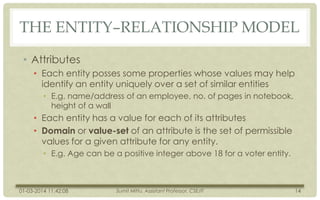
•
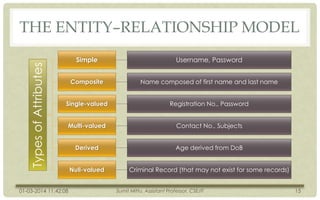
•
•
•
•
•
•
•

data modelling
overview of database design process
entity-relationship model
constraints
removing redundant attributes in entity sets
entity-relationship diagram
reduction to relational schema
entity-relationship design issues

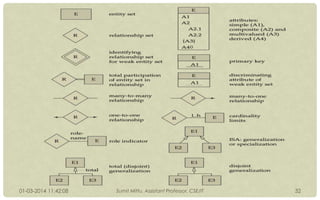
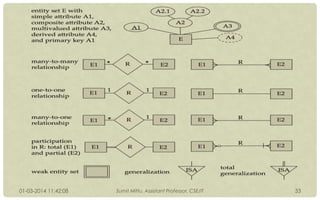
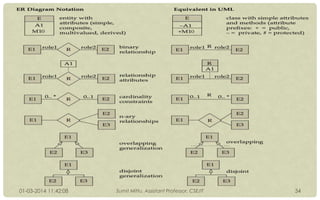
01-03-2014 11:42:07

Sumit Mittu, Assistant Professor, CSE/IT

2
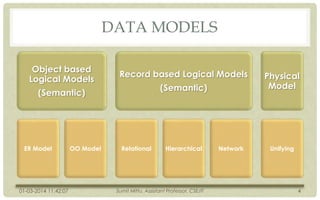
DATA MODELS
• Data Model defined…
• Collection of conceptual tools for describing:
•
•
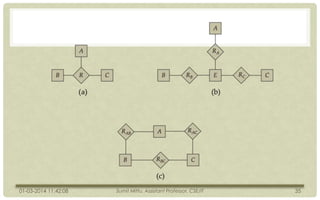
•
•

Data
Data relationships
Data semantics, and
Consistency constraints

• Types
• Object Based Logical data models
• Record Based Logical data models
• Physical data models
01-03-2014 11:42:07

Sumit Mittu, Assistant Professor, CSE/IT

3
DATA MODELS
Object based
Logical Models

Record based Logical Models
(Semantic)

(Semantic)

ER Model

01-03-2014 11:42:07

OO Model

Relational

Hierarchical

Sumit Mittu, Assistant Professor, CSE/IT

Network

Physical
Model

Unifying

4
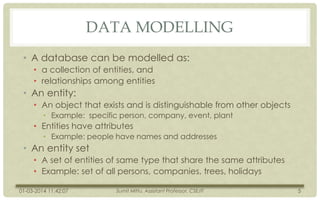
DATA MODELLING
• A database can be modelled as:
• a collection of entities, and
• relationships among entities

• An entity:
• An object that exists and is distinguishable from other objects
• Example: specific person, company, event, plant

• Entities have attributes
• Example: people have names and addresses

• An entity set
• A set of entities of same type that share the same attributes
• Example: set of all persons, companies, trees, holidays
01-03-2014 11:42:07

Sumit Mittu, Assistant Professor, CSE/IT

5
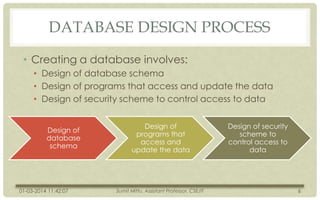
DATABASE DESIGN PROCESS
• Creating a database involves:
• Design of database schema
• Design of programs that access and update the data
• Design of security scheme to control access to data
Design of
database
schema

01-03-2014 11:42:07

Design of
programs that
access and
update the data

Sumit Mittu, Assistant Professor, CSE/IT

Design of security
scheme to
control access to
data

6
DATABASE DESIGN PROCESS
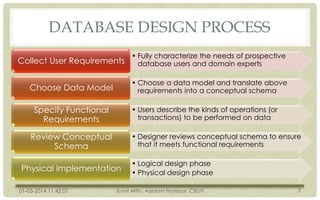
• Design Phases
Collect User Requirements

• Fully characterize the needs of prospective
database users and domain experts

Choose Data Model

• Choose a data model and translate above
requirements into a conceptual schema

Specify Functional
Requirements

• Users describe the kinds of operations (or
transactions) to be performed on data

Review Conceptual
Schema

• Designer reviews conceptual schema to ensure
that it meets functional requirements

Physical Implementation
01-03-2014 11:42:07

• Logical design phase
• Physical design phase

Sumit Mittu, Assistant Professor, CSE/IT

7
DATABASE DESIGN PROCESS
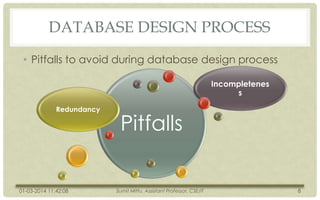
• Pitfalls to avoid during database design process
Incompletenes
s
Redundancy

01-03-2014 11:42:08

Pitfalls
Sumit Mittu, Assistant Professor, CSE/IT

8
SCRATCH YOUR MIND!!!
•

•

01-03-2014 11:42:08

Sumit Mittu, Assistant Professor, CSE/IT

9
THE ENTITY–RELATIONSHIP MODEL
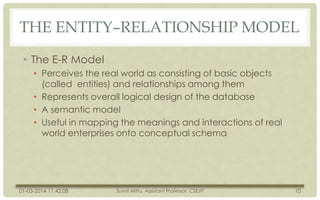
• The E-R Model
• Perceives the real world as consisting of basic objects
(called entities) and relationships among them
• Represents overall logical design of the database
• A semantic model
• Useful in mapping the meanings and interactions of real
world enterprises onto conceptual schema

01-03-2014 11:42:08

Sumit Mittu, Assistant Professor, CSE/IT

10
THE ENTITY–RELATIONSHIP MODEL
• The E-R Model
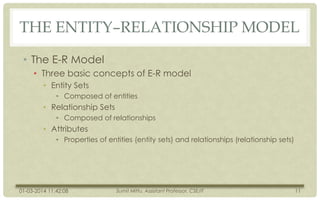
• Three basic concepts of E-R model
• Entity Sets
• Composed of entities

• Relationship Sets
• Composed of relationships

• Attributes
• Properties of entities (entity sets) and relationships (relationship sets)

01-03-2014 11:42:08

Sumit Mittu, Assistant Professor, CSE/IT

11
THE ENTITY–RELATIONSHIP MODEL
• Entity

• A thing of an object in real world distinguishable from the
others

• E.g. each employee in an enterprise, each notebook, each wall

• Entity may be: concrete or abstract

• Entity Set

• Collection of entities with same set of properties/attributes

• E.g. Set of all employees in an enterprise, set all notebooks in a bag,
set of all walls in a building

• Individual entities that constitute a set are known as extension
of the entity set.
• Two or more entity sets may be disjoint (overlapping)

01-03-2014 11:42:08

Sumit Mittu, Assistant Professor, CSE/IT

12
THE ENTITY–RELATIONSHIP MODEL

(Entities)

(Entity set)
(Entity set)
01-03-2014 11:42:08

Sumit Mittu, Assistant Professor, CSE/IT

13
THE ENTITY–RELATIONSHIP MODEL
• Attributes
• Each entity posses some properties whose values may help
identify an entity uniquely over a set of similar entities
• E.g. name/address of an employee, no. of pages in notebook,
height of a wall

• Each entity has a value for each of its attributes
• Domain or value-set of an attribute is the set of permissible
values for a given attribute for any entity.
• E.g. Age can be a positive integer above 18 for a voter entity.

01-03-2014 11:42:08

Sumit Mittu, Assistant Professor, CSE/IT

14
Types of Attributes

THE ENTITY–RELATIONSHIP MODEL
Simple

Username, Password

Composite

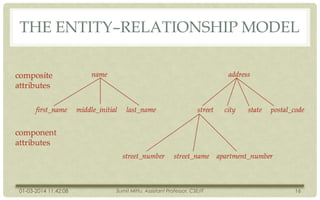
Name composed of first name and last name

Single-valued

Registration No., Password

Multi-valued

Contact No., Subjects

Derived

Age derived from DoB

Null-valued

Criminal Record (that may not exist for some records)

01-03-2014 11:42:08

Sumit Mittu, Assistant Professor, CSE/IT

15
THE ENTITY–RELATIONSHIP MODEL

01-03-2014 11:42:08

Sumit Mittu, Assistant Professor, CSE/IT

16
THE ENTITY–RELATIONSHIP MODEL
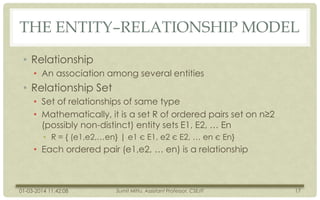
• Relationship
• An association among several entities

• Relationship Set
• Set of relationships of same type
• Mathematically, it is a set R of ordered pairs set on n≥2
(possibly non-distinct) entity sets E1, E2, … En
• R = { (e1,e2,…en} | e1 є E1, e2 є E2, … en є En}

• Each ordered pair (e1,e2, … en) is a relationship

01-03-2014 11:42:08

Sumit Mittu, Assistant Professor, CSE/IT

17
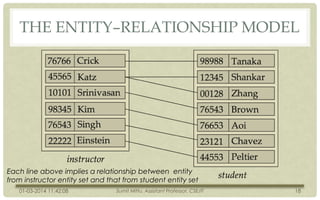
THE ENTITY–RELATIONSHIP MODEL

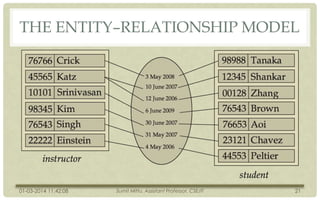
Each line above implies a relationship between entity
from instructor entity set and that from student entity set
01-03-2014 11:42:08

Sumit Mittu, Assistant Professor, CSE/IT

18
THE ENTITY–RELATIONSHIP MODEL
• Relationship Set
• Participation
• The association between entity sets in a relationship
• Types: Total or Partial

• Relationship instance
• An association between named entities

• Entity’s Role
• Function that entity plays in a relationship
• Types: Implicit or Explicit

• Recursive Relationship Set
• Entities of an entity set form relationship with other entities of same
entity set
01-03-2014 11:42:08

Sumit Mittu, Assistant Professor, CSE/IT

19
THE ENTITY–RELATIONSHIP MODEL
• Relationship
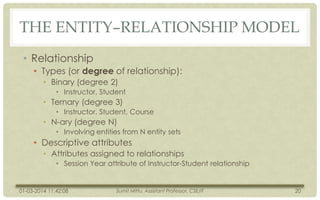
• Types (or degree of relationship):
• Binary (degree 2)
• Instructor, Student

• Ternary (degree 3)
• Instructor, Student, Course

• N-ary (degree N)
• Involving entities from N entity sets

• Descriptive attributes
• Attributes assigned to relationships
• Session Year attribute of Instructor-Student relationship

01-03-2014 11:42:08

Sumit Mittu, Assistant Professor, CSE/IT

20
THE ENTITY–RELATIONSHIP MODEL

01-03-2014 11:42:08

Sumit Mittu, Assistant Professor, CSE/IT

21
SCRATCH YOUR MIND!!!
•

•

•

01-03-2014 11:42:08

Sumit Mittu, Assistant Professor, CSE/IT

22
CONSTRAINTS
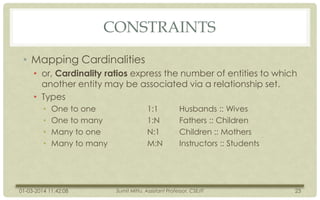
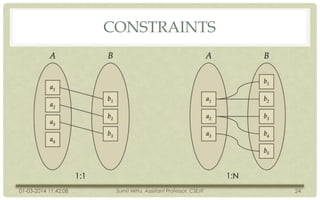
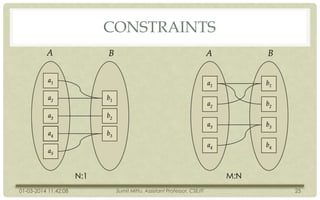
• Mapping Cardinalities
• or, Cardinality ratios express the number of entities to which
another entity may be associated via a relationship set.
• Types
•
•
•
•

One to one
One to many
Many to one
Many to many

01-03-2014 11:42:08

1:1
1:N
N:1
M:N

Husbands :: Wives
Fathers :: Children
Children :: Mothers
Instructors :: Students

Sumit Mittu, Assistant Professor, CSE/IT

23
CONSTRAINTS

1:N

1:1
01-03-2014 11:42:08

Sumit Mittu, Assistant Professor, CSE/IT

24
CONSTRAINTS

M:N

N:1
01-03-2014 11:42:08

Sumit Mittu, Assistant Professor, CSE/IT

25
CONSTRAINTS
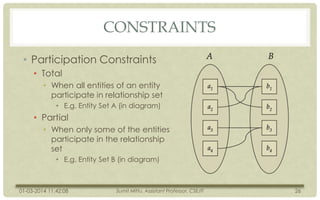
• Participation Constraints
• Total
• When all entities of an entity
participate in relationship set
• E.g. Entity Set A (in diagram)

• Partial
• When only some of the entities
participate in the relationship
set
• E.g. Entity Set B (in diagram)

01-03-2014 11:42:08

Sumit Mittu, Assistant Professor, CSE/IT

26
KEYS
• Keys
• Help identify a set of attributes that suffice to distinguish
entities from each other
• Entity Set Keys
•
•
•
•

Super keys
Candidate Keys
Primary Key
Alternate Keys

• Relationship Set Keys
• PK(E1) u PK(E2) u … u PK(En) u {a1,a2,…am}
01-03-2014 11:42:08

Sumit Mittu, Assistant Professor, CSE/IT

27
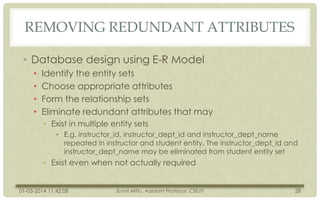
REMOVING REDUNDANT ATTRIBUTES
• Database design using E-R Model
•
•
•
•

Identify the entity sets
Choose appropriate attributes
Form the relationship sets
Eliminate redundant attributes that may
• Exist in multiple entity sets
• E.g. instructor_id, instructor_dept_id and instructor_dept_name
repeated in instructor and student entity. The instructor_dept_id and
instructor_dept_name may be eliminated from student entity set

• Exist even when not actually required

01-03-2014 11:42:08

Sumit Mittu, Assistant Professor, CSE/IT

28
SCRATCH YOUR MIND!!!
•

•

•

01-03-2014 11:42:08

Sumit Mittu, Assistant Professor, CSE/IT

29
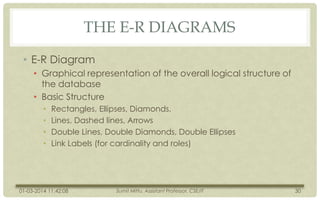
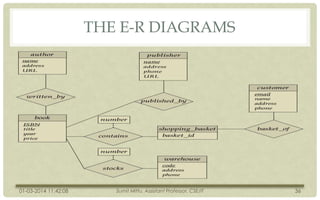
THE E-R DIAGRAMS
• E-R Diagram
• Graphical representation of the overall logical structure of
the database
• Basic Structure
•
•
•
•

Rectangles, Ellipses, Diamonds,
Lines, Dashed lines, Arrows
Double Lines, Double Diamonds, Double Ellipses
Link Labels (for cardinality and roles)

01-03-2014 11:42:08

Sumit Mittu, Assistant Professor, CSE/IT

30
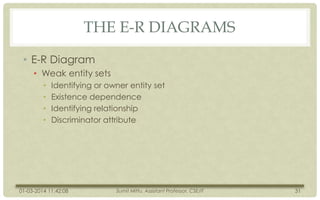
THE E-R DIAGRAMS
• E-R Diagram
• Weak entity sets
•
•
•
•

Identifying or owner entity set
Existence dependence
Identifying relationship
Discriminator attribute

01-03-2014 11:42:08

Sumit Mittu, Assistant Professor, CSE/IT

31
01-03-2014 11:42:08

Sumit Mittu, Assistant Professor, CSE/IT

32
01-03-2014 11:42:08

Sumit Mittu, Assistant Professor, CSE/IT

33
01-03-2014 11:42:08

Sumit Mittu, Assistant Professor, CSE/IT

34
01-03-2014 11:42:08

Sumit Mittu, Assistant Professor, CSE/IT

35
THE E-R DIAGRAMS

01-03-2014 11:42:08

Sumit Mittu, Assistant Professor, CSE/IT

36
THE E-R DIAGRAMS
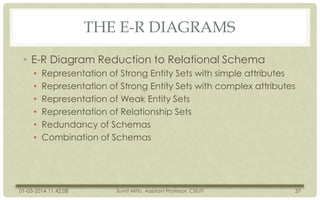
• E-R Diagram Reduction to Relational Schema
•
•
•
•
•
•

Representation of Strong Entity Sets with simple attributes
Representation of Strong Entity Sets with complex attributes
Representation of Weak Entity Sets
Representation of Relationship Sets
Redundancy of Schemas
Combination of Schemas

01-03-2014 11:42:08

Sumit Mittu, Assistant Professor, CSE/IT

37
THE E-R DIAGRAMS
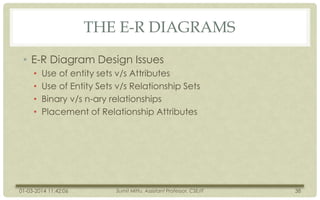
• E-R Diagram Design Issues
•
•
•
•

Use of entity sets v/s Attributes
Use of Entity Sets v/s Relationship Sets
Binary v/s n-ary relationships
Placement of Relationship Attributes

01-03-2014 11:42:06

Sumit Mittu, Assistant Professor, CSE/IT

38

Int306 02

  • 1.
    INT306 Database Management Systems DATABASEDESIGN & THE E-R MODEL Text book Database System Concepts A. Silberschatz, H. F. Korth, S. Sudarshan Course Instructor Mr. Sumit Mittu Assistant Professor and Placement Coordinator, CSE/IT Lovely Professional University, Punjab (India) sumit.12735@lpu.co.in sumit.mittu@gmail.com http://tinyurl.com/askSumit 01-03-2014 11:42:06
  • 2.
    IN THIS CHAPTER • • • • • • • • datamodelling overview of database design process entity-relationship model constraints removing redundant attributes in entity sets entity-relationship diagram reduction to relational schema entity-relationship design issues 01-03-2014 11:42:07 Sumit Mittu, Assistant Professor, CSE/IT 2
  • 3.
    DATA MODELS • DataModel defined… • Collection of conceptual tools for describing: • • • • Data Data relationships Data semantics, and Consistency constraints • Types • Object Based Logical data models • Record Based Logical data models • Physical data models 01-03-2014 11:42:07 Sumit Mittu, Assistant Professor, CSE/IT 3
  • 4.
    DATA MODELS Object based LogicalModels Record based Logical Models (Semantic) (Semantic) ER Model 01-03-2014 11:42:07 OO Model Relational Hierarchical Sumit Mittu, Assistant Professor, CSE/IT Network Physical Model Unifying 4
  • 5.
    DATA MODELLING • Adatabase can be modelled as: • a collection of entities, and • relationships among entities • An entity: • An object that exists and is distinguishable from other objects • Example: specific person, company, event, plant • Entities have attributes • Example: people have names and addresses • An entity set • A set of entities of same type that share the same attributes • Example: set of all persons, companies, trees, holidays 01-03-2014 11:42:07 Sumit Mittu, Assistant Professor, CSE/IT 5
  • 6.
    DATABASE DESIGN PROCESS •Creating a database involves: • Design of database schema • Design of programs that access and update the data • Design of security scheme to control access to data Design of database schema 01-03-2014 11:42:07 Design of programs that access and update the data Sumit Mittu, Assistant Professor, CSE/IT Design of security scheme to control access to data 6
  • 7.
    DATABASE DESIGN PROCESS •Design Phases Collect User Requirements • Fully characterize the needs of prospective database users and domain experts Choose Data Model • Choose a data model and translate above requirements into a conceptual schema Specify Functional Requirements • Users describe the kinds of operations (or transactions) to be performed on data Review Conceptual Schema • Designer reviews conceptual schema to ensure that it meets functional requirements Physical Implementation 01-03-2014 11:42:07 • Logical design phase • Physical design phase Sumit Mittu, Assistant Professor, CSE/IT 7
  • 8.
    DATABASE DESIGN PROCESS •Pitfalls to avoid during database design process Incompletenes s Redundancy 01-03-2014 11:42:08 Pitfalls Sumit Mittu, Assistant Professor, CSE/IT 8
  • 9.
    SCRATCH YOUR MIND!!! • • 01-03-201411:42:08 Sumit Mittu, Assistant Professor, CSE/IT 9
  • 10.
    THE ENTITY–RELATIONSHIP MODEL •The E-R Model • Perceives the real world as consisting of basic objects (called entities) and relationships among them • Represents overall logical design of the database • A semantic model • Useful in mapping the meanings and interactions of real world enterprises onto conceptual schema 01-03-2014 11:42:08 Sumit Mittu, Assistant Professor, CSE/IT 10
  • 11.
    THE ENTITY–RELATIONSHIP MODEL •The E-R Model • Three basic concepts of E-R model • Entity Sets • Composed of entities • Relationship Sets • Composed of relationships • Attributes • Properties of entities (entity sets) and relationships (relationship sets) 01-03-2014 11:42:08 Sumit Mittu, Assistant Professor, CSE/IT 11
  • 12.
    THE ENTITY–RELATIONSHIP MODEL •Entity • A thing of an object in real world distinguishable from the others • E.g. each employee in an enterprise, each notebook, each wall • Entity may be: concrete or abstract • Entity Set • Collection of entities with same set of properties/attributes • E.g. Set of all employees in an enterprise, set all notebooks in a bag, set of all walls in a building • Individual entities that constitute a set are known as extension of the entity set. • Two or more entity sets may be disjoint (overlapping) 01-03-2014 11:42:08 Sumit Mittu, Assistant Professor, CSE/IT 12
  • 13.
    THE ENTITY–RELATIONSHIP MODEL (Entities) (Entityset) (Entity set) 01-03-2014 11:42:08 Sumit Mittu, Assistant Professor, CSE/IT 13
  • 14.
    THE ENTITY–RELATIONSHIP MODEL •Attributes • Each entity posses some properties whose values may help identify an entity uniquely over a set of similar entities • E.g. name/address of an employee, no. of pages in notebook, height of a wall • Each entity has a value for each of its attributes • Domain or value-set of an attribute is the set of permissible values for a given attribute for any entity. • E.g. Age can be a positive integer above 18 for a voter entity. 01-03-2014 11:42:08 Sumit Mittu, Assistant Professor, CSE/IT 14
  • 15.
    Types of Attributes THEENTITY–RELATIONSHIP MODEL Simple Username, Password Composite Name composed of first name and last name Single-valued Registration No., Password Multi-valued Contact No., Subjects Derived Age derived from DoB Null-valued Criminal Record (that may not exist for some records) 01-03-2014 11:42:08 Sumit Mittu, Assistant Professor, CSE/IT 15
  • 16.
    THE ENTITY–RELATIONSHIP MODEL 01-03-201411:42:08 Sumit Mittu, Assistant Professor, CSE/IT 16
  • 17.
    THE ENTITY–RELATIONSHIP MODEL •Relationship • An association among several entities • Relationship Set • Set of relationships of same type • Mathematically, it is a set R of ordered pairs set on n≥2 (possibly non-distinct) entity sets E1, E2, … En • R = { (e1,e2,…en} | e1 є E1, e2 є E2, … en є En} • Each ordered pair (e1,e2, … en) is a relationship 01-03-2014 11:42:08 Sumit Mittu, Assistant Professor, CSE/IT 17
  • 18.
    THE ENTITY–RELATIONSHIP MODEL Eachline above implies a relationship between entity from instructor entity set and that from student entity set 01-03-2014 11:42:08 Sumit Mittu, Assistant Professor, CSE/IT 18
  • 19.
    THE ENTITY–RELATIONSHIP MODEL •Relationship Set • Participation • The association between entity sets in a relationship • Types: Total or Partial • Relationship instance • An association between named entities • Entity’s Role • Function that entity plays in a relationship • Types: Implicit or Explicit • Recursive Relationship Set • Entities of an entity set form relationship with other entities of same entity set 01-03-2014 11:42:08 Sumit Mittu, Assistant Professor, CSE/IT 19
  • 20.
    THE ENTITY–RELATIONSHIP MODEL •Relationship • Types (or degree of relationship): • Binary (degree 2) • Instructor, Student • Ternary (degree 3) • Instructor, Student, Course • N-ary (degree N) • Involving entities from N entity sets • Descriptive attributes • Attributes assigned to relationships • Session Year attribute of Instructor-Student relationship 01-03-2014 11:42:08 Sumit Mittu, Assistant Professor, CSE/IT 20
  • 21.
    THE ENTITY–RELATIONSHIP MODEL 01-03-201411:42:08 Sumit Mittu, Assistant Professor, CSE/IT 21
  • 22.
    SCRATCH YOUR MIND!!! • • • 01-03-201411:42:08 Sumit Mittu, Assistant Professor, CSE/IT 22
  • 23.
    CONSTRAINTS • Mapping Cardinalities •or, Cardinality ratios express the number of entities to which another entity may be associated via a relationship set. • Types • • • • One to one One to many Many to one Many to many 01-03-2014 11:42:08 1:1 1:N N:1 M:N Husbands :: Wives Fathers :: Children Children :: Mothers Instructors :: Students Sumit Mittu, Assistant Professor, CSE/IT 23
  • 24.
  • 25.
  • 26.
    CONSTRAINTS • Participation Constraints •Total • When all entities of an entity participate in relationship set • E.g. Entity Set A (in diagram) • Partial • When only some of the entities participate in the relationship set • E.g. Entity Set B (in diagram) 01-03-2014 11:42:08 Sumit Mittu, Assistant Professor, CSE/IT 26
  • 27.
    KEYS • Keys • Helpidentify a set of attributes that suffice to distinguish entities from each other • Entity Set Keys • • • • Super keys Candidate Keys Primary Key Alternate Keys • Relationship Set Keys • PK(E1) u PK(E2) u … u PK(En) u {a1,a2,…am} 01-03-2014 11:42:08 Sumit Mittu, Assistant Professor, CSE/IT 27
  • 28.
    REMOVING REDUNDANT ATTRIBUTES •Database design using E-R Model • • • • Identify the entity sets Choose appropriate attributes Form the relationship sets Eliminate redundant attributes that may • Exist in multiple entity sets • E.g. instructor_id, instructor_dept_id and instructor_dept_name repeated in instructor and student entity. The instructor_dept_id and instructor_dept_name may be eliminated from student entity set • Exist even when not actually required 01-03-2014 11:42:08 Sumit Mittu, Assistant Professor, CSE/IT 28
  • 29.
    SCRATCH YOUR MIND!!! • • • 01-03-201411:42:08 Sumit Mittu, Assistant Professor, CSE/IT 29
  • 30.
    THE E-R DIAGRAMS •E-R Diagram • Graphical representation of the overall logical structure of the database • Basic Structure • • • • Rectangles, Ellipses, Diamonds, Lines, Dashed lines, Arrows Double Lines, Double Diamonds, Double Ellipses Link Labels (for cardinality and roles) 01-03-2014 11:42:08 Sumit Mittu, Assistant Professor, CSE/IT 30
  • 31.
    THE E-R DIAGRAMS •E-R Diagram • Weak entity sets • • • • Identifying or owner entity set Existence dependence Identifying relationship Discriminator attribute 01-03-2014 11:42:08 Sumit Mittu, Assistant Professor, CSE/IT 31
  • 32.
    01-03-2014 11:42:08 Sumit Mittu,Assistant Professor, CSE/IT 32
  • 33.
    01-03-2014 11:42:08 Sumit Mittu,Assistant Professor, CSE/IT 33
  • 34.
    01-03-2014 11:42:08 Sumit Mittu,Assistant Professor, CSE/IT 34
  • 35.
    01-03-2014 11:42:08 Sumit Mittu,Assistant Professor, CSE/IT 35
  • 36.
    THE E-R DIAGRAMS 01-03-201411:42:08 Sumit Mittu, Assistant Professor, CSE/IT 36
  • 37.
    THE E-R DIAGRAMS •E-R Diagram Reduction to Relational Schema • • • • • • Representation of Strong Entity Sets with simple attributes Representation of Strong Entity Sets with complex attributes Representation of Weak Entity Sets Representation of Relationship Sets Redundancy of Schemas Combination of Schemas 01-03-2014 11:42:08 Sumit Mittu, Assistant Professor, CSE/IT 37
  • 38.
    THE E-R DIAGRAMS •E-R Diagram Design Issues • • • • Use of entity sets v/s Attributes Use of Entity Sets v/s Relationship Sets Binary v/s n-ary relationships Placement of Relationship Attributes 01-03-2014 11:42:06 Sumit Mittu, Assistant Professor, CSE/IT 38