Physical & Logical Clocks
CS4262 Distributed Systems
Dilum Bandara
Dilum.Bandara@uom.lk
Slides adapted from U Uthaiyashankar (WSO2) and Rajkumar Buyya’s (IU)
Outline
 Introduction to synchronization
 Time & clocks
 Synchronizing physical clocks
 Logical time & logical clocks
 Synchronizing logical clocks
 Lamport’s time stamp
 Vector clocks – Not covered
2
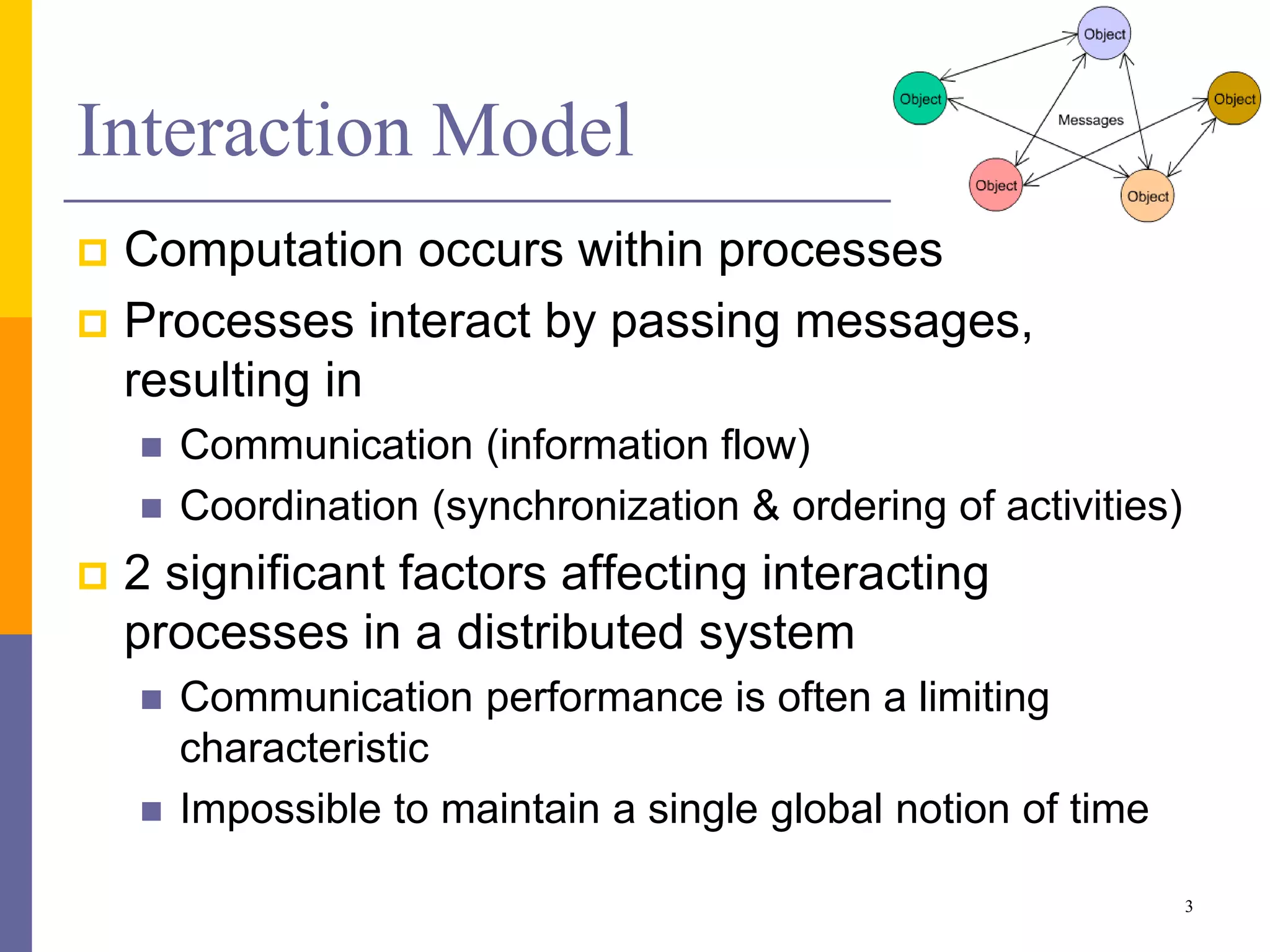
Interaction Model
 Computation occurs within processes
 Processes interact by passing messages,
resulting in
 Communication (information flow)
 Coordination (synchronization & ordering of activities)
 2 significant factors affecting interacting
processes in a distributed system
 Communication performance is often a limiting
characteristic
 Impossible to maintain a single global notion of time
3
Interaction Model (Cont.)
 Processes running on different nodes can
associate timestamps with their events
 This timestamp doesn’t make sense globally
 Clock drift
 Differing drift rates
 Complexity & cost of time synchronization
 GPS not accessible inside a building
4
2 Variants of Interaction Model
 Hard to set limits on time taken for
 Process execution
 Message delivery
 Clock drift
 2 simple models
 Synchronous model – based on a strong assumption
of time
 Asynchronous model – makes no assumption about
time
5
Synchronous DS Model
 Defined by following bounds
 Time taken to execute a step of a process has known
lower & upper bounds
 Each message transmitted over a channel is received
within a known bounded time
 Each process has a local clock whose drift rate from
real time has a known bound
6
Asynchronous DS Model
 Defined by assuming no bounds on
 Process execution speeds
 Message transmission delays
 Clock drift rates
 Models Internet very closely
 Any solution that is valid for an asynchronous
DS is also valid for a synchronous DS
 There are many design problems that can’t be solved
for an asynchronous DS, but can be solved when
some aspects of time are used
7
Event Ordering
 Whether an event occurred before, after, or
concurrently with another event at another
process?
 Execution of a system can be described in terms of
events & their ordering
 No need of accurate clocks
 Example
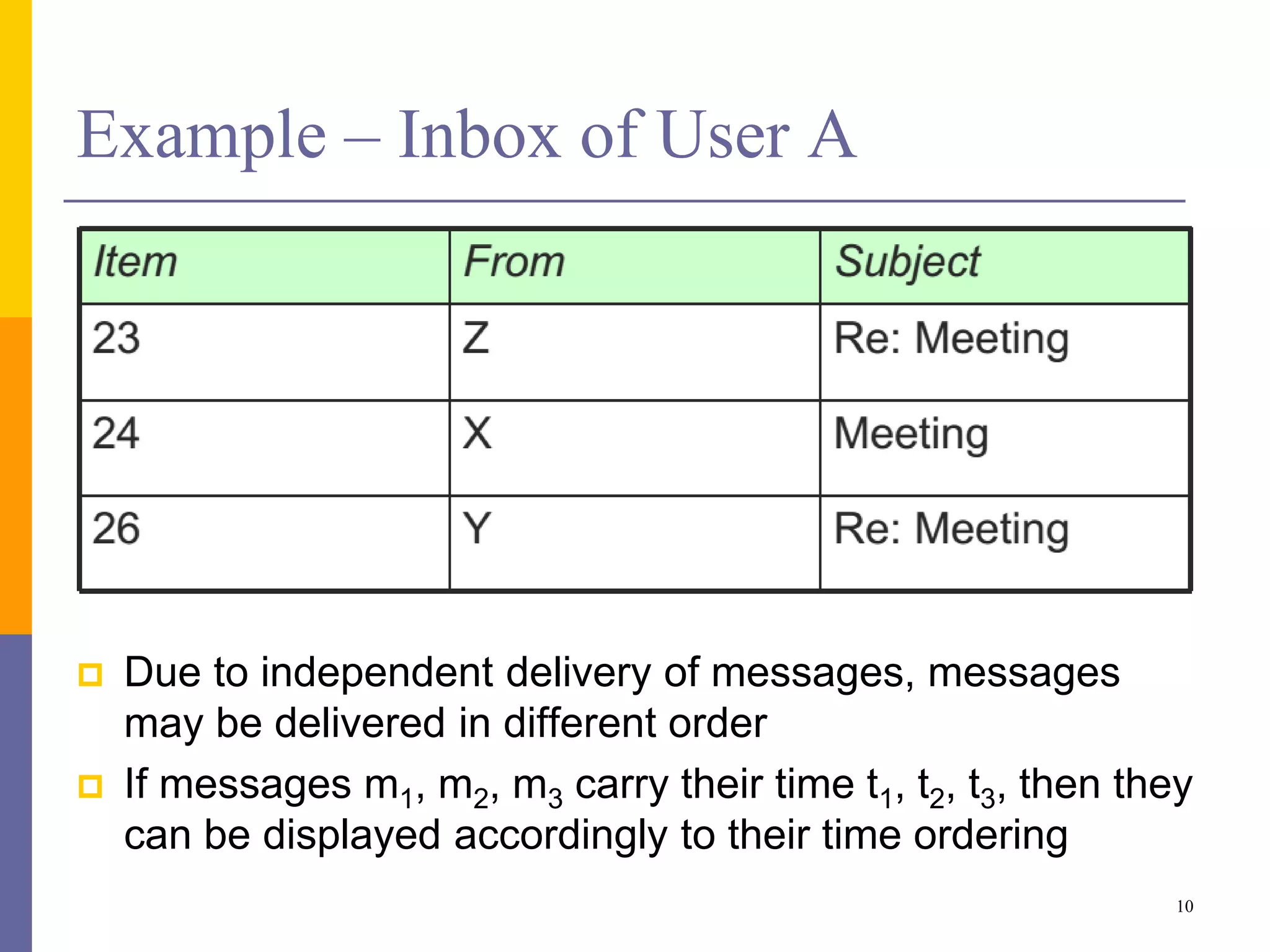
 Consider a mailing list with users X, Y, Z, & A
 User X sends a message with subject “meeting”
 Users Y & Z reply by sending messages with the
subject “Re: meeting”
8
Example – Real-Time Ordering of
Events
9Source: Tanenbaum & Van Steen, Distributed Systems: Principles and Paradigms, 2e, (c) 2007
Example – Inbox of User A
 Due to independent delivery of messages, messages
may be delivered in different order
 If messages m1, m2, m3 carry their time t1, t2, t3, then they
can be displayed accordingly to their time ordering
10
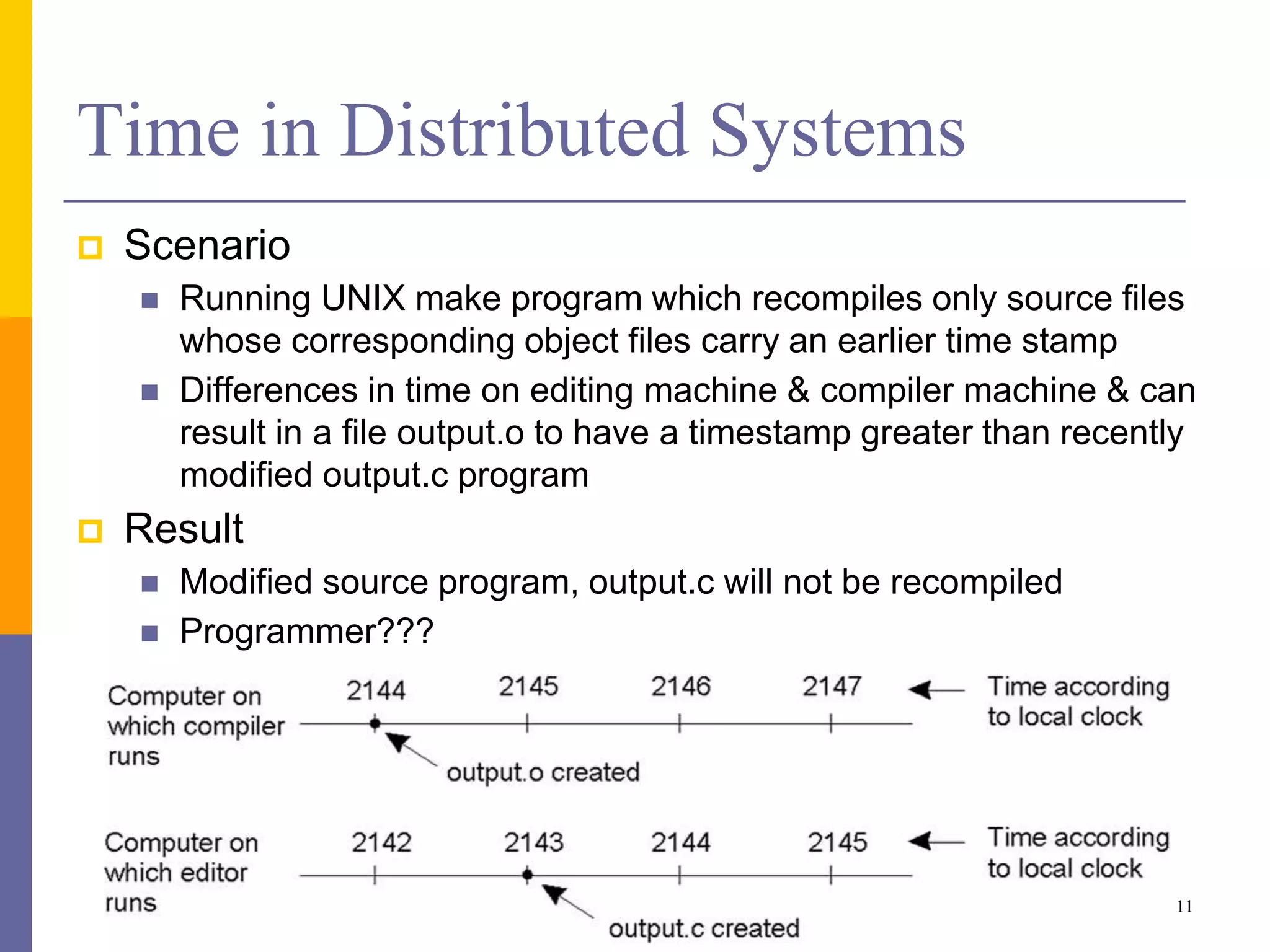
Time in Distributed Systems
 Scenario
 Running UNIX make program which recompiles only source files
whose corresponding object files carry an earlier time stamp
 Differences in time on editing machine & compiler machine & can
result in a file output.o to have a timestamp greater than recently
modified output.c program
 Result
 Modified source program, output.c will not be recompiled
 Programmer???
11
Time & Clocks
 Atomic Time
 Derived from atomic oscillators
 Very accurate
 Astronomical Time
 Based on Earth’s rotation about its axis & around sun
 Period of Earth’s rotation about its axis is gradually
getting longer
 Coordinated Universal Time (UTC)
 Broadcast from land-based radio stations & GPS
12
Clock Drift
 Different rates of counting time
 Physical variations of underlying oscillators
 Variance caused by temperature
 Extremely small differences that accumulate
over a large no of oscillations  Observable
difference in counters
 Drift rate
 Difference in reading between a clock & a nominal
“perfect clock” per unit of time
 10-6 seconds/sec for quartz crystals
 10-7 to 10-8 seconds/sec for high precision quartz
crystals 13
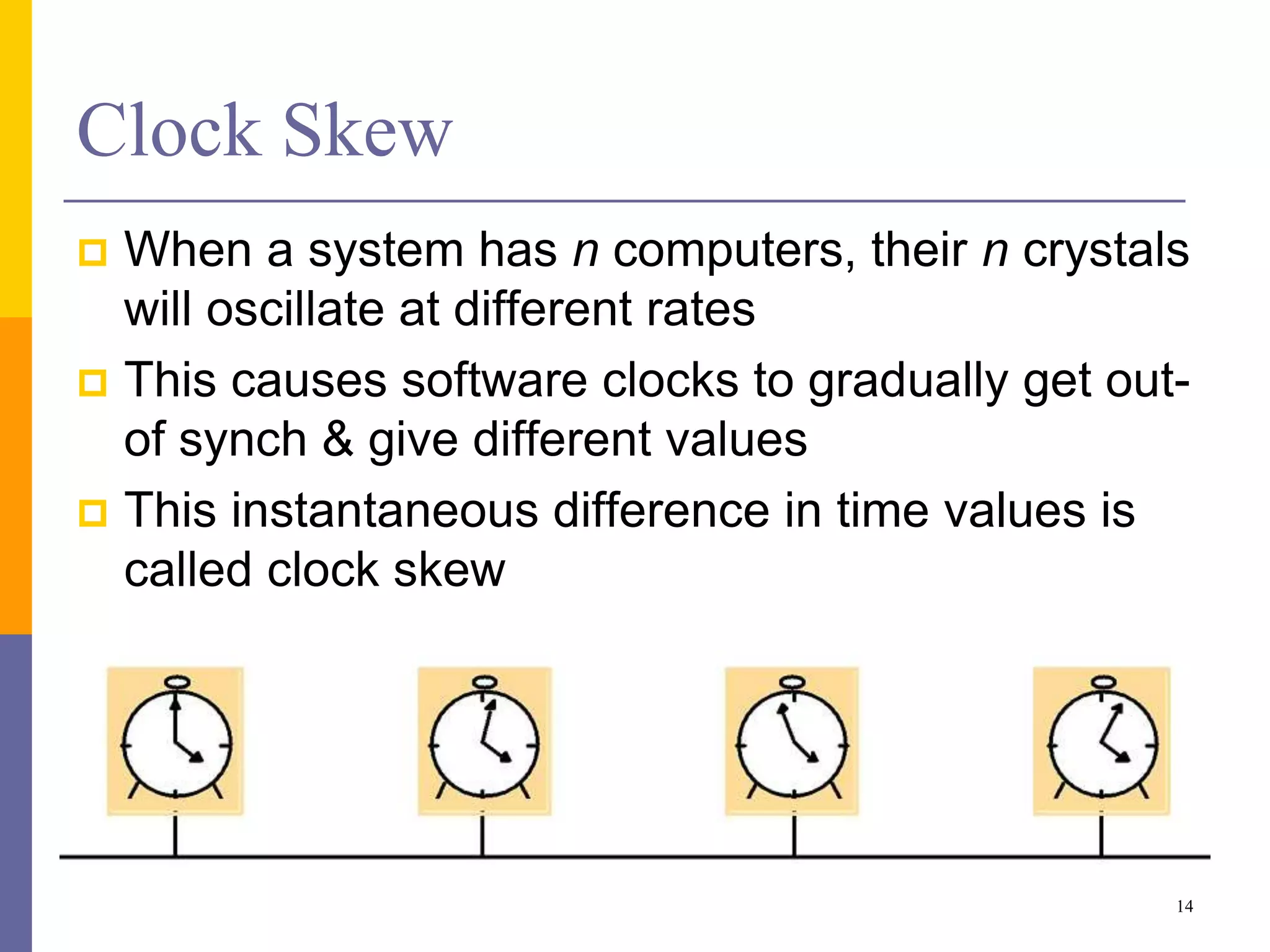
Clock Skew
 When a system has n computers, their n crystals
will oscillate at different rates
 This causes software clocks to gradually get out-
of synch & give different values
 This instantaneous difference in time values is
called clock skew
14
Clock Synchronization
 External synchronization
 If 1 machine has a WWW or GPS receiver, use it to
synchronize others
 Internal synchronization
 If no machines have receivers, each machine keeps
track of its own time
 Then keep all the machines together as well as
possible
 Many clock synchronization algorithms have
been proposed to achieve these goals
 Christian’s Algorithm, Berkeley Algorithm, Averaging
Algorithms, Network Time Protocol, etc. 15
Synchronization in Asynchronous
Systems
 There is no upper bound on message
transmission delays
 e.g., there is no maximum transmission delay for
Internet
 Ttransmit = min + x, where x > 0
 Ttransmit – time taken to transmit m
 Min – minimum time to transmit
 x may not be known in a particular case, but it is
possible to measure a distribution of values for a
particular installation
16
Network Time Protocol (NTP)
 Christian’s & Berkeley algorithms for intranets
 NTP designed for Internet
 Large & variable message delays are handled through
statistical techniques for filtering timing data
 Discriminates between quality of timing data from different
servers
 Redundant servers & redundant paths between servers
 Scalable – handles a large no of clients & servers
 Authentication to ensure trusted time sources
 Synchronization accuracy
 ~10s of milliseconds over Internet paths
 ~1 millisecond on LANs
17
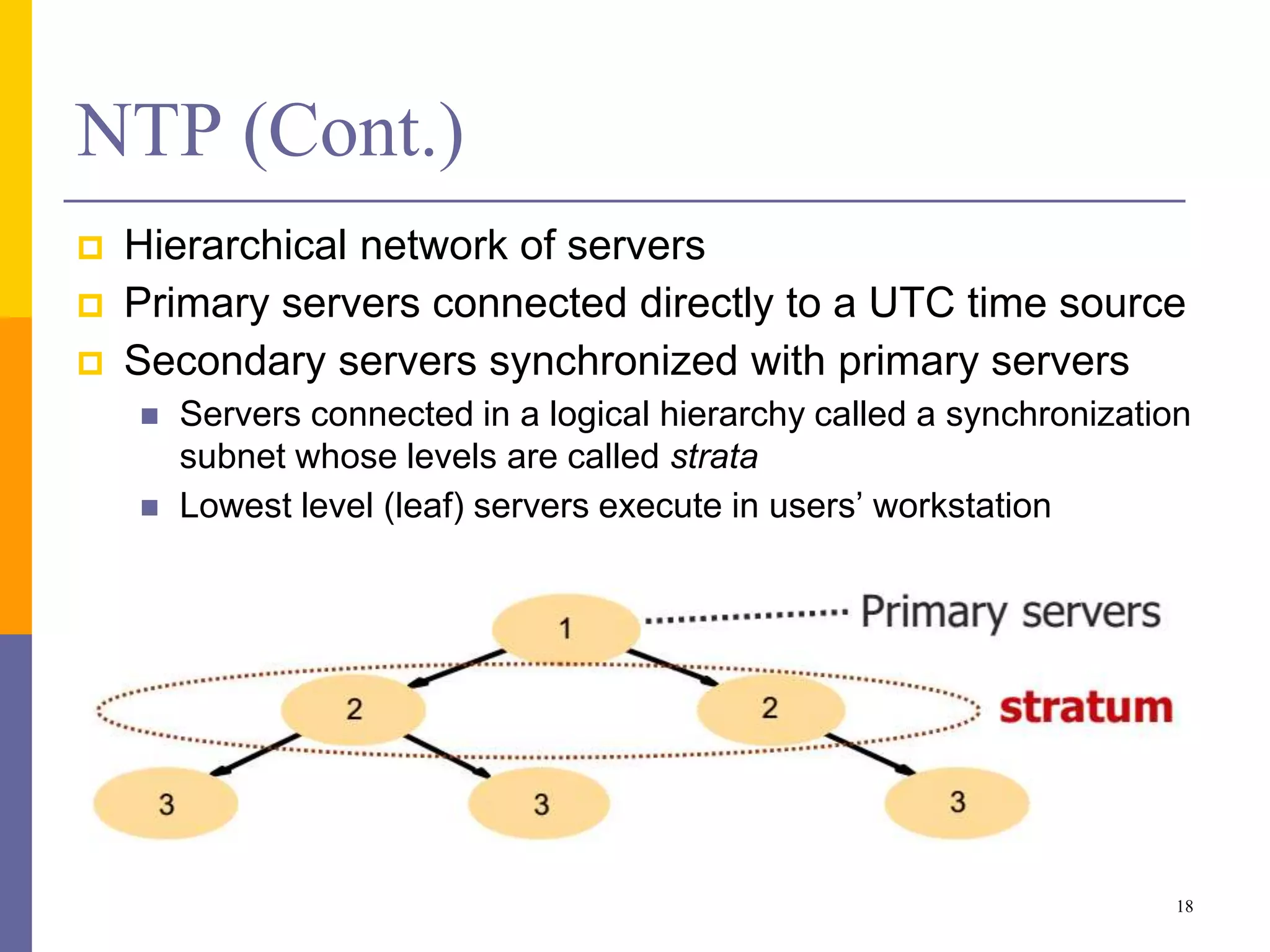
NTP (Cont.)
 Hierarchical network of servers
 Primary servers connected directly to a UTC time source
 Secondary servers synchronized with primary servers
 Servers connected in a logical hierarchy called a synchronization
subnet whose levels are called strata
 Lowest level (leaf) servers execute in users’ workstation
18
Logical Time & Logical Clocks
 Single process
 Events are ordered uniquely by local clock time
 Lamport (1978) pointed out that,
 “since we can’t synchronize clocks perfectly across a
distributed system, we can’t use physical time to find
out order of any arbitrary pair of events within a
distributed system”
 In general, we can use a scheme that is similar
to physical causality, to order some events that
occur in different processes
19
Physical Causality Based Ordering
 If events occur on same process P, then they
occur in the order in which P observes them
 If a & b are events within a single process Pi, and a
occurs before b, then a i b is true
 Whenever a message is sent between
processes, event of sending occurs before event
of receiving
 a = event of a message m being sent by process Pi
 b = event of message m being received
 then, a i b is true
20
Lamport’s Notion of Event Ordering
 Lamport generalized 2 (intuitive) physical-
causality-based event ordering points to obtain
happened-before partial ordering
 A.k.a relation of causal ordering or potential causal
ordering
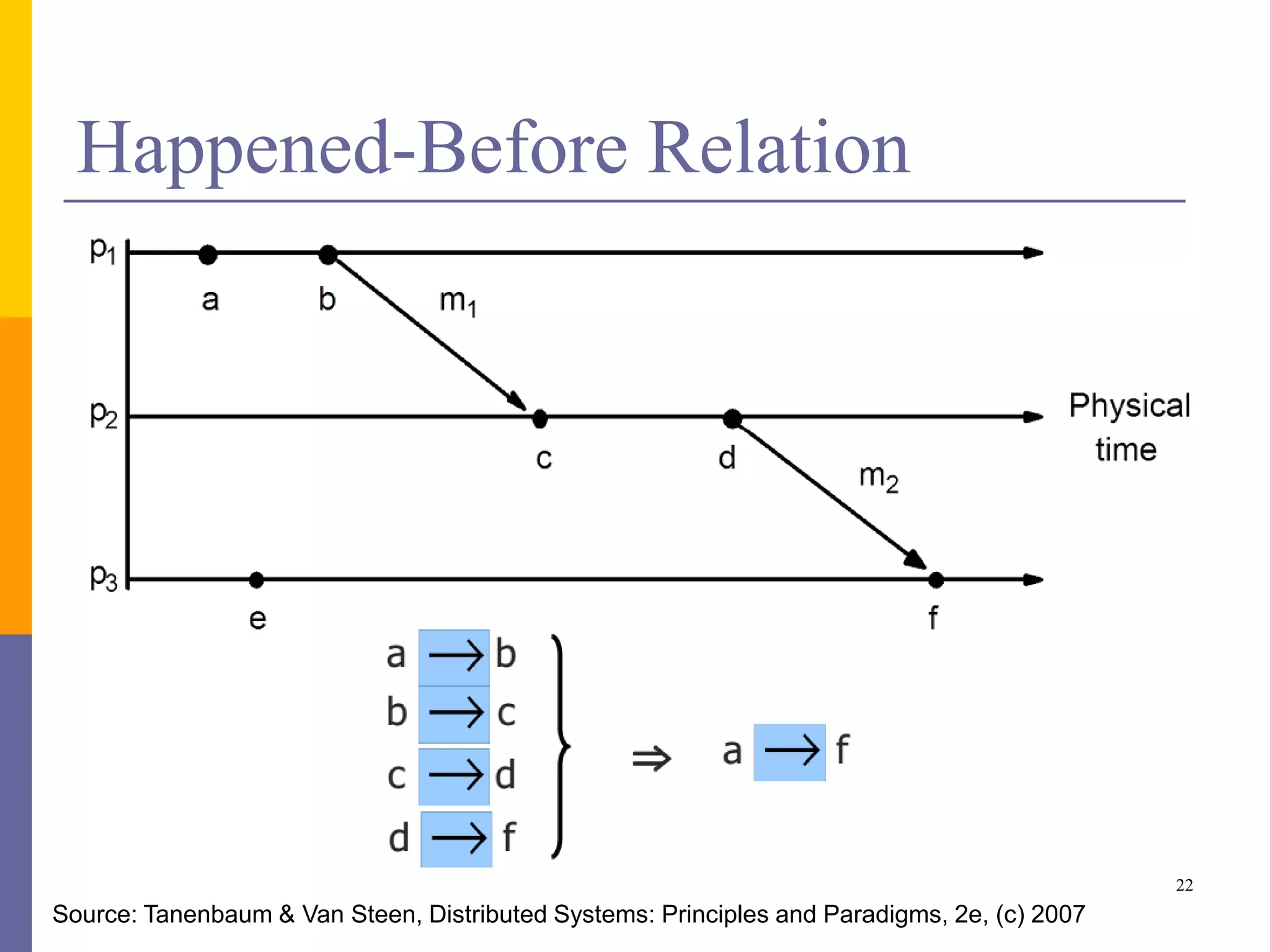
 Define “happened-before relation” (denoted by
) as follows
 e i e/ for process Pi ⇒ e  e/
 For any message m, send(m)  receive(m)
 e  e/ and e/  e// ⇒ e  e//
21
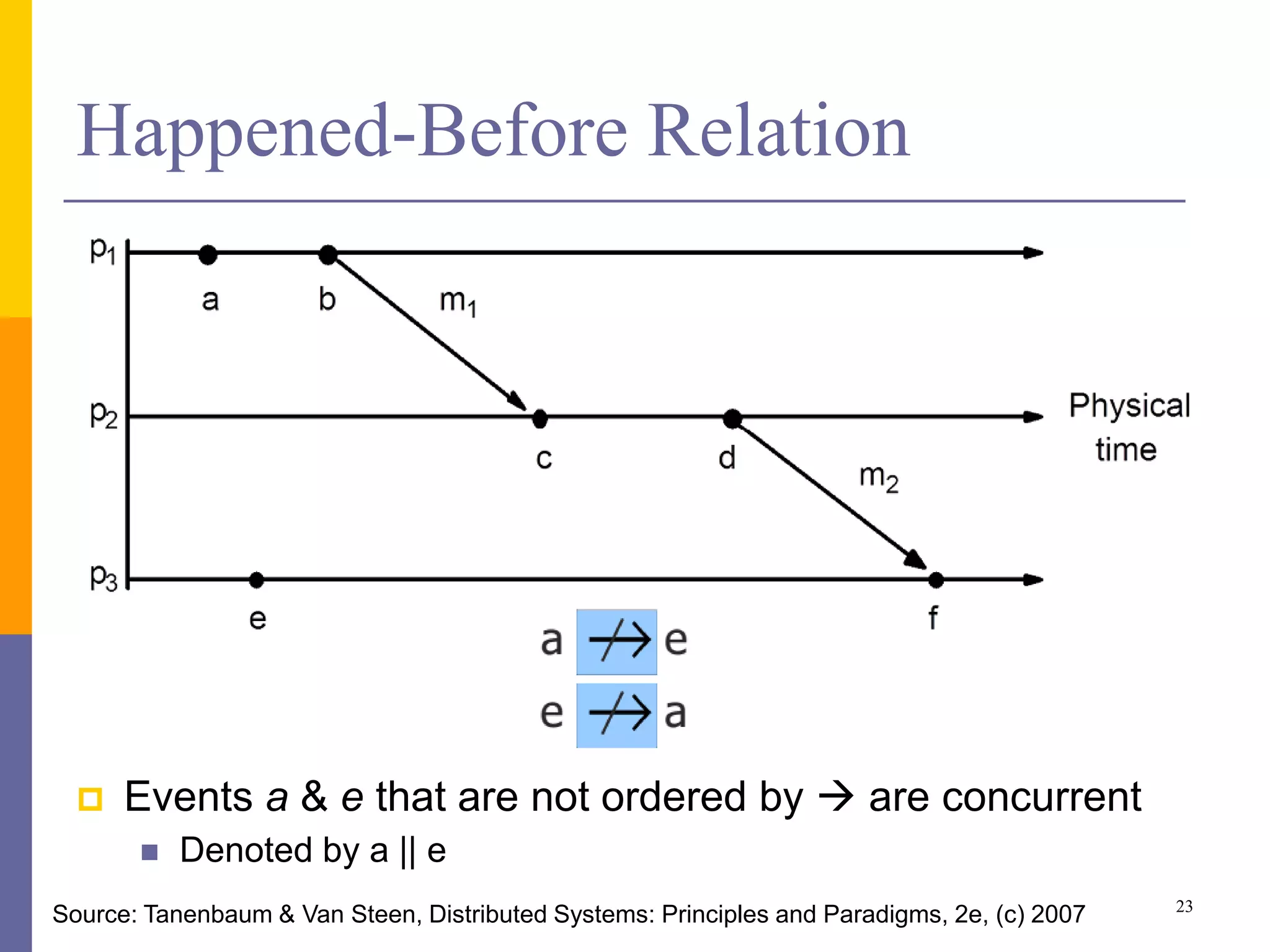
Happened-Before Relation
22
Source: Tanenbaum & Van Steen, Distributed Systems: Principles and Paradigms, 2e, (c) 2007
Happened-Before Relation
23
 Events a & e that are not ordered by  are concurrent
 Denoted by a || e
Source: Tanenbaum & Van Steen, Distributed Systems: Principles and Paradigms, 2e, (c) 2007
Logical Clocks
 Invented by Leslie Lamport to capture
happened-before ordering numerically
 Lamport Logical Clock
 Monotonically increasing software counter
 Value need not have a relationship to any physical
clock
 Each process Pi keeps its own logical clock Li,
which it uses to apply Lamport timestamps to
events
 Li(e) = timestamp of event e at Pi
 L(e) = timestamp of event e at process it occurred
24
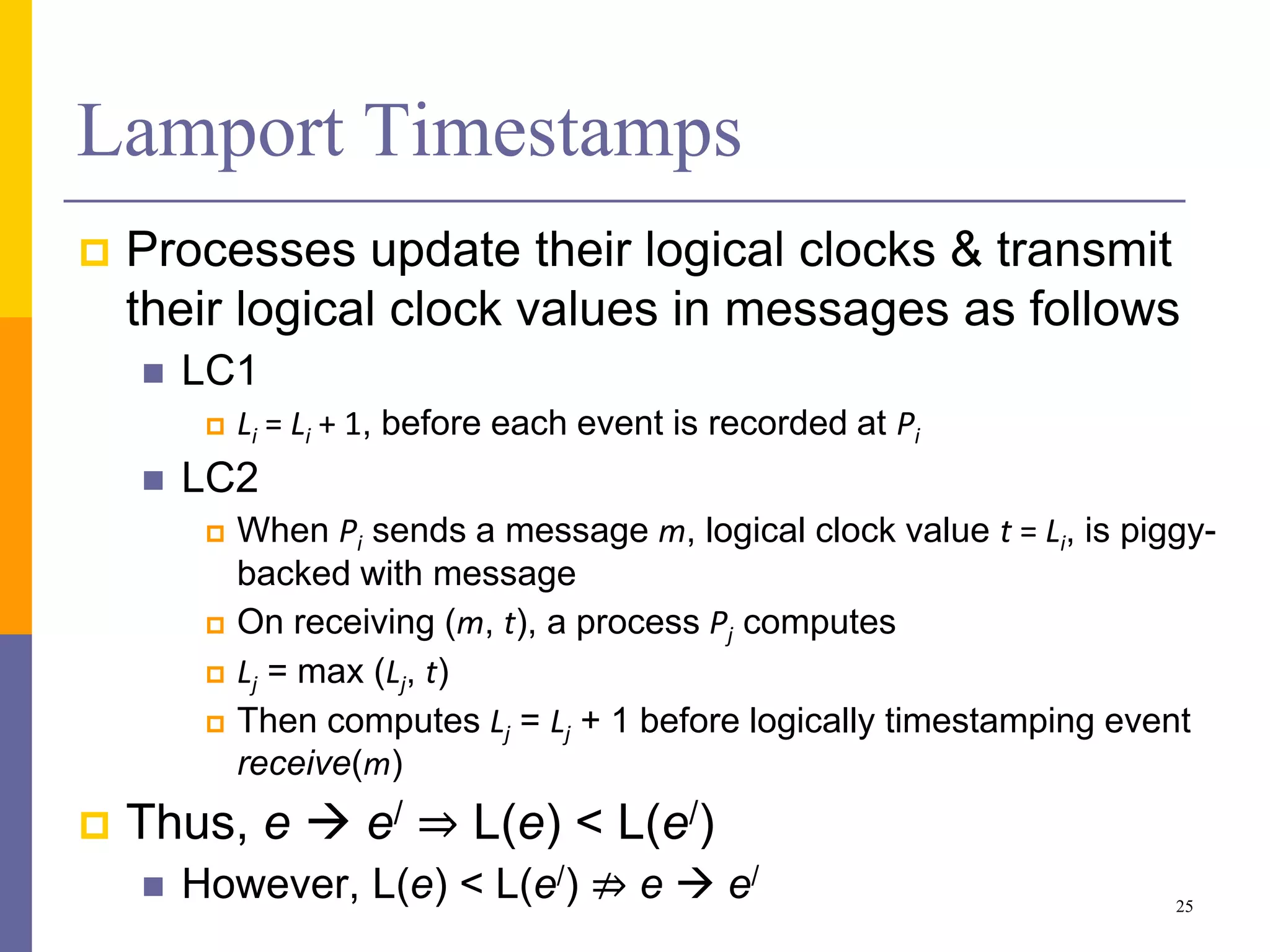
Lamport Timestamps
 Processes update their logical clocks & transmit
their logical clock values in messages as follows
 LC1
 Li = Li + 1, before each event is recorded at Pi
 LC2
 When Pi sends a message m, logical clock value t = Li, is piggy-
backed with message
 On receiving (m, t), a process Pj computes
 Lj = max (Lj, t)
 Then computes Lj = Lj + 1 before logically timestamping event
receive(m)
 Thus, e  e/ ⇒ L(e) < L(e/)
 However, L(e) < L(e/) ⇏ e  e/
25
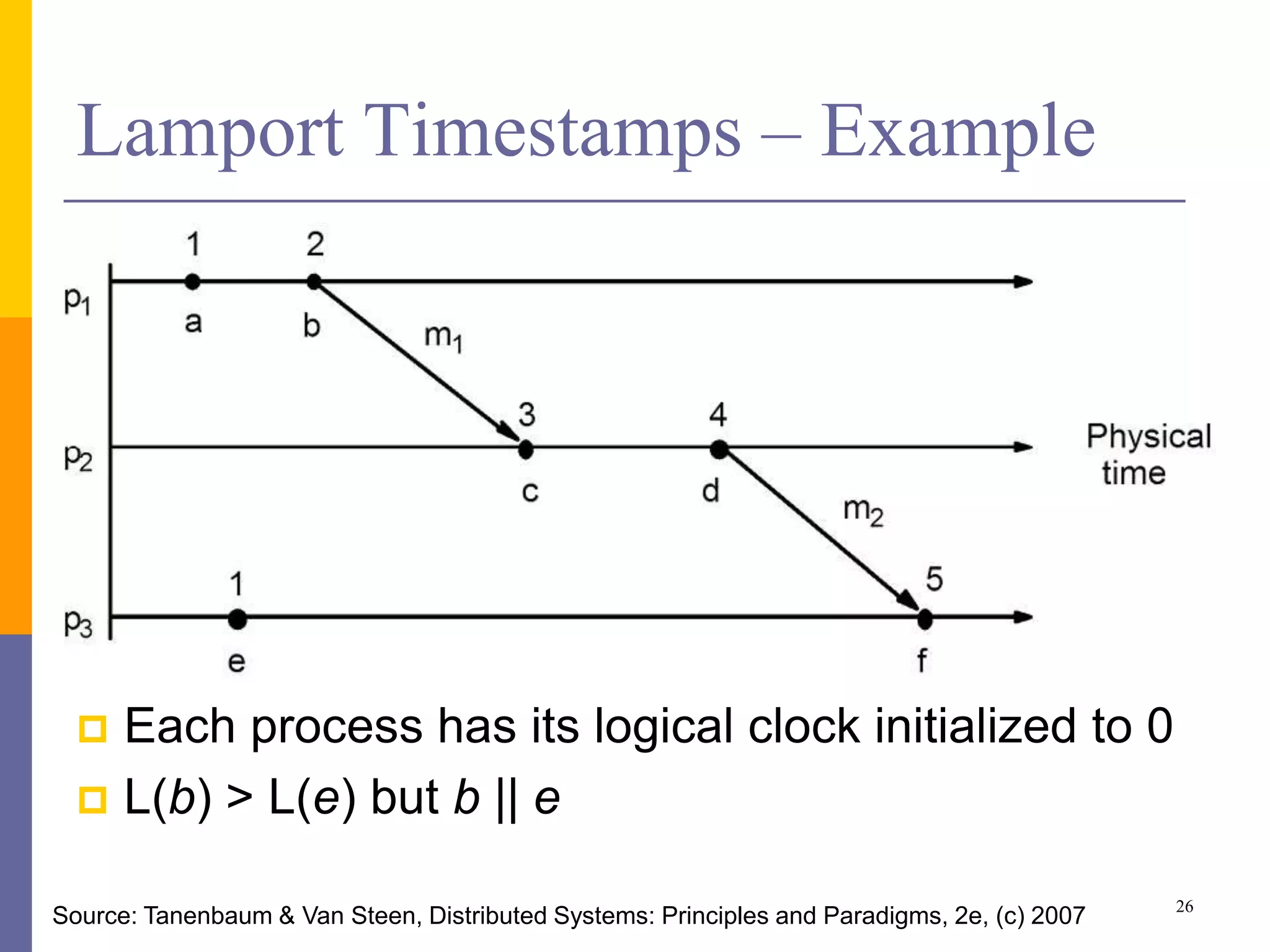
Lamport Timestamps – Example
 Each process has its logical clock initialized to 0
 L(b) > L(e) but b || e
26
Source: Tanenbaum & Van Steen, Distributed Systems: Principles and Paradigms, 2e, (c) 2007
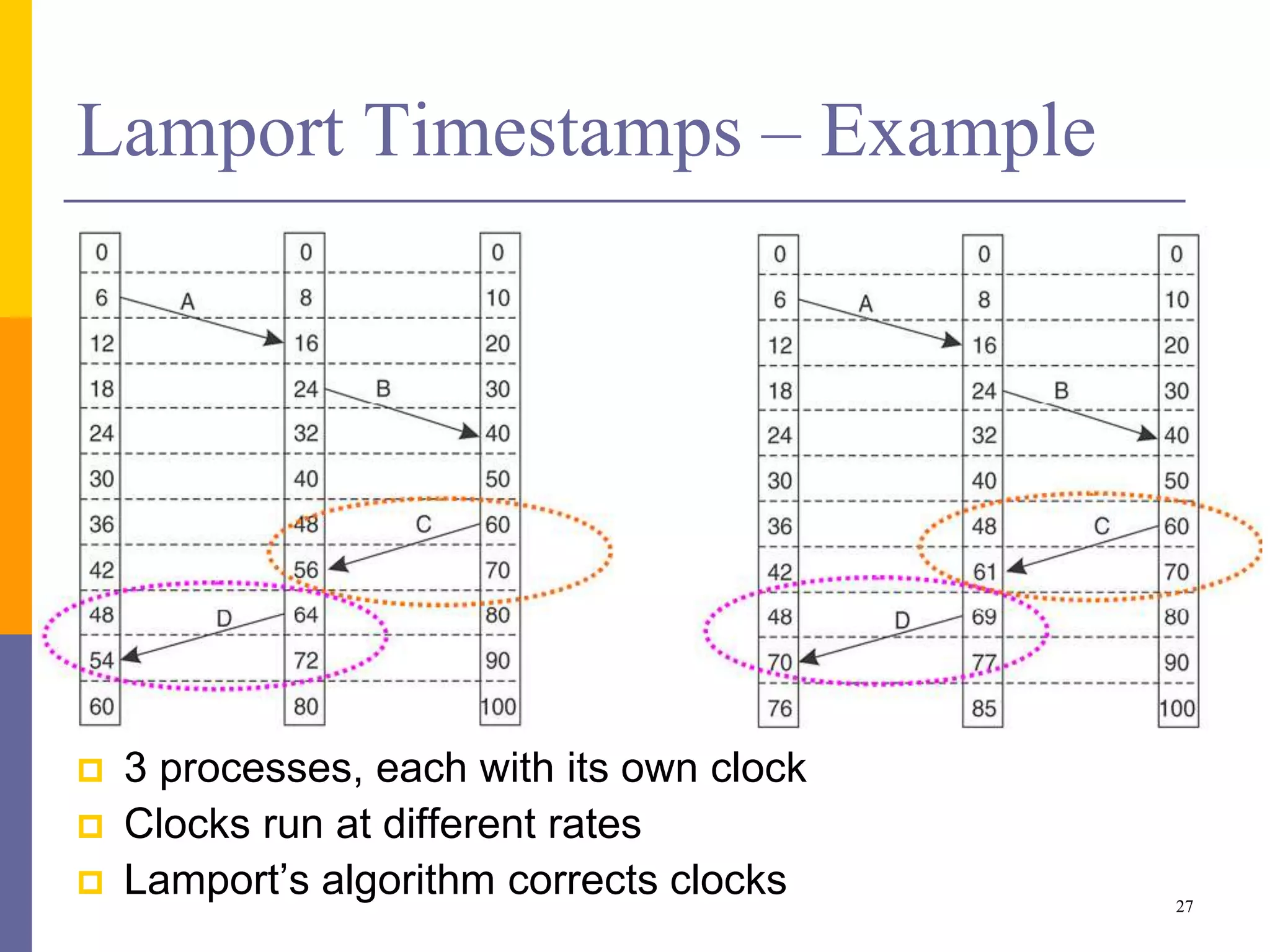
Lamport Timestamps – Example
 3 processes, each with its own clock
 Clocks run at different rates
 Lamport’s algorithm corrects clocks 27
Totally Ordered Logical Clocks
 Some pairs of distinct events generated by different
processes have identical Lamport timestamps
 A total order, where all pairs of distinct events are ordered,
can be created by noting IDs of processes
 Suppose,
 (Ti, i) = global logical timestamp for event e at process Pi with local
logical timestamp Ti
 Similarly (Tj, j)
 Then (Ti, i) < (Tj, j) ⇔ Ti < Tj or (Ti = Tj and i < j )
 No general physical significance since process IDs are
arbitrary
 e.g., 2 events in P1 & P2, both with timestamp 40 can be
globally timestamped as 40.1 & 40.2 28
Application of Lamport’s Timestamps
 Consider a database that has been replicated
across several sites
 e.g., a bank account database may be replicated in
Colombo & Kandy
 A query is always forwarded to the nearest copy
(for fast response)
 Update costs are higher since each update must
be carried out at each replica in same order
 Why?
29
Application (Cont.)
 Mr. Perera (lives in Kandy) has Rs. 1,000 in his account
 Mr. Perera wants to deposit Rs. 100 to his account
 At the same time, banking application (in Colombo)
initiates an update to increase account balance with 1%
interest
 Both updates must be carried out at both copies of the
database
 Due to communication delays, we may have following
situation:
 In Kandy DB, Mr. Perera’s deposit is performed before interest
update  (Rs. 1000 + Rs. 100) * 1.01 = Rs. 1,111
 In Colombo DB, interest update is performed before Mr. Perera’s
deposit  (Rs. 1000 * 1.01) + Rs. 100 = Rs. 1,110
30
Application (Cont.)
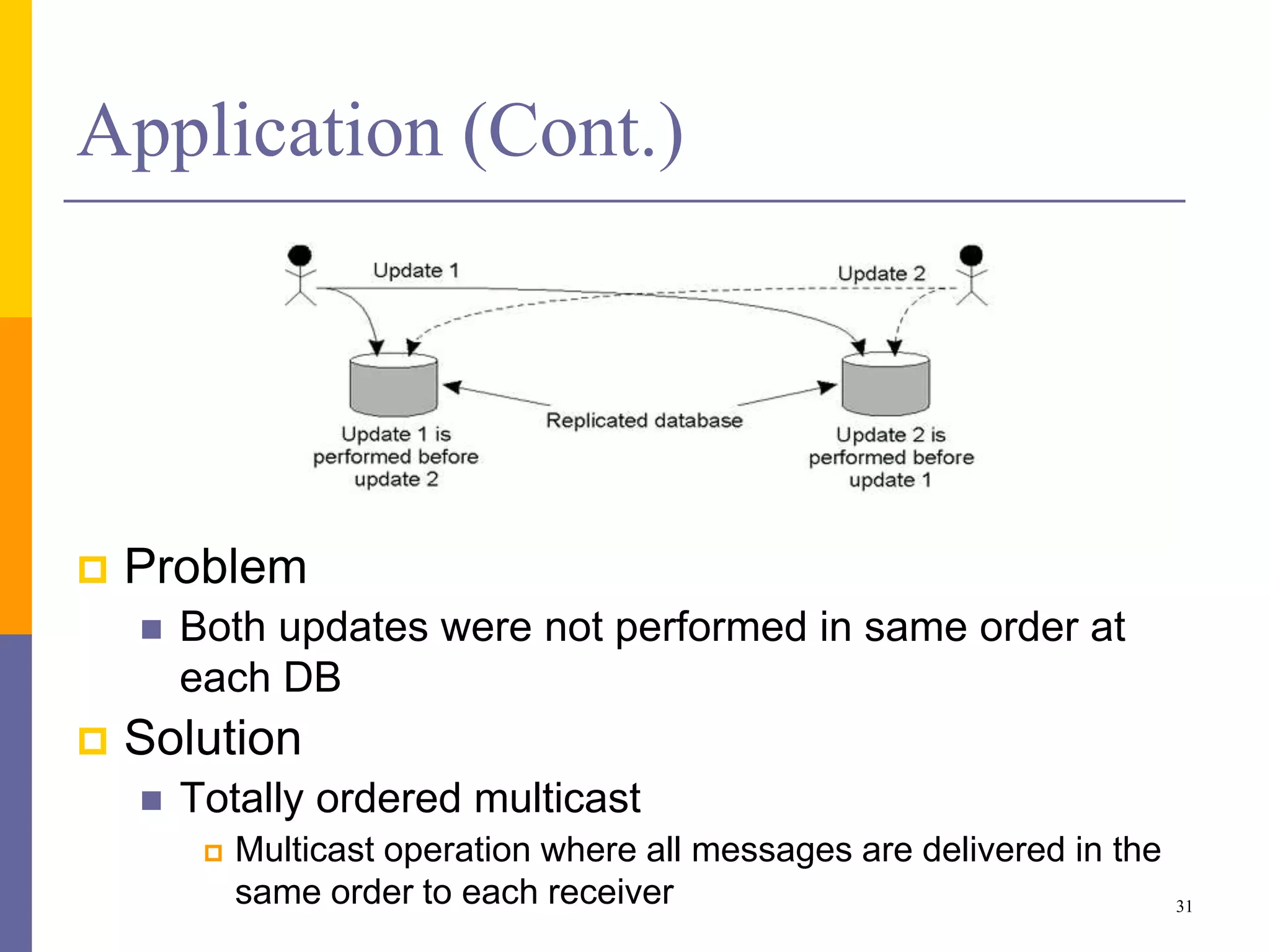
 Problem
 Both updates were not performed in same order at
each DB
 Solution
 Totally ordered multicast
 Multicast operation where all messages are delivered in the
same order to each receiver 31
Totally Ordered Multicast
 If process Pi sends messages x, y to processes
Pj, Pk ,.. then all processes Pj, Pk … receive
messages in the same order (x, y or y, x)
 This doesn’t imply causal or even FIFO ordering
 Solutions
 Multicast through a central coordinator
 Lamport’s solution
32
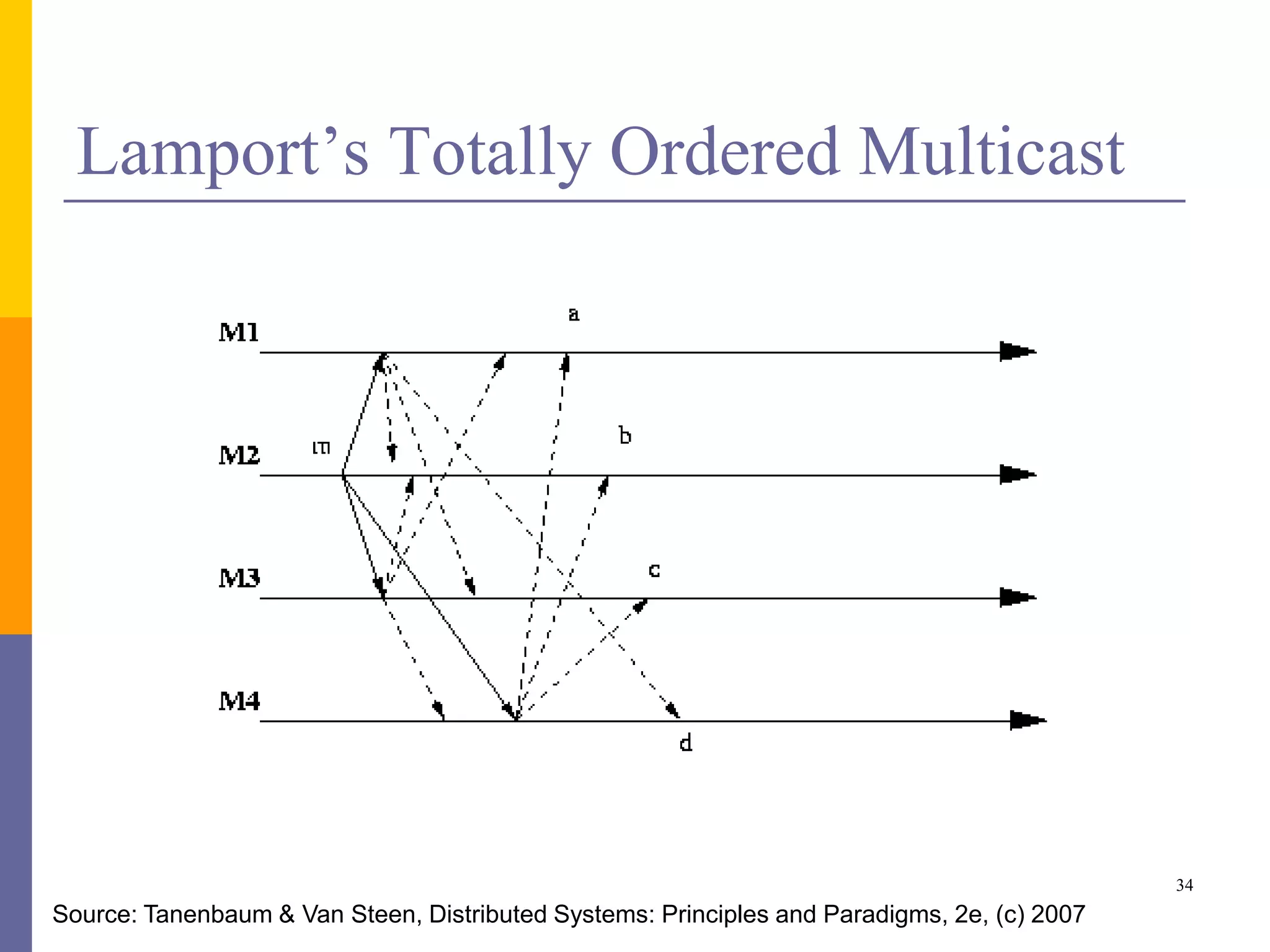
Lamport’s Totally Ordered Multicast
 Each multicast has a Lamport time stamp
 All processors store received multicast in a queue
 Order based on time stamp
 Everyone has the same queue
 Assume all messages sent by a sender are received in the
order they were sent & no messages are lost
 A time stamped ACK is sent back
 Timestamp of multicast message < timestamp of ACK
 A process can deliver (act on) the message at the
head of queue only when it has received an ACK
from all other processes
33
Lamport’s Totally Ordered Multicast
34
Source: Tanenbaum & Van Steen, Distributed Systems: Principles and Paradigms, 2e, (c) 2007
Summary
 Synchronization is important
 Clock drift & clock skew
 Physical clock synchronization
 Logical time & logical clocks
 Lamport Timestamps
 Vector Clocks
 Totally Ordered Multicast
35

Physical and Logical Clocks

  • 1.
    Physical & LogicalClocks CS4262 Distributed Systems Dilum Bandara Dilum.Bandara@uom.lk Slides adapted from U Uthaiyashankar (WSO2) and Rajkumar Buyya’s (IU)
  • 2.
    Outline  Introduction tosynchronization  Time & clocks  Synchronizing physical clocks  Logical time & logical clocks  Synchronizing logical clocks  Lamport’s time stamp  Vector clocks – Not covered 2
  • 3.
    Interaction Model  Computationoccurs within processes  Processes interact by passing messages, resulting in  Communication (information flow)  Coordination (synchronization & ordering of activities)  2 significant factors affecting interacting processes in a distributed system  Communication performance is often a limiting characteristic  Impossible to maintain a single global notion of time 3
  • 4.
    Interaction Model (Cont.) Processes running on different nodes can associate timestamps with their events  This timestamp doesn’t make sense globally  Clock drift  Differing drift rates  Complexity & cost of time synchronization  GPS not accessible inside a building 4
  • 5.
    2 Variants ofInteraction Model  Hard to set limits on time taken for  Process execution  Message delivery  Clock drift  2 simple models  Synchronous model – based on a strong assumption of time  Asynchronous model – makes no assumption about time 5
  • 6.
    Synchronous DS Model Defined by following bounds  Time taken to execute a step of a process has known lower & upper bounds  Each message transmitted over a channel is received within a known bounded time  Each process has a local clock whose drift rate from real time has a known bound 6
  • 7.
    Asynchronous DS Model Defined by assuming no bounds on  Process execution speeds  Message transmission delays  Clock drift rates  Models Internet very closely  Any solution that is valid for an asynchronous DS is also valid for a synchronous DS  There are many design problems that can’t be solved for an asynchronous DS, but can be solved when some aspects of time are used 7
  • 8.
    Event Ordering  Whetheran event occurred before, after, or concurrently with another event at another process?  Execution of a system can be described in terms of events & their ordering  No need of accurate clocks  Example  Consider a mailing list with users X, Y, Z, & A  User X sends a message with subject “meeting”  Users Y & Z reply by sending messages with the subject “Re: meeting” 8
  • 9.
    Example – Real-TimeOrdering of Events 9Source: Tanenbaum & Van Steen, Distributed Systems: Principles and Paradigms, 2e, (c) 2007
  • 10.
    Example – Inboxof User A  Due to independent delivery of messages, messages may be delivered in different order  If messages m1, m2, m3 carry their time t1, t2, t3, then they can be displayed accordingly to their time ordering 10
  • 11.
    Time in DistributedSystems  Scenario  Running UNIX make program which recompiles only source files whose corresponding object files carry an earlier time stamp  Differences in time on editing machine & compiler machine & can result in a file output.o to have a timestamp greater than recently modified output.c program  Result  Modified source program, output.c will not be recompiled  Programmer??? 11
  • 12.
    Time & Clocks Atomic Time  Derived from atomic oscillators  Very accurate  Astronomical Time  Based on Earth’s rotation about its axis & around sun  Period of Earth’s rotation about its axis is gradually getting longer  Coordinated Universal Time (UTC)  Broadcast from land-based radio stations & GPS 12
  • 13.
    Clock Drift  Differentrates of counting time  Physical variations of underlying oscillators  Variance caused by temperature  Extremely small differences that accumulate over a large no of oscillations  Observable difference in counters  Drift rate  Difference in reading between a clock & a nominal “perfect clock” per unit of time  10-6 seconds/sec for quartz crystals  10-7 to 10-8 seconds/sec for high precision quartz crystals 13
  • 14.
    Clock Skew  Whena system has n computers, their n crystals will oscillate at different rates  This causes software clocks to gradually get out- of synch & give different values  This instantaneous difference in time values is called clock skew 14
  • 15.
    Clock Synchronization  Externalsynchronization  If 1 machine has a WWW or GPS receiver, use it to synchronize others  Internal synchronization  If no machines have receivers, each machine keeps track of its own time  Then keep all the machines together as well as possible  Many clock synchronization algorithms have been proposed to achieve these goals  Christian’s Algorithm, Berkeley Algorithm, Averaging Algorithms, Network Time Protocol, etc. 15
  • 16.
    Synchronization in Asynchronous Systems There is no upper bound on message transmission delays  e.g., there is no maximum transmission delay for Internet  Ttransmit = min + x, where x > 0  Ttransmit – time taken to transmit m  Min – minimum time to transmit  x may not be known in a particular case, but it is possible to measure a distribution of values for a particular installation 16
  • 17.
    Network Time Protocol(NTP)  Christian’s & Berkeley algorithms for intranets  NTP designed for Internet  Large & variable message delays are handled through statistical techniques for filtering timing data  Discriminates between quality of timing data from different servers  Redundant servers & redundant paths between servers  Scalable – handles a large no of clients & servers  Authentication to ensure trusted time sources  Synchronization accuracy  ~10s of milliseconds over Internet paths  ~1 millisecond on LANs 17
  • 18.
    NTP (Cont.)  Hierarchicalnetwork of servers  Primary servers connected directly to a UTC time source  Secondary servers synchronized with primary servers  Servers connected in a logical hierarchy called a synchronization subnet whose levels are called strata  Lowest level (leaf) servers execute in users’ workstation 18
  • 19.
    Logical Time &Logical Clocks  Single process  Events are ordered uniquely by local clock time  Lamport (1978) pointed out that,  “since we can’t synchronize clocks perfectly across a distributed system, we can’t use physical time to find out order of any arbitrary pair of events within a distributed system”  In general, we can use a scheme that is similar to physical causality, to order some events that occur in different processes 19
  • 20.
    Physical Causality BasedOrdering  If events occur on same process P, then they occur in the order in which P observes them  If a & b are events within a single process Pi, and a occurs before b, then a i b is true  Whenever a message is sent between processes, event of sending occurs before event of receiving  a = event of a message m being sent by process Pi  b = event of message m being received  then, a i b is true 20
  • 21.
    Lamport’s Notion ofEvent Ordering  Lamport generalized 2 (intuitive) physical- causality-based event ordering points to obtain happened-before partial ordering  A.k.a relation of causal ordering or potential causal ordering  Define “happened-before relation” (denoted by ) as follows  e i e/ for process Pi ⇒ e  e/  For any message m, send(m)  receive(m)  e  e/ and e/  e// ⇒ e  e// 21
  • 22.
    Happened-Before Relation 22 Source: Tanenbaum& Van Steen, Distributed Systems: Principles and Paradigms, 2e, (c) 2007
  • 23.
    Happened-Before Relation 23  Eventsa & e that are not ordered by  are concurrent  Denoted by a || e Source: Tanenbaum & Van Steen, Distributed Systems: Principles and Paradigms, 2e, (c) 2007
  • 24.
    Logical Clocks  Inventedby Leslie Lamport to capture happened-before ordering numerically  Lamport Logical Clock  Monotonically increasing software counter  Value need not have a relationship to any physical clock  Each process Pi keeps its own logical clock Li, which it uses to apply Lamport timestamps to events  Li(e) = timestamp of event e at Pi  L(e) = timestamp of event e at process it occurred 24
  • 25.
    Lamport Timestamps  Processesupdate their logical clocks & transmit their logical clock values in messages as follows  LC1  Li = Li + 1, before each event is recorded at Pi  LC2  When Pi sends a message m, logical clock value t = Li, is piggy- backed with message  On receiving (m, t), a process Pj computes  Lj = max (Lj, t)  Then computes Lj = Lj + 1 before logically timestamping event receive(m)  Thus, e  e/ ⇒ L(e) < L(e/)  However, L(e) < L(e/) ⇏ e  e/ 25
  • 26.
    Lamport Timestamps –Example  Each process has its logical clock initialized to 0  L(b) > L(e) but b || e 26 Source: Tanenbaum & Van Steen, Distributed Systems: Principles and Paradigms, 2e, (c) 2007
  • 27.
    Lamport Timestamps –Example  3 processes, each with its own clock  Clocks run at different rates  Lamport’s algorithm corrects clocks 27
  • 28.
    Totally Ordered LogicalClocks  Some pairs of distinct events generated by different processes have identical Lamport timestamps  A total order, where all pairs of distinct events are ordered, can be created by noting IDs of processes  Suppose,  (Ti, i) = global logical timestamp for event e at process Pi with local logical timestamp Ti  Similarly (Tj, j)  Then (Ti, i) < (Tj, j) ⇔ Ti < Tj or (Ti = Tj and i < j )  No general physical significance since process IDs are arbitrary  e.g., 2 events in P1 & P2, both with timestamp 40 can be globally timestamped as 40.1 & 40.2 28
  • 29.
    Application of Lamport’sTimestamps  Consider a database that has been replicated across several sites  e.g., a bank account database may be replicated in Colombo & Kandy  A query is always forwarded to the nearest copy (for fast response)  Update costs are higher since each update must be carried out at each replica in same order  Why? 29
  • 30.
    Application (Cont.)  Mr.Perera (lives in Kandy) has Rs. 1,000 in his account  Mr. Perera wants to deposit Rs. 100 to his account  At the same time, banking application (in Colombo) initiates an update to increase account balance with 1% interest  Both updates must be carried out at both copies of the database  Due to communication delays, we may have following situation:  In Kandy DB, Mr. Perera’s deposit is performed before interest update  (Rs. 1000 + Rs. 100) * 1.01 = Rs. 1,111  In Colombo DB, interest update is performed before Mr. Perera’s deposit  (Rs. 1000 * 1.01) + Rs. 100 = Rs. 1,110 30
  • 31.
    Application (Cont.)  Problem Both updates were not performed in same order at each DB  Solution  Totally ordered multicast  Multicast operation where all messages are delivered in the same order to each receiver 31
  • 32.
    Totally Ordered Multicast If process Pi sends messages x, y to processes Pj, Pk ,.. then all processes Pj, Pk … receive messages in the same order (x, y or y, x)  This doesn’t imply causal or even FIFO ordering  Solutions  Multicast through a central coordinator  Lamport’s solution 32
  • 33.
    Lamport’s Totally OrderedMulticast  Each multicast has a Lamport time stamp  All processors store received multicast in a queue  Order based on time stamp  Everyone has the same queue  Assume all messages sent by a sender are received in the order they were sent & no messages are lost  A time stamped ACK is sent back  Timestamp of multicast message < timestamp of ACK  A process can deliver (act on) the message at the head of queue only when it has received an ACK from all other processes 33
  • 34.
    Lamport’s Totally OrderedMulticast 34 Source: Tanenbaum & Van Steen, Distributed Systems: Principles and Paradigms, 2e, (c) 2007
  • 35.
    Summary  Synchronization isimportant  Clock drift & clock skew  Physical clock synchronization  Logical time & logical clocks  Lamport Timestamps  Vector Clocks  Totally Ordered Multicast 35

Editor's Notes

  • #12 Maven in today’s context – for
  • #16 Christian’s algorithm and the Berkeley algorithm intended for intranets • Network Time Protocol (NTP) designed for the Internet
  • #20 physical causality - relationship between causes and effects
  • #21 Causality – Relationship between cause and effect
  • #29 Because Lamport Clocks induce a total ordering over all records, they actually imply more dependencies than truly exist.
  • #31 Rather than Mr. Perera getting more or less Rs. 1, key issue is 2 databases are not consistent