INT306
Database Management Systems
OTHER DATA MODELS
Text book

Database System Concepts
A. Silberschatz, H. F. Korth, S. Sudarshan
Course Instructor

Mr. Sumit Mittu

Assistant Professor and Placement Coordinator, CSE/IT
Lovely Professional University, Punjab (India)

sumit.12735@lpu.co.in sumit.mittu@gmail.com
http://tinyurl.com/askSumit
01-03-2014 11:29:39
IN THIS CHAPTER
•
•
•
•

object oriented model
network model
hierarchical model
relational model

01-03-2014 11:29:41

Sumit Mittu, Assistant Professor, CSE/IT

2
OBJECT ORIENTED DATA MODEL
• Need for complex data types
• Object Oriented Data Model
• Object Structure
• An object encapsulates set of variables, messages & methods

• Object Classes
• Inheritance
• Class hierarchies and Multiple inheritance

• Object Identity
• Name, value and built-in

• Object Containment
01-03-2014 11:29:41

Sumit Mittu, Assistant Professor, CSE/IT

3
OBJECT ORIENTED DATA MODEL
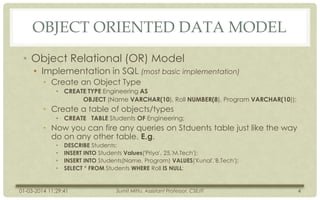
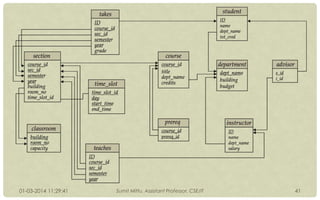
• Object Relational (OR) Model
• Implementation in SQL (most basic implementation)
• Create an Object Type
• CREATE TYPE Engineering AS
OBJECT (Name VARCHAR(10), Roll NUMBER(8), Program VARCHAR(10));

• Create a table of objects/types
• CREATE TABLE Students OF Engineering;

• Now you can fire any queries on Stduents table just like the way
do on any other table. E.g.
•
•
•
•

DESCRIBE Students;
INSERT INTO Students Values('Priya', 25,'M.Tech');
INSERT INTO Students(Name, Program) VALUES('Kunal','B.Tech');
SELECT * FROM Students WHERE Roll IS NULL;

01-03-2014 11:29:41

Sumit Mittu, Assistant Professor, CSE/IT

4
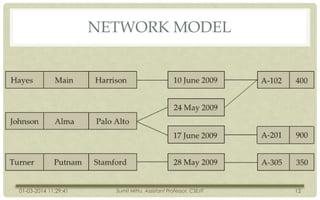
NETWORK MODEL
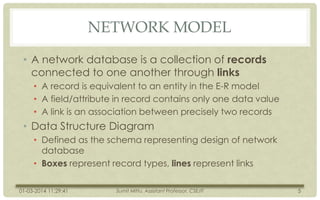
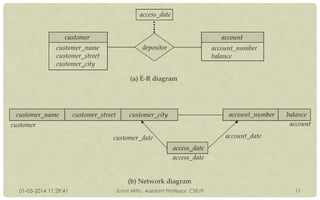
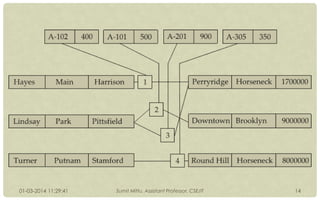
• A network database is a collection of records
connected to one another through links
• A record is equivalent to an entity in the E-R model
• A field/attribute in record contains only one data value
• A link is an association between precisely two records

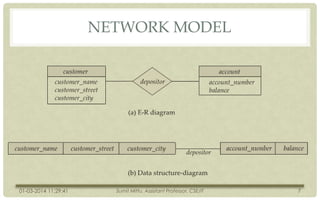
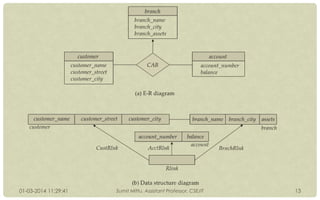
• Data Structure Diagram
• Defined as the schema representing design of network
database
• Boxes represent record types, lines represent links
01-03-2014 11:29:41

Sumit Mittu, Assistant Professor, CSE/IT

5
NETWORK MODEL
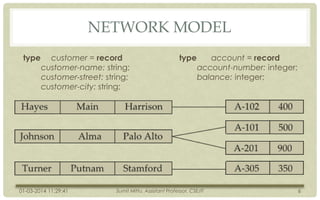
type

customer = record
customer-name: string;
customer-street: string;
customer-city: string;

01-03-2014 11:29:41

type

account = record
account-number: integer;
balance: integer;

Sumit Mittu, Assistant Professor, CSE/IT

6
NETWORK MODEL

01-03-2014 11:29:41

Sumit Mittu, Assistant Professor, CSE/IT

7
NETWORK MODEL
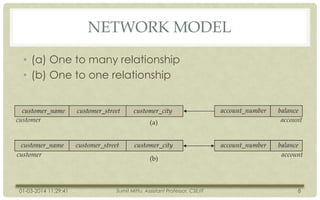
• (a) One to many relationship
• (b) One to one relationship

01-03-2014 11:29:41

Sumit Mittu, Assistant Professor, CSE/IT

8
NETWORK MODEL
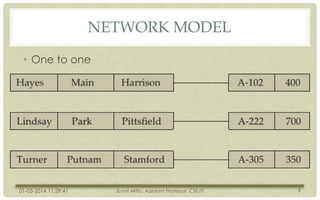
• One to one

01-03-2014 11:29:41

Sumit Mittu, Assistant Professor, CSE/IT

9
NETWORK MODEL
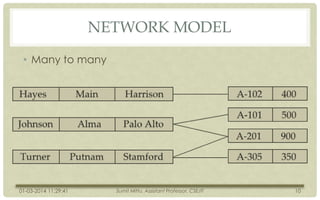
• Many to many

01-03-2014 11:29:41

Sumit Mittu, Assistant Professor, CSE/IT

10
01-03-2014 11:29:41

Sumit Mittu, Assistant Professor, CSE/IT

11
NETWORK MODEL

01-03-2014 11:29:41

Sumit Mittu, Assistant Professor, CSE/IT

12
01-03-2014 11:29:41

Sumit Mittu, Assistant Professor, CSE/IT

13
01-03-2014 11:29:41

Sumit Mittu, Assistant Professor, CSE/IT

14
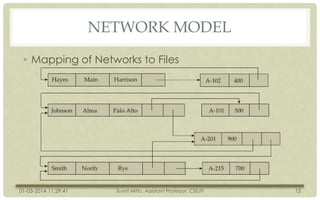
NETWORK MODEL
• Mapping of Networks to Files

01-03-2014 11:29:41

Sumit Mittu, Assistant Professor, CSE/IT

15
NETWORK MODEL
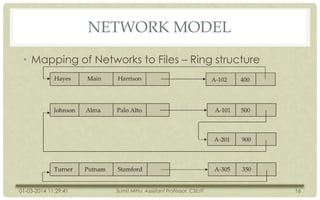
• Mapping of Networks to Files – Ring structure

01-03-2014 11:29:41

Sumit Mittu, Assistant Professor, CSE/IT

16
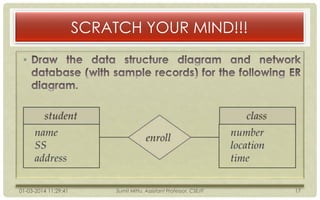
SCRATCH YOUR MIND!!!
•

01-03-2014 11:29:41

Sumit Mittu, Assistant Professor, CSE/IT

17
HIERARCHICAL MODEL
• A hierarchical database is a collection of records
connected to one another through links
• The basic concepts are similar to network model but…
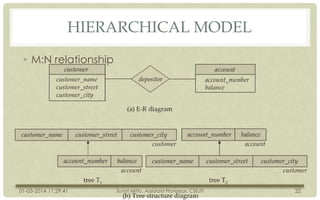
• Hierarchical Model supports only 1:1 and 1:N relationships
• Network Model supports 1:1, 1:N, N:1 as well as M:N relationships

01-03-2014 11:29:41

Sumit Mittu, Assistant Professor, CSE/IT

18
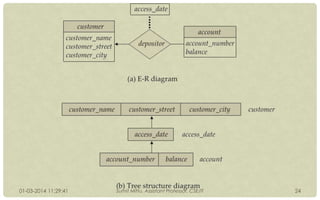
HIERARCHICAL MODEL
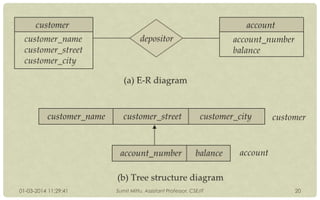
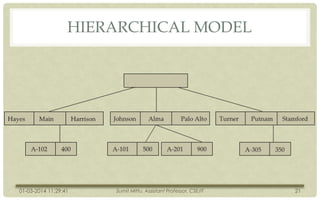
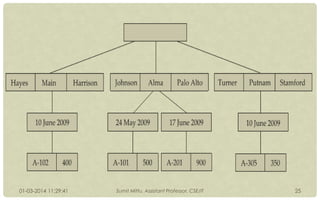
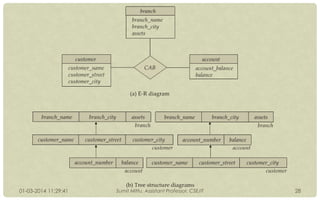
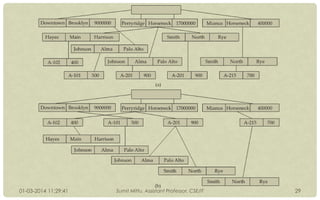
• Tree Structure Diagram
• Defined as the schema representing design of hierarchical
database
• The single instance of a database tree
• The root of this tree is a dummy node
• The children of that node are actual instances of the
appropriate record type

• Boxes represent record types, lines represent links
• Record organised as rooted trees called database tree
• No cycles in underlying graphs
01-03-2014 11:29:41

Sumit Mittu, Assistant Professor, CSE/IT

19
01-03-2014 11:29:41

Sumit Mittu, Assistant Professor, CSE/IT

20
HIERARCHICAL MODEL

01-03-2014 11:29:41

Sumit Mittu, Assistant Professor, CSE/IT

21
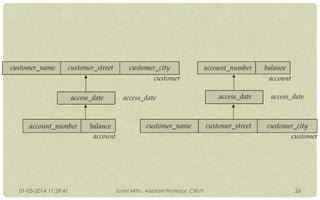
HIERARCHICAL MODEL
• M:N relationship

01-03-2014 11:29:41

Sumit Mittu, Assistant Professor, CSE/IT

22
01-03-2014 11:29:41

Sumit Mittu, Assistant Professor, CSE/IT

23
01-03-2014 11:29:41

Sumit Mittu, Assistant Professor, CSE/IT

24
01-03-2014 11:29:41

Sumit Mittu, Assistant Professor, CSE/IT

25
01-03-2014 11:29:41

Sumit Mittu, Assistant Professor, CSE/IT

26
01-03-2014 11:29:41

Sumit Mittu, Assistant Professor, CSE/IT

27
01-03-2014 11:29:41

Sumit Mittu, Assistant Professor, CSE/IT

28
01-03-2014 11:29:41

Sumit Mittu, Assistant Professor, CSE/IT

29
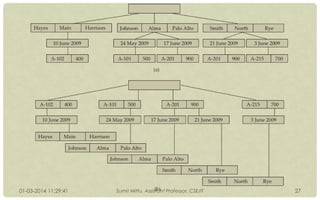
HIERARCHICAL MODEL
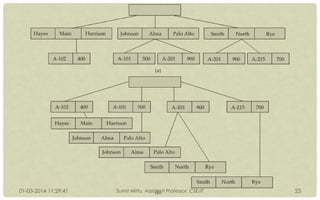
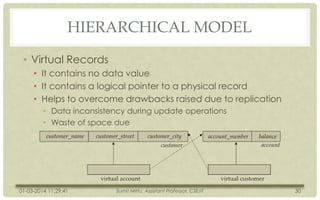
• Virtual Records
• It contains no data value
• It contains a logical pointer to a physical record
• Helps to overcome drawbacks raised due to replication
• Data inconsistency during update operations
• Waste of space due

01-03-2014 11:29:41

Sumit Mittu, Assistant Professor, CSE/IT

30
01-03-2014 11:29:41

Sumit Mittu, Assistant Professor, CSE/IT

31
HIERARCHICAL MODEL
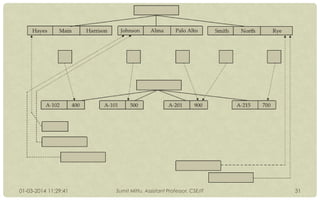
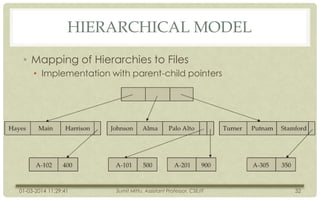
• Mapping of Hierarchies to Files
• Implementation with parent-child pointers

01-03-2014 11:29:41

Sumit Mittu, Assistant Professor, CSE/IT

32
HIERARCHICAL MODEL
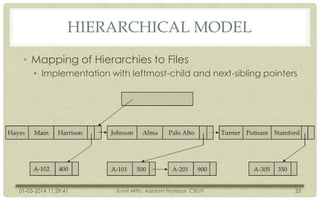
• Mapping of Hierarchies to Files
• Implementation with leftmost-child and next-sibling pointers

01-03-2014 11:29:41

Sumit Mittu, Assistant Professor, CSE/IT

33
HIERARCHICAL MODEL
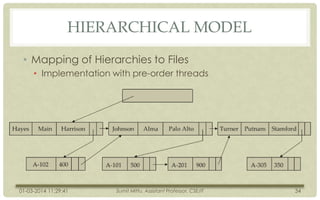
• Mapping of Hierarchies to Files
• Implementation with pre-order threads

01-03-2014 11:29:41

Sumit Mittu, Assistant Professor, CSE/IT

34
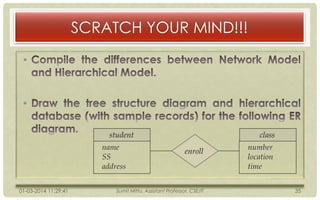
SCRATCH YOUR MIND!!!
•

•

01-03-2014 11:29:41

Sumit Mittu, Assistant Professor, CSE/IT

35
RELATIONAL MODEL
• Uses a collection of tables to represent both the
data and relationships among those data
• Relation/Tables
• Tuples/Records/rows of a table
• Attributes/Fields/columns of a table
• Domain of an attribute
• Atomic Domain
• NULL values

• Relation Schema (and Database Schema)
• Relation Instance (and Database Instance)
01-03-2014 11:29:41

Sumit Mittu, Assistant Professor, CSE/IT

36
RELATIONAL MODEL
• A1, A2, …, An are attributes
• R = (A1, A2, …, An) is a relation schema
• Example:
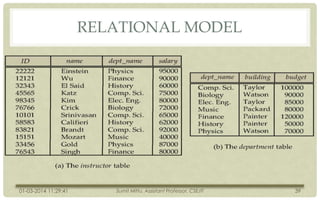
• instructor = (ID, name, dept_name, salary)

• Formally, given sets D1, D2, …. Dn, a relation r is a subset of
• D1 x D2 x … x Dn

• Thus, a relation is a set of n-tuples (a1, a2, …, an) where each ai  Di

• The current values (relation instance) of a relation are

specified by a table
• An element t of r is a tuple, represented by a row in a table
01-03-2014 11:29:41

Sumit Mittu, Assistant Professor, CSE/IT

37
RELATIONAL MODEL
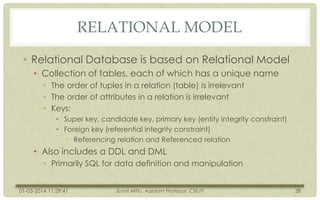
• Relational Database is based on Relational Model
• Collection of tables, each of which has a unique name
• The order of tuples in a relation (table) is irrelevant
• The order of attributes in a relation is irrelevant
• Keys:
• Super key, candidate key, primary key (entity integrity constraint)
• Foreign key (referential integrity constraint)
• Referencing relation and Referenced relation

• Also includes a DDL and DML
• Primarily SQL for data definition and manipulation
01-03-2014 11:29:41

Sumit Mittu, Assistant Professor, CSE/IT

38
RELATIONAL MODEL

01-03-2014 11:29:41

Sumit Mittu, Assistant Professor, CSE/IT

39
RELATIONAL MODEL
• Relational Database Design
• Database consists of multiple relations that contain
information about and enterprise broken up into multiple
parts
• Instructor, Student, Advisor, etc.

• Bad Design
• Repetition of information
• Missing information (due to null values)

• Normalization is required to generate good design
• Schema Diagrams
01-03-2014 11:29:41

Sumit Mittu, Assistant Professor, CSE/IT

40
01-03-2014 11:29:41

Sumit Mittu, Assistant Professor, CSE/IT

41
RELATIONAL MODEL
• DDL
• SQL Commands:
• CREATE, ALTER, DROP, RENAME, DESC or DESCRIBE

• DML
• Procedural
• PL/SQL Code blocks

• Declarative (Non-procedural) – Query language
• SQL Commands:
• SELECT, INSERT, UPDATE, DELETE

• Embedded SQL:
• Application programs, OLEDB/ODBC drivers, DML Pre-compilers, etc.

01-03-2014 11:29:41

Sumit Mittu, Assistant Professor, CSE/IT

42
RELATIONAL MODEL
• Other Relational Query Languages
• Procedural v/s Non-procedural(declarative)
• “Pure” Languages
• Relational Algebra
• Relational Calculus
• Tuple Relational Calculus
• Domain Relational Calculus

01-03-2014 11:29:41

Sumit Mittu, Assistant Professor, CSE/IT

43
RELATIONAL MODEL
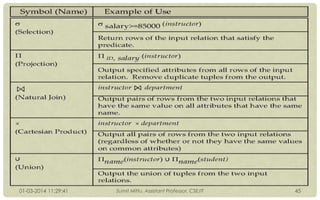
• Relational Algebra Operations
•
•
•
•

Selection
Projection
Cartesian Product
Joins
• Natural join, Inner Join, Theta Join, Self Join
• Outer Join (Left / Right / Full)

• Set Operations
• Union, Intersection, Difference

• Rename, Division, etc.
01-03-2014 11:29:41

Sumit Mittu, Assistant Professor, CSE/IT

44
01-03-2014 11:29:41

Sumit Mittu, Assistant Professor, CSE/IT

45
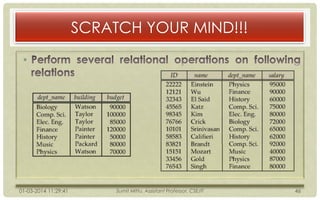
SCRATCH YOUR MIND!!!
•

01-03-2014 11:29:41

Sumit Mittu, Assistant Professor, CSE/IT

46
RELATIONAL MODEL
• Tuple Relational Calculus
• Non procedural query language
• Queries expressed as:
• { t | P(t) }

• Example queries
• { t | t є instructor ^ t[salary] > 5000 }
• { t |∃ s є instructor (t[id] = s[id] ^ s[salary] > 8000) }
• { t | ¬ (t є instructor) }

01-03-2014 11:29:41

Sumit Mittu, Assistant Professor, CSE/IT

47
RELATIONAL MODEL
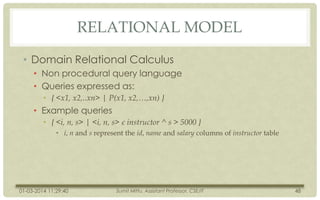
• Domain Relational Calculus
• Non procedural query language
• Queries expressed as:
• { <x1, x2,..xn> | P(x1, x2,…,xn) }

• Example queries
• { <i, n, s> | <i, n, s> є instructor ^ s > 5000 }
• i, n and s represent the id, name and salary columns of instructor table

01-03-2014 11:29:40

Sumit Mittu, Assistant Professor, CSE/IT

48

Int306 03

  • 1.
    INT306 Database Management Systems OTHERDATA MODELS Text book Database System Concepts A. Silberschatz, H. F. Korth, S. Sudarshan Course Instructor Mr. Sumit Mittu Assistant Professor and Placement Coordinator, CSE/IT Lovely Professional University, Punjab (India) sumit.12735@lpu.co.in sumit.mittu@gmail.com http://tinyurl.com/askSumit 01-03-2014 11:29:39
  • 2.
    IN THIS CHAPTER • • • • objectoriented model network model hierarchical model relational model 01-03-2014 11:29:41 Sumit Mittu, Assistant Professor, CSE/IT 2
  • 3.
    OBJECT ORIENTED DATAMODEL • Need for complex data types • Object Oriented Data Model • Object Structure • An object encapsulates set of variables, messages & methods • Object Classes • Inheritance • Class hierarchies and Multiple inheritance • Object Identity • Name, value and built-in • Object Containment 01-03-2014 11:29:41 Sumit Mittu, Assistant Professor, CSE/IT 3
  • 4.
    OBJECT ORIENTED DATAMODEL • Object Relational (OR) Model • Implementation in SQL (most basic implementation) • Create an Object Type • CREATE TYPE Engineering AS OBJECT (Name VARCHAR(10), Roll NUMBER(8), Program VARCHAR(10)); • Create a table of objects/types • CREATE TABLE Students OF Engineering; • Now you can fire any queries on Stduents table just like the way do on any other table. E.g. • • • • DESCRIBE Students; INSERT INTO Students Values('Priya', 25,'M.Tech'); INSERT INTO Students(Name, Program) VALUES('Kunal','B.Tech'); SELECT * FROM Students WHERE Roll IS NULL; 01-03-2014 11:29:41 Sumit Mittu, Assistant Professor, CSE/IT 4
  • 5.
    NETWORK MODEL • Anetwork database is a collection of records connected to one another through links • A record is equivalent to an entity in the E-R model • A field/attribute in record contains only one data value • A link is an association between precisely two records • Data Structure Diagram • Defined as the schema representing design of network database • Boxes represent record types, lines represent links 01-03-2014 11:29:41 Sumit Mittu, Assistant Professor, CSE/IT 5
  • 6.
    NETWORK MODEL type customer =record customer-name: string; customer-street: string; customer-city: string; 01-03-2014 11:29:41 type account = record account-number: integer; balance: integer; Sumit Mittu, Assistant Professor, CSE/IT 6
  • 7.
    NETWORK MODEL 01-03-2014 11:29:41 SumitMittu, Assistant Professor, CSE/IT 7
  • 8.
    NETWORK MODEL • (a)One to many relationship • (b) One to one relationship 01-03-2014 11:29:41 Sumit Mittu, Assistant Professor, CSE/IT 8
  • 9.
    NETWORK MODEL • Oneto one 01-03-2014 11:29:41 Sumit Mittu, Assistant Professor, CSE/IT 9
  • 10.
    NETWORK MODEL • Manyto many 01-03-2014 11:29:41 Sumit Mittu, Assistant Professor, CSE/IT 10
  • 11.
    01-03-2014 11:29:41 Sumit Mittu,Assistant Professor, CSE/IT 11
  • 12.
    NETWORK MODEL 01-03-2014 11:29:41 SumitMittu, Assistant Professor, CSE/IT 12
  • 13.
    01-03-2014 11:29:41 Sumit Mittu,Assistant Professor, CSE/IT 13
  • 14.
    01-03-2014 11:29:41 Sumit Mittu,Assistant Professor, CSE/IT 14
  • 15.
    NETWORK MODEL • Mappingof Networks to Files 01-03-2014 11:29:41 Sumit Mittu, Assistant Professor, CSE/IT 15
  • 16.
    NETWORK MODEL • Mappingof Networks to Files – Ring structure 01-03-2014 11:29:41 Sumit Mittu, Assistant Professor, CSE/IT 16
  • 17.
    SCRATCH YOUR MIND!!! • 01-03-201411:29:41 Sumit Mittu, Assistant Professor, CSE/IT 17
  • 18.
    HIERARCHICAL MODEL • Ahierarchical database is a collection of records connected to one another through links • The basic concepts are similar to network model but… • Hierarchical Model supports only 1:1 and 1:N relationships • Network Model supports 1:1, 1:N, N:1 as well as M:N relationships 01-03-2014 11:29:41 Sumit Mittu, Assistant Professor, CSE/IT 18
  • 19.
    HIERARCHICAL MODEL • TreeStructure Diagram • Defined as the schema representing design of hierarchical database • The single instance of a database tree • The root of this tree is a dummy node • The children of that node are actual instances of the appropriate record type • Boxes represent record types, lines represent links • Record organised as rooted trees called database tree • No cycles in underlying graphs 01-03-2014 11:29:41 Sumit Mittu, Assistant Professor, CSE/IT 19
  • 20.
    01-03-2014 11:29:41 Sumit Mittu,Assistant Professor, CSE/IT 20
  • 21.
    HIERARCHICAL MODEL 01-03-2014 11:29:41 SumitMittu, Assistant Professor, CSE/IT 21
  • 22.
    HIERARCHICAL MODEL • M:Nrelationship 01-03-2014 11:29:41 Sumit Mittu, Assistant Professor, CSE/IT 22
  • 23.
    01-03-2014 11:29:41 Sumit Mittu,Assistant Professor, CSE/IT 23
  • 24.
    01-03-2014 11:29:41 Sumit Mittu,Assistant Professor, CSE/IT 24
  • 25.
    01-03-2014 11:29:41 Sumit Mittu,Assistant Professor, CSE/IT 25
  • 26.
    01-03-2014 11:29:41 Sumit Mittu,Assistant Professor, CSE/IT 26
  • 27.
    01-03-2014 11:29:41 Sumit Mittu,Assistant Professor, CSE/IT 27
  • 28.
    01-03-2014 11:29:41 Sumit Mittu,Assistant Professor, CSE/IT 28
  • 29.
    01-03-2014 11:29:41 Sumit Mittu,Assistant Professor, CSE/IT 29
  • 30.
    HIERARCHICAL MODEL • VirtualRecords • It contains no data value • It contains a logical pointer to a physical record • Helps to overcome drawbacks raised due to replication • Data inconsistency during update operations • Waste of space due 01-03-2014 11:29:41 Sumit Mittu, Assistant Professor, CSE/IT 30
  • 31.
    01-03-2014 11:29:41 Sumit Mittu,Assistant Professor, CSE/IT 31
  • 32.
    HIERARCHICAL MODEL • Mappingof Hierarchies to Files • Implementation with parent-child pointers 01-03-2014 11:29:41 Sumit Mittu, Assistant Professor, CSE/IT 32
  • 33.
    HIERARCHICAL MODEL • Mappingof Hierarchies to Files • Implementation with leftmost-child and next-sibling pointers 01-03-2014 11:29:41 Sumit Mittu, Assistant Professor, CSE/IT 33
  • 34.
    HIERARCHICAL MODEL • Mappingof Hierarchies to Files • Implementation with pre-order threads 01-03-2014 11:29:41 Sumit Mittu, Assistant Professor, CSE/IT 34
  • 35.
    SCRATCH YOUR MIND!!! • • 01-03-201411:29:41 Sumit Mittu, Assistant Professor, CSE/IT 35
  • 36.
    RELATIONAL MODEL • Usesa collection of tables to represent both the data and relationships among those data • Relation/Tables • Tuples/Records/rows of a table • Attributes/Fields/columns of a table • Domain of an attribute • Atomic Domain • NULL values • Relation Schema (and Database Schema) • Relation Instance (and Database Instance) 01-03-2014 11:29:41 Sumit Mittu, Assistant Professor, CSE/IT 36
  • 37.
    RELATIONAL MODEL • A1,A2, …, An are attributes • R = (A1, A2, …, An) is a relation schema • Example: • instructor = (ID, name, dept_name, salary) • Formally, given sets D1, D2, …. Dn, a relation r is a subset of • D1 x D2 x … x Dn • Thus, a relation is a set of n-tuples (a1, a2, …, an) where each ai  Di • The current values (relation instance) of a relation are specified by a table • An element t of r is a tuple, represented by a row in a table 01-03-2014 11:29:41 Sumit Mittu, Assistant Professor, CSE/IT 37
  • 38.
    RELATIONAL MODEL • RelationalDatabase is based on Relational Model • Collection of tables, each of which has a unique name • The order of tuples in a relation (table) is irrelevant • The order of attributes in a relation is irrelevant • Keys: • Super key, candidate key, primary key (entity integrity constraint) • Foreign key (referential integrity constraint) • Referencing relation and Referenced relation • Also includes a DDL and DML • Primarily SQL for data definition and manipulation 01-03-2014 11:29:41 Sumit Mittu, Assistant Professor, CSE/IT 38
  • 39.
    RELATIONAL MODEL 01-03-2014 11:29:41 SumitMittu, Assistant Professor, CSE/IT 39
  • 40.
    RELATIONAL MODEL • RelationalDatabase Design • Database consists of multiple relations that contain information about and enterprise broken up into multiple parts • Instructor, Student, Advisor, etc. • Bad Design • Repetition of information • Missing information (due to null values) • Normalization is required to generate good design • Schema Diagrams 01-03-2014 11:29:41 Sumit Mittu, Assistant Professor, CSE/IT 40
  • 41.
    01-03-2014 11:29:41 Sumit Mittu,Assistant Professor, CSE/IT 41
  • 42.
    RELATIONAL MODEL • DDL •SQL Commands: • CREATE, ALTER, DROP, RENAME, DESC or DESCRIBE • DML • Procedural • PL/SQL Code blocks • Declarative (Non-procedural) – Query language • SQL Commands: • SELECT, INSERT, UPDATE, DELETE • Embedded SQL: • Application programs, OLEDB/ODBC drivers, DML Pre-compilers, etc. 01-03-2014 11:29:41 Sumit Mittu, Assistant Professor, CSE/IT 42
  • 43.
    RELATIONAL MODEL • OtherRelational Query Languages • Procedural v/s Non-procedural(declarative) • “Pure” Languages • Relational Algebra • Relational Calculus • Tuple Relational Calculus • Domain Relational Calculus 01-03-2014 11:29:41 Sumit Mittu, Assistant Professor, CSE/IT 43
  • 44.
    RELATIONAL MODEL • RelationalAlgebra Operations • • • • Selection Projection Cartesian Product Joins • Natural join, Inner Join, Theta Join, Self Join • Outer Join (Left / Right / Full) • Set Operations • Union, Intersection, Difference • Rename, Division, etc. 01-03-2014 11:29:41 Sumit Mittu, Assistant Professor, CSE/IT 44
  • 45.
    01-03-2014 11:29:41 Sumit Mittu,Assistant Professor, CSE/IT 45
  • 46.
    SCRATCH YOUR MIND!!! • 01-03-201411:29:41 Sumit Mittu, Assistant Professor, CSE/IT 46
  • 47.
    RELATIONAL MODEL • TupleRelational Calculus • Non procedural query language • Queries expressed as: • { t | P(t) } • Example queries • { t | t є instructor ^ t[salary] > 5000 } • { t |∃ s є instructor (t[id] = s[id] ^ s[salary] > 8000) } • { t | ¬ (t є instructor) } 01-03-2014 11:29:41 Sumit Mittu, Assistant Professor, CSE/IT 47
  • 48.
    RELATIONAL MODEL • DomainRelational Calculus • Non procedural query language • Queries expressed as: • { <x1, x2,..xn> | P(x1, x2,…,xn) } • Example queries • { <i, n, s> | <i, n, s> є instructor ^ s > 5000 } • i, n and s represent the id, name and salary columns of instructor table 01-03-2014 11:29:40 Sumit Mittu, Assistant Professor, CSE/IT 48