Getachew Teshome (Msc.)
ASTU
Fundamentals of electrical Engineering
( EPCE 2101)
Chapter Seven
Polyphase circuit
 Outline:
Outline:
 Generation of three phase voltage
 Three phase connections
 Source and load connection
 Power relationships in three phase system
Chapter Four:
Transient Circuit Analysis
1. Generation of Three Phase Voltage
There are two major advantages of three-phase systems over a
single-phase system:
1.More power per kilogram of metal form a three-phase machine;
2.Power delivered to a three-phase load is constant at all time, instead
of pulsing as it does in a single-phase system.
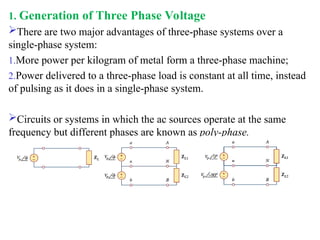
Circuits or systems in which the ac sources operate at the same
frequency but different phases are known as poly-phase.
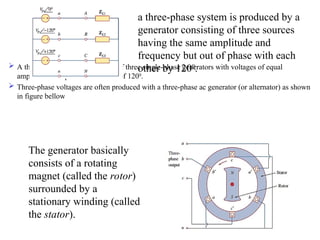
 A three-phase generator consists of three single-phase generators with voltages of equal
amplitudes and phase differences of 1200
.
 Three-phase voltages are often produced with a three-phase ac generator (or alternator) as shown
in figure bellow
 a three-phase system is produced by a
generator consisting of three sources
having the same amplitude and
frequency but out of phase with each
other by 1200
.
 The generator basically
consists of a rotating
magnet (called the rotor)
surrounded by a
stationary winding (called
the stator).
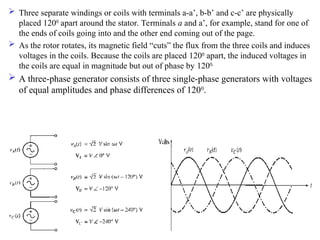
 Three separate windings or coils with terminals a-a’, b-b’ and c-c’ are physically
placed 1200
apart around the stator. Terminals a and a’, for example, stand for one of
the ends of coils going into and the other end coming out of the page.
 As the rotor rotates, its magnetic field “cuts” the flux from the three coils and induces
voltages in the coils. Because the coils are placed 1200
apart, the induced voltages in
the coils are equal in magnitude but out of phase by 1200.
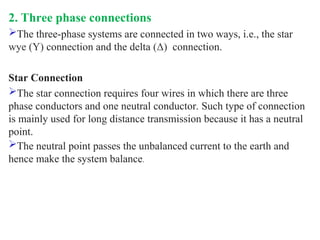
 A three-phase generator consists of three single-phase generators with voltages
of equal amplitudes and phase differences of 1200
.
2. Three phase connections
The three-phase systems are connected in two ways, i.e., the star
wye (Y) connection and the delta (Δ) connection.
Star Connection
The star connection requires four wires in which there are three
phase conductors and one neutral conductor. Such type of connection
is mainly used for long distance transmission because it has a neutral
point.
The neutral point passes the unbalanced current to the earth and
hence make the system balance.
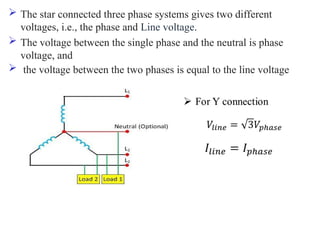
 The star connected three phase systems gives two different
voltages, i.e., the phase and Line voltage.
 The voltage between the single phase and the neutral is phase
voltage, and
 the voltage between the two phases is equal to the line voltage
Delta Connection
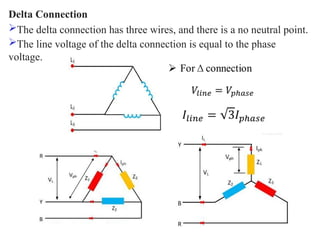
The delta connection has three wires, and there is a no neutral point.
The line voltage of the delta connection is equal to the phase
voltage.
3. Source and load connection
Since both the three-phase source and the three-phase load can be
either wye- or delta-connected, we have four possible connections:
i. Y-Y connection (i.e., Y-connected source with a Y-connected load).
ii. Y-∆ connection.
iii. ∆ - ∆ connection.
iv. ∆ -Y connection.
READING ASSIGNMENT
 Power relationships in three
phase system

Chapter-7 poly phase circuit analysis.ppt

  • 1.
    Getachew Teshome (Msc.) ASTU Fundamentalsof electrical Engineering ( EPCE 2101) Chapter Seven Polyphase circuit
  • 2.
     Outline: Outline:  Generationof three phase voltage  Three phase connections  Source and load connection  Power relationships in three phase system Chapter Four: Transient Circuit Analysis
  • 3.
    1. Generation ofThree Phase Voltage There are two major advantages of three-phase systems over a single-phase system: 1.More power per kilogram of metal form a three-phase machine; 2.Power delivered to a three-phase load is constant at all time, instead of pulsing as it does in a single-phase system. Circuits or systems in which the ac sources operate at the same frequency but different phases are known as poly-phase.
  • 4.
     A three-phasegenerator consists of three single-phase generators with voltages of equal amplitudes and phase differences of 1200 .  Three-phase voltages are often produced with a three-phase ac generator (or alternator) as shown in figure bellow  a three-phase system is produced by a generator consisting of three sources having the same amplitude and frequency but out of phase with each other by 1200 .  The generator basically consists of a rotating magnet (called the rotor) surrounded by a stationary winding (called the stator).
  • 5.
     Three separatewindings or coils with terminals a-a’, b-b’ and c-c’ are physically placed 1200 apart around the stator. Terminals a and a’, for example, stand for one of the ends of coils going into and the other end coming out of the page.  As the rotor rotates, its magnetic field “cuts” the flux from the three coils and induces voltages in the coils. Because the coils are placed 1200 apart, the induced voltages in the coils are equal in magnitude but out of phase by 1200.  A three-phase generator consists of three single-phase generators with voltages of equal amplitudes and phase differences of 1200 .
  • 6.
    2. Three phaseconnections The three-phase systems are connected in two ways, i.e., the star wye (Y) connection and the delta (Δ) connection. Star Connection The star connection requires four wires in which there are three phase conductors and one neutral conductor. Such type of connection is mainly used for long distance transmission because it has a neutral point. The neutral point passes the unbalanced current to the earth and hence make the system balance.
  • 7.
     The starconnected three phase systems gives two different voltages, i.e., the phase and Line voltage.  The voltage between the single phase and the neutral is phase voltage, and  the voltage between the two phases is equal to the line voltage
  • 8.
    Delta Connection The deltaconnection has three wires, and there is a no neutral point. The line voltage of the delta connection is equal to the phase voltage.
  • 9.
    3. Source andload connection Since both the three-phase source and the three-phase load can be either wye- or delta-connected, we have four possible connections: i. Y-Y connection (i.e., Y-connected source with a Y-connected load). ii. Y-∆ connection. iii. ∆ - ∆ connection. iv. ∆ -Y connection.
  • 10.
    READING ASSIGNMENT  Powerrelationships in three phase system