Seminar on
ABRASIVE JET MACHINING
Presented
By
Suravi sen
Diploma in Mechanical Engineering
3rd. year 6th semester
Guided by
Mr.Somenath Raha, Mr.Milan
Mondal and Mr. Asim Banerjee
K.G. Engineering Institute, Bishnupur
Introduction to
Advance Machining process
The expectations from present-day manufacturing industries are
very high.
 high economic manufacturing of high-performance
 high precision and complex parts made of very hard high-
strength materials of difficult-to-machine.
 need for high-quality low-cost parts of very small size.
The traditional machining methods are unable to meet such
stringent demands of various industries such as aerospace,
electronics, automobiles, etc.
As a result, a new class of machining processes has evolved over
a period of time to meet such demands, named non-traditional,
unconventional, modern or advanced machining processes.
OBJECTIVES
The purpose of this seminar is to provide a knowledge
about abrasive jet machining process (AJM).
This enables one to understand the difficulties in
manufacturing of many components.
Development of harder and difficult to machine materials
such as hastalloy, nitralloy, carbides, stainless steel, heat
resisting steels and many other high-strength- temperature-
resistance alloy are used widely in aerospace, nuclear
engineering and other industries
Selection of processes
The selection of Advanced machining process depends on :
 Physical parameters of the process.
e.g. current, voltage, power, gap, medium
 Shapes to be machined.
 Process capability.
e.g. MRR, surface finish, specific power, penetration
 Process economy
e.g. Capital cost, tooling and fixture, power reqd. efficiency,
total consumption.
CLASSIFICATION
 Mechanical advanced machining processes
 Abrasive jet machining (AJM)
 Ultrasonic machining (USM)
 Water jet machining (WJM)
 Abrasive water jet machining (AWJM)
 Thermal advanced machining processes
 Laser beam machining (LBM)
 Electron beam machining (EBM)
 Electro-discharge machining (EDM)
 Electro-chemical and chemical advanced machining processes
 Electrochemical machining (ECM)
 Chemical machining (CHM)
 Biochemical machining (BM)
Mechanical advanced machining process
Abrasive Jet Machining process
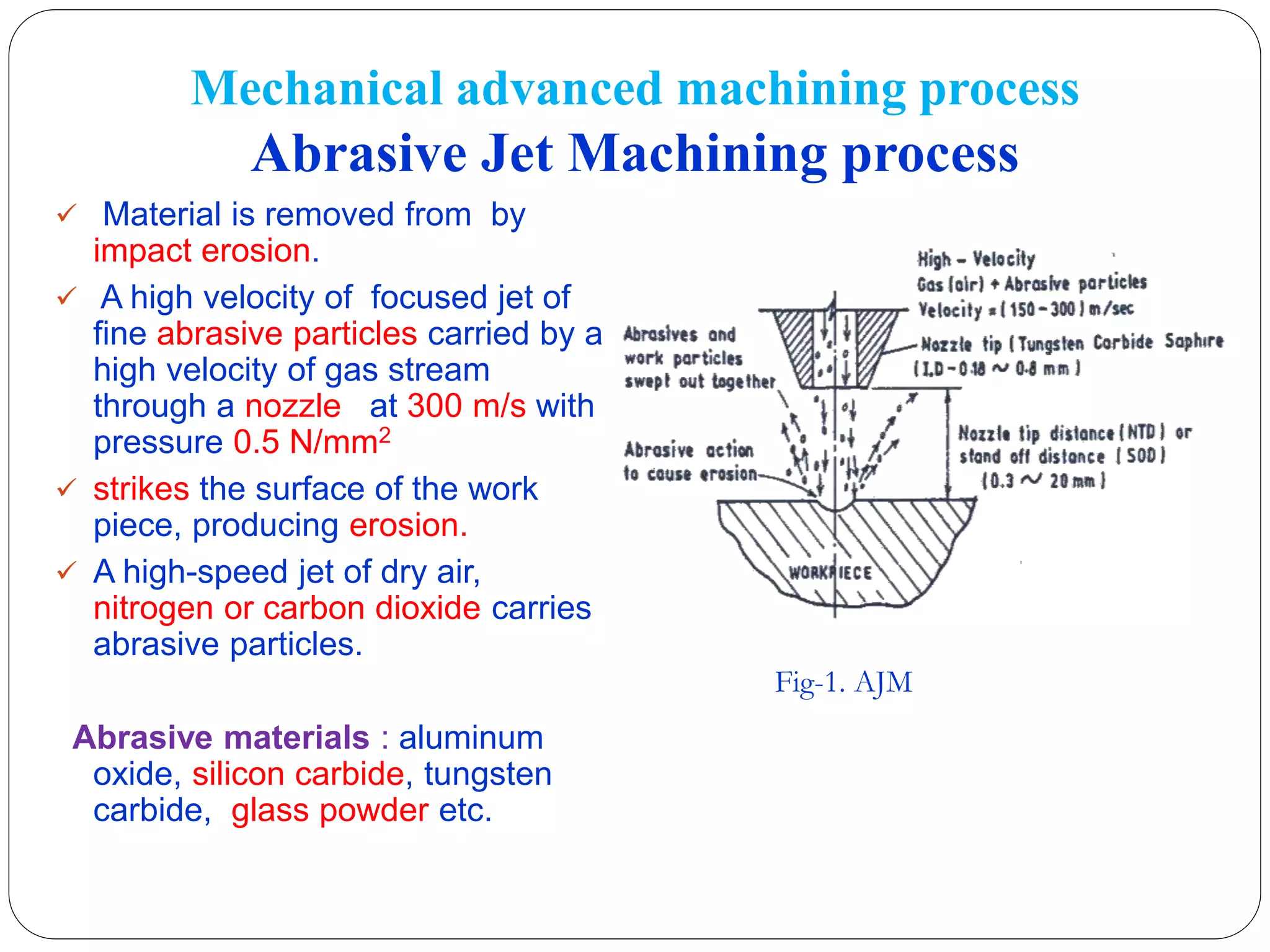
 Material is removed from by
impact erosion.
 A high velocity of focused jet of
fine abrasive particles carried by a
high velocity of gas stream
through a nozzle at 300 m/s with
pressure 0.5 N/mm2
 strikes the surface of the work
piece, producing erosion.
 A high-speed jet of dry air,
nitrogen or carbon dioxide carries
abrasive particles.
Abrasive materials : aluminum
oxide, silicon carbide, tungsten
carbide, glass powder etc.
Fig-1. AJM
Mechanical advanced machining process
Abrasive Jet Machining process
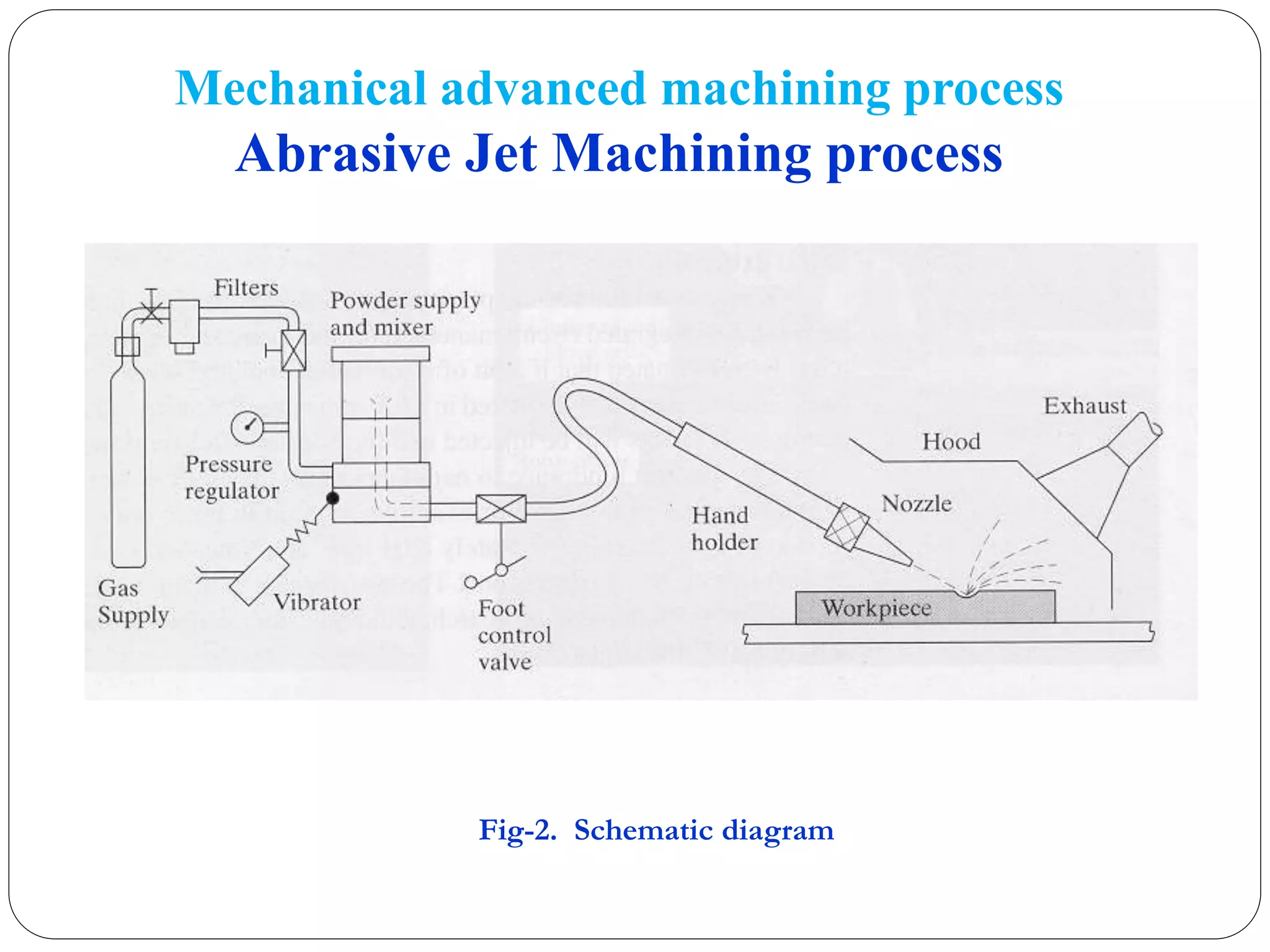
Fig-2. Schematic diagram
Abrasive Jet Machining (contd.)
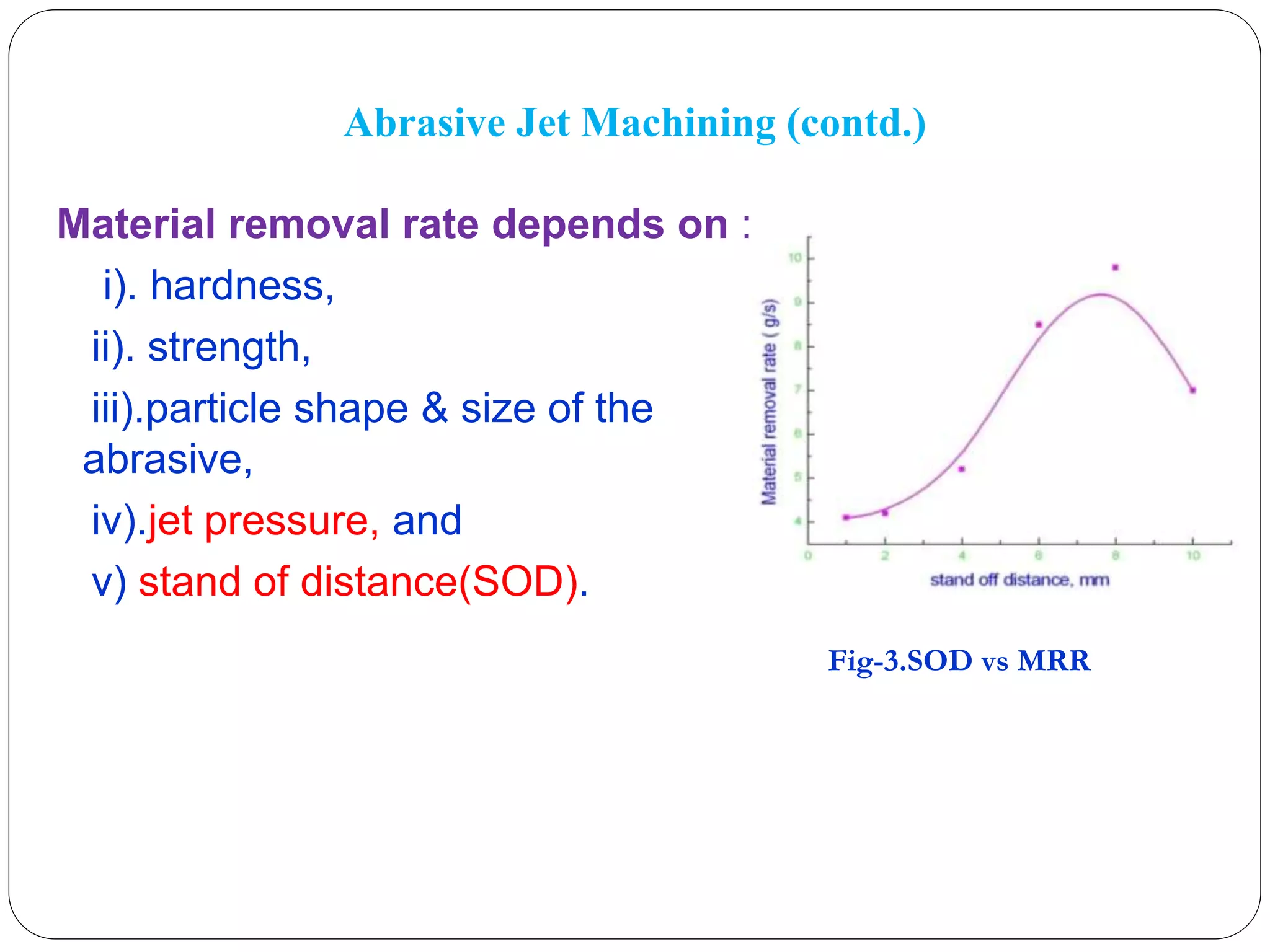
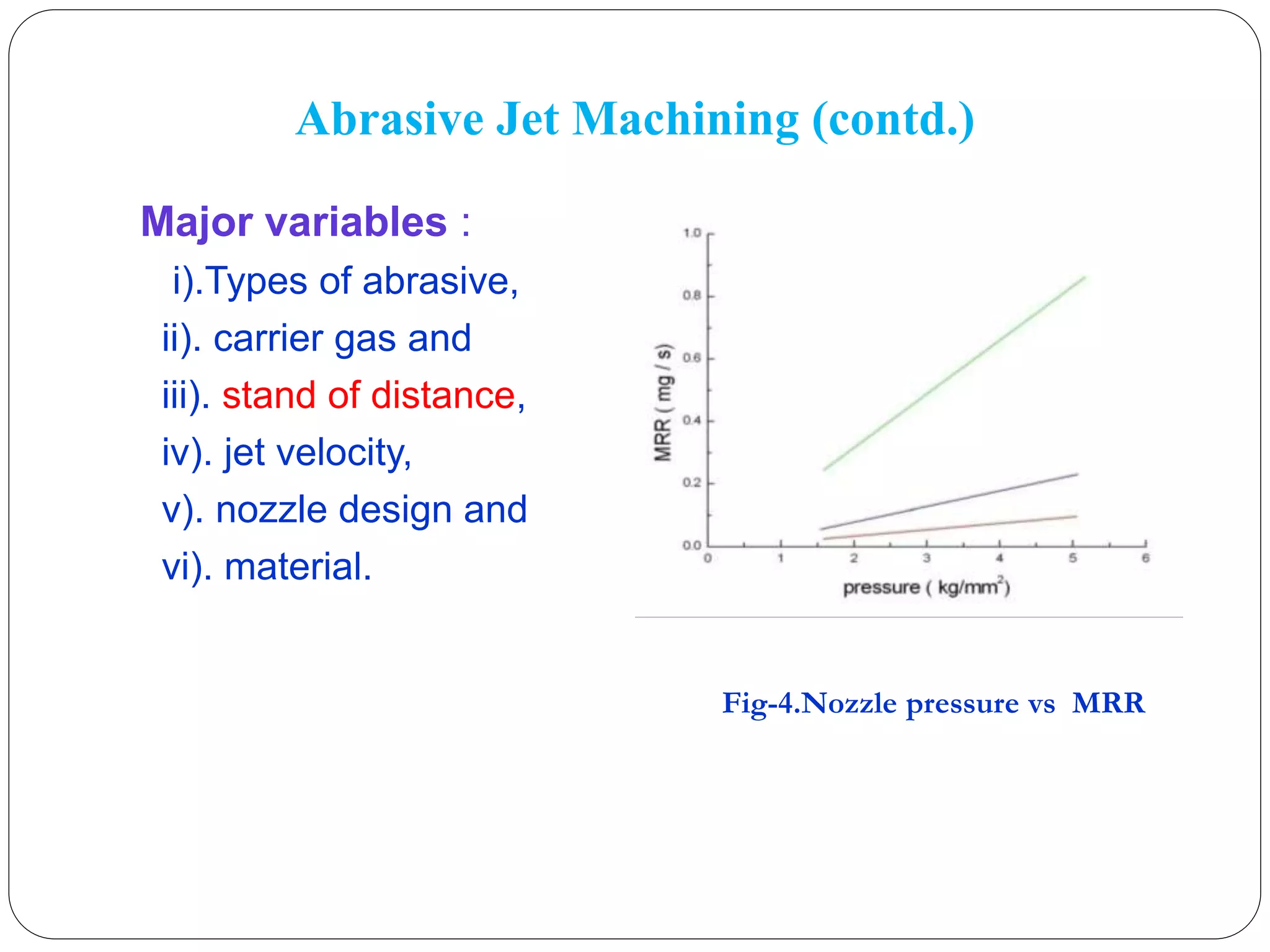
Material removal rate depends on :
i). hardness,
ii). strength,
iii).particle shape & size of the
abrasive,
iv).jet pressure, and
v) stand of distance(SOD).
Fig-3.SOD vs MRR
Abrasive Jet Machining (contd.)
Major variables :
i).Types of abrasive,
ii). carrier gas and
iii). stand of distance,
iv). jet velocity,
v). nozzle design and
vi). material.
Fig-4.Nozzle pressure vs MRR
Abrasive Jet Machining (contd.)
Applications:
 Good for cutting hard or brittle materials
 Removing the flash,
 Deburring and polishing of plastics
 Nylon and Teflon part.
 Removing glue and paint
Advantages :
 No heat generation,
 suitable for brittle material,
 low investment,
 low power consumption.
Conclusion
The Abrasive jet machining processes are based on
the direct application of energy for material removal .
These are the alternatives where conventional
procedures would be insufficient or uneconomical in
higher degree of accuracy and surface finish from the
microns ranges.
THANK YOU ALL

ABRASIVE JET MACHINING

  • 1.
    Seminar on ABRASIVE JETMACHINING Presented By Suravi sen Diploma in Mechanical Engineering 3rd. year 6th semester Guided by Mr.Somenath Raha, Mr.Milan Mondal and Mr. Asim Banerjee K.G. Engineering Institute, Bishnupur
  • 2.
    Introduction to Advance Machiningprocess The expectations from present-day manufacturing industries are very high.  high economic manufacturing of high-performance  high precision and complex parts made of very hard high- strength materials of difficult-to-machine.  need for high-quality low-cost parts of very small size. The traditional machining methods are unable to meet such stringent demands of various industries such as aerospace, electronics, automobiles, etc. As a result, a new class of machining processes has evolved over a period of time to meet such demands, named non-traditional, unconventional, modern or advanced machining processes.
  • 3.
    OBJECTIVES The purpose ofthis seminar is to provide a knowledge about abrasive jet machining process (AJM). This enables one to understand the difficulties in manufacturing of many components. Development of harder and difficult to machine materials such as hastalloy, nitralloy, carbides, stainless steel, heat resisting steels and many other high-strength- temperature- resistance alloy are used widely in aerospace, nuclear engineering and other industries
  • 4.
    Selection of processes Theselection of Advanced machining process depends on :  Physical parameters of the process. e.g. current, voltage, power, gap, medium  Shapes to be machined.  Process capability. e.g. MRR, surface finish, specific power, penetration  Process economy e.g. Capital cost, tooling and fixture, power reqd. efficiency, total consumption.
  • 5.
    CLASSIFICATION  Mechanical advancedmachining processes  Abrasive jet machining (AJM)  Ultrasonic machining (USM)  Water jet machining (WJM)  Abrasive water jet machining (AWJM)  Thermal advanced machining processes  Laser beam machining (LBM)  Electron beam machining (EBM)  Electro-discharge machining (EDM)  Electro-chemical and chemical advanced machining processes  Electrochemical machining (ECM)  Chemical machining (CHM)  Biochemical machining (BM)
  • 6.
    Mechanical advanced machiningprocess Abrasive Jet Machining process  Material is removed from by impact erosion.  A high velocity of focused jet of fine abrasive particles carried by a high velocity of gas stream through a nozzle at 300 m/s with pressure 0.5 N/mm2  strikes the surface of the work piece, producing erosion.  A high-speed jet of dry air, nitrogen or carbon dioxide carries abrasive particles. Abrasive materials : aluminum oxide, silicon carbide, tungsten carbide, glass powder etc. Fig-1. AJM
  • 7.
    Mechanical advanced machiningprocess Abrasive Jet Machining process Fig-2. Schematic diagram
  • 8.
    Abrasive Jet Machining(contd.) Material removal rate depends on : i). hardness, ii). strength, iii).particle shape & size of the abrasive, iv).jet pressure, and v) stand of distance(SOD). Fig-3.SOD vs MRR
  • 9.
    Abrasive Jet Machining(contd.) Major variables : i).Types of abrasive, ii). carrier gas and iii). stand of distance, iv). jet velocity, v). nozzle design and vi). material. Fig-4.Nozzle pressure vs MRR
  • 10.
    Abrasive Jet Machining(contd.) Applications:  Good for cutting hard or brittle materials  Removing the flash,  Deburring and polishing of plastics  Nylon and Teflon part.  Removing glue and paint Advantages :  No heat generation,  suitable for brittle material,  low investment,  low power consumption.
  • 11.
    Conclusion The Abrasive jetmachining processes are based on the direct application of energy for material removal . These are the alternatives where conventional procedures would be insufficient or uneconomical in higher degree of accuracy and surface finish from the microns ranges.
  • 12.