Unit-I
Introduction to Non-Traditional
Machining
Introduction
Manufacturing:
Act of making something (a product) from raw materials.
Process of converting raw material into finished product
through controlled machining processes.
Machining:
Machining is any process in which a cutting tool removes small
chips of material from the workpiece.
Types of Machining Processes:
1. Conventional/Traditional Machining Processes
2. Non-conventional/Non-traditional Machining Processes
Traditional Machining
• Traditional machining is mostly based on removal of materials using
tools that are harder than the materials themselves.
• New and novel materials because of their greatly improved
chemical, mechanical and thermal properties are sometimes
impossible to machine using traditional machining processes.
• Traditional machining methods are often ineffective in machining
hard materials like ceramics and composites or
machining under very tight tolerances as in micromachined
components.
• The need to a avoid surface damage that often accompanies the
stresses created by conventional machining.
Example: aerospace and electronics industries.
• They are classified under the domain of non traditional
processes.
In non-traditional machining there is no mechanical contact
between tool and the workpiece.
Non traditional machining process removes excess material by
various techniques involving. mechanical, thermal, electrical or
chemical energy or combinations of these energies.
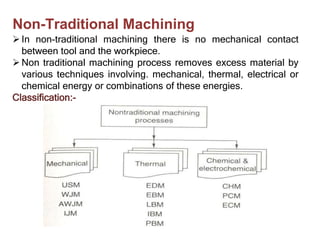
Classification:-
Non-Traditional Machining
These can be classified according to the source of energy used to
generate such a machining action: mechanical, thermal, chemical and
electrochemical.
Mechanical: Erosion of the work material by a high velocity stream of
abrasives or fluids (or both)
Thermal: The thermal energy is applied to a very small portion of the work
surface, causing that portion to be removed by fusion and/or vaporization
of the material. The thermal energy is generated by conversion of
electrical energy.
Electrochemical: Mechanism is reverse of electroplating.
Chemical: Most materials (metals particularly) are susceptible to
chemical attack by certain acids or other etchants. In chemical
machining, chemicals selectively remove material from portions of the
workpart, while other portions of the surface are protected by a mask.
Mechanical Machining
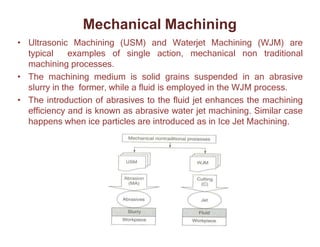
• Ultrasonic Machining (USM) and Waterjet Machining (WJM) are
typical examples of single action, mechanical non traditional
machining processes.
• The machining medium is solid grains suspended in an abrasive
slurry in the former, while a fluid is employed in the WJM process.
• The introduction of abrasives to the fluid jet enhances the machining
efficiency and is known as abrasive water jet machining. Similar case
happens when ice particles are introduced as in Ice Jet Machining.
Thermal Machining
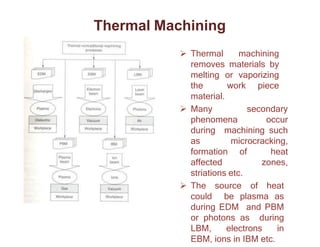
 Thermal machining
removes materials by
melting or vaporizing
the work piece
material.
 Many secondary
phenomena occur
during machining such
as microcracking,
formation of heat
affected zones,
striations etc.
 The source of heat
could be plasma as
during EDM and PBM
or photons as during
LBM, electrons in
EBM, ions in IBM etc.
Chemical and Electrochemical Machining
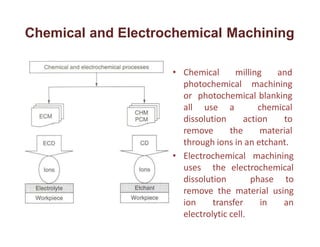
• Chemical milling and
photochemical machining
or photochemical blanking
all use a chemical
dissolution action to
remove the material
through ions in an etchant.
• Electrochemical machining
uses the electrochemical
dissolution phase to
remove the material using
ion transfer in an
electrolytic cell.
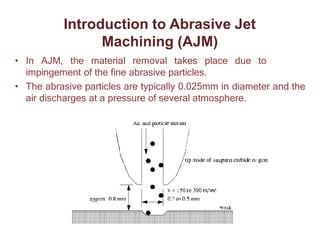
Introduction to Abrasive Jet
Machining (AJM)
• In AJM, the material removal takes place due to
impingement of the fine abrasive particles.
• The abrasive particles are typically 0.025mm in diameter and the
air discharges at a pressure of several atmosphere.
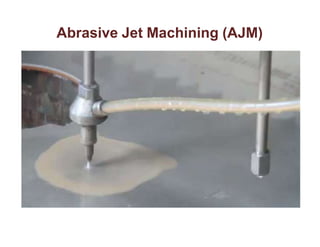
Abrasive Jet Machining (AJM)
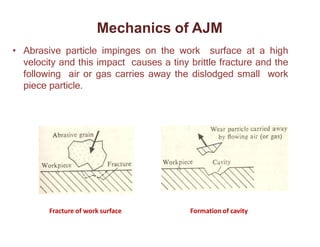
Mechanics of AJM
• Abrasive particle impinges on the work surface at a high
velocity and this impact causes a tiny brittle fracture and the
following air or gas carries away the dislodged small work
piece particle.
Fracture of work surface Formation of cavity
• The process is more suitable when the work material
is brittle and fragile.
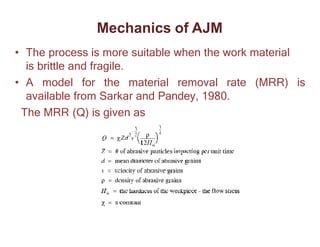
• A model for the material removal rate (MRR) is
available from Sarkar and Pandey, 1980.
The MRR (Q) is given as
Mechanics of AJM
Process Parameters
 The process characteristics can be evaluated by judging
(1) the MRR,
(2) the geometry of the cut,
(3) the roughness of the surface produced, and
(4) the rate of nozzle wear.
 The major parameters which control these quantities are:
1. The abrasive (composition, strength, size and mass flow rate).
2. The gas (composition, pressure and velocity).
3. The nozzle (geometry, material, distance from and inclination to
the work surface).
The Abrasive
 Mainly two types of abrasives are used (1) Aluminum oxide and (2) Silicon
carbide. (Grains with a diameter 10-50 microns are readily available)
 For good wear action on the surfaces, the abrasive grains should have
sharp edges.
 A reuse of the abrasive powder is normally not recommended because of
a decrease of cutting capacity and clogging of the nozzle orifices due to
contamination.
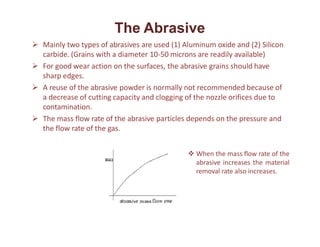
 The mass flow rate of the abrasive particles depends on the pressure and
the flow rate of the gas.
 When the mass flow rate of the
abrasive increases the material
removal rate also increases.
The Gas
 The AJM unit normally operates at a pressure of 0.2-1.0 N/mm2 .
 The composition of gas and a high velocity has a significant impact on the
MRR even if the mixing ratio is not changed.
The Nozzle
 The nozzle is one of the most vital elements controlling the process
characteristics.
The nozzle material should be hard to avoid any significant wear due to the
flowing abrasive. [Normally WC (avg. life: 12-30 hrs.) or Sapphire (Appr. =
300 hrs.) are used]
For a normal operation the cross-sectional area of the orifice can be either
circular or rectangular and between 0.05- 0.2mm2 .
Nozzle to Tip Distance (Stand off distance)
 The nozzle tip distance (NTD) or the stand off distance is a critical
parameter in AJM.
 The NTD not only affects the MRR from the work surface but also the
shape and size of the cavity produced.
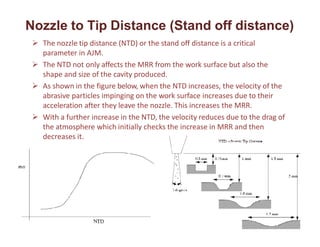
 As shown in the figure below, when the NTD increases, the velocity of the
abrasive particles impinging on the work surface increases due to their
acceleration after they leave the nozzle. This increases the MRR.
 With a further increase in the NTD, the velocity reduces due to the drag of
the atmosphere which initially checks the increase in MRR and then
decreases it.
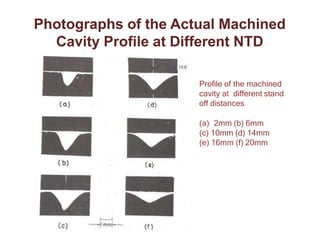
Photographs of the Actual Machined
Cavity Profile at Different NTD
Profile of the machined
cavity at different stand
off distances
(a) 2mm (b) 6mm
(c) 10mm (d) 14mm
(e) 16mm (f) 20mm
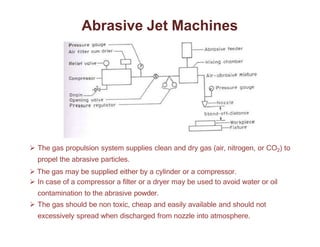
Abrasive Jet Machines
 The gas propulsion system supplies clean and dry gas (air, nitrogen, or CO2) to
propel the abrasive particles.
 The gas may be supplied either by a cylinder or a compressor.
 In case of a compressor a filter or a dryer may be used to avoid water or oil
contamination to the abrasive powder.
 The gas should be non toxic, cheap and easily available and should not
excessively spread when discharged from nozzle into atmosphere.
Advantages
• A high surface finish can be obtained.
• The depth of damage is low.
• It provides cool cutting action for glass and ceramics so
it can machine delicate and heat-sensitive material.
• The process is free from chatter and vibration as there
is no contact between the tool and the workpiece.
• In abrasive jet machining, the capital cost is low as it is
easy to operate.
• hard materials(thin sections) can be machined like
germanium.
• intricate shape holes of brittle materials can be
machined.
Disadvantages
• Less capacity of the process due to low Material
removal rate.
• While machining soft material abrasive gets
embedded which will decrease its surface finish.
• The accuracy of cutting is disturbed by the tapering of
the hole due to the unavoidable variation of an
abrasive jet.
• A dust collection system is a basic requirement to
prevent atmospheric pollution and health hazards so
the extra cost will be there.
• Deep holes will have a taper.

Notes-1.pptx

  • 1.
  • 2.
    Introduction Manufacturing: Act of makingsomething (a product) from raw materials. Process of converting raw material into finished product through controlled machining processes. Machining: Machining is any process in which a cutting tool removes small chips of material from the workpiece. Types of Machining Processes: 1. Conventional/Traditional Machining Processes 2. Non-conventional/Non-traditional Machining Processes
  • 3.
    Traditional Machining • Traditionalmachining is mostly based on removal of materials using tools that are harder than the materials themselves. • New and novel materials because of their greatly improved chemical, mechanical and thermal properties are sometimes impossible to machine using traditional machining processes. • Traditional machining methods are often ineffective in machining hard materials like ceramics and composites or machining under very tight tolerances as in micromachined components. • The need to a avoid surface damage that often accompanies the stresses created by conventional machining. Example: aerospace and electronics industries. • They are classified under the domain of non traditional processes.
  • 4.
    In non-traditional machiningthere is no mechanical contact between tool and the workpiece. Non traditional machining process removes excess material by various techniques involving. mechanical, thermal, electrical or chemical energy or combinations of these energies. Classification:- Non-Traditional Machining
  • 5.
    Non-Traditional Machining These canbe classified according to the source of energy used to generate such a machining action: mechanical, thermal, chemical and electrochemical. Mechanical: Erosion of the work material by a high velocity stream of abrasives or fluids (or both) Thermal: The thermal energy is applied to a very small portion of the work surface, causing that portion to be removed by fusion and/or vaporization of the material. The thermal energy is generated by conversion of electrical energy. Electrochemical: Mechanism is reverse of electroplating. Chemical: Most materials (metals particularly) are susceptible to chemical attack by certain acids or other etchants. In chemical machining, chemicals selectively remove material from portions of the workpart, while other portions of the surface are protected by a mask.
  • 6.
    Mechanical Machining • UltrasonicMachining (USM) and Waterjet Machining (WJM) are typical examples of single action, mechanical non traditional machining processes. • The machining medium is solid grains suspended in an abrasive slurry in the former, while a fluid is employed in the WJM process. • The introduction of abrasives to the fluid jet enhances the machining efficiency and is known as abrasive water jet machining. Similar case happens when ice particles are introduced as in Ice Jet Machining.
  • 7.
    Thermal Machining  Thermalmachining removes materials by melting or vaporizing the work piece material.  Many secondary phenomena occur during machining such as microcracking, formation of heat affected zones, striations etc.  The source of heat could be plasma as during EDM and PBM or photons as during LBM, electrons in EBM, ions in IBM etc.
  • 8.
    Chemical and ElectrochemicalMachining • Chemical milling and photochemical machining or photochemical blanking all use a chemical dissolution action to remove the material through ions in an etchant. • Electrochemical machining uses the electrochemical dissolution phase to remove the material using ion transfer in an electrolytic cell.
  • 9.
    Introduction to AbrasiveJet Machining (AJM) • In AJM, the material removal takes place due to impingement of the fine abrasive particles. • The abrasive particles are typically 0.025mm in diameter and the air discharges at a pressure of several atmosphere.
  • 10.
  • 11.
    Mechanics of AJM •Abrasive particle impinges on the work surface at a high velocity and this impact causes a tiny brittle fracture and the following air or gas carries away the dislodged small work piece particle. Fracture of work surface Formation of cavity
  • 12.
    • The processis more suitable when the work material is brittle and fragile. • A model for the material removal rate (MRR) is available from Sarkar and Pandey, 1980. The MRR (Q) is given as Mechanics of AJM
  • 13.
    Process Parameters  Theprocess characteristics can be evaluated by judging (1) the MRR, (2) the geometry of the cut, (3) the roughness of the surface produced, and (4) the rate of nozzle wear.  The major parameters which control these quantities are: 1. The abrasive (composition, strength, size and mass flow rate). 2. The gas (composition, pressure and velocity). 3. The nozzle (geometry, material, distance from and inclination to the work surface).
  • 14.
    The Abrasive  Mainlytwo types of abrasives are used (1) Aluminum oxide and (2) Silicon carbide. (Grains with a diameter 10-50 microns are readily available)  For good wear action on the surfaces, the abrasive grains should have sharp edges.  A reuse of the abrasive powder is normally not recommended because of a decrease of cutting capacity and clogging of the nozzle orifices due to contamination.  The mass flow rate of the abrasive particles depends on the pressure and the flow rate of the gas.  When the mass flow rate of the abrasive increases the material removal rate also increases.
  • 15.
    The Gas  TheAJM unit normally operates at a pressure of 0.2-1.0 N/mm2 .  The composition of gas and a high velocity has a significant impact on the MRR even if the mixing ratio is not changed. The Nozzle  The nozzle is one of the most vital elements controlling the process characteristics. The nozzle material should be hard to avoid any significant wear due to the flowing abrasive. [Normally WC (avg. life: 12-30 hrs.) or Sapphire (Appr. = 300 hrs.) are used] For a normal operation the cross-sectional area of the orifice can be either circular or rectangular and between 0.05- 0.2mm2 .
  • 16.
    Nozzle to TipDistance (Stand off distance)  The nozzle tip distance (NTD) or the stand off distance is a critical parameter in AJM.  The NTD not only affects the MRR from the work surface but also the shape and size of the cavity produced.  As shown in the figure below, when the NTD increases, the velocity of the abrasive particles impinging on the work surface increases due to their acceleration after they leave the nozzle. This increases the MRR.  With a further increase in the NTD, the velocity reduces due to the drag of the atmosphere which initially checks the increase in MRR and then decreases it.
  • 17.
    Photographs of theActual Machined Cavity Profile at Different NTD Profile of the machined cavity at different stand off distances (a) 2mm (b) 6mm (c) 10mm (d) 14mm (e) 16mm (f) 20mm
  • 18.
    Abrasive Jet Machines The gas propulsion system supplies clean and dry gas (air, nitrogen, or CO2) to propel the abrasive particles.  The gas may be supplied either by a cylinder or a compressor.  In case of a compressor a filter or a dryer may be used to avoid water or oil contamination to the abrasive powder.  The gas should be non toxic, cheap and easily available and should not excessively spread when discharged from nozzle into atmosphere.
  • 19.
    Advantages • A highsurface finish can be obtained. • The depth of damage is low. • It provides cool cutting action for glass and ceramics so it can machine delicate and heat-sensitive material. • The process is free from chatter and vibration as there is no contact between the tool and the workpiece. • In abrasive jet machining, the capital cost is low as it is easy to operate. • hard materials(thin sections) can be machined like germanium. • intricate shape holes of brittle materials can be machined.
  • 20.
    Disadvantages • Less capacityof the process due to low Material removal rate. • While machining soft material abrasive gets embedded which will decrease its surface finish. • The accuracy of cutting is disturbed by the tapering of the hole due to the unavoidable variation of an abrasive jet. • A dust collection system is a basic requirement to prevent atmospheric pollution and health hazards so the extra cost will be there. • Deep holes will have a taper.