WIRE AND BAR DRAWING
Presented by :-
Sanaan Umar Khan
Hamza Tanoli
Tauseef Ullah
Hassan
CONTENTS
• Introduction
• Components Used
• Drawing Process
• Types Of Drawing
• Lubrication
INTRODUCTION
• Wire and bar drawing is a process in which we decrease the diameter or cross-section
of a substance to make into a wire or a bar.
• The main difference in bar and wire drawing is the diameter of the product wire
drawing makes wire while bar drawing makes something bigger than a wire for
example a rebar.
• Bar drawing is done in single draft while wire drawing need many dies because its
diameter is too
small
COMPONENTS USED IS DRAWING
:
POINTERS:
Pointers as the name implies
is used to put a taper (or point on the start
end of the wire so that it can be threaded
through the die.
PULL IN DOGS:
Pull in dogs are used to
grip the wire end as it comes through the
die and once the dog is fastend to the block
the wire can be pulled through the die and
will then wrap round the block.
DIE:-
Is the tool that shapes the metal to bar or wire some die materials are:-
• 1.TUNGSTEN CARBIDE:
Lowest cost , shock resistance , large
sizes available, lower life expectancy . USED-for
steel wire drawing.
• 2.NATURAL DIAMONDS:
Wear resistance, gives
excellent wire surface, high thermal
conductivity , longer life expectancy
,limited availability in required high quality
&quantity.
• 3.SYNTHETIC SINGLE CRYSTAL:
Consistently uniform material ,gives excellent wire surface ,high thermal ,Conductivity ,
larger size ranges are still costly at this time.
• 4.POLY CRYSTALLINE DIAMOND:
Excels in life expectancy ,wear resistance of diamond ,shock resistance
of carbide ,high availability cost effectiveness, high drawing force
,smaller fines requires more filtration, may be
damaged by temperature . above 700c,wire
surface condition less
than from natural diamond.
DRAWING PROCESS
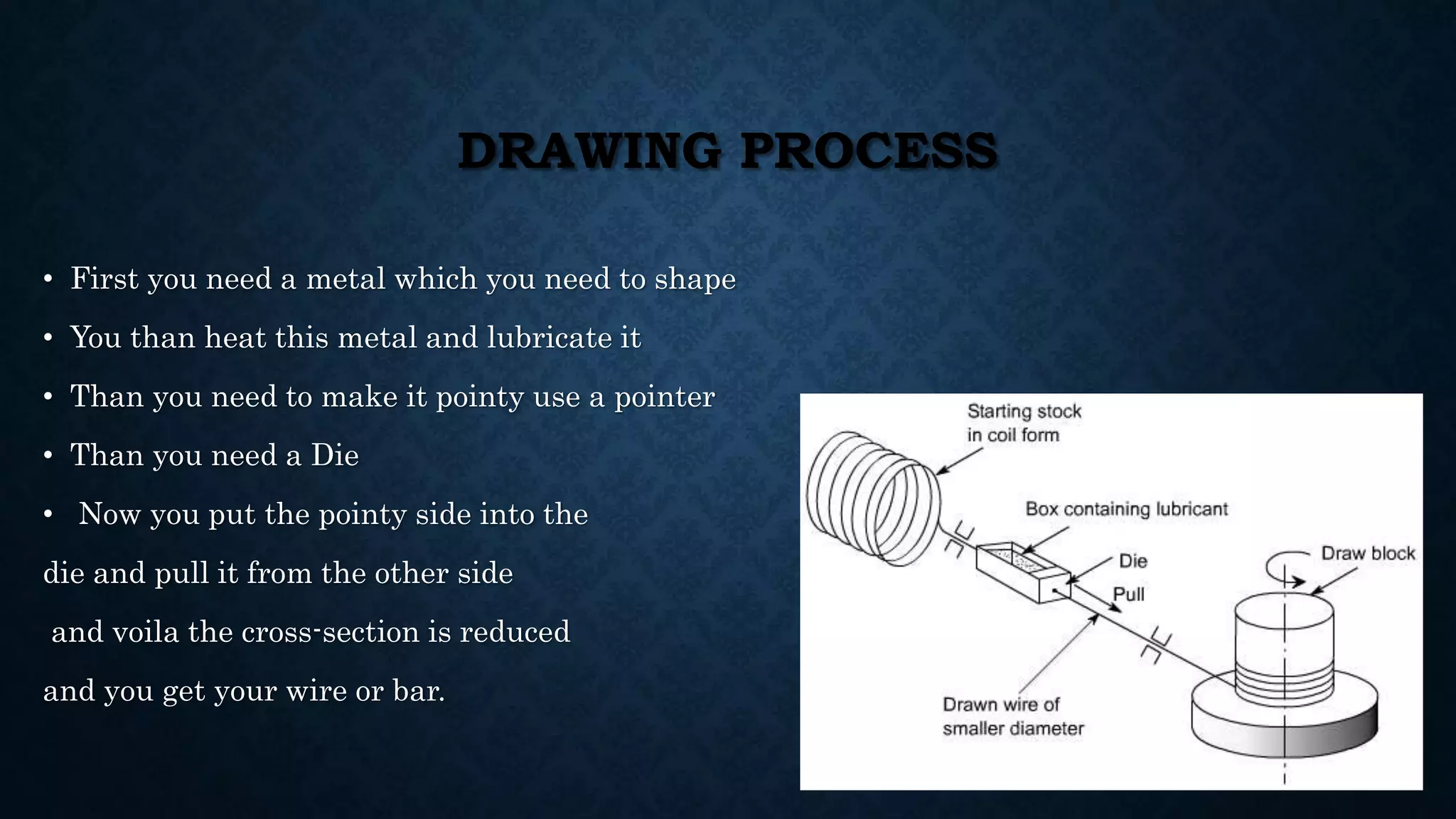
• First you need a metal which you need to shape
• You than heat this metal and lubricate it
• Than you need to make it pointy use a pointer
• Than you need a Die
• Now you put the pointy side into the
die and pull it from the other side
and voila the cross-section is reduced
and you get your wire or bar.
TYPES OF DRAWING
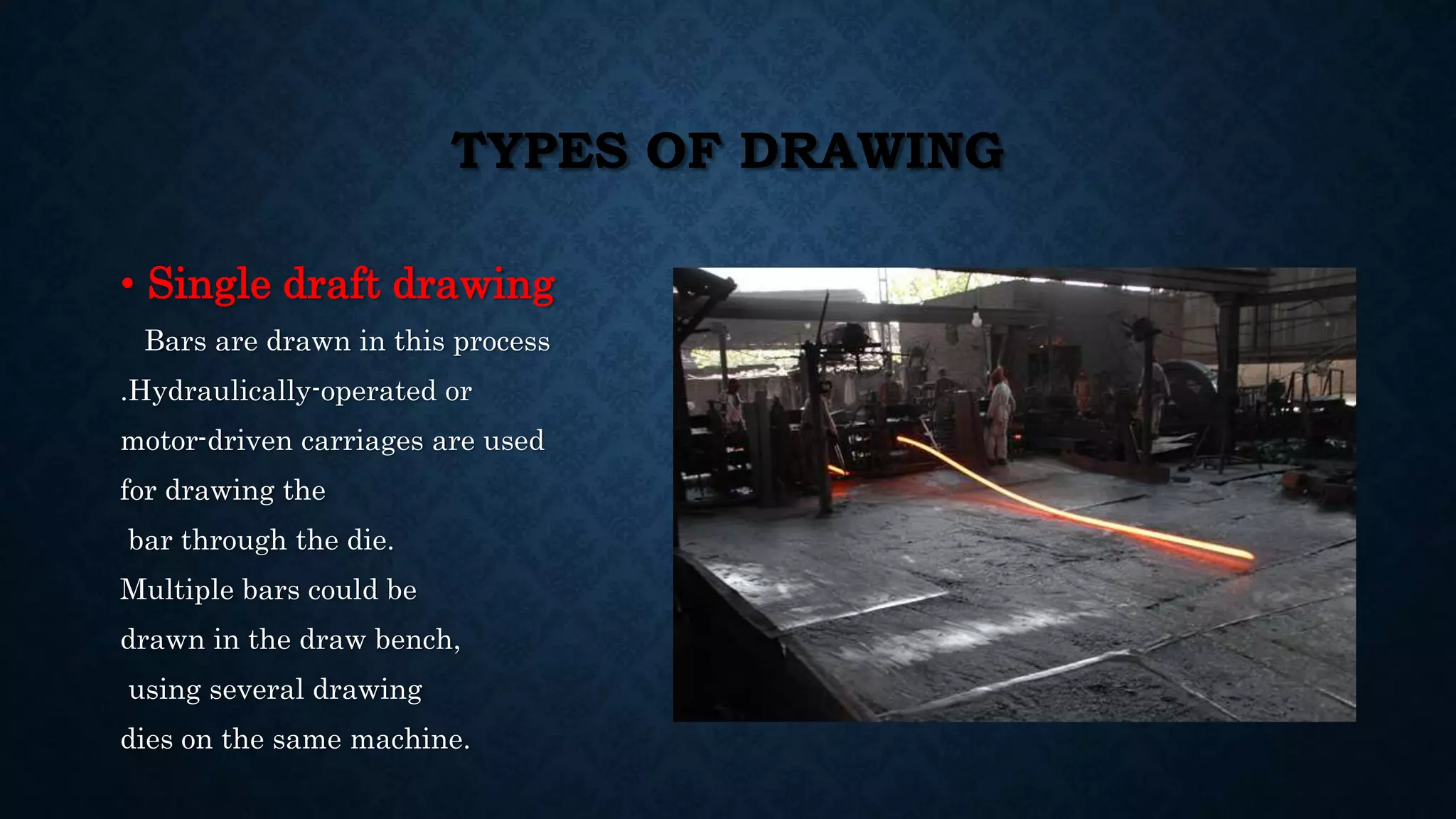
• Single draft drawing
Bars are drawn in this process
.Hydraulically-operated or
motor-driven carriages are used
for drawing the
bar through the die.
Multiple bars could be
drawn in the draw bench,
using several drawing
dies on the same machine.
• CONTINOUS /TANDEM DRAWING
• Wires are drawn by this process .Continuous drawing of wires is done through a series of
drawing dies, with intermediate winding drums. They wind the drawn wire before feeding
it to the next reduction stage. The drum applies mild tension on the wire.Multiple steps of
drawing, also called tandem drawing are required as the reduction of diameter achieved
per pass is usually limited.
LUBRICATION
• Lubrication in the drawing process is essential for maintaining good
surface finish and long die life. The following are different methods of
lubrication
• Wet drawing: the dies and wire or rod are completely immersed in
lubricants
• Dry drawing: the wire or rod passes through a container of lubricant
which coats the surface of the wire or rod
• Metal coating: the wire or rod is coated with a soft metal which acts as a
solid lubricant. ( Lubricant example copper sulfate solution)
IMPORTANCE
• The wire and bar drawing process had made wires and construction bars available
for mass use and cheap without wires we wont be having so many electrical
equipments . Without constructions bars we would not be able to make these big
tall and huge buildings.
wire and bar drwaing ppt

wire and bar drwaing ppt

  • 1.
    WIRE AND BARDRAWING Presented by :- Sanaan Umar Khan Hamza Tanoli Tauseef Ullah Hassan
  • 2.
    CONTENTS • Introduction • ComponentsUsed • Drawing Process • Types Of Drawing • Lubrication
  • 3.
    INTRODUCTION • Wire andbar drawing is a process in which we decrease the diameter or cross-section of a substance to make into a wire or a bar. • The main difference in bar and wire drawing is the diameter of the product wire drawing makes wire while bar drawing makes something bigger than a wire for example a rebar. • Bar drawing is done in single draft while wire drawing need many dies because its diameter is too small
  • 4.
    COMPONENTS USED ISDRAWING : POINTERS: Pointers as the name implies is used to put a taper (or point on the start end of the wire so that it can be threaded through the die. PULL IN DOGS: Pull in dogs are used to grip the wire end as it comes through the die and once the dog is fastend to the block the wire can be pulled through the die and will then wrap round the block.
  • 5.
    DIE:- Is the toolthat shapes the metal to bar or wire some die materials are:- • 1.TUNGSTEN CARBIDE: Lowest cost , shock resistance , large sizes available, lower life expectancy . USED-for steel wire drawing. • 2.NATURAL DIAMONDS: Wear resistance, gives excellent wire surface, high thermal conductivity , longer life expectancy ,limited availability in required high quality &quantity.
  • 6.
    • 3.SYNTHETIC SINGLECRYSTAL: Consistently uniform material ,gives excellent wire surface ,high thermal ,Conductivity , larger size ranges are still costly at this time. • 4.POLY CRYSTALLINE DIAMOND: Excels in life expectancy ,wear resistance of diamond ,shock resistance of carbide ,high availability cost effectiveness, high drawing force ,smaller fines requires more filtration, may be damaged by temperature . above 700c,wire surface condition less than from natural diamond.
  • 7.
    DRAWING PROCESS • Firstyou need a metal which you need to shape • You than heat this metal and lubricate it • Than you need to make it pointy use a pointer • Than you need a Die • Now you put the pointy side into the die and pull it from the other side and voila the cross-section is reduced and you get your wire or bar.
  • 8.
    TYPES OF DRAWING •Single draft drawing Bars are drawn in this process .Hydraulically-operated or motor-driven carriages are used for drawing the bar through the die. Multiple bars could be drawn in the draw bench, using several drawing dies on the same machine.
  • 9.
    • CONTINOUS /TANDEMDRAWING • Wires are drawn by this process .Continuous drawing of wires is done through a series of drawing dies, with intermediate winding drums. They wind the drawn wire before feeding it to the next reduction stage. The drum applies mild tension on the wire.Multiple steps of drawing, also called tandem drawing are required as the reduction of diameter achieved per pass is usually limited.
  • 10.
    LUBRICATION • Lubrication inthe drawing process is essential for maintaining good surface finish and long die life. The following are different methods of lubrication • Wet drawing: the dies and wire or rod are completely immersed in lubricants • Dry drawing: the wire or rod passes through a container of lubricant which coats the surface of the wire or rod • Metal coating: the wire or rod is coated with a soft metal which acts as a solid lubricant. ( Lubricant example copper sulfate solution)
  • 11.
    IMPORTANCE • The wireand bar drawing process had made wires and construction bars available for mass use and cheap without wires we wont be having so many electrical equipments . Without constructions bars we would not be able to make these big tall and huge buildings.