Abrasive Jet Machining
(AJM)
BY
SHIVAM PANDEY
GME122705
INTRODUCTION
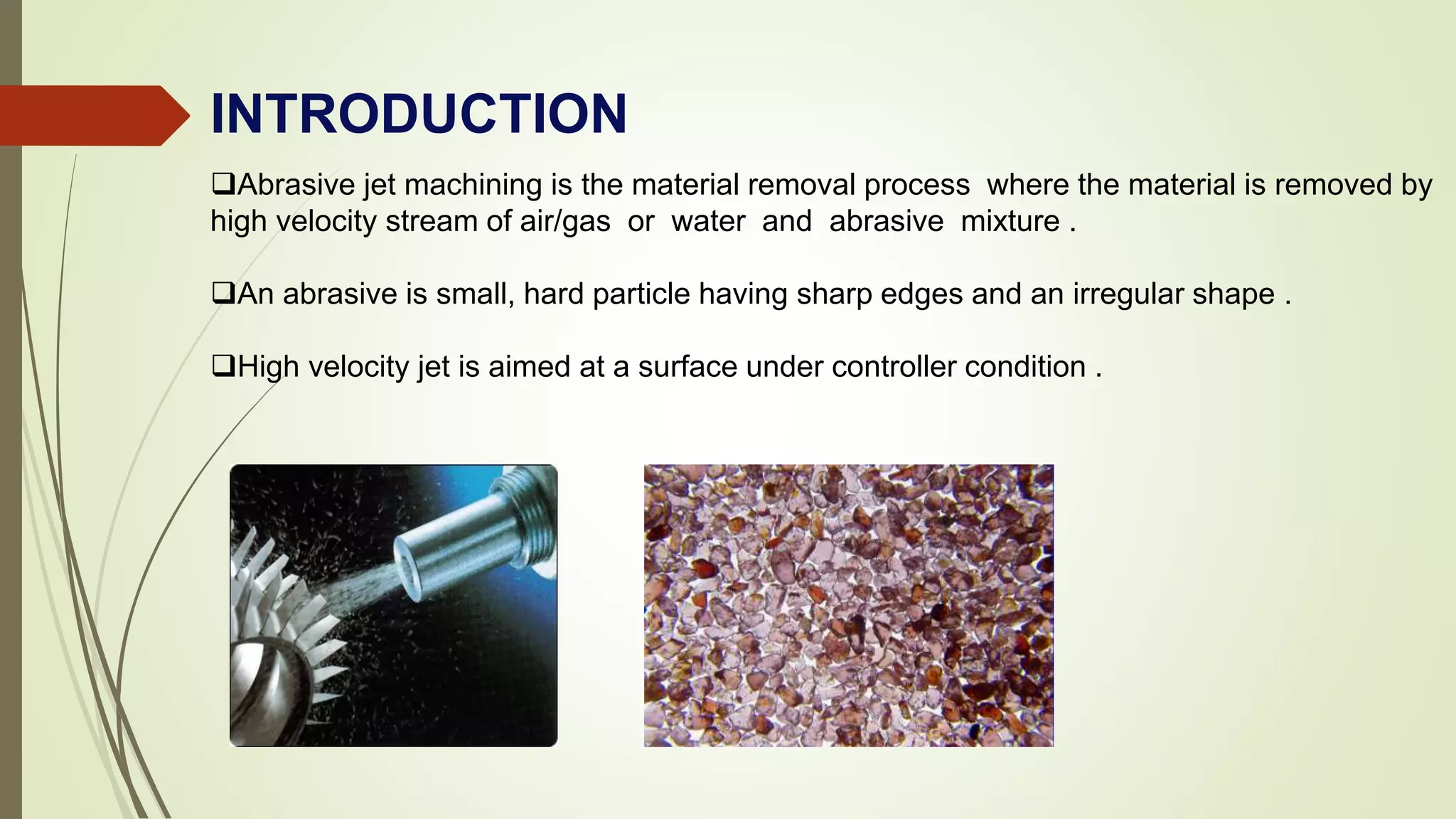
Abrasive jet machining is the material removal process where the material is removed by
high velocity stream of air/gas or water and abrasive mixture .
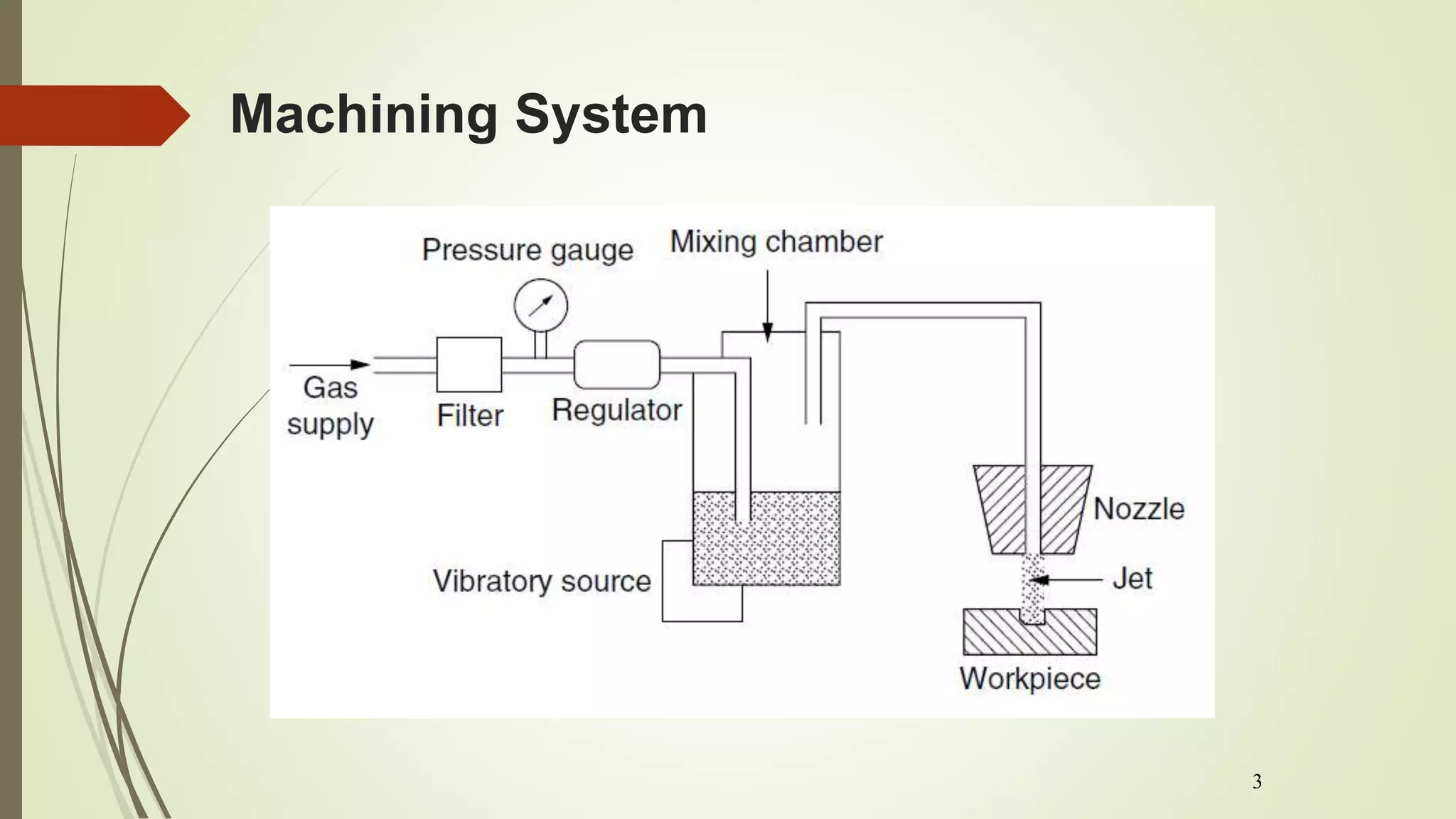
An abrasive is small, hard particle having sharp edges and an irregular shape .
High velocity jet is aimed at a surface under controller condition .
3
Machining System
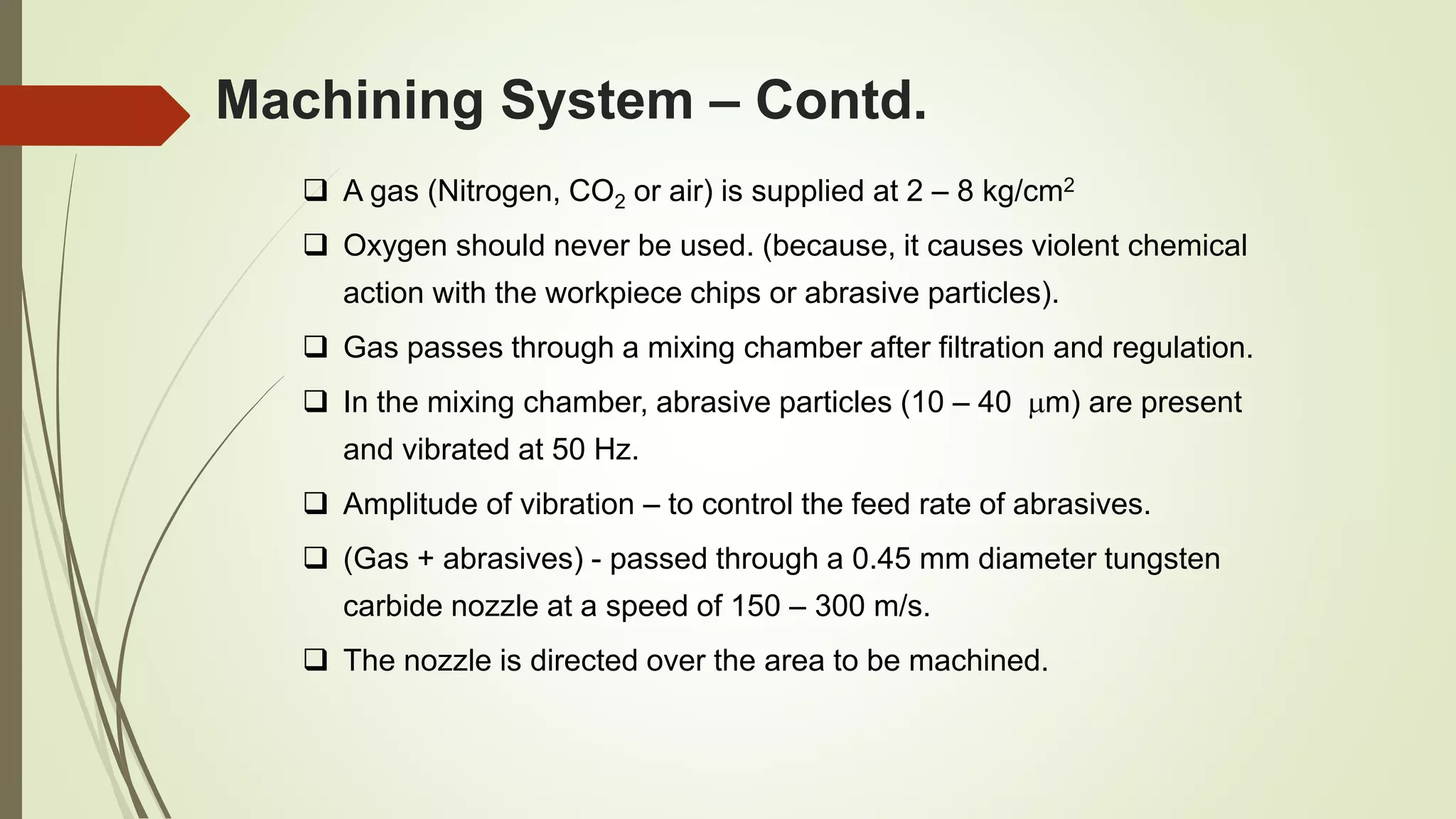
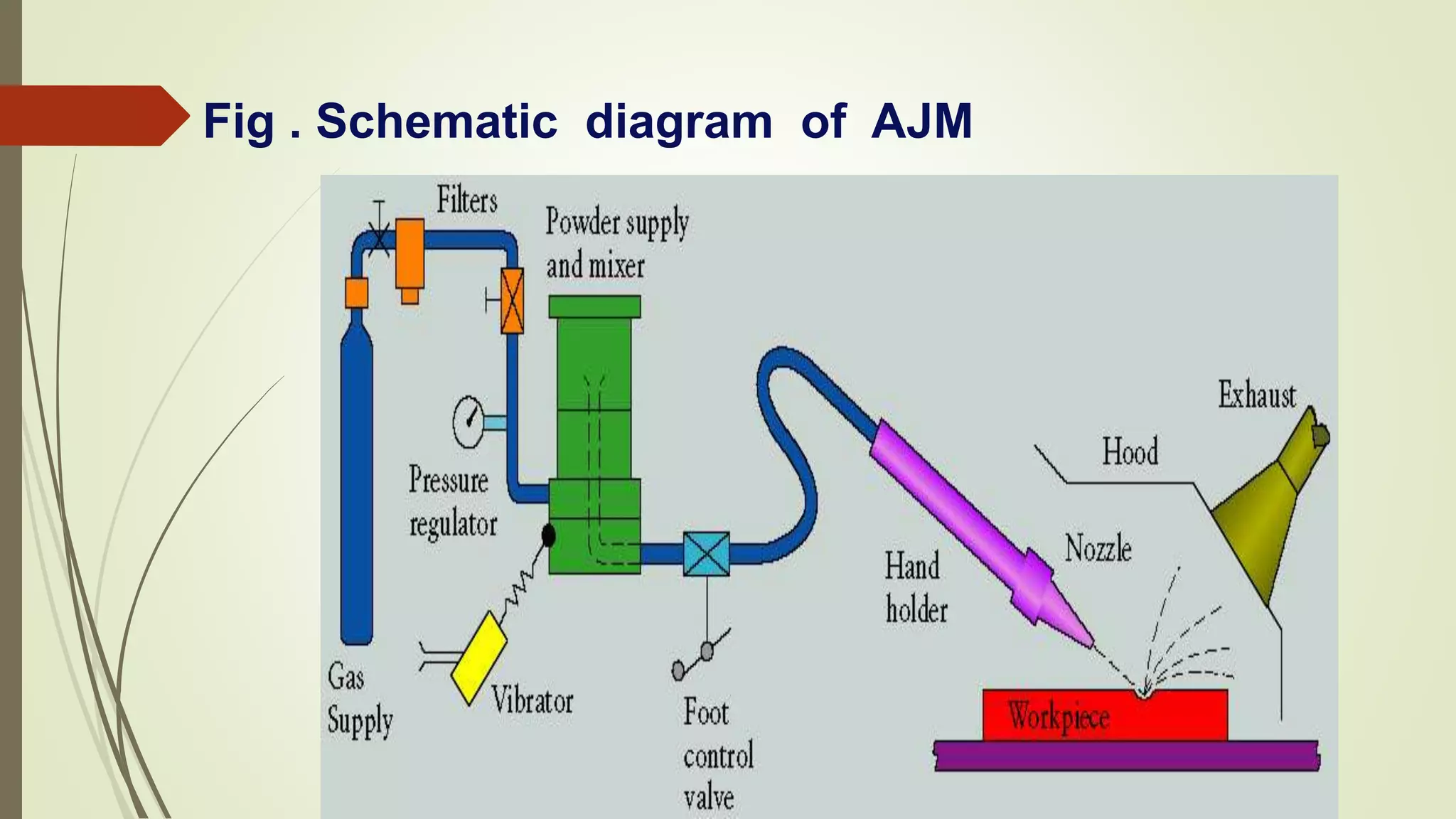
 A gas (Nitrogen, CO2 or air) is supplied at 2 – 8 kg/cm2
 Oxygen should never be used. (because, it causes violent chemical
action with the workpiece chips or abrasive particles).
 Gas passes through a mixing chamber after filtration and regulation.
 In the mixing chamber, abrasive particles (10 – 40 m) are present
and vibrated at 50 Hz.
 Amplitude of vibration – to control the feed rate of abrasives.
 (Gas + abrasives) - passed through a 0.45 mm diameter tungsten
carbide nozzle at a speed of 150 – 300 m/s.
 The nozzle is directed over the area to be machined.
Machining System – Contd.
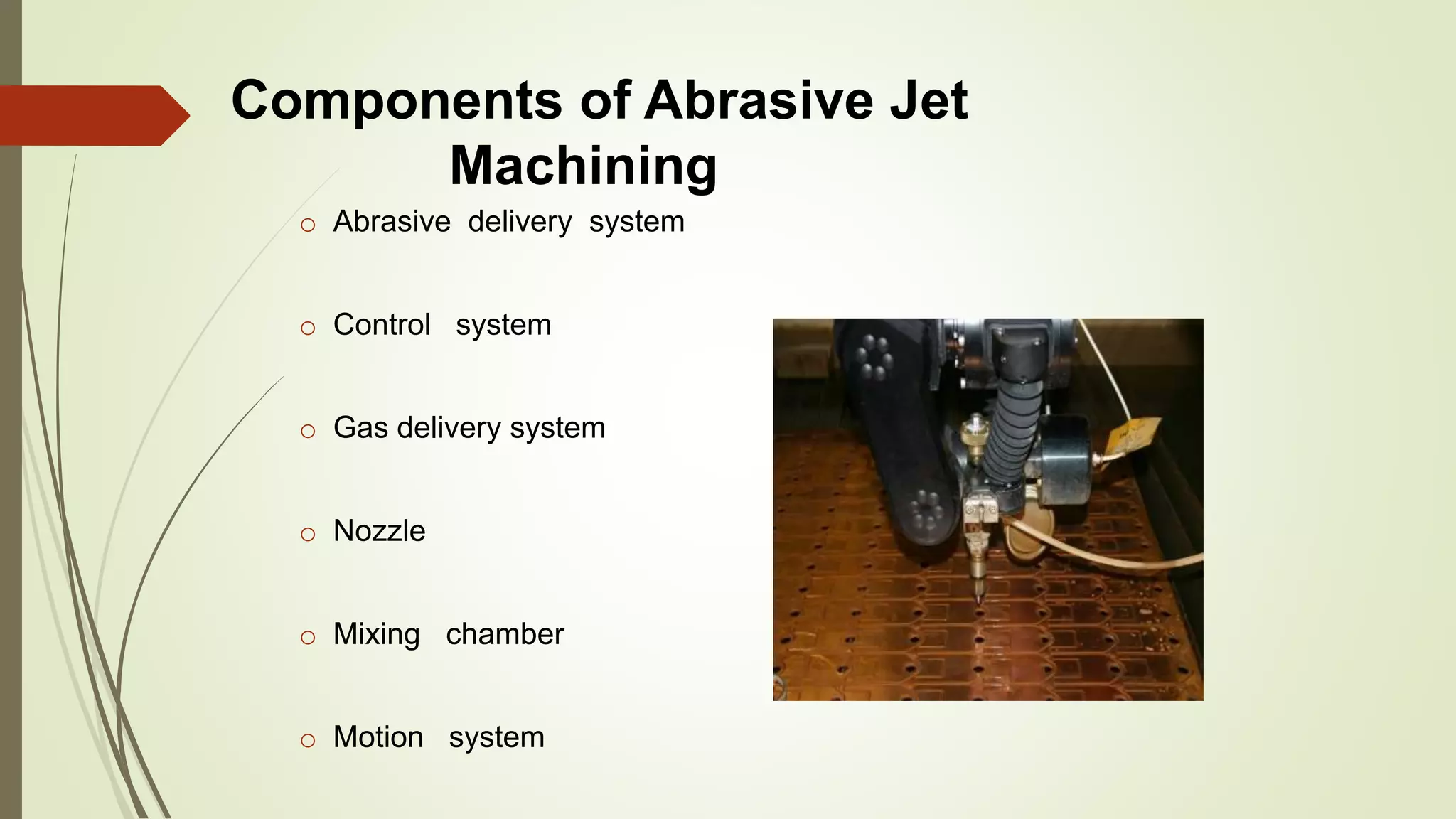
Components of Abrasive Jet
Machining
o Abrasive delivery system
o Control system
o Gas delivery system
o Nozzle
o Mixing chamber
o Motion system
Fig . Schematic diagram of AJM
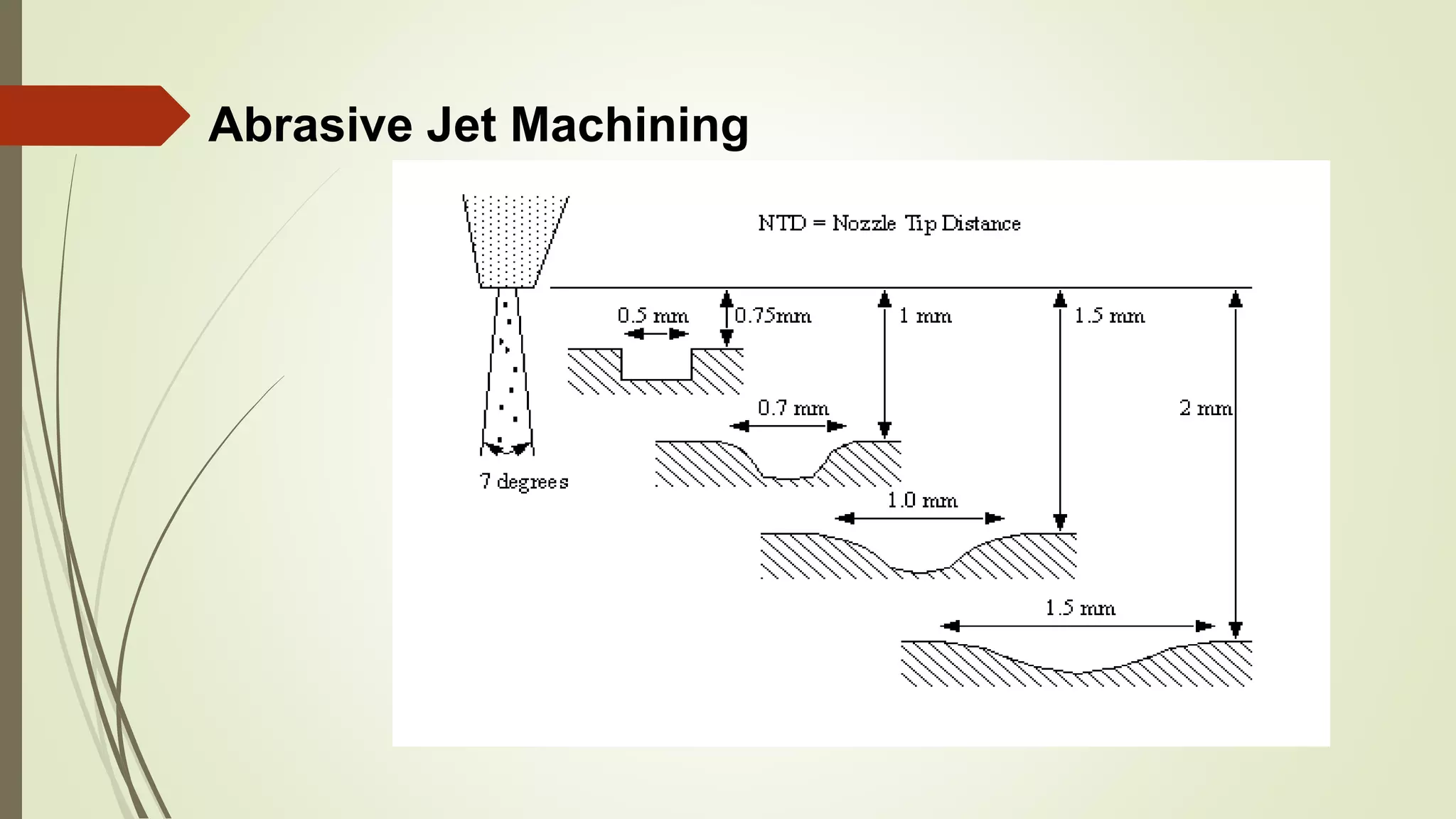
Abrasive Jet Machining
Process Parameters and
Machining Characteristics
Abrasive : Material – Al2O3 / SiC / glass beads
Shape – irregular / spherical
Size – 10 ~ 50 μm
Mass flow rate – 2 ~ 20 gm/min
Carrier gas : Composition – Air, CO2, N2
Density – Air ~ 1.3 kg/m3
Velocity – 500 ~ 700 m/s
Pressure – 2 ~ 10 bar
Flow rate – 5 ~ 30 lpm
Abrasive Jet : Velocity – 100 ~ 300 m/s
Mixing ratio – mass flow ratio of abrasive to gas
Stand-off distance – 0.5 ~ 5 mm
Impingement Angle – 600 ~ 900
Nozzle : Material – WC
Diameter – (Internal) 0.2 ~ 0.8 mm
Life – 10 ~ 300 hours
Abrasive Jet Machining
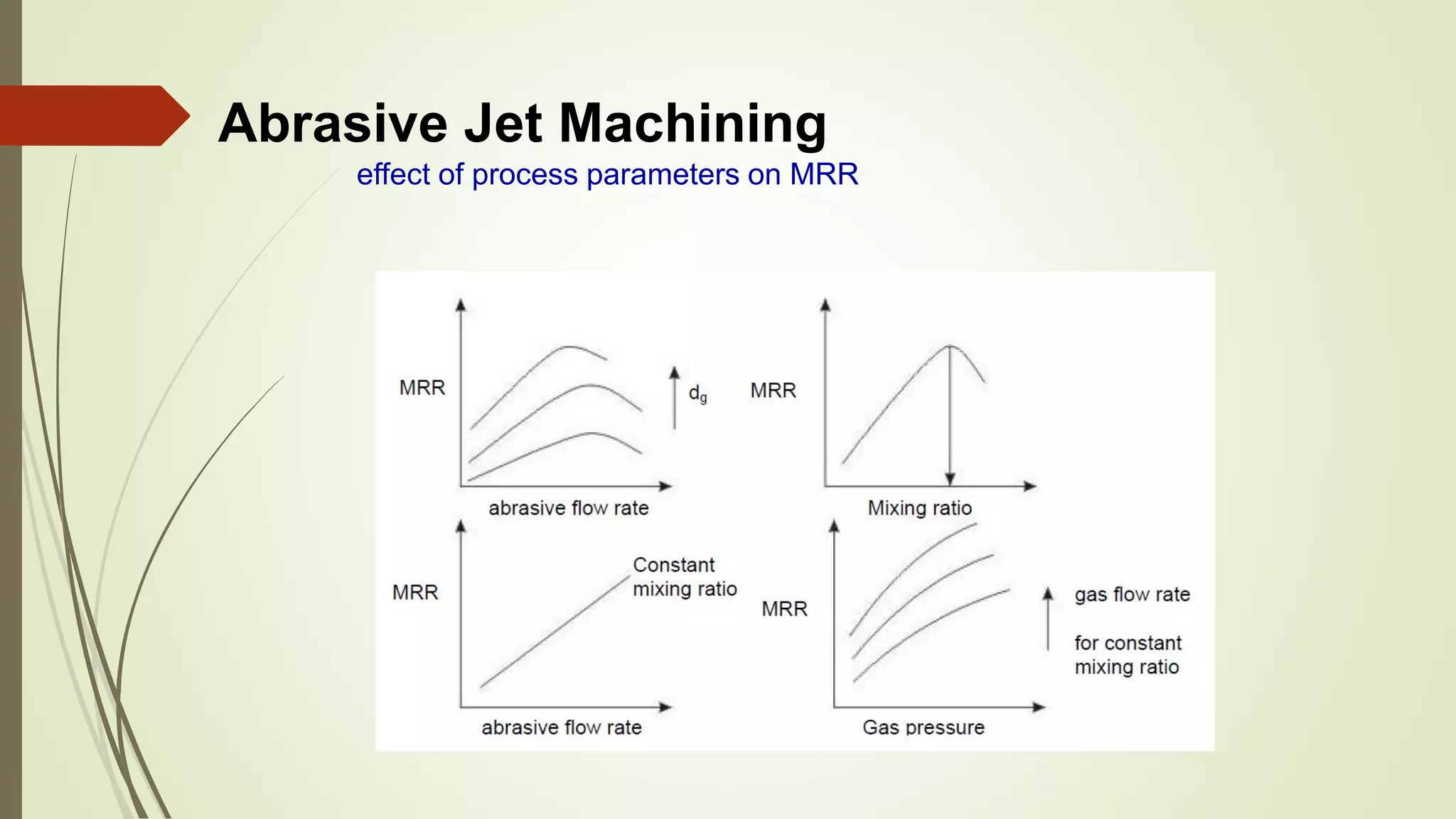
effect of process parameters on MRR
Abrasive Jet Machining
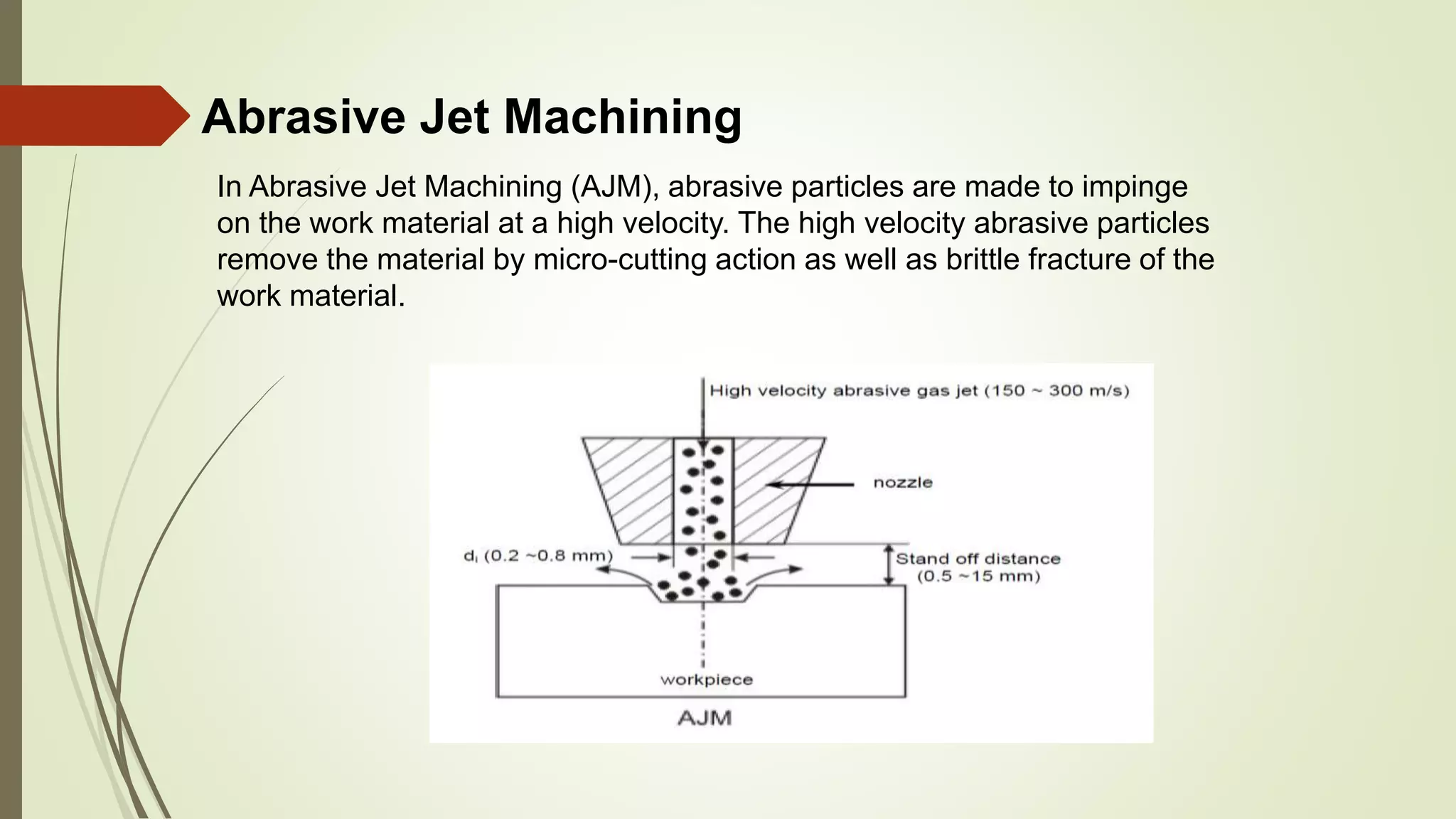
In Abrasive Jet Machining (AJM), abrasive particles are made to impinge
on the work material at a high velocity. The high velocity abrasive particles
remove the material by micro-cutting action as well as brittle fracture of the
work material.
Advantages
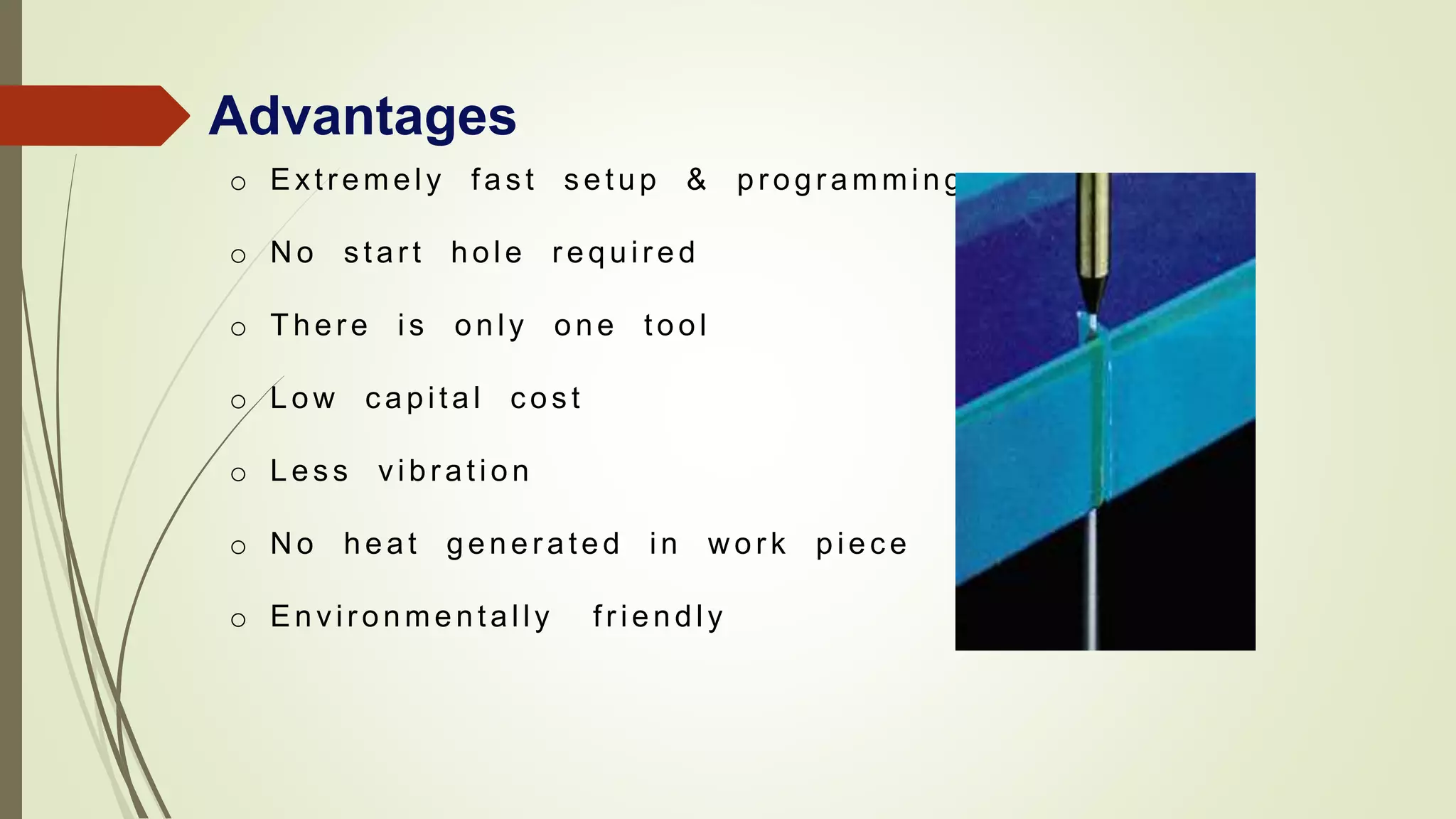
o Extr emely fas t s etup & pr ogr amming
o N o s tar t hole r equir ed
o There is only one tool
o Low c apital c os t
o Les s vibr ation
o N o heat gener ated in w or k piec e
o Envir onmentally fr iendly
Disadvantages
o Low metal removal rate
o Due to stay cutting accuracy is affected
o Abrasive powder cannot be reused
o Tapper is also a problem
13
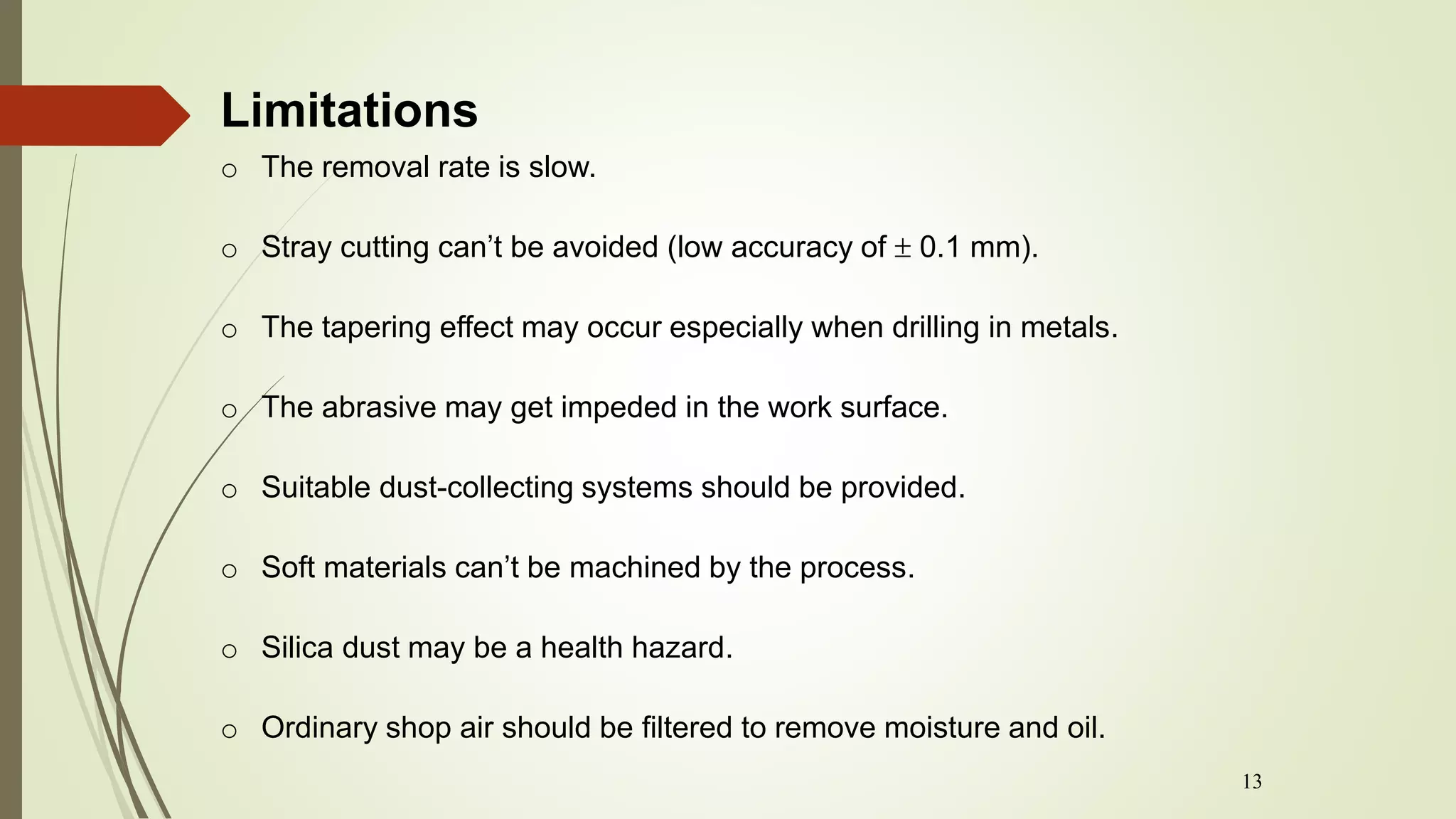
o The removal rate is slow.
o Stray cutting can’t be avoided (low accuracy of  0.1 mm).
o The tapering effect may occur especially when drilling in metals.
o The abrasive may get impeded in the work surface.
o Suitable dust-collecting systems should be provided.
o Soft materials can’t be machined by the process.
o Silica dust may be a health hazard.
o Ordinary shop air should be filtered to remove moisture and oil.
Limitations
Conclusion
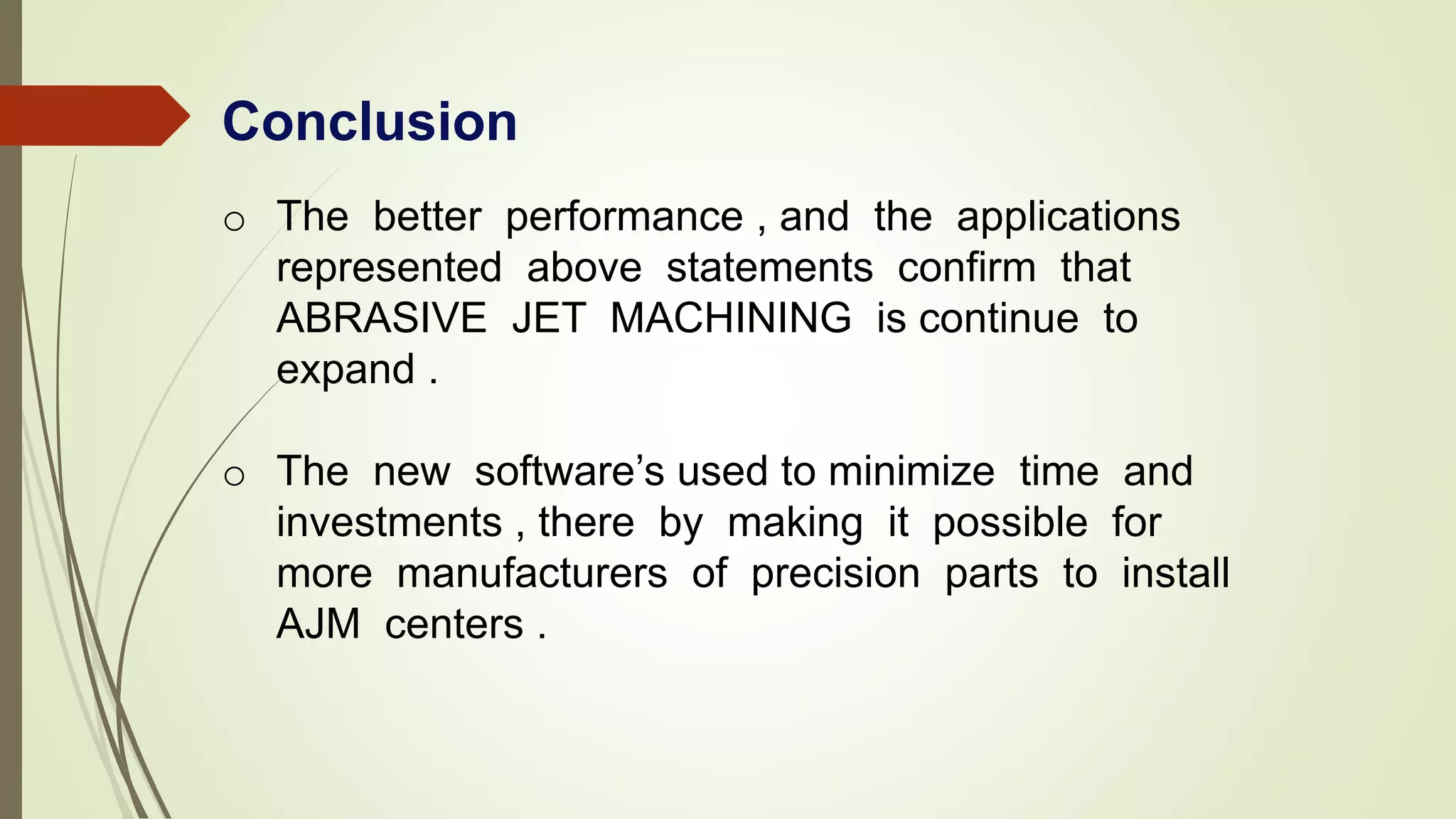
o The better performance , and the applications
represented above statements confirm that
ABRASIVE JET MACHINING is continue to
expand .
o The new software’s used to minimize time and
investments , there by making it possible for
more manufacturers of precision parts to install
AJM centers .
Shivam pandey ppt on ajm

Shivam pandey ppt on ajm

  • 1.
  • 2.
    INTRODUCTION Abrasive jet machiningis the material removal process where the material is removed by high velocity stream of air/gas or water and abrasive mixture . An abrasive is small, hard particle having sharp edges and an irregular shape . High velocity jet is aimed at a surface under controller condition .
  • 3.
  • 4.
     A gas(Nitrogen, CO2 or air) is supplied at 2 – 8 kg/cm2  Oxygen should never be used. (because, it causes violent chemical action with the workpiece chips or abrasive particles).  Gas passes through a mixing chamber after filtration and regulation.  In the mixing chamber, abrasive particles (10 – 40 m) are present and vibrated at 50 Hz.  Amplitude of vibration – to control the feed rate of abrasives.  (Gas + abrasives) - passed through a 0.45 mm diameter tungsten carbide nozzle at a speed of 150 – 300 m/s.  The nozzle is directed over the area to be machined. Machining System – Contd.
  • 5.
    Components of AbrasiveJet Machining o Abrasive delivery system o Control system o Gas delivery system o Nozzle o Mixing chamber o Motion system
  • 6.
    Fig . Schematicdiagram of AJM
  • 7.
  • 8.
    Process Parameters and MachiningCharacteristics Abrasive : Material – Al2O3 / SiC / glass beads Shape – irregular / spherical Size – 10 ~ 50 μm Mass flow rate – 2 ~ 20 gm/min Carrier gas : Composition – Air, CO2, N2 Density – Air ~ 1.3 kg/m3 Velocity – 500 ~ 700 m/s Pressure – 2 ~ 10 bar Flow rate – 5 ~ 30 lpm Abrasive Jet : Velocity – 100 ~ 300 m/s Mixing ratio – mass flow ratio of abrasive to gas Stand-off distance – 0.5 ~ 5 mm Impingement Angle – 600 ~ 900 Nozzle : Material – WC Diameter – (Internal) 0.2 ~ 0.8 mm Life – 10 ~ 300 hours
  • 9.
    Abrasive Jet Machining effectof process parameters on MRR
  • 10.
    Abrasive Jet Machining InAbrasive Jet Machining (AJM), abrasive particles are made to impinge on the work material at a high velocity. The high velocity abrasive particles remove the material by micro-cutting action as well as brittle fracture of the work material.
  • 11.
    Advantages o Extr emelyfas t s etup & pr ogr amming o N o s tar t hole r equir ed o There is only one tool o Low c apital c os t o Les s vibr ation o N o heat gener ated in w or k piec e o Envir onmentally fr iendly
  • 12.
    Disadvantages o Low metalremoval rate o Due to stay cutting accuracy is affected o Abrasive powder cannot be reused o Tapper is also a problem
  • 13.
    13 o The removalrate is slow. o Stray cutting can’t be avoided (low accuracy of  0.1 mm). o The tapering effect may occur especially when drilling in metals. o The abrasive may get impeded in the work surface. o Suitable dust-collecting systems should be provided. o Soft materials can’t be machined by the process. o Silica dust may be a health hazard. o Ordinary shop air should be filtered to remove moisture and oil. Limitations
  • 14.
    Conclusion o The betterperformance , and the applications represented above statements confirm that ABRASIVE JET MACHINING is continue to expand . o The new software’s used to minimize time and investments , there by making it possible for more manufacturers of precision parts to install AJM centers .