DENTIN
Peritubular Dentin:
- Surrounds dentinal tubules and highly mineralized
- Not found near pulpal areas
Intertubular Dentin:
- Body of dentin
- Less mineralized than peritubular dentin
- Matrix of collagen fibres and hydroxyapatite
Intratubular Dentin:
- Sclerotic dentin that fills up the dentinal tubules
o Reduce permeability of dentinal tubules
o Generally observed in elderly people and slowly progression caries
o Prolong pulp vitality
- Dentinal tubules contains odontoblastic processes
o Cytoplasmic extensions of odontoblasts
o The process tapers towards DEJ, dentinal tubules as well
o The process contains protein-synthesizing organelles
Primary Dentin (Mantle and Circumpulpal)
- Characterized by S shape dentinal tubules
- Incremental lines can be seen
o A.k.a Von Ebner Lines
o Due to daily rhythmic deposition of dentin
o Neonatal line – separate prenatal and postnatal dentin
o Right angle to dentinal tubules
Mantle dentin (Primary)
- Found near DEJ
- First dentine layer formed during crown and root formation
- Interdigitated with enamel at DEJ and globular dentine (before circumpulpal)
Circumpulpal dentin (Primary)
- Bulk of dentin
- Formed before root completion
- More mineral than mantle dentin
Predentin
- Unmineralised, newly formed dentine by odontoblastic cells
- Found at Dentine-Pulp Junction
Secondary Dentin (Regular and Irregular)
- Formed after root completion
- Seen as narrow band surrounding the pulp (roof and floor of pulp)
- Forms slowly, throughout the life of the tooth
Tertiary Dentin (Reparative dentin)
- In response to pulpal stimulation (injury/trauma/caries)
- Localised
- It helps seal off the area of injury causing resolution of inflammation & removal of dead
cells.
Tomes’ Granular Layer
- Grainy appearance
- Root only, adjacent to cementum
- Layer widens from CEJ to apex of root
- Unmineralised
Innervation of Dentin
- Intratubular nerves, with close association with odontoblast
- Nerve endings packed with vesicles of neurotransmitter?
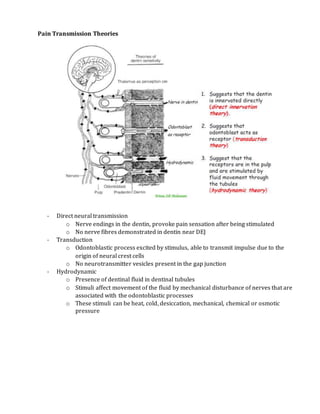
Pain Transmission Theories
- Direct neural transmission
o Nerve endings in the dentin, provoke pain sensation after being stimulated
o No nerve fibres demonstrated in dentin near DEJ
- Transduction
o Odontoblastic process excited by stimulus, able to transmit impulse due to the
origin of neural crest cells
o No neurotransmitter vesicles present in the gap junction
- Hydrodynamic
o Presence of dentinal fluid in dentinal tubules
o Stimuli affect movement of the fluid by mechanical disturbance of nerves that are
associated with the odontoblastic processes
o These stimuli can be heat, cold, desiccation, mechanical, chemical or osmotic
pressure

About Dentin

  • 1.
    DENTIN Peritubular Dentin: - Surroundsdentinal tubules and highly mineralized - Not found near pulpal areas Intertubular Dentin: - Body of dentin - Less mineralized than peritubular dentin - Matrix of collagen fibres and hydroxyapatite Intratubular Dentin: - Sclerotic dentin that fills up the dentinal tubules o Reduce permeability of dentinal tubules o Generally observed in elderly people and slowly progression caries o Prolong pulp vitality - Dentinal tubules contains odontoblastic processes o Cytoplasmic extensions of odontoblasts o The process tapers towards DEJ, dentinal tubules as well o The process contains protein-synthesizing organelles Primary Dentin (Mantle and Circumpulpal) - Characterized by S shape dentinal tubules - Incremental lines can be seen o A.k.a Von Ebner Lines o Due to daily rhythmic deposition of dentin o Neonatal line – separate prenatal and postnatal dentin o Right angle to dentinal tubules Mantle dentin (Primary) - Found near DEJ - First dentine layer formed during crown and root formation - Interdigitated with enamel at DEJ and globular dentine (before circumpulpal) Circumpulpal dentin (Primary) - Bulk of dentin - Formed before root completion - More mineral than mantle dentin Predentin - Unmineralised, newly formed dentine by odontoblastic cells - Found at Dentine-Pulp Junction
  • 2.
    Secondary Dentin (Regularand Irregular) - Formed after root completion - Seen as narrow band surrounding the pulp (roof and floor of pulp) - Forms slowly, throughout the life of the tooth Tertiary Dentin (Reparative dentin) - In response to pulpal stimulation (injury/trauma/caries) - Localised - It helps seal off the area of injury causing resolution of inflammation & removal of dead cells. Tomes’ Granular Layer - Grainy appearance - Root only, adjacent to cementum - Layer widens from CEJ to apex of root - Unmineralised Innervation of Dentin - Intratubular nerves, with close association with odontoblast - Nerve endings packed with vesicles of neurotransmitter?
  • 3.
    Pain Transmission Theories -Direct neural transmission o Nerve endings in the dentin, provoke pain sensation after being stimulated o No nerve fibres demonstrated in dentin near DEJ - Transduction o Odontoblastic process excited by stimulus, able to transmit impulse due to the origin of neural crest cells o No neurotransmitter vesicles present in the gap junction - Hydrodynamic o Presence of dentinal fluid in dentinal tubules o Stimuli affect movement of the fluid by mechanical disturbance of nerves that are associated with the odontoblastic processes o These stimuli can be heat, cold, desiccation, mechanical, chemical or osmotic pressure