DENTIN 
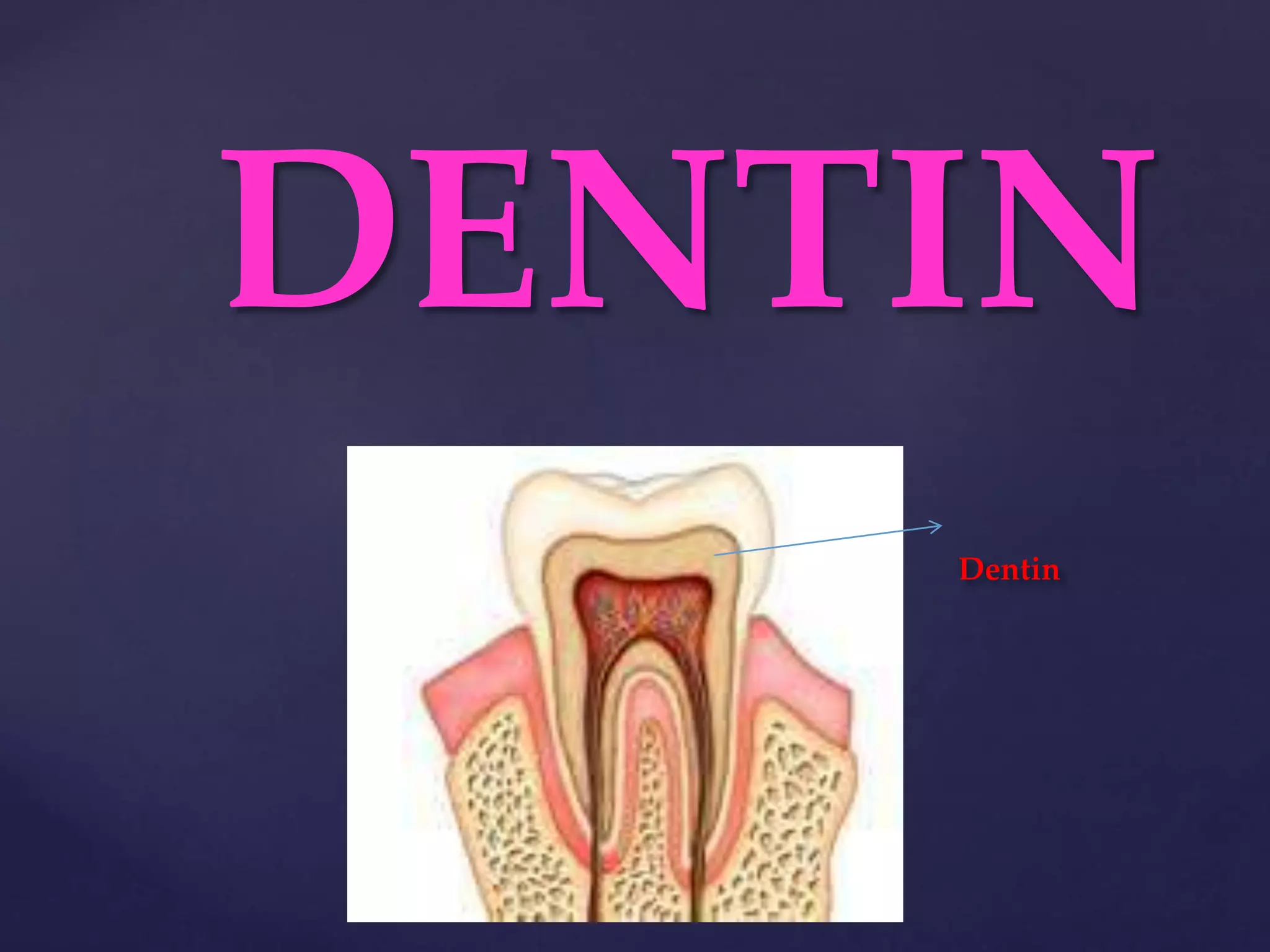
Dentin
Dentin is a crystalline material that 
enclose the pulp , formed by 
odontoblast and it is mesenchymal in 
origin. 
Dentin is coverd by enamel on the 
chrown and cementum on the root.
Dentin is the most voluminous 
mineralized conective tissue of 
the tooth. 
Forms the hard tissue portion of 
the dentino-pulp complex.
COMPOSITION
PHYSICAL PROPERTIES 
Hard tissue forming the bulk of 
the tooth. 
Softer than enamel but harder 
than bone and cementum. 
It has a yellow color. 
It has a rough surface texture 
than the enamel.
PHYSICAL PROPERTIES 
Vital and has nerve fibers but 
avascular. 
Less dense than enamel on 
radiograph and appear 
radiolucent. 
It is permeable. 
Has elastic quality.
BASIC COMPONENTS 
1. DENTINAL TUBULES 
 A long tubule extend from DEJ in 
the crown or DCJ in the root to outer 
wall of the pulp. 
 Follow a gentle ,S, -shaped curve 
in the tooth crown and are straight in 
the incisal edges, cusps and root areas. 
COMPONENTS OF DENTINAL 
TUBULE 
a. Odontoblastic cytoplasmic process. 
b. Dentinal fluid. 
c. Nerve fibers.
Dentinal tubules 
{ 
Cross section 
Longitudinal section
BASIC COMPONENTS 
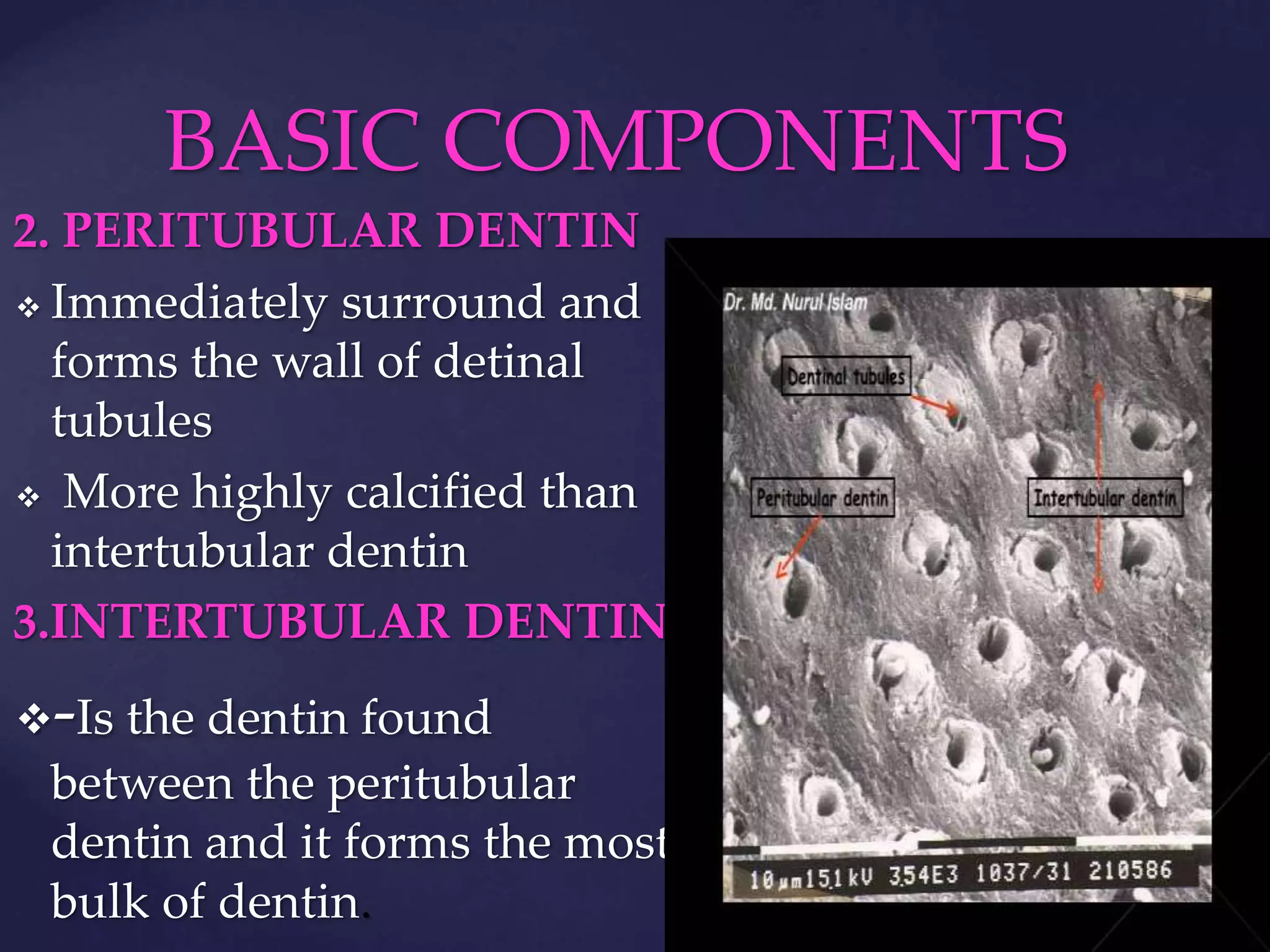
2. PERITUBULAR DENTIN 
 Immediately surround and 
forms the wall of detinal 
tubules 
 More highly calcified than 
intertubular dentin 
3.INTERTUBULAR DENTIN 
-Is the dentin found 
between the peritubular 
dentin and it forms the most 
bulk of dentin.
TYPES OF DENTIN 
PRIMARY DENTIN 
 Formed before root completion. 
 Formed by primary odontoblast. 
 Formed in faster rate. 
 Gives initial shape of the tooth. 
 It continues to grow till 3 years after tooth 
eruption. 
 It is more permeability. 
a. Mantle dentin. 
b. Circumpulpal dentin
Mentle 
dentin 
Primary dentin 
{ Circumpulpal dentin 
Irregular 
Secondary 
dentin 
Secondary dentin 
Predentin
SECONDARY DENTIN (Regular 
secondary dentin) 
 Formed after completion of root formation. 
 Formed at a slower rate than primary dentin. 
 Thickness increase with advacing age. 
 Formed by primary odontoblast. 
 Less permeability. 
TERTIARY DENTIN 
Known as (Irregular secondary or 
Reparative or sclerotic dentin) 
 -Frequently formed as a response to external 
stimuli such as (dental caries, attrition). 
 -Formed only at the site of odontoblast activation. 
 Formed by secondary odontoblast. 
 Thickness increase with advacing age. 
 The least permeability of dentin, therefore 
helping in prevention of diffusion of noxious 
agent from the tubules.
FUNCTIONS OF DENTIN 
1. Protection of the pulp. 
2. Affects the color of enamel. 
3. Shoch absorber and prevent 
fracture of enamel. 
4. Determine the shap of the crown.
Microscopic feature Of Dentin 
1. Imbrication line of Von Ebner,s 
2. Counter line of Owen 
3. DEJ 
4.CEJ 
5.Neonatal line 
6.Tome,s granular layers 
7.Interglobular dentin 
8.Age changes
Lines of Owen Neonatal line 
{
{ 
Incremental lines
Tomes granular layer 
{ 
Tomes granular layer
Age changes 
sclerotic dentin 
Dead tract
CLINICAL CONSIDERATION OF 
DENTIN 
1. As dentin is known to provide strength 
and rigidity to the tooth,care should be 
taken during tooth preparation. 
2. Tooth preparation should be done 
under constant air water spray to avoid 
build up of heat formation.
CLINICAL CONSIDERATION 
OF 
DENTIN 
3. Dentin should always be protected by 
liners,bases or dentin bonding agents. 
4. Smear layer is formed as a result of 
tooth cutting(quantities of cutting 
debris) for bonding of restorative 
materials to tooth structue,this smear 
layer has to be removed by etching 
process. 
.
Dentin ^_^

Dentin ^_^

  • 1.
  • 3.
    Dentin is acrystalline material that enclose the pulp , formed by odontoblast and it is mesenchymal in origin. Dentin is coverd by enamel on the chrown and cementum on the root.
  • 4.
    Dentin is themost voluminous mineralized conective tissue of the tooth. Forms the hard tissue portion of the dentino-pulp complex.
  • 5.
  • 6.
    PHYSICAL PROPERTIES Hardtissue forming the bulk of the tooth. Softer than enamel but harder than bone and cementum. It has a yellow color. It has a rough surface texture than the enamel.
  • 7.
    PHYSICAL PROPERTIES Vitaland has nerve fibers but avascular. Less dense than enamel on radiograph and appear radiolucent. It is permeable. Has elastic quality.
  • 8.
    BASIC COMPONENTS 1.DENTINAL TUBULES  A long tubule extend from DEJ in the crown or DCJ in the root to outer wall of the pulp.  Follow a gentle ,S, -shaped curve in the tooth crown and are straight in the incisal edges, cusps and root areas. COMPONENTS OF DENTINAL TUBULE a. Odontoblastic cytoplasmic process. b. Dentinal fluid. c. Nerve fibers.
  • 9.
    Dentinal tubules { Cross section Longitudinal section
  • 11.
    BASIC COMPONENTS 2.PERITUBULAR DENTIN  Immediately surround and forms the wall of detinal tubules  More highly calcified than intertubular dentin 3.INTERTUBULAR DENTIN -Is the dentin found between the peritubular dentin and it forms the most bulk of dentin.
  • 12.
    TYPES OF DENTIN PRIMARY DENTIN  Formed before root completion.  Formed by primary odontoblast.  Formed in faster rate.  Gives initial shape of the tooth.  It continues to grow till 3 years after tooth eruption.  It is more permeability. a. Mantle dentin. b. Circumpulpal dentin
  • 13.
    Mentle dentin Primarydentin { Circumpulpal dentin Irregular Secondary dentin Secondary dentin Predentin
  • 15.
    SECONDARY DENTIN (Regular secondary dentin)  Formed after completion of root formation.  Formed at a slower rate than primary dentin.  Thickness increase with advacing age.  Formed by primary odontoblast.  Less permeability. TERTIARY DENTIN Known as (Irregular secondary or Reparative or sclerotic dentin)  -Frequently formed as a response to external stimuli such as (dental caries, attrition).  -Formed only at the site of odontoblast activation.  Formed by secondary odontoblast.  Thickness increase with advacing age.  The least permeability of dentin, therefore helping in prevention of diffusion of noxious agent from the tubules.
  • 19.
    FUNCTIONS OF DENTIN 1. Protection of the pulp. 2. Affects the color of enamel. 3. Shoch absorber and prevent fracture of enamel. 4. Determine the shap of the crown.
  • 20.
    Microscopic feature OfDentin 1. Imbrication line of Von Ebner,s 2. Counter line of Owen 3. DEJ 4.CEJ 5.Neonatal line 6.Tome,s granular layers 7.Interglobular dentin 8.Age changes
  • 21.
    Lines of OwenNeonatal line {
  • 22.
  • 23.
    Tomes granular layer { Tomes granular layer
  • 25.
    Age changes scleroticdentin Dead tract
  • 26.
    CLINICAL CONSIDERATION OF DENTIN 1. As dentin is known to provide strength and rigidity to the tooth,care should be taken during tooth preparation. 2. Tooth preparation should be done under constant air water spray to avoid build up of heat formation.
  • 27.
    CLINICAL CONSIDERATION OF DENTIN 3. Dentin should always be protected by liners,bases or dentin bonding agents. 4. Smear layer is formed as a result of tooth cutting(quantities of cutting debris) for bonding of restorative materials to tooth structue,this smear layer has to be removed by etching process. .