MULTIPLEALLOTSAND
BLOOD GROUPING SYSTEM
MRS BINCY VARGHESE
ASSOCIATE PROFESSOR
NURSING
INTRODUCTION
ALLELE: Alternative form of the same gene.
 Most genes have two alleles, a dominant one and a
recessive one.
 If the organism is heterozygous for the trait, then the
dominant allele is expressed.
 A Recessive Allele is only expressed when the
organism is homozygous for that trait.
 Although, humans can have only two alleles for a
given gene. Multiple alleles may also exist.
MULTIPLE
ALLELES
Definition
Three or more alternative forms of gene which
occupies the same locus are referred to as
Multiple Alleles.
ABO BLOOD
GROUPS
 Blood groups are inherited from both parents. The
ABO blood type is controlled by a single gene:
the ABO gene.
 ABO Blood Group in Humans was discovered by
Landsteiner in 1901.
 The ABO Blood group system is characterised by the
presence or absence of Antigens on the surface of
RBCs.
 The ABO System in humans is controlled by three
alleles, usually referred to as IA, IB, and IO (the "I"
stands for Isohaemagglutinin).
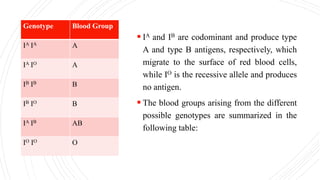
 IA and IB are codominant and produce type
A and type B antigens, respectively, which
migrate to the surface of red blood cells,
while IO is the recessive allele and produces
no antigen.
 The blood groups arising from the different
possible genotypes are summarized in the
following table:
Genotype Blood Group
IA IA A
IA IO A
IB IB B
IB IO B
IA IB AB
IO IO O
ANTIGEN
ANTIBODY
 It was found that there can be two antigens A or
B and as a result four blood groups.
 With these antigens A and B, there are certain
naturally occurring antibodies in the serum of the
blood.
 General principle of antibody and antigen
relationships is that antibodies in a particular
individual will be found only for those antigens
which are absent in blood of this individual.
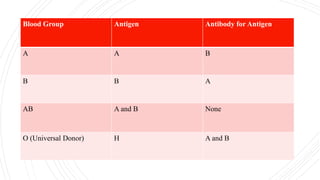
 The status of antigens and antibodies in different
blood groups is shown in Table.:
Blood Group Antigen Antibody for Antigen
A A B
B B A
AB A and B None
O (Universal Donor) H A and B
Rh(D) Type
 The two main blood group systems in transfusion practice
are the ABO system and the Rh(D) type- Rhesus
Antigen. Identification of the correct blood group is
important to prevent reaction following transfusion.
 The Rh(D) system person can be either Rh(D) positive or
Rh(D) negative. Each system is inherited independently
of the other.
 An RhD negative person with an RhD antibody will
destroy any RhD positive red cells they come in contact
with. This may occur with a transfusion or in a pregnant
woman with an RhD positive baby. Rh is very important
for women who are or may become pregnant as the
antibodies can cause problems for mother and baby.
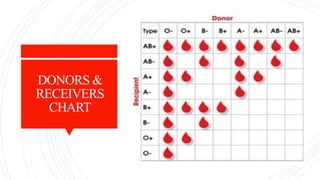
 There are eight main blood groups.
DONORS &
RECEIVERS
CHART
UNIVERSAL
DONOR &
RECIPIENT
AB+ is the “Universal Recipient” making
it a very important blood type. AB positive
blood, on the other hand, contains no anti-
A/anti-B/RhD antibodies.
The “Universal Donor” the O- blood
type is the only blood type that is able to
give red cells to all other blood types. O-
blood contains no A or B or RhD antigens.
CROSS
MATCHING
In transfusion medicine, Cross matching (part of series
of steps in blood compatibility tests) testing is done
before a blood transfusion to determine if
the donor's blood is compatible with the blood of an
intended recipient.
Cross-matching is also used to determine compatibility
between a donor and recipient in organ transplantation.
Compatibility is determined through matching of
different blood group systems, the most important of
which are the ABO and Rh system, and/or by directly
testing for the presence of antibodies against
the antigens in a sample of donor blood or other tissue.
RARE
BLOOD
TYPES
Ro SUBTYPE
 The Ro subtype is simply blood with a certain
combination of genes.
 What makes donors with the Ro subtype special, is the
fact that only 2% of donors have it.
 For blood transfusion the best known and most
important blood group systems are the ABO group and
the Rh group.
 The ABO group determines whether you belong to
blood group A, B, O or AB.
 Specifically, the RHD gene of the Rh group determines
whether someone has + or - blood. If the RHD gene is
present, it is positive (+) and if the RHD gene is absent,
it is negative (-).
Ro SUBTYPE
 Usually, when a patient requires a single blood
transfusion, they can be given blood based on only
the ABO group and Rh group.
 But when a patient requires multiple blood
transfusions, they need to be given more
extensively matched blood. Subtypes of all of the
blood group systems are taken into consideration,
when determining the most suitable blood to give to
the patient.
 Rh group is actually comprised of two genes: in
addition to the RHD gene, there’s the RHCE gene.
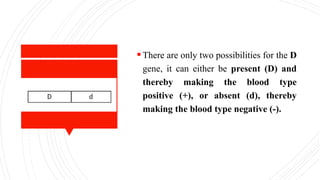
There are only two possibilities for the D
gene, it can either be present (D) and
thereby making the blood type
positive (+), or absent (d), thereby
making the blood type negative (-).
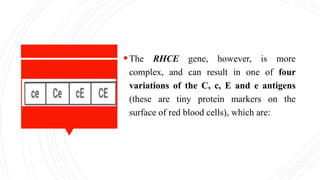
The RHCE gene, however, is more
complex, and can result in one of four
variations of the C, c, E and e antigens
(these are tiny protein markers on the
surface of red blood cells), which are:
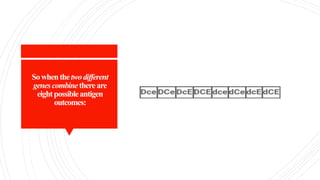
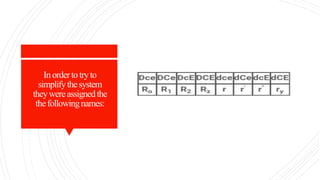
Sowhenthetwodifferent
genescombinethereare
eightpossibleantigen
outcomes:
Inordertotryto
simplifythesystem
theywereassignedthe
thefollowingnames:
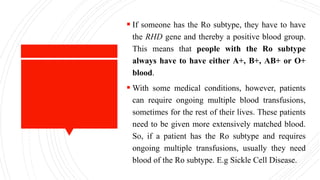
 If someone has the Ro subtype, they have to have
the RHD gene and thereby a positive blood group.
This means that people with the Ro subtype
always have to have either A+, B+, AB+ or O+
blood.
 With some medical conditions, however, patients
can require ongoing multiple blood transfusions,
sometimes for the rest of their lives. These patients
need to be given more extensively matched blood.
So, if a patient has the Ro subtype and requires
ongoing multiple transfusions, usually they need
blood of the Ro subtype. E.g Sickle Cell Disease.
GOLDEN
BLOOD
Rhnull
 One has a ‘rare’ blood type if blood is missing an antigen
which is common to most people, or if it has an antigen
which most people don’t have.
 One of the rarest blood types in the world is Rhnull,
sometimes referred to as ‘Golden Blood’. People with
this blood type have a complete absence of any of the
Rh antigens.
 It was first discovered in an Aboriginal Australian and
is extremely rare, with fewer than 50 individuals known
to have Rhnull blood in the 50 years after its discovery.
 Its rarity means that donations of Rhnull are incredibly
scarce and difficult to obtain when an Rhnull individual
needs a blood transfusion, relying on the cooperation of a
small network of regular Rhnull donors around the world
to ensure this blood type is always available when needed
BOMBAY
BLOOD
GROUP
(hh)
 The Bombay blood group (also called hh), is
deficient in expressing antigen H.
It means the RBC of hh blood group has no antigen H.
 Often the hh blood group is confused with the O
group. The difference is that the O group has
Antigen H, while the hh group does not.
 The rare Bombay blood group was first discovered in
Mumbai (then Bombay) in 1952 by Dr Y M
Bhende.
 Globally, the hh blood type has an incidence of one in
four million.
The individuals with Bombay blood group
can only be transfused blood from
individuals of Bombay hh phenotype only
which is very rare.
Rejection may occur if they receive blood
from A, B, AB or O blood group.
In contrast, hh blood group can donate
their blood to ABO blood types.
ERRORS IN
TRANSMISSION
(MUTATION)
A mutation, which may arise during
replication and/or recombination, is a
permanent change in the nucleotide
sequence of DNA.
Mutations, for the most part, are harmless
except when they lead to cell death or
tumor formation.
Types
 Substitutions: Changes to single base pairs. Many
of these substitute an incorrect amino acid in the
corresponding position in the encoded protein, and
of these a large proportion result in altered protein
function.
 Deletion & Insertion: of single base pairs,
generally has a profound effect on the protein
function.
 Duplication
 Inversion
Causes of
Mutations
 Errors in DNA Replication
 Errors in DNA Recombination
 Chemical Damage to DNA: Many chemical
mutagens, some exogenous, some man-made,
some environmental, are capable of damaging
DNA.
 Radiation

ABO Blood Grouping

  • 1.
    MULTIPLEALLOTSAND BLOOD GROUPING SYSTEM MRSBINCY VARGHESE ASSOCIATE PROFESSOR NURSING
  • 2.
    INTRODUCTION ALLELE: Alternative formof the same gene.  Most genes have two alleles, a dominant one and a recessive one.  If the organism is heterozygous for the trait, then the dominant allele is expressed.  A Recessive Allele is only expressed when the organism is homozygous for that trait.  Although, humans can have only two alleles for a given gene. Multiple alleles may also exist.
  • 3.
    MULTIPLE ALLELES Definition Three or morealternative forms of gene which occupies the same locus are referred to as Multiple Alleles.
  • 4.
    ABO BLOOD GROUPS  Bloodgroups are inherited from both parents. The ABO blood type is controlled by a single gene: the ABO gene.  ABO Blood Group in Humans was discovered by Landsteiner in 1901.  The ABO Blood group system is characterised by the presence or absence of Antigens on the surface of RBCs.  The ABO System in humans is controlled by three alleles, usually referred to as IA, IB, and IO (the "I" stands for Isohaemagglutinin).
  • 5.
     IA andIB are codominant and produce type A and type B antigens, respectively, which migrate to the surface of red blood cells, while IO is the recessive allele and produces no antigen.  The blood groups arising from the different possible genotypes are summarized in the following table: Genotype Blood Group IA IA A IA IO A IB IB B IB IO B IA IB AB IO IO O
  • 6.
    ANTIGEN ANTIBODY  It wasfound that there can be two antigens A or B and as a result four blood groups.  With these antigens A and B, there are certain naturally occurring antibodies in the serum of the blood.  General principle of antibody and antigen relationships is that antibodies in a particular individual will be found only for those antigens which are absent in blood of this individual.  The status of antigens and antibodies in different blood groups is shown in Table.:
  • 7.
    Blood Group AntigenAntibody for Antigen A A B B B A AB A and B None O (Universal Donor) H A and B
  • 8.
    Rh(D) Type  Thetwo main blood group systems in transfusion practice are the ABO system and the Rh(D) type- Rhesus Antigen. Identification of the correct blood group is important to prevent reaction following transfusion.  The Rh(D) system person can be either Rh(D) positive or Rh(D) negative. Each system is inherited independently of the other.  An RhD negative person with an RhD antibody will destroy any RhD positive red cells they come in contact with. This may occur with a transfusion or in a pregnant woman with an RhD positive baby. Rh is very important for women who are or may become pregnant as the antibodies can cause problems for mother and baby.  There are eight main blood groups.
  • 9.
  • 10.
    UNIVERSAL DONOR & RECIPIENT AB+ isthe “Universal Recipient” making it a very important blood type. AB positive blood, on the other hand, contains no anti- A/anti-B/RhD antibodies. The “Universal Donor” the O- blood type is the only blood type that is able to give red cells to all other blood types. O- blood contains no A or B or RhD antigens.
  • 11.
    CROSS MATCHING In transfusion medicine,Cross matching (part of series of steps in blood compatibility tests) testing is done before a blood transfusion to determine if the donor's blood is compatible with the blood of an intended recipient. Cross-matching is also used to determine compatibility between a donor and recipient in organ transplantation. Compatibility is determined through matching of different blood group systems, the most important of which are the ABO and Rh system, and/or by directly testing for the presence of antibodies against the antigens in a sample of donor blood or other tissue.
  • 12.
    RARE BLOOD TYPES Ro SUBTYPE  TheRo subtype is simply blood with a certain combination of genes.  What makes donors with the Ro subtype special, is the fact that only 2% of donors have it.  For blood transfusion the best known and most important blood group systems are the ABO group and the Rh group.  The ABO group determines whether you belong to blood group A, B, O or AB.  Specifically, the RHD gene of the Rh group determines whether someone has + or - blood. If the RHD gene is present, it is positive (+) and if the RHD gene is absent, it is negative (-).
  • 13.
    Ro SUBTYPE  Usually,when a patient requires a single blood transfusion, they can be given blood based on only the ABO group and Rh group.  But when a patient requires multiple blood transfusions, they need to be given more extensively matched blood. Subtypes of all of the blood group systems are taken into consideration, when determining the most suitable blood to give to the patient.  Rh group is actually comprised of two genes: in addition to the RHD gene, there’s the RHCE gene.
  • 14.
    There are onlytwo possibilities for the D gene, it can either be present (D) and thereby making the blood type positive (+), or absent (d), thereby making the blood type negative (-).
  • 15.
    The RHCE gene,however, is more complex, and can result in one of four variations of the C, c, E and e antigens (these are tiny protein markers on the surface of red blood cells), which are:
  • 16.
  • 17.
  • 18.
     If someonehas the Ro subtype, they have to have the RHD gene and thereby a positive blood group. This means that people with the Ro subtype always have to have either A+, B+, AB+ or O+ blood.  With some medical conditions, however, patients can require ongoing multiple blood transfusions, sometimes for the rest of their lives. These patients need to be given more extensively matched blood. So, if a patient has the Ro subtype and requires ongoing multiple transfusions, usually they need blood of the Ro subtype. E.g Sickle Cell Disease.
  • 19.
    GOLDEN BLOOD Rhnull  One hasa ‘rare’ blood type if blood is missing an antigen which is common to most people, or if it has an antigen which most people don’t have.  One of the rarest blood types in the world is Rhnull, sometimes referred to as ‘Golden Blood’. People with this blood type have a complete absence of any of the Rh antigens.  It was first discovered in an Aboriginal Australian and is extremely rare, with fewer than 50 individuals known to have Rhnull blood in the 50 years after its discovery.  Its rarity means that donations of Rhnull are incredibly scarce and difficult to obtain when an Rhnull individual needs a blood transfusion, relying on the cooperation of a small network of regular Rhnull donors around the world to ensure this blood type is always available when needed
  • 20.
    BOMBAY BLOOD GROUP (hh)  The Bombayblood group (also called hh), is deficient in expressing antigen H. It means the RBC of hh blood group has no antigen H.  Often the hh blood group is confused with the O group. The difference is that the O group has Antigen H, while the hh group does not.  The rare Bombay blood group was first discovered in Mumbai (then Bombay) in 1952 by Dr Y M Bhende.  Globally, the hh blood type has an incidence of one in four million.
  • 21.
    The individuals withBombay blood group can only be transfused blood from individuals of Bombay hh phenotype only which is very rare. Rejection may occur if they receive blood from A, B, AB or O blood group. In contrast, hh blood group can donate their blood to ABO blood types.
  • 22.
    ERRORS IN TRANSMISSION (MUTATION) A mutation,which may arise during replication and/or recombination, is a permanent change in the nucleotide sequence of DNA. Mutations, for the most part, are harmless except when they lead to cell death or tumor formation.
  • 23.
    Types  Substitutions: Changesto single base pairs. Many of these substitute an incorrect amino acid in the corresponding position in the encoded protein, and of these a large proportion result in altered protein function.  Deletion & Insertion: of single base pairs, generally has a profound effect on the protein function.  Duplication  Inversion
  • 24.
    Causes of Mutations  Errorsin DNA Replication  Errors in DNA Recombination  Chemical Damage to DNA: Many chemical mutagens, some exogenous, some man-made, some environmental, are capable of damaging DNA.  Radiation