Chromosomal
Aberrations
Mrs Bincy Varghese
Associate Professor
Nursing
Introduction
• The chromosome is made of DNA
containing many genes.
• Genes are functional units of heredity.
• Every gene comprises of the particular
set of instructions for a particular
function or protein coding.
• Humans have about 20,000 to 23,000
genes.
• In humans, somatic cell nuclei normally have 46
chromosomes in 23 pairs.
• Each pair consists of one chromosome from the
mother and one from the father.
• Twenty-two of the pairs, chromosome numbers 1 to
22, the Autosomes, are normally homologous
(identical in size, shape, and position and number of
genes).
• The 23rd pair, the sex chromosomes (X and Y),
Allosomes, determines a person’s sex.
• Women have 2 X chromosomes (which are
homologous) in somatic cell nuclei; men have 1 X
and 1 Y chromosome (which are heterologous).
Definition
“A gene is a specific sequence of DNA containing
genetic information required to make a specific
protein”.
History of Genes
• The classical principles of genetics were
deduced by Gregor Mendel in 1865 on the
basis of breeding experiments with peas.
• He assumed that each trait is determined by a
pair of inherited ‘factors’ which are now called
Gene.
• In 1909, Wilhelm Johannsen coined the term
‘GENE’.
CHROMOSOMAL
ABERRATIONS
Introduction
• Chromosomal alterations lead to genetic
instability, which is a major cause of various
genetic disorders.
• These chromosomal alterations (loss or gain)
in complete set of chromosome may be lethal.
• Consequently, chromosomal abnormality is
also responsible for failure of gametogenesis,
fertilization, birth defects, deformities in live-
born infants and mental retardations
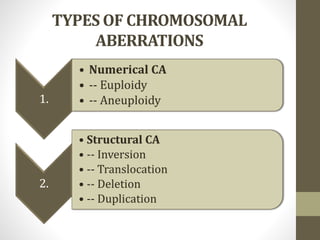
TYPES OF CHROMOSOMAL
ABERRATIONS
1.
• Numerical CA
• -- Euploidy
• -- Aneuploidy
2.
• Structural CA
• -- Inversion
• -- Translocation
• -- Deletion
• -- Duplication
NUMERICALCA
Euploidy
• Condition of a cell has one or more than one
complete set of chromosomes.
• Euploidy can be divided into two categories:
a) Monoploidy—(One set of chromosome
present)
b) Polyploidy—(Number of chromosomes
present in multiple copies)
Aneuploidy
• Aneuploidy is the presence of an abnormal
number of chromosome in cells. Instead of 46
chromosomes, human cell has 45/47
chromosomes or more.
• Four categories:
a) Nullisomy—(Lack of one pair of chromosome
than the normal i.e 22 pairs: Nullisomics)
b) Monosomy—(There is one less chromosome
than the normal)
c) Trisomy—(Presence of one extra chromosome
than the normal)
d) Tetrasomy—(Presence of one pair of
chromosomes than the normal)
STRUCTURALCA
• Structural chromosomal abnormalities occur
when there is a change in the parts of a
chromosome.
• It involves the rearrangement through gain,
loss, and reallocation of chromosomal
segment.
• Four types:
a) Deletion
b) Duplication
c) Inversion
d) Translocation
a) Inversion
Inversion occurs when a segment of a
chromosome is clipped off, inverted around 180
degrees and reallocated into the same
chromosome.
b) Translocation
When two nonhomologous chromosomes
exchange their parts, the resulting chromosomal
rearrangements are translocation.
c) Deletion
A deletion is the loss of a segment of a
chromosome which are associated with a
phenotypic effect. Deletion of chromosome
segment leads to the various syndromes.
E.g. Cri-du-chat syndrome
Occurs when the variable portion of the short
arm of chromosome 5 is deleted or missing. The
individual suffering from these syndromes are
severely impaired, mentally as well as
physically, cat like crying.
d) Duplication
Duplication is the occurrence of a segment of
chromosomes in two or more copies per
genome.
E.g. Charcot–Marie–Tooth disease—One of the
most common congenital neurological disorders
that is caused by the duplication of the gene on
chromosome 17. It affects the nerves of our feet,
ankle and legs.
Causes of Chromosomal Aberrations
• Ionising radiations: Have excess energy and
facilitates DNA damage.
• Spontaneous DNA Break: Double strand DNA
break can also be induced spontaneously and
occurs when there is an error during different
phases of cell cycle following mitosis and
meiosis.
• Chemicals: Genotoxicity is generally induced
by chemicals when DNA damage interferes
with DNA replication. E.g Nanoparticles
(Titanium dioxide), Pesticides, Chemicals
(Diethyl sulphate).
Methods of detection of
Chromosomal Aberrations
Cytogenetic Testing
• Chromosomal Aberration Test
• Micronucleus Assay
• Karyotyping
Prenatal Screening
Clinical Manifestationof Chromosomal
Aberrations
• Chromosomal abnormalities occur in 6% of all
recognized congenital malformations.
• It also accounts for 30%–40% of severe
mental retardation and 10% of the mild
mental retardation.
• Intrauterine growth retardation
• Congenital Anomalies
• Cancer: Wilms tumor, Retinoblastoma and
Osteosarcoma are some cancer types in which
gene deletions and duplications are considered
to be responsible for cancer progression
Changes in Course of Adolescence and Fertility
• Premature aging is generally very common in
autosomal chromosome aberration and is
observed at the age group from 18 to 25 years.
• Puberty is either diminished, delayed, or
completely absent in individuals.
• In females, there is frequent occurrence of
primary amenorrhea and secondary
amenorrhea.
• It is well known that most of the individuals
having CAs generally do not have offspring,
which is due to gonadal hypoplasia.

Chromosomal Aberration

  • 1.
  • 2.
    Introduction • The chromosomeis made of DNA containing many genes. • Genes are functional units of heredity. • Every gene comprises of the particular set of instructions for a particular function or protein coding. • Humans have about 20,000 to 23,000 genes.
  • 3.
    • In humans,somatic cell nuclei normally have 46 chromosomes in 23 pairs. • Each pair consists of one chromosome from the mother and one from the father. • Twenty-two of the pairs, chromosome numbers 1 to 22, the Autosomes, are normally homologous (identical in size, shape, and position and number of genes). • The 23rd pair, the sex chromosomes (X and Y), Allosomes, determines a person’s sex. • Women have 2 X chromosomes (which are homologous) in somatic cell nuclei; men have 1 X and 1 Y chromosome (which are heterologous).
  • 4.
    Definition “A gene isa specific sequence of DNA containing genetic information required to make a specific protein”.
  • 5.
    History of Genes •The classical principles of genetics were deduced by Gregor Mendel in 1865 on the basis of breeding experiments with peas. • He assumed that each trait is determined by a pair of inherited ‘factors’ which are now called Gene. • In 1909, Wilhelm Johannsen coined the term ‘GENE’.
  • 6.
  • 7.
    Introduction • Chromosomal alterationslead to genetic instability, which is a major cause of various genetic disorders. • These chromosomal alterations (loss or gain) in complete set of chromosome may be lethal. • Consequently, chromosomal abnormality is also responsible for failure of gametogenesis, fertilization, birth defects, deformities in live- born infants and mental retardations
  • 8.
    TYPES OF CHROMOSOMAL ABERRATIONS 1. •Numerical CA • -- Euploidy • -- Aneuploidy 2. • Structural CA • -- Inversion • -- Translocation • -- Deletion • -- Duplication
  • 9.
    NUMERICALCA Euploidy • Condition ofa cell has one or more than one complete set of chromosomes. • Euploidy can be divided into two categories: a) Monoploidy—(One set of chromosome present) b) Polyploidy—(Number of chromosomes present in multiple copies)
  • 10.
    Aneuploidy • Aneuploidy isthe presence of an abnormal number of chromosome in cells. Instead of 46 chromosomes, human cell has 45/47 chromosomes or more. • Four categories: a) Nullisomy—(Lack of one pair of chromosome than the normal i.e 22 pairs: Nullisomics) b) Monosomy—(There is one less chromosome than the normal) c) Trisomy—(Presence of one extra chromosome than the normal) d) Tetrasomy—(Presence of one pair of chromosomes than the normal)
  • 11.
    STRUCTURALCA • Structural chromosomalabnormalities occur when there is a change in the parts of a chromosome. • It involves the rearrangement through gain, loss, and reallocation of chromosomal segment. • Four types: a) Deletion b) Duplication c) Inversion d) Translocation
  • 12.
    a) Inversion Inversion occurswhen a segment of a chromosome is clipped off, inverted around 180 degrees and reallocated into the same chromosome. b) Translocation When two nonhomologous chromosomes exchange their parts, the resulting chromosomal rearrangements are translocation.
  • 13.
    c) Deletion A deletionis the loss of a segment of a chromosome which are associated with a phenotypic effect. Deletion of chromosome segment leads to the various syndromes. E.g. Cri-du-chat syndrome Occurs when the variable portion of the short arm of chromosome 5 is deleted or missing. The individual suffering from these syndromes are severely impaired, mentally as well as physically, cat like crying.
  • 14.
    d) Duplication Duplication isthe occurrence of a segment of chromosomes in two or more copies per genome. E.g. Charcot–Marie–Tooth disease—One of the most common congenital neurological disorders that is caused by the duplication of the gene on chromosome 17. It affects the nerves of our feet, ankle and legs.
  • 15.
    Causes of ChromosomalAberrations • Ionising radiations: Have excess energy and facilitates DNA damage. • Spontaneous DNA Break: Double strand DNA break can also be induced spontaneously and occurs when there is an error during different phases of cell cycle following mitosis and meiosis. • Chemicals: Genotoxicity is generally induced by chemicals when DNA damage interferes with DNA replication. E.g Nanoparticles (Titanium dioxide), Pesticides, Chemicals (Diethyl sulphate).
  • 16.
    Methods of detectionof Chromosomal Aberrations Cytogenetic Testing • Chromosomal Aberration Test • Micronucleus Assay • Karyotyping Prenatal Screening
  • 17.
    Clinical Manifestationof Chromosomal Aberrations •Chromosomal abnormalities occur in 6% of all recognized congenital malformations. • It also accounts for 30%–40% of severe mental retardation and 10% of the mild mental retardation. • Intrauterine growth retardation • Congenital Anomalies • Cancer: Wilms tumor, Retinoblastoma and Osteosarcoma are some cancer types in which gene deletions and duplications are considered to be responsible for cancer progression
  • 18.
    Changes in Courseof Adolescence and Fertility • Premature aging is generally very common in autosomal chromosome aberration and is observed at the age group from 18 to 25 years. • Puberty is either diminished, delayed, or completely absent in individuals. • In females, there is frequent occurrence of primary amenorrhea and secondary amenorrhea. • It is well known that most of the individuals having CAs generally do not have offspring, which is due to gonadal hypoplasia.

Editor's Notes