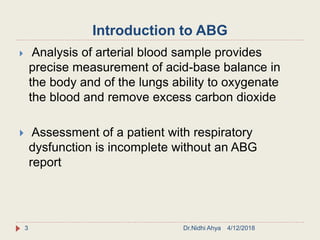
INTERPRETATION OF
ARTERIAL BLOOD GASES (ABG)
Dr. Nidhi Ahya ( M.P.T Cardio-Pulmonary)
Assistant Professor, Cardio-Vascular & Respiratory PT
DVVPF College of Physiotherapy,
Ahmednagar 414111
CONTENTS
 Introduction to ABG
 Background Definitions & Terminology
 Normal Acid-Base Status
 Normal Values
 Steps in Interpretation of ABG
 Acid-Base Disorders and Compensatory Mechanisms
 Respiratory Acidosis
 Respiratory Alkalosis
 Metabolic Acidosis
 Metabolic Alkalosis
 Examples
4/12/20182 Dr.Nidhi Ahya
Introduction to ABG
 Analysis of arterial blood sample provides
precise measurement of acid-base balance in
the body and of the lungs ability to oxygenate
the blood and remove excess carbon dioxide
 Assessment of a patient with respiratory
dysfunction is incomplete without an ABG
report
4/12/20183 Dr.Nidhi Ahya
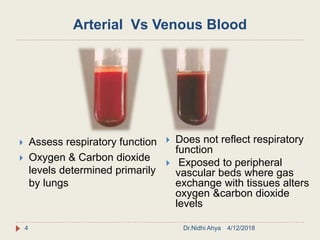
Arterial Vs Venous Blood
 Assess respiratory function
 Oxygen & Carbon dioxide
levels determined primarily
by lungs
 Does not reflect respiratory
function
 Exposed to peripheral
vascular beds where gas
exchange with tissues alters
oxygen &carbon dioxide
levels
4/12/20184 Dr.Nidhi Ahya
Arterial Blood Sampling
4/12/2018Dr.Nidhi Ahya5
 Arteriotomy- Invasive procedure
 Review patients chart for clinical
laboratory tests- PT/INR and
APTT
 Arterial blood sample obtained
from- Radial, Dorsalis Pedis,
Brachial or femoral arteries
 Radial Artery is the preferred
 accessible
 easy to stabilize post-puncture
Modified Allen’s Test
4/12/2018Dr.Nidhi Ahya6
 To evaluate the degree of collateral circulation to the
hand before puncture of radial artery
Obtaining Arterial Blood Sample
4/12/2018Dr.Nidhi Ahya7
 Requirements-
 Anticoagulant (liquid sodium)
 Sterile glass or low diffusibility plastic syringe
 Short bivel 20-22 gauge needle
 Isopropyl alchohol
 Sterile gauze squares
 Ice water bath
4/12/2018Dr.Nidhi Ahya8
 Sample must be obtained without being exposed to
the environment
 Air bubbles if any, should be removed, sample stored
in ice water bath to inhibit continued metabolism
 Samples at room temperature to be analyzed within
10-15 minutes
Background Definitions & Terminology
4/12/2018Dr.Nidhi Ahya9
 pH : The negative logarithm to the base 10 of the
hydrogen ion concentration in mol/L
ph = 1
log 10 (H+ )ion concentration
 Neutral pH : It is the pH at which there are equal no. of
H+ ions and OH– ions
The body preserves neutrality inside our cells
maintaining the blood at pH 7.4
4/12/2018Dr.Nidhi Ahya10
 Henderson-Hasselbalch equation:
pH œ OH- ion concentration
H+
ion concentration
 An increase in the pH indicates a proportionate
decrease in the [H+] and a decrease in the pH
indicates a proportionate increase in the [H+].
4/12/2018Dr.Nidhi Ahya11
 Acidosis and alkalosis :
Acidosis is an abnormality which tends to produce
an acidic pH i.e < 7.45
Alkalosis is the opposite. It produces an alkaline pH
i.e
pH > 7.45
7.00 7.25 7.45 7.67 7.85
Normal Acid-Base Status
4/12/2018Dr.Nidhi Ahya12
 Normal metabolism of proteins and nucleotides
generates about 100 mmol H+ per day in the form of
sulphuric and phosphoric acids.
 By comparison, hydration of CO2 to form H2CO3
generates 12,500 mmol H+ per day.
 The hydrogen ion environment is tightly controlled
by buffer systems
Minutes: CO2 excretion by the lungs
Hours to days: renal excretion of H+, reabsorption of
HCO3
Normal Values
4/12/2018Dr.Nidhi Ahya13
 pH - Measure of acid/base balance & ventilation
7.35-7.45
 PaCO2 - Measure of ventilation
35-45mmHg
 PaO2 - Measure of oxygenation or gas exchange
85-100mmHg
 HCO3 - Measure of metabolic disturbance
22-28 mEqm/l
 Base Excess - Measure of metabolic disturbance
-2 to +2
Steps in Interpretation of ABG
4/12/2018Dr.Nidhi Ahya14
 Step 1: Identify the pH. Is it within normal range?
pH >7.45 Alkalosis, pH < 7.35 Acidosis
Alkalosis- Respiratory or Metabolic
Acidosis- Respiratory or Metabolic
To confirm
 Step 2: Look at PaCO2 and HCO3
Increase in PaCO2 and decrease in HCO3 contributes to
acidosis
Decrease in PaCO2 and increase in HCO3 contributes to
alkalosis
4/12/2018Dr.Nidhi Ahya15
 Step 3: If pH is normal, but PaCO2 and HCO3 are not in
the ideal range- Compensatory mechanisms are active.
For metabolic abnormality, respiratory system
compensates, and for respiratory abnormality, metabolic
system acts.
RULE: Compensation always happens in the same
direction as the pH
i.e. To increase pH, HCO3 should increase
To decrease pH, HCO3 should decrease.
Alkolotic pH should decrease to become normal
Acidotic pH should increase to become normal
Interpretation of Acid Base Disorders
4/12/2018Dr.Nidhi Ahya16
 pH- 7.22
 PaCo2 - 56mmHg
 PaO2 -78 mmHg
 HCO3 - 23 mEqm/lit
Respiratory Acidosis
4/12/2018Dr.Nidhi Ahya17
 Respiratory Acidosis:
 Abnormality in which there is primary reduction in
alveolar ventilation relative to rate of CO2 production
 PaCO2 levels are above normal
 Respiratory acidosis is seen in-
 Severe diffuse airway obstruction
 Massive pulmonary edema
 Drug overdose
 Neuromusculoar disease
 Identifying the expected change in HCO3 is useful to
determine the level of compensation
 HCO3 increases 1mEq/L for each 10-15mmHg rise in
PaCO2
Interpretation of Acid Base Disorders
4/12/2018Dr.Nidhi Ahya18
 pH- 7.54
 PaCo2 - 29mmHg
 PaO2 -85 mmHg
 HCO3 - 23 mEqm/lit
Respiratory Alkalosis
4/12/2018Dr.Nidhi Ahya19
 Respiratory Alkalosis:
 Abnormality in which there is primary increase in
alveolar ventilation relative to rate of CO2 production
 PaCO2 levels are below expected level indicating
Hyperventilation
 Respiratory alkalosis is seen in-
 Pain
 Anxiety
 Fever
 Kidneys compensate by excreting HCO3
 Normal HCO3 with low PaCO2 and increased pH is a
uncompensated respiratory alkalosis.
Interpretation of Acid Base Disorders
4/12/2018Dr.Nidhi Ahya20
 pH- 7.28
 PaCo2 - 39mmHg
 PaO2 -89 mmHg
 HCO3 - 19 mEqm/lit
Metabolic Acidosis
4/12/2018Dr.Nidhi Ahya21
 Metabolic Acidosis:
 It is identified when the plasma HCO3 or base excess
falls below normal
 Occurs when increased load of H+ ions is present or body
is unable to excrete acids
 Loss of HCO3- Diarrhea, renal disease
 Increase in metabolic acid production- Ketoacidosis,
Lactic acidosis or ingestion of certain toxins like methanol
 A reduction in PaCO2 via hyperventilation compensates
for metabolic acidosis
 Kussmaul’s respiration is obvious sign of metabolic
acidosis
Interpretation of Acid Base Disorders
4/12/2018Dr.Nidhi Ahya22
 pH- 7.50
 PaCo2 - 42mmHg
 PaO2 -89 mmHg
 HCO3 - 33 mEqm/lit
Metabolic Alkalosis
4/12/2018Dr.Nidhi Ahya23
 Metabolic alkalosis:
 It is identifies by an above normal elevation of
plasma HCO3
 Occurs whenever HCO3
- ions accumulate in the
blood or when abnormal no. of H+ ions are lost from
plasma
 Common causes-
 Hypokalemia
 Persistant vomiting
 Diuretic Therapy
 Hypoventilation and an elevation of PaCO2
compensate for metabolic alkalosis
Summary
4/12/2018Dr.Nidhi Ahya24
 Introduction to ABG
 Background Definitions & Terminology
 Normal Acid-Base Status
 Normal Values
 Steps in Interpretation of ABG
 Acid-Base Disorders and Compensatory Mechanisms
 Examples
QUESTION
4/12/2018Dr.Nidhi Ahya25
 WRITE THE DEFINATION AND TERMINOLOGY OF
THE ABG ANALYSIS. 5MARKS
Thank You…
Solve the examples on the board....Before a Bye
Bye….!!!
4/12/2018Dr.Nidhi Ahya26

ABG analysis

  • 1.
    INTERPRETATION OF ARTERIAL BLOODGASES (ABG) Dr. Nidhi Ahya ( M.P.T Cardio-Pulmonary) Assistant Professor, Cardio-Vascular & Respiratory PT DVVPF College of Physiotherapy, Ahmednagar 414111
  • 2.
    CONTENTS  Introduction toABG  Background Definitions & Terminology  Normal Acid-Base Status  Normal Values  Steps in Interpretation of ABG  Acid-Base Disorders and Compensatory Mechanisms  Respiratory Acidosis  Respiratory Alkalosis  Metabolic Acidosis  Metabolic Alkalosis  Examples 4/12/20182 Dr.Nidhi Ahya
  • 3.
    Introduction to ABG Analysis of arterial blood sample provides precise measurement of acid-base balance in the body and of the lungs ability to oxygenate the blood and remove excess carbon dioxide  Assessment of a patient with respiratory dysfunction is incomplete without an ABG report 4/12/20183 Dr.Nidhi Ahya
  • 4.
    Arterial Vs VenousBlood  Assess respiratory function  Oxygen & Carbon dioxide levels determined primarily by lungs  Does not reflect respiratory function  Exposed to peripheral vascular beds where gas exchange with tissues alters oxygen &carbon dioxide levels 4/12/20184 Dr.Nidhi Ahya
  • 5.
    Arterial Blood Sampling 4/12/2018Dr.NidhiAhya5  Arteriotomy- Invasive procedure  Review patients chart for clinical laboratory tests- PT/INR and APTT  Arterial blood sample obtained from- Radial, Dorsalis Pedis, Brachial or femoral arteries  Radial Artery is the preferred  accessible  easy to stabilize post-puncture
  • 6.
    Modified Allen’s Test 4/12/2018Dr.NidhiAhya6  To evaluate the degree of collateral circulation to the hand before puncture of radial artery
  • 7.
    Obtaining Arterial BloodSample 4/12/2018Dr.Nidhi Ahya7  Requirements-  Anticoagulant (liquid sodium)  Sterile glass or low diffusibility plastic syringe  Short bivel 20-22 gauge needle  Isopropyl alchohol  Sterile gauze squares  Ice water bath
  • 8.
    4/12/2018Dr.Nidhi Ahya8  Samplemust be obtained without being exposed to the environment  Air bubbles if any, should be removed, sample stored in ice water bath to inhibit continued metabolism  Samples at room temperature to be analyzed within 10-15 minutes
  • 9.
    Background Definitions &Terminology 4/12/2018Dr.Nidhi Ahya9  pH : The negative logarithm to the base 10 of the hydrogen ion concentration in mol/L ph = 1 log 10 (H+ )ion concentration  Neutral pH : It is the pH at which there are equal no. of H+ ions and OH– ions The body preserves neutrality inside our cells maintaining the blood at pH 7.4
  • 10.
    4/12/2018Dr.Nidhi Ahya10  Henderson-Hasselbalchequation: pH œ OH- ion concentration H+ ion concentration  An increase in the pH indicates a proportionate decrease in the [H+] and a decrease in the pH indicates a proportionate increase in the [H+].
  • 11.
    4/12/2018Dr.Nidhi Ahya11  Acidosisand alkalosis : Acidosis is an abnormality which tends to produce an acidic pH i.e < 7.45 Alkalosis is the opposite. It produces an alkaline pH i.e pH > 7.45 7.00 7.25 7.45 7.67 7.85
  • 12.
    Normal Acid-Base Status 4/12/2018Dr.NidhiAhya12  Normal metabolism of proteins and nucleotides generates about 100 mmol H+ per day in the form of sulphuric and phosphoric acids.  By comparison, hydration of CO2 to form H2CO3 generates 12,500 mmol H+ per day.  The hydrogen ion environment is tightly controlled by buffer systems Minutes: CO2 excretion by the lungs Hours to days: renal excretion of H+, reabsorption of HCO3
  • 13.
    Normal Values 4/12/2018Dr.Nidhi Ahya13 pH - Measure of acid/base balance & ventilation 7.35-7.45  PaCO2 - Measure of ventilation 35-45mmHg  PaO2 - Measure of oxygenation or gas exchange 85-100mmHg  HCO3 - Measure of metabolic disturbance 22-28 mEqm/l  Base Excess - Measure of metabolic disturbance -2 to +2
  • 14.
    Steps in Interpretationof ABG 4/12/2018Dr.Nidhi Ahya14  Step 1: Identify the pH. Is it within normal range? pH >7.45 Alkalosis, pH < 7.35 Acidosis Alkalosis- Respiratory or Metabolic Acidosis- Respiratory or Metabolic To confirm  Step 2: Look at PaCO2 and HCO3 Increase in PaCO2 and decrease in HCO3 contributes to acidosis Decrease in PaCO2 and increase in HCO3 contributes to alkalosis
  • 15.
    4/12/2018Dr.Nidhi Ahya15  Step3: If pH is normal, but PaCO2 and HCO3 are not in the ideal range- Compensatory mechanisms are active. For metabolic abnormality, respiratory system compensates, and for respiratory abnormality, metabolic system acts. RULE: Compensation always happens in the same direction as the pH i.e. To increase pH, HCO3 should increase To decrease pH, HCO3 should decrease. Alkolotic pH should decrease to become normal Acidotic pH should increase to become normal
  • 16.
    Interpretation of AcidBase Disorders 4/12/2018Dr.Nidhi Ahya16  pH- 7.22  PaCo2 - 56mmHg  PaO2 -78 mmHg  HCO3 - 23 mEqm/lit Respiratory Acidosis
  • 17.
    4/12/2018Dr.Nidhi Ahya17  RespiratoryAcidosis:  Abnormality in which there is primary reduction in alveolar ventilation relative to rate of CO2 production  PaCO2 levels are above normal  Respiratory acidosis is seen in-  Severe diffuse airway obstruction  Massive pulmonary edema  Drug overdose  Neuromusculoar disease  Identifying the expected change in HCO3 is useful to determine the level of compensation  HCO3 increases 1mEq/L for each 10-15mmHg rise in PaCO2
  • 18.
    Interpretation of AcidBase Disorders 4/12/2018Dr.Nidhi Ahya18  pH- 7.54  PaCo2 - 29mmHg  PaO2 -85 mmHg  HCO3 - 23 mEqm/lit Respiratory Alkalosis
  • 19.
    4/12/2018Dr.Nidhi Ahya19  RespiratoryAlkalosis:  Abnormality in which there is primary increase in alveolar ventilation relative to rate of CO2 production  PaCO2 levels are below expected level indicating Hyperventilation  Respiratory alkalosis is seen in-  Pain  Anxiety  Fever  Kidneys compensate by excreting HCO3  Normal HCO3 with low PaCO2 and increased pH is a uncompensated respiratory alkalosis.
  • 20.
    Interpretation of AcidBase Disorders 4/12/2018Dr.Nidhi Ahya20  pH- 7.28  PaCo2 - 39mmHg  PaO2 -89 mmHg  HCO3 - 19 mEqm/lit Metabolic Acidosis
  • 21.
    4/12/2018Dr.Nidhi Ahya21  MetabolicAcidosis:  It is identified when the plasma HCO3 or base excess falls below normal  Occurs when increased load of H+ ions is present or body is unable to excrete acids  Loss of HCO3- Diarrhea, renal disease  Increase in metabolic acid production- Ketoacidosis, Lactic acidosis or ingestion of certain toxins like methanol  A reduction in PaCO2 via hyperventilation compensates for metabolic acidosis  Kussmaul’s respiration is obvious sign of metabolic acidosis
  • 22.
    Interpretation of AcidBase Disorders 4/12/2018Dr.Nidhi Ahya22  pH- 7.50  PaCo2 - 42mmHg  PaO2 -89 mmHg  HCO3 - 33 mEqm/lit Metabolic Alkalosis
  • 23.
    4/12/2018Dr.Nidhi Ahya23  Metabolicalkalosis:  It is identifies by an above normal elevation of plasma HCO3  Occurs whenever HCO3 - ions accumulate in the blood or when abnormal no. of H+ ions are lost from plasma  Common causes-  Hypokalemia  Persistant vomiting  Diuretic Therapy  Hypoventilation and an elevation of PaCO2 compensate for metabolic alkalosis
  • 24.
    Summary 4/12/2018Dr.Nidhi Ahya24  Introductionto ABG  Background Definitions & Terminology  Normal Acid-Base Status  Normal Values  Steps in Interpretation of ABG  Acid-Base Disorders and Compensatory Mechanisms  Examples
  • 25.
    QUESTION 4/12/2018Dr.Nidhi Ahya25  WRITETHE DEFINATION AND TERMINOLOGY OF THE ABG ANALYSIS. 5MARKS
  • 26.
    Thank You… Solve theexamples on the board....Before a Bye Bye….!!! 4/12/2018Dr.Nidhi Ahya26