Positive expiratory pressure
• The development of the positive expiratory
pressure (PEP) breathing came abou 1980s in
Denmark.
• Several devices deliver PEP in either oscillatory or
smooth flow method.
• Positive expiratory pressure includes one way
breathing valve and an adjustable level of
expiratory resistance that create back pressure to
stent the airways opening during exhalation.
• PEP therapy involves active expiration against
a fixed orifice flow resistor or variable orifice
threshold resistor capable of developing
pressure of 10-20cm H2O.
• A patient uses PEP in cycle of about 10
breaths at tidal volume with slightly active
expiration followed huffing and coughing.
Theory
• PEP breathing reinflates collapsed alveoli by
allowing air to be redistributed through
collateral channels- the pores of Kohn, and the
Lambert canals- allowing pressure to build up
distal to the obstruction and promoting the
movement of secretion toward the larger
airways.
Low pressure PEP
• The resistance is regulated to achieve 10-
20cm H2O during slightly active expiration.
• The appropriate resistor provide a flow
volume curve, demonstrating a maximal
forced vital capacity, good plateau and no
curvilinearity.
High pressure PEP
• It use the same principle but at much higher
levels of pressure (50-120cm H2O).
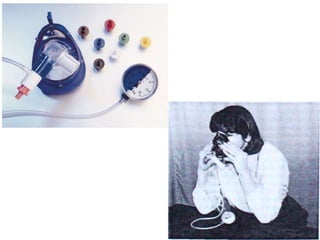
• Inspiration is performed to total lung capacity,
followed by a forced expiratory maneuver against
the PEP mask, which is connected to the
spirometer.
• The equipment consist of ventilation mask, one
way valve and various resistor.
• Spirometery is used to determine the
appropriate resistance for each individual
patients.
• 1 ½mm resistor:- infants
• 2 ½ to 3mm:- older children
• 3 ½mm:- adults
Indications of positive expiratory
pressure
• Improve airway clearance
• Cystic fibrosis
• Bronchiectasis
• COPD
• Acute and chronic respiratory failure
• Improve lung function
• Post operative atelectasis
Contraindication of positive expiratory
pressure
• Untreated pneumothorax
• Acute hemoptysis
• Recent trauma or surgery
• Acute sinuitis or epistaxis
• Increased intracranial pressure
Uses of PEP
• Improve ventilation and gas exchange
• Help in airway clearance
• Prevent post operative atelectasis
• Reduce pulmonary hyperinflation
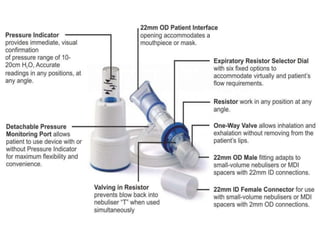
TheraPEP
• It consist of mouth piece expiratory resistor that
can accommodate many levels of expiratory
flow.
• It come with a detachable pressure monitoring
part and indicator to show 10-20cm H2O.
• It can accommodate mask of different sizes.
Uses of TheraPEP
• mobilize secretions
• chronic respiratory diseases
• Cystic Fibrosis (CF),
• prevent atelectasis,
• Post operative patients
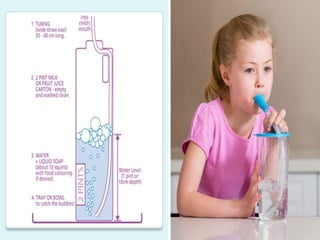
Bubble PEP
• A system that incorporates a column of water ( to
the level of PEP required:- 10-12cm H2O ) and
asking the child to blow through the column of
water via flexible straw or tubing.
• Adding a little liquid detergent to the water, on
exhalation produce stream of bubbles.
• It is important that the child is instructed to only
exhale through the tubing and never inhale.
Oscillating PEP
• It provide rapid fluctuation in airway as the
patient exhales.
• The frequency of the vibration range from 10-
30Hz with amplitude ranging from 20 to 100 torr
at flow of 10-25L/min.
• It provide positive expiratory pressure, oscillation
of the airway and accelerated expiratory flow rate
to loose secretion and move secretion centrally.
• Patient must be able to take deep breath (>10-
12 mL/kg) to generate adequate pressure,
oscillation and prolonged exhalation.
• Commonly used devices:-
1. Flutter
2. R-C cornet
3. Acapella
Flutter
• This is a pipe like device consist of a steel ball, a
plastic cone , a perforated cover and a mouth
piece.
• Exhaled air cause the steel ball to roll up and
down the cone causing airflow vibration.
• The PEP maintained by the flutter (5-35cm H2O)
prevent dynamic airway compression and
improve airway acceleration.
• Movement of the flutter
Upward:- increase pressure and frequency
Downward:- lower pressure and frequency
Uses of flutter
• loosening mucus
• facilitating movement of mucus up the
airways
• prevent the alveoli from collapsing
• Effective in cystic fibrosis and COPD pt.
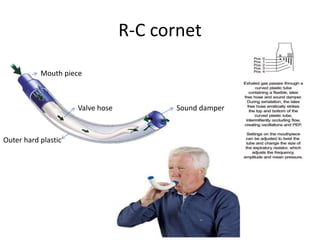
R-C cornet
Mouth piece
Valve hose
Outer hard plastic
Sound damper
• Consist of a curved hard plastic outer tube,
mouth piece and flexible iatex free inner tube.
• The flow, pressure and frequency of the
oscillation can be adjusted to suit the
individual and it can be used in any position.
• It is independent of gravitational forces.
• It can be used for 10-15 min.
Uses of R-C cornet
• Airway clearance
• Effective in:-
COPD
 Cystic fibrosis
Pulmonary disease
Bronchiectasis
Acapella
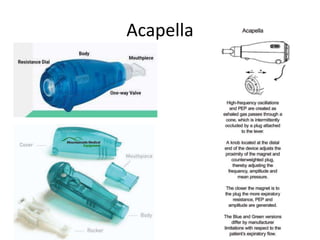
• Acapella consist of a mouth piece attached to the
body of the unit that uses a counterweighted plug
and magnet to create airflow oscillation and a dial
for expiratory resistance at the other end.
• It comes in several models such as:
Green:- maintain expiratory flow rate of 15L/min
or more
Blue:- expiratory flow rate is less than 15L/min
Uses of acapella
• Effective in:
Cystic fibrosis
COPD
Bronchiectasis
Asthma
Mucociliary disorders
References
• Dean E, Frownfelter DL. Cardiovascular and
pulmonary physical therapy: Evidence and
practice. Mosby; 2006.
• Kacmarek RM, Stoller JK, Heuer A. Egan's
Fundamentals of Respiratory Care. Elsevier
Health Sciences; 2016 Feb 5.
• Pryor JA, Prasad AS. Physiotherapy for respiratory
and cardiac problems: adults and paediatrics.
Elsevier Health Sciences; 2008 Mar 6.
THANK YOU

Pep devices

  • 1.
    Positive expiratory pressure •The development of the positive expiratory pressure (PEP) breathing came abou 1980s in Denmark. • Several devices deliver PEP in either oscillatory or smooth flow method. • Positive expiratory pressure includes one way breathing valve and an adjustable level of expiratory resistance that create back pressure to stent the airways opening during exhalation.
  • 2.
    • PEP therapyinvolves active expiration against a fixed orifice flow resistor or variable orifice threshold resistor capable of developing pressure of 10-20cm H2O. • A patient uses PEP in cycle of about 10 breaths at tidal volume with slightly active expiration followed huffing and coughing.
  • 3.
    Theory • PEP breathingreinflates collapsed alveoli by allowing air to be redistributed through collateral channels- the pores of Kohn, and the Lambert canals- allowing pressure to build up distal to the obstruction and promoting the movement of secretion toward the larger airways.
  • 4.
    Low pressure PEP •The resistance is regulated to achieve 10- 20cm H2O during slightly active expiration. • The appropriate resistor provide a flow volume curve, demonstrating a maximal forced vital capacity, good plateau and no curvilinearity.
  • 5.
    High pressure PEP •It use the same principle but at much higher levels of pressure (50-120cm H2O). • Inspiration is performed to total lung capacity, followed by a forced expiratory maneuver against the PEP mask, which is connected to the spirometer. • The equipment consist of ventilation mask, one way valve and various resistor.
  • 7.
    • Spirometery isused to determine the appropriate resistance for each individual patients. • 1 ½mm resistor:- infants • 2 ½ to 3mm:- older children • 3 ½mm:- adults
  • 8.
    Indications of positiveexpiratory pressure • Improve airway clearance • Cystic fibrosis • Bronchiectasis • COPD • Acute and chronic respiratory failure • Improve lung function • Post operative atelectasis
  • 9.
    Contraindication of positiveexpiratory pressure • Untreated pneumothorax • Acute hemoptysis • Recent trauma or surgery • Acute sinuitis or epistaxis • Increased intracranial pressure
  • 10.
    Uses of PEP •Improve ventilation and gas exchange • Help in airway clearance • Prevent post operative atelectasis • Reduce pulmonary hyperinflation
  • 11.
    TheraPEP • It consistof mouth piece expiratory resistor that can accommodate many levels of expiratory flow. • It come with a detachable pressure monitoring part and indicator to show 10-20cm H2O. • It can accommodate mask of different sizes.
  • 13.
    Uses of TheraPEP •mobilize secretions • chronic respiratory diseases • Cystic Fibrosis (CF), • prevent atelectasis, • Post operative patients
  • 14.
    Bubble PEP • Asystem that incorporates a column of water ( to the level of PEP required:- 10-12cm H2O ) and asking the child to blow through the column of water via flexible straw or tubing. • Adding a little liquid detergent to the water, on exhalation produce stream of bubbles. • It is important that the child is instructed to only exhale through the tubing and never inhale.
  • 16.
    Oscillating PEP • Itprovide rapid fluctuation in airway as the patient exhales. • The frequency of the vibration range from 10- 30Hz with amplitude ranging from 20 to 100 torr at flow of 10-25L/min. • It provide positive expiratory pressure, oscillation of the airway and accelerated expiratory flow rate to loose secretion and move secretion centrally.
  • 18.
    • Patient mustbe able to take deep breath (>10- 12 mL/kg) to generate adequate pressure, oscillation and prolonged exhalation. • Commonly used devices:- 1. Flutter 2. R-C cornet 3. Acapella
  • 19.
  • 20.
    • This isa pipe like device consist of a steel ball, a plastic cone , a perforated cover and a mouth piece. • Exhaled air cause the steel ball to roll up and down the cone causing airflow vibration. • The PEP maintained by the flutter (5-35cm H2O) prevent dynamic airway compression and improve airway acceleration. • Movement of the flutter Upward:- increase pressure and frequency Downward:- lower pressure and frequency
  • 21.
    Uses of flutter •loosening mucus • facilitating movement of mucus up the airways • prevent the alveoli from collapsing • Effective in cystic fibrosis and COPD pt.
  • 22.
    R-C cornet Mouth piece Valvehose Outer hard plastic Sound damper
  • 23.
    • Consist ofa curved hard plastic outer tube, mouth piece and flexible iatex free inner tube. • The flow, pressure and frequency of the oscillation can be adjusted to suit the individual and it can be used in any position. • It is independent of gravitational forces. • It can be used for 10-15 min.
  • 24.
    Uses of R-Ccornet • Airway clearance • Effective in:- COPD  Cystic fibrosis Pulmonary disease Bronchiectasis
  • 25.
  • 26.
    • Acapella consistof a mouth piece attached to the body of the unit that uses a counterweighted plug and magnet to create airflow oscillation and a dial for expiratory resistance at the other end. • It comes in several models such as: Green:- maintain expiratory flow rate of 15L/min or more Blue:- expiratory flow rate is less than 15L/min
  • 27.
    Uses of acapella •Effective in: Cystic fibrosis COPD Bronchiectasis Asthma Mucociliary disorders
  • 28.
    References • Dean E,Frownfelter DL. Cardiovascular and pulmonary physical therapy: Evidence and practice. Mosby; 2006. • Kacmarek RM, Stoller JK, Heuer A. Egan's Fundamentals of Respiratory Care. Elsevier Health Sciences; 2016 Feb 5. • Pryor JA, Prasad AS. Physiotherapy for respiratory and cardiac problems: adults and paediatrics. Elsevier Health Sciences; 2008 Mar 6.
  • 29.