Interpretation of ABG
Presenter : Dr. Saran A K
26 September 2023
It is a diagnostic procedure in which a blood is drawn from
an artery directly by an arterial puncture or from an
indwelling arterial catheter.
Indications : Obtain information about patient’s
• Ventilation(pCO2)
• Oxygenation (pO2)
• Acid-Base balance
DR. SARAN A K 2
Objectives
• ABG sampling
• Interpretation of ABG
• Oxygenation status
• Acid base status
DR. SARAN A K 3
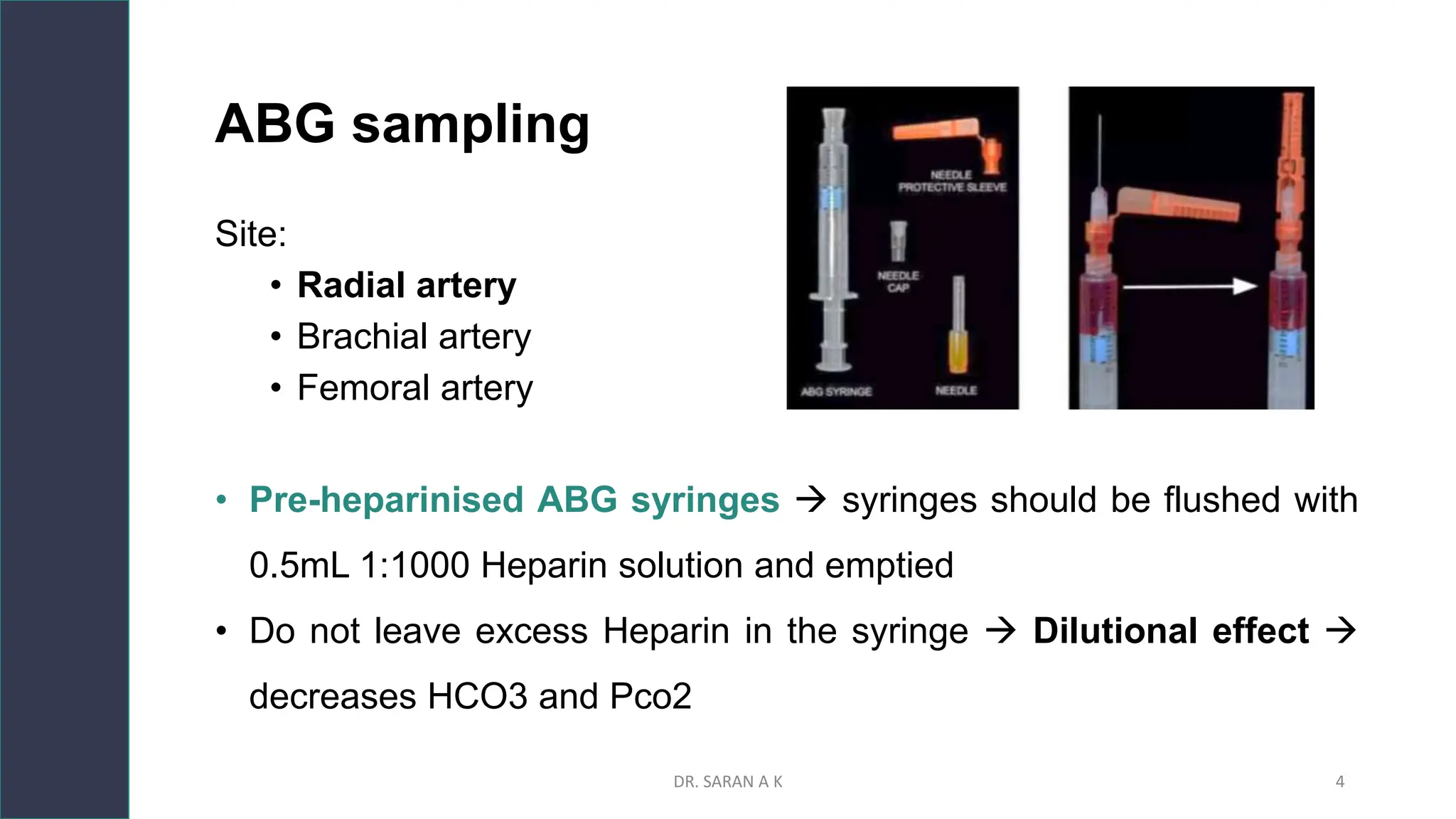
ABG sampling
Site:
• Radial artery
• Brachial artery
• Femoral artery
• Pre-heparinised ABG syringes  syringes should be flushed with
0.5mL 1:1000 Heparin solution and emptied
• Do not leave excess Heparin in the syringe  Dilutional effect 
decreases HCO3 and Pco2
DR. SARAN A K 4
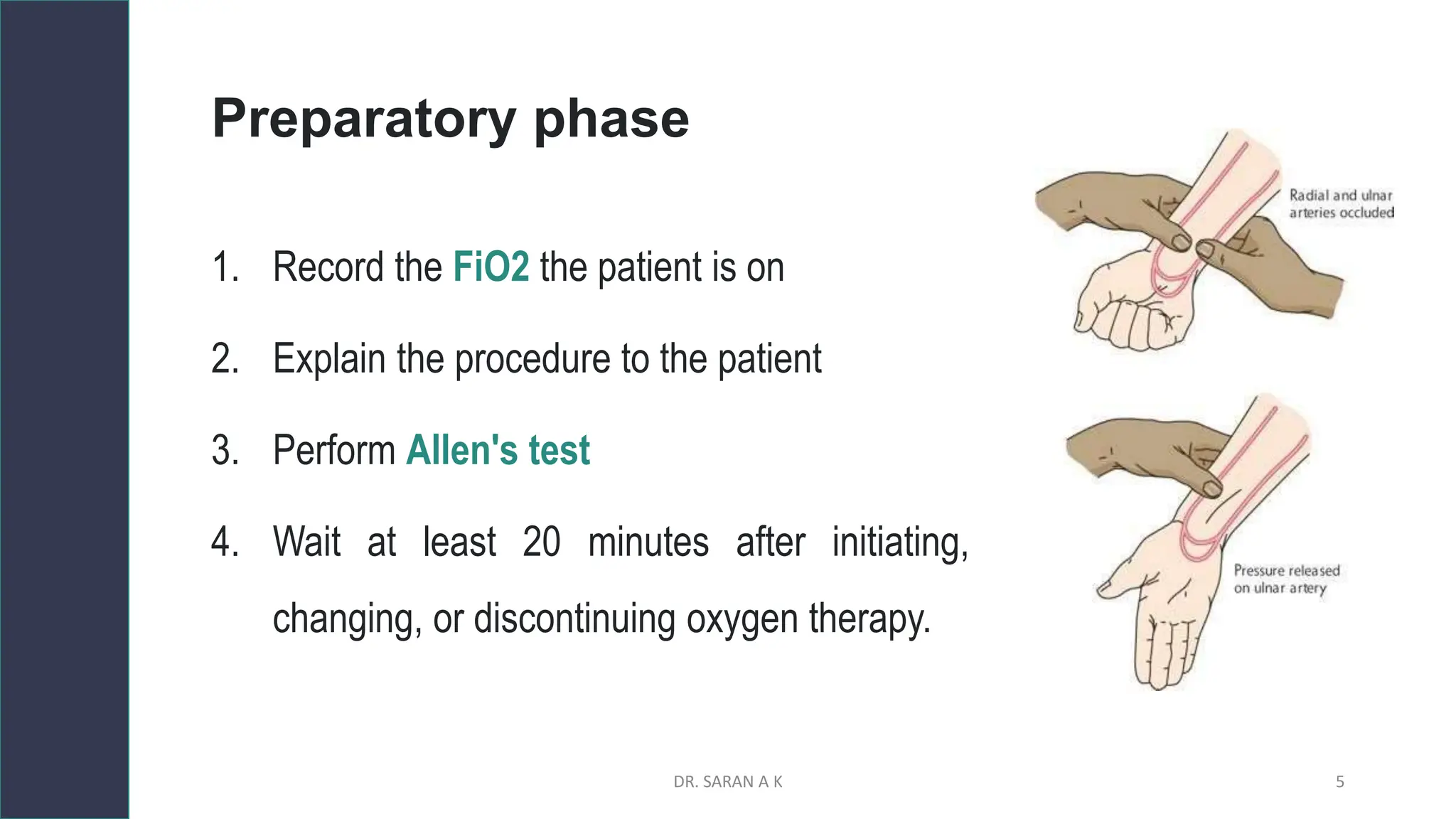
Preparatory phase
1. Record the FiO2 the patient is on
2. Explain the procedure to the patient
3. Perform Allen's test
4. Wait at least 20 minutes after initiating,
changing, or discontinuing oxygen therapy.
DR. SARAN A K 5
Technical errors
1. Risk of alteration of results
• Increased size of syringe / needle -Use < 3mL syringe
• Decreased volume of sample- Syringes must have > 50% blood
2. Air bubbles (Po2 150mmHg and Pco2 0mmHg)
• Increase Po2 and decrease Pco2. Seal syringe immediately
after sampling
3. Body temperature
• ABG analyser controlled for normal body temperatures
DR. SARAN A K 6
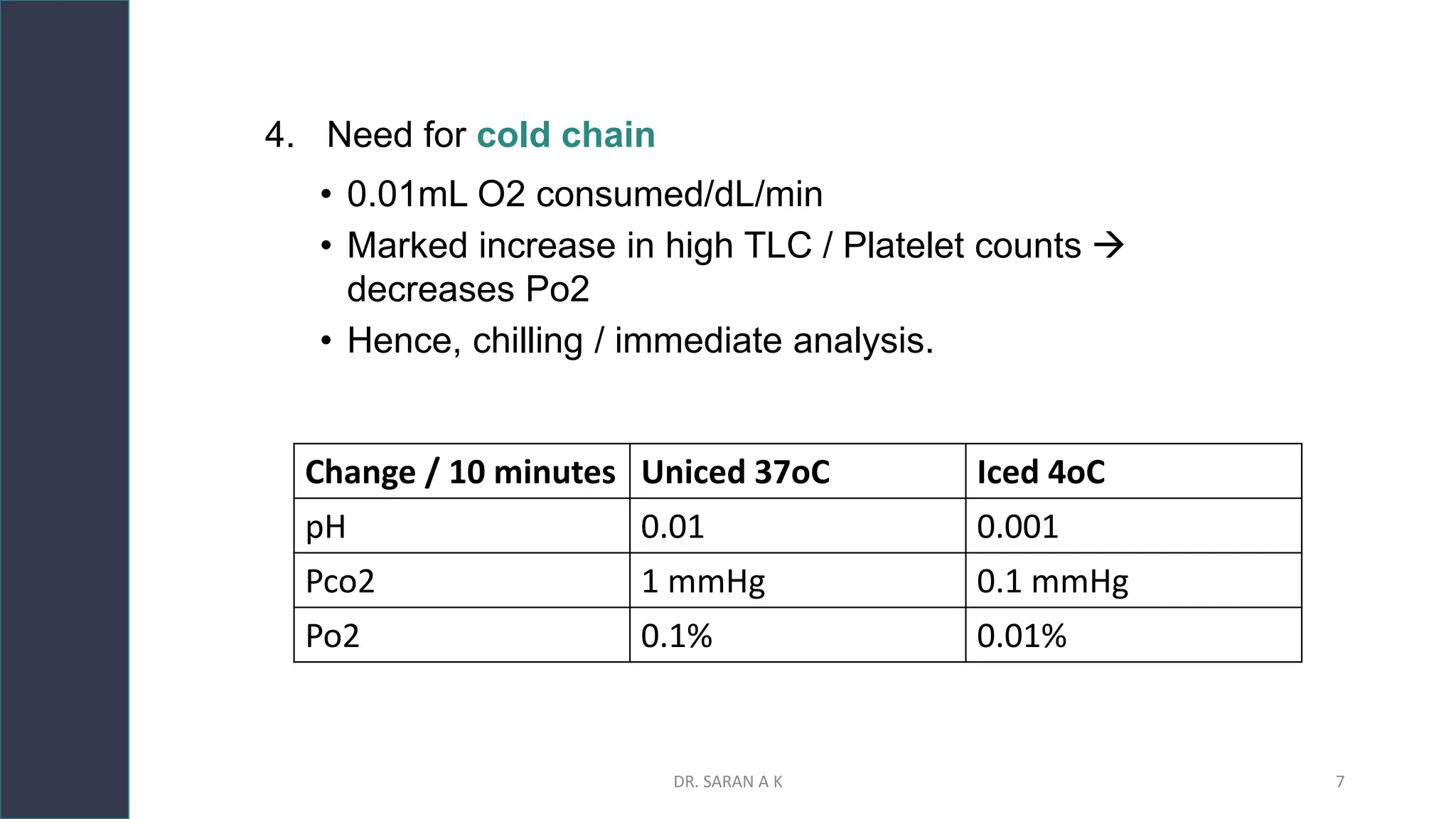
4. Need for cold chain
• 0.01mL O2 consumed/dL/min
• Marked increase in high TLC / Platelet counts 
decreases Po2
• Hence, chilling / immediate analysis.
Change / 10 minutes Uniced 37oC Iced 4oC
pH 0.01 0.001
Pco2 1 mmHg 0.1 mmHg
Po2 0.1% 0.01%
DR. SARAN A K 7
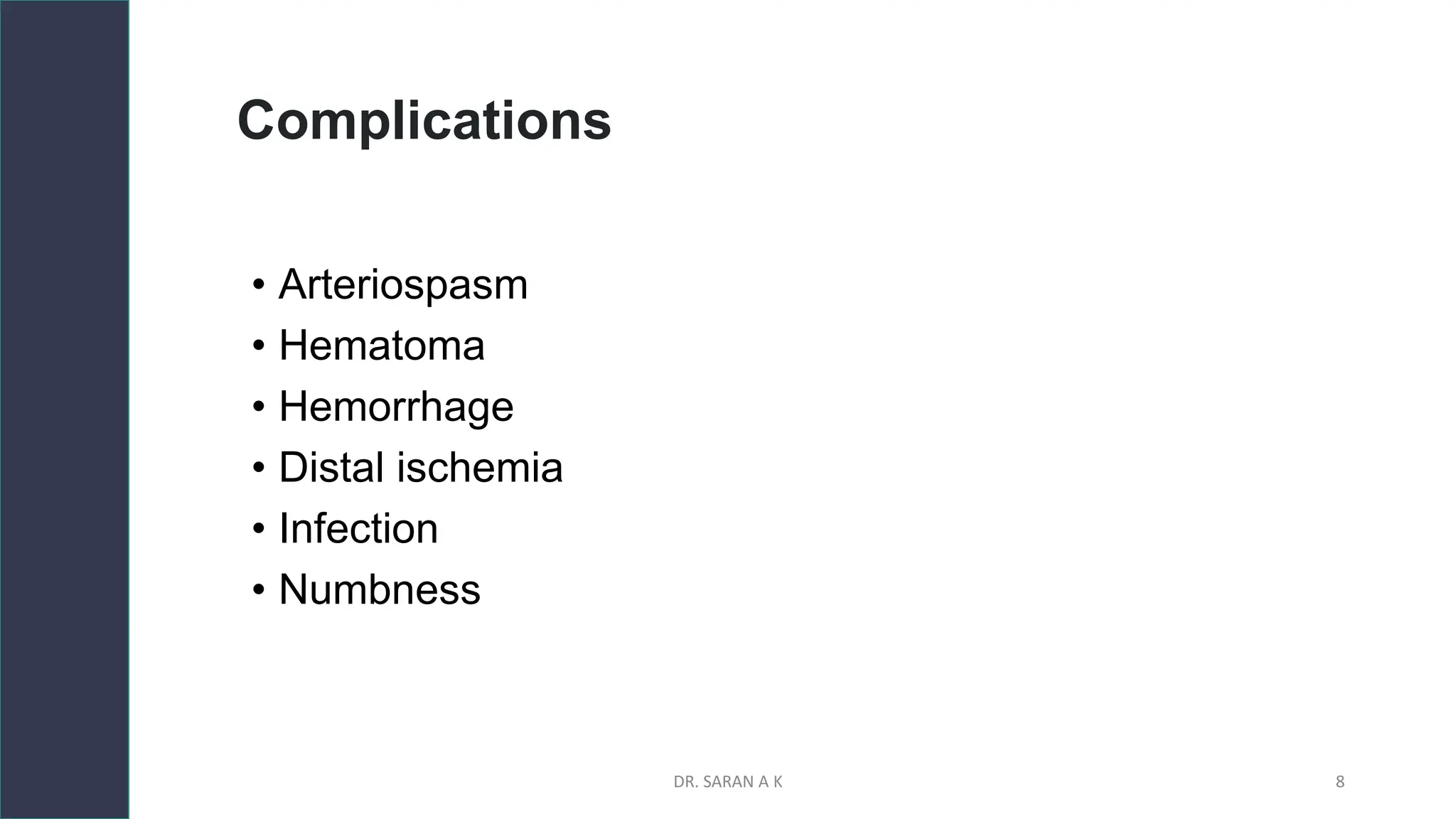
Complications
• Arteriospasm
• Hematoma
• Hemorrhage
• Distal ischemia
• Infection
• Numbness
DR. SARAN A K 8
ABG components
1. pH: indicates H+ ion concentration pH = - log[H+]
2. pO2: O2 that is dissolved in the blood , it reflects the body’s ability
to pick up oxygen from the lungs
3. pCO2 : CO2 that is carried by the blood for excretion through the
lungs - Respiratory parameter
4. HCO3 : Metabolic parameter. It reflects the kidney’s ability to
retain and excrete HCO3
DR. SARAN A K 9
Interpretation of ABG
• Gas Exchange
• Acid Base Status
DR. SARAN A K 10
A. Gas Exchange
1. Determination of PO2
• PaO2 is dependent upon Age, FiO2, Patm
• As age increases, PaO2 decreases
PaO2 = 109- 0.4 (Age)
• As FiO2 increases, the expected PaO2 increases
(Alveolar Gas Equation)
PAO2 = (PB-PH20) X FiO2 – PCO2/R
DR. SARAN A K 11
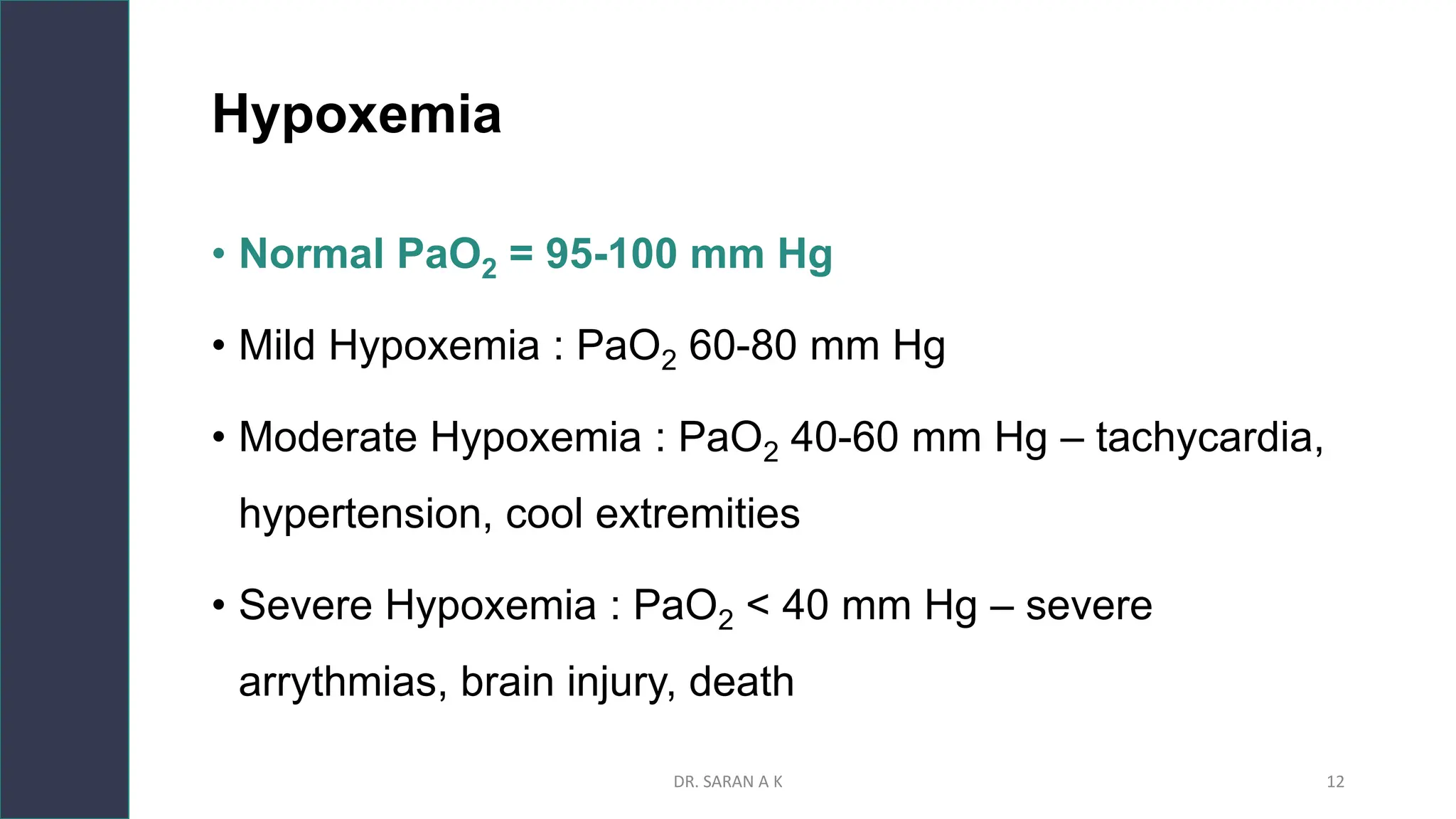
Hypoxemia
• Normal PaO2 = 95-100 mm Hg
• Mild Hypoxemia : PaO2 60-80 mm Hg
• Moderate Hypoxemia : PaO2 40-60 mm Hg – tachycardia,
hypertension, cool extremities
• Severe Hypoxemia : PaO2 < 40 mm Hg – severe
arrythmias, brain injury, death
DR. SARAN A K 12
2. Alveolar- Arterial O2 gradient
• P(A-a)O2 is the alveolar- arterial difference in partial
pressures of oxygen
• PAO2 = 150 – PaCO2/RQ
• Normal Range : 5-25 mm Hg (increases with age)
• Increase P(A-a)O2 – lung parenchymal disease
DR. SARAN A K 13
3. PaO2/FiO2 Ratio
• Inspired Air FiO2 = 21%
• PiO2 = 150 mmHg
• PAO2 = 100 mm Hg
• PaO2 = 90 mm Hg
PaO2/FiO2 Ratio Inference
200-300 mmHg Mild ARDS
100-200 mmHg Moderate ARDS
<100 mm Hg Severe ARDS
Berlin Criteria for ARDS Severity
DR. SARAN A K 14
4. Hypercapnia
• PaCO2 is directly proportional to CO2 production and
inversely proportional to alveolar ventilation.
• Normal PaCO2 is 35-45mm Hg
DR. SARAN A K 15
DR. SARAN A K 16
B. Acid Base Status
• pH = -log [H+] : Sorensen formula
DR. SARAN A K 17
Henderson Hesselbalch Equation
Correlates metabolic and respiratory regulations.
DR. SARAN A K 18
DR. SARAN A K 19
Bicarbonate Buffer System
DR. SARAN A K 20
Respiratory Regulation
DR. SARAN A K 21
Renal Regulation
Kidneys control the acid base
balance by excreting a basic or an
acidic urine
1. Excretion of HCO3
-
2. Regeneration of HCO3
- with
excretion of H+
DR. SARAN A K 22
Response
• Bicarbonate Buffer System – acts in few seconds
• Respiratory Regulation – starts within minutes
good response by 2 hrs, complete by 12-24 hrs
• Renal Regulation – starts after few hrs, complete
by 5-7hrs
DR. SARAN A K 23
Normal values
DR. SARAN A K 24
Simple Acid Base Disorders
A single primary process of acidosis or alkalosis
with or without compensation.
DR. SARAN A K 25
Compensation
The body always tries to normalize the pH - pCO2 and HCO3
-
rise and fall together in simple disorders
• Compensation never overcorrects the pH
• Lack of comp in an appropriate time defines a 2nd disorder.
• Requires normally functioning lungs and kidney
DR. SARAN A K 26
Characteristics of primary acid base disorders
DR. SARAN A K 27
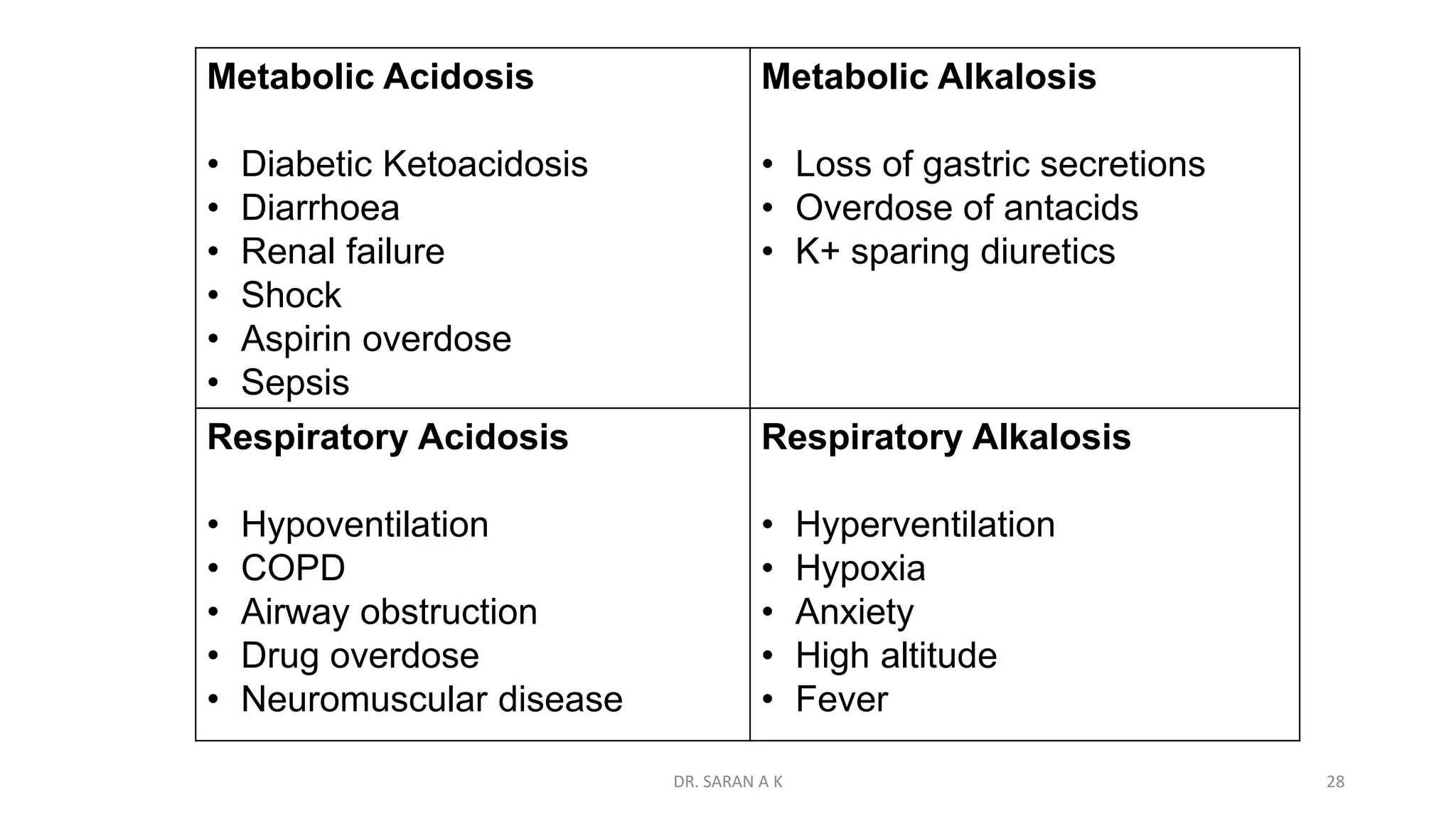
Metabolic Acidosis
• Diabetic Ketoacidosis
• Diarrhoea
• Renal failure
• Shock
• Aspirin overdose
• Sepsis
Metabolic Alkalosis
• Loss of gastric secretions
• Overdose of antacids
• K+ sparing diuretics
Respiratory Acidosis
• Hypoventilation
• COPD
• Airway obstruction
• Drug overdose
• Neuromuscular disease
Respiratory Alkalosis
• Hyperventilation
• Hypoxia
• Anxiety
• High altitude
• Fever
DR. SARAN A K 28
Mixed Acid Base Disorders
Presence of more than one acid base disorder simultaneously
Clues to a mixed disorder
• Normal pH with abnormal HCO3
- or pCO2
• pCO2 and HCO3
- move in the opposite directions
• pH changes in an opposite direction for a known primary disorder
DR. SARAN A K 29
Step by Step Analysis
of Acid Base Balance
DR. SARAN A K 30
Clinical History
• A 24-year-old male, k/c/o T1DM on insulin for past 2 years
presented to the ED with complaints of SOB for one day, fever for 3
days. The patient also complained about abdominal pain in
epigastric region since the previous day.
• On examination, sensorium impaired, RR>30/min Chest AEBE,
S1 S2 Normal, Abdomen soft
• ABG was ordered.
DR. SARAN A K 31
DR. SARAN A K 32
Step 1 : Acidemia/ Alkalemia?
DR. SARAN A K 33
Step 2 : What is the primary disorder?
DR. SARAN A K 34
Step 3 : Calculation of compensation
DR. SARAN A K 35
Response to metabolic acid-base disorder
∆minute ventilation – mediated by peripheral chemoreceptors
Fast response = 30-120 min.
Metabolic acidosis
• ↑ 𝑀𝑉 - ↑ 𝐶𝑂2 washout
• Winter’s formula : 𝑬𝒙𝒑𝒆𝒄𝒕𝒆𝒅 PCO2 = 1.5 X [HCO3] + 8±2
Metabolic alkalosis
• ↓ 𝑀𝑉 - ↓ CO2 washout = ↑ PCO2
• E𝒙𝒑𝒆𝒄𝒕𝒆𝒅 PCO2 = 0.7 X HCO3 + 20 ± 5
DR. SARAN A K 36
Winter’s formula :
𝐸𝑥𝑝𝑒𝑐𝑡𝑒𝑑 PCO2 = 1.5 X [HCO3] + 8±2
Expected PCO2 = 1.5 x 3.2 + 8±2
Expected PCO2 = 4.8 + 8±2
Expected PCO2 = 12.8 ±2
= 10.8- 14.8
DR. SARAN A K 37
• Metabolic Acidosis
• Metabolic Alkalosis
DR. SARAN A K 38
Response to respiratory acid-base disorder
• Proximal renal tubules adjusts the absorption of HCO3 to produce
change in plasma HCO3
• Slow response : 2-3 days
DR. SARAN A K 39
Acute respiratory disorders
• A/c resp. acidosis : E𝑥𝑝𝑒𝑐𝑡𝑒𝑑 𝑐ℎ𝑎𝑛𝑔𝑒 𝑖𝑛 𝐻𝐶𝑂3 = 0.1 𝑋 ∆𝑃𝑎𝐶𝑂2
• A/c resp. alkalosis : E𝑥𝑝𝑒𝑐𝑡𝑒𝑑 𝑐ℎ𝑎𝑛𝑔𝑒 𝑖𝑛 𝐻𝐶𝑂3 = 0.2 𝑋 ∆𝑃𝑎𝐶𝑂2
Chronic respiratory disorders
• ↑PaCO2 = ↑ HCO3 abso𝑟𝑝𝑡𝑖𝑜𝑛
• ↓ PaCO2 = ↓HCO3 abso𝑟𝑝𝑡𝑖𝑜𝑛
• 𝐸𝑥𝑝𝑒𝑐𝑡𝑒𝑑 change in HCO3 = 0.4 X ∆PaCO2
DR. SARAN A K 40
Respiratory Acidosis
• If Serum HCO3 > expected bicarbonate, additional metabolic
alkalosis and vice versa.
Respiratory Alkalosis
• If Serum HCO3 < expected bicarbonate, additional metabolic
acidosis and vice versa
DR. SARAN A K 41
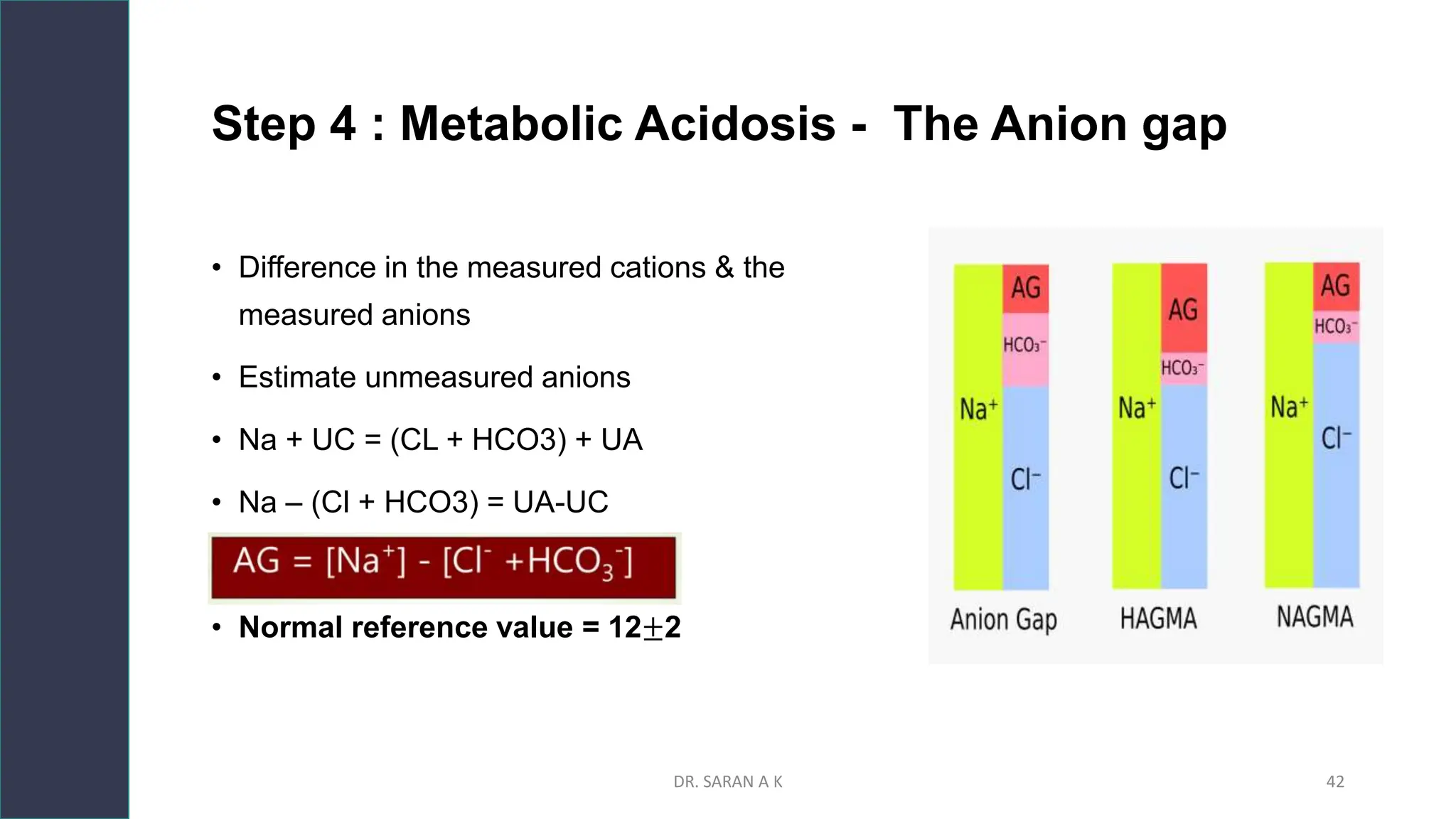
Step 4 : Metabolic Acidosis - The Anion gap
• Difference in the measured cations & the
measured anions
• Estimate unmeasured anions
• Na + UC = (CL + HCO3) + UA
• Na – (Cl + HCO3) = UA-UC
• AG = Na-(Cl + HCO3)
• Normal reference value = 12±2
DR. SARAN A K 42
DR. SARAN A K 43
HAGMA NAGMA
Diabetic Ketoacidosis
Chronic Kidney Disease
Lactic Acidosis
Alcoholic Keto acidosis
Aspirin Poisoning
Methanol poisoning
Ethylene Glycol Poisoning
Starvation
Diarrhea
Renal Tubular Acidosis
Addison's Disease
Carbonic Anhydrase
Inhibitors
DR. SARAN A K 44
Influence of albumin
• Principal determinant of AG
• Low albumin lowers AG-mask the presence of UA
• AGc = AG + 2.5 ( 4.5 - [albumin in g/dL])
DR. SARAN A K 45
Delta Gap
• The difference between patients AG and normal AG
• The coexistence of 2 metabolic acid-base disorders may be apparent
• Delta gap = Anion Gap -12
• Delta gap + HCO3- = 22-26 mEq/l
• If >26, consider additional metabolic alkalosis
• If < 22, consider additional non-AG metabolic acidosis
DR. SARAN A K 46
Summary
• ABG is a diagnostic tool that helps us to understand the
ventilation, oxygenation and acid base status of the patient.
• Stepwise approach to ABG interpretation can help to
elucidate the underlying acid base disorders- metabolic or
respiratory and acidosis or alkalosis.
DR. SARAN A K 47
THANK YOU !
saran.adhoc@gmail.com
DR. SARAN A K 48

Interpretation of ABG.pptx

  • 1.
    Interpretation of ABG Presenter: Dr. Saran A K 26 September 2023
  • 2.
    It is adiagnostic procedure in which a blood is drawn from an artery directly by an arterial puncture or from an indwelling arterial catheter. Indications : Obtain information about patient’s • Ventilation(pCO2) • Oxygenation (pO2) • Acid-Base balance DR. SARAN A K 2
  • 3.
    Objectives • ABG sampling •Interpretation of ABG • Oxygenation status • Acid base status DR. SARAN A K 3
  • 4.
    ABG sampling Site: • Radialartery • Brachial artery • Femoral artery • Pre-heparinised ABG syringes  syringes should be flushed with 0.5mL 1:1000 Heparin solution and emptied • Do not leave excess Heparin in the syringe  Dilutional effect  decreases HCO3 and Pco2 DR. SARAN A K 4
  • 5.
    Preparatory phase 1. Recordthe FiO2 the patient is on 2. Explain the procedure to the patient 3. Perform Allen's test 4. Wait at least 20 minutes after initiating, changing, or discontinuing oxygen therapy. DR. SARAN A K 5
  • 6.
    Technical errors 1. Riskof alteration of results • Increased size of syringe / needle -Use < 3mL syringe • Decreased volume of sample- Syringes must have > 50% blood 2. Air bubbles (Po2 150mmHg and Pco2 0mmHg) • Increase Po2 and decrease Pco2. Seal syringe immediately after sampling 3. Body temperature • ABG analyser controlled for normal body temperatures DR. SARAN A K 6
  • 7.
    4. Need forcold chain • 0.01mL O2 consumed/dL/min • Marked increase in high TLC / Platelet counts  decreases Po2 • Hence, chilling / immediate analysis. Change / 10 minutes Uniced 37oC Iced 4oC pH 0.01 0.001 Pco2 1 mmHg 0.1 mmHg Po2 0.1% 0.01% DR. SARAN A K 7
  • 8.
    Complications • Arteriospasm • Hematoma •Hemorrhage • Distal ischemia • Infection • Numbness DR. SARAN A K 8
  • 9.
    ABG components 1. pH:indicates H+ ion concentration pH = - log[H+] 2. pO2: O2 that is dissolved in the blood , it reflects the body’s ability to pick up oxygen from the lungs 3. pCO2 : CO2 that is carried by the blood for excretion through the lungs - Respiratory parameter 4. HCO3 : Metabolic parameter. It reflects the kidney’s ability to retain and excrete HCO3 DR. SARAN A K 9
  • 10.
    Interpretation of ABG •Gas Exchange • Acid Base Status DR. SARAN A K 10
  • 11.
    A. Gas Exchange 1.Determination of PO2 • PaO2 is dependent upon Age, FiO2, Patm • As age increases, PaO2 decreases PaO2 = 109- 0.4 (Age) • As FiO2 increases, the expected PaO2 increases (Alveolar Gas Equation) PAO2 = (PB-PH20) X FiO2 – PCO2/R DR. SARAN A K 11
  • 12.
    Hypoxemia • Normal PaO2= 95-100 mm Hg • Mild Hypoxemia : PaO2 60-80 mm Hg • Moderate Hypoxemia : PaO2 40-60 mm Hg – tachycardia, hypertension, cool extremities • Severe Hypoxemia : PaO2 < 40 mm Hg – severe arrythmias, brain injury, death DR. SARAN A K 12
  • 13.
    2. Alveolar- ArterialO2 gradient • P(A-a)O2 is the alveolar- arterial difference in partial pressures of oxygen • PAO2 = 150 – PaCO2/RQ • Normal Range : 5-25 mm Hg (increases with age) • Increase P(A-a)O2 – lung parenchymal disease DR. SARAN A K 13
  • 14.
    3. PaO2/FiO2 Ratio •Inspired Air FiO2 = 21% • PiO2 = 150 mmHg • PAO2 = 100 mm Hg • PaO2 = 90 mm Hg PaO2/FiO2 Ratio Inference 200-300 mmHg Mild ARDS 100-200 mmHg Moderate ARDS <100 mm Hg Severe ARDS Berlin Criteria for ARDS Severity DR. SARAN A K 14
  • 15.
    4. Hypercapnia • PaCO2is directly proportional to CO2 production and inversely proportional to alveolar ventilation. • Normal PaCO2 is 35-45mm Hg DR. SARAN A K 15
  • 16.
  • 17.
    B. Acid BaseStatus • pH = -log [H+] : Sorensen formula DR. SARAN A K 17
  • 18.
    Henderson Hesselbalch Equation Correlatesmetabolic and respiratory regulations. DR. SARAN A K 18
  • 19.
  • 20.
  • 21.
  • 22.
    Renal Regulation Kidneys controlthe acid base balance by excreting a basic or an acidic urine 1. Excretion of HCO3 - 2. Regeneration of HCO3 - with excretion of H+ DR. SARAN A K 22
  • 23.
    Response • Bicarbonate BufferSystem – acts in few seconds • Respiratory Regulation – starts within minutes good response by 2 hrs, complete by 12-24 hrs • Renal Regulation – starts after few hrs, complete by 5-7hrs DR. SARAN A K 23
  • 24.
  • 25.
    Simple Acid BaseDisorders A single primary process of acidosis or alkalosis with or without compensation. DR. SARAN A K 25
  • 26.
    Compensation The body alwaystries to normalize the pH - pCO2 and HCO3 - rise and fall together in simple disorders • Compensation never overcorrects the pH • Lack of comp in an appropriate time defines a 2nd disorder. • Requires normally functioning lungs and kidney DR. SARAN A K 26
  • 27.
    Characteristics of primaryacid base disorders DR. SARAN A K 27
  • 28.
    Metabolic Acidosis • DiabeticKetoacidosis • Diarrhoea • Renal failure • Shock • Aspirin overdose • Sepsis Metabolic Alkalosis • Loss of gastric secretions • Overdose of antacids • K+ sparing diuretics Respiratory Acidosis • Hypoventilation • COPD • Airway obstruction • Drug overdose • Neuromuscular disease Respiratory Alkalosis • Hyperventilation • Hypoxia • Anxiety • High altitude • Fever DR. SARAN A K 28
  • 29.
    Mixed Acid BaseDisorders Presence of more than one acid base disorder simultaneously Clues to a mixed disorder • Normal pH with abnormal HCO3 - or pCO2 • pCO2 and HCO3 - move in the opposite directions • pH changes in an opposite direction for a known primary disorder DR. SARAN A K 29
  • 30.
    Step by StepAnalysis of Acid Base Balance DR. SARAN A K 30
  • 31.
    Clinical History • A24-year-old male, k/c/o T1DM on insulin for past 2 years presented to the ED with complaints of SOB for one day, fever for 3 days. The patient also complained about abdominal pain in epigastric region since the previous day. • On examination, sensorium impaired, RR>30/min Chest AEBE, S1 S2 Normal, Abdomen soft • ABG was ordered. DR. SARAN A K 31
  • 32.
  • 33.
    Step 1 :Acidemia/ Alkalemia? DR. SARAN A K 33
  • 34.
    Step 2 :What is the primary disorder? DR. SARAN A K 34
  • 35.
    Step 3 :Calculation of compensation DR. SARAN A K 35
  • 36.
    Response to metabolicacid-base disorder ∆minute ventilation – mediated by peripheral chemoreceptors Fast response = 30-120 min. Metabolic acidosis • ↑ 𝑀𝑉 - ↑ 𝐶𝑂2 washout • Winter’s formula : 𝑬𝒙𝒑𝒆𝒄𝒕𝒆𝒅 PCO2 = 1.5 X [HCO3] + 8±2 Metabolic alkalosis • ↓ 𝑀𝑉 - ↓ CO2 washout = ↑ PCO2 • E𝒙𝒑𝒆𝒄𝒕𝒆𝒅 PCO2 = 0.7 X HCO3 + 20 ± 5 DR. SARAN A K 36
  • 37.
    Winter’s formula : 𝐸𝑥𝑝𝑒𝑐𝑡𝑒𝑑PCO2 = 1.5 X [HCO3] + 8±2 Expected PCO2 = 1.5 x 3.2 + 8±2 Expected PCO2 = 4.8 + 8±2 Expected PCO2 = 12.8 ±2 = 10.8- 14.8 DR. SARAN A K 37
  • 38.
    • Metabolic Acidosis •Metabolic Alkalosis DR. SARAN A K 38
  • 39.
    Response to respiratoryacid-base disorder • Proximal renal tubules adjusts the absorption of HCO3 to produce change in plasma HCO3 • Slow response : 2-3 days DR. SARAN A K 39
  • 40.
    Acute respiratory disorders •A/c resp. acidosis : E𝑥𝑝𝑒𝑐𝑡𝑒𝑑 𝑐ℎ𝑎𝑛𝑔𝑒 𝑖𝑛 𝐻𝐶𝑂3 = 0.1 𝑋 ∆𝑃𝑎𝐶𝑂2 • A/c resp. alkalosis : E𝑥𝑝𝑒𝑐𝑡𝑒𝑑 𝑐ℎ𝑎𝑛𝑔𝑒 𝑖𝑛 𝐻𝐶𝑂3 = 0.2 𝑋 ∆𝑃𝑎𝐶𝑂2 Chronic respiratory disorders • ↑PaCO2 = ↑ HCO3 abso𝑟𝑝𝑡𝑖𝑜𝑛 • ↓ PaCO2 = ↓HCO3 abso𝑟𝑝𝑡𝑖𝑜𝑛 • 𝐸𝑥𝑝𝑒𝑐𝑡𝑒𝑑 change in HCO3 = 0.4 X ∆PaCO2 DR. SARAN A K 40
  • 41.
    Respiratory Acidosis • IfSerum HCO3 > expected bicarbonate, additional metabolic alkalosis and vice versa. Respiratory Alkalosis • If Serum HCO3 < expected bicarbonate, additional metabolic acidosis and vice versa DR. SARAN A K 41
  • 42.
    Step 4 :Metabolic Acidosis - The Anion gap • Difference in the measured cations & the measured anions • Estimate unmeasured anions • Na + UC = (CL + HCO3) + UA • Na – (Cl + HCO3) = UA-UC • AG = Na-(Cl + HCO3) • Normal reference value = 12±2 DR. SARAN A K 42
  • 43.
  • 44.
    HAGMA NAGMA Diabetic Ketoacidosis ChronicKidney Disease Lactic Acidosis Alcoholic Keto acidosis Aspirin Poisoning Methanol poisoning Ethylene Glycol Poisoning Starvation Diarrhea Renal Tubular Acidosis Addison's Disease Carbonic Anhydrase Inhibitors DR. SARAN A K 44
  • 45.
    Influence of albumin •Principal determinant of AG • Low albumin lowers AG-mask the presence of UA • AGc = AG + 2.5 ( 4.5 - [albumin in g/dL]) DR. SARAN A K 45
  • 46.
    Delta Gap • Thedifference between patients AG and normal AG • The coexistence of 2 metabolic acid-base disorders may be apparent • Delta gap = Anion Gap -12 • Delta gap + HCO3- = 22-26 mEq/l • If >26, consider additional metabolic alkalosis • If < 22, consider additional non-AG metabolic acidosis DR. SARAN A K 46
  • 47.
    Summary • ABG isa diagnostic tool that helps us to understand the ventilation, oxygenation and acid base status of the patient. • Stepwise approach to ABG interpretation can help to elucidate the underlying acid base disorders- metabolic or respiratory and acidosis or alkalosis. DR. SARAN A K 47
  • 48.

Editor's Notes

  • #6 It is a test done to determine that collateral circulation is present from the ulnar artery in case thrombosis occur in the radial artery
  • #15 ARDS is characterized by an acute onset within 1 week, bilateral radiographic pulmonary infiltrates, respiratory failure not fully explained by heart failure or volume overload, and a PaO2/FiO2 ratio <300 mmHg.