OUT LINES
1. Introduction
2. Definition
3. Purpose
4. Indication
5. Contraindication
6. Common ABG value
7. Compensatory mechanism
8. Steps of ABG interpretation
9. Maintaining acid base balance
10.Different acid base balance disorders
INTRODUCTION
• Arterial-blood gas test, It is an important investigation
tool we use in monitor acid-base imbalance, indicate
the severity of patient’s condition. It helps in diagnosis,
And assessing the treatment.
DEFINITION
• An arterial-blood gas test: It is measures the amounts of
arterial gases, such as oxygen and carbon dioxide. And
it requires a small volume of blood be drawn from an
artery (radial-femoral-catheter).
PURPOSE
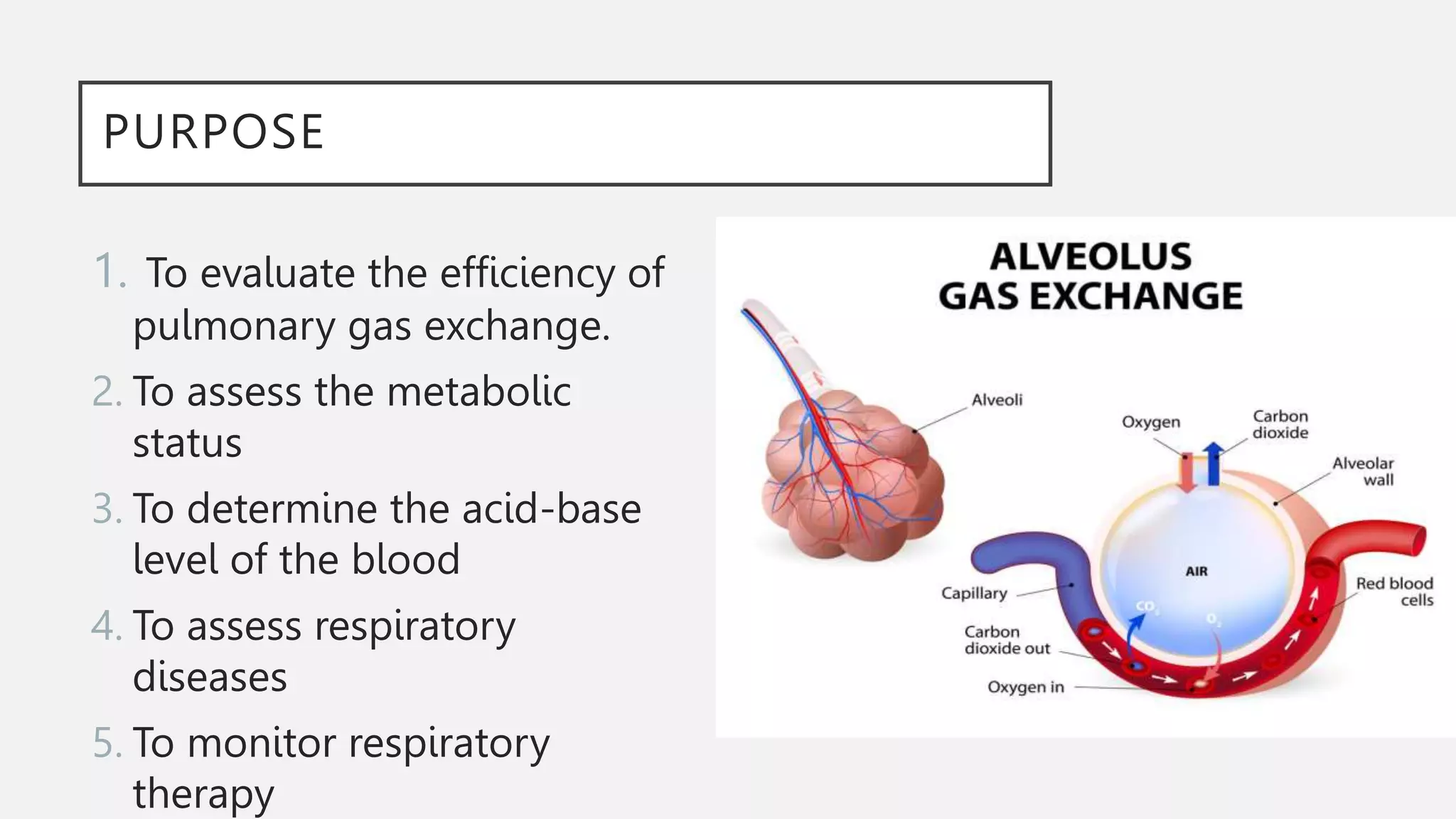
1. To evaluate the efficiency of
pulmonary gas exchange.
2. To assess the metabolic
status
3. To determine the acid-base
level of the blood
4. To assess respiratory
diseases
5. To monitor respiratory
therapy
INDICATION
1. To measure the partial pressures of oxygen (PaO2) and
carbon dioxide (PaCO2)
2. Providing information on the ventilation status
3. To identify and monitor acid-base status
4. Monitor gas exchange
5. To evaluate clinical intervention (oxygen therapy)
CONTRAINDICATIONS
1. Local infection
2. Distorted anatomy
3. Presence of arterio-venous fistulas
4. Peripheral vascular disease of the limb to be sampled
5. Severe coagulopathy or recent thrombolysis
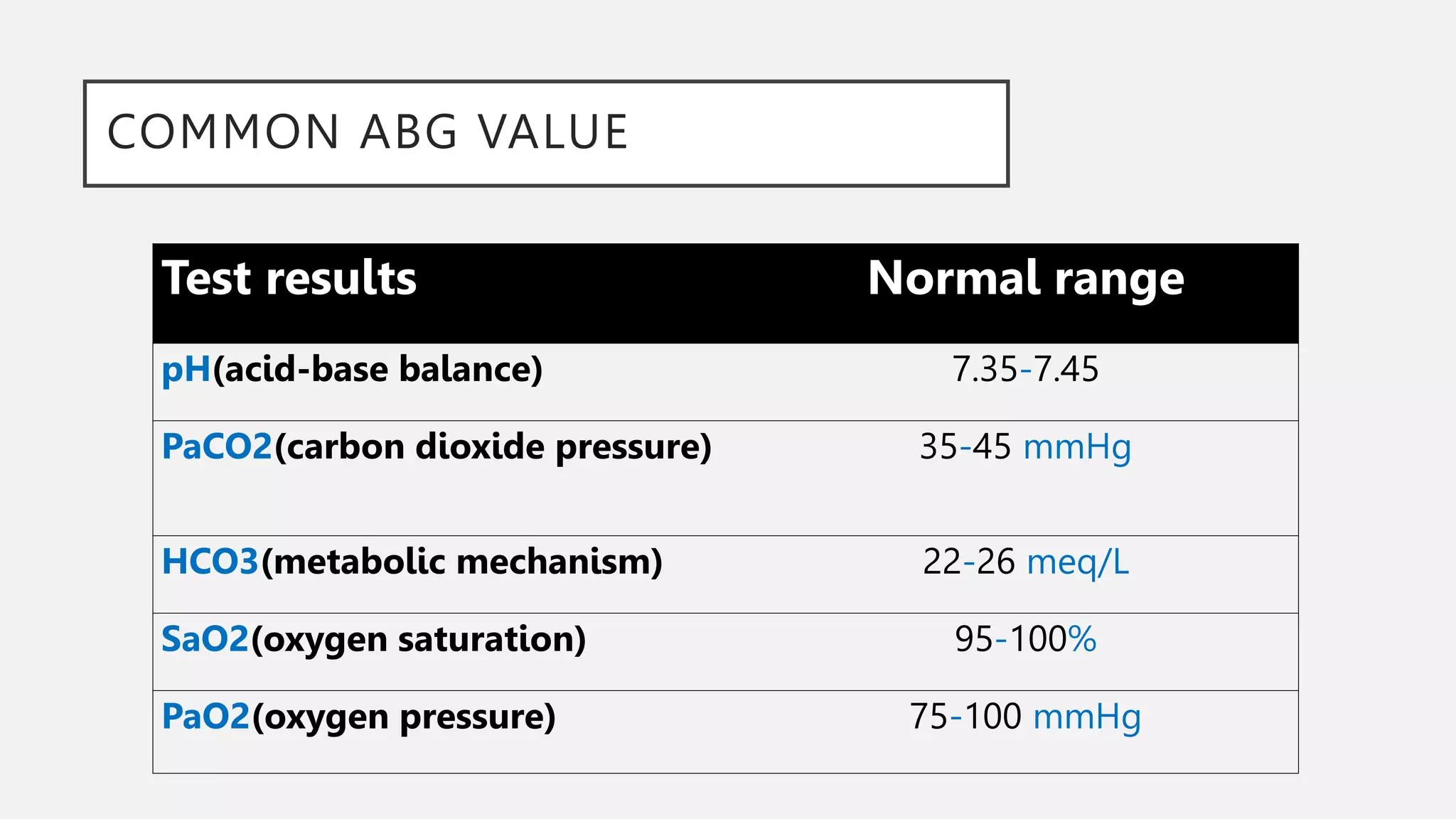
COMMON ABG VALUE
Test results Normal range
pH(acid-base balance) 7.35-7.45
PaCO2(carbon dioxide pressure) 35-45 mmHg
HCO3(metabolic mechanism) 22-26 meq/L
SaO2(oxygen saturation) 95-100%
PaO2(oxygen pressure) 75-100 mmHg
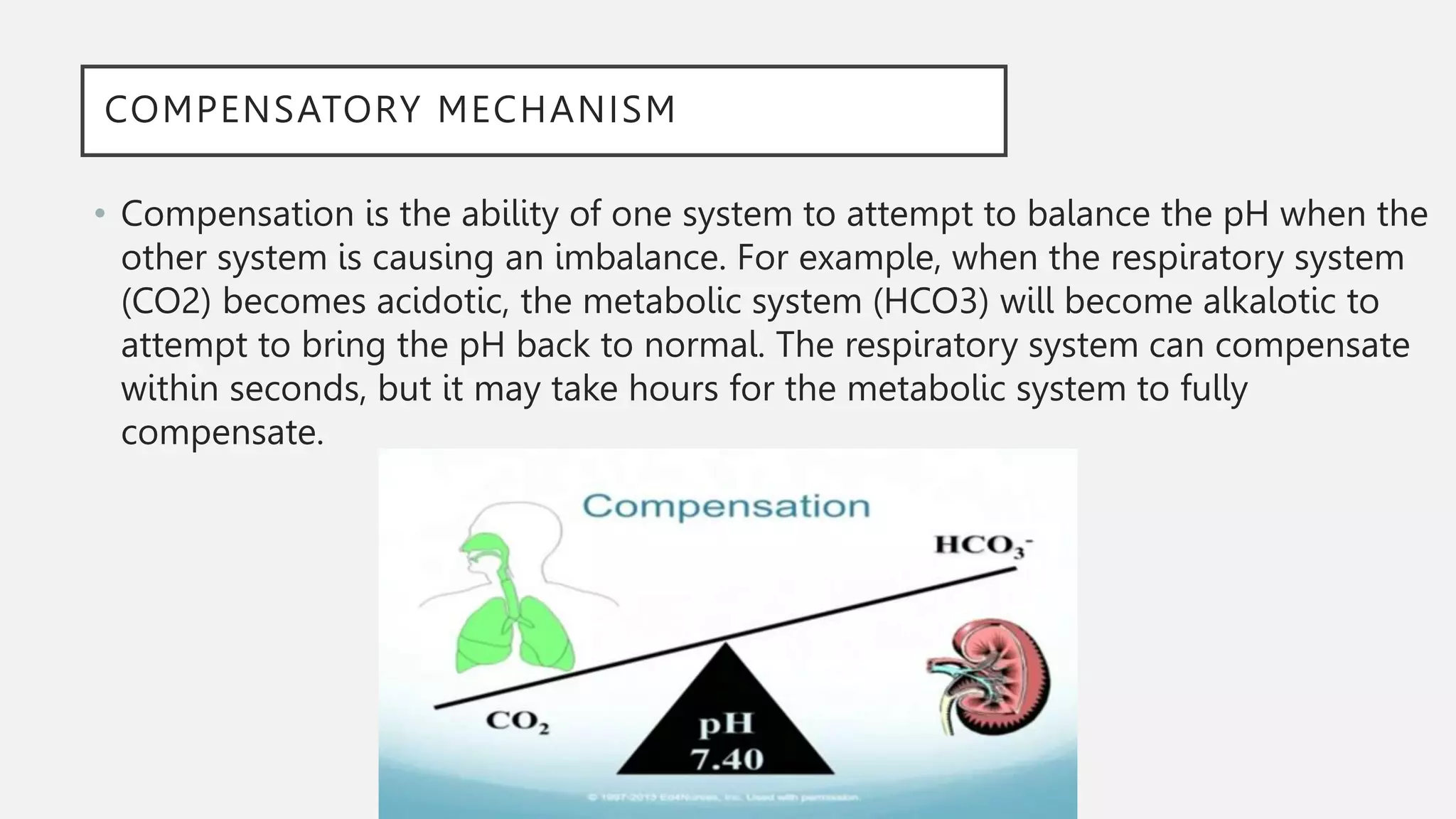
COMPENSATORY MECHANISM
• Compensation is the ability of one system to attempt to balance the pH when the
other system is causing an imbalance. For example, when the respiratory system
(CO2) becomes acidotic, the metabolic system (HCO3) will become alkalotic to
attempt to bring the pH back to normal. The respiratory system can compensate
within seconds, but it may take hours for the metabolic system to fully
compensate.
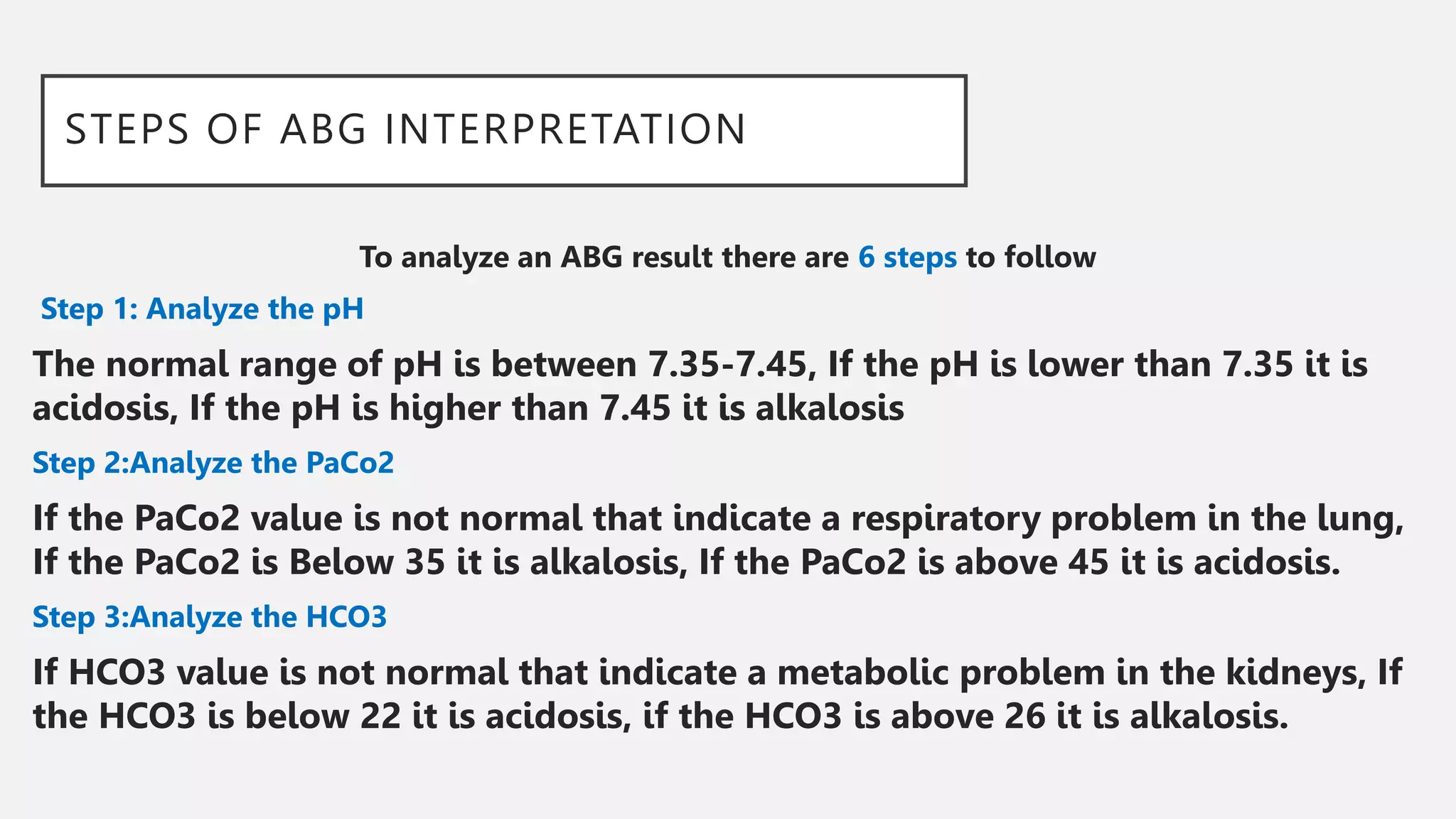
STEPS OF ABG INTERPRETATION
To analyze an ABG result there are 6 steps to follow
Step 1: Analyze the pH
The normal range of pH is between 7.35-7.45, If the pH is lower than 7.35 it is
acidosis, If the pH is higher than 7.45 it is alkalosis
Step 2:Analyze the PaCo2
If the PaCo2 value is not normal that indicate a respiratory problem in the lung,
If the PaCo2 is Below 35 it is alkalosis, If the PaCo2 is above 45 it is acidosis.
Step 3:Analyze the HCO3
If HCO3 value is not normal that indicate a metabolic problem in the kidneys, If
the HCO3 is below 22 it is acidosis, if the HCO3 is above 26 it is alkalosis.
Step 4: Match either PaCo2 or HCO3 with pH
To determine primary the acid-base disorder, For example, if the pH is acidotic, and
the CO2 is acidotic, then the acid-base disturbance is being caused by the respiratory
system. Therefore, we call it a respiratory acidosis. However, if the pH is alkalotic and
the HCO3 is alkalotic, the acid-base disturbance is being caused by the metabolic (or
renal) system. Therefore, it will be a metabolic alkalosis.
Step 5:Which of PaCo2 or HCO3 go in the opposite direction of pH
If so, there is compensation by that system. For example, the pH is acidotic, the CO2 is
acidotic, and the HCO3 is alkalotic. The CO2 matches the pH making the primary acid-
base disorder respiratory acidosis. The HCO3 is the opposite of the pH and would be
evidence of compensation from the metabolic system.
If the PaCo2 & HCO3 both match with pH that means that there are respiratory &
metabolic problems
Step 6: Analyze the PaO2 and SaO2
Finally, evaluate the PaO2 and O2 sat. If they are below normal there is evidence of
hypoxemia.
pH 7.20
PaCo2 53
HCO3 31
SaO2 82
Respiratory Acidosis, Hypoxemia
pH 7.85
PaCo2 49
HCO3 30
SaO3 86
Metabolic alkalosis
pH 8.12
PaCo2 32
HCO3 29
SaO2 96
Respiratory alkalosis, Metabolic alkalosis
MAINTAINING ACID BASE BALANCE
• Maintaining of acid base balance depend on maintaining a normal
value of carbon dioxide pressure & (H+) ion in the blood and which
is controlled by both the lung(PaCo2) and the kidneys(HCO3).
DIFFERENT ACID BASE BALANCE DISORDERS
4 Basic acid-base balance disorders :
1. Respiratory acidosis
2. Respiratory alkalosis
3. Metabolic acidosis
4. Metabolic alkalosis
RECOURSES
• ACCN Essentials of Critical Care Nursing. 3rd Edition. Suzanne M. Burns, MSN, RRT, ACNP, CCRN,
FAAN, FCCM, FAANP. 2014. McGraw Hill Education.
• Medical-Surgical Nursing: Concepts for Interprofessional Collaborative Care. 9th Edition. Donna D.
Ignatavicius, MS, RN, CNE, ANEF. 2018. Elsevier, Inc.⁰
• Peripheral Arterial Disease. Zemaitis MR, Boll JM, Dreyer MA. [Updated 2022 Jul 7]. In: StatPearls
[Internet]. Treasure Island (FL): StatPearls Publishing; 2022 Jan-. Available
from: https://www.ncbi.nlm.nih.gov/books/NBK430745/
• Peripheral Vascular Disease. Anna Giorgi and Judith Marcin, M.D. Updated September 17, 2018.
Healthline. From: https://www.healthline.com/health/peripheral-vascular-disease
• Peripheral Vascular Disease. Everett Stephens, MD; Chief Editor: Erik D Schraga, MD. Updated: May
24, 2022. The Hear.org Medscape. From: https://emedicine.medscape.com/article/761556-overview
• Peripheral Vascular Disease. John Hopkins Medicine. Copyright © 2022 The Johns Hopkins
University, The Johns Hopkins Hospital, and Johns Hopkins Health System.
From: https://www.hopkinsmedicine.org/health/conditions-and-diseases/peripheral-vascular-
disease
THANK YOU FOR LISTENING

ABG interpretation

  • 2.
    OUT LINES 1. Introduction 2.Definition 3. Purpose 4. Indication 5. Contraindication 6. Common ABG value 7. Compensatory mechanism 8. Steps of ABG interpretation 9. Maintaining acid base balance 10.Different acid base balance disorders
  • 3.
    INTRODUCTION • Arterial-blood gastest, It is an important investigation tool we use in monitor acid-base imbalance, indicate the severity of patient’s condition. It helps in diagnosis, And assessing the treatment.
  • 4.
    DEFINITION • An arterial-bloodgas test: It is measures the amounts of arterial gases, such as oxygen and carbon dioxide. And it requires a small volume of blood be drawn from an artery (radial-femoral-catheter).
  • 5.
    PURPOSE 1. To evaluatethe efficiency of pulmonary gas exchange. 2. To assess the metabolic status 3. To determine the acid-base level of the blood 4. To assess respiratory diseases 5. To monitor respiratory therapy
  • 6.
    INDICATION 1. To measurethe partial pressures of oxygen (PaO2) and carbon dioxide (PaCO2) 2. Providing information on the ventilation status 3. To identify and monitor acid-base status 4. Monitor gas exchange 5. To evaluate clinical intervention (oxygen therapy)
  • 7.
    CONTRAINDICATIONS 1. Local infection 2.Distorted anatomy 3. Presence of arterio-venous fistulas 4. Peripheral vascular disease of the limb to be sampled 5. Severe coagulopathy or recent thrombolysis
  • 8.
    COMMON ABG VALUE Testresults Normal range pH(acid-base balance) 7.35-7.45 PaCO2(carbon dioxide pressure) 35-45 mmHg HCO3(metabolic mechanism) 22-26 meq/L SaO2(oxygen saturation) 95-100% PaO2(oxygen pressure) 75-100 mmHg
  • 9.
    COMPENSATORY MECHANISM • Compensationis the ability of one system to attempt to balance the pH when the other system is causing an imbalance. For example, when the respiratory system (CO2) becomes acidotic, the metabolic system (HCO3) will become alkalotic to attempt to bring the pH back to normal. The respiratory system can compensate within seconds, but it may take hours for the metabolic system to fully compensate.
  • 10.
    STEPS OF ABGINTERPRETATION To analyze an ABG result there are 6 steps to follow Step 1: Analyze the pH The normal range of pH is between 7.35-7.45, If the pH is lower than 7.35 it is acidosis, If the pH is higher than 7.45 it is alkalosis Step 2:Analyze the PaCo2 If the PaCo2 value is not normal that indicate a respiratory problem in the lung, If the PaCo2 is Below 35 it is alkalosis, If the PaCo2 is above 45 it is acidosis. Step 3:Analyze the HCO3 If HCO3 value is not normal that indicate a metabolic problem in the kidneys, If the HCO3 is below 22 it is acidosis, if the HCO3 is above 26 it is alkalosis.
  • 11.
    Step 4: Matcheither PaCo2 or HCO3 with pH To determine primary the acid-base disorder, For example, if the pH is acidotic, and the CO2 is acidotic, then the acid-base disturbance is being caused by the respiratory system. Therefore, we call it a respiratory acidosis. However, if the pH is alkalotic and the HCO3 is alkalotic, the acid-base disturbance is being caused by the metabolic (or renal) system. Therefore, it will be a metabolic alkalosis. Step 5:Which of PaCo2 or HCO3 go in the opposite direction of pH If so, there is compensation by that system. For example, the pH is acidotic, the CO2 is acidotic, and the HCO3 is alkalotic. The CO2 matches the pH making the primary acid- base disorder respiratory acidosis. The HCO3 is the opposite of the pH and would be evidence of compensation from the metabolic system. If the PaCo2 & HCO3 both match with pH that means that there are respiratory & metabolic problems Step 6: Analyze the PaO2 and SaO2 Finally, evaluate the PaO2 and O2 sat. If they are below normal there is evidence of hypoxemia.
  • 12.
    pH 7.20 PaCo2 53 HCO331 SaO2 82 Respiratory Acidosis, Hypoxemia pH 7.85 PaCo2 49 HCO3 30 SaO3 86 Metabolic alkalosis pH 8.12 PaCo2 32 HCO3 29 SaO2 96 Respiratory alkalosis, Metabolic alkalosis
  • 13.
    MAINTAINING ACID BASEBALANCE • Maintaining of acid base balance depend on maintaining a normal value of carbon dioxide pressure & (H+) ion in the blood and which is controlled by both the lung(PaCo2) and the kidneys(HCO3).
  • 14.
    DIFFERENT ACID BASEBALANCE DISORDERS 4 Basic acid-base balance disorders : 1. Respiratory acidosis 2. Respiratory alkalosis 3. Metabolic acidosis 4. Metabolic alkalosis
  • 15.
    RECOURSES • ACCN Essentialsof Critical Care Nursing. 3rd Edition. Suzanne M. Burns, MSN, RRT, ACNP, CCRN, FAAN, FCCM, FAANP. 2014. McGraw Hill Education. • Medical-Surgical Nursing: Concepts for Interprofessional Collaborative Care. 9th Edition. Donna D. Ignatavicius, MS, RN, CNE, ANEF. 2018. Elsevier, Inc.⁰ • Peripheral Arterial Disease. Zemaitis MR, Boll JM, Dreyer MA. [Updated 2022 Jul 7]. In: StatPearls [Internet]. Treasure Island (FL): StatPearls Publishing; 2022 Jan-. Available from: https://www.ncbi.nlm.nih.gov/books/NBK430745/ • Peripheral Vascular Disease. Anna Giorgi and Judith Marcin, M.D. Updated September 17, 2018. Healthline. From: https://www.healthline.com/health/peripheral-vascular-disease • Peripheral Vascular Disease. Everett Stephens, MD; Chief Editor: Erik D Schraga, MD. Updated: May 24, 2022. The Hear.org Medscape. From: https://emedicine.medscape.com/article/761556-overview • Peripheral Vascular Disease. John Hopkins Medicine. Copyright © 2022 The Johns Hopkins University, The Johns Hopkins Hospital, and Johns Hopkins Health System. From: https://www.hopkinsmedicine.org/health/conditions-and-diseases/peripheral-vascular- disease
  • 16.
    THANK YOU FORLISTENING