Current and Voltage (potential)
Instrument transformers
Instruction for installation, use and maintenance

ABB
Content:
1. Service conditions …………………………………………………………… 3
2. Technical details ……………………………………………………………. 3
3. Instruction for Installation ………………………………………………….. 5
General Information …………………………………………………… 5
Safety Instructions …………………………………………………… 5
Mounting ………………………………………………………………. 5
Primary connection …………………………………………………… 6
Secondary connection ……………………………………………….. 7
Capacitive voltage indicator (divider) ………………………………. 8
Fuses ………………………………………………………………….. 8
4. Instruction for use …………………………………………………………… 9
Routing test report …………………………………………………… 9
5. Instruction for maintenance ………………………………………………… 9
6. Transport and storage ……………………………………………………… 9
7. Disposal ……………………………………………………………………….9
8. Handling with the transformer ……………………………………………… 9
9. Normative references ……………………………………………………… 10
Appendix 1. Example of secondary terminal marking ……………………… 11
Appendix 2. Wiring diagrams ………………………………………………… 13
Appendix 3. Damping ferroresonance for VT; VT-Guard ………………….. 17
Appendix 4. Handling with transformer ……………………………………… 19
Appendix 5. Dimensional drawings ………………………………………….. 21

2

1VLM000610 Rev.4, en 2009.6.16
Instruction for installation, use and maintenance for Current
and Voltage (potential) transformers
This installation, use and maintenance guide is valid for current and voltage
transformers operating in outdoor or indoor conditions.
These instructions are valid for Current transformer type:

TPU; TPO; TP; TTR; BB; BBO;
KOKS; KOFA; IHBF

Voltage transformers types: TJC; TDC; TDO; TJO; TJP;
TDP; KGUG; KGUGI; KRED

1. Service conditions
Indoor transformers
The transformers should be mounted in dry indoor conditions where the ambient air is
not significantly polluted by dust, smoke, corrosive gases, vapours or salt.
The transformers are designed for standard ambient temperature between –5 °C and
+40 °C. The altitude for use should be lower than 1000 m above the sea level. The
transformers may be used also in higher or lower ambient temperatures and higher altitudes
when agreed between the manufacturer and purchaser.

Outdoor transformers
The transformers should be mounted in outdoor conditions where the ambient air may
be polluted by dust, smoke, corrosive cases, vapours or salt.
The transformers are designed for standard ambient temperature between –40°C and
+40 °C. The average value of the ambient temperature, measured over a period of 24 hours,
should not exceed 35°C.

2. Technical details
The technical details for each individual transformer are mentioned on the rating plate
fastened on the transformer. Values mentioned on the rating plate must not be exceeded.
Markings used on the rating plate are as follows:

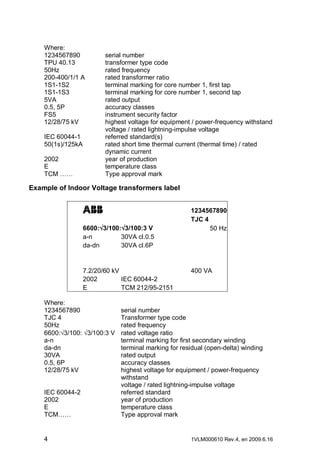
Example of Indoor current transformer label

ABB
200-400/1/1 A
1S1-1S2 200/1A
1S1-1S3 400/1A
2S1-2S2 200/1A
2S1-2S3 400/1A
12/28/75 kV
2002
E

3

1234567890
TPU 40.13
50 Hz
5VA cl. 0.5 FS 5
10VA cl. 0.5 FS 5
5VA cl. 5P15
10VA cl. 5P15
50(1s)/125 kA
IEC 60044-1
TCM 212/95-2150

1VLM000610 Rev.4, en 2009.6.16
Where:
1234567890
TPU 40.13
50Hz
200-400/1/1 A
1S1-1S2
1S1-1S3
5VA
0.5, 5P
FS5
12/28/75 kV
IEC 60044-1
50(1s)/125kA
2002
E
TCM ……

serial number
transformer type code
rated frequency
rated transformer ratio
terminal marking for core number 1, first tap
terminal marking for core number 1, second tap
rated output
accuracy classes
instrument security factor
highest voltage for equipment / power-frequency withstand
voltage / rated lightning-impulse voltage
referred standard(s)
rated short time thermal current (thermal time) / rated
dynamic current
year of production
temperature class
Type approval mark

Example of Indoor Voltage transformers label

ABB
6600:Ö3/100:Ö3/100:3 V
a-n
30VA cl.0.5
da-dn
30VA cl.6P

7.2/20/60 kV
2002
IEC 60044-2
E
TCM 212/95-2151
Where:
1234567890
TJC 4
50Hz
6600:Ö3/100: Ö3/100:3 V
a-n
da-dn
30VA
0.5, 6P
12/28/75 kV
IEC 60044-2
2002
E
TCM……

4

1234567890
TJC 4
50 Hz

400 VA

serial number
Transformer type code
rated frequency
rated voltage ratio
terminal marking for first secondary winding
terminal marking for residual (open-delta) winding
rated output
accuracy classes
highest voltage for equipment / power-frequency
withstand
voltage / rated lightning-impulse voltage
referred standard
year of production
temperature class
Type approval mark

1VLM000610 Rev.4, en 2009.6.16
3. Instruction for installation
General information
Instrument transformer is an electrical equipment and the electrical installation shall be
done by skilled person only. National legislation can set down the minimum age and the
criteria for competence of skilled persons working on, with, or near an electrical installation.
Where is not the national legislation requirements for competence, the criteria shall be used
at least according to EN 50110-1.

Safety instructions
1. Always consider transformer as a part of the circuit to which it is connected, and do
not touch the leads and terminals or other parts of the transformer unless they are
known to be grounded.
2. Always ground the metallic bases of instrument transformer.
3. Always ground one secondary terminal of the transformer, except if the windings of
voltage transformer are connected to open delta. Residual voltage windings
connected to open delta must have dn terminal earthed only on one of three
transformers (earthing screws at dn terminals of others two transformers have to be
removed). When the secondary of transformer is interconnected, there should be only
one grounded point to prevent accidental paralleling with system grounding wire. In
case of disconnection from the ground, the grounding screw has to be removed from
the secondary terminal. Connection between secondary terminal and base plate
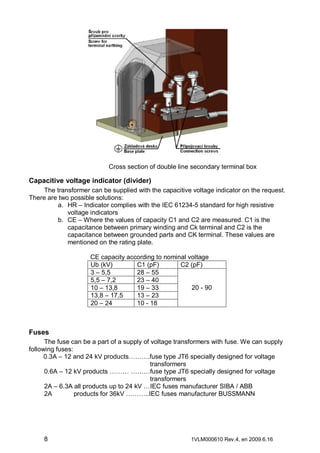
(ground) is shown on the picture “Crossection of double line terminal box“
4. Always short-circuit the secondary of the current transformer, which is not currently in
use to prevent secondary voltages which may be hazardous to personnel or damaging
to the transformer’s secondary. The secondary like this must be additionally grounded.
5. Never short-circuit the secondary terminal of a voltage transformer even this is not in
use. A secondary short-circuit will cause the unit to overheat and fail in a very short
period of time.
6. Protection of single pole insulated voltage transformers against feroresonance
phenomena is stated in appendix 3. – Damping of the feroresonance in Voltage
transformers type TJC/TJP.
7. In case of the current transformer with voltage indication (coupling electrode included)
is secondary terminal box equiped with PE terminal, which is connected with earthing
screw to the base plate, which must be generally earthed.
Connection between secondary terminal and base plate is shown on the picture
“Crossection of single line terminal box“
Attention: Terminal PE must be always earthed, this is hold generally, even if the base
plate is removed. In case of disassembling the base plate, producer doesn’t
warranting the earthing.

Mounting
Following information is general and some details can differentiate according to type
and variants of transformers. It is necessary to combine it with other technical and marketing
specifications like catalogues, dimensional drawings and rating plate for specific transformer
type.

Indoor current and voltage transformers
The mounting position of the indoor transformer can be freely chosen. The transformer
is fixed using the mounting base with four screws M10 and washers. Fastening must be done
on a smooth surface.
There is a M8 screw for earthing the transformer on the base plate.

5

1VLM000610 Rev.4, en 2009.6.16
Outdoor current and voltage transformers
The mounting position of the outdoor transformer is only horizontal. The other position
can be agreed with the supplier. The transformer is fixed using the mounting base (VT) with
four screws M10 and washers or two U profiles (CT) with M12 screws. Fastening must be
done on a smooth surface.
There is a M12 screw for grounding of current transformer and M8 screw for grounding
of voltage transformer.

Primary connection
Primary terminals of the current transformer are made of cooper and they are silver or
tin plated. There are M12 screws used for fastening of primary conductor to the terminal. For
primary reconnectable transformers the ratio can be reconnected by changing position of the
links fixed by M8 screws without removing already fitted primary conductors.
Maximum allowed torques for screw connections of current transformers:
Screw
Max. torque [Nm]
Min. torque [Nm]
M5
3.5
2.8
M6
4
3
M8
20
16
M10
20
16
M12
70
56
Maximum allowed torque for screw connection of voltage transformer is 20 Nm.
Maximum allowed cantilever strength is: Voltage transformers 2000 N.
Current transformers 5000 N.

In case of Bus CT, there must be
always connected CT shielding to
the primary bar. Connection must
be done at least on one side of
the CT. One example of KOKS
12 shielding connection is
described on the picture

6

1VLM000610 Rev.4, en 2009.6.16
Secondary connections
The terminals, screws, nuts and washers are made of stainless steel. Secondary
grounding screws and secondary terminal fastening screws are made of nickel-plated brass.
The secondary terminal cover box for indoor use is made from the plastic and provided
with three detachable threaded inserts Pg16. The terminals are provided with M5 screws for
secondary wiring connection and with through going holes for direct earthing of the
secondary circuit by M5 screws. The terminal cover is seal able.
The secondary cover for outdoor CT is made of epoxy resin and provided with one
insert Pg21. The secondary cover for outdoor VT is made of plastic and provided with two
insert Pg21.
Degrees of IP protection
Indoor transformers: IP40, or IP30 for transformers TTR, BB, KOKS
Outdoor transformers: IP54
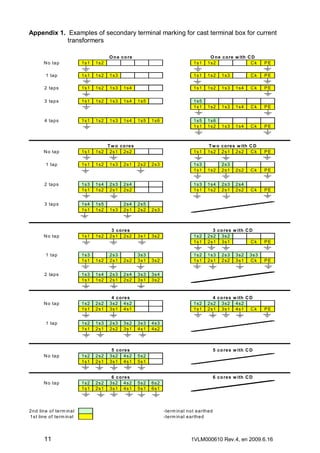
For terminal marking see appendix 1.

Example of current transformers terminal boxes

TJC,TDC

TJC7

TJC,TDC

TJP,TJC,TDC
TJO7
TJO6,TDO6
Example of voltage transformers terminal boxes

7

1VLM000610 Rev.4, en 2009.6.16
Cross section of double line secondary terminal box

Capacitive voltage indicator (divider)
The transformer can be supplied with the capacitive voltage indicator on the request.
There are two possible solutions:
a. HR – Indicator complies with the IEC 61234-5 standard for high resistive
voltage indicators
b. CE – Where the values of capacity C1 and C2 are measured. C1 is the
capacitance between primary winding and Ck terminal and C2 is the
capacitance between grounded parts and CK terminal. These values are
mentioned on the rating plate.
CE capacity according to nominal voltage
Ub (kV)
C1 (pF)
C2 (pF)
3 – 5,5
28 – 55
5,5 – 7,2
23 – 40
20 - 90
10 – 13,8
19 – 33
13,8 – 17,5
13 – 23
20 – 24
10 - 18

Fuses
The fuse can be a part of a supply of voltage transformers with fuse. We can supply
following fuses:
0.3A – 12 and 24 kV products……….fuse type JT6 specially designed for voltage
transformers
0.6A – 12 kV products ……… ………fuse type JT6 specially designed for voltage
transformers
2A – 6.3A all products up to 24 kV …IEC fuses manufacturer SIBA / ABB
2A
products for 36kV ………..IEC fuses manufacturer BUSSMANN

8

1VLM000610 Rev.4, en 2009.6.16
4. Instruction for use
Current and Voltage instrument transformers are used:
to convert large currents or voltage in the primary circuit to an appropriate level for
secondary circuit equipment (relays and meters)
- to insulate primary and secondary circuit from each other to protect the secondary
equipment from the harmful effects of large current or voltage appearing during the
operation (short circuits)
The use of current or voltage transformer for other purpose then described above is
forbidden if not agreed with the producer.
-

Routine test report
Together with instrument transformer are delivered:
- routine test report
- two rating plates (one plastered on the transformer and one free)
The following information can be included on the request. These are free of charge.
- theoretical current/voltage errors and phase displacement values
- theoretical excitation curves
There are additional extra paid reports which can be supplied on request:
- accuracy test report
- magnetizing curve ( for current transformers )
- additional labels (if more then 2)
- verification tests

5. Instruction for maintenance
Excessive dust or other kind of pollution must be brushed off the transformer. Polluted
transformers can be cleaned with spirit, petrol or toluene.
Traces of arcs and minor surface damages can be easily removed with sandpaper
after which the surface is to be treated by applying a thin layer of silicone paste on it.
Instruction for repairing greater surface damages must be requested from the
manufacturer.

6. Transport and storage
The permissible transport and storage temperature is from –40 °C to +70 °C. During
transport and storage the transformers must be protected against direct sunshine. The
transformers are delivered fastened to a transport pallet.

7. Disposal
Materials used in instrument transformers are considered as materials without
dangerous environmental impact and materials are not toxic. Disposal of instrument
transformers is controlled by national legislation of communal waste.

8. Handling with the transformers
Handling with the transformer is described in the Appendix 4.

9

1VLM000610 Rev.4, en 2009.6.16
9. Normative references
IEC60044-1… Instrument transformers – Current transformers
IEC60044-2… Instrument transformers – Voltage transformers
IEC61243-5… Voltage detectors – Voltage detecting systems (VDS)
IEC60529…… Degrees of protection provided by enclosures (IP Code)
ISO12100…… Safety of machinery — Basic concepts, general principles for design
EN 50110-1 …Operation of electrical installations
Current and Voltage transformers are designed, tested and produced according to
international or national standards required by custommers and agreed by producer.
Specific standard is always mention on the Rating plate of transformer
For example these standards:
IEC 60044-1; IEC 60044-2 ; IEC 60044-6
AS 60044-1; AS 60044-2
AS 1243-1982; AS 1675-1986
ČSN 351301; ČSN 351302; ČSN 351361
ČSN EN 60044-1; ČSN EN 60044-2 ; ČSN EN 60044-6
IEEE Std C57.13.6-2005
ANSI C57.13-1978
CSA Std CAN3-C13-M83
GOST 1516.3-96; GOST 7746-2001
BS 3939:1973 ; BS EN 60044-1
If it is agreed between custommer and producer is possible to deliver also other
standard or standards which are mention above with different revision.

10

1VLM000610 Rev.4, en 2009.6.16
Appendix 1. Examples of secondary terminal marking for cast terminal box for current
transformers
O n e c o re
1s1

1s1

1 ta p

1s1

1s2

2 ta p s

1s1

1s2

1s3

3 ta p s

1s1

1s2

1s3

1s4

4 ta p s

1s1

1s2

N o ta p

1s1

1s2

1 ta p

1s1

1s2

2 ta p s

3 ta p s

N o ta p

1 ta p

1s3

1s4

1s6

T w o c o re s
2s1 2s2
1s3

2s1

2s2

2s3

1s3
1s1

1s4
1s2

2s3
2s1

2s4
2s2

1s4
1s1

1s5
1s2

1s3

2s4
2s1

2s5
2s2

1s2

3 c o re s
2s1 2s2

3s1

3s2

1s2

1s3

1s4

Ck

PE

1s2

1s3

1s4

Ck

PE

1s5
1s1

1s6
1s2

1s3

1s4

Ck

PE

T w o c o re s w ith C D
1s2 2s1 2s2
Ck

PE

1s3
1s1

1s2

2s3
2s1

2s2

Ck

PE

1s4
1s2

2s3
2s1

2s4
2s2

Ck

PE

1s2
1s1

3 c o re s w ith C D
2s2 3s2
2s1 3s1
Ck

PE

1s2
1s1

1s3
2s1

3s3
Ck

PE

4 c o re s w ith C D
2s2 3s2 4s2
2s1 3s1 4s1
Ck

PE

2s3

1s1

PE

1s2
1s1

1s5

Ck

1s3
1s1

1s5

1s3

1s1

1s4

1s2

1s5
1s1

1s3

PE

1s1

1s2

O n e c o re w ith C D
1s2
Ck

1s1

N o ta p

1s3
1s1

1s2

2s3
2s1

2s2

3s3
3s1

3s2

2 ta p s

1s3
1s1

1s4
1s2

2s3
2s1

2s4
2s2

3s3
3s1

3s4
3s2

N o ta p

1s2
1s1

2s2
2s1

4 c o re s
3s2 4s2
3s1 4s1

1 ta p

1s2
1s1

1s3
2s1

2s3
2s2

3s2
3s1

3s3
4s1

N o ta p

1s2
1s1

2s2
2s1

5 c o re s
3s2 4s2
3s1 4s1

5s2
5s1

N o ta p

1s2
1s1

2s2
2s1

6 c o re s
3s2 4s2
3s1 4s1

5s2
5s1

2 n d lin e o f te rm in a l
1 s t lin e o f te rm in a l

11

2s3
2s2

3s2
3s1

4s3
4s2

5 c o re s w ith C D

6 c o re s w ith C D
6s2
6s1

-te rm in a l n o t e a rth e d
-te rm in a l e a rth e d

1VLM000610 Rev.4, en 2009.6.16
Examples of secondary terminal marking for cast and assembled (phoenix)
terminal box for Voltage transformers
One pole insulated voltage transformer
2 measuring windings

1a

1n

2a

2n

N

PE

Measuring and residual
winding

a

n

da

dn

N

PE

2 ratios measuring winding

a1

a2

n

N

PE

a

n

N

PE

One measuring winding

Assembled secondary terminal (Phoenix)
2 measuring and residual
winding

1a

2 measuring double rations
winding

1a1

1a2

1n

2a1

2a2

2n

N

PE

a1

a2

n

da1

da2

dn

N

PE

2 ratios measuring and
residual winding

1n

2a

2n

da

dn

N

PE

Double pole insulated transformer
2 measuring windings

2 ratios measuring winding
One measuring winding

12

1a

1b

2a

a1

a2

b

a

b

2b

PE
PE
PE

1VLM000610 Rev.4, en 2009.6.16
Appendix 2.
Wiring diagram examples
Current transformers:

13

1VLM000610 Rev.4, en 2009.6.16
Wiring diagram examples
Voltage transformers:

14

1VLM000610 Rev.4, en 2009.6.16
Examples of current transformers connection

15

1VLM000610 Rev.4, en 2009.6.16
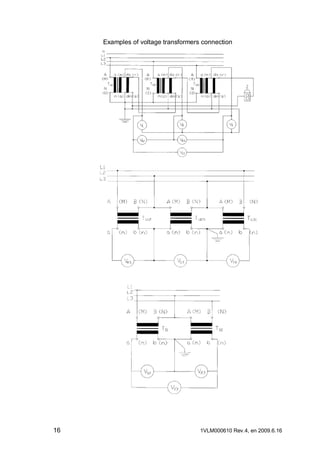
Examples of voltage transformers connection

16

1VLM000610 Rev.4, en 2009.6.16
Appendix 3.

Damping ferroresonance for voltage transformer type TJC/TJP
TECHNICAL BACKGROUND
Ferroresonance is a phenomenon usually characterized by over-voltages and very irregular
wave shapes and is associated with the excitation of one or more saturable inductors through
capacitance in parallel with nonlinear inductor. The saturable inductor usually is present in the form of an
instrument transformer, power transformer or reactor witch utilizes an iron core.
Ferroresonance of single-pole insulated transformers in unearthed network is one of the most
common ferroresonance case. Depending on the supply voltage, capacitance and inductance the
oscillation can be either periodic (over- or sub-harmonic or with fundamental frequency) or aperiodic.
Using damping resistor or VT guard in the residual voltage secondary, shown in Fig.1, can
considerably reduce the risk for ferroresonance.
There is additionally factor that can in some cases reduce or totally eliminate the risk for
ferroresonance and it is over-voltage factor. According to IEC standard is the rated over-voltage factor
1.9xUn/ 8h. Higher rated over-voltage factor shift the operating point towards lower flux values of voltage
transformer. It results in smaller sensitivity of transformer to some kind of transients usually initiate
ferroresonance.
RECOMMENDATION
Rated voltage factor: We recommended using the voltage transformers with the over-voltage
factor in the range (2.5-3) xUn/8h. We cannot guarantee the value of the over-voltage factor if the
requirements for the secondary winding are too high.
Damping resistor:

See the recommended value of damping resistor below:

Voltage of residual
winding
100:3 V
110:3 V

Value of Rdamp
22 W
27 W

Damping power
450 W
450 W

Fig.1.

17

1VLM000610 Rev.4, en 2009.6.16
VT Guard – function
1. VT-Guard description:
VT Guard is a preventive device against the ferroresonance phenomenon which may be
triggered in power networks with ungrounded or not directly grounded neutral point. VT Guard
should be used in cooperation with voltage transformers connected in open delta – more in
User’s manual.

Important: Read the User’s manual before use.
2. Basic operating states:
Simple diagram
a) In case of full balance in a threephase network, there is zero voltage on an
open delta winding (VT Guard terminals)
REFI
Uo=0. No current flows through VT Guard.
The device isn’t active.
b) In case of unbalance in a threephase network, there is voltage on VT
Guard terminals Uo>0.
If the Uo is lower than threshold
voltage Ut (Ut =20-24V), then current
Uo
I=
flows
( RPTC // REFI ) + R1 + R 2
through the device.
Total resistance value is higher then
100ohm and voltage Uo is max 24V in this
case. Current flowing thorough the device
has very low value.
c) In case Uo is higher then treshold
voltage (ferroresonance), the „switching
circuit“ is switched on and current flows
trough RPTC//REFI and R1. Because of low values of these resistors there is steep increase of
current and fast ferroresonance dumping. High current flows trough the device for short time, the
PTC resistors arn’t warm up significantly.
d) In case Uo is higher then treshold voltage(earth fault), the „switching circuit“ is switched
on and current flows trough RPTC//REFI and R1. Because of low values of these resistors there is
steep increase of current. High current flows trough the device and cause to warm up PTC
resistors. PTC resistor increase their resistance (The resistance is proportional to flowing
current). Current is limited. Time needed for worming up PTC resistors for Uo = 100V is
approximately 1.4s. After earth-fault is removed, the PTC resistors cool-down (approximately 3
min). It is necessary to mount VT Guard in vertical position far from other thermal
sources.

18

1VLM000610 Rev.4, en 2009.6.16
Appendix 4.
Handling with transformers
There are few possibilities of handling:
1) Manual handling.
Transformers are possible to handle by hands in case if
the weight of the transformer is not higher than 25kg.
Always use the glows in case of manual handling. For
grasp of the transformers always use handling grip (see
the picture), or the base of the transformer.
Note. Types TJP or TDP never handle by gripping of
the fuse holder – risk of break.

2) Handling by the belt
Transformers where it is possible, from safety
reasons, can be handling by hanging on the belts.
Than the handling can be done by hanging of the
transformer on the crane.
Note: This system is recommended for types: TTR,
TSR, BB(O), KOKS. Hanging systems for those
types are visualized on pictures.
Safety warning ! Lifting capacity of the belts and
the crane has to be 200kg at. Always make sure
that the belts hold safely on the crane and on the
transformer.
TTR, TSR

KOKS, BB(O)

3) Handling by the self-locking hooks.
With transformers which are equiped with handling
grips is possible to handle by self-locking hooks
hanging on the crane. With transformer without
this handling grips is possible to grip the hooks
under the base of the transformer.
Note. This system is recommended for types:
TPU, TJC TJP, TDP, TDC, KGUG, KGUGI. This
handling system is vizualized on the pictures.
Safety warning ! Lifting capacity of the hooks and
the crane has to be 200kg at least. Always make
sure that the hooks hold safely on the crane and on
the transformer.

19

1VLM000610 Rev.4, en 2009.6.16
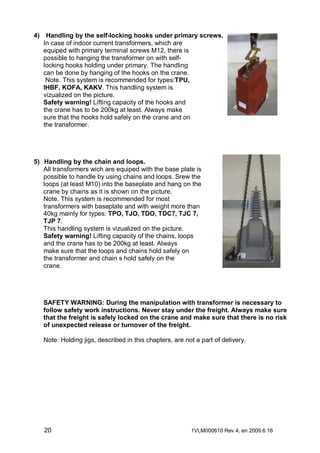
4) Handling by the self-locking hooks under primary screws.
In case of indoor current transformers, which are
equiped with primary terminal screws M12, there is
possible to hanging the transformer on with selflocking hooks holding under primary. The handling
can be done by hanging of the hooks on the crane.
Note. This system is recommended for types:TPU,
IHBF, KOFA, KAKV. This handling system is
vizualized on the picture.
Safety warning! Lifting capacity of the hooks and
the crane has to be 200kg at least. Always make
sure that the hooks hold safely on the crane and on
the transformer.

5) Handling by the chain and loops.
All transformers wich are equiped with the base plate is
possible to handle by using chains and loops. Srew the
loops (at least M10) into the baseplate and hang on the
crane by chains as it is shown on the picture.
Note. This system is recommended for most
transformers with baseplate and with weight more than
40kg mainly for types: TPO, TJO, TDO, TDC7, TJC 7,
TJP 7.
This handling system is vizualized on the picture.
Safety warning! Lifting capacity of the chains, loops
and the crane has to be 200kg at least. Always
make sure that the loops and chains hold safely on
the transformer and chain s hold safely on the
crane.

SAFETY WARNING: During the manipulation with transformer is necessary to
follow safety work instructions. Never stay under the freight. Always make sure
that the freight is safely locked on the crane and make sure that there is no risk
of unexpected release or turnover of the freight.
Note: Holding jigs, described in this chapters, are not a part of delivery.

20

1VLM000610 Rev.4, en 2009.6.16
Appendix 5.

21

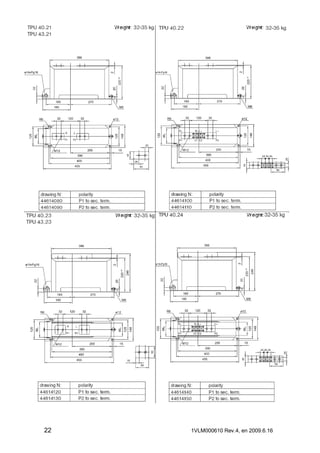
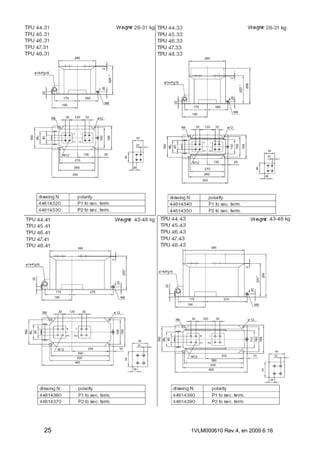
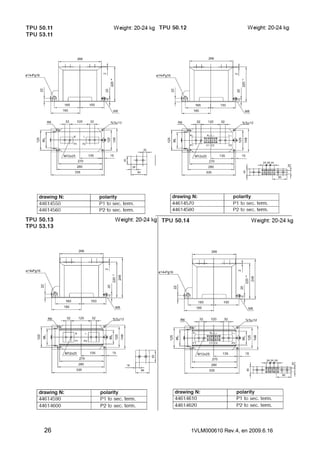
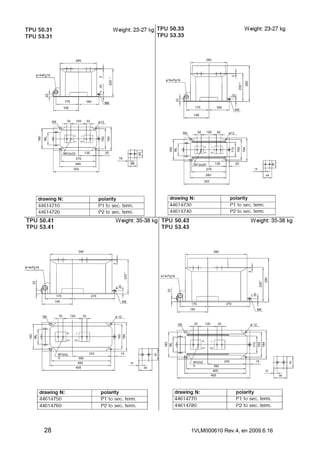
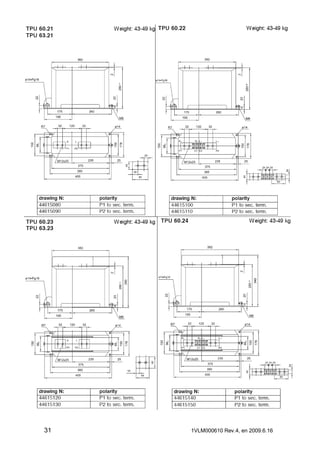
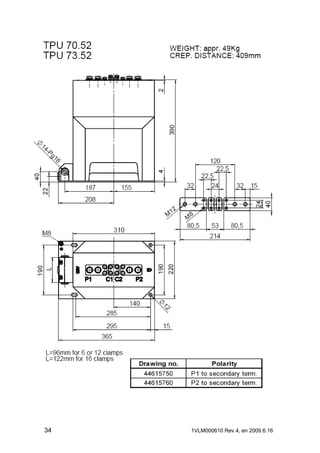
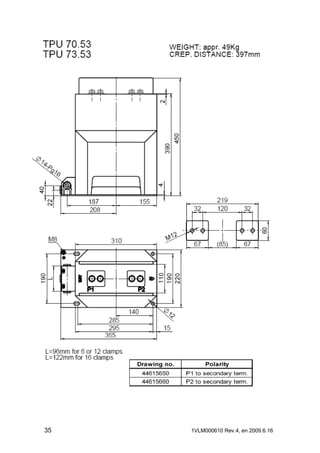
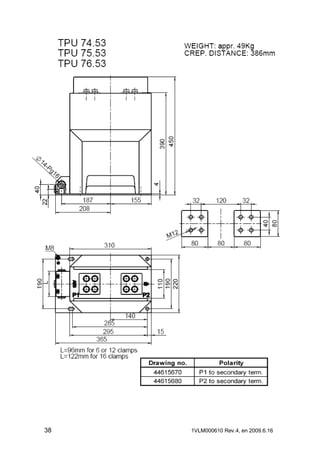
Dimensional Drawings´

1VLM000610 Rev.4, en 2009.6.16
22

1VLM000610 Rev.4, en 2009.6.16
23

1VLM000610 Rev.4, en 2009.6.16
24

1VLM000610 Rev.4, en 2009.6.16
25

1VLM000610 Rev.4, en 2009.6.16
26

1VLM000610 Rev.4, en 2009.6.16
27

1VLM000610 Rev.4, en 2009.6.16
28

1VLM000610 Rev.4, en 2009.6.16
29

1VLM000610 Rev.4, en 2009.6.16
30

1VLM000610 Rev.4, en 2009.6.16
31

1VLM000610 Rev.4, en 2009.6.16
32

1VLM000610 Rev.4, en 2009.6.16
33

1VLM000610 Rev.4, en 2009.6.16
34

1VLM000610 Rev.4, en 2009.6.16
35

1VLM000610 Rev.4, en 2009.6.16
36

1VLM000610 Rev.4, en 2009.6.16
37

1VLM000610 Rev.4, en 2009.6.16
38

1VLM000610 Rev.4, en 2009.6.16
39

1VLM000610 Rev.4, en 2009.6.16
40

1VLM000610 Rev.4, en 2009.6.16
41

1VLM000610 Rev.4, en 2009.6.16
42

1VLM000610 Rev.4, en 2009.6.16
43

1VLM000610 Rev.4, en 2009.6.16
44

1VLM000610 Rev.4, en 2009.6.16
45

1VLM000610 Rev.4, en 2009.6.16
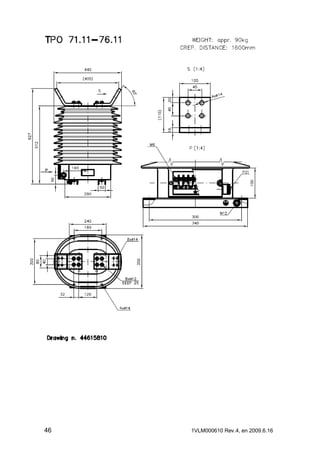
46

1VLM000610 Rev.4, en 2009.6.16
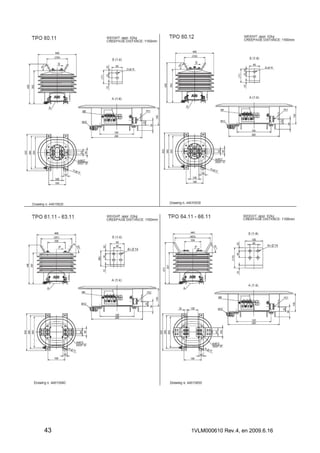
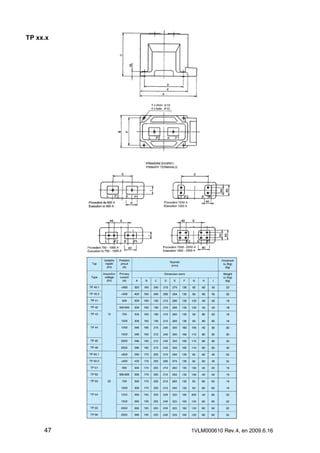
TP xx.x

47

1VLM000610 Rev.4, en 2009.6.16
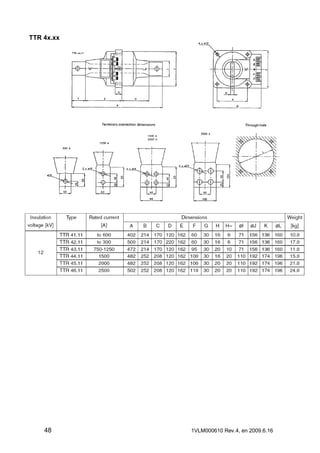
TTR 4x.xx

48

1VLM000610 Rev.4, en 2009.6.16
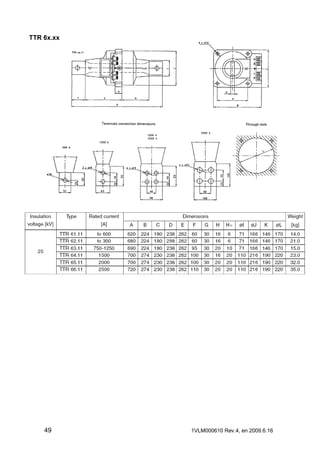
TTR 6x.xx

49

1VLM000610 Rev.4, en 2009.6.16
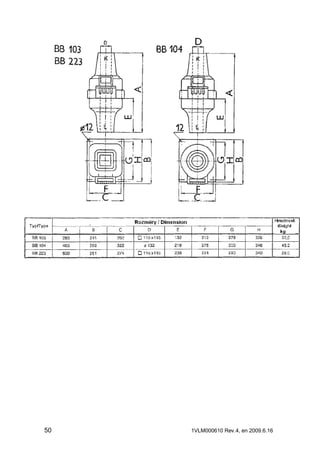
50

1VLM000610 Rev.4, en 2009.6.16
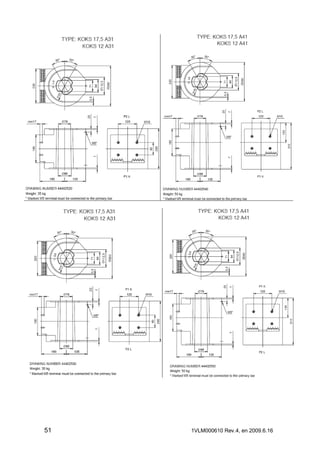
51

1VLM000610 Rev.4, en 2009.6.16
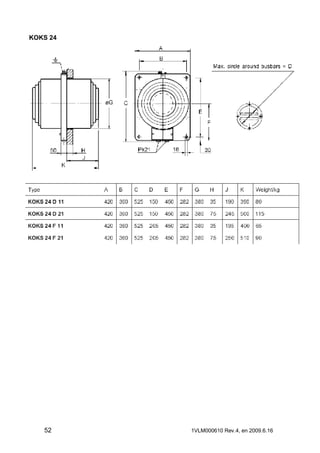
KOKS 24

52

1VLM000610 Rev.4, en 2009.6.16
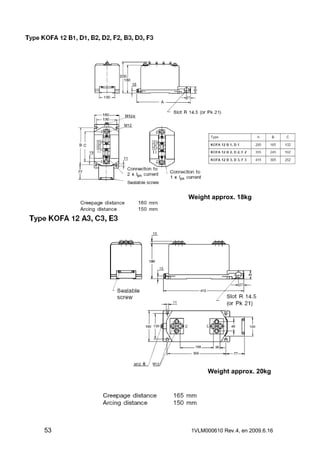
Weight approx. 18kg

Weight approx. 20kg

53

1VLM000610 Rev.4, en 2009.6.16
Weight approx. 18kg

Weight approx. 24kg

54

1VLM000610 Rev.4, en 2009.6.16
Weight approx. 19kg

Weight approx. 27kg

55

1VLM000610 Rev.4, en 2009.6.16
Weight approx. 14kg

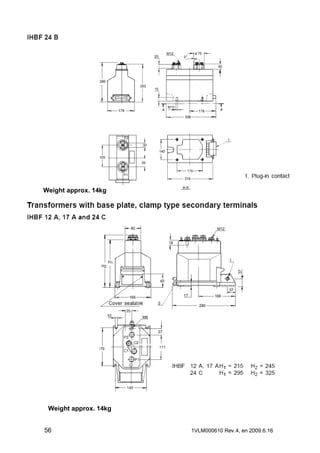
Weight approx. 14kg
56

1VLM000610 Rev.4, en 2009.6.16
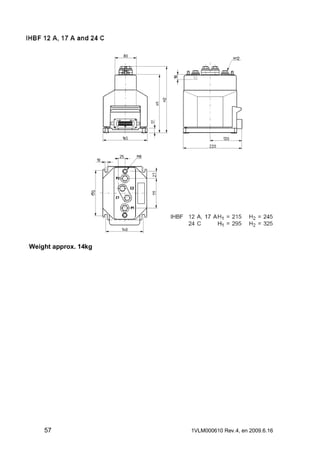
Weight approx. 14kg

57

1VLM000610 Rev.4, en 2009.6.16
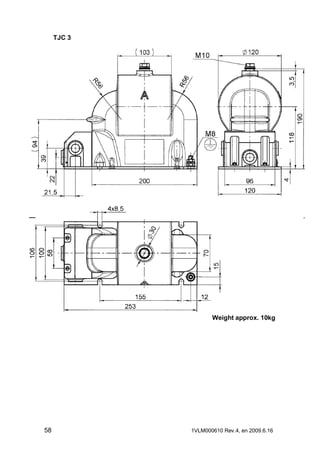
TJC 3

Weight approx. 10kg

58

1VLM000610 Rev.4, en 2009.6.16
TJC 4 , TJC 5

Weight approx. 19kg

59

1VLM000610 Rev.4, en 2009.6.16
TJC 6

Weight approx. 36kg

60

1VLM000610 Rev.4, en 2009.6.16
TJC 6-G

Weight approx. 36kg

61

1VLM000610 Rev.4, en 2009.6.16
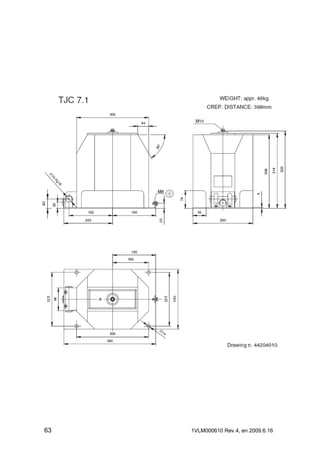
TJC 7

Weight approx. 47kg

62

1VLM000610 Rev.4, en 2009.6.16
63

1VLM000610 Rev.4, en 2009.6.16
TJC 7.0-G

64

Weight approx.: 45kg

1VLM000610 Rev.4, en 2009.6.16
TDC 4, TDC 5

Weight approx. 20kG

65

1VLM000610 Rev.4, en 2009.6.16
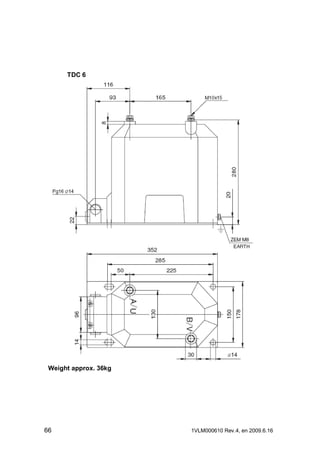
TDC 6

Weight approx. 36kg

66

1VLM000610 Rev.4, en 2009.6.16
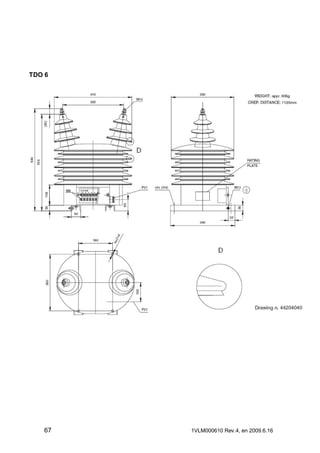
TDO 6

67

1VLM000610 Rev.4, en 2009.6.16
68

1VLM000610 Rev.4, en 2009.6.16
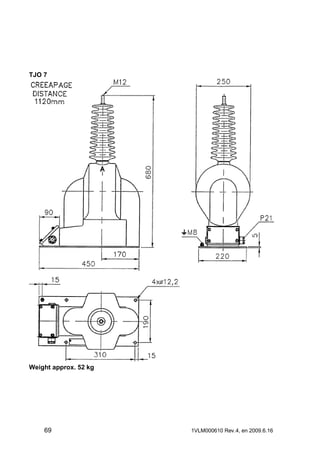
TJO 7

Weight approx. 52 kg

69

1VLM000610 Rev.4, en 2009.6.16
TJP 4.0 TJP 5.0 , fuse IEC 60282-1

70

1VLM000610 Rev.4, en 2009.6.16
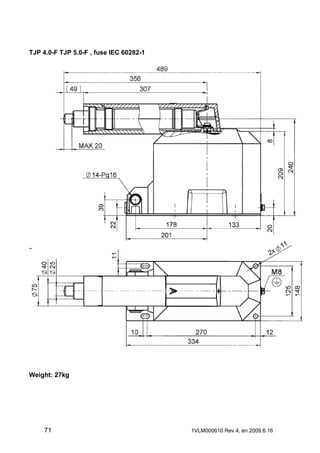
TJP 4.0-F TJP 5.0-F , fuse IEC 60282-1

Weight: 27kg

71

1VLM000610 Rev.4, en 2009.6.16
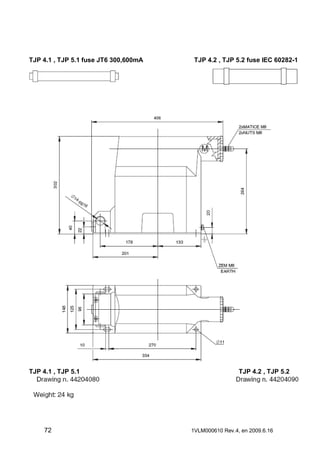
TJP 4.1 , TJP 5.1 fuse JT6 300,600mA

TJP 4.1 , TJP 5.1

72

TJP 4.2 , TJP 5.2 fuse IEC 60282-1

TJP 4.2 , TJP 5.2

1VLM000610 Rev.4, en 2009.6.16
73

1VLM000610 Rev.4, en 2009.6.16
TJP 6.2-G fuse IEC 60282-1

74

Weight approx.: 42kg

1VLM000610 Rev.4, en 2009.6.16
75

1VLM000610 Rev.4, en 2009.6.16
76

1VLM000610 Rev.4, en 2009.6.16
TDP 4.1 fuse JT6 300,600mA

77

TDP 4.2 Fuse IEC 600282-1

1VLM000610 Rev.4, en 2009.6.16
TDP 6.1 fuse JT6 300,600mA

78

TDP 6.2 Fuse IEC 600282-1

1VLM000610 Rev.4, en 2009.6.16
79

1VLM000610 Rev.4, en 2009.6.16
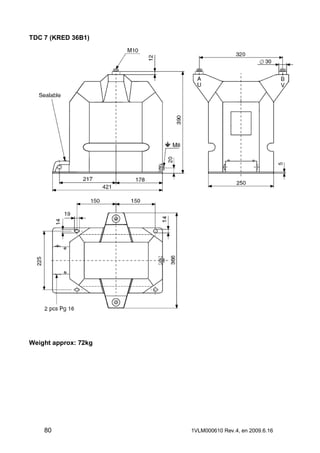
TDC 7 (KRED 36B1)

Weight approx: 72kg

80

1VLM000610 Rev.4, en 2009.6.16
ABB s.r.o.
PPMV Brno
Vídeňská 117
61900 Brno, Czech Republic
E-mail: info.ejf@cz.abb.com
http://www.abb.cz/ejf

81

The data and ilustrations in this catalogue are not binding.
We reserve the right to make changes of the content,
in the course of technical development of the product
.

1VLM000610 Rev.4, en 2009.6.16

ABB Medium Voltage MV Indoor and Outdoor Current Transformers - ABB CT's Current Transformers - ABB TTR, ABB TPU, ABB TPE, ABB KON-17, ABB TPO6

  • 1.
    Current and Voltage(potential) Instrument transformers Instruction for installation, use and maintenance ABB
  • 2.
    Content: 1. Service conditions…………………………………………………………… 3 2. Technical details ……………………………………………………………. 3 3. Instruction for Installation ………………………………………………….. 5 General Information …………………………………………………… 5 Safety Instructions …………………………………………………… 5 Mounting ………………………………………………………………. 5 Primary connection …………………………………………………… 6 Secondary connection ……………………………………………….. 7 Capacitive voltage indicator (divider) ………………………………. 8 Fuses ………………………………………………………………….. 8 4. Instruction for use …………………………………………………………… 9 Routing test report …………………………………………………… 9 5. Instruction for maintenance ………………………………………………… 9 6. Transport and storage ……………………………………………………… 9 7. Disposal ……………………………………………………………………….9 8. Handling with the transformer ……………………………………………… 9 9. Normative references ……………………………………………………… 10 Appendix 1. Example of secondary terminal marking ……………………… 11 Appendix 2. Wiring diagrams ………………………………………………… 13 Appendix 3. Damping ferroresonance for VT; VT-Guard ………………….. 17 Appendix 4. Handling with transformer ……………………………………… 19 Appendix 5. Dimensional drawings ………………………………………….. 21 2 1VLM000610 Rev.4, en 2009.6.16
  • 3.
    Instruction for installation,use and maintenance for Current and Voltage (potential) transformers This installation, use and maintenance guide is valid for current and voltage transformers operating in outdoor or indoor conditions. These instructions are valid for Current transformer type: TPU; TPO; TP; TTR; BB; BBO; KOKS; KOFA; IHBF Voltage transformers types: TJC; TDC; TDO; TJO; TJP; TDP; KGUG; KGUGI; KRED 1. Service conditions Indoor transformers The transformers should be mounted in dry indoor conditions where the ambient air is not significantly polluted by dust, smoke, corrosive gases, vapours or salt. The transformers are designed for standard ambient temperature between –5 °C and +40 °C. The altitude for use should be lower than 1000 m above the sea level. The transformers may be used also in higher or lower ambient temperatures and higher altitudes when agreed between the manufacturer and purchaser. Outdoor transformers The transformers should be mounted in outdoor conditions where the ambient air may be polluted by dust, smoke, corrosive cases, vapours or salt. The transformers are designed for standard ambient temperature between –40°C and +40 °C. The average value of the ambient temperature, measured over a period of 24 hours, should not exceed 35°C. 2. Technical details The technical details for each individual transformer are mentioned on the rating plate fastened on the transformer. Values mentioned on the rating plate must not be exceeded. Markings used on the rating plate are as follows: Example of Indoor current transformer label ABB 200-400/1/1 A 1S1-1S2 200/1A 1S1-1S3 400/1A 2S1-2S2 200/1A 2S1-2S3 400/1A 12/28/75 kV 2002 E 3 1234567890 TPU 40.13 50 Hz 5VA cl. 0.5 FS 5 10VA cl. 0.5 FS 5 5VA cl. 5P15 10VA cl. 5P15 50(1s)/125 kA IEC 60044-1 TCM 212/95-2150 1VLM000610 Rev.4, en 2009.6.16
  • 4.
    Where: 1234567890 TPU 40.13 50Hz 200-400/1/1 A 1S1-1S2 1S1-1S3 5VA 0.5,5P FS5 12/28/75 kV IEC 60044-1 50(1s)/125kA 2002 E TCM …… serial number transformer type code rated frequency rated transformer ratio terminal marking for core number 1, first tap terminal marking for core number 1, second tap rated output accuracy classes instrument security factor highest voltage for equipment / power-frequency withstand voltage / rated lightning-impulse voltage referred standard(s) rated short time thermal current (thermal time) / rated dynamic current year of production temperature class Type approval mark Example of Indoor Voltage transformers label ABB 6600:Ö3/100:Ö3/100:3 V a-n 30VA cl.0.5 da-dn 30VA cl.6P 7.2/20/60 kV 2002 IEC 60044-2 E TCM 212/95-2151 Where: 1234567890 TJC 4 50Hz 6600:Ö3/100: Ö3/100:3 V a-n da-dn 30VA 0.5, 6P 12/28/75 kV IEC 60044-2 2002 E TCM…… 4 1234567890 TJC 4 50 Hz 400 VA serial number Transformer type code rated frequency rated voltage ratio terminal marking for first secondary winding terminal marking for residual (open-delta) winding rated output accuracy classes highest voltage for equipment / power-frequency withstand voltage / rated lightning-impulse voltage referred standard year of production temperature class Type approval mark 1VLM000610 Rev.4, en 2009.6.16
  • 5.
    3. Instruction forinstallation General information Instrument transformer is an electrical equipment and the electrical installation shall be done by skilled person only. National legislation can set down the minimum age and the criteria for competence of skilled persons working on, with, or near an electrical installation. Where is not the national legislation requirements for competence, the criteria shall be used at least according to EN 50110-1. Safety instructions 1. Always consider transformer as a part of the circuit to which it is connected, and do not touch the leads and terminals or other parts of the transformer unless they are known to be grounded. 2. Always ground the metallic bases of instrument transformer. 3. Always ground one secondary terminal of the transformer, except if the windings of voltage transformer are connected to open delta. Residual voltage windings connected to open delta must have dn terminal earthed only on one of three transformers (earthing screws at dn terminals of others two transformers have to be removed). When the secondary of transformer is interconnected, there should be only one grounded point to prevent accidental paralleling with system grounding wire. In case of disconnection from the ground, the grounding screw has to be removed from the secondary terminal. Connection between secondary terminal and base plate (ground) is shown on the picture “Crossection of double line terminal box“ 4. Always short-circuit the secondary of the current transformer, which is not currently in use to prevent secondary voltages which may be hazardous to personnel or damaging to the transformer’s secondary. The secondary like this must be additionally grounded. 5. Never short-circuit the secondary terminal of a voltage transformer even this is not in use. A secondary short-circuit will cause the unit to overheat and fail in a very short period of time. 6. Protection of single pole insulated voltage transformers against feroresonance phenomena is stated in appendix 3. – Damping of the feroresonance in Voltage transformers type TJC/TJP. 7. In case of the current transformer with voltage indication (coupling electrode included) is secondary terminal box equiped with PE terminal, which is connected with earthing screw to the base plate, which must be generally earthed. Connection between secondary terminal and base plate is shown on the picture “Crossection of single line terminal box“ Attention: Terminal PE must be always earthed, this is hold generally, even if the base plate is removed. In case of disassembling the base plate, producer doesn’t warranting the earthing. Mounting Following information is general and some details can differentiate according to type and variants of transformers. It is necessary to combine it with other technical and marketing specifications like catalogues, dimensional drawings and rating plate for specific transformer type. Indoor current and voltage transformers The mounting position of the indoor transformer can be freely chosen. The transformer is fixed using the mounting base with four screws M10 and washers. Fastening must be done on a smooth surface. There is a M8 screw for earthing the transformer on the base plate. 5 1VLM000610 Rev.4, en 2009.6.16
  • 6.
    Outdoor current andvoltage transformers The mounting position of the outdoor transformer is only horizontal. The other position can be agreed with the supplier. The transformer is fixed using the mounting base (VT) with four screws M10 and washers or two U profiles (CT) with M12 screws. Fastening must be done on a smooth surface. There is a M12 screw for grounding of current transformer and M8 screw for grounding of voltage transformer. Primary connection Primary terminals of the current transformer are made of cooper and they are silver or tin plated. There are M12 screws used for fastening of primary conductor to the terminal. For primary reconnectable transformers the ratio can be reconnected by changing position of the links fixed by M8 screws without removing already fitted primary conductors. Maximum allowed torques for screw connections of current transformers: Screw Max. torque [Nm] Min. torque [Nm] M5 3.5 2.8 M6 4 3 M8 20 16 M10 20 16 M12 70 56 Maximum allowed torque for screw connection of voltage transformer is 20 Nm. Maximum allowed cantilever strength is: Voltage transformers 2000 N. Current transformers 5000 N. In case of Bus CT, there must be always connected CT shielding to the primary bar. Connection must be done at least on one side of the CT. One example of KOKS 12 shielding connection is described on the picture 6 1VLM000610 Rev.4, en 2009.6.16
  • 7.
    Secondary connections The terminals,screws, nuts and washers are made of stainless steel. Secondary grounding screws and secondary terminal fastening screws are made of nickel-plated brass. The secondary terminal cover box for indoor use is made from the plastic and provided with three detachable threaded inserts Pg16. The terminals are provided with M5 screws for secondary wiring connection and with through going holes for direct earthing of the secondary circuit by M5 screws. The terminal cover is seal able. The secondary cover for outdoor CT is made of epoxy resin and provided with one insert Pg21. The secondary cover for outdoor VT is made of plastic and provided with two insert Pg21. Degrees of IP protection Indoor transformers: IP40, or IP30 for transformers TTR, BB, KOKS Outdoor transformers: IP54 For terminal marking see appendix 1. Example of current transformers terminal boxes TJC,TDC TJC7 TJC,TDC TJP,TJC,TDC TJO7 TJO6,TDO6 Example of voltage transformers terminal boxes 7 1VLM000610 Rev.4, en 2009.6.16
  • 8.
    Cross section ofdouble line secondary terminal box Capacitive voltage indicator (divider) The transformer can be supplied with the capacitive voltage indicator on the request. There are two possible solutions: a. HR – Indicator complies with the IEC 61234-5 standard for high resistive voltage indicators b. CE – Where the values of capacity C1 and C2 are measured. C1 is the capacitance between primary winding and Ck terminal and C2 is the capacitance between grounded parts and CK terminal. These values are mentioned on the rating plate. CE capacity according to nominal voltage Ub (kV) C1 (pF) C2 (pF) 3 – 5,5 28 – 55 5,5 – 7,2 23 – 40 20 - 90 10 – 13,8 19 – 33 13,8 – 17,5 13 – 23 20 – 24 10 - 18 Fuses The fuse can be a part of a supply of voltage transformers with fuse. We can supply following fuses: 0.3A – 12 and 24 kV products……….fuse type JT6 specially designed for voltage transformers 0.6A – 12 kV products ……… ………fuse type JT6 specially designed for voltage transformers 2A – 6.3A all products up to 24 kV …IEC fuses manufacturer SIBA / ABB 2A products for 36kV ………..IEC fuses manufacturer BUSSMANN 8 1VLM000610 Rev.4, en 2009.6.16
  • 9.
    4. Instruction foruse Current and Voltage instrument transformers are used: to convert large currents or voltage in the primary circuit to an appropriate level for secondary circuit equipment (relays and meters) - to insulate primary and secondary circuit from each other to protect the secondary equipment from the harmful effects of large current or voltage appearing during the operation (short circuits) The use of current or voltage transformer for other purpose then described above is forbidden if not agreed with the producer. - Routine test report Together with instrument transformer are delivered: - routine test report - two rating plates (one plastered on the transformer and one free) The following information can be included on the request. These are free of charge. - theoretical current/voltage errors and phase displacement values - theoretical excitation curves There are additional extra paid reports which can be supplied on request: - accuracy test report - magnetizing curve ( for current transformers ) - additional labels (if more then 2) - verification tests 5. Instruction for maintenance Excessive dust or other kind of pollution must be brushed off the transformer. Polluted transformers can be cleaned with spirit, petrol or toluene. Traces of arcs and minor surface damages can be easily removed with sandpaper after which the surface is to be treated by applying a thin layer of silicone paste on it. Instruction for repairing greater surface damages must be requested from the manufacturer. 6. Transport and storage The permissible transport and storage temperature is from –40 °C to +70 °C. During transport and storage the transformers must be protected against direct sunshine. The transformers are delivered fastened to a transport pallet. 7. Disposal Materials used in instrument transformers are considered as materials without dangerous environmental impact and materials are not toxic. Disposal of instrument transformers is controlled by national legislation of communal waste. 8. Handling with the transformers Handling with the transformer is described in the Appendix 4. 9 1VLM000610 Rev.4, en 2009.6.16
  • 10.
    9. Normative references IEC60044-1…Instrument transformers – Current transformers IEC60044-2… Instrument transformers – Voltage transformers IEC61243-5… Voltage detectors – Voltage detecting systems (VDS) IEC60529…… Degrees of protection provided by enclosures (IP Code) ISO12100…… Safety of machinery — Basic concepts, general principles for design EN 50110-1 …Operation of electrical installations Current and Voltage transformers are designed, tested and produced according to international or national standards required by custommers and agreed by producer. Specific standard is always mention on the Rating plate of transformer For example these standards: IEC 60044-1; IEC 60044-2 ; IEC 60044-6 AS 60044-1; AS 60044-2 AS 1243-1982; AS 1675-1986 ČSN 351301; ČSN 351302; ČSN 351361 ČSN EN 60044-1; ČSN EN 60044-2 ; ČSN EN 60044-6 IEEE Std C57.13.6-2005 ANSI C57.13-1978 CSA Std CAN3-C13-M83 GOST 1516.3-96; GOST 7746-2001 BS 3939:1973 ; BS EN 60044-1 If it is agreed between custommer and producer is possible to deliver also other standard or standards which are mention above with different revision. 10 1VLM000610 Rev.4, en 2009.6.16
  • 11.
    Appendix 1. Examplesof secondary terminal marking for cast terminal box for current transformers O n e c o re 1s1 1s1 1 ta p 1s1 1s2 2 ta p s 1s1 1s2 1s3 3 ta p s 1s1 1s2 1s3 1s4 4 ta p s 1s1 1s2 N o ta p 1s1 1s2 1 ta p 1s1 1s2 2 ta p s 3 ta p s N o ta p 1 ta p 1s3 1s4 1s6 T w o c o re s 2s1 2s2 1s3 2s1 2s2 2s3 1s3 1s1 1s4 1s2 2s3 2s1 2s4 2s2 1s4 1s1 1s5 1s2 1s3 2s4 2s1 2s5 2s2 1s2 3 c o re s 2s1 2s2 3s1 3s2 1s2 1s3 1s4 Ck PE 1s2 1s3 1s4 Ck PE 1s5 1s1 1s6 1s2 1s3 1s4 Ck PE T w o c o re s w ith C D 1s2 2s1 2s2 Ck PE 1s3 1s1 1s2 2s3 2s1 2s2 Ck PE 1s4 1s2 2s3 2s1 2s4 2s2 Ck PE 1s2 1s1 3 c o re s w ith C D 2s2 3s2 2s1 3s1 Ck PE 1s2 1s1 1s3 2s1 3s3 Ck PE 4 c o re s w ith C D 2s2 3s2 4s2 2s1 3s1 4s1 Ck PE 2s3 1s1 PE 1s2 1s1 1s5 Ck 1s3 1s1 1s5 1s3 1s1 1s4 1s2 1s5 1s1 1s3 PE 1s1 1s2 O n e c o re w ith C D 1s2 Ck 1s1 N o ta p 1s3 1s1 1s2 2s3 2s1 2s2 3s3 3s1 3s2 2 ta p s 1s3 1s1 1s4 1s2 2s3 2s1 2s4 2s2 3s3 3s1 3s4 3s2 N o ta p 1s2 1s1 2s2 2s1 4 c o re s 3s2 4s2 3s1 4s1 1 ta p 1s2 1s1 1s3 2s1 2s3 2s2 3s2 3s1 3s3 4s1 N o ta p 1s2 1s1 2s2 2s1 5 c o re s 3s2 4s2 3s1 4s1 5s2 5s1 N o ta p 1s2 1s1 2s2 2s1 6 c o re s 3s2 4s2 3s1 4s1 5s2 5s1 2 n d lin e o f te rm in a l 1 s t lin e o f te rm in a l 11 2s3 2s2 3s2 3s1 4s3 4s2 5 c o re s w ith C D 6 c o re s w ith C D 6s2 6s1 -te rm in a l n o t e a rth e d -te rm in a l e a rth e d 1VLM000610 Rev.4, en 2009.6.16
  • 12.
    Examples of secondaryterminal marking for cast and assembled (phoenix) terminal box for Voltage transformers One pole insulated voltage transformer 2 measuring windings 1a 1n 2a 2n N PE Measuring and residual winding a n da dn N PE 2 ratios measuring winding a1 a2 n N PE a n N PE One measuring winding Assembled secondary terminal (Phoenix) 2 measuring and residual winding 1a 2 measuring double rations winding 1a1 1a2 1n 2a1 2a2 2n N PE a1 a2 n da1 da2 dn N PE 2 ratios measuring and residual winding 1n 2a 2n da dn N PE Double pole insulated transformer 2 measuring windings 2 ratios measuring winding One measuring winding 12 1a 1b 2a a1 a2 b a b 2b PE PE PE 1VLM000610 Rev.4, en 2009.6.16
  • 13.
    Appendix 2. Wiring diagramexamples Current transformers: 13 1VLM000610 Rev.4, en 2009.6.16
  • 14.
    Wiring diagram examples Voltagetransformers: 14 1VLM000610 Rev.4, en 2009.6.16
  • 15.
    Examples of currenttransformers connection 15 1VLM000610 Rev.4, en 2009.6.16
  • 16.
    Examples of voltagetransformers connection 16 1VLM000610 Rev.4, en 2009.6.16
  • 17.
    Appendix 3. Damping ferroresonancefor voltage transformer type TJC/TJP TECHNICAL BACKGROUND Ferroresonance is a phenomenon usually characterized by over-voltages and very irregular wave shapes and is associated with the excitation of one or more saturable inductors through capacitance in parallel with nonlinear inductor. The saturable inductor usually is present in the form of an instrument transformer, power transformer or reactor witch utilizes an iron core. Ferroresonance of single-pole insulated transformers in unearthed network is one of the most common ferroresonance case. Depending on the supply voltage, capacitance and inductance the oscillation can be either periodic (over- or sub-harmonic or with fundamental frequency) or aperiodic. Using damping resistor or VT guard in the residual voltage secondary, shown in Fig.1, can considerably reduce the risk for ferroresonance. There is additionally factor that can in some cases reduce or totally eliminate the risk for ferroresonance and it is over-voltage factor. According to IEC standard is the rated over-voltage factor 1.9xUn/ 8h. Higher rated over-voltage factor shift the operating point towards lower flux values of voltage transformer. It results in smaller sensitivity of transformer to some kind of transients usually initiate ferroresonance. RECOMMENDATION Rated voltage factor: We recommended using the voltage transformers with the over-voltage factor in the range (2.5-3) xUn/8h. We cannot guarantee the value of the over-voltage factor if the requirements for the secondary winding are too high. Damping resistor: See the recommended value of damping resistor below: Voltage of residual winding 100:3 V 110:3 V Value of Rdamp 22 W 27 W Damping power 450 W 450 W Fig.1. 17 1VLM000610 Rev.4, en 2009.6.16
  • 18.
    VT Guard –function 1. VT-Guard description: VT Guard is a preventive device against the ferroresonance phenomenon which may be triggered in power networks with ungrounded or not directly grounded neutral point. VT Guard should be used in cooperation with voltage transformers connected in open delta – more in User’s manual. Important: Read the User’s manual before use. 2. Basic operating states: Simple diagram a) In case of full balance in a threephase network, there is zero voltage on an open delta winding (VT Guard terminals) REFI Uo=0. No current flows through VT Guard. The device isn’t active. b) In case of unbalance in a threephase network, there is voltage on VT Guard terminals Uo>0. If the Uo is lower than threshold voltage Ut (Ut =20-24V), then current Uo I= flows ( RPTC // REFI ) + R1 + R 2 through the device. Total resistance value is higher then 100ohm and voltage Uo is max 24V in this case. Current flowing thorough the device has very low value. c) In case Uo is higher then treshold voltage (ferroresonance), the „switching circuit“ is switched on and current flows trough RPTC//REFI and R1. Because of low values of these resistors there is steep increase of current and fast ferroresonance dumping. High current flows trough the device for short time, the PTC resistors arn’t warm up significantly. d) In case Uo is higher then treshold voltage(earth fault), the „switching circuit“ is switched on and current flows trough RPTC//REFI and R1. Because of low values of these resistors there is steep increase of current. High current flows trough the device and cause to warm up PTC resistors. PTC resistor increase their resistance (The resistance is proportional to flowing current). Current is limited. Time needed for worming up PTC resistors for Uo = 100V is approximately 1.4s. After earth-fault is removed, the PTC resistors cool-down (approximately 3 min). It is necessary to mount VT Guard in vertical position far from other thermal sources. 18 1VLM000610 Rev.4, en 2009.6.16
  • 19.
    Appendix 4. Handling withtransformers There are few possibilities of handling: 1) Manual handling. Transformers are possible to handle by hands in case if the weight of the transformer is not higher than 25kg. Always use the glows in case of manual handling. For grasp of the transformers always use handling grip (see the picture), or the base of the transformer. Note. Types TJP or TDP never handle by gripping of the fuse holder – risk of break. 2) Handling by the belt Transformers where it is possible, from safety reasons, can be handling by hanging on the belts. Than the handling can be done by hanging of the transformer on the crane. Note: This system is recommended for types: TTR, TSR, BB(O), KOKS. Hanging systems for those types are visualized on pictures. Safety warning ! Lifting capacity of the belts and the crane has to be 200kg at. Always make sure that the belts hold safely on the crane and on the transformer. TTR, TSR KOKS, BB(O) 3) Handling by the self-locking hooks. With transformers which are equiped with handling grips is possible to handle by self-locking hooks hanging on the crane. With transformer without this handling grips is possible to grip the hooks under the base of the transformer. Note. This system is recommended for types: TPU, TJC TJP, TDP, TDC, KGUG, KGUGI. This handling system is vizualized on the pictures. Safety warning ! Lifting capacity of the hooks and the crane has to be 200kg at least. Always make sure that the hooks hold safely on the crane and on the transformer. 19 1VLM000610 Rev.4, en 2009.6.16
  • 20.
    4) Handling bythe self-locking hooks under primary screws. In case of indoor current transformers, which are equiped with primary terminal screws M12, there is possible to hanging the transformer on with selflocking hooks holding under primary. The handling can be done by hanging of the hooks on the crane. Note. This system is recommended for types:TPU, IHBF, KOFA, KAKV. This handling system is vizualized on the picture. Safety warning! Lifting capacity of the hooks and the crane has to be 200kg at least. Always make sure that the hooks hold safely on the crane and on the transformer. 5) Handling by the chain and loops. All transformers wich are equiped with the base plate is possible to handle by using chains and loops. Srew the loops (at least M10) into the baseplate and hang on the crane by chains as it is shown on the picture. Note. This system is recommended for most transformers with baseplate and with weight more than 40kg mainly for types: TPO, TJO, TDO, TDC7, TJC 7, TJP 7. This handling system is vizualized on the picture. Safety warning! Lifting capacity of the chains, loops and the crane has to be 200kg at least. Always make sure that the loops and chains hold safely on the transformer and chain s hold safely on the crane. SAFETY WARNING: During the manipulation with transformer is necessary to follow safety work instructions. Never stay under the freight. Always make sure that the freight is safely locked on the crane and make sure that there is no risk of unexpected release or turnover of the freight. Note: Holding jigs, described in this chapters, are not a part of delivery. 20 1VLM000610 Rev.4, en 2009.6.16
  • 21.
  • 22.
  • 23.
  • 24.
  • 25.
  • 26.
  • 27.
  • 28.
  • 29.
  • 30.
  • 31.
  • 32.
  • 33.
  • 34.
  • 35.
  • 36.
  • 37.
  • 38.
  • 39.
  • 40.
  • 41.
  • 42.
  • 43.
  • 44.
  • 45.
  • 46.
  • 47.
  • 48.
  • 49.
  • 50.
  • 51.
  • 52.
  • 53.
    Weight approx. 18kg Weightapprox. 20kg 53 1VLM000610 Rev.4, en 2009.6.16
  • 54.
    Weight approx. 18kg Weightapprox. 24kg 54 1VLM000610 Rev.4, en 2009.6.16
  • 55.
    Weight approx. 19kg Weightapprox. 27kg 55 1VLM000610 Rev.4, en 2009.6.16
  • 56.
    Weight approx. 14kg Weightapprox. 14kg 56 1VLM000610 Rev.4, en 2009.6.16
  • 57.
  • 58.
    TJC 3 Weight approx.10kg 58 1VLM000610 Rev.4, en 2009.6.16
  • 59.
    TJC 4 ,TJC 5 Weight approx. 19kg 59 1VLM000610 Rev.4, en 2009.6.16
  • 60.
    TJC 6 Weight approx.36kg 60 1VLM000610 Rev.4, en 2009.6.16
  • 61.
    TJC 6-G Weight approx.36kg 61 1VLM000610 Rev.4, en 2009.6.16
  • 62.
    TJC 7 Weight approx.47kg 62 1VLM000610 Rev.4, en 2009.6.16
  • 63.
  • 64.
    TJC 7.0-G 64 Weight approx.:45kg 1VLM000610 Rev.4, en 2009.6.16
  • 65.
    TDC 4, TDC5 Weight approx. 20kG 65 1VLM000610 Rev.4, en 2009.6.16
  • 66.
    TDC 6 Weight approx.36kg 66 1VLM000610 Rev.4, en 2009.6.16
  • 67.
  • 68.
  • 69.
    TJO 7 Weight approx.52 kg 69 1VLM000610 Rev.4, en 2009.6.16
  • 70.
    TJP 4.0 TJP5.0 , fuse IEC 60282-1 70 1VLM000610 Rev.4, en 2009.6.16
  • 71.
    TJP 4.0-F TJP5.0-F , fuse IEC 60282-1 Weight: 27kg 71 1VLM000610 Rev.4, en 2009.6.16
  • 72.
    TJP 4.1 ,TJP 5.1 fuse JT6 300,600mA TJP 4.1 , TJP 5.1 72 TJP 4.2 , TJP 5.2 fuse IEC 60282-1 TJP 4.2 , TJP 5.2 1VLM000610 Rev.4, en 2009.6.16
  • 73.
  • 74.
    TJP 6.2-G fuseIEC 60282-1 74 Weight approx.: 42kg 1VLM000610 Rev.4, en 2009.6.16
  • 75.
  • 76.
  • 77.
    TDP 4.1 fuseJT6 300,600mA 77 TDP 4.2 Fuse IEC 600282-1 1VLM000610 Rev.4, en 2009.6.16
  • 78.
    TDP 6.1 fuseJT6 300,600mA 78 TDP 6.2 Fuse IEC 600282-1 1VLM000610 Rev.4, en 2009.6.16
  • 79.
  • 80.
    TDC 7 (KRED36B1) Weight approx: 72kg 80 1VLM000610 Rev.4, en 2009.6.16
  • 81.
    ABB s.r.o. PPMV Brno Vídeňská117 61900 Brno, Czech Republic E-mail: info.ejf@cz.abb.com http://www.abb.cz/ejf 81 The data and ilustrations in this catalogue are not binding. We reserve the right to make changes of the content, in the course of technical development of the product . 1VLM000610 Rev.4, en 2009.6.16