
Himanshu Paghdal
232825
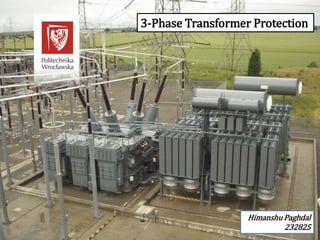
3-Phase Transformer Protection
Overview
⤞ Introduction
⤞ Transformer construction
⤞ Three phase transformer connection
⤞ Differential Protection of transformer
⤞ Restricted earth fault protection
⤞ Overcurrent protection
⤞ Protection against over heating
⤞ Protection against fire
⤞ Protection against lightening
⤞ Conclusions
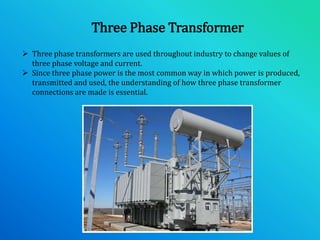
Three Phase Transformer
 Three phase transformers are used throughout industry to change values of
three phase voltage and current.
 Since three phase power is the most common way in which power is produced,
transmitted and used, the understanding of how three phase transformer
connections are made is essential.
Three Phase Transformer
Constructions
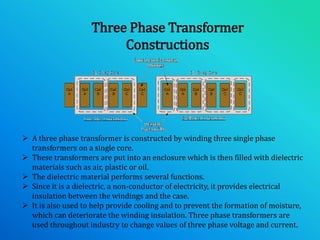
 A three phase transformer is constructed by winding three single phase
transformers on a single core.
 These transformers are put into an enclosure which is then filled with dielectric
materials such as air, plastic or oil.
 The dielectric material performs several functions.
 Since it is a dielectric, a non-conductor of electricity, it provides electrical
insulation between the windings and the case.
 It is also used to help provide cooling and to prevent the formation of moisture,
which can deteriorate the winding insulation. Three phase transformers are
used throughout industry to change values of three phase voltage and current.
Three Phase Transformer
Connections
 Delta to Delta - industrial applications
 Delta to Star - most common; commercial and industrial
 Star to Delta - high voltage transmissions
 Star to Star - rare, don't use causes harmonics and balancing problems.
Left: A 1300 MVA, 24.5/345 kV, 60Hz transformer with forced oil
and air (fan) cooling.
Right: A 60 MVA, 225/26.4 kV, 60 Hz showing the conservator.
Three Phase Transformer
Causes of faults in Transformer
Percentage Differential Protection
 The following factors affect the differential current in transformers and should
be considered while applying differential protection.
 These factors can result in a differential current even under balanced power in
and out conditions,
Magnetizing inrush current
Over excitation
CT Saturation
Phase displacement in Delta-Star transformers
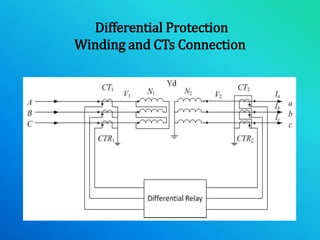
Differential Protection
Winding and CTs Connection
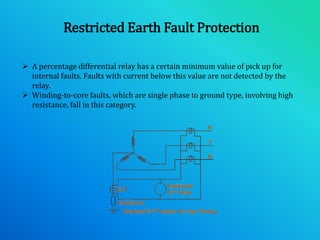
Restricted Earth Fault Protection
 A percentage differential relay has a certain minimum value of pick up for
internal faults. Faults with current below this value are not detected by the
relay.
 Winding-to-core faults, which are single phase to ground type, involving high
resistance, fall in this category.
Over Current Protection
 Over current protection is used for the purpose of providing back up protection
for large transformers.
 Two phase fault and one ground fault relay is sufficient to provide OC
protection to star delta transformer.
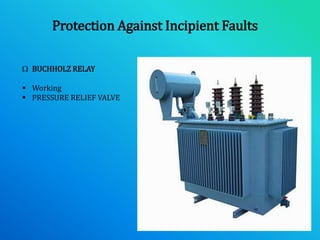
Protection Against Incipient Faults
 BUCHHOLZ RELAY
 Working
 PRESSURE RELIEF VALVE
Protection Against Incipient Faults
 Buchholz Relay
 Minor internal fault
 Break down of core of transformer
 Core heating
 Transformer insulating oil
(decomposed to CO2 and CO)
Protection Against Incipient Faults
 Buchholz Relay Construction and working
Protection Against Incipient Faults
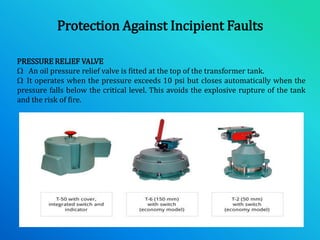
PRESSURE RELIEF VALVE
 An oil pressure relief valve is fitted at the top of the transformer tank.
 It operates when the pressure exceeds 10 psi but closes automatically when the
pressure falls below the critical level. This avoids the explosive rupture of the tank
and the risk of fire.
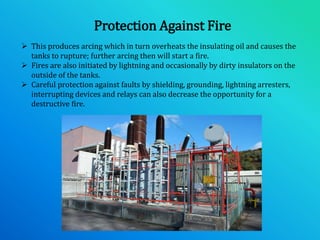
Protection Against Fire
 This produces arcing which in turn overheats the insulating oil and causes the
tanks to rupture; further arcing then will start a fire.
 Fires are also initiated by lightning and occasionally by dirty insulators on the
outside of the tanks.
 Careful protection against faults by shielding, grounding, lightning arresters,
interrupting devices and relays can also decrease the opportunity for a
destructive fire.
Protection Against Lightning
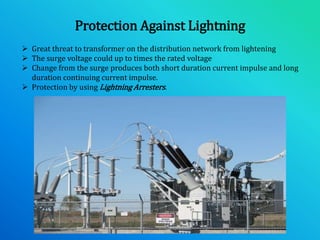
 Great threat to transformer on the distribution network from lightening
 The surge voltage could up to times the rated voltage
 Change from the surge produces both short duration current impulse and long
duration continuing current impulse.
 Protection by using Lightning Arresters.
Conclusions
 Transformers are the critical and expensive component of the power system.
 Transformer failures are expensive and also may be dangerous for personnel.
 The cost of energy not delivered because of transformer unavailability and
additional costs may be very high.
 Proper and accurate protection methods must be applied to protect the
transformer and to ensure the uninterrupted and efficient working of it.
Thank you..!

3 phase transformer protection

  • 1.
  • 2.
    Overview ⤞ Introduction ⤞ Transformerconstruction ⤞ Three phase transformer connection ⤞ Differential Protection of transformer ⤞ Restricted earth fault protection ⤞ Overcurrent protection ⤞ Protection against over heating ⤞ Protection against fire ⤞ Protection against lightening ⤞ Conclusions
  • 3.
    Three Phase Transformer Three phase transformers are used throughout industry to change values of three phase voltage and current.  Since three phase power is the most common way in which power is produced, transmitted and used, the understanding of how three phase transformer connections are made is essential.
  • 4.
    Three Phase Transformer Constructions A three phase transformer is constructed by winding three single phase transformers on a single core.  These transformers are put into an enclosure which is then filled with dielectric materials such as air, plastic or oil.  The dielectric material performs several functions.  Since it is a dielectric, a non-conductor of electricity, it provides electrical insulation between the windings and the case.  It is also used to help provide cooling and to prevent the formation of moisture, which can deteriorate the winding insulation. Three phase transformers are used throughout industry to change values of three phase voltage and current.
  • 5.
    Three Phase Transformer Connections Delta to Delta - industrial applications  Delta to Star - most common; commercial and industrial  Star to Delta - high voltage transmissions  Star to Star - rare, don't use causes harmonics and balancing problems.
  • 6.
    Left: A 1300MVA, 24.5/345 kV, 60Hz transformer with forced oil and air (fan) cooling. Right: A 60 MVA, 225/26.4 kV, 60 Hz showing the conservator. Three Phase Transformer
  • 7.
    Causes of faultsin Transformer
  • 8.
    Percentage Differential Protection The following factors affect the differential current in transformers and should be considered while applying differential protection.  These factors can result in a differential current even under balanced power in and out conditions, Magnetizing inrush current Over excitation CT Saturation Phase displacement in Delta-Star transformers
  • 9.
  • 10.
  • 11.
    Restricted Earth FaultProtection  A percentage differential relay has a certain minimum value of pick up for internal faults. Faults with current below this value are not detected by the relay.  Winding-to-core faults, which are single phase to ground type, involving high resistance, fall in this category.
  • 12.
    Over Current Protection Over current protection is used for the purpose of providing back up protection for large transformers.  Two phase fault and one ground fault relay is sufficient to provide OC protection to star delta transformer.
  • 13.
    Protection Against IncipientFaults  BUCHHOLZ RELAY  Working  PRESSURE RELIEF VALVE
  • 14.
    Protection Against IncipientFaults  Buchholz Relay  Minor internal fault  Break down of core of transformer  Core heating  Transformer insulating oil (decomposed to CO2 and CO)
  • 15.
    Protection Against IncipientFaults  Buchholz Relay Construction and working
  • 16.
    Protection Against IncipientFaults PRESSURE RELIEF VALVE  An oil pressure relief valve is fitted at the top of the transformer tank.  It operates when the pressure exceeds 10 psi but closes automatically when the pressure falls below the critical level. This avoids the explosive rupture of the tank and the risk of fire.
  • 17.
    Protection Against Fire This produces arcing which in turn overheats the insulating oil and causes the tanks to rupture; further arcing then will start a fire.  Fires are also initiated by lightning and occasionally by dirty insulators on the outside of the tanks.  Careful protection against faults by shielding, grounding, lightning arresters, interrupting devices and relays can also decrease the opportunity for a destructive fire.
  • 18.
    Protection Against Lightning Great threat to transformer on the distribution network from lightening  The surge voltage could up to times the rated voltage  Change from the surge produces both short duration current impulse and long duration continuing current impulse.  Protection by using Lightning Arresters.
  • 19.
    Conclusions  Transformers arethe critical and expensive component of the power system.  Transformer failures are expensive and also may be dangerous for personnel.  The cost of energy not delivered because of transformer unavailability and additional costs may be very high.  Proper and accurate protection methods must be applied to protect the transformer and to ensure the uninterrupted and efficient working of it.
  • 20.