The history of the European Union
We must build a kind of United States of Europe.
In this way only, will hundreds of millions of toilers
be able to regain the simple joys and hopes which
make life worth living.
Winston Churchill, 1946
European Integration●
●
European integration started after the end of World War II in 1945.
●
●
In Europe after the war, there was a powerful economic crisis. It was
decided to unite to save the continent from financial collapse.
●
●
European integration has created the prospect of a quick reconstruction
from the devastation of war and outlined a chance to accelerate the
development of european civilization.
The Schuman Declaration
●
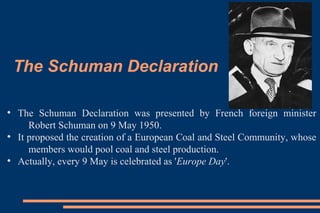
The Schuman Declaration was presented by French foreign minister
Robert Schuman on 9 May 1950.
●
It proposed the creation of a European Coal and Steel Community, whose
members would pool coal and steel production.
●
Actually, every 9 May is celebrated as 'Europe Day'.
●
In 1950, the nations of Europe were still struggling to overcome the
devastation wrought by World War II, which had ended 5 years
earlier.
●
Determined to prevent another such terrible war, European governments
concluded that pooling coal and steel production would – in the words
of the Declaration – make war between historic rivals France and
Germany "not merely unthinkable, but materially impossible".
The Treaty of Paris
●
The Treaty of Paris was signed on 18 April 1951. It was
created European Coal and Steel Community.
●
The treaty came into force on 23 July 1952 and expired on 23
July 2002, exactly fifty years after it came into effect.
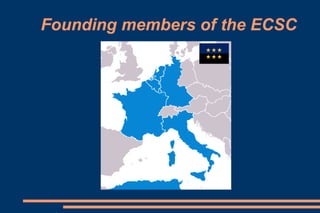
Founding members of the ECSC
The Treaties of Rome
●
25 March 1957 the same 6 countries signed two treaties. They
established the European Economic Community (EEC) and the
European Atomic Energy Community (Euratom).
●
Both treaties entered into force on 1 January 1958.
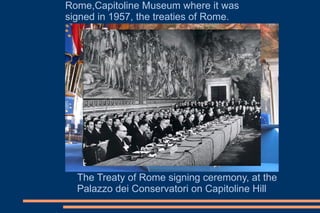
The Treaty of Rome signing ceremony, at the
Palazzo dei Conservatori on Capitoline Hill
Rome,Capitoline Museum where it was
signed in 1957, the treaties of Rome.
● The aim of the EEC was to create a single European market
(common policies for agriculture, transport and trade), and the
establishment of a customs union.
● The aim of the Euratom is ensure the control and cooperation in the
peaceful uses of atomic energy.
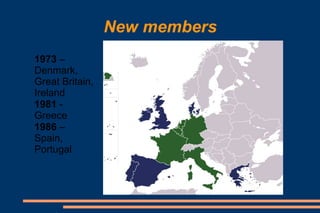
New members
1973 –
Denmark,
Great Britain,
Ireland
1981 -
Greece
1986 –
Spain,
Portugal
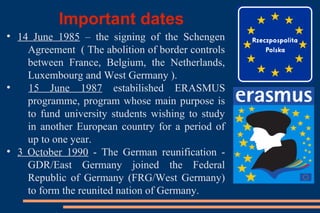
Important dates
●
14 June 1985 – the signing of the Schengen
Agreement ( The abolition of border controls
between France, Belgium, the Netherlands,
Luxembourg and West Germany ).
●
15 June 1987 estabilished ERASMUS
programme, program whose main purpose is
to fund university students wishing to study
in another European country for a period of
up to one year.
●
3 October 1990 - The German reunification -
GDR/East Germany joined the Federal
Republic of Germany (FRG/West Germany)
to form the reunited nation of Germany.
Treaty on European Union
●
The Treaty was signed on 7 February 1992 , by the
members of the European Community, in Maastricht
(Holland) and entered into force on 1 November
1993.
Treaty created the European Union (EU) based
on 3 pillars:
●
European Community, European Coal and Steel
Community and Euratom,
●
Common Foreign and Security Policy (CFSP)
●
Justice and Home Affairs.
The main provisions of the Treaty
●
the introduction of Euro currency on 1 January 1999
●
realization of a common security and foreign policy
●
establishing the citizenship of the European Union
●
development of cooperation in the field of justice
●
the creation of Economic and Monetary Union
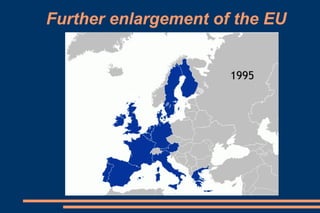
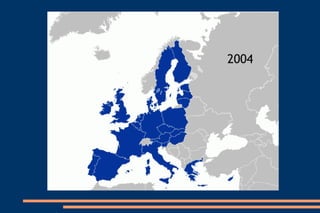
Further enlargement of the EU
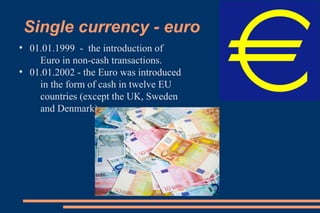
Single currency - euro
●
01.01.1999 - the introduction of
Euro in non-cash transactions.
●
01.01.2002 - the Euro was introduced
in the form of cash in twelve EU
countries (except the UK, Sweden
and Denmark).
Treaty of Lisbon
●
The Treaty of Lisbon was signed by the EU member states
on 13 December 2007, and entered into force on 1
December 2009.
●
Treaty gave the EU a unified structure and legal personality.
Main provisions of the Treaty
●
Since 2009, the European Parliament will have a maximum of
750 members (previously 785)
●
the introduction of the position of the President of the European
Council
●
indirect legislative initiative will require citizens to collect 1
million votes in a given case
●
reduce the number of European Commissioners to 18 (even
though it's 28 Member States)
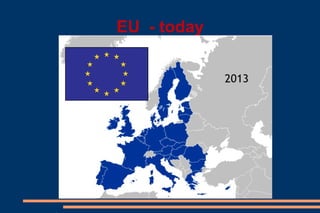
EU - today
Prepared by Szymon Wytlib, 1st year student
Institutions of the European Union
The European parliament
The European Parliament shares the legislative and budgetary authority of the Union with
the Council of the European Union. Its 751 members are elected every five years by universal
suffrage and sit according to political allegiance.
This institution has three main roles:
• debating and passing European laws
• examining other EU institutions, particularly the Commission, to make sure they are
working properly
• debating and adopting the EU's budget
European Council
The European Council is the institution that comprises the heads of state or government of
the member states, along with the council's own president and the president of the
Commission. The High Representative of the Union for Foreign Affairs and Security Policy
also takes part in its meetings.
While the European Council has no formal legislative power, it is a strategic (and
crisis-solving) body that provides the union with general political directions and
priorities, and acts as a collective presidency.
Court of Justice of the European Union
The Court of Justice interprets EU law to make sure it is applied in the same way
in all EU countries. It also settles legal disputes between EU governments and EU
institutions.
Individuals, companies or organisations can also bring cases before the Court if they feel
their rights have been infringed by an EU institution.
European Central Bank
The Bank works with the central banks in all 28 EU countries. It also leads the close
cooperation between central banks in the euro area– the 18 EU countries that have adopted
the euro, also known as the eurozone. The cooperation between this smaller, tighter group of
banks is referred to as the ‘Eurosystem’.
European Central Bank’s main purpose is to:
• keep prices stable (keep inflation under control), especially in countries that use the euro.
• keep the financial system stable – by making sure financial markets and institutions are
properly supervised.
European Commission
The European Commission is one of the main institutions of the European Union. It
represents and upholds the interests of the EU as a whole.
It oversees EU polices by:
• proposing new laws to Parliament and the Council
• managing the EU's budget and allocating funding
• enforcing EU law (together with the Court of Justice)
• representing the EU internationally, for example, by negotiating agreements between the
EU and other countries.
The 28 commissioners, one from each EU country, provide the Commission’s political
leadership during their 5-year term. Each Commissioner is assigned responsibility for specific
policy areas by the President
European Economic and Social Committee
Representatives of Europe's employers, workers and other interest groups can express their
views on EU issues through the European Economic and Social Committee (EESC).
The European Economic and Social Committee has 353 members drawn from economic and
social interest groups across Europe.
The number of members from each country depends on the national population.
European External Action Service
The EEAS manages the EU’s diplomatic relations with other countries outside the bloc. It
aims to make the EU's foreign policy more consistent and efficient, thereby increasing
Europe's influence in the world.
Committee of the Regions
The role of the Committee of the Regions (CoR) is to put forward local and regional points of
view on EU legislation. It does so by issuing reports (‘opinions’) on Commission proposals.
European Investment Fund
The EIF provides venture capital for small firms particularly new firms and technology-
oriented businesses. It also provides guarantees to financial institutions (such as banks) to
cover their loans .
These are the most important institutions of the European Union. I hope it wasn’t waste of
time waching it 
Prepared by Olivia Kucharska, 1st year student
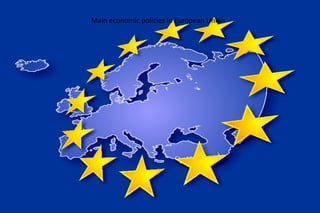
Main economic policies in European Union
The main goal of economic policy of the European Union is preventing the financial and economic crisis by:
- Promoting the growth of employment and a higher level of social protection for all
- Dealing with the global economic and financial challenges
- creating new jobs
- protecting savings
- getting business loans
- Joining the euro area
Advantages of the Euro area
- much cheaper (or even free) cross-border payments
- the same currency in different countries
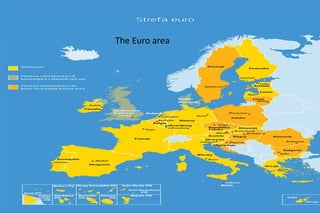
The Euro Area
The Euro area
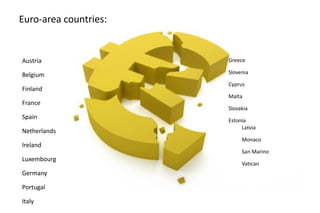
Euro-area countries:
Austria
Belgium 
Finland
  France
  Spain
Netherlands
Ireland
Luxembourg
  Germany
  Portugal
  Italy
Greece
  Slovenia
  Cyprus
  Malta
  Slovakia
  Estonia
Latvia
Monaco
San Marino
Vatican
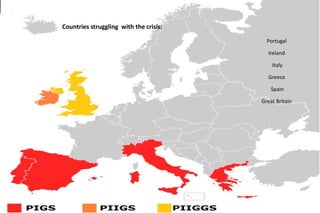
Countries struggling with the crisis:
Portugal
Ireland
Italy
Greece
Spain
Great Britain
Prepared by Konrad Rybczyk
Cultural differences and similarities in
Europe
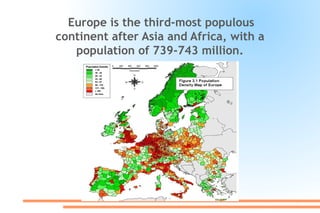
Europe is the third-most populous
continent after Asia and Africa, with a
population of 739-743 million.
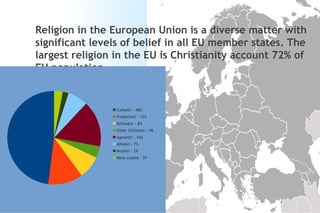
Religion in the European Union is a diverse matter with
significant levels of belief in all EU member states. The
largest religion in the EU is Christianity account 72% of
EU population.
Catholic - 48%
Protestant - 12%
Orthodox - 8%
Other Christian - 4%
Agnostic - 16%
Atheist - 7%
Muslim - 2%
None stated - 3%
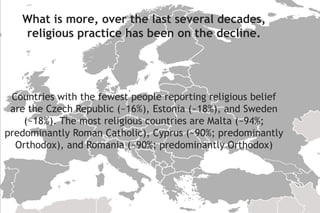
Countries with the fewest people reporting religious belief
are the Czech Republic (~16%), Estonia (~18%), and Sweden
(~18%). The most religious countries are Malta (~94%;
predominantly Roman Catholic), Cyprus (~90%; predominantly
Orthodox), and Romania (~90%; predominantly Orthodox)
What is more, over the last several decades,
religious practice has been on the decline.
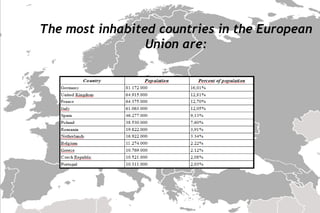
The most inhabited countries in the European
Union are:
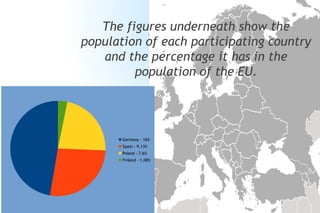
The figures underneath show the
population of each participating country
and the percentage it has in the
population of the EU.
Germany - 16%
Spain - 9,13%
Poland - 7,6%
Finland - 1,08%
Prepared by Szczepan Domagała

A1 poland

  • 1.
    The history ofthe European Union We must build a kind of United States of Europe. In this way only, will hundreds of millions of toilers be able to regain the simple joys and hopes which make life worth living. Winston Churchill, 1946
  • 2.
    European Integration● ● European integrationstarted after the end of World War II in 1945. ● ● In Europe after the war, there was a powerful economic crisis. It was decided to unite to save the continent from financial collapse. ● ● European integration has created the prospect of a quick reconstruction from the devastation of war and outlined a chance to accelerate the development of european civilization.
  • 3.
    The Schuman Declaration ● TheSchuman Declaration was presented by French foreign minister Robert Schuman on 9 May 1950. ● It proposed the creation of a European Coal and Steel Community, whose members would pool coal and steel production. ● Actually, every 9 May is celebrated as 'Europe Day'.
  • 4.
    ● In 1950, thenations of Europe were still struggling to overcome the devastation wrought by World War II, which had ended 5 years earlier. ● Determined to prevent another such terrible war, European governments concluded that pooling coal and steel production would – in the words of the Declaration – make war between historic rivals France and Germany "not merely unthinkable, but materially impossible".
  • 5.
    The Treaty ofParis ● The Treaty of Paris was signed on 18 April 1951. It was created European Coal and Steel Community. ● The treaty came into force on 23 July 1952 and expired on 23 July 2002, exactly fifty years after it came into effect.
  • 6.
  • 7.
    The Treaties ofRome ● 25 March 1957 the same 6 countries signed two treaties. They established the European Economic Community (EEC) and the European Atomic Energy Community (Euratom). ● Both treaties entered into force on 1 January 1958.
  • 8.
    The Treaty ofRome signing ceremony, at the Palazzo dei Conservatori on Capitoline Hill Rome,Capitoline Museum where it was signed in 1957, the treaties of Rome.
  • 9.
    ● The aimof the EEC was to create a single European market (common policies for agriculture, transport and trade), and the establishment of a customs union. ● The aim of the Euratom is ensure the control and cooperation in the peaceful uses of atomic energy.
  • 10.
    New members 1973 – Denmark, GreatBritain, Ireland 1981 - Greece 1986 – Spain, Portugal
  • 11.
    Important dates ● 14 June1985 – the signing of the Schengen Agreement ( The abolition of border controls between France, Belgium, the Netherlands, Luxembourg and West Germany ). ● 15 June 1987 estabilished ERASMUS programme, program whose main purpose is to fund university students wishing to study in another European country for a period of up to one year. ● 3 October 1990 - The German reunification - GDR/East Germany joined the Federal Republic of Germany (FRG/West Germany) to form the reunited nation of Germany.
  • 12.
    Treaty on EuropeanUnion ● The Treaty was signed on 7 February 1992 , by the members of the European Community, in Maastricht (Holland) and entered into force on 1 November 1993. Treaty created the European Union (EU) based on 3 pillars: ● European Community, European Coal and Steel Community and Euratom, ● Common Foreign and Security Policy (CFSP) ● Justice and Home Affairs.
  • 13.
    The main provisionsof the Treaty ● the introduction of Euro currency on 1 January 1999 ● realization of a common security and foreign policy ● establishing the citizenship of the European Union ● development of cooperation in the field of justice ● the creation of Economic and Monetary Union
  • 14.
  • 16.
    Single currency -euro ● 01.01.1999 - the introduction of Euro in non-cash transactions. ● 01.01.2002 - the Euro was introduced in the form of cash in twelve EU countries (except the UK, Sweden and Denmark).
  • 17.
    Treaty of Lisbon ● TheTreaty of Lisbon was signed by the EU member states on 13 December 2007, and entered into force on 1 December 2009. ● Treaty gave the EU a unified structure and legal personality.
  • 18.
    Main provisions ofthe Treaty ● Since 2009, the European Parliament will have a maximum of 750 members (previously 785) ● the introduction of the position of the President of the European Council ● indirect legislative initiative will require citizens to collect 1 million votes in a given case ● reduce the number of European Commissioners to 18 (even though it's 28 Member States)
  • 19.
  • 20.
    Prepared by SzymonWytlib, 1st year student
  • 21.
    Institutions of theEuropean Union
  • 22.
  • 23.
    The European Parliamentshares the legislative and budgetary authority of the Union with the Council of the European Union. Its 751 members are elected every five years by universal suffrage and sit according to political allegiance.
  • 24.
    This institution hasthree main roles: • debating and passing European laws • examining other EU institutions, particularly the Commission, to make sure they are working properly • debating and adopting the EU's budget
  • 25.
  • 26.
    The European Councilis the institution that comprises the heads of state or government of the member states, along with the council's own president and the president of the Commission. The High Representative of the Union for Foreign Affairs and Security Policy also takes part in its meetings.
  • 27.
    While the EuropeanCouncil has no formal legislative power, it is a strategic (and crisis-solving) body that provides the union with general political directions and priorities, and acts as a collective presidency.
  • 28.
    Court of Justiceof the European Union
  • 29.
    The Court ofJustice interprets EU law to make sure it is applied in the same way in all EU countries. It also settles legal disputes between EU governments and EU institutions.
  • 30.
    Individuals, companies ororganisations can also bring cases before the Court if they feel their rights have been infringed by an EU institution.
  • 31.
  • 32.
    The Bank workswith the central banks in all 28 EU countries. It also leads the close cooperation between central banks in the euro area– the 18 EU countries that have adopted the euro, also known as the eurozone. The cooperation between this smaller, tighter group of banks is referred to as the ‘Eurosystem’.
  • 33.
    European Central Bank’smain purpose is to: • keep prices stable (keep inflation under control), especially in countries that use the euro. • keep the financial system stable – by making sure financial markets and institutions are properly supervised.
  • 34.
  • 35.
    The European Commissionis one of the main institutions of the European Union. It represents and upholds the interests of the EU as a whole.
  • 36.
    It oversees EUpolices by: • proposing new laws to Parliament and the Council • managing the EU's budget and allocating funding • enforcing EU law (together with the Court of Justice) • representing the EU internationally, for example, by negotiating agreements between the EU and other countries.
  • 37.
    The 28 commissioners,one from each EU country, provide the Commission’s political leadership during their 5-year term. Each Commissioner is assigned responsibility for specific policy areas by the President
  • 38.
    European Economic andSocial Committee
  • 39.
    Representatives of Europe'semployers, workers and other interest groups can express their views on EU issues through the European Economic and Social Committee (EESC).
  • 40.
    The European Economicand Social Committee has 353 members drawn from economic and social interest groups across Europe. The number of members from each country depends on the national population.
  • 41.
  • 42.
    The EEAS managesthe EU’s diplomatic relations with other countries outside the bloc. It aims to make the EU's foreign policy more consistent and efficient, thereby increasing Europe's influence in the world.
  • 43.
  • 44.
    The role ofthe Committee of the Regions (CoR) is to put forward local and regional points of view on EU legislation. It does so by issuing reports (‘opinions’) on Commission proposals.
  • 45.
  • 46.
    The EIF providesventure capital for small firms particularly new firms and technology- oriented businesses. It also provides guarantees to financial institutions (such as banks) to cover their loans .
  • 47.
    These are themost important institutions of the European Union. I hope it wasn’t waste of time waching it 
  • 48.
    Prepared by OliviaKucharska, 1st year student
  • 49.
    Main economic policiesin European Union
  • 50.
    The main goalof economic policy of the European Union is preventing the financial and economic crisis by: - Promoting the growth of employment and a higher level of social protection for all - Dealing with the global economic and financial challenges - creating new jobs - protecting savings - getting business loans - Joining the euro area
  • 51.
    Advantages of theEuro area - much cheaper (or even free) cross-border payments - the same currency in different countries
  • 52.
  • 53.
    Euro-area countries: Austria Belgium  Finland   France  Spain Netherlands Ireland Luxembourg   Germany   Portugal   Italy Greece   Slovenia   Cyprus   Malta   Slovakia   Estonia Latvia Monaco San Marino Vatican
  • 54.
    Countries struggling withthe crisis: Portugal Ireland Italy Greece Spain Great Britain
  • 55.
  • 56.
    Cultural differences andsimilarities in Europe
  • 57.
    Europe is thethird-most populous continent after Asia and Africa, with a population of 739-743 million.
  • 58.
    Religion in theEuropean Union is a diverse matter with significant levels of belief in all EU member states. The largest religion in the EU is Christianity account 72% of EU population. Catholic - 48% Protestant - 12% Orthodox - 8% Other Christian - 4% Agnostic - 16% Atheist - 7% Muslim - 2% None stated - 3%
  • 59.
    Countries with thefewest people reporting religious belief are the Czech Republic (~16%), Estonia (~18%), and Sweden (~18%). The most religious countries are Malta (~94%; predominantly Roman Catholic), Cyprus (~90%; predominantly Orthodox), and Romania (~90%; predominantly Orthodox) What is more, over the last several decades, religious practice has been on the decline.
  • 60.
    The most inhabitedcountries in the European Union are:
  • 61.
    The figures underneathshow the population of each participating country and the percentage it has in the population of the EU. Germany - 16% Spain - 9,13% Poland - 7,6% Finland - 1,08%
  • 62.