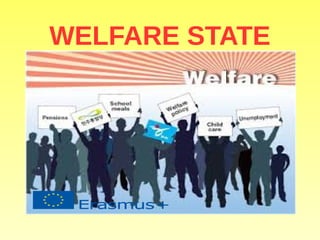
WELFARE STATE
INDEX:
1. Basic Concepts:
1.1. “Welfare State” definition
1.2. Social and economical welfare
1.3. Main interventions: education, health service, social benefits
2. Basic support for Welfare State: the State key role in the protection and promotion of
the economic and social well-being of its citizens.
3. Indicators of State interventions: Education, Healthcare, Social Security, social
services.
4. Main recipients of social aids in Spain:
- contributory benefits
- universal benefits
- compensatory benefits
5. Welfare State basic pillars in Spain (I): Education
6. Welfare State basic pillars in Spain (II): Healthcare services
7. Social Security System in Spain:
7.1. What is Social Security?
7.2. Contributions and social benefits.
7.3. The main Social Security expense: pensions.
8. Different types of Welfare System in the world.
1
WELFARE STATE:WELFARE STATE:
Definition andDefinition and
Basic conceptsBasic concepts
Made by:Made by:
Alba Sánchez SánchezAlba Sánchez Sánchez
Esther Agúndez AriasEsther Agúndez Arias
(1º Bachillerato F)(1º Bachillerato F)
Carlos Rodríguez TelloCarlos Rodríguez Tello
Sergio Bejarano CaneloSergio Bejarano Canelo
(1º Bachillerato E)(1º Bachillerato E)
WELFARE STATEWELFARE STATE
● It is a group of
activities developed
by Governments
related to social
and economical
welfare
achivement.
A welfare state is a concept of government
in which the state plays a key role in the
protection and promotion of the economic
and social well-being of its citizens.
The welfare state involves a transfer of
funds from the state, to the services
provided (i.e., healthcare, education, etc.),
as well as directly to individuals
("benefits").
SOCIAL WELFARESOCIAL WELFARE
● This concept includes
everything needed to have a
good quality of life: a decent
job, economical resources to
satisfy basic needs, a home,
and access to education and
medical care.
● It is a full satisfaction of
basic, cultural and economic
needs by a certain
community.
ECONOMIC WELFAREECONOMIC WELFARE
● Economic welfare is the
level of prosperity and
standard of living of
either an individual or a
group of persons.
● It refers to that part of
social welfare that can be
fulfilled through
economic activity.
Official definition
•
The welfare state means all activities carried out by the
governments with social and redistributive purpose, through the
state budget . It refers, to the activity of the Social Security on four
fronts: cash transfers ( unemployment or old age ) , health care ( a
system of universal free health care ) , education services ( ensuring
knowledge access of all citizens ) and provision of housing, food and
other care services.
MAIN INTERVENTIONS
Ana Franco de la Vega – 1º Bachillerato E
-Education. The education is the process of facilitating
the learning everywhere by means of knowledge, skills,
values, beliefs and habits that a group of persons transfers
to others. Worlwide, is recognized the right of every
person to the education.
-Health. The health is a condition of complete physical,
mental and social well-being, and not only the absence
of disease or ailment. Inside the promotion of the health,
this one has been considered not as an abstract condition,
but as a way to come to an end. The health is a resource
for the daily life, not the aim of the life.
-Social services. Social services are a type of
services, considered fundamental for the social
well-being. So, they are known as one of the
pillars of the systems of well-being in a
community. The essential aim is to improve the
quality of life of the persons in all the stages of his
life.
https://www.youtube.com/watch?v=LvqYknY8pvA&index=6&list=PL710BE7CBB720441C
2
Basic support for Welfare State: the State key role in the
protection and promotion of the economic and social
well-being of its citizens.
IMPORTANCE OF STATE INTERVENTION AS CORRECTION OF INEQUALITY
ÁLVARO ANDRADA TATO
VÍCTOR RAMOS MARTÍN
1º BACHILLERATO F
MARKET FAILURES
A market failure is a situation in which the allocation of
goods and services is not efficient.
Market failures are 4:
● Externalities( Pollution, Positive
externalities in production, External
effects on consumption)
● Public goods
● Lack of free competition
● Unequal distribution of income
TOOLS OF THE STATE TO SOLVE MARKET
FAILURES
● There are various measures a government could
undertake to correct market failure: for example, indirect
taxation, subsidies, tradable pollution permits, the
extension of property rights, regulation, buffer stocks
and minimum prices.
● Fluid interaction between government and productive
forces.
● Implement controls on the results.
● Promote actions of state promotion.
● Designing a productive long-term policy.
3
FABIOLA BALLESTEROS GARCÍA
MARTA MONTERO RODRÍGUEZ
ALBA SALGADO GALVÁN
1º BACHILLERATO E
WELFARE STATE:
Indicators of state intervention
The Welfare state is the set of activities developped by theThe Welfare state is the set of activities developped by the
Governments that guard relation with the search of socialGovernments that guard relation with the search of social
redistributive purposes and across the public budgets of the State.redistributive purposes and across the public budgets of the State.
The Welfare state supports on four indicators:
•
The Social Security.
•
Health Service.
•
Education.
•
Social Services. Economic aids to the dependence.
WELFARE STATE:
Taxes are used for redistributing the wealth of the State so that inequalities
between people with major or fewer income are reduced.
• The Social Security → It pays subsidies and unemployment benefits.
• Health Service. System of Universal free health care.
•Education → Public system of free access to the education.
•Social Services → Economic aids to the dependence.
Education
The education, obligatory and free in the
first stages, and strongly subsidized in
the top levels, it is a formation destined
to develop the intellectual, moral and
affective capacity of people.
Health
The health, at the beginning universal and
free, in some European countries begins to be
restricted to certain groups and citizens start
contributing to the costs.
The social security
The social security includes pensions (basically
retirement pensions) that can be different amounts
depending on the contributions made by workers
along his labor life.
There are also different benefits to attend different
situations (orphanhood, widowhood, disease, etc.).
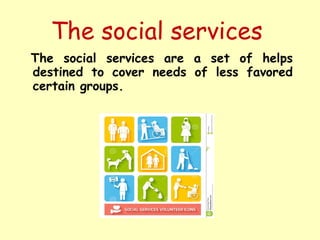
The social services
The social services are a set of helps
destined to cover needs of less favored
certain groups.
4
Paloma Barrantes Durán
Cristina Iglesias Herrero
1º BACHILLERATO E
MAIN RECIPIENTS OF SOCIAL
SPENDING IN SPAIN
- contributory benefits
- universal benefits
- compensatory benefits
Kind of benefits
Contributory benefits, as
unemployment benefit,
retirement pension or
disability benefit.
Beneficiaries are people
who have previously
contributed to the Social
Security System. It means
they have paid a part of
their salary (Social Security
Fee) during their work life.
Universal benefits,
like education and
health service.
They are aimed to
all the population, so
beneficiaries are
everybody.
Compensatory benefits, wich are aimed to poor families or
individuals without economic resources.
Beneficiaries are people with no economic resources or people who
have no rights to contributory benefits.
5
BASIC PILLARS OF THE WELFARE
STATE IN SPAIN(I): EDUCATION
The importance of education
for the Society
Education is one of the factors that influences more
in people and companies' advance and progress.
Education enriches the culture, the spirit, the values
and all that characterizes us as human beings.
Education has always been important for the
development, but it acquires more relevancy in
nowadys' world, because we live through deep
transformations, motivated partly by the dizzy
advance of the science and his applications, as well as
for the not less intensive development of the media
and the information technologies.
Money spended by the State on
education, in Spain (2013)
Spain: annual
expense in
education for
pupil, in
dollars, in
state and
private
education.
The current Spanish education system
ANDREA VÁZQUEZ PANIAGUA.
BERNARDO DONAIRE FRANCO.
1 BACHILLERATO E.
INTRODUCTION.
According to the Constitution, the
Government makes a distribution of the
educational subjects:
●
Pre-school education (between 0 and 6 years old).
●
Primary education (between 6 and 12 years old).
●
Obligatory Secondary education (between 12 and 16 years old)
●
Post-obligatory Secondary education (between 16 and 18 years old)
●
Higher education.
Pre-school education.
●
Pre-school Education is the educational stage
that covers children from birth to six years for
contribute to their physical, emotional, social
and intellectual development. It is organized
into two cycles: the first comprises up to three
years; the second, which is free, goes from
three to six years old.
●
It is taught in kindergartens and schools.
Primary education.
●
Primary education is the one that provides
proper literacy. It means that teaches reading,
writing, basic arithmetic and some of the
cultural concepts considered essential.
●
It is taught at primary schools.
Secondary education.
Obligatory Secondary Education (ESO) is the
Spanish education system of secondary
education and aims to prepare students
between 12 and 16 years for their future studies
and / or the workplace. It is filed in the IES
(Institutes of Secondary Education), or in private
and aided schools..
Higher education.
There are 76 universities in Spain, most of which are supported
by state funding. 24 Spanish universities are private, of which 7
are affiliated with the catholic church.
It is a post-secondary education step, and it is common, but not
essential, that pupils must pass some kind of access exam,
based on academic performance during the secondary stage.
6
FRANCISCO MONTES BARROSO
1º BACHILLERATO E
BASIC PILLARS OF THE WELFARE
STATE IN SPAIN(II): HEALTH
+IMPORTANCE OF HEALTHCARE FOR
SOCIETY.
+ GLOBAL BUDGET FOR STATE
HEALTHCARE SYSTEM.
IMPORTANCE OF THE
HEALTHCARE FOR SOCIETY:
• The Spanish healthcare system is among the best in the world.
• If you're living and working in Spain you'll have access to Spain's
free state healthcare, paid partly by social security payments, which
will be deducted from your salary.
• Spain spends about 10 percent of its GDP on healthcare, and is
ranked 6th in the EU for the number of doctors with around four
doctors per 1,000 people. A 2012 World Health Organisation survey
showed that Spanish women outlive all other nationalities (living to
85.1 years) apart from the Japanese.
STATE HEALTHCARE IS FREE TO ANYONE
LIVING AND WORKING IN SPAIN:
You are entitled to free state healthcare if you are:
●
resident in Spain and work in employment or self-employment and
pay social security contributions,
●
resident in Spain and receiving certain state benefits,
●
resident in Spain and recently divorced or separated from a partner
registered with social security,
●
a child resident in Spain,
●
a pregnant woman who is resident in Spain,
●
under 26 and studying in Spain,
●
a state pensioner
●
staying temporarily in Spain and have an EHIC card
(European Health Insurance card)
1. Healthcare ranking
2. Population coverage
3. Total health expense (public and private)
4. Total public health expense
5. Life expectancy
6. Child mortality rate
GLOBAL BUDGET FOR STATE HEALTHCARE SYSTEM
(money spent on healthcare in Spain)
Spain vs. OECD
GLOBAL BUDGET FOR STATE
HEALTHCARE SYSTEM
• Public expenditure on health in Spain decreases 4830.6
million in 2013, ie 3.79% to 64,918.2 million euros, which
accounted for 13.95% of total public expenditure. This figure
means that the public health expenditure in 2013 reached
6.25% of GDP, down 0.42 points from 2012, when spending
was 6.67% of GDP.
• In 2013, Spain held the same position in the ranking of
countries invested in healthcare, ranking 10. In terms of
amount respect to GDP ratio, since Spain has fallen from 28
to 35 from 188 countries.
SpanishHealthcare
SystemStructure
María Rojas González
Isabel Ventura López
1º Bachillerato E
HealthcareSystem
•
It is a decentralised
organization in which each
region manages through the
corresponding health
counseling, their competence
in health.
•
It is one of the best systems of
the world because there is not
restrictions in its services, and
the professional training of its
staff.
Types of Healthcare Systems
● Public
● Private
Public Sanitary Sector
•
All Spanish people have
right, independently of
their economic and
employment situation,
to recieve medical
assistance
•
Access to public sanitary
services is through the
Sanitary Card.
Private Sanitary Sector
•
It is a minority part of
the sanitary sector
because the Spanish
System covers all the
medical needs.
•
In some cases this
sector also works for
the Sanitary System.
7
Cristina Santano Bazaga
Sonia Hernández Gómez
1º BACHILLERATO E
SOCIAL SECURITY IN SPAIN (I)
This pic was post in a virtual journal in 2008.
•
What is the social secutiry?
In simple terms, the agree that society in which a person lives
should help them to develop and to make the most of all the
advantages (culture, work, social welfare) which are offered to
them in the country.
•
How is the social security in Spain?
The Social Security System in Spain is the principal system of
social protection. The concept of social security first appeared in
Spain in 1883, under the Committee for Social Reform, it was
expanded several times during the twentieth century.
The purpose of social security is to guarantee to those
people who carry out an occupational activity, or those that
meet the requirements of the non-contributory category,
such as family members or dependants for whom they
have responsibility, adequate protection against those
contingencies and situations contemplated by the law.
Protection provided by social security will include (cover):
1. Healthcare (primary or hospitalisation)in the case of maternity,
common, occupational illness or accidents, whether or not
occupational;
2. Professional care for those illnesses or accidents;
3. Benefits for the following:
- Temporary incapacity
- Maternity
- Death and survival
And for both contributory and non-contributory schemes:
- Invalidity
- Retirement
- Unemployment
•
Quotes (fees) are the percentage of the employee's
salary that its given to Social Security. A part of this
fee comes from the employee and the other part
comes from the business owner.
•
With that money the State pay services like
pensions or benefits.
José Ángel Sierra González
Andrés Poza Salgado
1º BACHILLERATO F
SOCIAL SECURITY IN SPAIN (II)
Social Security in Spain
Spain Social Security System is the director of the
State Social Protection .
Social Benefits
Benefits are a set of measures that allows the
Social Security to anticipate, repair or overcome
certain misfortune situations
The main Social Security expense:
retirement pensions.
● The minimum
retirement pension
(contributory) is 634,50
€ per month, in Spain.
● The maximum
retirement pension
(contributory)is 2.560 €
per month, in Spain.
You can compare different countries' retirement
pensions in the next link:
http://elpais.com/elpais/2015/12/01/media/1448
967648_541034.html
8
Different types of Welfare Systems in the World
% of GDP in social expenditures in OECD states, 2013
● Nordic model
● Continental model
● Anglo-saxon model
● Mediterranean model
NORDIC MODEL
Denmark, Finland, Norway, Sweden and the Netherlands.
This model holds the highest level of social
insurance. Its main characteristic is its universal
provision nature which is based on the principle of
"citizenship". Therefore, there exists a more
generalised access, with lower conditionability, to
the social provisions.
The Nordic model is also characterised by a high tax
wedge.
CONTINENTAL MODEL
Austria, Belgium, France, Germany and Luxembourg.
The Continental model has some similarities with
the Nordic model. Nevertheless, it has a higher
share of its expenditures devoted to pensions. The
model is based on the principle of "security" and a
system of subsidies which are not conditioned to
employability (for example in the case of France or
Belgium, there exist subsidies whose only
requirement is being older than 25).
ANGLO-SAXON MODEL
Ireland and the United Kingdom.
This model features a lower level of expenditures
than the previous ones. Its main particularity is its
social assistance of last resort. Subsidies are
directed to a higher extent to the working-age
population and to a lower extent to pensions.
Access to subsidies is (more) conditioned to
employability (for instance, they are conditioned on
having worked previously).
MEDITERRANEAN MODEL
Greece, Italy, Portugal and Spain.
It is the model with the lowest share of
expenditures and is strongly based on pensions and
a low level of social assistance. There exists in these
countries a higher segmentation of rights and
status of persons receiving subsidies which has as
one of its consequences a strongly conditioned
access to social provisions.
Sources: https://en.wikipedia.org/wiki/European_social_model
You can find out more information about the
different models of Welfare State here:
(specially from minute 1:30)
https://www.youtube.com/watch?v=Jv3hMfTTCfY

A5 spain

  • 1.
  • 2.
    INDEX: 1. Basic Concepts: 1.1.“Welfare State” definition 1.2. Social and economical welfare 1.3. Main interventions: education, health service, social benefits 2. Basic support for Welfare State: the State key role in the protection and promotion of the economic and social well-being of its citizens. 3. Indicators of State interventions: Education, Healthcare, Social Security, social services. 4. Main recipients of social aids in Spain: - contributory benefits - universal benefits - compensatory benefits 5. Welfare State basic pillars in Spain (I): Education 6. Welfare State basic pillars in Spain (II): Healthcare services 7. Social Security System in Spain: 7.1. What is Social Security? 7.2. Contributions and social benefits. 7.3. The main Social Security expense: pensions. 8. Different types of Welfare System in the world.
  • 3.
  • 4.
    WELFARE STATE:WELFARE STATE: DefinitionandDefinition and Basic conceptsBasic concepts Made by:Made by: Alba Sánchez SánchezAlba Sánchez Sánchez Esther Agúndez AriasEsther Agúndez Arias (1º Bachillerato F)(1º Bachillerato F) Carlos Rodríguez TelloCarlos Rodríguez Tello Sergio Bejarano CaneloSergio Bejarano Canelo (1º Bachillerato E)(1º Bachillerato E)
  • 5.
    WELFARE STATEWELFARE STATE ●It is a group of activities developed by Governments related to social and economical welfare achivement.
  • 6.
    A welfare stateis a concept of government in which the state plays a key role in the protection and promotion of the economic and social well-being of its citizens.
  • 7.
    The welfare stateinvolves a transfer of funds from the state, to the services provided (i.e., healthcare, education, etc.), as well as directly to individuals ("benefits").
  • 8.
    SOCIAL WELFARESOCIAL WELFARE ●This concept includes everything needed to have a good quality of life: a decent job, economical resources to satisfy basic needs, a home, and access to education and medical care. ● It is a full satisfaction of basic, cultural and economic needs by a certain community.
  • 9.
    ECONOMIC WELFAREECONOMIC WELFARE ●Economic welfare is the level of prosperity and standard of living of either an individual or a group of persons. ● It refers to that part of social welfare that can be fulfilled through economic activity.
  • 10.
    Official definition • The welfarestate means all activities carried out by the governments with social and redistributive purpose, through the state budget . It refers, to the activity of the Social Security on four fronts: cash transfers ( unemployment or old age ) , health care ( a system of universal free health care ) , education services ( ensuring knowledge access of all citizens ) and provision of housing, food and other care services.
  • 11.
    MAIN INTERVENTIONS Ana Francode la Vega – 1º Bachillerato E -Education. The education is the process of facilitating the learning everywhere by means of knowledge, skills, values, beliefs and habits that a group of persons transfers to others. Worlwide, is recognized the right of every person to the education. -Health. The health is a condition of complete physical, mental and social well-being, and not only the absence of disease or ailment. Inside the promotion of the health, this one has been considered not as an abstract condition, but as a way to come to an end. The health is a resource for the daily life, not the aim of the life.
  • 12.
    -Social services. Socialservices are a type of services, considered fundamental for the social well-being. So, they are known as one of the pillars of the systems of well-being in a community. The essential aim is to improve the quality of life of the persons in all the stages of his life. https://www.youtube.com/watch?v=LvqYknY8pvA&index=6&list=PL710BE7CBB720441C
  • 13.
  • 14.
    Basic support forWelfare State: the State key role in the protection and promotion of the economic and social well-being of its citizens. IMPORTANCE OF STATE INTERVENTION AS CORRECTION OF INEQUALITY ÁLVARO ANDRADA TATO VÍCTOR RAMOS MARTÍN 1º BACHILLERATO F
  • 15.
    MARKET FAILURES A marketfailure is a situation in which the allocation of goods and services is not efficient. Market failures are 4: ● Externalities( Pollution, Positive externalities in production, External effects on consumption) ● Public goods ● Lack of free competition ● Unequal distribution of income
  • 16.
    TOOLS OF THESTATE TO SOLVE MARKET FAILURES ● There are various measures a government could undertake to correct market failure: for example, indirect taxation, subsidies, tradable pollution permits, the extension of property rights, regulation, buffer stocks and minimum prices. ● Fluid interaction between government and productive forces. ● Implement controls on the results. ● Promote actions of state promotion. ● Designing a productive long-term policy.
  • 17.
  • 18.
    FABIOLA BALLESTEROS GARCÍA MARTAMONTERO RODRÍGUEZ ALBA SALGADO GALVÁN 1º BACHILLERATO E WELFARE STATE: Indicators of state intervention
  • 19.
    The Welfare stateis the set of activities developped by theThe Welfare state is the set of activities developped by the Governments that guard relation with the search of socialGovernments that guard relation with the search of social redistributive purposes and across the public budgets of the State.redistributive purposes and across the public budgets of the State. The Welfare state supports on four indicators: • The Social Security. • Health Service. • Education. • Social Services. Economic aids to the dependence. WELFARE STATE: Taxes are used for redistributing the wealth of the State so that inequalities between people with major or fewer income are reduced.
  • 20.
    • The SocialSecurity → It pays subsidies and unemployment benefits. • Health Service. System of Universal free health care.
  • 21.
    •Education → Publicsystem of free access to the education. •Social Services → Economic aids to the dependence.
  • 22.
    Education The education, obligatoryand free in the first stages, and strongly subsidized in the top levels, it is a formation destined to develop the intellectual, moral and affective capacity of people.
  • 23.
    Health The health, atthe beginning universal and free, in some European countries begins to be restricted to certain groups and citizens start contributing to the costs.
  • 24.
    The social security Thesocial security includes pensions (basically retirement pensions) that can be different amounts depending on the contributions made by workers along his labor life. There are also different benefits to attend different situations (orphanhood, widowhood, disease, etc.).
  • 25.
    The social services Thesocial services are a set of helps destined to cover needs of less favored certain groups.
  • 26.
  • 27.
    Paloma Barrantes Durán CristinaIglesias Herrero 1º BACHILLERATO E MAIN RECIPIENTS OF SOCIAL SPENDING IN SPAIN
  • 28.
    - contributory benefits -universal benefits - compensatory benefits
  • 29.
    Kind of benefits Contributorybenefits, as unemployment benefit, retirement pension or disability benefit. Beneficiaries are people who have previously contributed to the Social Security System. It means they have paid a part of their salary (Social Security Fee) during their work life. Universal benefits, like education and health service. They are aimed to all the population, so beneficiaries are everybody. Compensatory benefits, wich are aimed to poor families or individuals without economic resources. Beneficiaries are people with no economic resources or people who have no rights to contributory benefits.
  • 30.
  • 31.
    BASIC PILLARS OFTHE WELFARE STATE IN SPAIN(I): EDUCATION
  • 32.
    The importance ofeducation for the Society Education is one of the factors that influences more in people and companies' advance and progress. Education enriches the culture, the spirit, the values and all that characterizes us as human beings. Education has always been important for the development, but it acquires more relevancy in nowadys' world, because we live through deep transformations, motivated partly by the dizzy advance of the science and his applications, as well as for the not less intensive development of the media and the information technologies.
  • 33.
    Money spended bythe State on education, in Spain (2013) Spain: annual expense in education for pupil, in dollars, in state and private education.
  • 34.
    The current Spanisheducation system ANDREA VÁZQUEZ PANIAGUA. BERNARDO DONAIRE FRANCO. 1 BACHILLERATO E.
  • 35.
    INTRODUCTION. According to theConstitution, the Government makes a distribution of the educational subjects: ● Pre-school education (between 0 and 6 years old). ● Primary education (between 6 and 12 years old). ● Obligatory Secondary education (between 12 and 16 years old) ● Post-obligatory Secondary education (between 16 and 18 years old) ● Higher education.
  • 36.
    Pre-school education. ● Pre-school Educationis the educational stage that covers children from birth to six years for contribute to their physical, emotional, social and intellectual development. It is organized into two cycles: the first comprises up to three years; the second, which is free, goes from three to six years old. ● It is taught in kindergartens and schools.
  • 37.
    Primary education. ● Primary educationis the one that provides proper literacy. It means that teaches reading, writing, basic arithmetic and some of the cultural concepts considered essential. ● It is taught at primary schools.
  • 38.
    Secondary education. Obligatory SecondaryEducation (ESO) is the Spanish education system of secondary education and aims to prepare students between 12 and 16 years for their future studies and / or the workplace. It is filed in the IES (Institutes of Secondary Education), or in private and aided schools..
  • 39.
    Higher education. There are76 universities in Spain, most of which are supported by state funding. 24 Spanish universities are private, of which 7 are affiliated with the catholic church. It is a post-secondary education step, and it is common, but not essential, that pupils must pass some kind of access exam, based on academic performance during the secondary stage.
  • 40.
  • 41.
    FRANCISCO MONTES BARROSO 1ºBACHILLERATO E BASIC PILLARS OF THE WELFARE STATE IN SPAIN(II): HEALTH
  • 42.
    +IMPORTANCE OF HEALTHCAREFOR SOCIETY. + GLOBAL BUDGET FOR STATE HEALTHCARE SYSTEM.
  • 44.
    IMPORTANCE OF THE HEALTHCAREFOR SOCIETY: • The Spanish healthcare system is among the best in the world. • If you're living and working in Spain you'll have access to Spain's free state healthcare, paid partly by social security payments, which will be deducted from your salary. • Spain spends about 10 percent of its GDP on healthcare, and is ranked 6th in the EU for the number of doctors with around four doctors per 1,000 people. A 2012 World Health Organisation survey showed that Spanish women outlive all other nationalities (living to 85.1 years) apart from the Japanese.
  • 45.
    STATE HEALTHCARE ISFREE TO ANYONE LIVING AND WORKING IN SPAIN: You are entitled to free state healthcare if you are: ● resident in Spain and work in employment or self-employment and pay social security contributions, ● resident in Spain and receiving certain state benefits, ● resident in Spain and recently divorced or separated from a partner registered with social security, ● a child resident in Spain, ● a pregnant woman who is resident in Spain, ● under 26 and studying in Spain, ● a state pensioner ● staying temporarily in Spain and have an EHIC card (European Health Insurance card)
  • 46.
    1. Healthcare ranking 2.Population coverage 3. Total health expense (public and private) 4. Total public health expense 5. Life expectancy 6. Child mortality rate
  • 47.
    GLOBAL BUDGET FORSTATE HEALTHCARE SYSTEM (money spent on healthcare in Spain) Spain vs. OECD
  • 48.
    GLOBAL BUDGET FORSTATE HEALTHCARE SYSTEM • Public expenditure on health in Spain decreases 4830.6 million in 2013, ie 3.79% to 64,918.2 million euros, which accounted for 13.95% of total public expenditure. This figure means that the public health expenditure in 2013 reached 6.25% of GDP, down 0.42 points from 2012, when spending was 6.67% of GDP. • In 2013, Spain held the same position in the ranking of countries invested in healthcare, ranking 10. In terms of amount respect to GDP ratio, since Spain has fallen from 28 to 35 from 188 countries.
  • 50.
  • 51.
    HealthcareSystem • It is adecentralised organization in which each region manages through the corresponding health counseling, their competence in health. • It is one of the best systems of the world because there is not restrictions in its services, and the professional training of its staff.
  • 52.
    Types of HealthcareSystems ● Public ● Private
  • 53.
    Public Sanitary Sector • AllSpanish people have right, independently of their economic and employment situation, to recieve medical assistance • Access to public sanitary services is through the Sanitary Card.
  • 54.
    Private Sanitary Sector • Itis a minority part of the sanitary sector because the Spanish System covers all the medical needs. • In some cases this sector also works for the Sanitary System.
  • 55.
  • 56.
    Cristina Santano Bazaga SoniaHernández Gómez 1º BACHILLERATO E SOCIAL SECURITY IN SPAIN (I)
  • 57.
    This pic waspost in a virtual journal in 2008.
  • 58.
    • What is thesocial secutiry? In simple terms, the agree that society in which a person lives should help them to develop and to make the most of all the advantages (culture, work, social welfare) which are offered to them in the country. • How is the social security in Spain? The Social Security System in Spain is the principal system of social protection. The concept of social security first appeared in Spain in 1883, under the Committee for Social Reform, it was expanded several times during the twentieth century.
  • 59.
    The purpose ofsocial security is to guarantee to those people who carry out an occupational activity, or those that meet the requirements of the non-contributory category, such as family members or dependants for whom they have responsibility, adequate protection against those contingencies and situations contemplated by the law.
  • 60.
    Protection provided bysocial security will include (cover): 1. Healthcare (primary or hospitalisation)in the case of maternity, common, occupational illness or accidents, whether or not occupational; 2. Professional care for those illnesses or accidents; 3. Benefits for the following: - Temporary incapacity - Maternity - Death and survival And for both contributory and non-contributory schemes: - Invalidity - Retirement - Unemployment
  • 61.
    • Quotes (fees) arethe percentage of the employee's salary that its given to Social Security. A part of this fee comes from the employee and the other part comes from the business owner. • With that money the State pay services like pensions or benefits.
  • 62.
    José Ángel SierraGonzález Andrés Poza Salgado 1º BACHILLERATO F SOCIAL SECURITY IN SPAIN (II)
  • 63.
    Social Security inSpain Spain Social Security System is the director of the State Social Protection .
  • 64.
    Social Benefits Benefits area set of measures that allows the Social Security to anticipate, repair or overcome certain misfortune situations
  • 65.
    The main SocialSecurity expense: retirement pensions. ● The minimum retirement pension (contributory) is 634,50 € per month, in Spain. ● The maximum retirement pension (contributory)is 2.560 € per month, in Spain.
  • 66.
    You can comparedifferent countries' retirement pensions in the next link: http://elpais.com/elpais/2015/12/01/media/1448 967648_541034.html
  • 67.
  • 68.
    Different types ofWelfare Systems in the World % of GDP in social expenditures in OECD states, 2013
  • 69.
    ● Nordic model ●Continental model ● Anglo-saxon model ● Mediterranean model
  • 70.
    NORDIC MODEL Denmark, Finland,Norway, Sweden and the Netherlands. This model holds the highest level of social insurance. Its main characteristic is its universal provision nature which is based on the principle of "citizenship". Therefore, there exists a more generalised access, with lower conditionability, to the social provisions. The Nordic model is also characterised by a high tax wedge.
  • 71.
    CONTINENTAL MODEL Austria, Belgium,France, Germany and Luxembourg. The Continental model has some similarities with the Nordic model. Nevertheless, it has a higher share of its expenditures devoted to pensions. The model is based on the principle of "security" and a system of subsidies which are not conditioned to employability (for example in the case of France or Belgium, there exist subsidies whose only requirement is being older than 25).
  • 72.
    ANGLO-SAXON MODEL Ireland andthe United Kingdom. This model features a lower level of expenditures than the previous ones. Its main particularity is its social assistance of last resort. Subsidies are directed to a higher extent to the working-age population and to a lower extent to pensions. Access to subsidies is (more) conditioned to employability (for instance, they are conditioned on having worked previously).
  • 73.
    MEDITERRANEAN MODEL Greece, Italy,Portugal and Spain. It is the model with the lowest share of expenditures and is strongly based on pensions and a low level of social assistance. There exists in these countries a higher segmentation of rights and status of persons receiving subsidies which has as one of its consequences a strongly conditioned access to social provisions. Sources: https://en.wikipedia.org/wiki/European_social_model
  • 74.
    You can findout more information about the different models of Welfare State here: (specially from minute 1:30) https://www.youtube.com/watch?v=Jv3hMfTTCfY