European Union
2016PCS 4
Lauri Uljas
Sources: EU website
EU Documents
Share slides
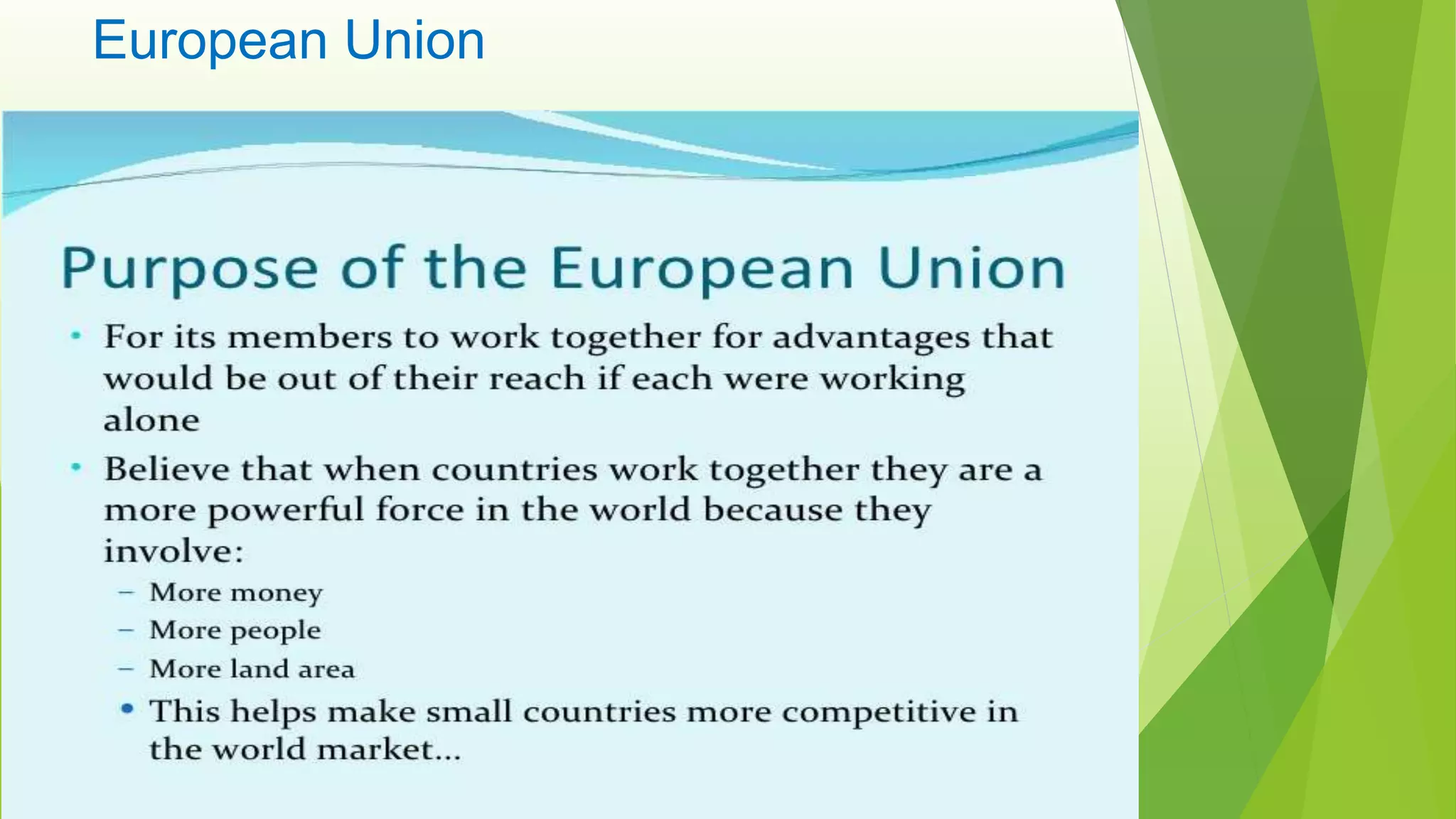
What is the purpose of EU ?
What are the main positive out
puts in context of Finland?
What are the main challenges in
Eu as a system and E as
everyday policies and practices?
Policy Areas 1-4: The
Four Freedoms
Chapter 1: Free Movement of Goods
Chapter2: Freedom of movement for workers
Chapter 3: Right of establishment and freedom
to provide services
Chapter 4: Free movement of capital
European Union
European Union
European Union
European Union
European Union
European Union
questions
 How many countries are part of the European Union?
 How many countries use the Euro?
 Which is the biggest member state?
 Which is the smallest member state?
 How many official and working langugaes are in the EU?
European Union (Croatia is now 28th EU Member country)
European Union (Croatia is now the 28th EU country)
European Union
European Union
European Union
European Union
European Union
 European Commission president – Jean-Claude Juncker
 Term: November 2014 - October 2019
 Appointed by: national leaders (heads of state or government of EU
countries), with the approval of the European Parliament.
 Role:
 Gives political guidance to the Commission
 Calls and chairs meetings of the college of the Commissioners
 Leads the Commission's work in implementing EU policies
 Takes part in G7 meetings
 Contributes to major debates both in the European Parliament and
between EU governments in the Council of the European Union
The EU Parliament
The Parliament acts as a co-legislator,
sharing with the Council the power to
adopt and amend legislative proposals
and to decide on the EU budget. It also
supervises the work of the Commission
and other EU bodies and cooperates
with national parliaments of EU
countries to get their inputs into the
legislation.
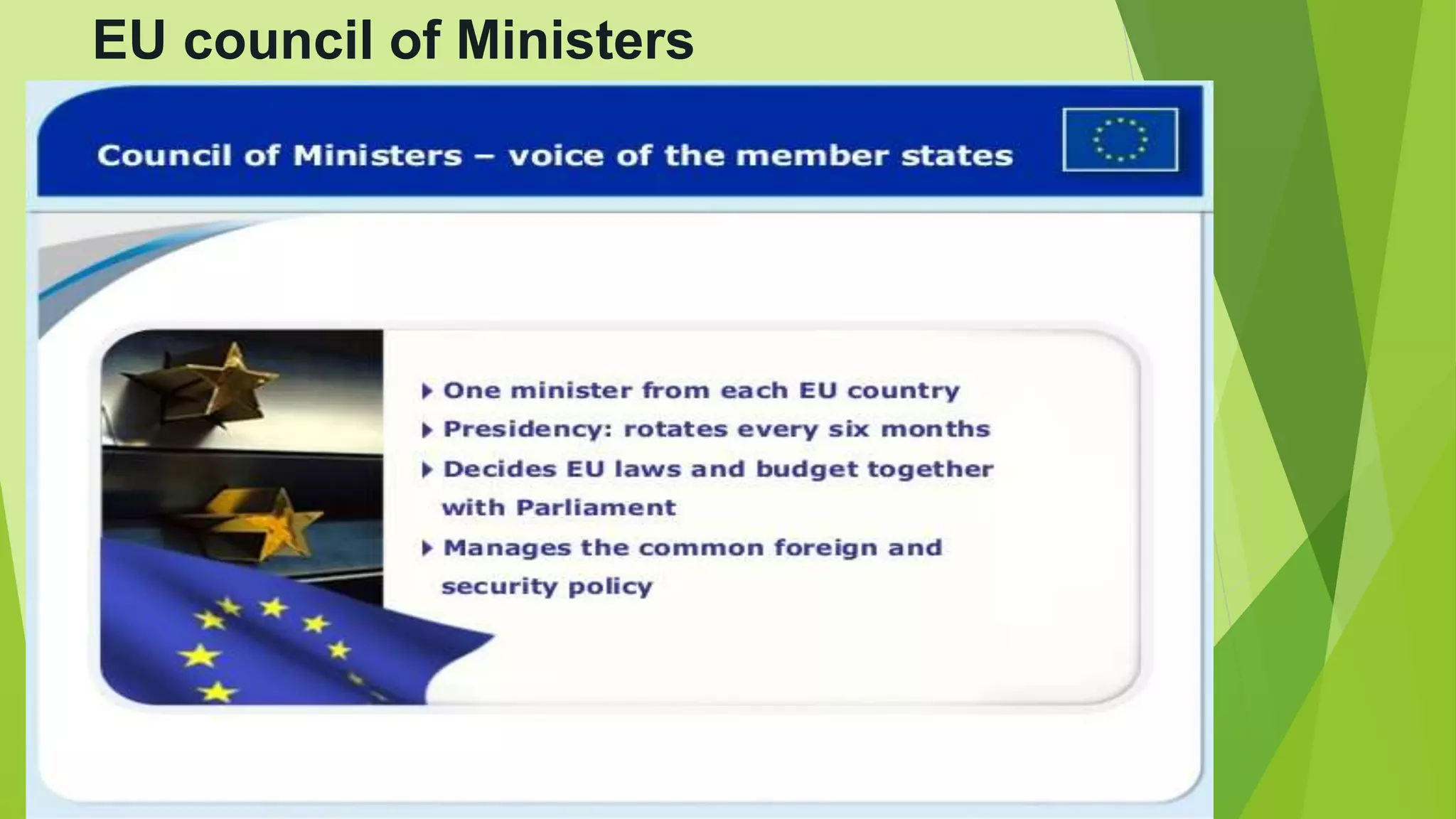
EU council of Ministers
The EU Summit
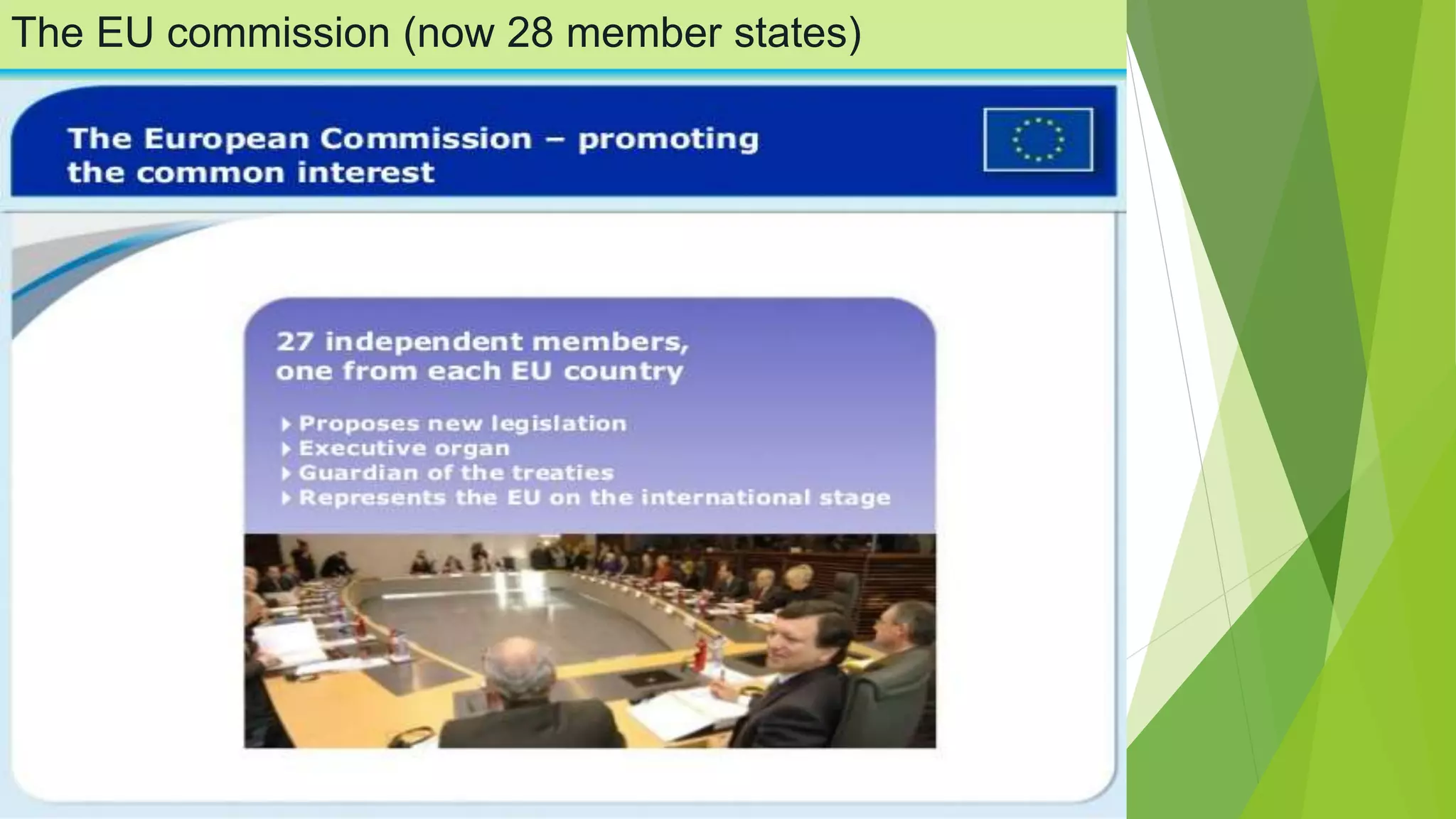
The EU commission (now 28 member states)
The Court of Justice
The EU court of Auditors
What does the European Court of Auditors do?
Audits EU revenue & expenditure, to check EU funds are
correctly raised, spent, achieve value for money and
accounted fo European Court of Auditors
Checks any person or organisation handling EU funds –
including spot checks in EU institutions (especially the
Commission), EU countries and countries receiving EU
aid.
Writes up findings and recommendations in audit
reports, for the European Commission and national
governments.
Reports suspected fraud, corruption or other illegal
activity to the European Anti-Fraud Office (OLAF)
Produces an annual report for the European
Parliament and Council of the EU, which the Parliament
examines before deciding whether to approve the
Commission's handling of the EU budget.
Gives its expert opinion to EU policymakers on how
EU finances could be better managed and made more
accountable to citizens.
The EU Central Bank
European Central Bank
"The primary objective of the European System of Central Banks […] shall be to
maintain price stability".
It continues as follows: "Without prejudice to the objective of price stability, the
ESCB shall support the general economic policies in the Union with a view to
contributing to the achievement of the objectives of the Union as laid down in
Article 3 of the Treaty on European Union."
The European Union has multiple objectives (Article 3 of the Treaty on European
Union), which include the sustainable development of Europe based on balanced
economic growth and price stability, and a highly competitive social market
economy, aiming at full employment and social progress. Consequently, price
stability is not only the primary objective of the ECB’s monetary policy, but also an
objective of the European Union as a whole. Thus, the Treaty on the Functioning of
the European Union and the Treaty on European Union establish a clear hierarchy
of objectives for the Euro system, making it clear that price stability is the most
important contribution that monetary policy can make to achieving a favourable
economic environment and a high level of employment.
European Investment Bank at a glance
The EU's bank
The EIB is the European Union's bank. We are the only bank owned by and
representing the interests of the European Union Member States. We work closely
with other EU institutions to implement EU policy.
A major player
As the largest multilateral borrower and lender by volume, we provide finance and
expertise for sound and sustainable investment projects which contribute to
furthering EU policy objectives. More than 90% of our activity is focused on Europe
but we also support the EU's external and development policies.
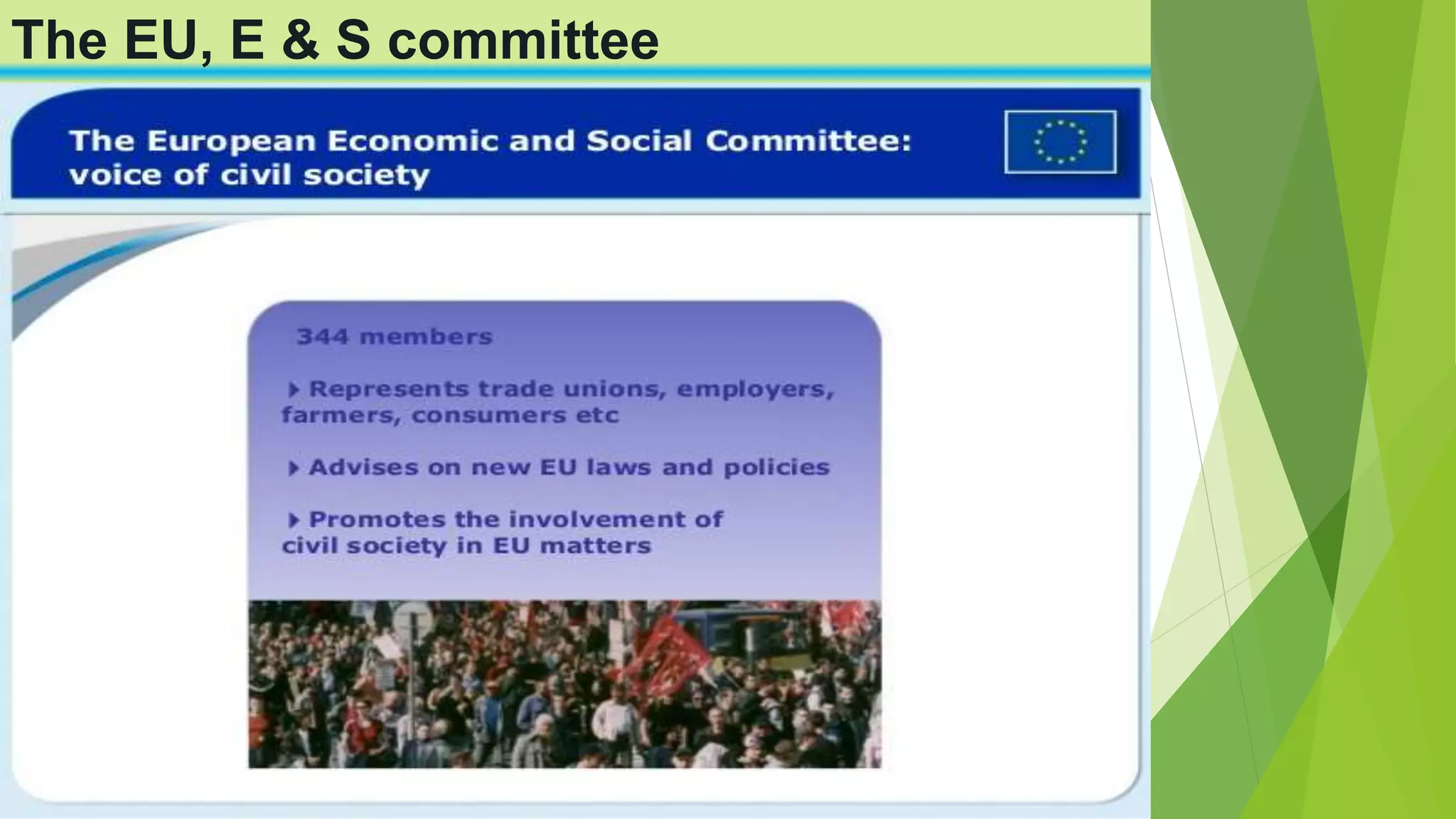
The EU, E & S committee
E & S Comite EESC mission statement
Committed to European integration, the EESC contributes to strengthening the
democratic legitimacy and effectiveness of the European Union by enabling civil
society organisations from the Member States to express their views at European
level. This Committee fulfils three key missions:
helping to ensure that European policies and legislation tie in better with
economic, social and civic circumstances on the ground, by assisting the European
Parliament, Council and European Commission, making use of EESC members'
experience and representativeness, dialogue and efforts to secure consensus serving
the general interest;
promoting the development of a more participatory European Union which is more
in touch with popular opinion, by acting as an institutional forum representing,
informing, expressing the views of and securing dialogue with organised civil society;
promoting the values on which European integration is founded and advancing, in
Europe and across the world, the cause of democracy and participatory democracy,
as well as the role of civil society organisations
7. The European Economic and Social Committee (EESC)
is a consultative body of the European Union. This part
of the web site is dedicated to the general presentation
of the Committee including information on its role, work
and structure. The organisational chart and the
information on the different working bodies, such as
Presidency, Groups and Sections, can be found here. The
EESC Members, documents, policy areas (themes),
events and press related information can be found under
the other main navigation tabs. Under the tab "Take
part" you can find information on the different ways the
citizens can get involved with the Committee; this can
be through the interactive tools available on this web
site or taking physically part in the visits, competitions
and other activities organised by the EESC.
Europe 2020 - Steering Committee
The Europe 2020 Strategy is the current EU reform agenda for growth and jobs.
Driven by a long-term vision, this overarching policy strategy was proposed by the
European Commission, and then agreed by the European Council in June 2010.
It aims at helping Europe to recover from the crisis and to transform it into a
smart, sustainable and inclusive economy with high levels of employment,
productivity and social cohesion and at reinforcing the EU as an actor in global
governance.
Europe 2020 builds on lessons learned from the Lisbon Strategy, recognising its
strengths (e.g. the right goals of growth and job creation), but addressing its
weaknesses (e.g. lack of implementation). The current strategy pleas for a new
kind of growth (smart, sustainable and inclusive), for a country-tailored approach
and counts on stronger governance: better monitoring and enforcement, highest
leadership of the European Council, etc.)
Europe 2020 mobilises all existing EU policies (Single market, external policy, etc.)
instruments and laws, as well as financial and coordination instruments
(Multiannual financial framework).
The EU regional committee
The Committee of the Regions is the voice of regions and cities in the European Union.
350 members - regional and locally elected representatives from the 28 EU countries.
6 commissions covering competences in the following policy areas based on the EU Treaties:
Employment, vocational training, economic and social cohesion, social policy, health.
Education and culture.
Environment, climate change, energy.
Transport and trans-European networks.
Civil protection and services of general interests.
The EU work Force
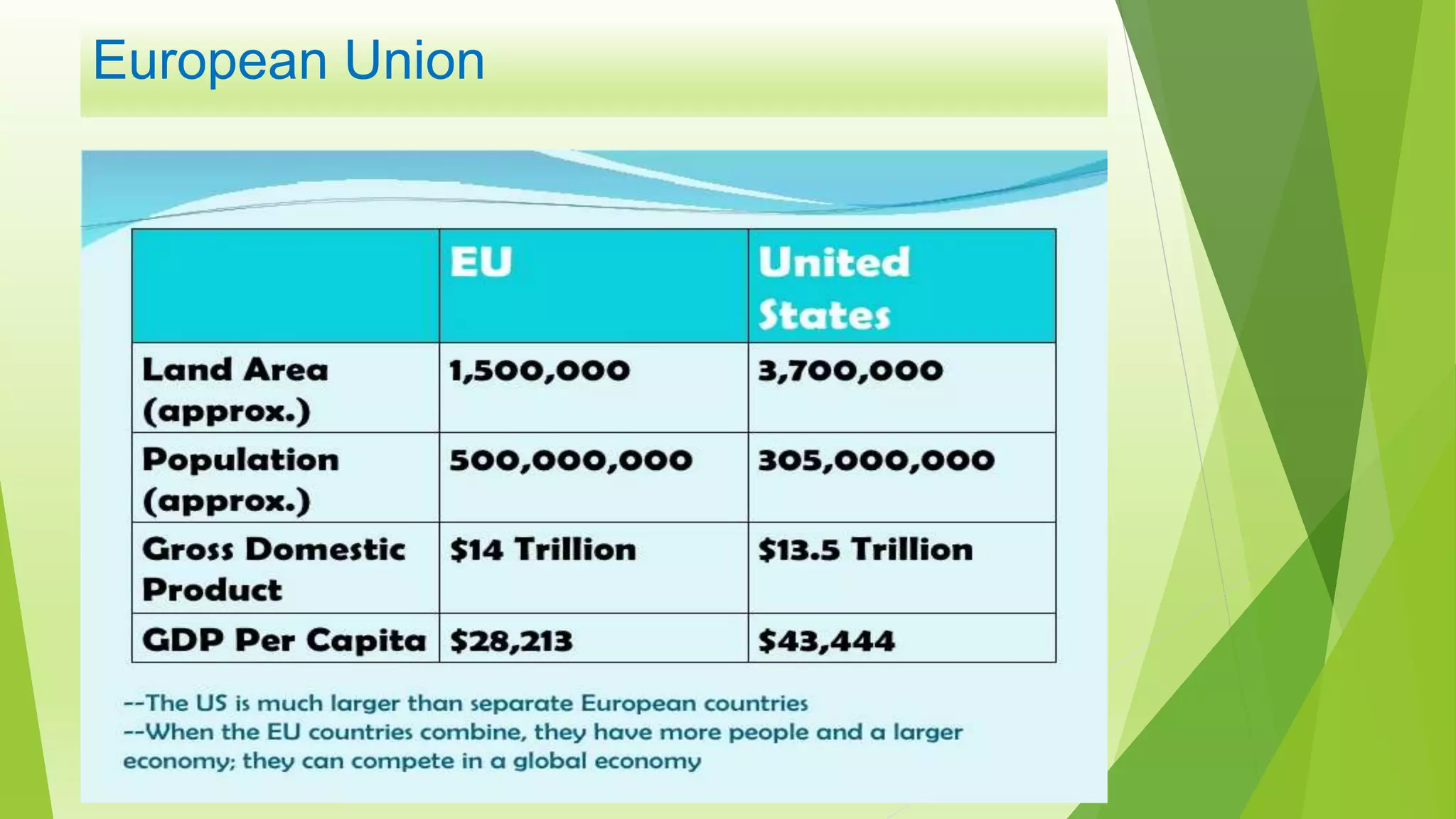
The EU Population
The EU area
EU Spending
EU challenges
European Union

EUROPEAN UNION GUIDE

  • 1.
    European Union 2016PCS 4 LauriUljas Sources: EU website EU Documents Share slides
  • 2.
    What is thepurpose of EU ? What are the main positive out puts in context of Finland? What are the main challenges in Eu as a system and E as everyday policies and practices?
  • 3.
    Policy Areas 1-4:The Four Freedoms Chapter 1: Free Movement of Goods Chapter2: Freedom of movement for workers Chapter 3: Right of establishment and freedom to provide services Chapter 4: Free movement of capital
  • 4.
  • 5.
  • 6.
  • 7.
  • 8.
  • 9.
  • 10.
    questions  How manycountries are part of the European Union?  How many countries use the Euro?  Which is the biggest member state?  Which is the smallest member state?  How many official and working langugaes are in the EU?
  • 11.
    European Union (Croatiais now 28th EU Member country)
  • 12.
    European Union (Croatiais now the 28th EU country)
  • 13.
  • 14.
  • 15.
  • 16.
  • 17.
    European Union  EuropeanCommission president – Jean-Claude Juncker  Term: November 2014 - October 2019  Appointed by: national leaders (heads of state or government of EU countries), with the approval of the European Parliament.  Role:  Gives political guidance to the Commission  Calls and chairs meetings of the college of the Commissioners  Leads the Commission's work in implementing EU policies  Takes part in G7 meetings  Contributes to major debates both in the European Parliament and between EU governments in the Council of the European Union
  • 18.
  • 19.
    The Parliament actsas a co-legislator, sharing with the Council the power to adopt and amend legislative proposals and to decide on the EU budget. It also supervises the work of the Commission and other EU bodies and cooperates with national parliaments of EU countries to get their inputs into the legislation.
  • 20.
    EU council ofMinisters
  • 21.
  • 22.
    The EU commission(now 28 member states)
  • 23.
    The Court ofJustice
  • 24.
    The EU courtof Auditors
  • 25.
    What does theEuropean Court of Auditors do? Audits EU revenue & expenditure, to check EU funds are correctly raised, spent, achieve value for money and accounted fo European Court of Auditors Checks any person or organisation handling EU funds – including spot checks in EU institutions (especially the Commission), EU countries and countries receiving EU aid. Writes up findings and recommendations in audit reports, for the European Commission and national governments. Reports suspected fraud, corruption or other illegal activity to the European Anti-Fraud Office (OLAF) Produces an annual report for the European Parliament and Council of the EU, which the Parliament examines before deciding whether to approve the Commission's handling of the EU budget. Gives its expert opinion to EU policymakers on how EU finances could be better managed and made more accountable to citizens.
  • 26.
  • 27.
    European Central Bank "Theprimary objective of the European System of Central Banks […] shall be to maintain price stability". It continues as follows: "Without prejudice to the objective of price stability, the ESCB shall support the general economic policies in the Union with a view to contributing to the achievement of the objectives of the Union as laid down in Article 3 of the Treaty on European Union." The European Union has multiple objectives (Article 3 of the Treaty on European Union), which include the sustainable development of Europe based on balanced economic growth and price stability, and a highly competitive social market economy, aiming at full employment and social progress. Consequently, price stability is not only the primary objective of the ECB’s monetary policy, but also an objective of the European Union as a whole. Thus, the Treaty on the Functioning of the European Union and the Treaty on European Union establish a clear hierarchy of objectives for the Euro system, making it clear that price stability is the most important contribution that monetary policy can make to achieving a favourable economic environment and a high level of employment.
  • 28.
    European Investment Bankat a glance The EU's bank The EIB is the European Union's bank. We are the only bank owned by and representing the interests of the European Union Member States. We work closely with other EU institutions to implement EU policy. A major player As the largest multilateral borrower and lender by volume, we provide finance and expertise for sound and sustainable investment projects which contribute to furthering EU policy objectives. More than 90% of our activity is focused on Europe but we also support the EU's external and development policies.
  • 29.
    The EU, E& S committee
  • 30.
    E & SComite EESC mission statement Committed to European integration, the EESC contributes to strengthening the democratic legitimacy and effectiveness of the European Union by enabling civil society organisations from the Member States to express their views at European level. This Committee fulfils three key missions: helping to ensure that European policies and legislation tie in better with economic, social and civic circumstances on the ground, by assisting the European Parliament, Council and European Commission, making use of EESC members' experience and representativeness, dialogue and efforts to secure consensus serving the general interest; promoting the development of a more participatory European Union which is more in touch with popular opinion, by acting as an institutional forum representing, informing, expressing the views of and securing dialogue with organised civil society; promoting the values on which European integration is founded and advancing, in Europe and across the world, the cause of democracy and participatory democracy, as well as the role of civil society organisations
  • 31.
    7. The EuropeanEconomic and Social Committee (EESC) is a consultative body of the European Union. This part of the web site is dedicated to the general presentation of the Committee including information on its role, work and structure. The organisational chart and the information on the different working bodies, such as Presidency, Groups and Sections, can be found here. The EESC Members, documents, policy areas (themes), events and press related information can be found under the other main navigation tabs. Under the tab "Take part" you can find information on the different ways the citizens can get involved with the Committee; this can be through the interactive tools available on this web site or taking physically part in the visits, competitions and other activities organised by the EESC.
  • 32.
    Europe 2020 -Steering Committee The Europe 2020 Strategy is the current EU reform agenda for growth and jobs. Driven by a long-term vision, this overarching policy strategy was proposed by the European Commission, and then agreed by the European Council in June 2010. It aims at helping Europe to recover from the crisis and to transform it into a smart, sustainable and inclusive economy with high levels of employment, productivity and social cohesion and at reinforcing the EU as an actor in global governance. Europe 2020 builds on lessons learned from the Lisbon Strategy, recognising its strengths (e.g. the right goals of growth and job creation), but addressing its weaknesses (e.g. lack of implementation). The current strategy pleas for a new kind of growth (smart, sustainable and inclusive), for a country-tailored approach and counts on stronger governance: better monitoring and enforcement, highest leadership of the European Council, etc.) Europe 2020 mobilises all existing EU policies (Single market, external policy, etc.) instruments and laws, as well as financial and coordination instruments (Multiannual financial framework).
  • 33.
    The EU regionalcommittee
  • 34.
    The Committee ofthe Regions is the voice of regions and cities in the European Union. 350 members - regional and locally elected representatives from the 28 EU countries. 6 commissions covering competences in the following policy areas based on the EU Treaties: Employment, vocational training, economic and social cohesion, social policy, health. Education and culture. Environment, climate change, energy. Transport and trans-European networks. Civil protection and services of general interests.
  • 35.
  • 36.
  • 37.
  • 38.
  • 39.
  • 40.