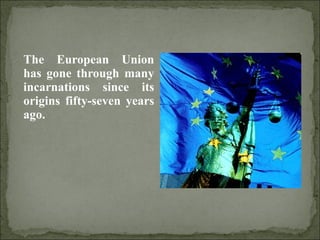
The European Union has gone through many incarnations since its origins fifty-seven years ago.
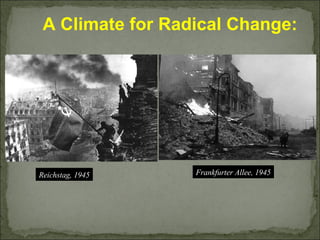
Reichstag, 1945 Frankfurter Allee, 1945 A Climate for Radical Change:
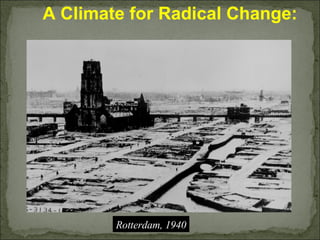
A Climate for Radical Change: Rotterdam, 1940
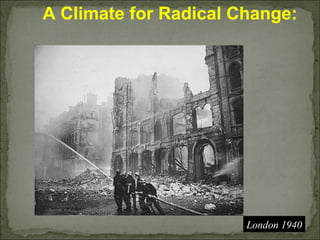
A Climate for Radical Change: London 1940
The European Union is based on the rule of law and democracy. It is neither a new State replacing existing ones nor is it comparable to other international organizations. Its Member States delegate sovereignty to common institutions representing the interests of the Union as a whole on questions of joint interest. All decisions and procedures are derived from the basic treaties ratified by the Member States.
The European Union (EU) is a political and economic community of twenty-seven  member states , located primarily in  Europe . It was established in 1993 by the  Treaty of Maastricht , adding new areas of policy to the existing  European Community . With almost 500 million citizens, the EU combined generates an estimated 30% share of the world's nominal  gross domestic product  ( US$ 16.6 trillion) in 2007.
The Single Market Based on Four Freedoms: Free movement of goods; Free movement of capital; Free movement of persons; Free movement of services. GDP boosted by nearly €900 billion over 10 year period 1992-2002 (over $1 trillion) and 2.5 million jobs created from the single market alone.
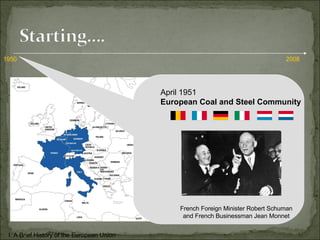
France  West Germany  Italy Belgium  Netherlands Luxembourg
To continue to improve Europe’s economy by regulating trade and commerce. To form a single market for Europe's economic resources. As these goals were accomplished, other goals were developed:  Environmental movements Regulatory acts Human rights concerns.
Establish European Citizenship Ensure freedom, security, and justice Promote economic and social progress Assert Europe’s role in the world
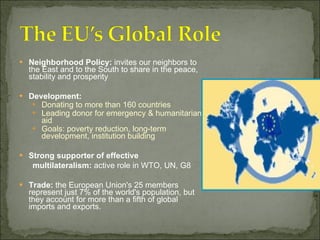
Neighborhood Policy:  invites our neighbors to the East and to the South to share in the peace, stability and prosperity Development:  Donating to more than 160 countries Leading donor for emergency & humanitarian aid Goals: poverty reduction, long-term development, institution building Strong supporter of effective  multilateralism:  active role in WTO, UN, G8 Trade:  the European Union's 25 members represent just 7% of the world's population, but they account for more than a fifth of global imports and exports.
1950 2008 April 1951 European Coal and Steel Community French Foreign Minister Robert Schuman and French Businessman Jean Monnet I. A Brief History of the European Union
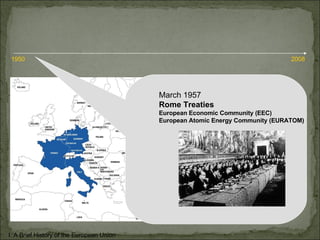
March 1957 Rome Treaties European Economic Community (EEC) European Atomic Energy Community (EURATOM) I. A Brief History of the European Union 1950 2008
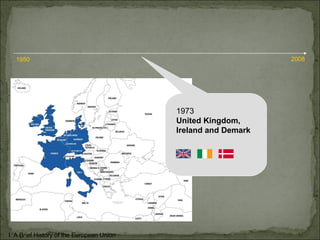
1973 United Kingdom,  Ireland and Demark I. A Brief History of the European Union 1950 2008
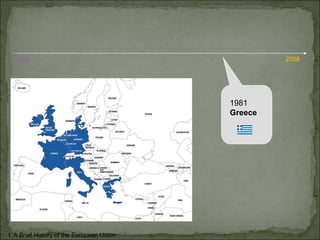
1981 Greece I. A Brief History of the European Union 1950 2008
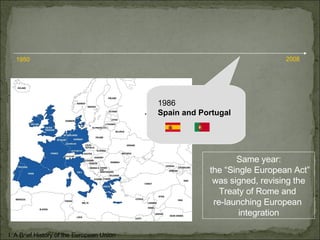
1986 Spain and Portugal I. A Brief History of the European Union 1950 2008 Same year: the “Single European Act” was signed, revising the  Treaty of Rome and  re-launching European  integration
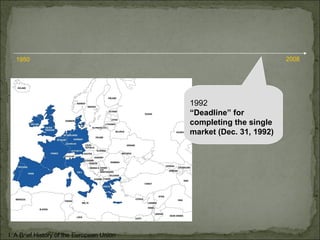
1992 “ Deadline” for completing the single market (Dec. 31, 1992) I. A Brief History of the European Union 1950 2008
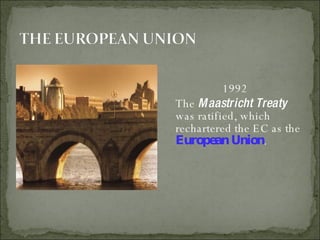
1992 The  Maastricht Treaty  was ratified, which rechartered the EC as the  European Union .
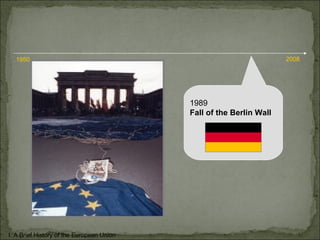
1989 Fall of the Berlin Wall I. A Brief History of the European Union 1950 2008
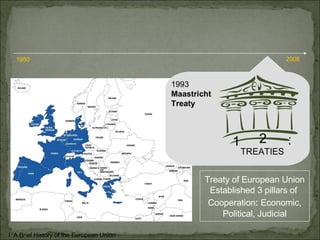
1993 Maastricht  Treaty 1 2 3 TREATIES I. A Brief History of the European Union 1950 2008 Treaty of European Union Established 3 pillars of  Cooperation :  Economic, Political, Judicial
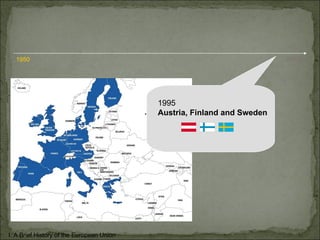
1995 Austria, Finland and Sweden I. A Brief History of the European Union 1950 2008
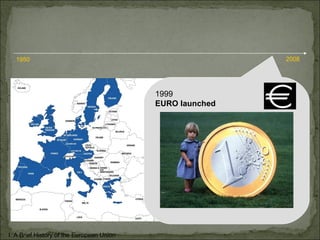
1999 EURO launched I. A Brief History of the European Union 1950 2008
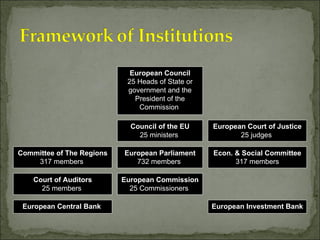
European Court of Justice 25 judges  European Parliament 732 members  European Commission 25 Commissioners  European Council 15 Heads of State or government and the President of the Commission  Council of the EU 15 ministers  European Court of Justice 15 ministers  European Parliament 626 members  European Commission 20 Commissioners  European Investment Bank European Central Bank  Court of Auditors 25 members  Committee of The Regions 317 members  Econ. & Social Committee 317 members European Council 25 Heads of State or government and the President of the Commission  Council of the EU 25 ministers
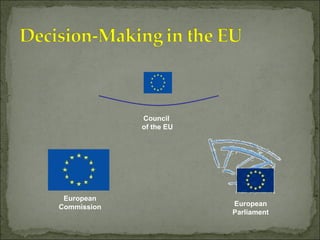
European Commission Council  of the EU European Parliament
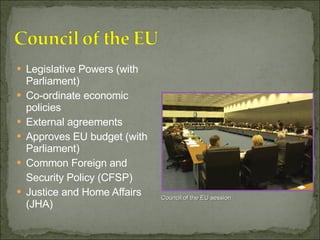
Legislative Powers (with Parliament) Co-ordinate economic policies  External agreements  Approves EU budget (with Parliament) Common Foreign and  Security Policy (CFSP) Justice and Home Affairs (JHA) Council of the EU session
Members elected every 5 years  625 members as of July 2003 Three essential functions: Legislate laws along w/ Council Budget authority along w/ Council Supervision of Commission
Composed of the head of each member country (Prime Minster/President, etc) & the President of the EU Commission  1 Minister acts as President, rotating twice yearly 2 meetings a year, in President’s country  Main decision making body  of the EU Responsibilities Legislation & budgetary policies along w/ Parliament Economic policies International agreements
Embodies and upholds the general interest of the Union.  20 members: 1 President, 2 vice-Presidents & 17 Commissioners Elected every 5 years  by the Member States after they have been approved by the European Parliament.   As the EU’s executive body, it: Drafts legislation for Parliament & Council; Implements legislation Guardian of treaties, along with Court of Justice Represents EU internationally  Manages the 15 EU agencies
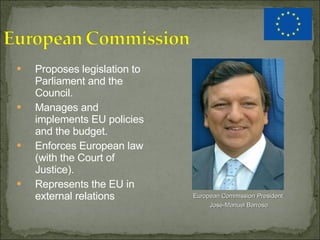
Proposes legislation to Parliament and the Council. Manages and implements EU policies and the budget. Enforces European law (with the Court of Justice). Represents the EU in external relations European Commission   President  Jose-Manuel Barroso
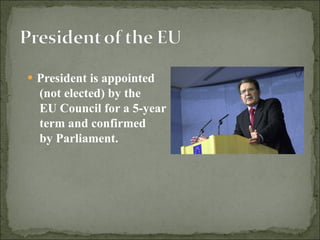
President is appointed  (not elected) by the  EU Council for a 5-year  term and  confirmed  by Parliament.
15 judges and 8 advocate generals  appointed by member states for 6 year terms.  The Court of Justice ensures that Community law is uniformly interpreted and effectively applied.  It has jurisdiction in disputes involving Member States, EU institutions, businesses and individuals
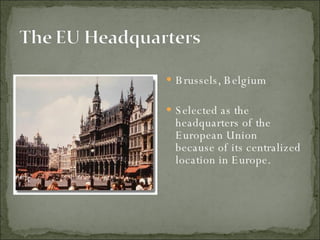
Brussels, Belgium  Selected as the headquarters of the European Union  because of its centralized location in Europe.
1.  Enlargement:  * Ten countries joined the EU in 2004, making 27 countries total. 2. The Euro:  *The Common Currency for the EU Countries. 3. Multilingualism:  *20 official languages (as of 2004) for 27 countries.  4.  Openness, Access and Transparency:  * How to get the documents to the people? 5.  Safety & security of Europe:   *Against terrorism.
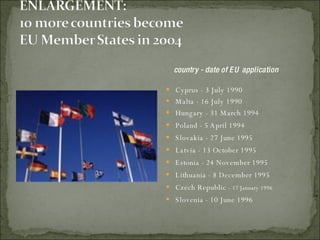
 
country - date of EU application Cyprus - 3 July 1990 Malta - 16 July 1990 Hungary - 31 March 1994 Poland - 5 April 1994 Slovakia - 27 June 1995 Latvia - 13 October 1995 Estonia - 24 November 1995 Lithuania - 8 December 1995 Czech Republic  -  17 January 1996 Slovenia - 10 June 1996
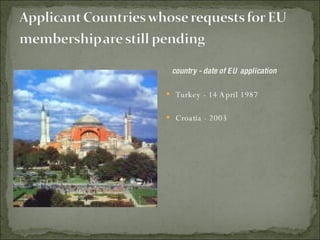
country - date of EU application Turkey - 14 April 1987 Croatia - 2003
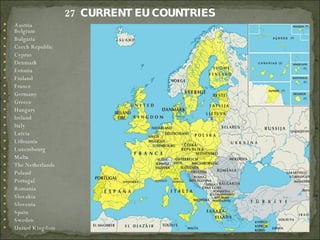
27  CURRENT EU COUNTRIES Austria Belgium Bulgaria Czech Republic Cyprus Denmark Estonia Finland France Germany Greece Hungary Ireland Italy Latvia Lithuania Luxembourg Malta The Netherlands Poland  Portugal Romania Slovakia Slovenia Spain Sweden  United Kingdom
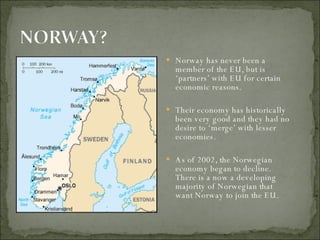
Norway has never been a member of the EU, but is ‘partners’ with EU for certain economic reasons.  Their economy has historically been very good and they had no desire to ‘merge’ with lesser economies.  As of 2002, the Norwegian economy began to decline. There is a now a developing majority of Norwegian that  want Norway to join the EU.
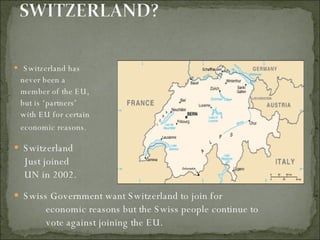
Switzerland has  never been a  member of the EU, but is ‘partners’  with EU for certain economic reasons.  Switzerland  Just joined UN in 2002. Swiss Government want Switzerland to join for economic reasons but the Swiss people continue to vote against joining the EU.
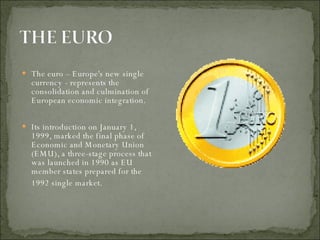
The euro – Europe's new single currency - represents the consolidation and culmination of European economic integration. Its introduction on January 1, 1999, marked the final phase of Economic and Monetary Union (EMU), a three-stage process that was launched in 1990 as EU member states prepared for the 1992 single market.
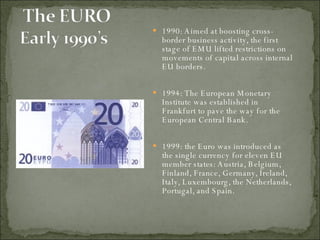
1990: Aimed at boosting cross-border business activity, the first stage of EMU lifted restrictions on movements of capital across internal EU borders. 1994: The European Monetary Institute was established in Frankfurt to pave the way for the European Central Bank.  1999: the Euro was introduced as the single currency for eleven EU member states: Austria, Belgium, Finland, France, Germany, Ireland, Italy, Luxembourg, the Netherlands, Portugal, and Spain.
1999-2002: The Euro and the previous national currencies were concurrently used in participating states.  2002: The participating  countries had their previous national currencies withdrawn permanently as legal tender. EU member states not yet using the Euro as currency: Denmark, Greece, Sweden, United Kingdom
 

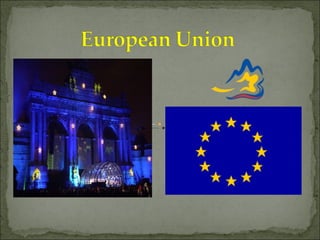
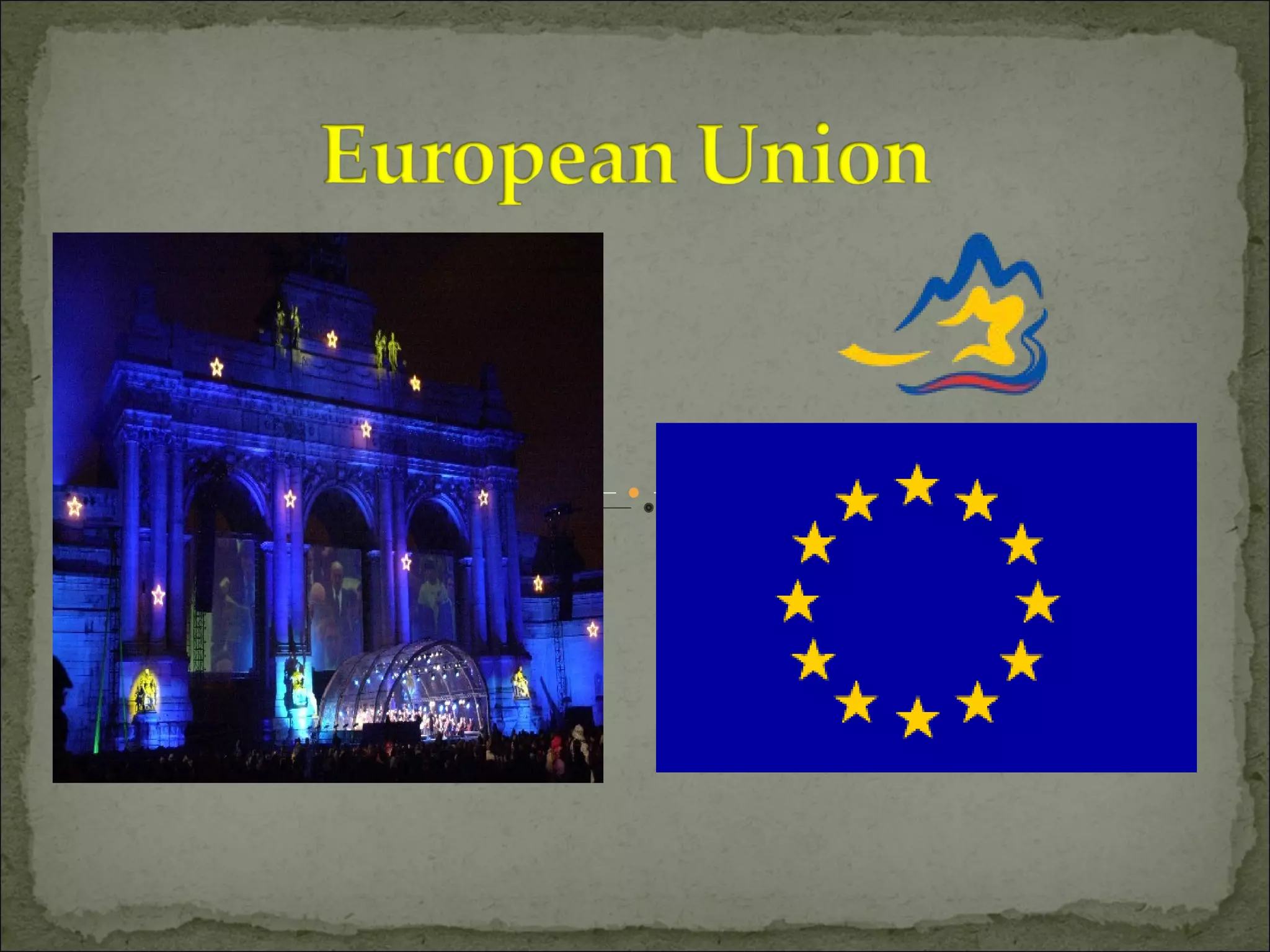
European Union

  • 1.
  • 2.
    The European Unionhas gone through many incarnations since its origins fifty-seven years ago.
  • 3.
    Reichstag, 1945 FrankfurterAllee, 1945 A Climate for Radical Change:
  • 4.
    A Climate forRadical Change: Rotterdam, 1940
  • 5.
    A Climate forRadical Change: London 1940
  • 6.
    The European Unionis based on the rule of law and democracy. It is neither a new State replacing existing ones nor is it comparable to other international organizations. Its Member States delegate sovereignty to common institutions representing the interests of the Union as a whole on questions of joint interest. All decisions and procedures are derived from the basic treaties ratified by the Member States.
  • 7.
    The European Union(EU) is a political and economic community of twenty-seven member states , located primarily in Europe . It was established in 1993 by the Treaty of Maastricht , adding new areas of policy to the existing European Community . With almost 500 million citizens, the EU combined generates an estimated 30% share of the world's nominal gross domestic product ( US$ 16.6 trillion) in 2007.
  • 8.
    The Single MarketBased on Four Freedoms: Free movement of goods; Free movement of capital; Free movement of persons; Free movement of services. GDP boosted by nearly €900 billion over 10 year period 1992-2002 (over $1 trillion) and 2.5 million jobs created from the single market alone.
  • 9.
    France WestGermany Italy Belgium Netherlands Luxembourg
  • 10.
    To continue toimprove Europe’s economy by regulating trade and commerce. To form a single market for Europe's economic resources. As these goals were accomplished, other goals were developed: Environmental movements Regulatory acts Human rights concerns.
  • 11.
    Establish European CitizenshipEnsure freedom, security, and justice Promote economic and social progress Assert Europe’s role in the world
  • 12.
    Neighborhood Policy: invites our neighbors to the East and to the South to share in the peace, stability and prosperity Development: Donating to more than 160 countries Leading donor for emergency & humanitarian aid Goals: poverty reduction, long-term development, institution building Strong supporter of effective multilateralism: active role in WTO, UN, G8 Trade: the European Union's 25 members represent just 7% of the world's population, but they account for more than a fifth of global imports and exports.
  • 13.
    1950 2008 April1951 European Coal and Steel Community French Foreign Minister Robert Schuman and French Businessman Jean Monnet I. A Brief History of the European Union
  • 14.
    March 1957 RomeTreaties European Economic Community (EEC) European Atomic Energy Community (EURATOM) I. A Brief History of the European Union 1950 2008
  • 15.
    1973 United Kingdom, Ireland and Demark I. A Brief History of the European Union 1950 2008
  • 16.
    1981 Greece I.A Brief History of the European Union 1950 2008
  • 17.
    1986 Spain andPortugal I. A Brief History of the European Union 1950 2008 Same year: the “Single European Act” was signed, revising the Treaty of Rome and re-launching European integration
  • 18.
    1992 “ Deadline”for completing the single market (Dec. 31, 1992) I. A Brief History of the European Union 1950 2008
  • 19.
    1992 The Maastricht Treaty was ratified, which rechartered the EC as the European Union .
  • 20.
    1989 Fall ofthe Berlin Wall I. A Brief History of the European Union 1950 2008
  • 21.
    1993 Maastricht Treaty 1 2 3 TREATIES I. A Brief History of the European Union 1950 2008 Treaty of European Union Established 3 pillars of Cooperation : Economic, Political, Judicial
  • 22.
    1995 Austria, Finlandand Sweden I. A Brief History of the European Union 1950 2008
  • 23.
    1999 EURO launchedI. A Brief History of the European Union 1950 2008
  • 24.
    European Court ofJustice 25 judges European Parliament 732 members European Commission 25 Commissioners European Council 15 Heads of State or government and the President of the Commission Council of the EU 15 ministers European Court of Justice 15 ministers European Parliament 626 members European Commission 20 Commissioners European Investment Bank European Central Bank Court of Auditors 25 members Committee of The Regions 317 members Econ. & Social Committee 317 members European Council 25 Heads of State or government and the President of the Commission Council of the EU 25 ministers
  • 25.
    European Commission Council of the EU European Parliament
  • 26.
    Legislative Powers (withParliament) Co-ordinate economic policies External agreements Approves EU budget (with Parliament) Common Foreign and Security Policy (CFSP) Justice and Home Affairs (JHA) Council of the EU session
  • 27.
    Members elected every5 years 625 members as of July 2003 Three essential functions: Legislate laws along w/ Council Budget authority along w/ Council Supervision of Commission
  • 28.
    Composed of thehead of each member country (Prime Minster/President, etc) & the President of the EU Commission 1 Minister acts as President, rotating twice yearly 2 meetings a year, in President’s country Main decision making body of the EU Responsibilities Legislation & budgetary policies along w/ Parliament Economic policies International agreements
  • 29.
    Embodies and upholdsthe general interest of the Union. 20 members: 1 President, 2 vice-Presidents & 17 Commissioners Elected every 5 years by the Member States after they have been approved by the European Parliament. As the EU’s executive body, it: Drafts legislation for Parliament & Council; Implements legislation Guardian of treaties, along with Court of Justice Represents EU internationally Manages the 15 EU agencies
  • 30.
    Proposes legislation toParliament and the Council. Manages and implements EU policies and the budget. Enforces European law (with the Court of Justice). Represents the EU in external relations European Commission President Jose-Manuel Barroso
  • 31.
    President is appointed (not elected) by the EU Council for a 5-year term and confirmed by Parliament.
  • 32.
    15 judges and8 advocate generals appointed by member states for 6 year terms. The Court of Justice ensures that Community law is uniformly interpreted and effectively applied. It has jurisdiction in disputes involving Member States, EU institutions, businesses and individuals
  • 33.
    Brussels, Belgium Selected as the headquarters of the European Union because of its centralized location in Europe.
  • 34.
    1. Enlargement: * Ten countries joined the EU in 2004, making 27 countries total. 2. The Euro: *The Common Currency for the EU Countries. 3. Multilingualism: *20 official languages (as of 2004) for 27 countries. 4. Openness, Access and Transparency: * How to get the documents to the people? 5. Safety & security of Europe: *Against terrorism.
  • 35.
  • 36.
    country - dateof EU application Cyprus - 3 July 1990 Malta - 16 July 1990 Hungary - 31 March 1994 Poland - 5 April 1994 Slovakia - 27 June 1995 Latvia - 13 October 1995 Estonia - 24 November 1995 Lithuania - 8 December 1995 Czech Republic - 17 January 1996 Slovenia - 10 June 1996
  • 37.
    country - dateof EU application Turkey - 14 April 1987 Croatia - 2003
  • 38.
    27 CURRENTEU COUNTRIES Austria Belgium Bulgaria Czech Republic Cyprus Denmark Estonia Finland France Germany Greece Hungary Ireland Italy Latvia Lithuania Luxembourg Malta The Netherlands Poland Portugal Romania Slovakia Slovenia Spain Sweden United Kingdom
  • 39.
    Norway has neverbeen a member of the EU, but is ‘partners’ with EU for certain economic reasons. Their economy has historically been very good and they had no desire to ‘merge’ with lesser economies. As of 2002, the Norwegian economy began to decline. There is a now a developing majority of Norwegian that want Norway to join the EU.
  • 40.
    Switzerland has never been a member of the EU, but is ‘partners’ with EU for certain economic reasons. Switzerland Just joined UN in 2002. Swiss Government want Switzerland to join for economic reasons but the Swiss people continue to vote against joining the EU.
  • 41.
    The euro –Europe's new single currency - represents the consolidation and culmination of European economic integration. Its introduction on January 1, 1999, marked the final phase of Economic and Monetary Union (EMU), a three-stage process that was launched in 1990 as EU member states prepared for the 1992 single market.
  • 42.
    1990: Aimed atboosting cross-border business activity, the first stage of EMU lifted restrictions on movements of capital across internal EU borders. 1994: The European Monetary Institute was established in Frankfurt to pave the way for the European Central Bank. 1999: the Euro was introduced as the single currency for eleven EU member states: Austria, Belgium, Finland, France, Germany, Ireland, Italy, Luxembourg, the Netherlands, Portugal, and Spain.
  • 43.
    1999-2002: The Euroand the previous national currencies were concurrently used in participating states. 2002: The participating countries had their previous national currencies withdrawn permanently as legal tender. EU member states not yet using the Euro as currency: Denmark, Greece, Sweden, United Kingdom
  • 44.