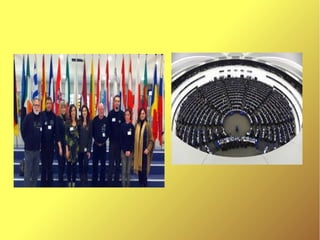
THE EUROPEAN UNION
1. History
2. Figures
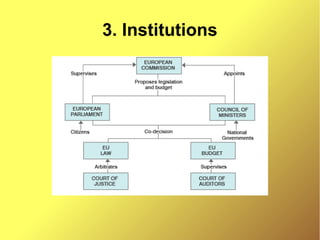
3. Institutions
Students from 1º Bachillerato G.
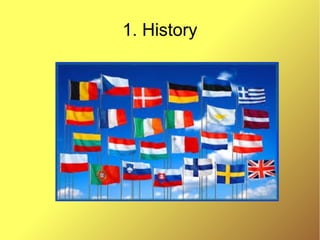
1. History
THE  HISTORY
 OF THE 
EUROPEAN  UNION
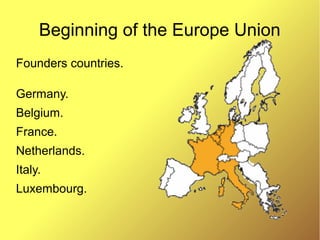
Beginning of the Europe Union
Founders countries.
Germany.
Belgium.
France.
Netherlands.
Italy.
Luxembourg.
THE
SIXTIES
30 July 1962
The EU starts its ‘common agricultural policy’
giving the countries joint control over food
production.
20 July 1963
The EU signs its first big international agreement
— a deal to help 18 former colonies in Africa. By
2005, it has a special partnership with 78
countries in Africa, the Caribbean and Pacific
(ACP) regions. The EU is the world’s biggest
provider of development assistance to poorer
countries. Its aid is linked to respect for human
rights by recipients.
1 July 1968
The six remove customs duties on goods
imported from each other, allowing free cross-
border trade for the first time. Trade among the six
and between the EU and the rest of the world
grows rapidly.
THE
SEVENTIES
24 April 1972
The EU’s first plan for a single currency dates
from 1970. The EU adopts laws to protect the
environment, introducing the notion of ‘the polluter
pays ’ for the first time.
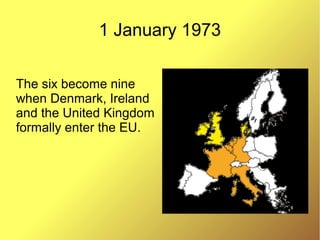
1 January 1973
The six become nine
when Denmark, Ireland
and the United Kingdom
formally enter the EU.
10 December 1974
To show their solidarity, EU leaders set up the
European Regional Development Fund.
7–10 June 1979
EU citizens directly elect the members of the
European Parliament for the first time. Previously
they were delegated by national parliaments.
Members sit in pan-European political groups
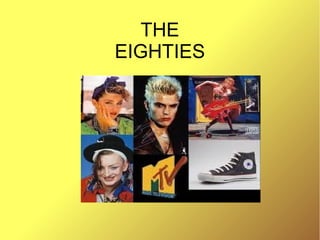
THE
EIGHTIES
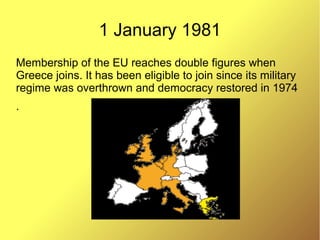
1 January 1981
Membership of the EU reaches double figures when
Greece joins. It has been eligible to join since its military
regime was overthrown and democracy restored in 1974
.
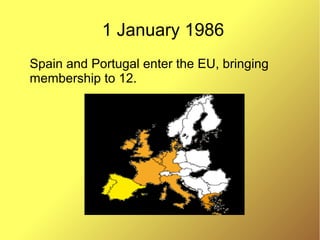
1 January 1986
Spain and Portugal enter the EU, bringing
membership to 12.
17 February 1986
Although customs duties disappeared in 1968,
trade is not flowing freely across EU borders.
The main obstacles are differences in national
regulations. The Single European Act of 1986
launches a vast six-year programme to sort
these out.
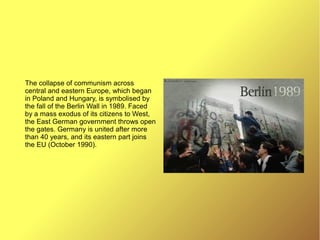
The collapse of communism across
central and eastern Europe, which began
in Poland and Hungary, is symbolised by
the fall of the Berlin Wall in 1989. Faced
by a mass exodus of its citizens to West,
the East German government throws open
the gates. Germany is united after more
than 40 years, and its eastern part joins
the EU (October 1990).
THE
NINETIES
7 February 1992
● The Treaty on European Union is signed in
Maastricht. It is a major EU milestone, setting
clear rules for the future single currency as well
as for foreign and security policy and closer
cooperation in justice and home affairs. Under
the treaty, the name ‘European Union’ officially
replaces ‘European Community’.
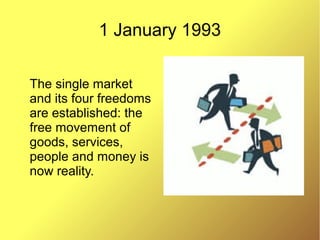
1 January 1993
The single market
and its four freedoms
are established: the
free movement of
goods, services,
people and money is
now reality.
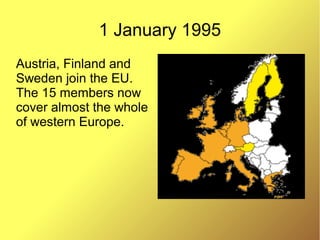
1 January 1995
Austria, Finland and
Sweden join the EU.
The 15 members now
cover almost the whole
of western Europe.
26 March 1995
The Schengentakes effect in seven countries —
Belgium, Germany, Spain, France, Luxembourg,
the Netherlands and Portugal. Travellers of any
nationality can travel between all these countries
without any passport control at the frontiers. Other
countries have since joined the passport-free
Schengen area.
13 December 1997
EU leaders agree to start the process of
membership negotiations with 10 countries of
central and eastern Europe: Bulgaria, the Czech
Republic, Estonia, Hungary, Latvia, Lithuania,
Poland, Romania, Slovakia and Slovenia. The
Mediterranean islands of Cyprus and Malta are
also included.
1 January 1999
The euro is introduced in 11 countries (joined
by Greece in 2001) for commercial and
financial transactions only. Notes and coins will
come later.
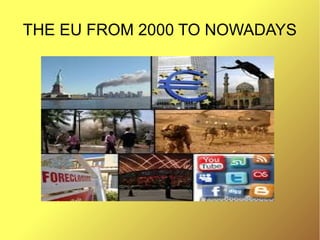
THE EU FROM 2000 TO NOWADAYS
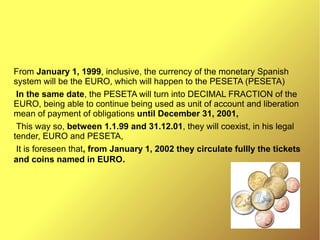
From January 1, 1999, inclusive, the currency of the monetary Spanish
system will be the EURO, which will happen to the PESETA (PESETA)
In the same date, the PESETA will turn into DECIMAL FRACTION of the
EURO, being able to continue being used as unit of account and liberation
mean of payment of obligations until December 31, 2001,
This way so, between 1.1.99 and 31.12.01, they will coexist, in his legal
tender, EURO and PESETA,
It is foreseen that, from January 1, 2002 they circulate fullly the tickets
and coins named in EURO.
1 January 2002
Euro notes and coins arrive. Printing, minting
and distributing them in 12 countries is a major
logistical operation. More than 80 billion coins are
involved.
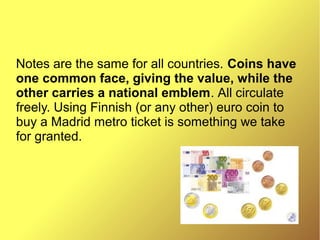
Notes are the same for all countries. Coins have
one common face, giving the value, while the
other carries a national emblem. All circulate
freely. Using Finnish (or any other) euro coin to
buy a Madrid metro ticket is something we take
for granted.
1 May 2004
Eight countries of central and eastern Europe — the
Czech Republic, Estonia, Latvia, Lithuania, Hungary, Poland,
Slovenia and Slovakia — join the EU, finally ending the
division of Europe decided by the Great Powers 60 years
earlier at Yalta. Cyprus and Malta also become members.
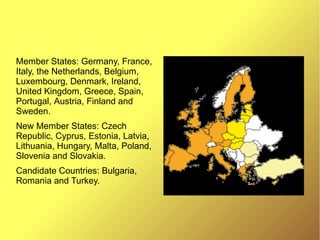
Member States: Germany, France,
Italy, the Netherlands, Belgium,
Luxembourg, Denmark, Ireland,
United Kingdom, Greece, Spain,
Portugal, Austria, Finland and
Sweden.
New Member States: Czech
Republic, Cyprus, Estonia, Latvia,
Lithuania, Hungary, Malta, Poland,
Slovenia and Slovakia.
Candidate Countries: Bulgaria,
Romania and Turkey.
29 October 2004
The 25 EU countries sign a Treaty establishing
a European Constitution.
1 January 2007
Two more countries from eastern Europe,
Bulgaria and Romania, nw join the EU, brining
the number of member states to 27 countries.
Croatia, the Former Yugoslav Republic of
Macedonia and Turkey are also candidates for
future membership
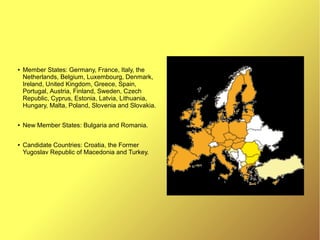
● Member States: Germany, France, Italy, the
Netherlands, Belgium, Luxembourg, Denmark,
Ireland, United Kingdom, Greece, Spain,
Portugal, Austria, Finland, Sweden, Czech
Republic, Cyprus, Estonia, Latvia, Lithuania,
Hungary, Malta, Poland, Slovenia and Slovakia.
● New Member States: Bulgaria and Romania.
● Candidate Countries: Croatia, the Former
Yugoslav Republic of Macedonia and Turkey.
13 December 2007
The 27 EU countries sign the Treaty of Lisbon
September 2008
A major financial crisis hits the world economy. The
problems start with mortgage loans in the United States.
Several European banks also experience difficulties. The
crisis leads to closer economic cooperation between EU
countries.
The new decade starts with a severe economic crisis, but
also with the hope that investments in new green and
climate-friendly technologies and closer European
cooperation will bring lasting growth and welfare.
2. Figures
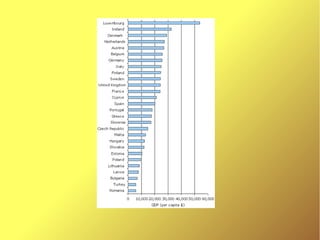
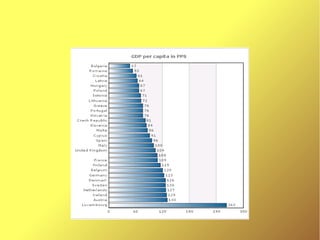
QUALITY OF LIFE
Living standards can be compared by
measuring the price of a range of goods
and services in each country relative to
income, using a common notional
currency called the purchasing power
standard (PPS). Comparing GDP per
inhabitant in PPS provides an overview of
living standards across the EU+.
SIZE AND POPULATION
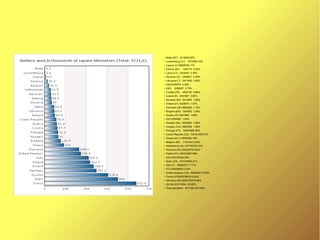
The EU covers over 4 million km² and has 503
million inhabitants — the world’s third largest
population after China and India. By surface area,
France is the biggest EU country and Malta the
smallest.
Europe’s population is increasing through a
combination of natural growth ( more people
are born each year than die) and net migration
(more people settle in the EU than leave it).
At the same time, the population of Europe is
ageing as life expectancy increases and fewer
children are born.
●
Malta (MT) 4213640.08%
●
Luxembourg (LU) 5370390.10%
●
Cyprus (CY)8658780.17%
●
Estonia (EE) 1320174 0.26%
● Latvia (LV) 2023825 0.39%
● Slovenia (SI) 2058821 0.40%
●
Lithuania (LT) 2971905 0.58%
●
(AM)3026878 0.59%
●
(MD) 3559497 0.70%
●
Croatia (HR) 4262140 0.84%
●
Ireland (IE) 4591087 0.90%
●
Slovakia (SK) 5410836 1.06%
●
Finland (FI) 5426674 1.07%
●
Denmark (DK) 5602628 1.10%
●
Bulgaria (BG) 7284552 1.43%
●
Austria (AT) 8451860 1.66%
●
(AZ) 9356483 1.84%
●
Sweden (SE) 9555893 1.88%
●
Hungary (HU) 9908798 1.95%
●
Portugal (PT) 104872892.06%
●
Czech Republic (CZ) 105161252.07%
●
Greece (EL)110625082.18%
●
Belgium (BE) 11161642 2.20%
●
Netherlands (NL)167795753.30%
●
Romania (RO) 200200743.94%
● Poland (PL) 385332997.59%
●
(UA)453726928.94%
●
Spain (ES) 467278909.21%
●
Italy (IT) 5968522711.77%
●
(FX) 6365960812.55%
●
United Kingdom (UK) 6390529712.60%
●
France (FR)6557881912.93%
●
Germany (DE) 8052374615.88%
●
(EA18) 333114254 65.69%
●
Total population 507 069 424100%
Measuring the EU’s economy
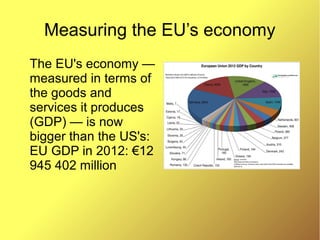
The EU's economy —
measured in terms of
the goods and
services it produces
(GDP) — is now
bigger than the US's:
EU GDP in 2012: €12
945 402 million
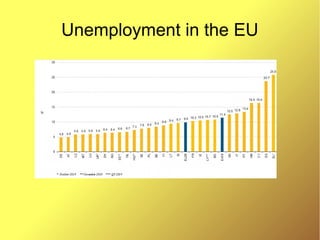
Unemployment in the EU
The UE Symbols
The EU is recognisable by several symbols,
the most well-known being the circle of yellow
stars on a blue background.
This site introduces other symbols such as
the European anthem and motto
The European Flag
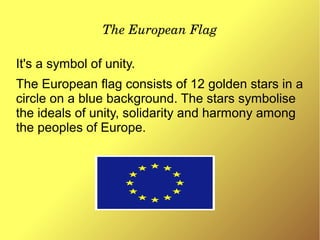
It's a symbol of unity.
The European flag consists of 12 golden stars in a
circle on a blue background. The stars symbolise
the ideals of unity, solidarity and harmony among
the peoples of Europe.
History of the European Flag.
The history of the flag goes back to 1955. The
council of Europe, adopted the present design for
its own use.
In 1983, the European parlament adopted the
flag. In 1985, it was adopted by all EU leaders as
the official emblem of the European Union (called
the European Communities at the time). All
European institutions now use an emblem of their
own.
The European anthem.
The melody used to symbolize the EU comes from the Ninth Symphony composed in 
1823 by Ludwig Van Beethoven.
The anthem symbolises not only the European Union but also Europe in a wider 
sense. The anthem expresses idealistic vision of the human race becoming brothers.
In 1972, the Council of Europe adopted Beethoven's "Ode to Joy" theme as its 
anthem. In 1985, it was adopted by EU leaders as the official anthem of the 
European Union. Without words, in the universal language of music, this anthem 
expresses the European ideals of freedom, peace and solidarity.
● Europe Day – EU Open Doors
Europe Day held on 9 May every year celebrates peace and unity in Europe. The date
marks the anniversary of the historical `Schuman declaration´. At a speech in Paris in
1950, Robert Schuman, the then French foreign minister, set out his idea for a new
form of political cooperation in Europe, which would make war between Europe’s
nations unthinkable.
His vision was to create a European institution that would pool and manage coal and
steel production. A treaty creating such a body was signed just under a year later.
Schuman’s proposal is considered to be the beginning of what is now the European
Union.
– Open doors at EU institutions.
To celebrate Europe Day, the EU institutions open their doors to the public in early
May in Brussels and Strasbourg. Local EU offices in Europe and all over the world
organise a variety of activities and events for all ages.
The EU motto.
"United in diversity", the motto of the European
Union, first came into use in 2000.
It signifies how Europeans have come together, in
the form of the EU, to work for peace and
prosperity, while at the same time being enriched
by the continent's many different cultures,
traditions and languages.
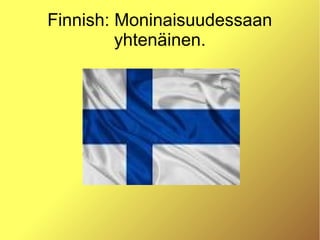
Finnish: Moninaisuudessaan
yhtenäinen.
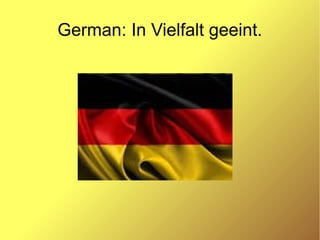
German: In Vielfalt geeint.
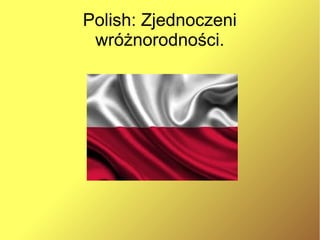
Polish: Zjednoczeni
wróżnorodności.
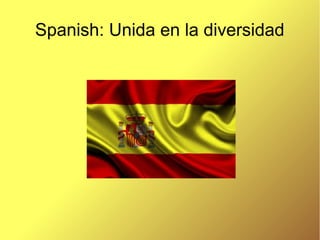
Spanish: Unida en la diversidad
3. Institutions
INDEX
● Parliament
● European Council
● Council of the UE
● European Commission
● Court of Justice of the UE
● European Central Bank
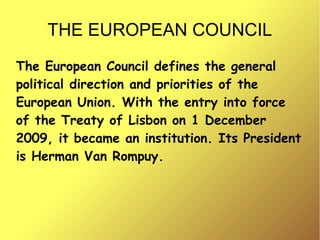
PARLIAMENT
Directly elected by EU voters every 5 years,
members of the European Parliament represent
the people. Parliament is one of the EU’s main
law-making institutions
.
ROLES:
-Passing european laws.
-Democratic supervision.
-Supervising the budget.
-Composition.
-Location
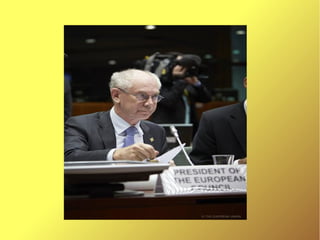
THE EUROPEAN COUNCIL
The European Council defines the general
political direction and priorities of the
European Union. With the entry into force
of the Treaty of Lisbon on 1 December
2009, it became an institution. Its President
is Herman Van Rompuy.
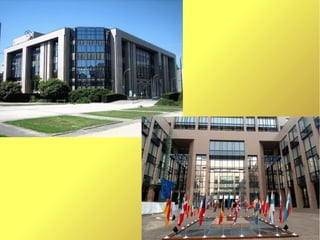
COUNCIL OF THE UE
Also informally known as the EU Council, this is
where national ministers from each EU country
meet to adopt laws and coordinate policies.
Not to be confused with:
European Council
Council of Europe
What does it do?
- Passes EU laws
-Coordinates the broad economic policies of EU member
countries
- Signs agreements between the EU and other countries
- Approves the annual EU budget
- Develops the EU's foreign and defence policies
- Coordinates cooperation between courts and police forces
of member countries
Who are the members of the Council?
There are no fixed members as such. At each Council meeting, each
country sends the minister for the policy field being discussed
Who chairs the meetings?
The foreign ministers’ Council has a permanent chairperson – the EU's
High Representative for foreign and security policy.
All other Council meetings are chaired by the relevant minister of the
country holding the rotating EU presidency
Voting
Decisions in the Council of the EU are taken by qualified majority as a
general rule. The bigger a country’s population, the more votes it has,
but in fact the numbers are weighted in favour of the less populous
countries.
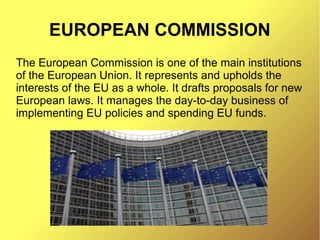
EUROPEAN COMMISSION
The European Commission is one of the main institutions
of the European Union. It represents and upholds the
interests of the EU as a whole. It drafts proposals for new
European laws. It manages the day-to-day business of
implementing EU policies and spending EU funds.
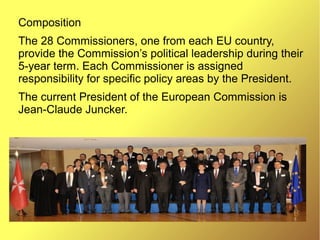
Composition
The 28 Commissioners, one from each EU country,
provide the Commission’s political leadership during their
5-year term. Each Commissioner is assigned
responsibility for specific policy areas by the President.
The current President of the European Commission is
Jean-Claude Juncker.
Purpose
The Commission represents and upholds the interests of the EU
as a whole. It oversees and implements EU policies by:
proposing new laws to Parliament and the Council
managing the EU's budget and allocating funding
enforcing EU law (together with the Court of Justice)
representing the EU internationally, for example, by
negotiating agreements between the EU and other countries.
Location
The Commission is based in Brussels and Luxembourg and has
offices (representations) in every EU country and delegations in
capital cities around the world.
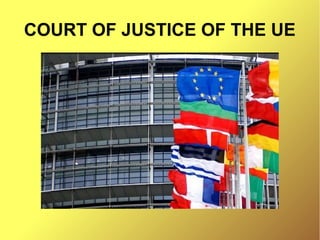
COURT OF JUSTICE OF THE UE
The Court of Justice is composed of 28 Judges and nine
Advocates General. The Judges and Advocates General
are appointed by common accord of the governments of
the Member States after consultation of a panel
responsible for giving an opinion on prospective
candidates' suitability to perform the duties concerned.
They are appointed for a term of office of six years, which
is renewable. They are chosen from among individuals
whose independence is beyond doubt and who possess
the qualifications required for appointment, in their
respective countries, to the highest judicial offices, or
who are of recognised competence.
The Court of Justice of UE is seated in Luxembourg.
European Central Bank.
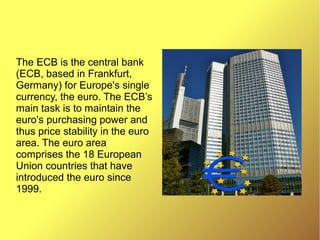
The ECB is the central bank
(ECB, based in Frankfurt,
Germany) for Europe's single
currency, the euro. The ECB’s
main task is to maintain the
euro's purchasing power and
thus price stability in the euro
area. The euro area
comprises the 18 European
Union countries that have
introduced the euro since
1999.
The European Central Bank and the national
central banks together constitute the Eurosystem,
the central banking system of the euro area. The
main objective of the Eurosystem is to maintain
price stability: safeguarding the value of the euro.
.
A1 spain

A1 spain

  • 2.
    THE EUROPEAN UNION 1.History 2. Figures 3. Institutions Students from 1º Bachillerato G.
  • 3.
  • 4.
  • 5.
    Beginning of theEurope Union Founders countries. Germany. Belgium. France. Netherlands. Italy. Luxembourg.
  • 6.
  • 7.
    30 July 1962 TheEU starts its ‘common agricultural policy’ giving the countries joint control over food production.
  • 8.
    20 July 1963 TheEU signs its first big international agreement — a deal to help 18 former colonies in Africa. By 2005, it has a special partnership with 78 countries in Africa, the Caribbean and Pacific (ACP) regions. The EU is the world’s biggest provider of development assistance to poorer countries. Its aid is linked to respect for human rights by recipients.
  • 9.
    1 July 1968 Thesix remove customs duties on goods imported from each other, allowing free cross- border trade for the first time. Trade among the six and between the EU and the rest of the world grows rapidly.
  • 10.
  • 11.
    24 April 1972 TheEU’s first plan for a single currency dates from 1970. The EU adopts laws to protect the environment, introducing the notion of ‘the polluter pays ’ for the first time.
  • 12.
    1 January 1973 Thesix become nine when Denmark, Ireland and the United Kingdom formally enter the EU.
  • 13.
    10 December 1974 Toshow their solidarity, EU leaders set up the European Regional Development Fund.
  • 14.
    7–10 June 1979 EUcitizens directly elect the members of the European Parliament for the first time. Previously they were delegated by national parliaments. Members sit in pan-European political groups
  • 15.
  • 16.
    1 January 1981 Membershipof the EU reaches double figures when Greece joins. It has been eligible to join since its military regime was overthrown and democracy restored in 1974 .
  • 17.
    1 January 1986 Spainand Portugal enter the EU, bringing membership to 12.
  • 18.
    17 February 1986 Althoughcustoms duties disappeared in 1968, trade is not flowing freely across EU borders. The main obstacles are differences in national regulations. The Single European Act of 1986 launches a vast six-year programme to sort these out.
  • 19.
    The collapse ofcommunism across central and eastern Europe, which began in Poland and Hungary, is symbolised by the fall of the Berlin Wall in 1989. Faced by a mass exodus of its citizens to West, the East German government throws open the gates. Germany is united after more than 40 years, and its eastern part joins the EU (October 1990).
  • 20.
  • 21.
    7 February 1992 ●The Treaty on European Union is signed in Maastricht. It is a major EU milestone, setting clear rules for the future single currency as well as for foreign and security policy and closer cooperation in justice and home affairs. Under the treaty, the name ‘European Union’ officially replaces ‘European Community’.
  • 22.
    1 January 1993 Thesingle market and its four freedoms are established: the free movement of goods, services, people and money is now reality.
  • 23.
    1 January 1995 Austria,Finland and Sweden join the EU. The 15 members now cover almost the whole of western Europe.
  • 24.
    26 March 1995 TheSchengentakes effect in seven countries — Belgium, Germany, Spain, France, Luxembourg, the Netherlands and Portugal. Travellers of any nationality can travel between all these countries without any passport control at the frontiers. Other countries have since joined the passport-free Schengen area.
  • 25.
    13 December 1997 EUleaders agree to start the process of membership negotiations with 10 countries of central and eastern Europe: Bulgaria, the Czech Republic, Estonia, Hungary, Latvia, Lithuania, Poland, Romania, Slovakia and Slovenia. The Mediterranean islands of Cyprus and Malta are also included.
  • 26.
    1 January 1999 Theeuro is introduced in 11 countries (joined by Greece in 2001) for commercial and financial transactions only. Notes and coins will come later.
  • 27.
    THE EU FROM2000 TO NOWADAYS
  • 28.
    From January 1,1999, inclusive, the currency of the monetary Spanish system will be the EURO, which will happen to the PESETA (PESETA) In the same date, the PESETA will turn into DECIMAL FRACTION of the EURO, being able to continue being used as unit of account and liberation mean of payment of obligations until December 31, 2001, This way so, between 1.1.99 and 31.12.01, they will coexist, in his legal tender, EURO and PESETA, It is foreseen that, from January 1, 2002 they circulate fullly the tickets and coins named in EURO.
  • 29.
    1 January 2002 Euronotes and coins arrive. Printing, minting and distributing them in 12 countries is a major logistical operation. More than 80 billion coins are involved.
  • 30.
    Notes are thesame for all countries. Coins have one common face, giving the value, while the other carries a national emblem. All circulate freely. Using Finnish (or any other) euro coin to buy a Madrid metro ticket is something we take for granted.
  • 31.
    1 May 2004 Eightcountries of central and eastern Europe — the Czech Republic, Estonia, Latvia, Lithuania, Hungary, Poland, Slovenia and Slovakia — join the EU, finally ending the division of Europe decided by the Great Powers 60 years earlier at Yalta. Cyprus and Malta also become members.
  • 32.
    Member States: Germany,France, Italy, the Netherlands, Belgium, Luxembourg, Denmark, Ireland, United Kingdom, Greece, Spain, Portugal, Austria, Finland and Sweden. New Member States: Czech Republic, Cyprus, Estonia, Latvia, Lithuania, Hungary, Malta, Poland, Slovenia and Slovakia. Candidate Countries: Bulgaria, Romania and Turkey.
  • 33.
    29 October 2004 The25 EU countries sign a Treaty establishing a European Constitution.
  • 34.
    1 January 2007 Twomore countries from eastern Europe, Bulgaria and Romania, nw join the EU, brining the number of member states to 27 countries. Croatia, the Former Yugoslav Republic of Macedonia and Turkey are also candidates for future membership
  • 35.
    ● Member States:Germany, France, Italy, the Netherlands, Belgium, Luxembourg, Denmark, Ireland, United Kingdom, Greece, Spain, Portugal, Austria, Finland, Sweden, Czech Republic, Cyprus, Estonia, Latvia, Lithuania, Hungary, Malta, Poland, Slovenia and Slovakia. ● New Member States: Bulgaria and Romania. ● Candidate Countries: Croatia, the Former Yugoslav Republic of Macedonia and Turkey.
  • 36.
    13 December 2007 The27 EU countries sign the Treaty of Lisbon September 2008 A major financial crisis hits the world economy. The problems start with mortgage loans in the United States. Several European banks also experience difficulties. The crisis leads to closer economic cooperation between EU countries. The new decade starts with a severe economic crisis, but also with the hope that investments in new green and climate-friendly technologies and closer European cooperation will bring lasting growth and welfare.
  • 37.
  • 38.
    QUALITY OF LIFE Livingstandards can be compared by measuring the price of a range of goods and services in each country relative to income, using a common notional currency called the purchasing power standard (PPS). Comparing GDP per inhabitant in PPS provides an overview of living standards across the EU+.
  • 40.
    SIZE AND POPULATION TheEU covers over 4 million km² and has 503 million inhabitants — the world’s third largest population after China and India. By surface area, France is the biggest EU country and Malta the smallest.
  • 41.
    Europe’s population isincreasing through a combination of natural growth ( more people are born each year than die) and net migration (more people settle in the EU than leave it). At the same time, the population of Europe is ageing as life expectancy increases and fewer children are born.
  • 42.
    ● Malta (MT) 4213640.08% ● Luxembourg(LU) 5370390.10% ● Cyprus (CY)8658780.17% ● Estonia (EE) 1320174 0.26% ● Latvia (LV) 2023825 0.39% ● Slovenia (SI) 2058821 0.40% ● Lithuania (LT) 2971905 0.58% ● (AM)3026878 0.59% ● (MD) 3559497 0.70% ● Croatia (HR) 4262140 0.84% ● Ireland (IE) 4591087 0.90% ● Slovakia (SK) 5410836 1.06% ● Finland (FI) 5426674 1.07% ● Denmark (DK) 5602628 1.10% ● Bulgaria (BG) 7284552 1.43% ● Austria (AT) 8451860 1.66% ● (AZ) 9356483 1.84% ● Sweden (SE) 9555893 1.88% ● Hungary (HU) 9908798 1.95% ● Portugal (PT) 104872892.06% ● Czech Republic (CZ) 105161252.07% ● Greece (EL)110625082.18% ● Belgium (BE) 11161642 2.20% ● Netherlands (NL)167795753.30% ● Romania (RO) 200200743.94% ● Poland (PL) 385332997.59% ● (UA)453726928.94% ● Spain (ES) 467278909.21% ● Italy (IT) 5968522711.77% ● (FX) 6365960812.55% ● United Kingdom (UK) 6390529712.60% ● France (FR)6557881912.93% ● Germany (DE) 8052374615.88% ● (EA18) 333114254 65.69% ● Total population 507 069 424100%
  • 43.
    Measuring the EU’seconomy The EU's economy — measured in terms of the goods and services it produces (GDP) — is now bigger than the US's: EU GDP in 2012: €12 945 402 million
  • 45.
  • 46.
    The UE Symbols TheEU is recognisable by several symbols, the most well-known being the circle of yellow stars on a blue background. This site introduces other symbols such as the European anthem and motto
  • 47.
    The European Flag It's a symbolof unity. The European flag consists of 12 golden stars in a circle on a blue background. The stars symbolise the ideals of unity, solidarity and harmony among the peoples of Europe.
  • 48.
    History of the European Flag. The history ofthe flag goes back to 1955. The council of Europe, adopted the present design for its own use. In 1983, the European parlament adopted the flag. In 1985, it was adopted by all EU leaders as the official emblem of the European Union (called the European Communities at the time). All European institutions now use an emblem of their own.
  • 49.
  • 50.
    ● Europe Day – EU Open Doors Europe Dayheld on 9 May every year celebrates peace and unity in Europe. The date marks the anniversary of the historical `Schuman declaration´. At a speech in Paris in 1950, Robert Schuman, the then French foreign minister, set out his idea for a new form of political cooperation in Europe, which would make war between Europe’s nations unthinkable. His vision was to create a European institution that would pool and manage coal and steel production. A treaty creating such a body was signed just under a year later. Schuman’s proposal is considered to be the beginning of what is now the European Union. – Open doors at EU institutions. To celebrate Europe Day, the EU institutions open their doors to the public in early May in Brussels and Strasbourg. Local EU offices in Europe and all over the world organise a variety of activities and events for all ages.
  • 51.
    The EU motto. "United in diversity",the motto of the European Union, first came into use in 2000. It signifies how Europeans have come together, in the form of the EU, to work for peace and prosperity, while at the same time being enriched by the continent's many different cultures, traditions and languages.
  • 52.
  • 53.
  • 54.
  • 55.
    Spanish: Unida enla diversidad
  • 56.
  • 57.
    INDEX ● Parliament ● EuropeanCouncil ● Council of the UE ● European Commission ● Court of Justice of the UE ● European Central Bank
  • 58.
    PARLIAMENT Directly elected byEU voters every 5 years, members of the European Parliament represent the people. Parliament is one of the EU’s main law-making institutions . ROLES: -Passing european laws. -Democratic supervision. -Supervising the budget. -Composition. -Location
  • 61.
    THE EUROPEAN COUNCIL TheEuropean Council defines the general political direction and priorities of the European Union. With the entry into force of the Treaty of Lisbon on 1 December 2009, it became an institution. Its President is Herman Van Rompuy.
  • 63.
    COUNCIL OF THEUE Also informally known as the EU Council, this is where national ministers from each EU country meet to adopt laws and coordinate policies. Not to be confused with: European Council Council of Europe
  • 64.
    What does itdo? - Passes EU laws -Coordinates the broad economic policies of EU member countries - Signs agreements between the EU and other countries - Approves the annual EU budget - Develops the EU's foreign and defence policies - Coordinates cooperation between courts and police forces of member countries
  • 65.
    Who are themembers of the Council? There are no fixed members as such. At each Council meeting, each country sends the minister for the policy field being discussed Who chairs the meetings? The foreign ministers’ Council has a permanent chairperson – the EU's High Representative for foreign and security policy. All other Council meetings are chaired by the relevant minister of the country holding the rotating EU presidency Voting Decisions in the Council of the EU are taken by qualified majority as a general rule. The bigger a country’s population, the more votes it has, but in fact the numbers are weighted in favour of the less populous countries.
  • 67.
    EUROPEAN COMMISSION The EuropeanCommission is one of the main institutions of the European Union. It represents and upholds the interests of the EU as a whole. It drafts proposals for new European laws. It manages the day-to-day business of implementing EU policies and spending EU funds.
  • 68.
    Composition The 28 Commissioners,one from each EU country, provide the Commission’s political leadership during their 5-year term. Each Commissioner is assigned responsibility for specific policy areas by the President. The current President of the European Commission is Jean-Claude Juncker.
  • 69.
    Purpose The Commission representsand upholds the interests of the EU as a whole. It oversees and implements EU policies by: proposing new laws to Parliament and the Council managing the EU's budget and allocating funding enforcing EU law (together with the Court of Justice) representing the EU internationally, for example, by negotiating agreements between the EU and other countries. Location The Commission is based in Brussels and Luxembourg and has offices (representations) in every EU country and delegations in capital cities around the world.
  • 70.
  • 71.
    The Court ofJustice is composed of 28 Judges and nine Advocates General. The Judges and Advocates General are appointed by common accord of the governments of the Member States after consultation of a panel responsible for giving an opinion on prospective candidates' suitability to perform the duties concerned. They are appointed for a term of office of six years, which is renewable. They are chosen from among individuals whose independence is beyond doubt and who possess the qualifications required for appointment, in their respective countries, to the highest judicial offices, or who are of recognised competence. The Court of Justice of UE is seated in Luxembourg.
  • 72.
  • 73.
    The ECB isthe central bank (ECB, based in Frankfurt, Germany) for Europe's single currency, the euro. The ECB’s main task is to maintain the euro's purchasing power and thus price stability in the euro area. The euro area comprises the 18 European Union countries that have introduced the euro since 1999.
  • 74.
    The European CentralBank and the national central banks together constitute the Eurosystem, the central banking system of the euro area. The main objective of the Eurosystem is to maintain price stability: safeguarding the value of the euro. .