EUROPEAN UNION
• Since the creation of the EU half a
century ago, Europe has enjoyed the
longest period of peace in its history.
• European political integration is
unprecedented in history.
• EU enlargement has helped overcome
the division of Europe – contributing to
peace, prosperity, and stability across the
continent.
• A single market and a common currency
conditions for companies and consumers.
• EU has united the citizens of Europe –
while preserving Europe’s diversity.
European Union
United in diversity
• Shared values: liberty, democracy,
respect for human rights and
fundamental freedoms, and the rule of
law.
• Largest economic body in the world.
• World’s most successful model for
advancing peace and democracy.
• A unique institution – Member States
voluntarily cede national sovereignty in
many areas to carry out common
policies and governance.
• Not a super-state to replace existing
states, nor just an organization for
international cooperation.
• World’s most open market for goods
and commodities from developing
countries.
28
7
30
490
million
Member States
Combined
population
of
EU Member
States
Percent of world’s
population
Percent of
global GDP
55
Percent of combined
worldwide Official
Development Assistance
European Commission
• 27 Commissioners, representing the
European perspective, each responsible
for a specific policy area.
• EU’s executive branch proposes legislation,
manages Union’s day-to-day business and
budget, and enforces rules.
• Negotiates trade agreements and manages
Europe’s multilateral development
cooperation.
Council of the European Union
• EU’s main decision-making body,
comprised of ministers of 27 Member
States, representing Member State’s point
of view.
• Decides on foreign policy issues.
• Council presidency rotates among
Member States every six months.
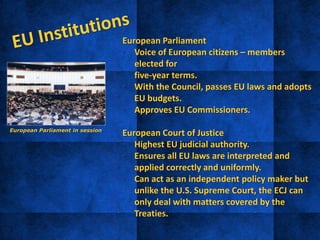
European Parliament
• Voice of European citizens – members
elected for
five-year terms.
• With the Council, passes EU laws and adopts
EU budgets.
• Approves EU Commissioners.
European Court of Justice
• Highest EU judicial authority.
• Ensures all EU laws are interpreted and
applied correctly and uniformly.
• Can act as an independent policy maker but
unlike the U.S. Supreme Court, the ECJ can
only deal with matters covered by the
Treaties.
European Parliament in session
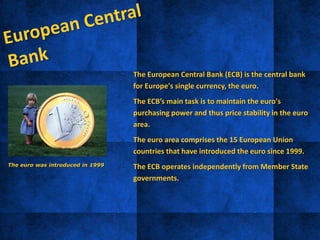
• The European Central Bank (ECB) is the central bank
for Europe's single currency, the euro.
• The ECB’s main task is to maintain the euro's
purchasing power and thus price stability in the euro
area.
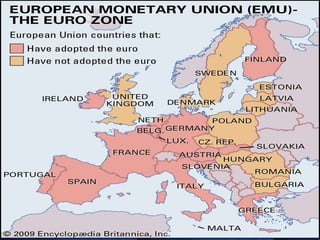
• The euro area comprises the 15 European Union
countries that have introduced the euro since 1999.
• The ECB operates independently from Member State
governments.
The euro was introduced in 1999
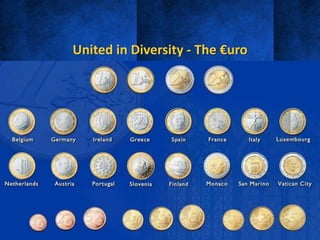
United in Diversity - The €uro
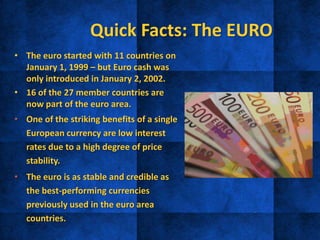
Quick Facts: The EURO
• The euro started with 11 countries on
January 1, 1999 – but Euro cash was
only introduced in January 2, 2002.
• 16 of the 27 member countries are
now part of the euro area.
• One of the striking benefits of a single
European currency are low interest
rates due to a high degree of price
stability.
• The euro is as stable and credible as
the best-performing currencies
previously used in the euro area
countries.
10
Quick Facts: The EURO
• The euro banknotes
(and coins) easily
circulated around
the euro area, unlike
national banknotes
that moved across
borders but to a
more limited extent.
[www.ecb.int]
BUT…
• EU membership does not automatically
guarantee membership to the Economic and
Monetary Union
– However, member states pledge to become
members of the euro zone as part of their EU
membership agreement
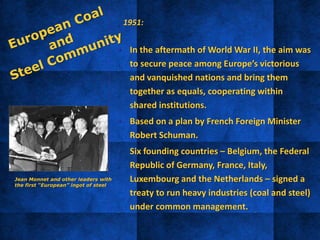
1951:
• In the aftermath of World War II, the aim was
to secure peace among Europe’s victorious
and vanquished nations and bring them
together as equals, cooperating within
shared institutions.
• Based on a plan by French Foreign Minister
Robert Schuman.
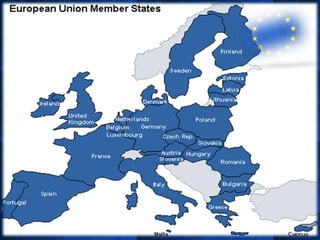
• Six founding countries – Belgium, the Federal
Republic of Germany, France, Italy,
Luxembourg and the Netherlands – signed a
treaty to run heavy industries (coal and steel)
under common management.
Jean Monnet and other leaders with
the first “European” ingot of steel
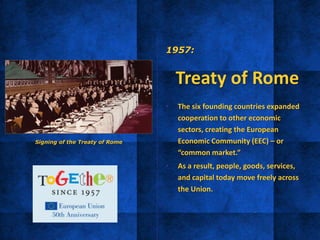
Treaty of Rome
• The six founding countries expanded
cooperation to other economic
sectors, creating the European
Economic Community (EEC) – or
“common market.”
• As a result, people, goods, services,
and capital today move freely across
the Union.
1957:
Signing of the Treaty of Rome
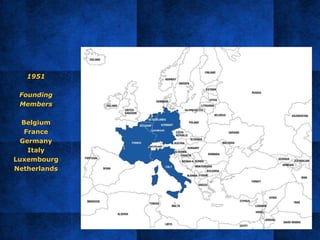
1951
Founding
Members
Belgium
France
Germany
Italy
Luxembourg
Netherlands
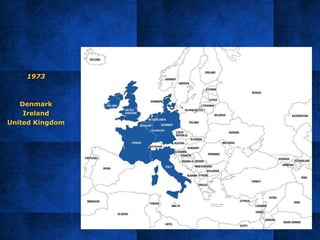
1973
Denmark
Ireland
United Kingdom
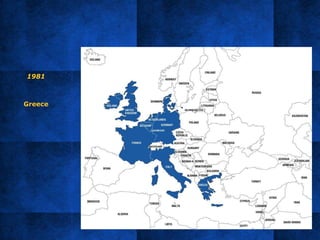
1981
Greece
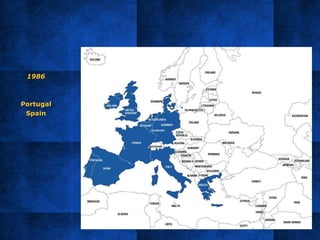
1986
Portugal
Spain
November
1989
Fall of the
Berlin Wall
sets the
stage for
unifying
Europe and
EU
enlargement
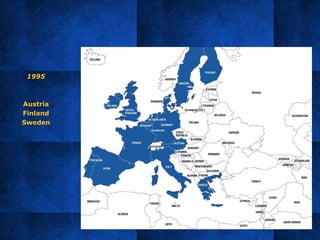
1995
Austria
Finland
Sweden
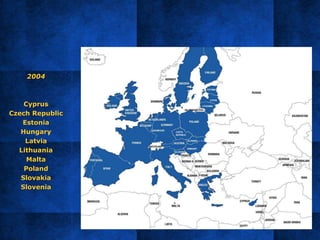
2004
Cyprus
Czech Republic
Estonia
Hungary
Latvia
Lithuania
Malta
Poland
Slovakia
Slovenia
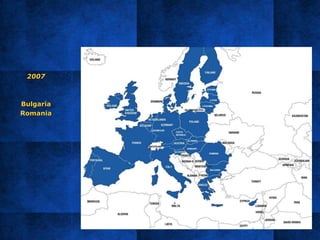
2007
Bulgaria
Romania
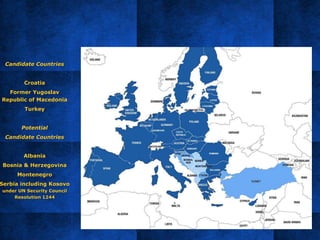
Candidate Countries
Croatia
Former Yugoslav
Republic of Macedonia
Turkey
Potential
Candidate Countries
Albania
Bosnia & Herzegovina
Montenegro
Serbia including Kosovo
under UN Security Council
Resolution 1244
Enlargement has:
• Inspired reforms and
consolidated common
principles of liberty,
democracy, respect for
human rights, fundamental
freedoms, the rule of law, and
market economy.
• Enhanced the EU’s weight in
the world and made it a
stronger and more attractive
international partner.
“Enlargement has been a
success story for the
European Union and
Europe as a whole. It
has helped to overcome
the division of Europe
and contributed to peace
and stability throughout
the continent.”
European Council
Declaration
Dec. 15, 2006
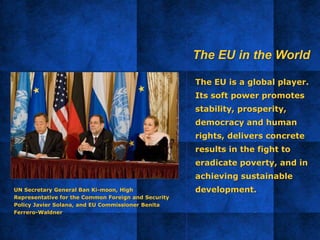
The EU is a global player.
Its soft power promotes
stability, prosperity,
democracy and human
rights, delivers concrete
results in the fight to
eradicate poverty, and in
achieving sustainable
development.UN Secretary General Ban Ki-moon, High
Representative for the Common Foreign and Security
Policy Javier Solana, and EU Commissioner Benita
Ferrero-Waldner
The EU in the World
Addressing Global Challenges
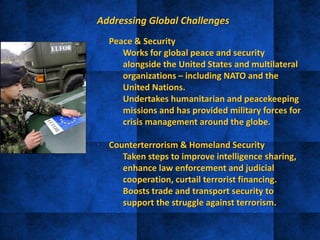
• Peace & Security
– Works for global peace and security
alongside the United States and multilateral
organizations – including NATO and the
United Nations.
– Undertakes humanitarian and peacekeeping
missions and has provided military forces for
crisis management around the globe.
• Counterterrorism & Homeland Security
– Taken steps to improve intelligence sharing,
enhance law enforcement and judicial
cooperation, curtail terrorist financing.
– Boosts trade and transport security to
support the struggle against terrorism.
• Democracy & Human Rights
– Works globally for free elections and
open democratic processes.
– Fights racism and intolerance at home
and abroad.
– Campaigns globally against capital
punishment.
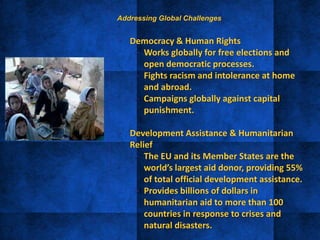
• Development Assistance & Humanitarian
Relief
– The EU and its Member States are the
world’s largest aid donor, providing 55%
of total official development assistance.
– Provides billions of dollars in
humanitarian aid to more than 100
countries in response to crises and
natural disasters.
Addressing Global Challenges
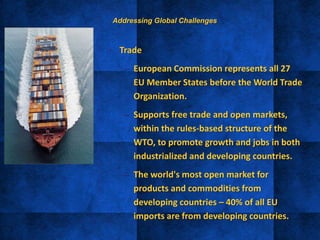
• Trade
– European Commission represents all 27
EU Member States before the World Trade
Organization.
– Supports free trade and open markets,
within the rules-based structure of the
WTO, to promote growth and jobs in both
industrialized and developing countries.
– The world's most open market for
products and commodities from
developing countries – 40% of all EU
imports are from developing countries.
Addressing Global Challenges
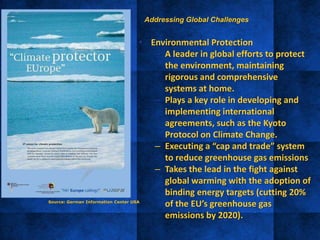
• Environmental Protection
– A leader in global efforts to protect
the environment, maintaining
rigorous and comprehensive
systems at home.
– Plays a key role in developing and
implementing international
agreements, such as the Kyoto
Protocol on Climate Change.
– Executing a “cap and trade” system
to reduce greenhouse gas emissions
– Takes the lead in the fight against
global warming with the adoption of
binding energy targets (cutting 20%
of the EU’s greenhouse gas
emissions by 2020).
Addressing Global Challenges
Source: German Information Center USA
EUROPEAN UNION

EUROPEAN UNION

  • 1.
  • 3.
    • Since thecreation of the EU half a century ago, Europe has enjoyed the longest period of peace in its history. • European political integration is unprecedented in history. • EU enlargement has helped overcome the division of Europe – contributing to peace, prosperity, and stability across the continent. • A single market and a common currency conditions for companies and consumers. • EU has united the citizens of Europe – while preserving Europe’s diversity. European Union United in diversity
  • 4.
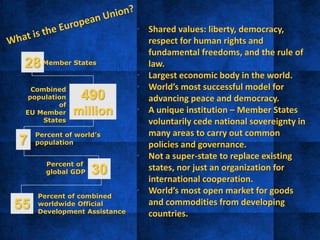
    • Shared values:liberty, democracy, respect for human rights and fundamental freedoms, and the rule of law. • Largest economic body in the world. • World’s most successful model for advancing peace and democracy. • A unique institution – Member States voluntarily cede national sovereignty in many areas to carry out common policies and governance. • Not a super-state to replace existing states, nor just an organization for international cooperation. • World’s most open market for goods and commodities from developing countries. 28 7 30 490 million Member States Combined population of EU Member States Percent of world’s population Percent of global GDP 55 Percent of combined worldwide Official Development Assistance
  • 5.
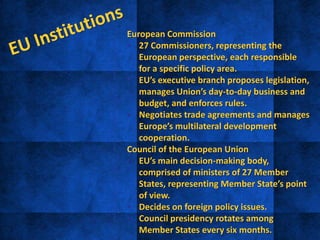
    European Commission • 27Commissioners, representing the European perspective, each responsible for a specific policy area. • EU’s executive branch proposes legislation, manages Union’s day-to-day business and budget, and enforces rules. • Negotiates trade agreements and manages Europe’s multilateral development cooperation. Council of the European Union • EU’s main decision-making body, comprised of ministers of 27 Member States, representing Member State’s point of view. • Decides on foreign policy issues. • Council presidency rotates among Member States every six months.
  • 6.
    European Parliament • Voiceof European citizens – members elected for five-year terms. • With the Council, passes EU laws and adopts EU budgets. • Approves EU Commissioners. European Court of Justice • Highest EU judicial authority. • Ensures all EU laws are interpreted and applied correctly and uniformly. • Can act as an independent policy maker but unlike the U.S. Supreme Court, the ECJ can only deal with matters covered by the Treaties. European Parliament in session
  • 7.
    • The EuropeanCentral Bank (ECB) is the central bank for Europe's single currency, the euro. • The ECB’s main task is to maintain the euro's purchasing power and thus price stability in the euro area. • The euro area comprises the 15 European Union countries that have introduced the euro since 1999. • The ECB operates independently from Member State governments. The euro was introduced in 1999
  • 8.
    United in Diversity- The €uro
  • 9.
    Quick Facts: TheEURO • The euro started with 11 countries on January 1, 1999 – but Euro cash was only introduced in January 2, 2002. • 16 of the 27 member countries are now part of the euro area. • One of the striking benefits of a single European currency are low interest rates due to a high degree of price stability. • The euro is as stable and credible as the best-performing currencies previously used in the euro area countries.
  • 10.
  • 11.
    Quick Facts: TheEURO • The euro banknotes (and coins) easily circulated around the euro area, unlike national banknotes that moved across borders but to a more limited extent. [www.ecb.int]
  • 12.
    BUT… • EU membershipdoes not automatically guarantee membership to the Economic and Monetary Union – However, member states pledge to become members of the euro zone as part of their EU membership agreement
  • 13.
    1951: • In theaftermath of World War II, the aim was to secure peace among Europe’s victorious and vanquished nations and bring them together as equals, cooperating within shared institutions. • Based on a plan by French Foreign Minister Robert Schuman. • Six founding countries – Belgium, the Federal Republic of Germany, France, Italy, Luxembourg and the Netherlands – signed a treaty to run heavy industries (coal and steel) under common management. Jean Monnet and other leaders with the first “European” ingot of steel
  • 14.
    Treaty of Rome •The six founding countries expanded cooperation to other economic sectors, creating the European Economic Community (EEC) – or “common market.” • As a result, people, goods, services, and capital today move freely across the Union. 1957: Signing of the Treaty of Rome
  • 15.
  • 16.
  • 17.
  • 18.
  • 19.
    November 1989 Fall of the BerlinWall sets the stage for unifying Europe and EU enlargement
  • 20.
  • 21.
  • 22.
  • 23.
    Candidate Countries Croatia Former Yugoslav Republicof Macedonia Turkey Potential Candidate Countries Albania Bosnia & Herzegovina Montenegro Serbia including Kosovo under UN Security Council Resolution 1244
  • 24.
    Enlargement has: • Inspiredreforms and consolidated common principles of liberty, democracy, respect for human rights, fundamental freedoms, the rule of law, and market economy. • Enhanced the EU’s weight in the world and made it a stronger and more attractive international partner. “Enlargement has been a success story for the European Union and Europe as a whole. It has helped to overcome the division of Europe and contributed to peace and stability throughout the continent.” European Council Declaration Dec. 15, 2006
  • 25.
    The EU isa global player. Its soft power promotes stability, prosperity, democracy and human rights, delivers concrete results in the fight to eradicate poverty, and in achieving sustainable development.UN Secretary General Ban Ki-moon, High Representative for the Common Foreign and Security Policy Javier Solana, and EU Commissioner Benita Ferrero-Waldner The EU in the World
  • 26.
    Addressing Global Challenges •Peace & Security – Works for global peace and security alongside the United States and multilateral organizations – including NATO and the United Nations. – Undertakes humanitarian and peacekeeping missions and has provided military forces for crisis management around the globe. • Counterterrorism & Homeland Security – Taken steps to improve intelligence sharing, enhance law enforcement and judicial cooperation, curtail terrorist financing. – Boosts trade and transport security to support the struggle against terrorism.
  • 27.
    • Democracy &Human Rights – Works globally for free elections and open democratic processes. – Fights racism and intolerance at home and abroad. – Campaigns globally against capital punishment. • Development Assistance & Humanitarian Relief – The EU and its Member States are the world’s largest aid donor, providing 55% of total official development assistance. – Provides billions of dollars in humanitarian aid to more than 100 countries in response to crises and natural disasters. Addressing Global Challenges
  • 28.
    • Trade – EuropeanCommission represents all 27 EU Member States before the World Trade Organization. – Supports free trade and open markets, within the rules-based structure of the WTO, to promote growth and jobs in both industrialized and developing countries. – The world's most open market for products and commodities from developing countries – 40% of all EU imports are from developing countries. Addressing Global Challenges
  • 29.
    • Environmental Protection –A leader in global efforts to protect the environment, maintaining rigorous and comprehensive systems at home. – Plays a key role in developing and implementing international agreements, such as the Kyoto Protocol on Climate Change. – Executing a “cap and trade” system to reduce greenhouse gas emissions – Takes the lead in the fight against global warming with the adoption of binding energy targets (cutting 20% of the EU’s greenhouse gas emissions by 2020). Addressing Global Challenges Source: German Information Center USA

Editor's Notes

  • #10 The euro zone began life on 1 January 1999, with the participation of eleven EU countries. The euro, at that time, was only used for electronic transactions. On that day, the exchange rates of all EMU (European Monetary Union) currencies were irrevocably fixed and euro officially became a legal currency. In January 2002, euro coins and banknotes were officially introduced as legal tender, and six months down the line national currencies disappeared.
  • #13 It is interesting to note that some EU member states, however, have refused to replace their national currencies with the centrally-controlled euro.[UK, Sweden and Denmark (formally opt out of euro zone membership)]Thus, there are some member states that do not intend to participate in certain cooperative aspects within the framework of the EU.However, this was not an option for the new member states upon their accession to the EU in 2004 and 2007.[Of the twelve member states that joined the Union between 2004 and 2007, Slovenia, Cyprus, Malta and Slovakia have fulfilled the convergence criteria and are now part of the euro area. Czech Republic is on its way.]