The Republic
of Poland
General information about Poland
National symbols of Poland
The coat of arms
The flag
Anthem: Mazurek Dąbrowskiego
„Poland Is Not Yet Lost”
GEOGRAPHY
ž Poland is located in the very centre of
Europe. With the total area of 312,679
km² (120,728 sq mi) it’s the seventh
biggest country on the continent. Polish
population is over 38,5 million people.
ž The people of Poland use the Polish
language. The population, over 38.5
million people, occupy an area of
312,700 square kilometers.
ž The capital city is Warsaw (around 2
million inhabitants). Poland borders with
7 countries: Germany on the west,
Czech Republic and Slovakia on the
south, Ukraine, Belarus and Lithuania on
the east, and Russia on the north.
ž Most of the country is located on lowlands.
On the south there are upland areas with
two major mountain chains – the
Carpathians (Karpaty) and the Sudetes
(Sudety). The Baltic sea coastline on the
north measures 770 km. The longest river,
Vistula (Wisła) is 1,047 km (678 miles) long.
the Carpathians
The Baltic sea
ž The climate is moderate. The average
summer temperature ranges from 20 °C (68
°F) to 30 °C (86 °F). Winters are cold – the
average ranges from 3 °C (37,4 °F) in the
northwest to –8 °C (17,6 °F) in the northeast.
POLITICAL SYSTEM
ž Poland is a parliamentary republic. Prime
Minister and Council of Ministers led by him
are the leading institutions. The President is
a head of state and is elected every five
years in a popular election. The Parliament
is bicameral and consists of a 460-member
Sejm (the lower house) and a 100-member
Senat. The elections take place every four
years.
Government
President- Bronisław Komorowski Prime Minister- Ewa Kopacz
Religion
ž There are 46 religious denominations in
Poland, the largest of which is the Roman
Catholic Church; about 95 % of the
population are Roman Catholic.
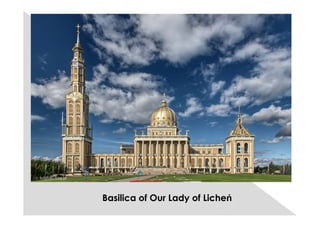
Basilica of Our Lady of Licheń
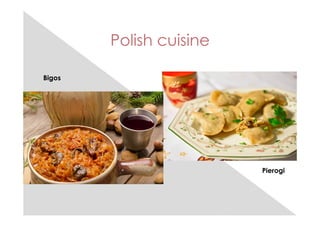
Polish cuisine
Bigos
Pierogi
Rosół
Kotlet schabowy
Thanks for watching J
Prepared by Alicja Dziadek, 3rd year student

A2 poland

  • 1.
    The Republic of Poland Generalinformation about Poland
  • 2.
    National symbols of Poland The coatof arms The flag Anthem: Mazurek Dąbrowskiego „Poland Is Not Yet Lost”
  • 3.
    GEOGRAPHY ž Poland is locatedin the very centre of Europe. With the total area of 312,679 km² (120,728 sq mi) it’s the seventh biggest country on the continent. Polish population is over 38,5 million people.
  • 4.
    ž The people ofPoland use the Polish language. The population, over 38.5 million people, occupy an area of 312,700 square kilometers. ž The capital city is Warsaw (around 2 million inhabitants). Poland borders with 7 countries: Germany on the west, Czech Republic and Slovakia on the south, Ukraine, Belarus and Lithuania on the east, and Russia on the north.
  • 6.
    ž Most of thecountry is located on lowlands. On the south there are upland areas with two major mountain chains – the Carpathians (Karpaty) and the Sudetes (Sudety). The Baltic sea coastline on the north measures 770 km. The longest river, Vistula (Wisła) is 1,047 km (678 miles) long.
  • 7.
  • 8.
    ž The climate ismoderate. The average summer temperature ranges from 20 °C (68 °F) to 30 °C (86 °F). Winters are cold – the average ranges from 3 °C (37,4 °F) in the northwest to –8 °C (17,6 °F) in the northeast.
  • 9.
    POLITICAL SYSTEM ž Poland isa parliamentary republic. Prime Minister and Council of Ministers led by him are the leading institutions. The President is a head of state and is elected every five years in a popular election. The Parliament is bicameral and consists of a 460-member Sejm (the lower house) and a 100-member Senat. The elections take place every four years.
  • 10.
  • 11.
    Religion ž There are 46religious denominations in Poland, the largest of which is the Roman Catholic Church; about 95 % of the population are Roman Catholic.
  • 12.
    Basilica of OurLady of Licheń
  • 13.
  • 14.
  • 15.
  • 16.
    Prepared by AlicjaDziadek, 3rd year student