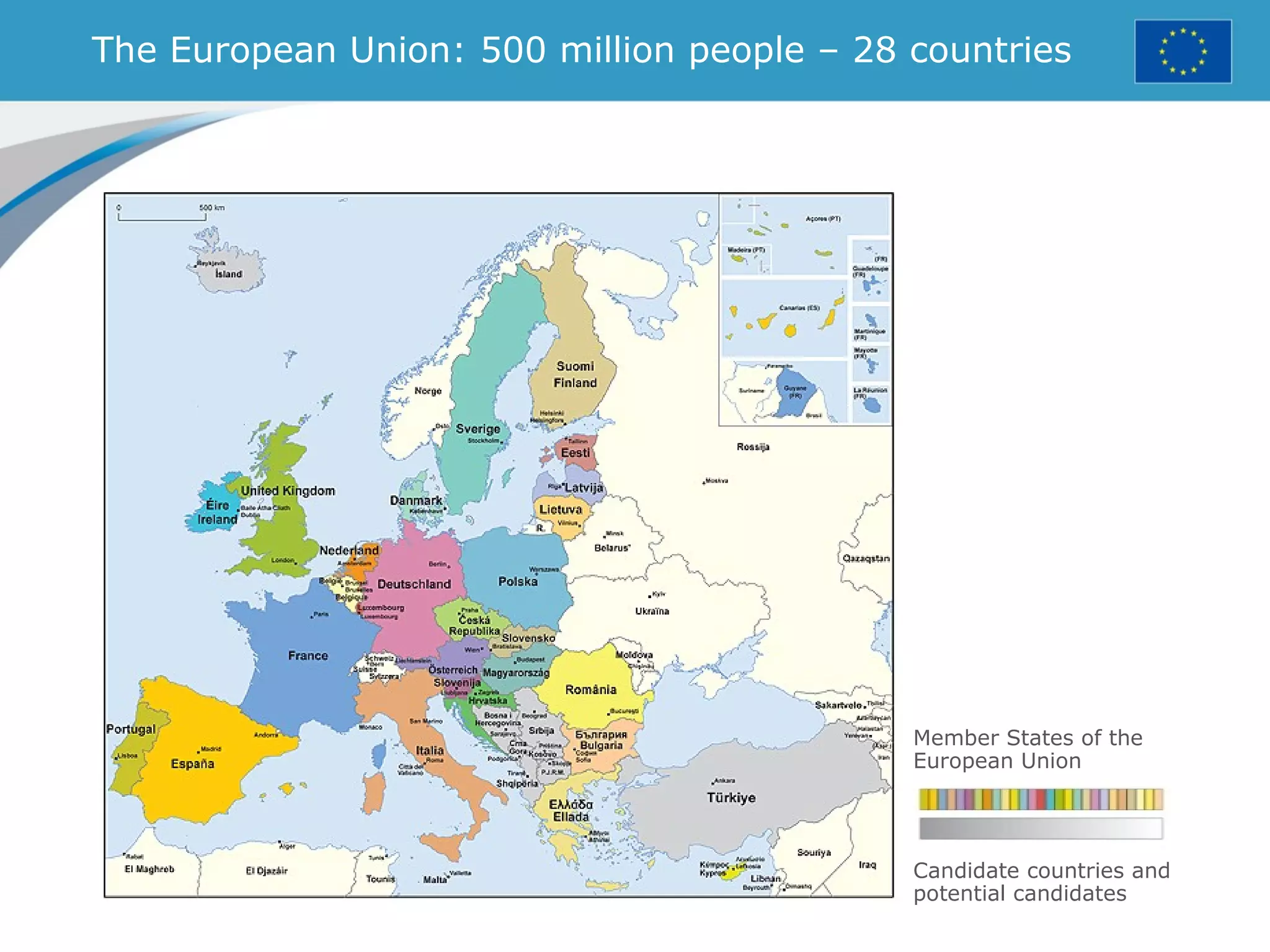
The European Union: 500 million people – 28 countries
Member States of the
European Union
Candidate countries and
potential candidates
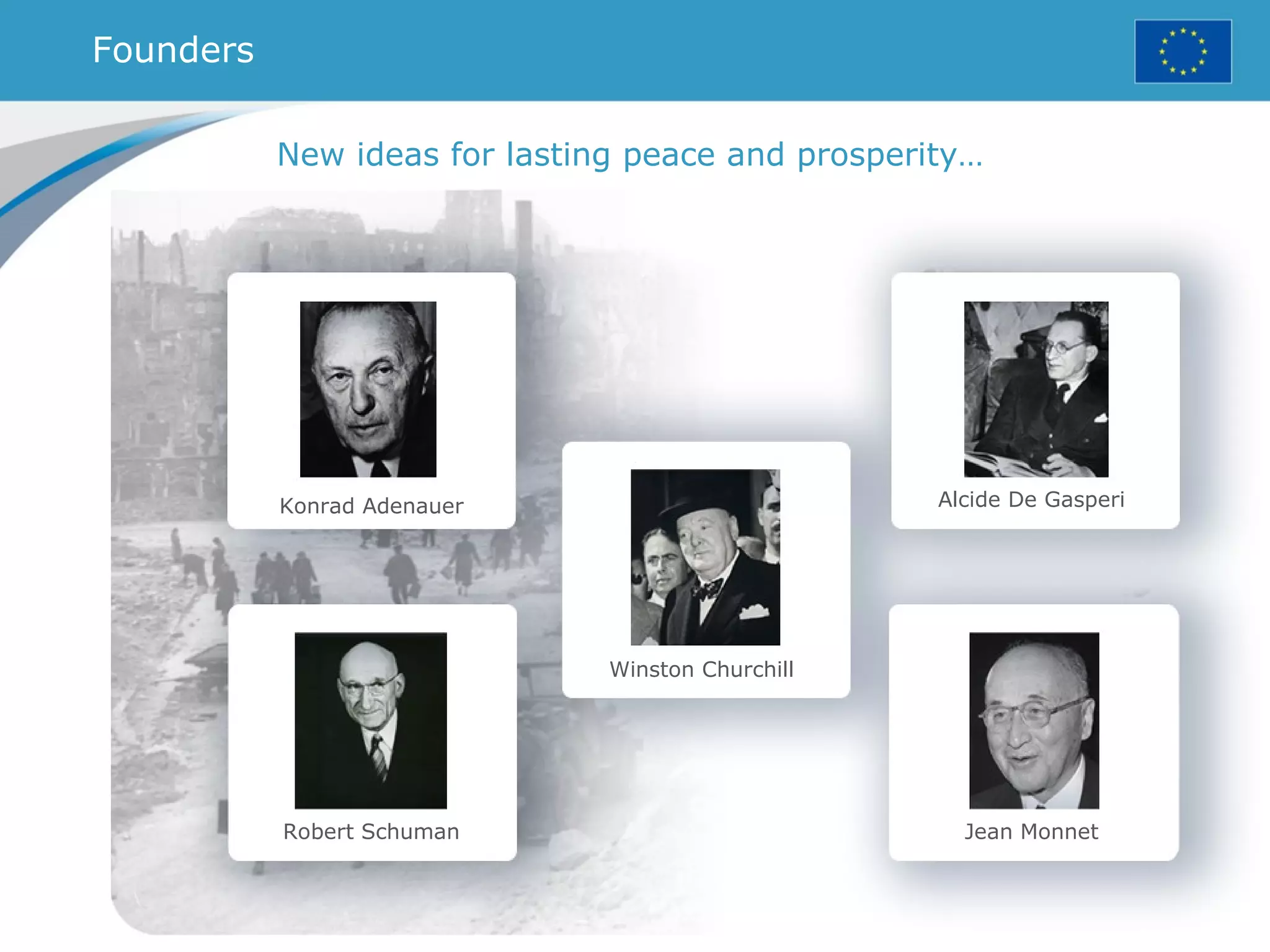
Konrad Adenauer
Robert Schuman
Winston Churchill
Alcide De Gasperi
Jean Monnet
New ideas for lasting peace and prosperity…
Founders
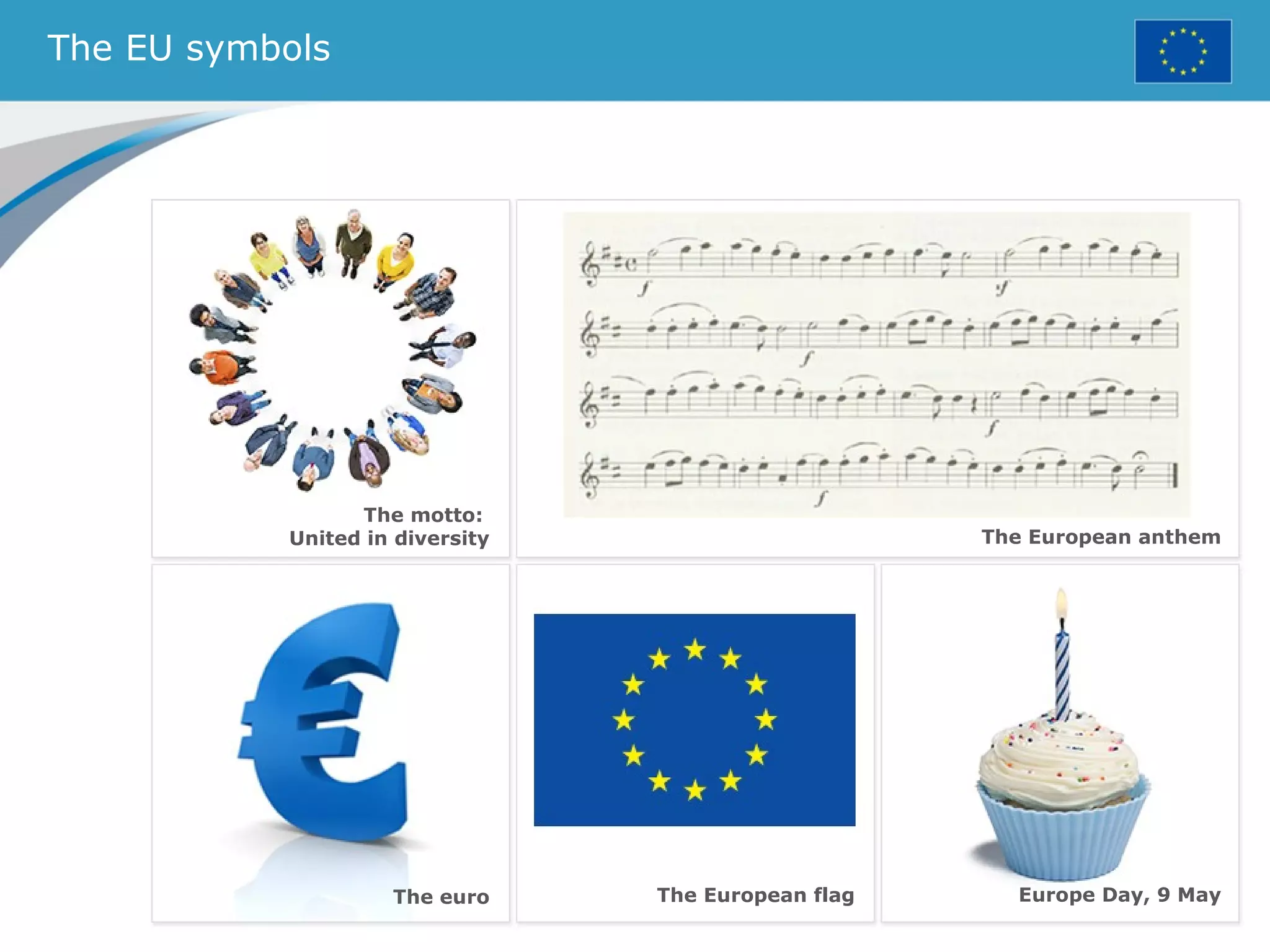
The EU symbols
The European flag
The European anthem
The euro Europe Day, 9 May
The motto:
United in diversity
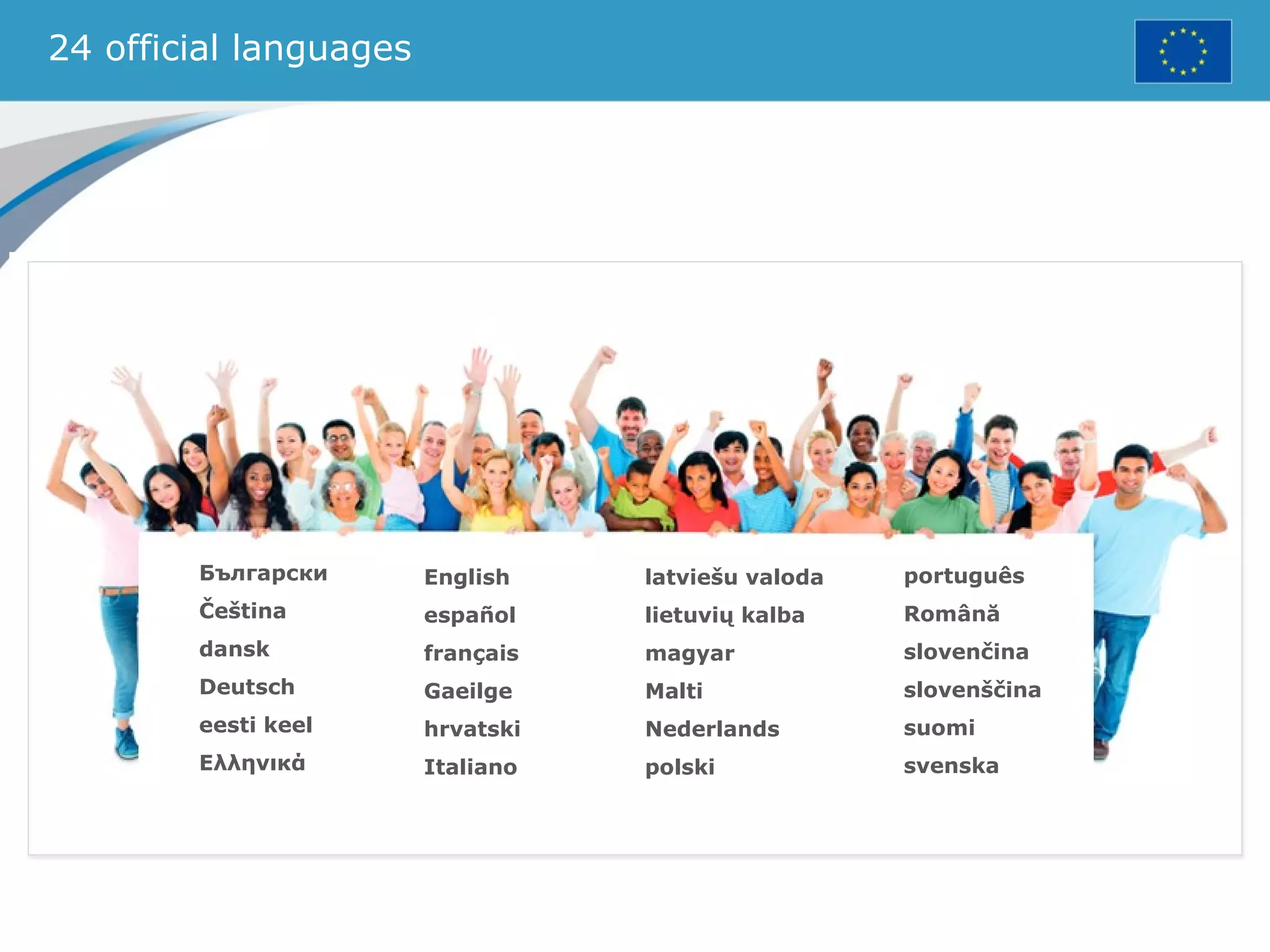
24 official languages
Български
Čeština
dansk
Deutsch
eesti keel
Ελληνικά
English
español
français
Gaeilge
hrvatski
Italiano
latviešu valoda
lietuvių kalba
magyar
Malti
Nederlands
polski
português
Română
slovenčina
slovenščina
suomi
svenska
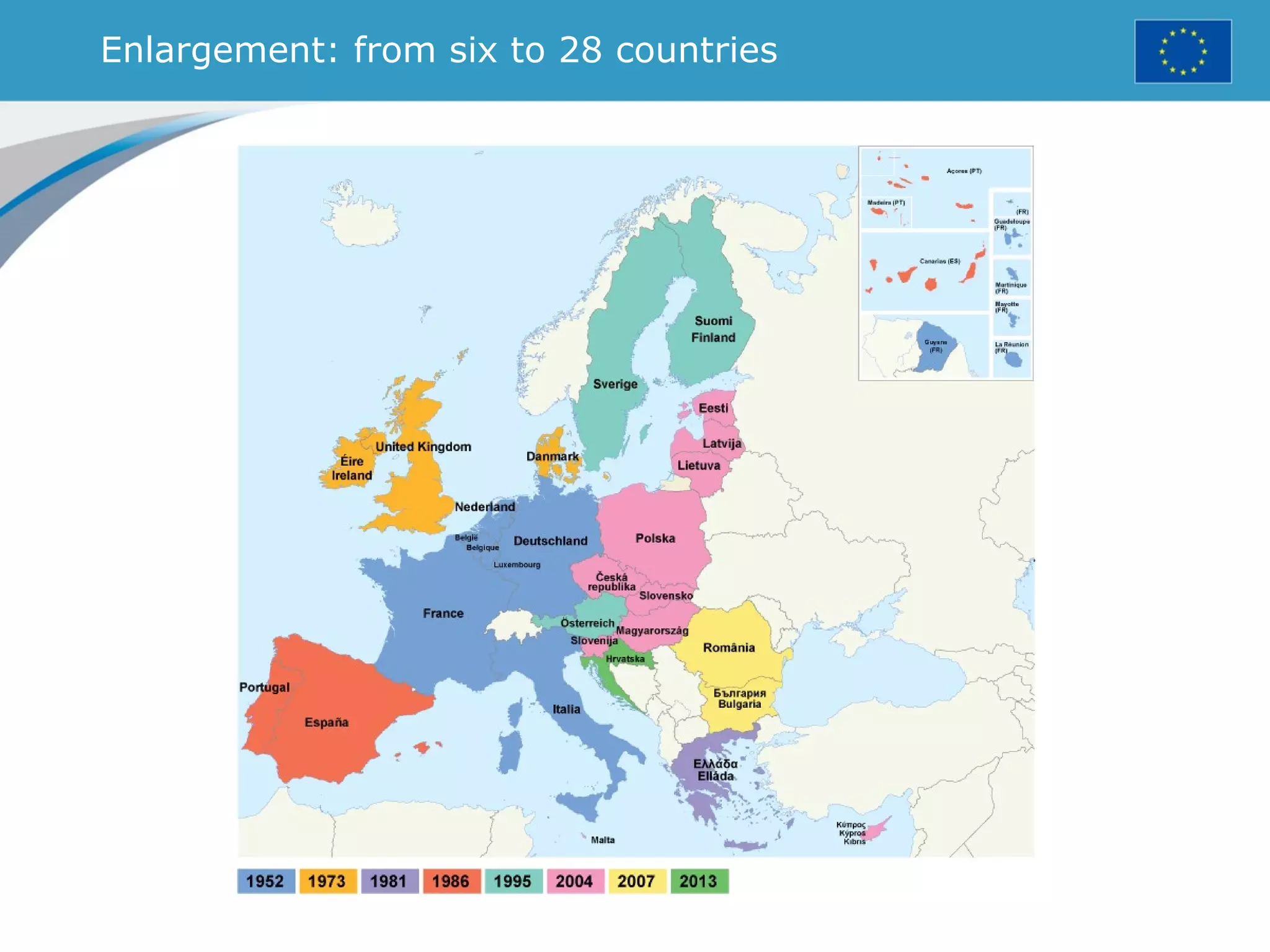
Enlargement: from six to 28 countries
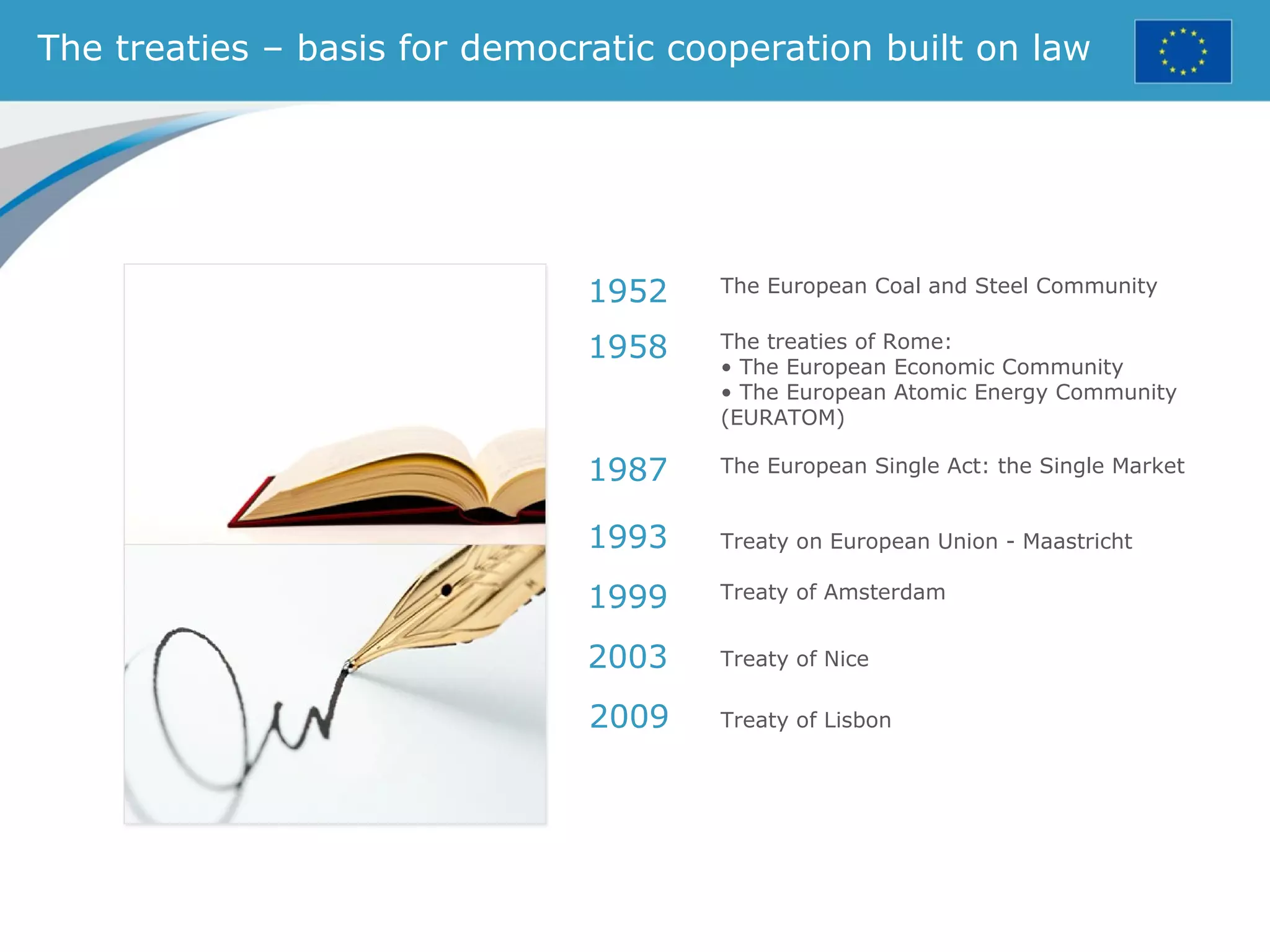
The treaties – basis for democratic cooperation built on law
The European Coal and Steel Community
The treaties of Rome:
• The European Economic Community
• The European Atomic Energy Community
(EURATOM)
The European Single Act: the Single Market
Treaty on European Union - Maastricht
Treaty of Amsterdam
1952
1958
1987
1993
1999
2003 Treaty of Nice
2009 Treaty of Lisbon
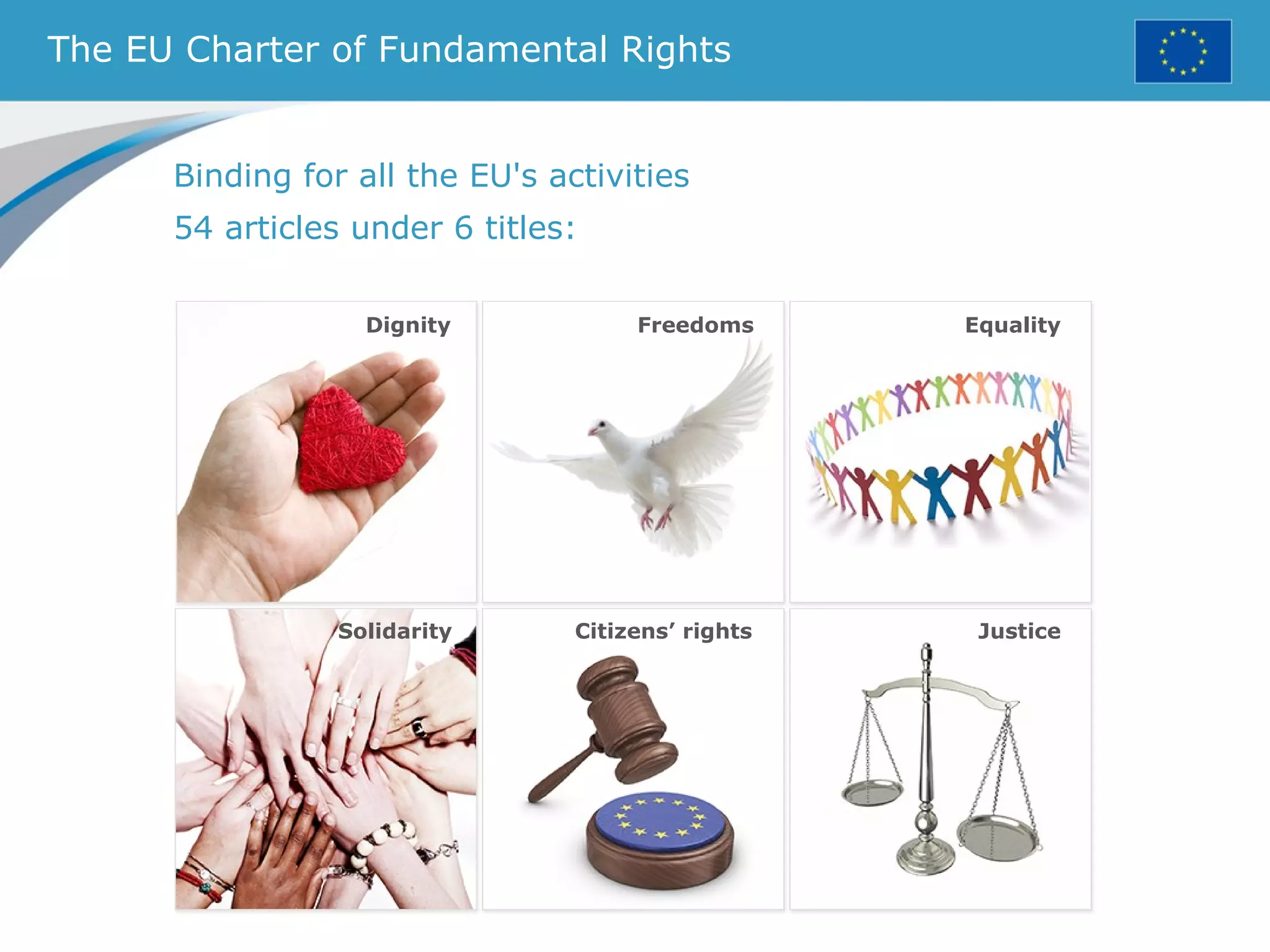
The EU Charter of Fundamental Rights
Binding for all the EU's activities
54 articles under 6 titles:
Freedoms Equality
Solidarity Citizens’ rights Justice
Dignity
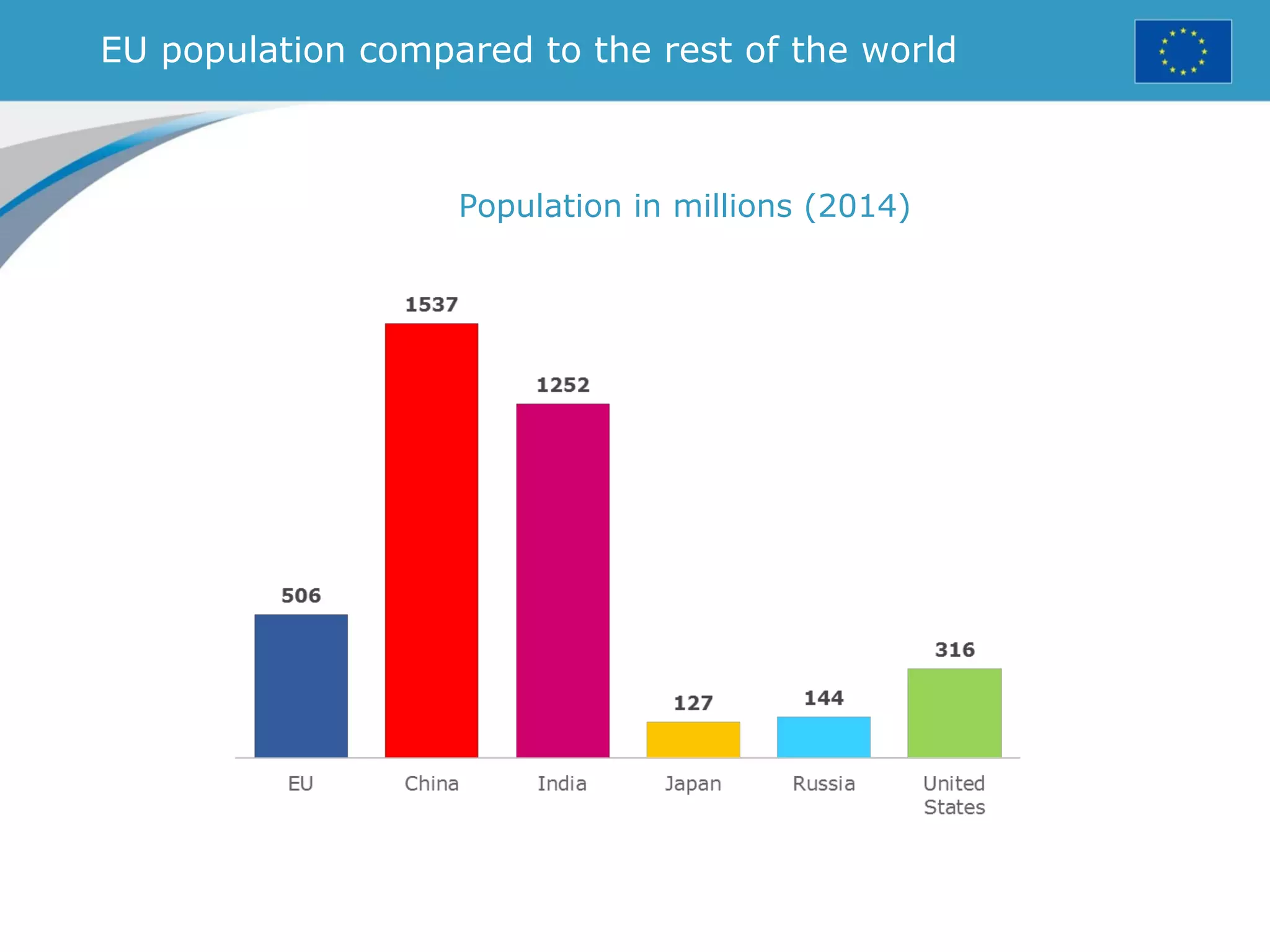
EU population compared to the rest of the world
Population in millions (2014)
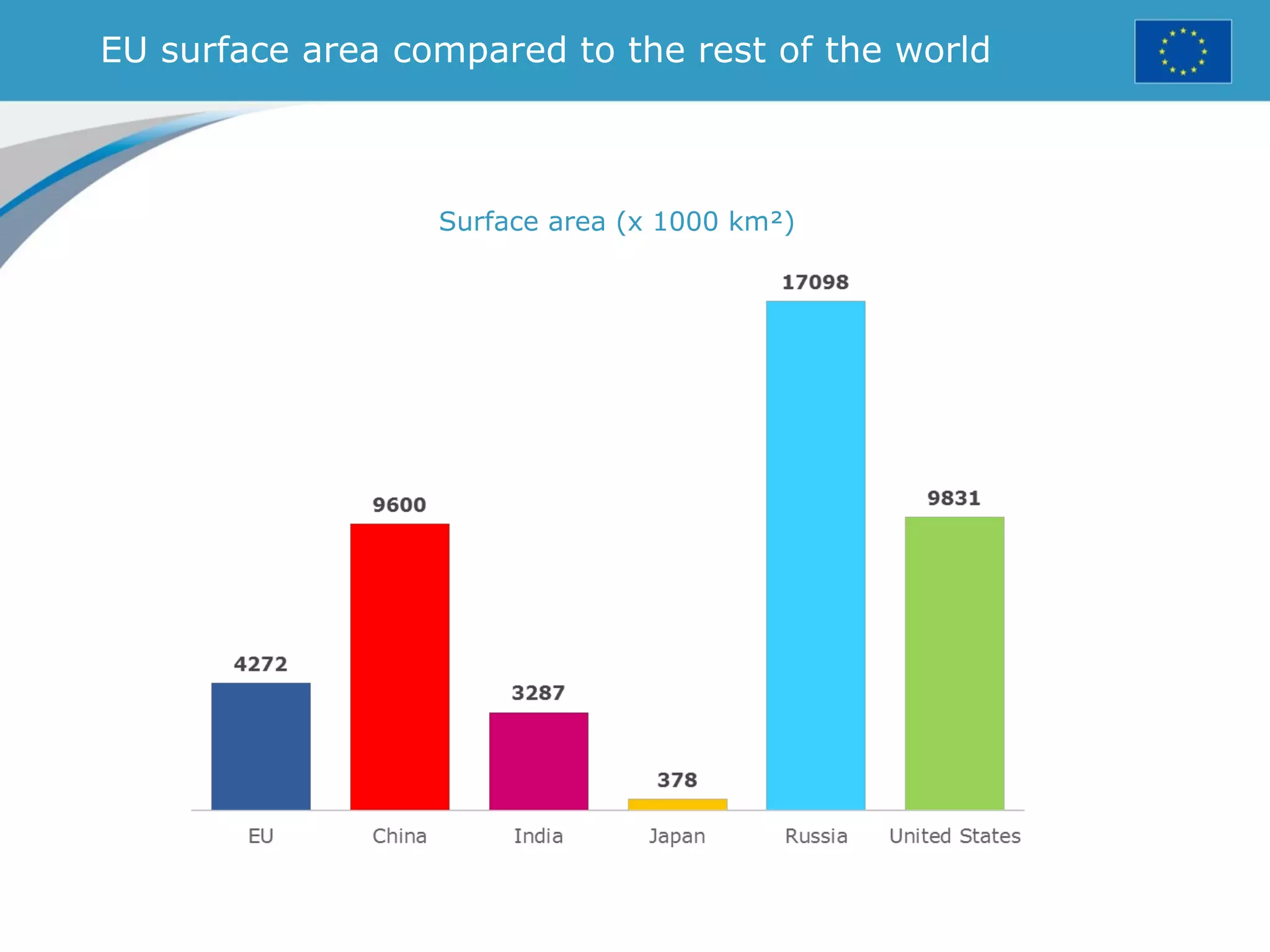
EU surface area compared to the rest of the world
Surface area (x 1000 km²)
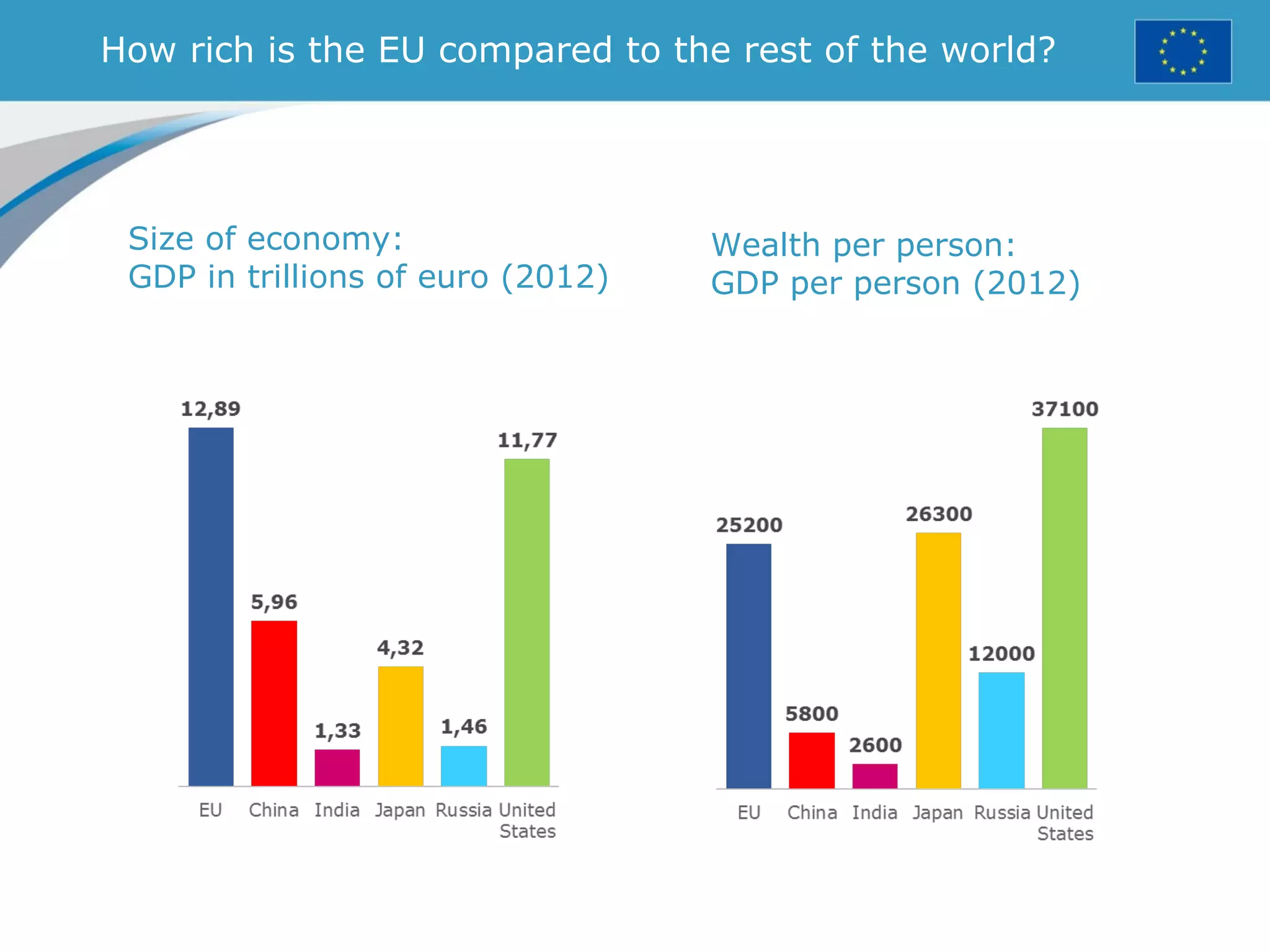
How rich is the EU compared to the rest of the world?
Size of economy:
GDP in trillions of euro (2012)
Wealth per person:
GDP per person (2012)
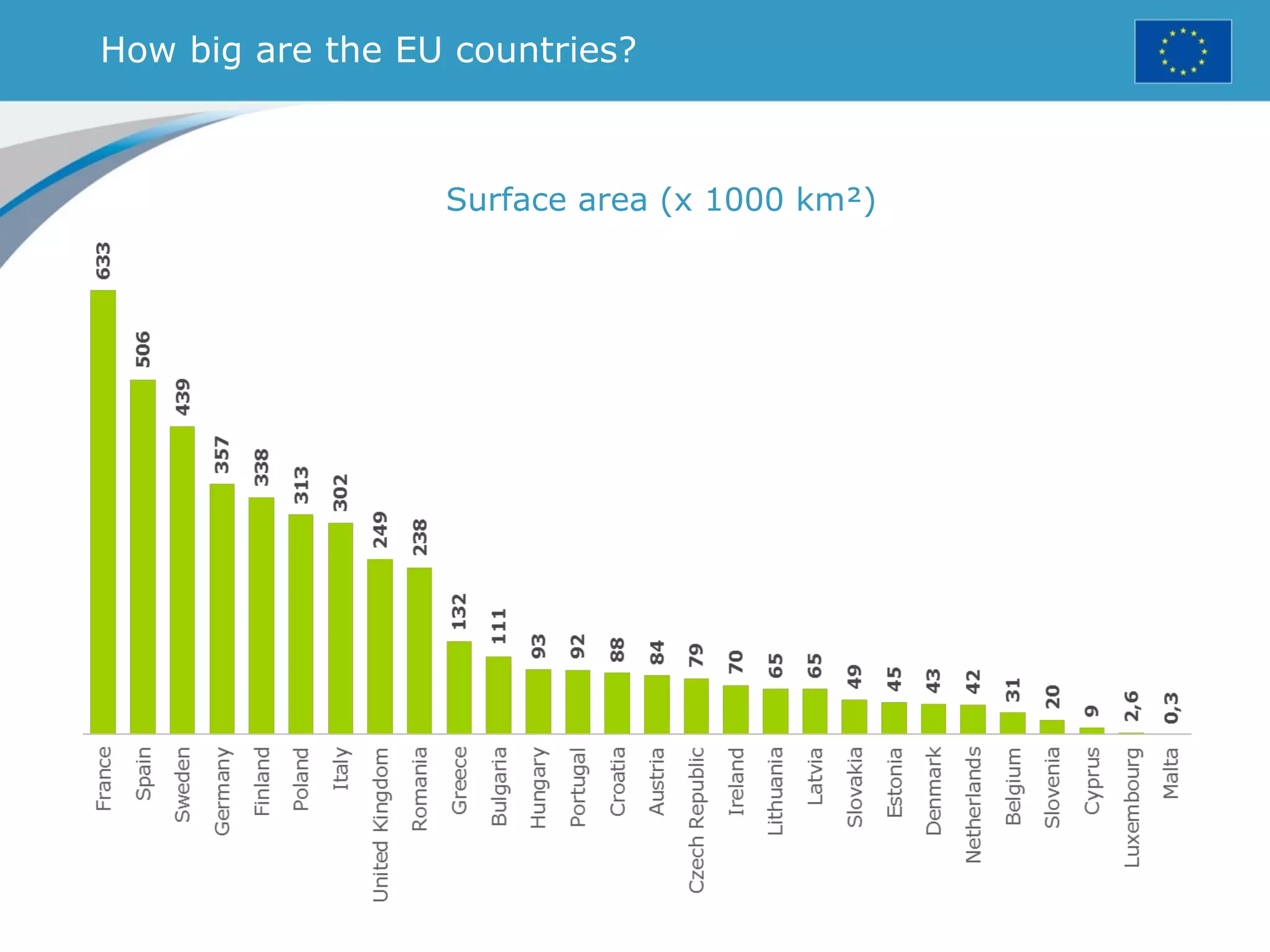
How big are the EU countries?
Surface area (x 1000 km²)
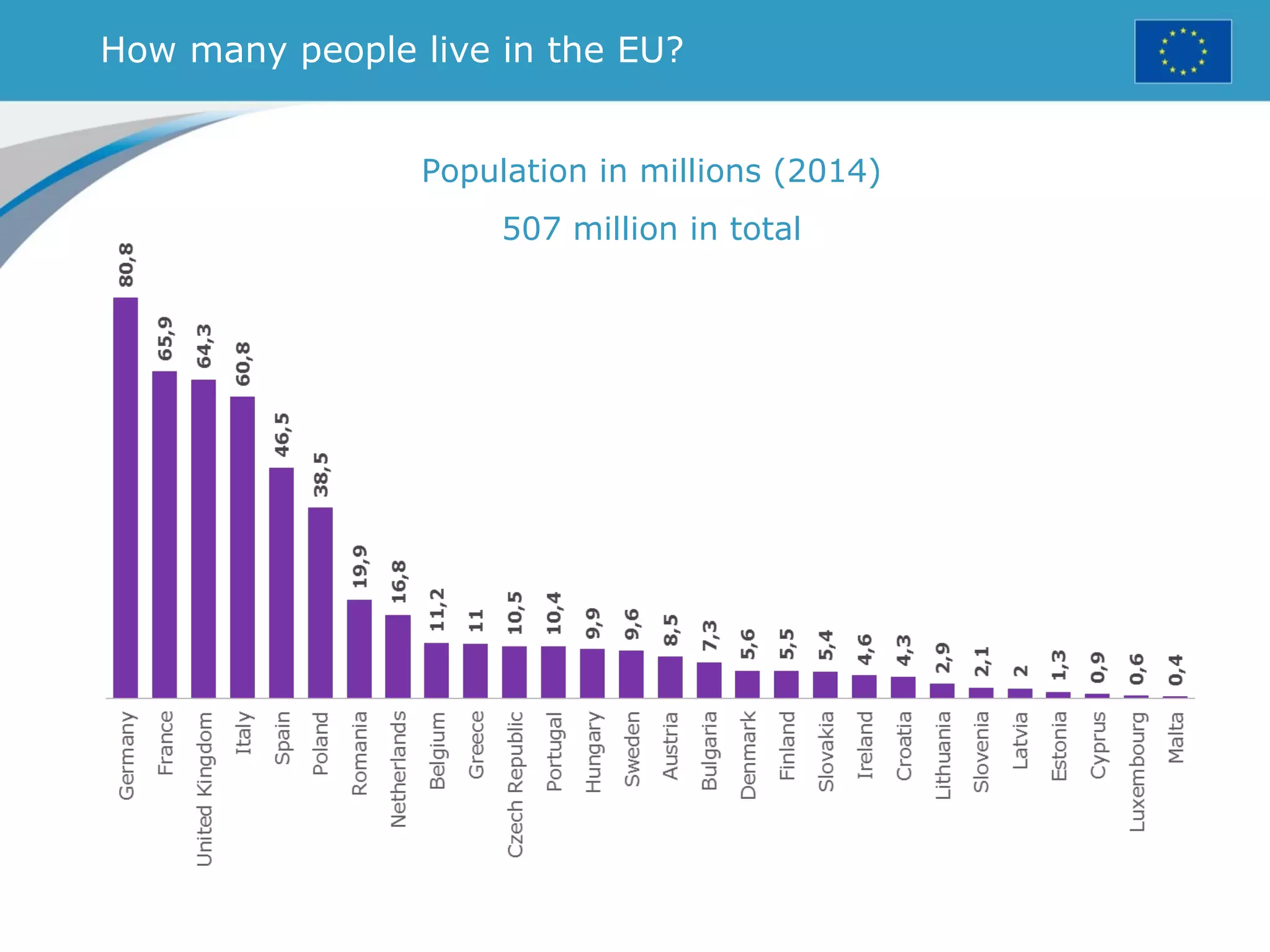
How many people live in the EU?
Population in millions (2014)
507 million in total
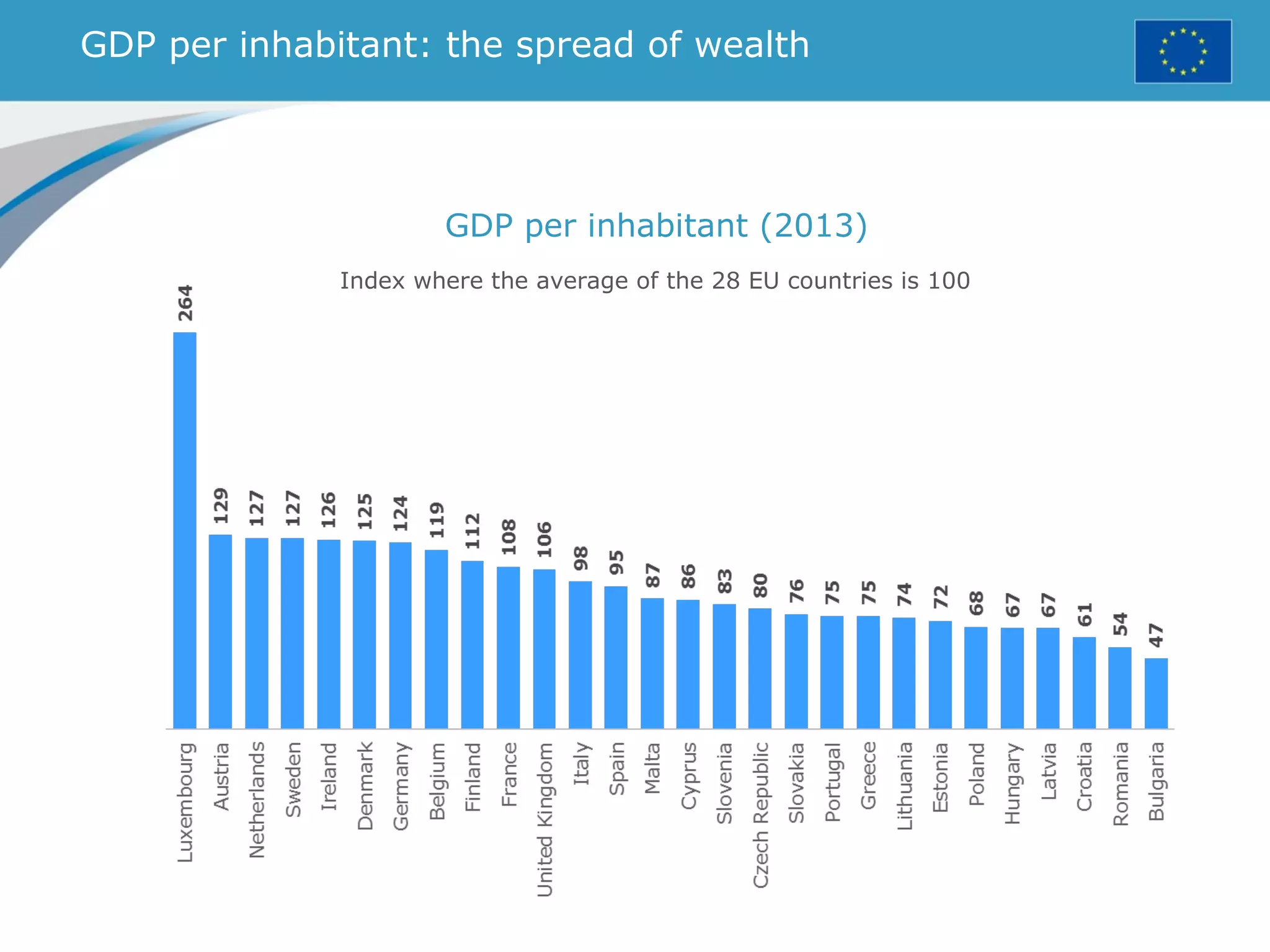
GDP per inhabitant: the spread of wealth
GDP per inhabitant (2013)
Index where the average of the 28 EU countries is 100
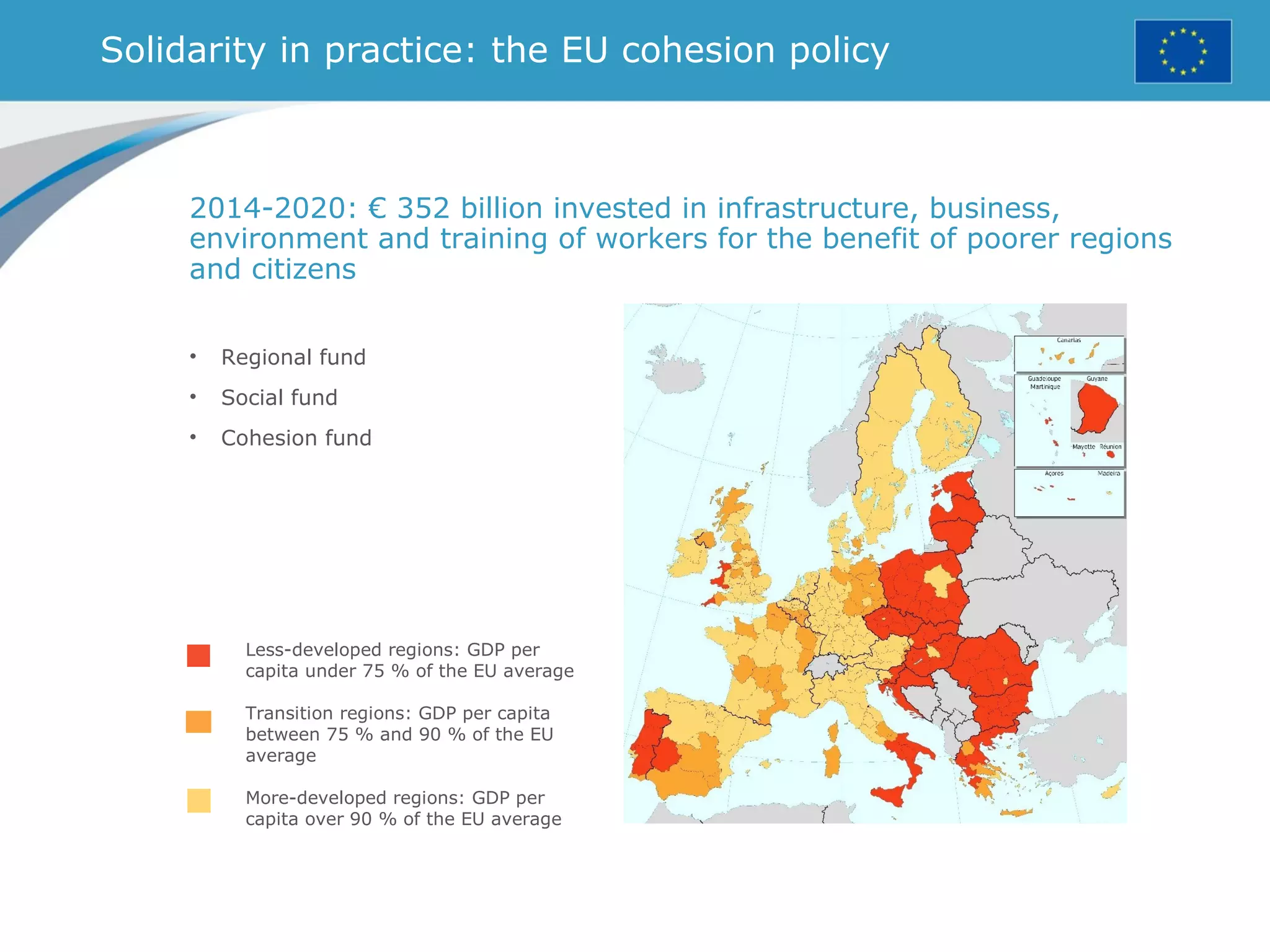
Solidarity in practice: the EU cohesion policy
• Regional fund
• Social fund
• Cohesion fund
Less-developed regions: GDP per
capita under 75 % of the EU average
Transition regions: GDP per capita
between 75 % and 90 % of the EU
average
More-developed regions: GDP per
capita over 90 % of the EU average
2014-2020: € 352 billion invested in infrastructure, business,
environment and training of workers for the benefit of poorer regions
and citizens
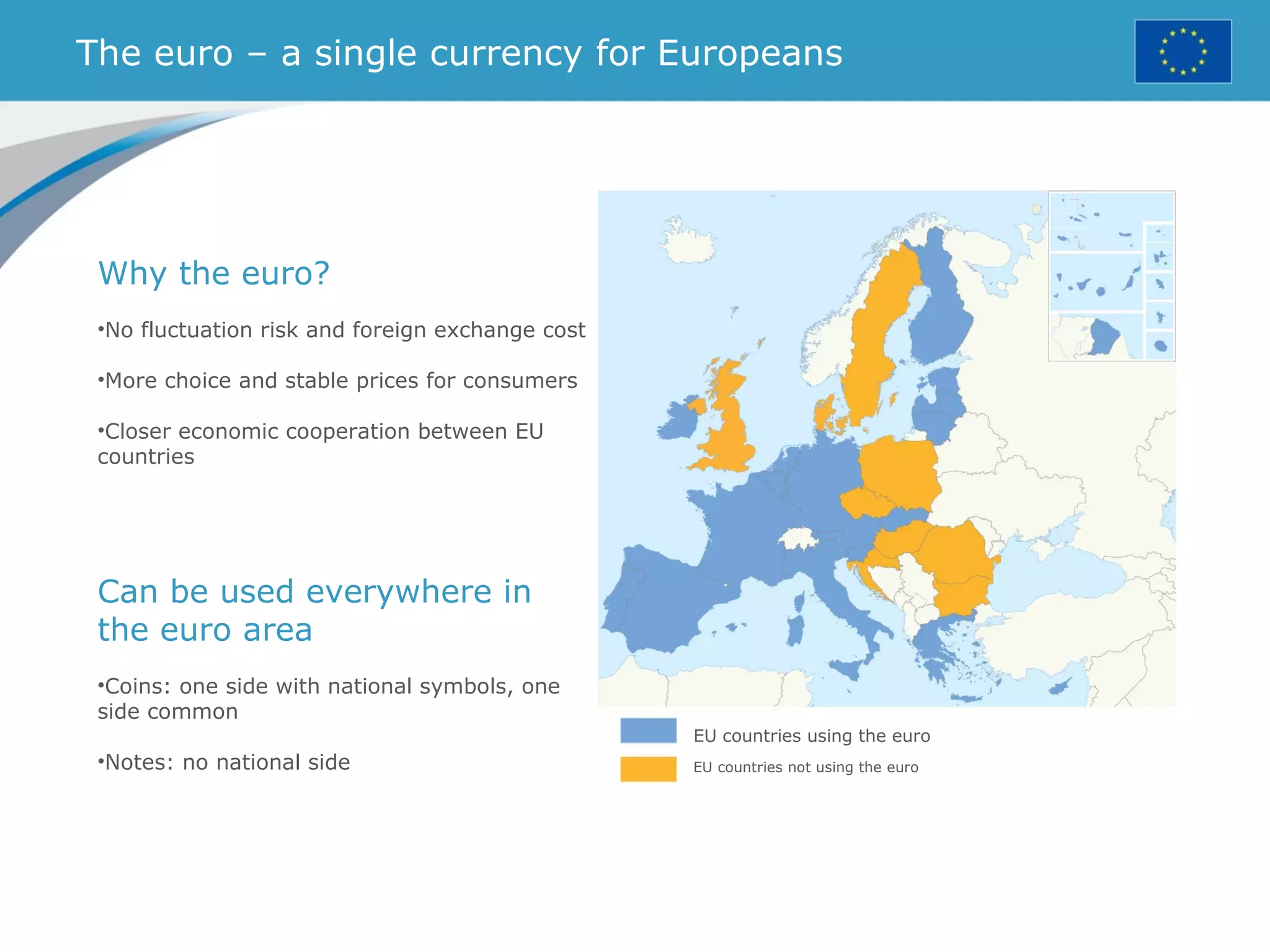
The euro – a single currency for Europeans
EU countries using the euro
EU countries not using the euro
Why the euro?
•No fluctuation risk and foreign exchange cost
•More choice and stable prices for consumers
•Closer economic cooperation between EU
countries
Can be used everywhere in
the euro area
•Coins: one side with national symbols, one
side common
•Notes: no national side
Beating inflation
European Economic and Monetary Union: stable prices
0
2
4
6
8
10
12
14
16
1970
1971
1972
1973
1974
1975
1976
1977
1978
1979
1980
1981
1982
1983
1984
1985
1986
1987
1988
1989
1990
1991
1992
1993
1994
1995
1996
1997
1998
1999
2000
2001
2002
2003
2004
2005
2006
2007
2008
2009
2010
2011
2012
2013
Average annual inflation in the 18 EU countries using the euro (2013)
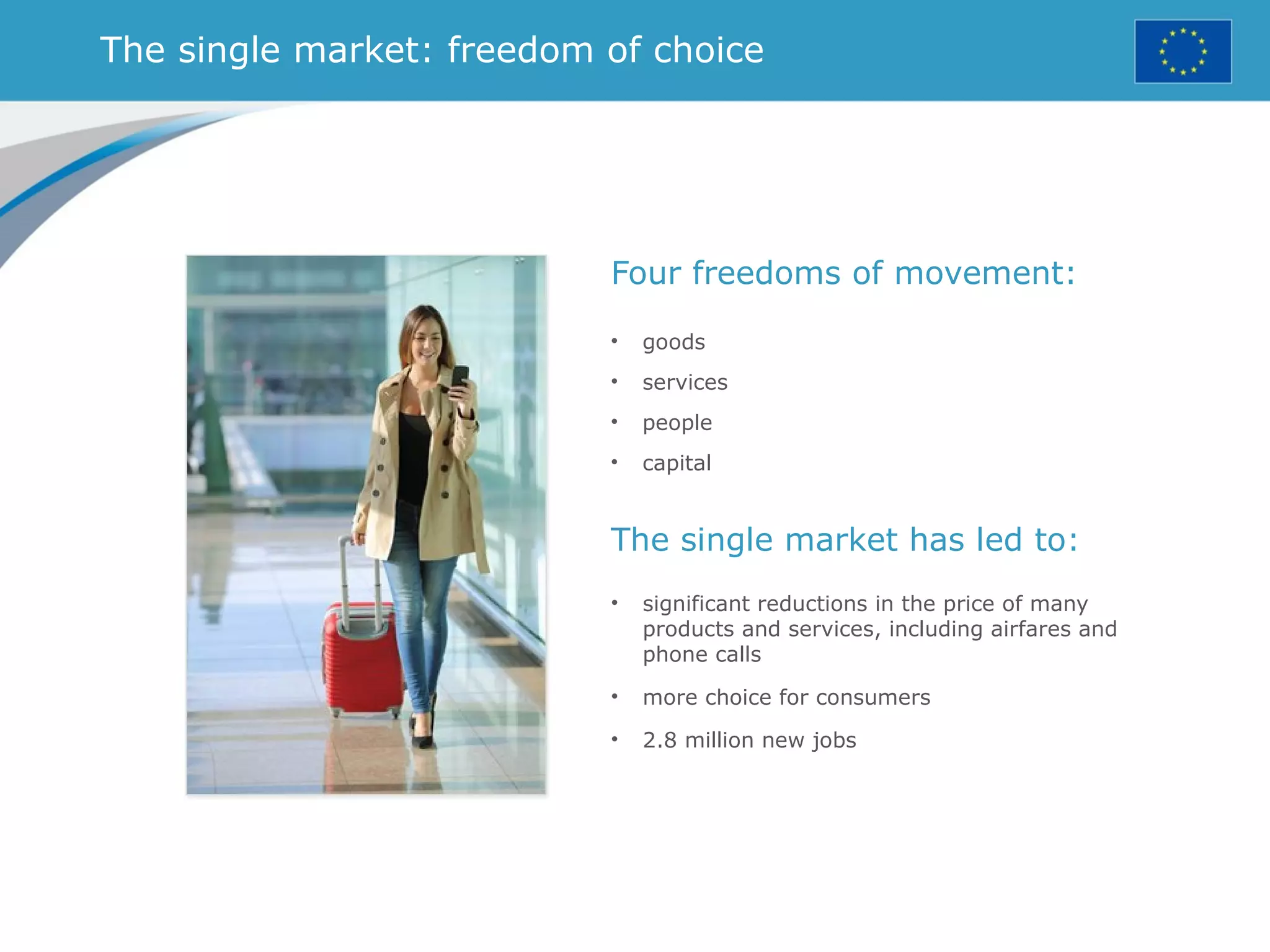
The single market: freedom of choice
The single market has led to:
• significant reductions in the price of many
products and services, including airfares and
phone calls
• more choice for consumers
• 2.8 million new jobs
Four freedoms of movement:
• goods
• services
• people
• capital
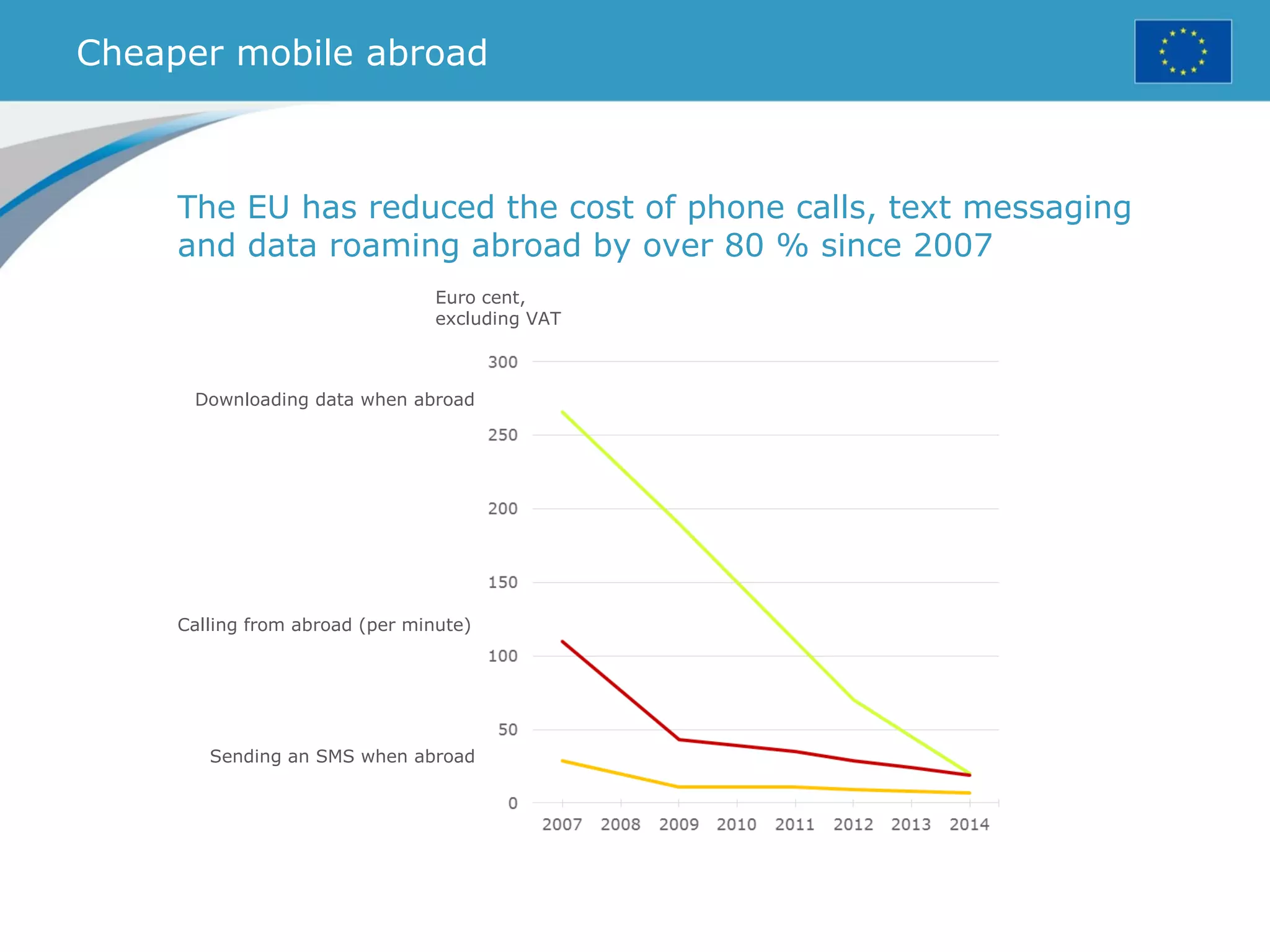
Cheaper mobile abroad
The EU has reduced the cost of phone calls, text messaging
and data roaming abroad by over 80 % since 2007
Sending an SMS when abroad
Calling from abroad (per minute)
Downloading data when abroad
Euro cent,
excluding VAT
Going abroad to learn
Erasmus+
Every year, more than 400 000
young people study or pursue
personal development in other
European countries with the
support of the EU’s Erasmus+
programme for education,
training, youth and sport.
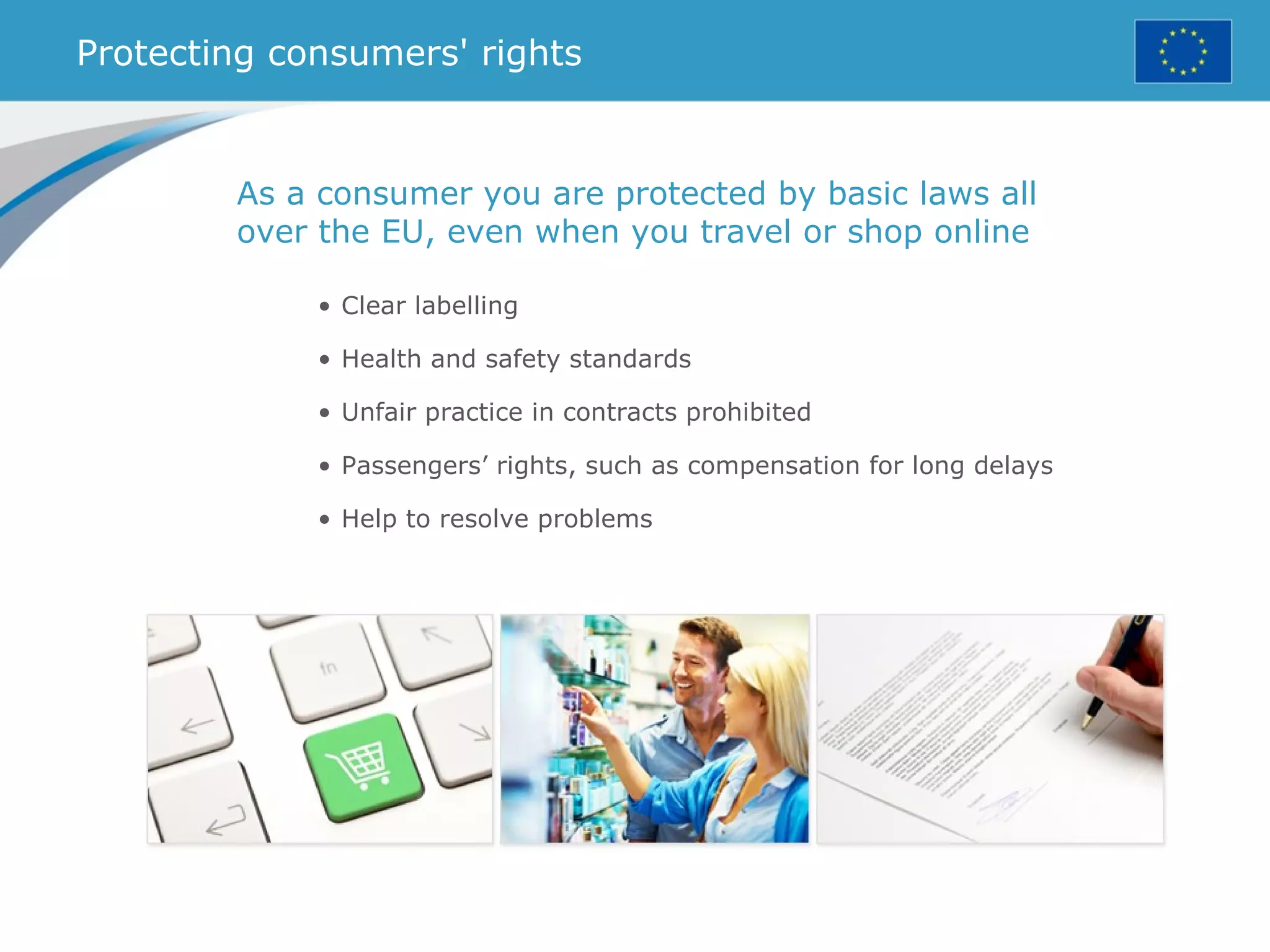
Protecting consumers' rights
• Clear labelling
• Health and safety standards
• Unfair practice in contracts prohibited
• Passengers’ rights, such as compensation for long delays
• Help to resolve problems
As a consumer you are protected by basic laws all
over the EU, even when you travel or shop online
Gender equality
The gender pay gap:
Women in the EU earn on average 16.4 % less per hour
than men.
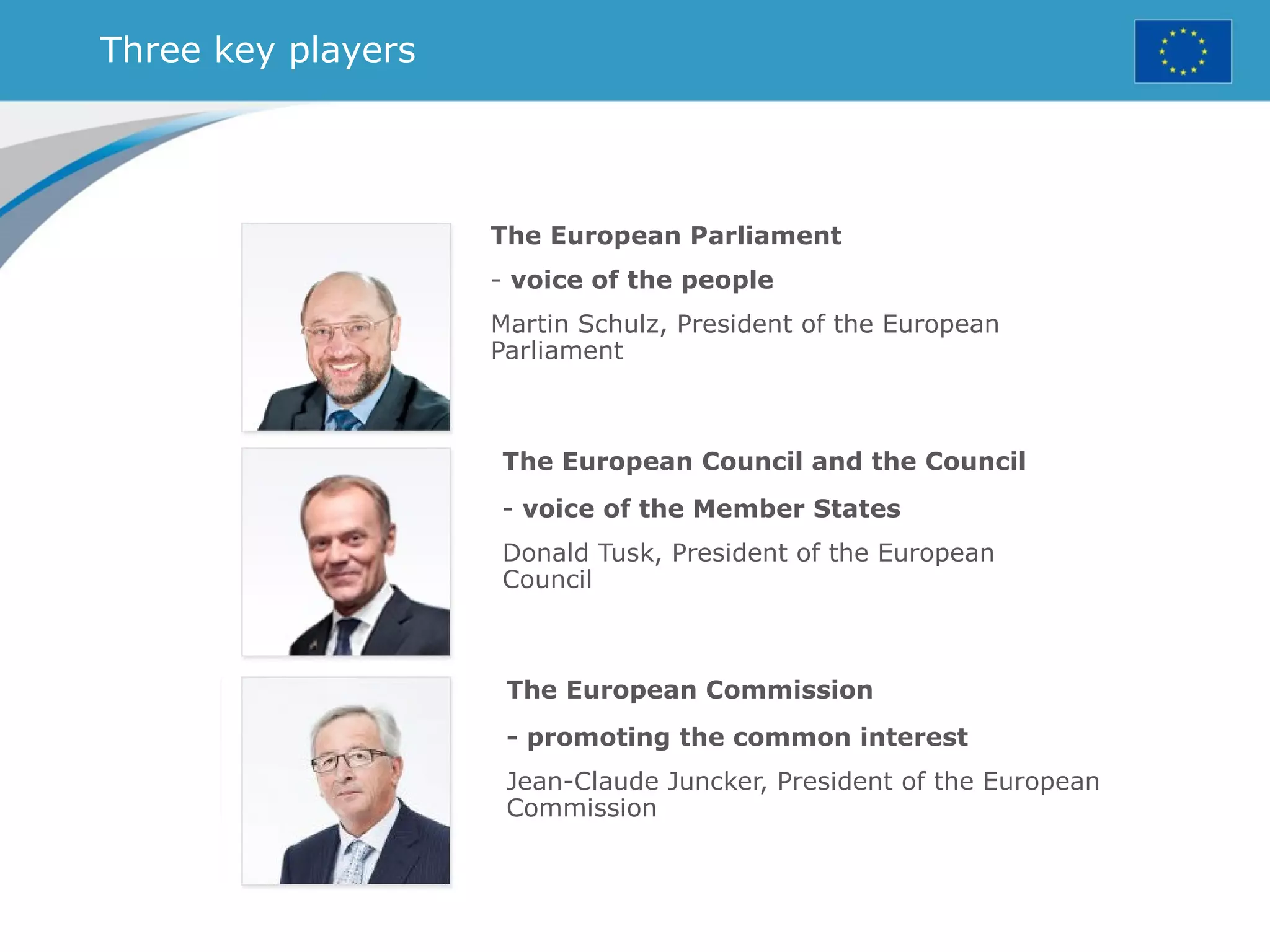
Three key players
The European Parliament
- voice of the people
Martin Schulz, President of the European
Parliament
The European Council and the Council
- voice of the Member States
Donald Tusk, President of the European
Council
The European Commission
- promoting the common interest
Jean-Claude Juncker, President of the European
Commission
The EU institutions
European Parliament
Court of
Justice
Court of
Auditors
Economic and Social
Committee Committee of the Regions
Council of Ministers
(The Council) European Commission
European Investment Bank European Central BankAgencies
European Council (summit)
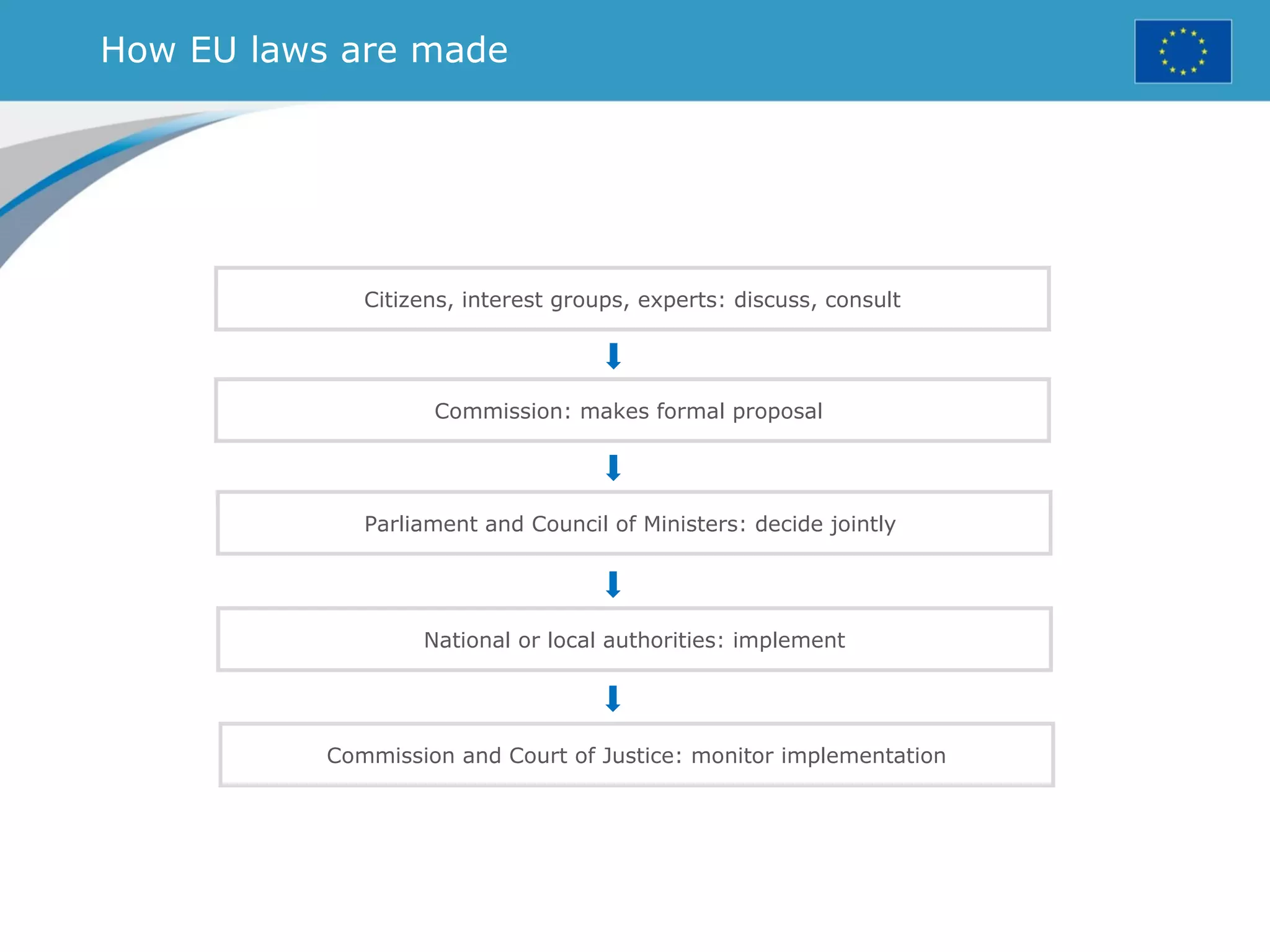
How EU laws are made
Citizens, interest groups, experts: discuss, consult
Commission: makes formal proposal
Parliament and Council of Ministers: decide jointly
National or local authorities: implement
Commission and Court of Justice: monitor implementation
The European Parliament – voice of the people
Number of members elected in each country
Decides EU laws and budget together with the Council of Ministers
Democratic supervision of all the EU’s work
Austria - 18
Belgium - 21
Bulgaria - 17
Croatia - 11
Cyprus - 6
Czech Republic - 21
Denmark - 13
Estonia - 6
Finland - 13
France - 74
Germany - 96
Greece - 21
Hungary - 21
Ireland - 11
Italy - 73
Latvia - 8
Lithuania - 11
Luxembourg - 6
Malta - 6
Total - 751
Netherlands - 26
Poland - 51
Portugal - 21
Romania - 32
Slovakia - 13
Slovenia - 8
Spain - 54
Sweden - 20
United Kingdom - 73
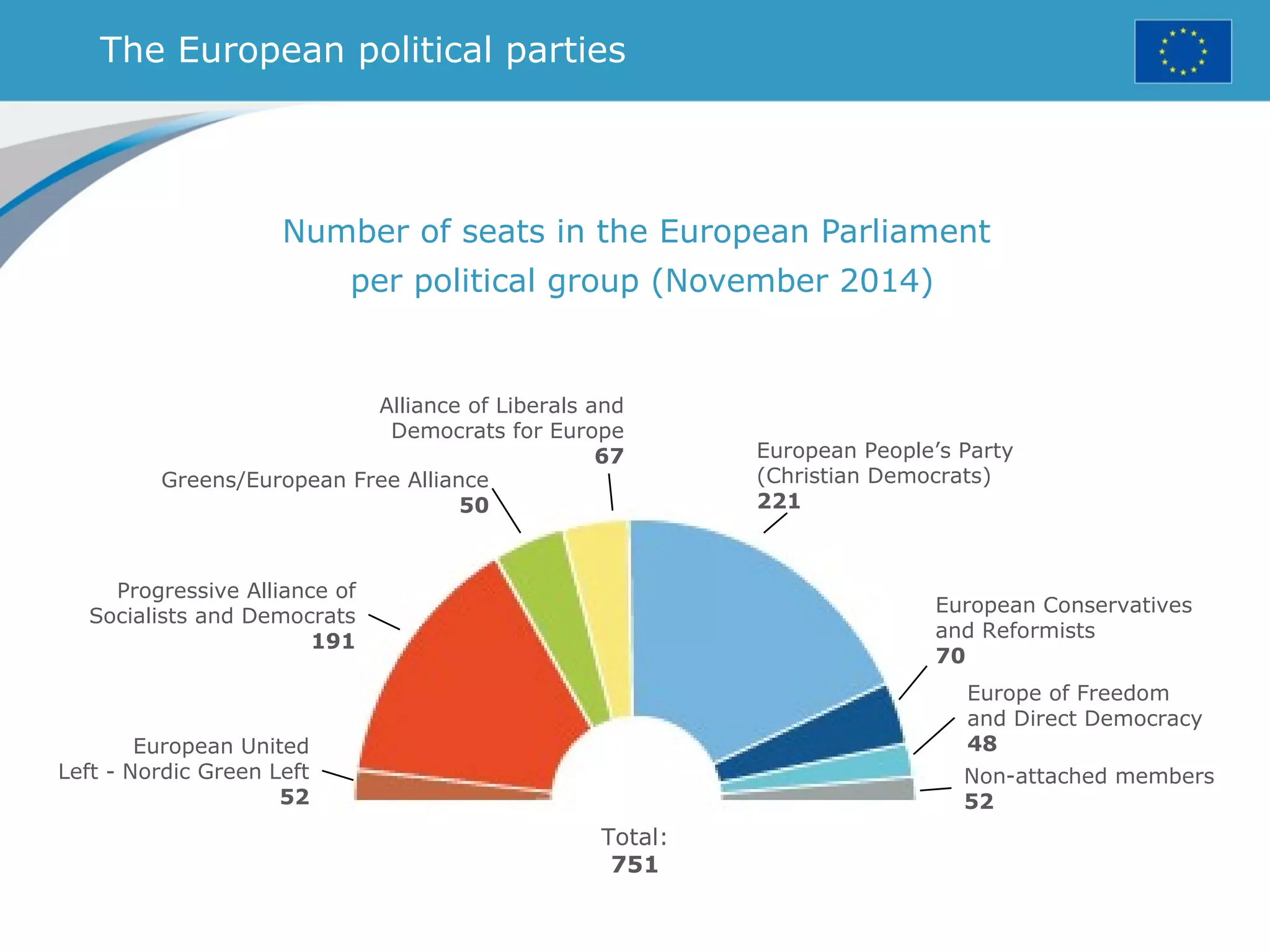
The European political parties
Number of seats in the European Parliament
per political group (November 2014)
Greens/European Free Alliance
50
European Conservatives
and Reformists
70
Alliance of Liberals and
Democrats for Europe
67 European People’s Party
(Christian Democrats)
221
Non-attached members
52
Progressive Alliance of
Socialists and Democrats
191
European United
Left - Nordic Green Left
52
Europe of Freedom
and Direct Democracy
48
Total:
751
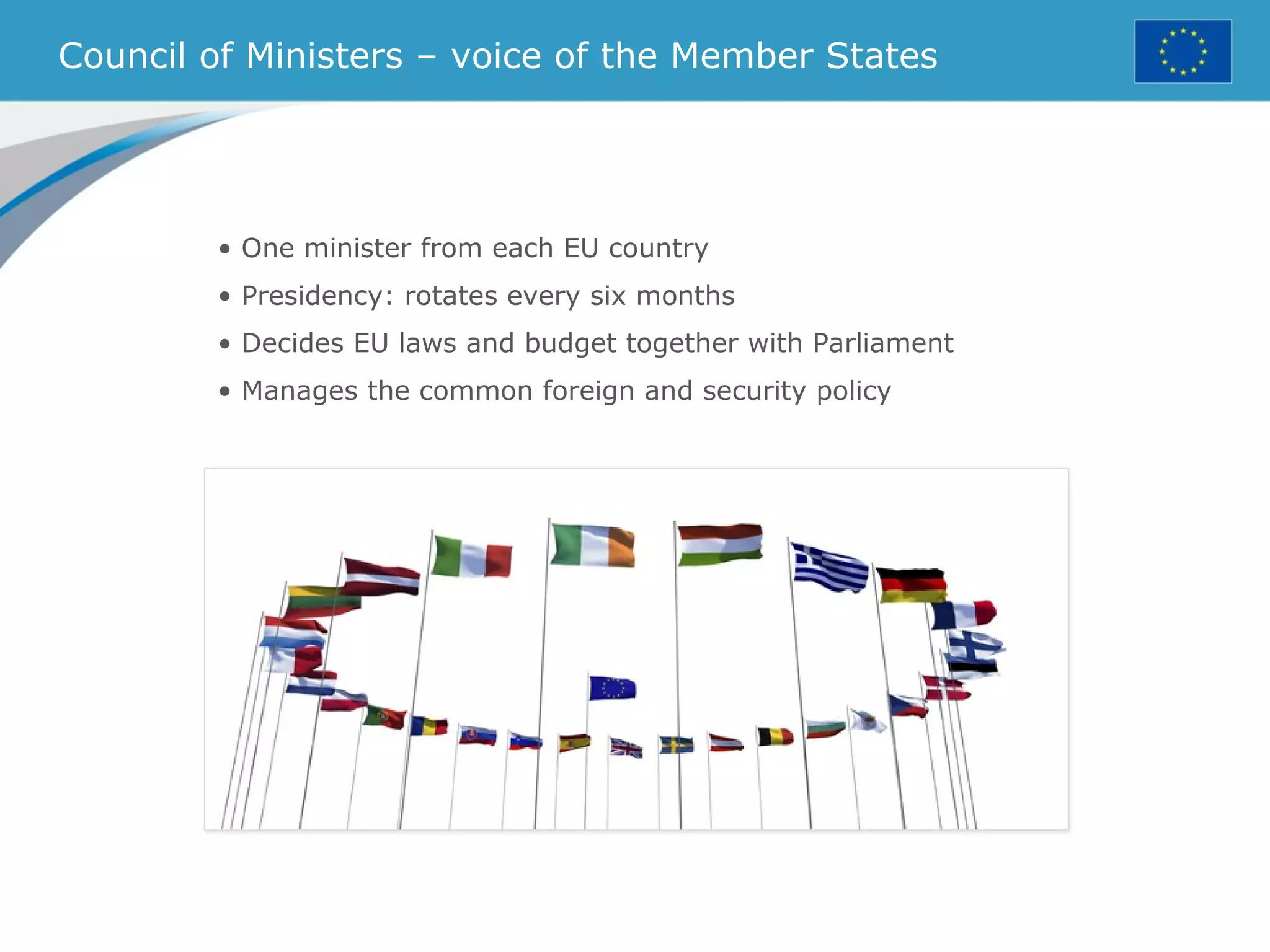
Council of Ministers – voice of the Member States
• One minister from each EU country
• Presidency: rotates every six months
• Decides EU laws and budget together with Parliament
• Manages the common foreign and security policy
Council of Ministers – how they vote
Most decisions in the Council are taken by ‘double majority’.
A decision must have the support of at least:
• 55 % of Member States (16 countries)
• Member States that represent 65 % of the EU’s population
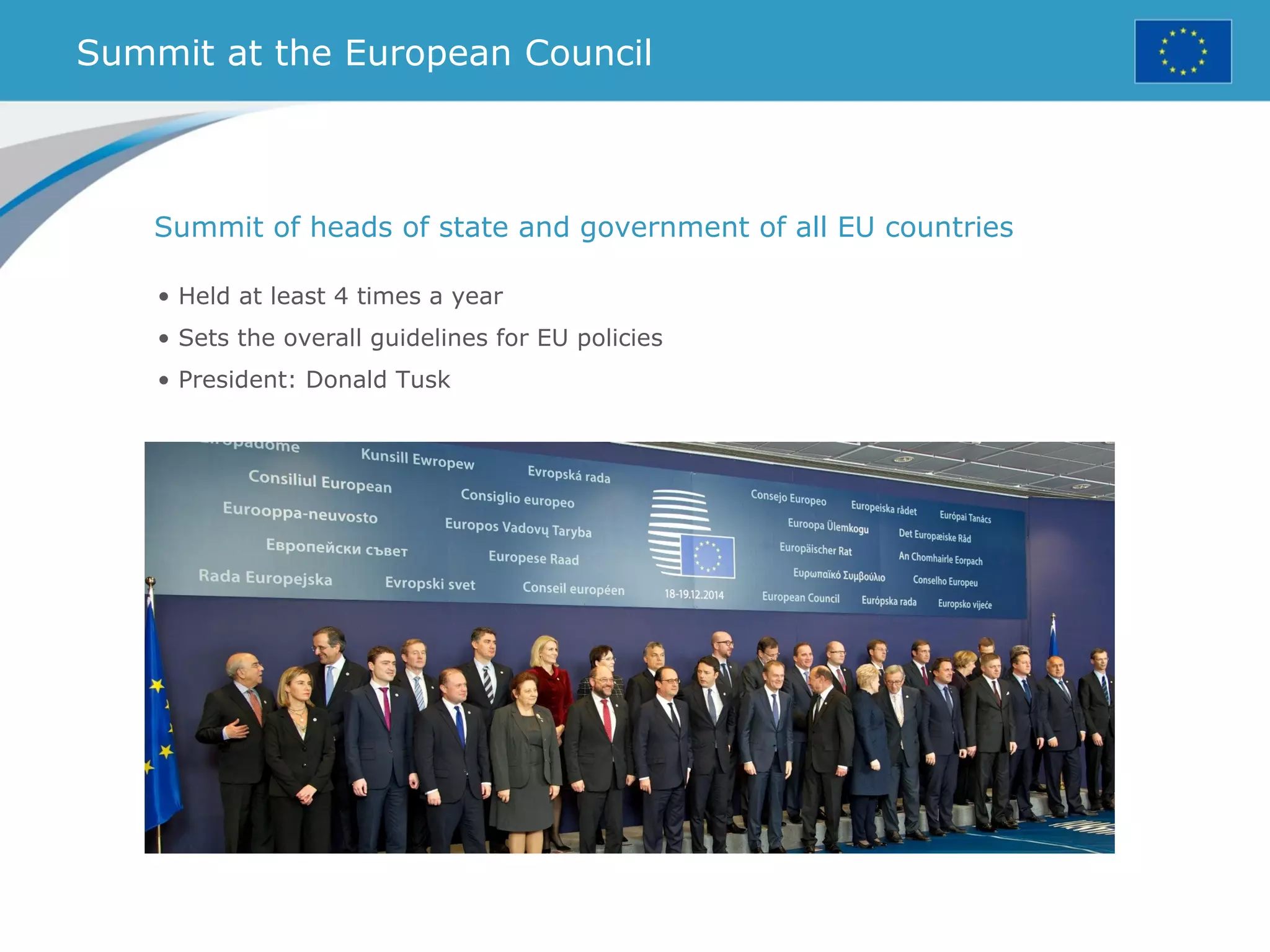
Summit at the European Council
• Held at least 4 times a year
• Sets the overall guidelines for EU policies
• President: Donald Tusk
Summit of heads of state and government of all EU countries
A high representative for foreign affairs and security
• Double role:
– chairs meetings of the Foreign Affairs
Council
– Vice-President of the European
Commission
• Manages the common foreign affairs and
security policy
• Head of the European External Action Service
Federica Mogherini
The European Commission – promoting the common interest
28 independent members, one from each EU country
•Proposes new legislation
•Executive organ
•Guardian of the treaties
•Represents the EU on the international stage
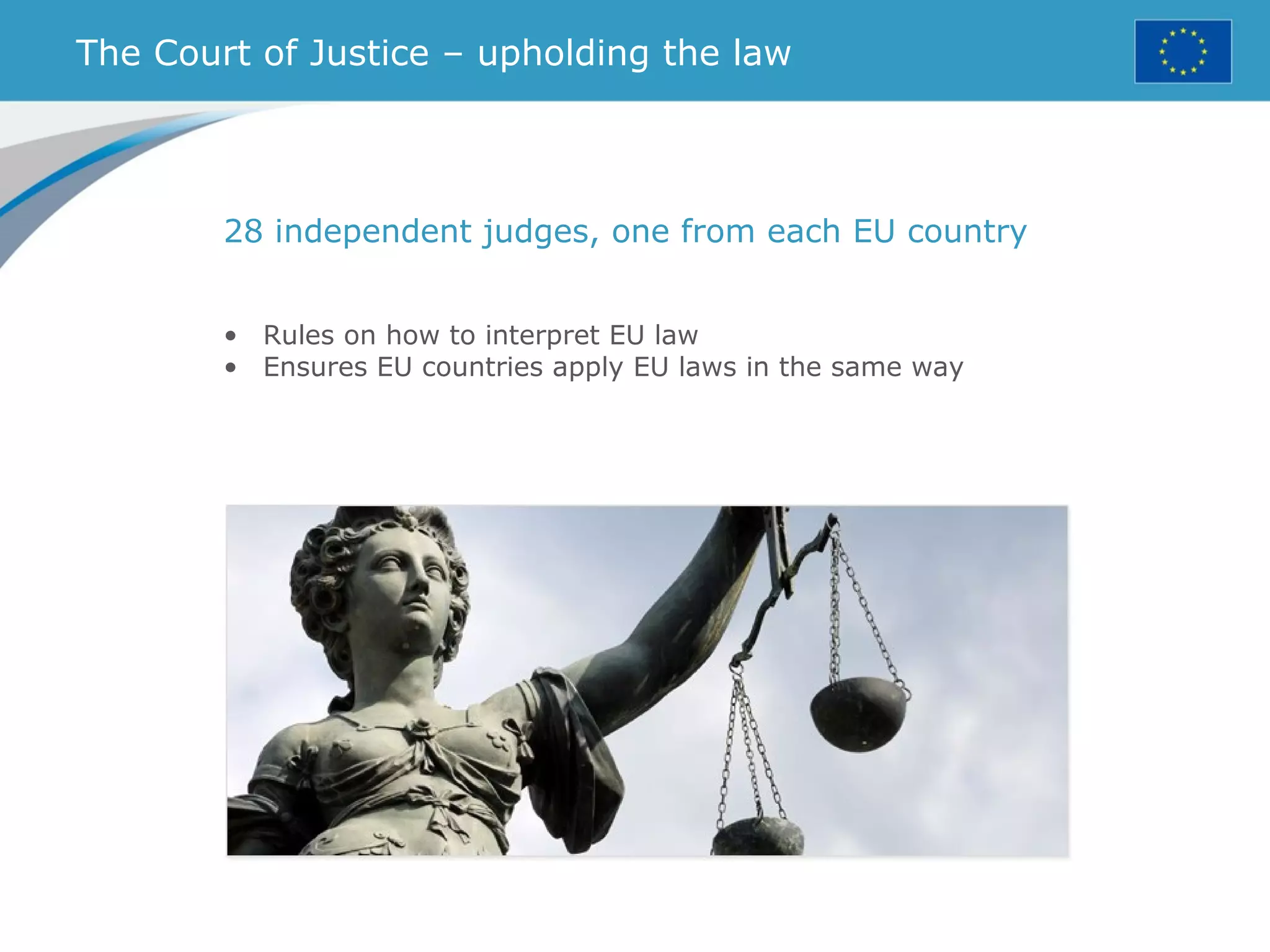
The Court of Justice – upholding the law
28 independent judges, one from each EU country
• Rules on how to interpret EU law
• Ensures EU countries apply EU laws in the same way
The European Ombudsman
Emily O’Reilly
The European Ombudsman
• Investigates complaints about poor or
failed administration by the EU
institutions
• For example: unfairness, discrimination,
abuse of power, unnecessary delay,
failure to reply or incorrect procedures
• Anyone in the EU can make a complaint
The European Court of Auditors: getting value
for your money
28 independent members
•Checks that EU funds are used properly
•Can audit any person or organisation dealing with EU funds
• Ensures price stability
• Controls money supply and decides
interest rates
• Supervises that banks are safe
• Works independently from governments
The European Central Bank: managing the euro
Mario Draghi
President of the Central Bank
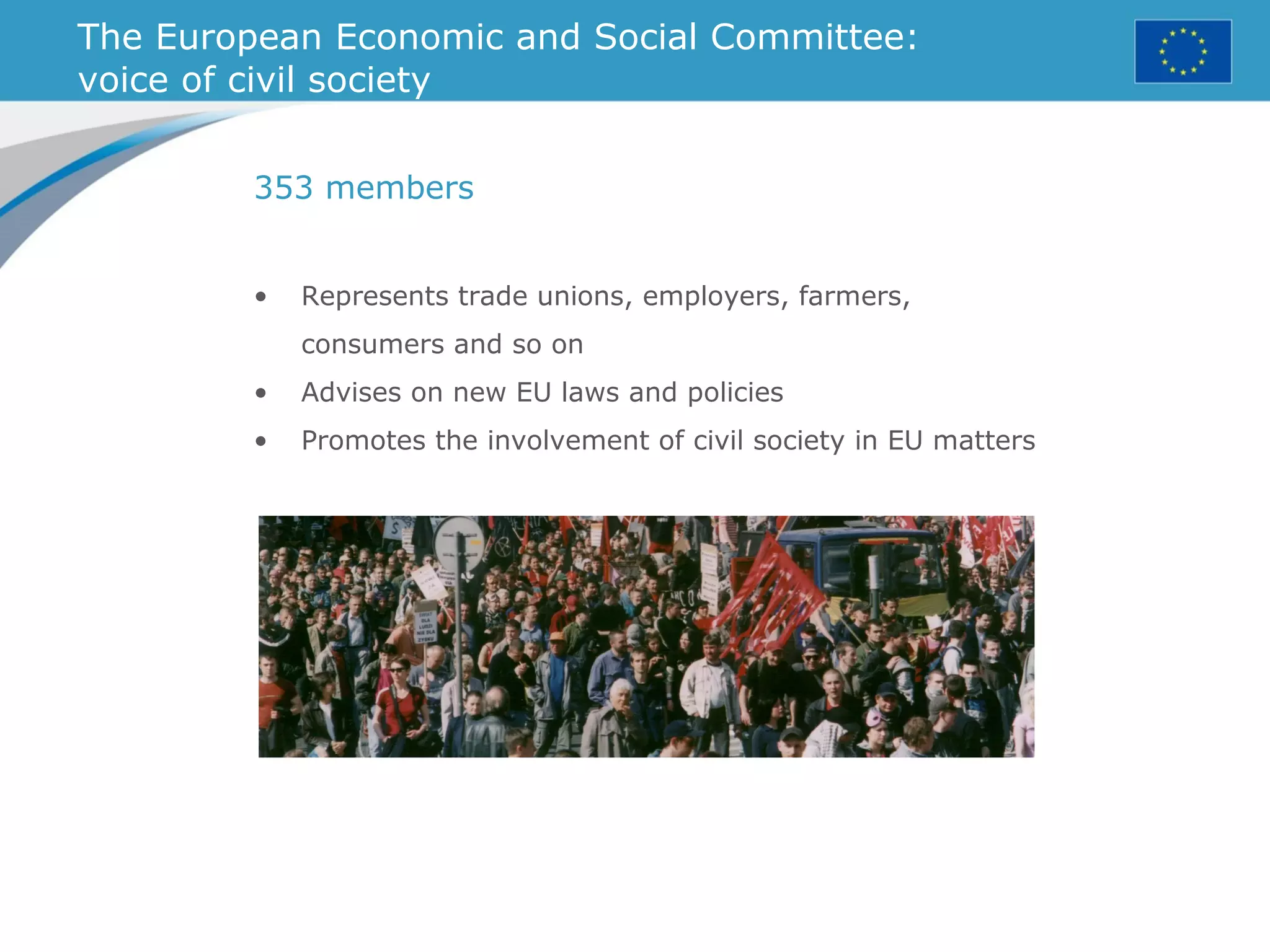
The European Economic and Social Committee:
voice of civil society
• Represents trade unions, employers, farmers,
consumers and so on
• Advises on new EU laws and policies
• Promotes the involvement of civil society in EU matters
353 members
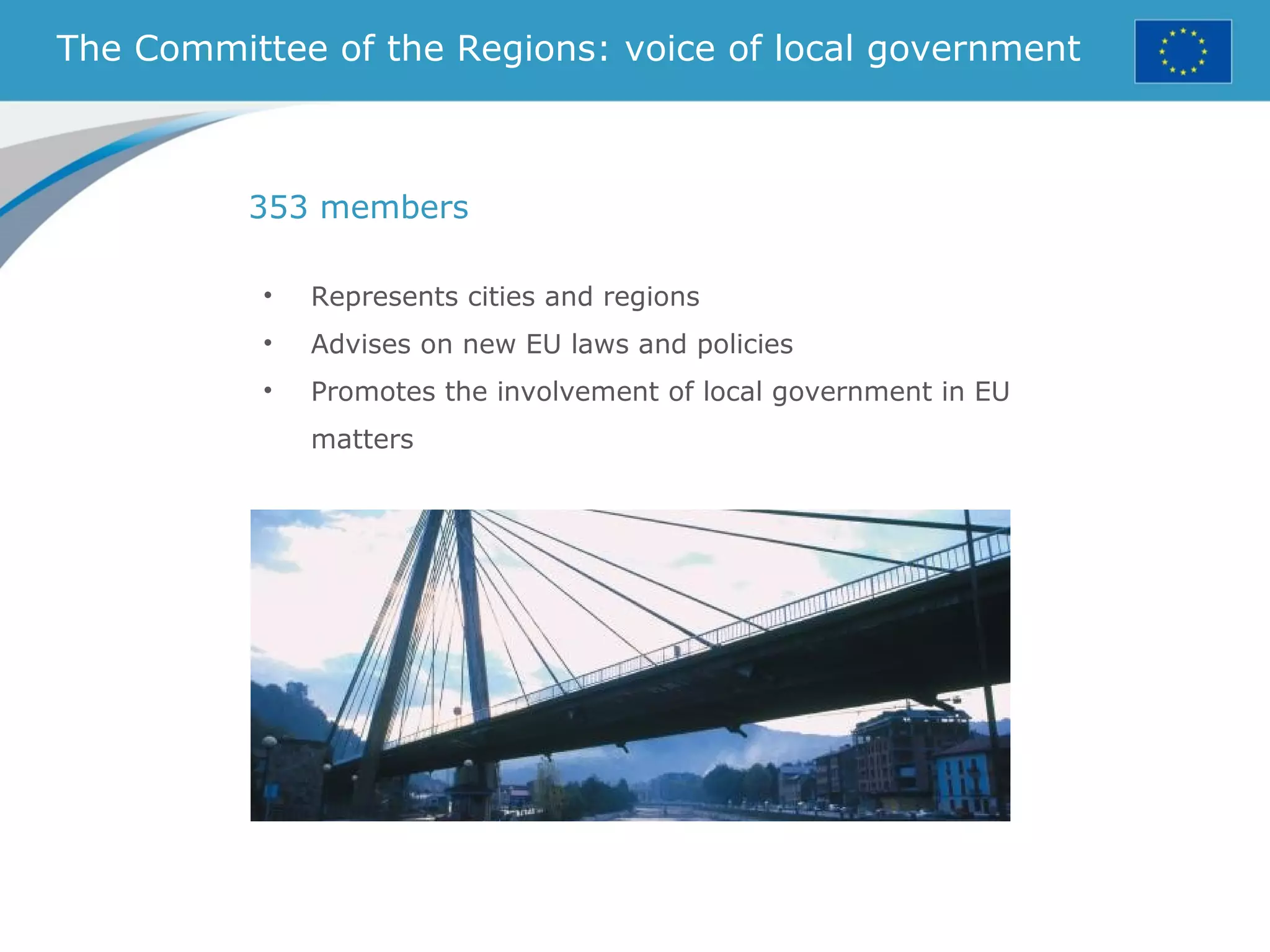
The Committee of the Regions: voice of local government
• Represents cities and regions
• Advises on new EU laws and policies
• Promotes the involvement of local government in EU
matters
353 members
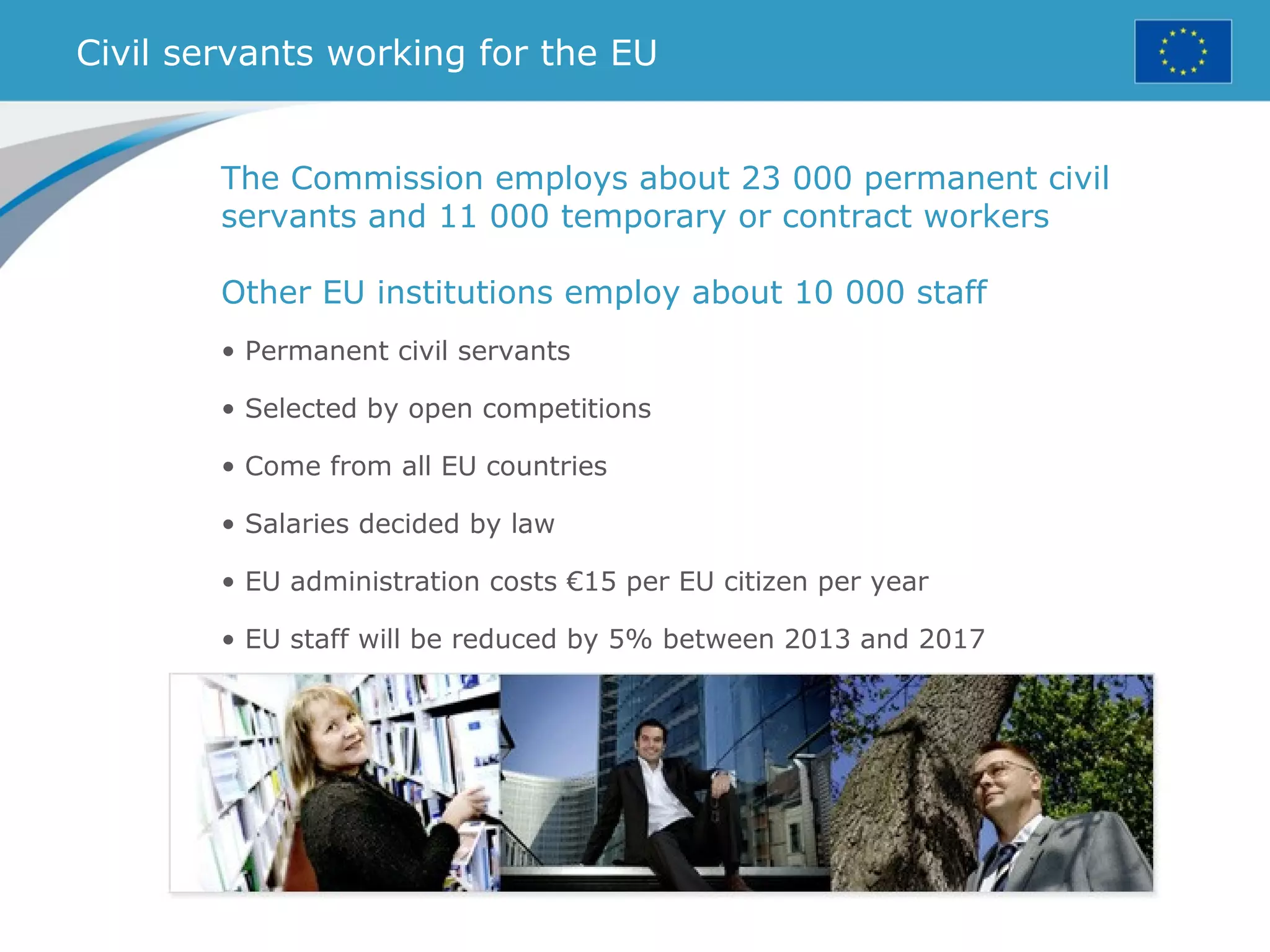
Civil servants working for the EU
The Commission employs about 23 000 permanent civil
servants and 11 000 temporary or contract workers
Other EU institutions employ about 10 000 staff
• Permanent civil servants
• Selected by open competitions
• Come from all EU countries
• Salaries decided by law
• EU administration costs €15 per EU citizen per year
• EU staff will be reduced by 5% between 2013 and 2017
Getting in touch with the EU
Questions about the EU? Europe Direct can help
• By phone, email or webchat
• Over 500 regional information
centres
europa.eu/europedirect

Eu in slides

  • 1.
    The European Union:500 million people – 28 countries Member States of the European Union Candidate countries and potential candidates
  • 2.
    Konrad Adenauer Robert Schuman WinstonChurchill Alcide De Gasperi Jean Monnet New ideas for lasting peace and prosperity… Founders
  • 3.
    The EU symbols TheEuropean flag The European anthem The euro Europe Day, 9 May The motto: United in diversity
  • 4.
    24 official languages Български Čeština dansk Deutsch eestikeel Ελληνικά English español français Gaeilge hrvatski Italiano latviešu valoda lietuvių kalba magyar Malti Nederlands polski português Română slovenčina slovenščina suomi svenska
  • 5.
    Enlargement: from sixto 28 countries
  • 6.
    The treaties –basis for democratic cooperation built on law The European Coal and Steel Community The treaties of Rome: • The European Economic Community • The European Atomic Energy Community (EURATOM) The European Single Act: the Single Market Treaty on European Union - Maastricht Treaty of Amsterdam 1952 1958 1987 1993 1999 2003 Treaty of Nice 2009 Treaty of Lisbon
  • 7.
    The EU Charterof Fundamental Rights Binding for all the EU's activities 54 articles under 6 titles: Freedoms Equality Solidarity Citizens’ rights Justice Dignity
  • 8.
    EU population comparedto the rest of the world Population in millions (2014)
  • 9.
    EU surface areacompared to the rest of the world Surface area (x 1000 km²)
  • 10.
    How rich isthe EU compared to the rest of the world? Size of economy: GDP in trillions of euro (2012) Wealth per person: GDP per person (2012)
  • 11.
    How big arethe EU countries? Surface area (x 1000 km²)
  • 12.
    How many peoplelive in the EU? Population in millions (2014) 507 million in total
  • 13.
    GDP per inhabitant:the spread of wealth GDP per inhabitant (2013) Index where the average of the 28 EU countries is 100
  • 14.
    Solidarity in practice:the EU cohesion policy • Regional fund • Social fund • Cohesion fund Less-developed regions: GDP per capita under 75 % of the EU average Transition regions: GDP per capita between 75 % and 90 % of the EU average More-developed regions: GDP per capita over 90 % of the EU average 2014-2020: € 352 billion invested in infrastructure, business, environment and training of workers for the benefit of poorer regions and citizens
  • 15.
    The euro –a single currency for Europeans EU countries using the euro EU countries not using the euro Why the euro? •No fluctuation risk and foreign exchange cost •More choice and stable prices for consumers •Closer economic cooperation between EU countries Can be used everywhere in the euro area •Coins: one side with national symbols, one side common •Notes: no national side
  • 16.
    Beating inflation European Economicand Monetary Union: stable prices 0 2 4 6 8 10 12 14 16 1970 1971 1972 1973 1974 1975 1976 1977 1978 1979 1980 1981 1982 1983 1984 1985 1986 1987 1988 1989 1990 1991 1992 1993 1994 1995 1996 1997 1998 1999 2000 2001 2002 2003 2004 2005 2006 2007 2008 2009 2010 2011 2012 2013 Average annual inflation in the 18 EU countries using the euro (2013)
  • 17.
    The single market:freedom of choice The single market has led to: • significant reductions in the price of many products and services, including airfares and phone calls • more choice for consumers • 2.8 million new jobs Four freedoms of movement: • goods • services • people • capital
  • 18.
    Cheaper mobile abroad TheEU has reduced the cost of phone calls, text messaging and data roaming abroad by over 80 % since 2007 Sending an SMS when abroad Calling from abroad (per minute) Downloading data when abroad Euro cent, excluding VAT
  • 19.
    Going abroad tolearn Erasmus+ Every year, more than 400 000 young people study or pursue personal development in other European countries with the support of the EU’s Erasmus+ programme for education, training, youth and sport.
  • 20.
    Protecting consumers' rights •Clear labelling • Health and safety standards • Unfair practice in contracts prohibited • Passengers’ rights, such as compensation for long delays • Help to resolve problems As a consumer you are protected by basic laws all over the EU, even when you travel or shop online
  • 21.
    Gender equality The genderpay gap: Women in the EU earn on average 16.4 % less per hour than men.
  • 22.
    Three key players TheEuropean Parliament - voice of the people Martin Schulz, President of the European Parliament The European Council and the Council - voice of the Member States Donald Tusk, President of the European Council The European Commission - promoting the common interest Jean-Claude Juncker, President of the European Commission
  • 23.
    The EU institutions EuropeanParliament Court of Justice Court of Auditors Economic and Social Committee Committee of the Regions Council of Ministers (The Council) European Commission European Investment Bank European Central BankAgencies European Council (summit)
  • 24.
    How EU lawsare made Citizens, interest groups, experts: discuss, consult Commission: makes formal proposal Parliament and Council of Ministers: decide jointly National or local authorities: implement Commission and Court of Justice: monitor implementation
  • 25.
    The European Parliament– voice of the people Number of members elected in each country Decides EU laws and budget together with the Council of Ministers Democratic supervision of all the EU’s work Austria - 18 Belgium - 21 Bulgaria - 17 Croatia - 11 Cyprus - 6 Czech Republic - 21 Denmark - 13 Estonia - 6 Finland - 13 France - 74 Germany - 96 Greece - 21 Hungary - 21 Ireland - 11 Italy - 73 Latvia - 8 Lithuania - 11 Luxembourg - 6 Malta - 6 Total - 751 Netherlands - 26 Poland - 51 Portugal - 21 Romania - 32 Slovakia - 13 Slovenia - 8 Spain - 54 Sweden - 20 United Kingdom - 73
  • 26.
    The European politicalparties Number of seats in the European Parliament per political group (November 2014) Greens/European Free Alliance 50 European Conservatives and Reformists 70 Alliance of Liberals and Democrats for Europe 67 European People’s Party (Christian Democrats) 221 Non-attached members 52 Progressive Alliance of Socialists and Democrats 191 European United Left - Nordic Green Left 52 Europe of Freedom and Direct Democracy 48 Total: 751
  • 27.
    Council of Ministers– voice of the Member States • One minister from each EU country • Presidency: rotates every six months • Decides EU laws and budget together with Parliament • Manages the common foreign and security policy
  • 28.
    Council of Ministers– how they vote Most decisions in the Council are taken by ‘double majority’. A decision must have the support of at least: • 55 % of Member States (16 countries) • Member States that represent 65 % of the EU’s population
  • 29.
    Summit at theEuropean Council • Held at least 4 times a year • Sets the overall guidelines for EU policies • President: Donald Tusk Summit of heads of state and government of all EU countries
  • 30.
    A high representativefor foreign affairs and security • Double role: – chairs meetings of the Foreign Affairs Council – Vice-President of the European Commission • Manages the common foreign affairs and security policy • Head of the European External Action Service Federica Mogherini
  • 31.
    The European Commission– promoting the common interest 28 independent members, one from each EU country •Proposes new legislation •Executive organ •Guardian of the treaties •Represents the EU on the international stage
  • 32.
    The Court ofJustice – upholding the law 28 independent judges, one from each EU country • Rules on how to interpret EU law • Ensures EU countries apply EU laws in the same way
  • 33.
    The European Ombudsman EmilyO’Reilly The European Ombudsman • Investigates complaints about poor or failed administration by the EU institutions • For example: unfairness, discrimination, abuse of power, unnecessary delay, failure to reply or incorrect procedures • Anyone in the EU can make a complaint
  • 34.
    The European Courtof Auditors: getting value for your money 28 independent members •Checks that EU funds are used properly •Can audit any person or organisation dealing with EU funds
  • 35.
    • Ensures pricestability • Controls money supply and decides interest rates • Supervises that banks are safe • Works independently from governments The European Central Bank: managing the euro Mario Draghi President of the Central Bank
  • 36.
    The European Economicand Social Committee: voice of civil society • Represents trade unions, employers, farmers, consumers and so on • Advises on new EU laws and policies • Promotes the involvement of civil society in EU matters 353 members
  • 37.
    The Committee ofthe Regions: voice of local government • Represents cities and regions • Advises on new EU laws and policies • Promotes the involvement of local government in EU matters 353 members
  • 38.
    Civil servants workingfor the EU The Commission employs about 23 000 permanent civil servants and 11 000 temporary or contract workers Other EU institutions employ about 10 000 staff • Permanent civil servants • Selected by open competitions • Come from all EU countries • Salaries decided by law • EU administration costs €15 per EU citizen per year • EU staff will be reduced by 5% between 2013 and 2017
  • 39.
    Getting in touchwith the EU Questions about the EU? Europe Direct can help • By phone, email or webchat • Over 500 regional information centres europa.eu/europedirect