Politics in Germany
Erasmus +
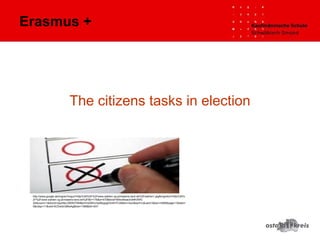
The citizens tasks in election
Erasmus +
http://www.google.de/imgres?imgurl=http%3A%2F%2Fwww.wahlen.vg-pirmasens-land.de%2Fwahlen1.jpg&imgrefurl=http%3A%
2F%2Fwww.wahlen.vg-pirmasens-land.de%2F&h=176&w=470&tbnid=8AkvMwac0vMKVM%
3A&zoom=1&docid=ybjcMsLGBWbTKM&ei=hS2MVcHpIMygsgH3r4HYCA&tbm=isch&iact=rc&uact=3&dur=4065&page=1&start=
0&ndsp=11&ved=0CDwQrQMwAg&biw=1366&bih=631
General information
• With voting people elect their group of interest
• Voting is really important
• The five basics of voting in Germany:
– Free
– Equal
– General
– Secret
– Immediate
• This is standard of every voting!
Erasmus +
Who is allowed to elect?
• Persons with German citizenship
• Persons over 18
• Main residence: Since three month in Germany
Not allowed to elect:
• Persons with a guardian
• Dangerous criminals
Erasmus +
Kinds of voting (political voting)
The three importanst ones in Germany:
• Federal election
• State election
• Local elections
Furthermore there are:
• Municipal election, European election
• Non political elections like church election
• Referendums
Erasmus +
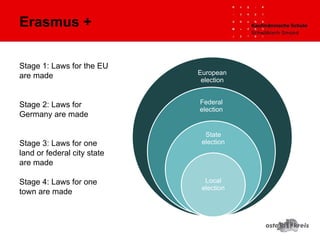
European
election
Federal
election
State
election
Local
election
Stage 1: Laws for the EU
are made
Stage 2: Laws for
Germany are made
Stage 3: Laws for one
land or federal city state
are made
Stage 4: Laws for one
town are made
Erasmus +
How the voting works
• Federal election:
– Every voter two votes
• Party
• Person
– Voting takes place in poll sites in whole
Germany- election assistants help
– Normally every four years
Erasmus +
• State election:
– Two votes
– Period of five years
• Local election:
– More than two votes, but it’s every year
different
Erasmus +
• General:
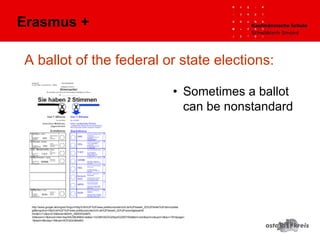
– Sometimes a ballot can be nonstandard
– For each constituency one responsible
elections administrator
– Responsible for keeping the five basics of
voting
Erasmus +
A ballot of the federal or state elections:
• Sometimes a ballot
can be nonstandard
http://www.google.de/imgres?imgurl=http%3A%2F%2Fwww.politikundunterricht.de%2Fbtwahl_02%2Fbilder%2Fstimmzettel.
gif&imgrefurl=http%3A%2F%2Fwww.politikundunterricht.de%2Fbtwahl_02%2Fsowirdgewaehlt.
htm&h=712&w=472&tbnid=M2HH_iSMDDDdIM%
3A&zoom=1&docid=r4ds1AqmhKZMUM&hl=de&ei=1mOMVdDOOsWjsAGZ9IDYBA&tbm=isch&iact=rc&uact=3&dur=781&page=
1&start=0&ndsp=19&ved=0CEQQrQMwBQ
Erasmus +
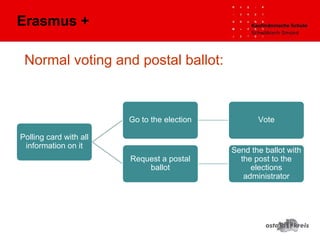
Normal voting and postal ballot:
Polling card with all
information on it
Go to the election Vote
Request a postal
ballot
Send the ballot with
the post to the
elections
administrator
Erasmus +
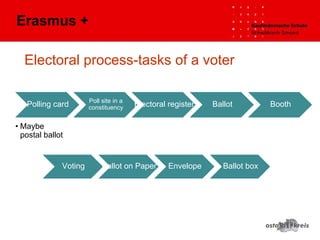
Electoral process-tasks of a voter
Polling card
• Maybe
postal ballot
Poll site in a
constituency Electoral register Ballot Booth
Erasmus +
Voting Ballot on Paper Envelope Ballot box
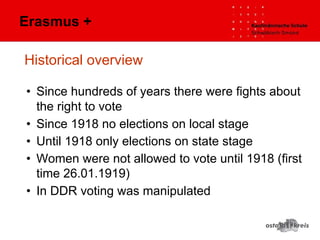
Historical overview
• Since hundreds of years there were fights about
the right to vote
• Since 1918 no elections on local stage
• Until 1918 only elections on state stage
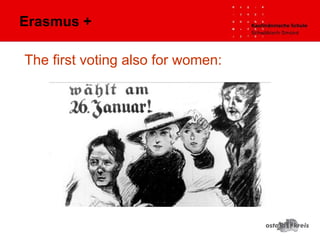
• Women were not allowed to vote until 1918 (first
time 26.01.1919)
• In DDR voting was manipulated
Erasmus +
• In BRD was fair voting on federal stage
• First federal election in 1949 in BRD
• One and only free voting in DDR: 1990, after that
free voting in the new states
• Since 1953 five percent hurdle
Erasmus +
The first voting also for women:
Erasmus +
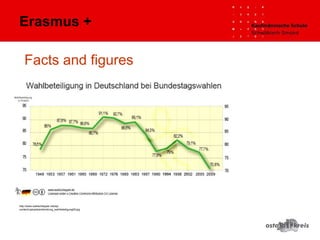
Facts and figures
Erasmus +
http://www.wahlschlepper.net/wp-
content/uploads/entwicklung_wahlbeteiligung09.jpg
International comparison
• In the USA there is a two party system
• Democrats and republicans
• They have only a majority election
• They don’t need a five percent hurdle
• We have a majority election and a proportional
representation
Erasmus +
International comparison
• In some countries voting is not warranted or
really unfair- no basics of voting
• In some countries (e.g. USA) there are electors
• In Germany: No electors- immediate election
Erasmus +
Sources
• http://www.refreshpolitics.at/de/intern:67/warum-waehlen-so-wichtig-ist/waehlen-
gehen/marketshow-wahlvorgang
• http://www.medienwerkstatt-online.de/lws_wissen/vorlagen/showcard.php?
id=3626&edit=0
• http://blinde-kuh.de/bksearch.cgi?input=startpage&query=wahlen+in+deutschland
• http://www.kidsweb.de/wahl_spezial/w_wie_wahlen_sachtext.html
• http://www.kiraka.de/spielen-und-hoeren/wissen/geschichte/beitrag/b/1919-frauen-in-
deutschland-duerfen-erstmals-waehlen/
• http://de.wikipedia.org/wiki/Geschichte_des_Wahlrechts_in_Deutschland
• https://www.bundestag.de/service/glossar/W/wahlgrundsaetze/246378
• http://sonderpaedagoge.de/mitmischen/index.php?menuid=34
Erasmus +
Erasmus +
Erasmus +
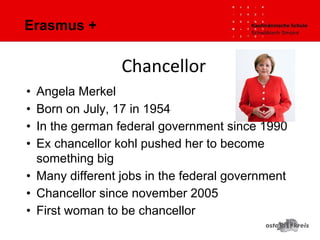
• Angela Merkel
• Born on July, 17 in 1954
• In the german federal government since 1990
• Ex chancellor kohl pushed her to become
something big
• Many different jobs in the federal government
• Chancellor since november 2005
• First woman to be chancellor
Chancellor
Erasmus +
• proposes the candidates for ministerial office
• head of the Federal Cabinet and chairs Cabinet
meetings
• has the right to form the Federal Cabinet
• determines and is responsible for the general
guidelines of government policy
• In charge of all the governments buisnesses
Erasmus +
• Suggests the chancellor
• Appoints and fires the federal judge
• Represents the country
• Announces the officers of the german army
• Signs contracts in the name of germany
• Has to prove the laws in germany
Tasks of the Head of government
Erasmus +
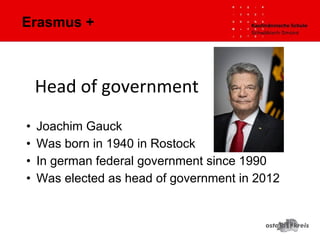
• Joachim Gauck
• Was born in 1940 in Rostock
• In german federal government since 1990
• Was elected as head of government in 2012
Head of government
Erasmus +
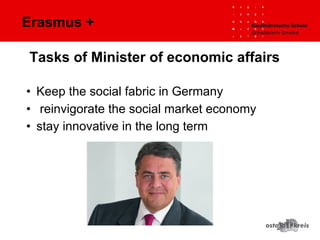
• Sigmar Gabriel
• Born on September, 12 in 1959
• 2005-2007 minister of environment
• Since 17 December 2013 Federal Minister for
Economic Affairs and Energy
Minister of economic affairs
Erasmus +
• Keep the social fabric in Germany
• reinvigorate the social market economy
• stay innovative in the long term
Tasks of Minister of economic affairs
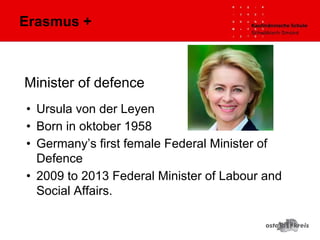
Minister of defence
• Ursula von der Leyen
• Born in oktober 1958
• Germany’s first female Federal Minister of
Defence
• 2009 to 2013 Federal Minister of Labour and
Social Affairs.
Erasmus +
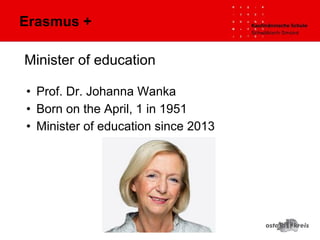
Minister of education
• Prof. Dr. Johanna Wanka
• Born on the April, 1 in 1951
• Minister of education since 2013
Erasmus +
Tasks of the minister of defence
• superior of all the soldiers
• command of the Armed Forces
• Introduction of new weaponsystems
• relocation of combat units
Erasmus +
Tasks of the Minister of education
• Is responsible for education in every stage of
human life
• Responsible for every type of school
• Responsible for job education and after future
perspectives after leaving school
Erasmus +
Erasmus +
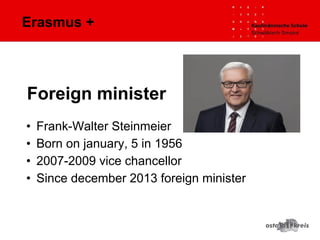
• Frank-Walter Steinmeier
• Born on january, 5 in 1956
• 2007-2009 vice chancellor
• Since december 2013 foreign minister
Foreign minister
Erasmus +
• The formation of globalization
• Want to convey a positive image of germany
• Work with international partners all over the
world
Tasks of the foreign minster
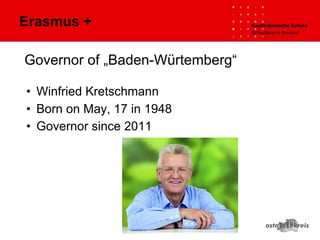
Governor of „Baden-Würtemberg“
• Winfried Kretschmann
• Born on May, 17 in 1948
• Governor since 2011
Erasmus +
Tasks of the governor
• is the Head of the State Government
• Minister President shall determine and bear
responsibility for guidelines of State policy
• appoints judges and state officials
• chairs the Government and directs its business
Erasmus +
Sources:
,• http://www.bundeskanzlerin.
de/Webs/BKin/EN/Chancellery/Tasks_of_the_Ch
ancellor/tasks_of_the_chancellor_node.html
• http://www.bundeskanzlerin.
de/Webs/BKin/DE/AngelaMerkel/angela_merkel
_node.html
• http://www.bundespraesident.
de/DE/Bundespraesident-Joachim-
Gauck/Persoenliches/persoenliches-node.html
• http://europe.hkbu.edu.
hk/polshyp/sorgan/bpraes/bpaufg.htm
Erasmus +
• http://www.auswaertiges-amt.
de/DE/AAmt/AuswDienst/Aufgaben_node.html
• http://www.baden-wuerttemberg.
de/en/government/minister-president/position-
and-responsibilities/
• http://www.bmbf.de/de/555.php
Erasmus +
Erasmus +
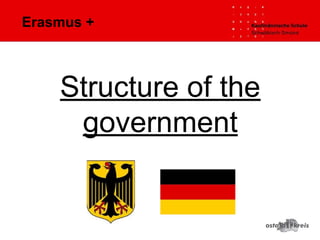
Structure of the
government
Erasmus +
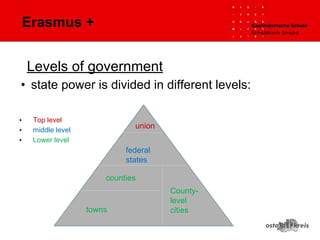
Levels of government
• state power is divided in different levels:
• Top level
• middle level
• Lower level
union
federal
states
counties
towns
County-
level
cities
Erasmus +
Structure of government (Separation of
political power)
• Seperation of political power in 3 branches :
legislature, executive,judiciary
• Different institutions and people are responsible
for one of these branches
• They control each other to ensure freedom and
equality
• an important component of democracy
Erasmus +
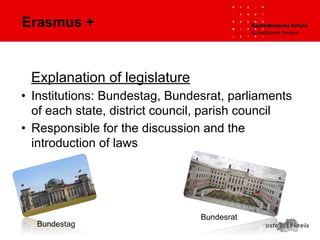
Explanation of legislature
• Institutions: Bundestag, Bundesrat, parliaments
of each state, district council, parish council
• Responsible for the discussion and the
introduction of laws
Bundestag
Bundesrat
Erasmus +
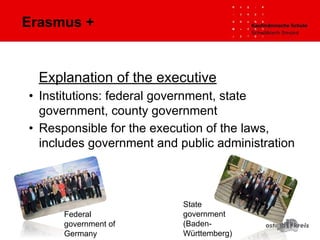
Explanation of the executive
• Institutions: federal government, state
government, county government
• Responsible for the execution of the laws,
includes government and public administration
Federal
government of
Germany
State
government
(Baden-
Württemberg)
Erasmus +
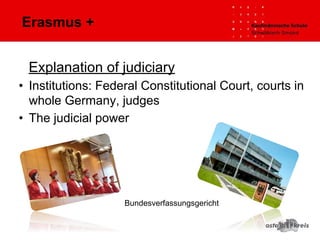
Explanation of judiciary
• Institutions: Federal Constitutional Court, courts in
whole Germany, judges
• The judicial power
Bundesverfassungsgericht
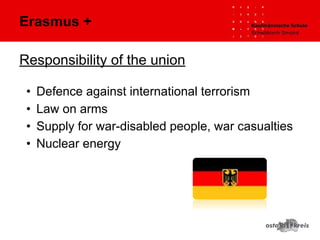
Responsibility of the union
• Defence against international terrorism
• Law on arms
• Supply for war-disabled people, war casualties
• Nuclear energy
Erasmus +
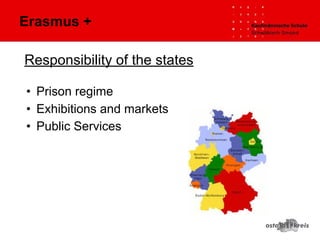
Responsibility of the states
• Prison regime
• Exhibitions and markets
• Public Services
Erasmus +
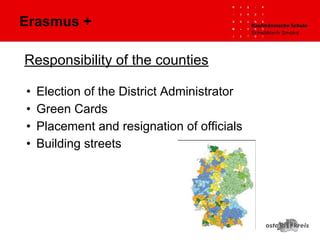
Responsibility of the counties
• Election of the District Administrator
• Green Cards
• Placement and resignation of officials
• Building streets
Erasmus +
Responsibility of the communes
• Elections in the community/ town
• Remove wastewater
• Fire department
• Social issues
Erasmus +
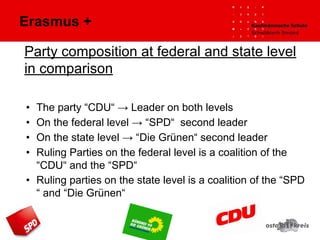
Party composition at federal and state level
in comparison
• The party “CDU“ → Leader on both levels
• On the federal level → “SPD“ second leader
• On the state level → “Die Grünen“ second leader
• Ruling Parties on the federal level is a coalition of the
“CDU“ and the “SPD“
• Ruling parties on the state level is a coalition of the “SPD
“ and “Die Grünen“
Erasmus +
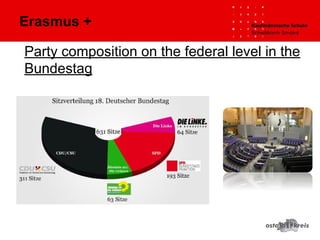
Party composition on the federal level in the
Bundestag
Erasmus +
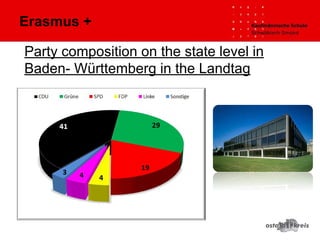
Party composition on the state level in
Baden- Württemberg in the Landtag
Erasmus +
Erasmus +
Sources literature
o www.bundestag.de
o www.bundesrat.de
o www.kommunalwahl-bw.de
o www.bundesregierung.de
o www.wikipeida.de
o www.deutsch-werden.de
o www.bpb.de
Sources pictures
• http://www.zeit.de/sport/2011-10/glosse-bundesadler-
innenministerium-handball
• https://de.wikipedia.org/wiki/Flagge_Deutschlands
• www.bundestag.de
• www.bundesrat.de
• http://silviakostova.blogspot.de/2015/05/lektion-1-die-
deutschen-bundeslander.html
• http://blog.markus-ritter.de/tag/landtag/
Erasmus +
Definition Democracy
Definition: Democracy is the system of a
government in which the people elect
representatives to decide political decisions for the
country and the people. In Germany, democracy
was introduced in 1948.
Erasmus +
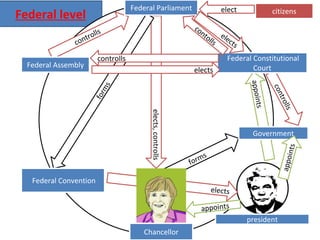
Federal level
elects
forms
controlls
elect
elects,controlls
controlls
forms
appoints
appoints
Chancellor
president
Government
Federal Constitutional
Court
citizensFederal Parliament
Federal Assembly
Federal Convention
elects
controlls
contolls
elects
appoints
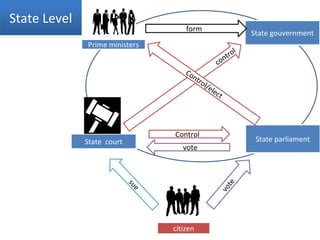
Ministers
control
citizen
State court
State gouvernment
State parliament
Prime ministers
form
Control
vote
sue
Control/elect
State Level
vote
Bundestag
Erasmus +
Erasmus +
Erasmus +
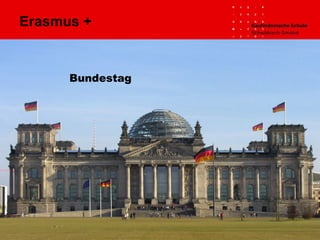
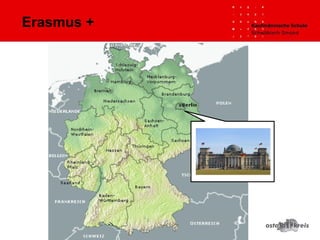
• It´s the place in Berlin where all the politicians
meet.
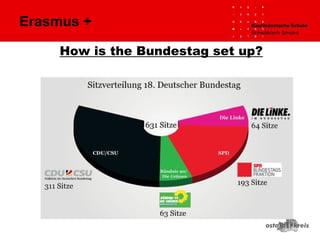
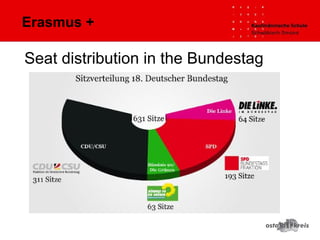
• There´re enough seats for 631 politicians
• To make desicions to achieve the goals of their
party.
• The german Bundestag exists since 1949 in
Bonn but it moved to Berlin in 1999.
Bundestag – What´s that?
Erasmus +
• The politicians represent our needs and wishes.
That´s why they have long dicussions to create
new laws.
• Another important task is to vote for the
chancellor
• They also have to controll the work of the
government
Bundestag- Why does it exist?
Erasmus +
• First: Stay in school!
• Be set up for the election:
- 18 years old
- german nationality
- don´t have to be part of a party
• Party-members have 2 options:
1.) direct mandate
2.) through coutry list of party.
How can I get in the Bundestag?
Distribution of seats
• Distribution of seats is organised by numbers of
votes that each party gets
• A party will only get seats in the plenary, if they
got at least 5% of the votes in the elections.
Erasmus +
How is the Bundestag set up?
Erasmus +
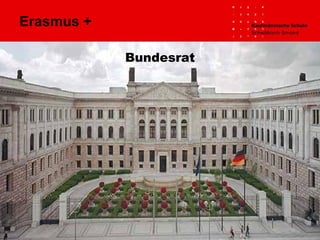
Bundesrat
Erasmus +
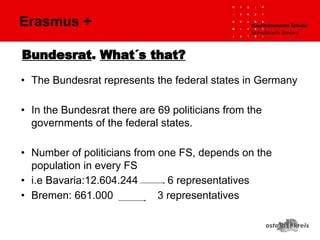
Bundesrat. What´s that?
• The Bundesrat represents the federal states in Germany
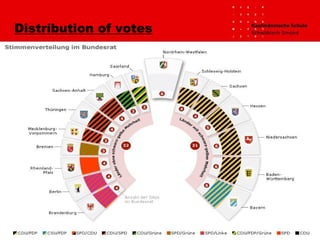
• In the Bundesrat there are 69 politicians from the
governments of the federal states.
• Number of politicians from one FS, depends on the
population in every FS
• i.e Bavaria:12.604.244 6 representatives
• Bremen: 661.000 3 representatives
Erasmus +
Distribution of votes
Erasmus +
Functions of the Bundesrat
• Veryfying law resolutions:
Politicians verify the laws that the Bundestag has made
These laws are only valid if the Bundesrat accepts them.
• Representing the population:
It defends the interests of the population of each federal
state.
Erasmus +
The voting:
• The voting is pretty complicated
• All the 69 politicians can vote BUT not everyone can
vote in the way that he/she wants to.
• Before the voting all the politicians from one FS have to
have the same opinion.
• Have to decide wether they answer with „yes or no“
Erasmus +
How to get to the Bundesrat?
• Each government from the federal states can decide on
their own who they want to send to Berlin
• But the prime minister of each sate is always with
him/her.
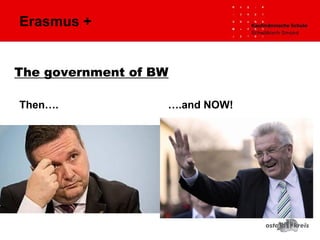
The government of BW
Then…. ….and NOW!
Erasmus +
Erasmus +
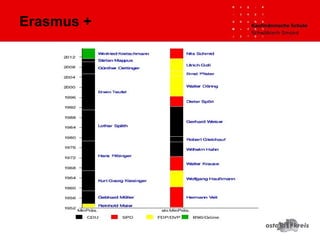
Then (until 2011):
• The Blacks (#noracism) or CDU (former prime
minister from BW: Stefan Mappus)
• The party is based on religious and
conservative backgrounds.
• It governed the last 58 years in BW
• Reasons: The population of BW liked the
slogans and the attitude of the party, that´s why
they got the most votes throughout all this
years.
The government of Baden-Württemberg:
then and now
Erasmus +
Erasmus +
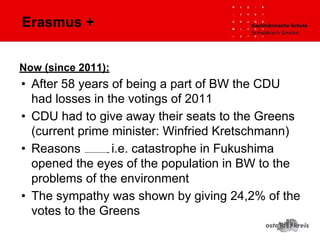
Now (since 2011):
• After 58 years of being a part of BW the CDU
had losses in the votings of 2011
• CDU had to give away their seats to the Greens
(current prime minister: Winfried Kretschmann)
• Reasons i.e. catastrophe in Fukushima
opened the eyes of the population in BW to the
problems of the environment
• The sympathy was shown by giving 24,2% of the
votes to the Greens
Sources
• http://upload.wikimedia.org/wikipedia/commons/9/9f/Der_Deutsche_Bundestag_Plenarsaal-
Gebäude_Reichstagsgebäude_Platz_der_Republik_Berlin_-
_Foto_2009_Wolfgang_Pehlemann_Steinberg_DSCN9832.jpg
•
• http://www.bundestag.de/htdocs_e/bundestag/plenary/distributionofseats
• http://www.google.de/imgres?imgurl=http%3A%2F%2Fgsb.download.bva.bund.de%2FBR%2Fschaufenster%
2Fimg%2Fbundesrat.jpg&imgrefurl=http%3A%2F%2Fgsb.download.bva.bund.de%2FBR%2Fschaufenster%
2Fde%2Fgabrieletergitpromenade.html&h=273&w=552&tbnid=PvCmL55PmBqfiM%
3A&zoom=1&docid=Gfa5qO6fydeGFM&ei=2f2LVb6ZHsv9UqmDoqAH&tbm=isch&iact=rc&uact=3&dur=2463&pag
e=1&start=0&ndsp=8&ved=0CE0QrQMwBw
• http://gsb.download.bva.bund.de/BR/schaufenster/img/bundesrat.jpg
• http://www.google.de/imgres?imgurl=http%3A%2F%2Fwww.express.de%2Fimage%2Fview%2F2011%2F2%
2F27%2F8273272%2C5132001%2ChighRes%2CDDI0821-20110327.jpg&imgrefurl=http%3A%2F%2Fwww.
express.de%2Fpolitik-wirtschaft%2Fgruene-wahlsensation-im-laendle-mappus-gestuerzt--was-nun--frau-merkel-%
2C2184%2C8272738.html&h=316&w=480&tbnid=rx8jz6DEivGn5M%
3A&zoom=1&docid=ILRZTShhAhBSiM&ei=ff-
LVZr7N8mAUdSQgpAC&tbm=isch&iact=rc&uact=3&dur=1531&page=5&start=61&ndsp=17&ved=0CI0CEK0DME
Y
Erasmus +
Attitude and goals
of the big parties
Erasmus +
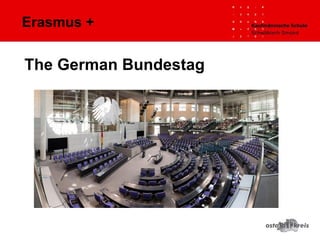
The German Bundestag
Erasmus +
• CDU/CSU
• SPD
• Die Grünen
• Die Linke
The parties in the german Bundestag
Erasmus +
• CDU = „Christlich Demokratische Union“
• In English: „Christian Democratic Union“
• Founded in 1945
• Part of the Bundestag since its foundation
• Cooperating with the CSU
CDU
Erasmus +
• CSU = „Christlich-Soziale Union“
• In English: „Christian Social Union“
• Also founded 1945
• Only working in a local area in Bavaria
• Working with the CDU at federal level
• sister party of the CDU
CSU
Erasmus +
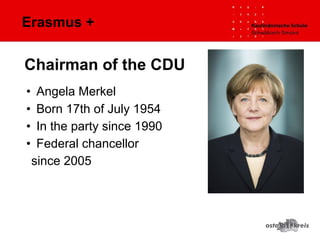
• Angela Merkel
• Born 17th of July 1954
• In the party since 1990
• Federal chancellor
since 2005
Chairman of the CDU
Erasmus +
Economic policy:
• Freedom, prosperity, protection of the future in
the social market economy
• Full employment
• Freer market and more competetion
• Reducing debts of Germany
• No increase of taxes
Main targets of the CDU/CSU
Erasmus +
External and domestic policy:
• Harder punishments for crimes → more safety
• More interaction with the USA
• European integration
Social policy:
• Equality / no discrimination
• Supporting education (schools and universities)
• Controlled immigration policy
Main targets of the CDU/CSU
Erasmus +
• SPD =
„Sozialdemokratische Partei Deutschland“
• In English: „Sociodemocratical Party Germany“
• Foundation in 1875
• Party in the Bundestag since 1945
SPD
Erasmus +
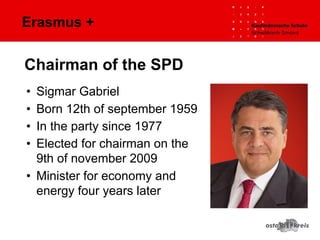
• Sigmar Gabriel
• Born 12th of september 1959
• In the party since 1977
• Elected for chairman on the
9th of november 2009
• Minister for economy and
energy four years later
Chairman of the SPD
Erasmus +
Economic policy:
• Public welfare and progress
• Stronger regulations of the finance markets
• Rejecting nuclear power
• Supporting renewable energies
• Sustainability while decreasing debts
Main targets of the SPD
Erasmus +
External and domestic policy:
• Safing peace and human rights
• Agreeing to dual citizenship
Social policy:
• Emancipation (proportion of females in jobs)
• Modern and tolerant society
• Supporting sick, disabled and jobless people
• Minimum wage (8,50€) and rent control
Main targets of the SPD
Erasmus +
• English:
„The Green Party“ / „The Greens“
• Foundation: 1980
• Time in the Bundestag: 1983-1990; since 1994
Die Grünen
Erasmus +
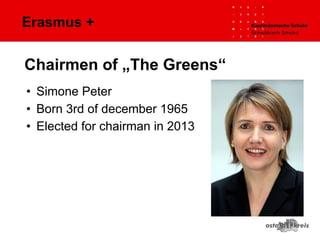
• Simone Peter
• Born 3rd of december 1965
• Elected for chairman in 2013
Chairmen of „The Greens“
Erasmus +
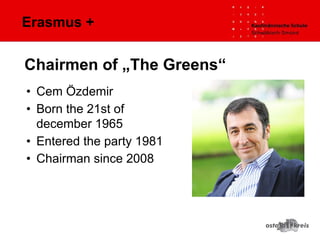
• Cem Özdemir
• Born the 21st of
december 1965
• Entered the party 1981
• Chairman since 2008
Chairmen of „The Greens“
Erasmus +
Economic policy:
• Criticizing capitalism
• Socialistic economic aims (untie conglomerates)
• Sustainability and environmental protection
• Demanding to disable all nuclear power stations
• Only use renewable energies until 2030
• Debt limit for banks
Main targets of the Green Party
Erasmus +
External and domestic policy:
• Participation at several peacemovements
• Reduce armament exports
• Against observation of the citizens
Social policy:
• Minimum wage
• All citizens‘ insurance instead of private covers
Main targets of the Green Party
Erasmus +
• English: „The Left Party“ / „The Left“
• Foundation: 2007
• Part of the Bundestag since 2007
Die Linke
Erasmus +
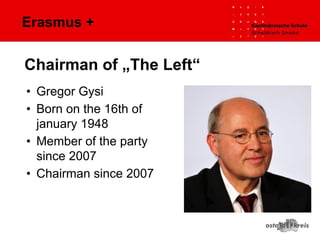
• Gregor Gysi
• Born on the 16th of
january 1948
• Member of the party
since 2007
• Chairman since 2007
Chairman of „The Left“
Erasmus +
Economic policy:
• Increasing wages
• 40 billion Euros more for infrastructure per year
• Much higher taxes for big companies
• Reintroduce capital taxes
• Set the maximum tax rate to 50%
Main targets of the Left Party
Erasmus +
External and domestic policy:
• Disarmament and dissolvement of the NATO
• Fair economic and social order in the world
• Direct democracy and more individual rights
Social policy:
• Higher living standard and less old-age poverty
• Better healthcare and social coverage
• Higher minimum wage
Main targets of the Left Party
Erasmus +
Seat distribution in the Bundestag
Erasmus +
• http://www.spdfraktion.de/sites/default/files/gabriel_sigmar.jpg
• http://www.sigmar-gabriel.de/Lebenslauf/
• https://www.dbu.de/media/280211092902bhha.jpg
• http://www.gruene.
de/fileadmin/user_upload/Bilder/Redaktion/Themenbilder_Lizenz/Partei_und_Koepfe/
Pressefoto_Cem-Oezdemir_2013.jpg
• http://upload.wikimedia.org/wikipedia/commons/c/cb/13-06-10-dosb-wahlhearing-
vorauswahl-03.jpg
SOURCES
SOURCES
• http://www.cdu.de/
• http://www.spd.de/
• https://www.gruene.de/startseite.html
• http://www.die-linke.de/die-linke/aktuell/
• https://de.wikipedia.org/wiki/Die_Linke
• https://de.wikipedia.org/wiki/B%C3%BCndnis_90/Die_Gr%C3%BCnen
• https://de.wikipedia.org/wiki/Sozialdemokratische_Partei_Deutschlands
• http://www.die-linke.de/fileadmin/tpl/gfx/logo_die-linke_530x168.png
• https://de.wikipedia.org/wiki/Christlich_Demokratische_Union_Deutschlands
Erasmus +
SOURCES
• https://de.wikipedia.org/wiki/Simone_Peter
• https://de.wikipedia.org/wiki/Cem_%C3%96zdemir
• https://de.wikipedia.org/wiki/Gregor_Gysi
• https://de.wikipedia.org/wiki/Angela_Merkel
• http://data.unionlive.de/images/2015/04/10/246-55281d204226c.jpg
• http://www.gruene-en.de/uploads/pics/30316entwurf1gruen.gif
• http://www.beraternews.net/wp-
content/uploads/2013/10/Bundesadler_Fotolia_50339311_S.jpg
Erasmus +
SOURCES
• http://www.itgovernance.eu/blog/wp-content/uploads/2015/05/bundestag_1.jpg
• https://upload.wikimedia.org/wikipedia/de/thumb/9/9f/CDU_flagge_logo.svg/2000px-
CDU_flagge_logo.svg.png
• http://www.csu-altdorf-ndb.de/assets/images/CSU_Logo.jpg
• http://www.gabriele-loesekrug-moeller.
de/imperia/md/images/spd/bildlinks_neu/logosspd/logo_cnmi_zoom.gif
• https://www.bundestag.
de/image/242374/Querformat__16x9/475/267/c830f2fd38a935dea3588e06783dd437/
MZ/sitzverteilung_18_xl.png
Erasmus +

A3 germany

  • 1.
  • 2.
    The citizens tasksin election Erasmus + http://www.google.de/imgres?imgurl=http%3A%2F%2Fwww.wahlen.vg-pirmasens-land.de%2Fwahlen1.jpg&imgrefurl=http%3A% 2F%2Fwww.wahlen.vg-pirmasens-land.de%2F&h=176&w=470&tbnid=8AkvMwac0vMKVM% 3A&zoom=1&docid=ybjcMsLGBWbTKM&ei=hS2MVcHpIMygsgH3r4HYCA&tbm=isch&iact=rc&uact=3&dur=4065&page=1&start= 0&ndsp=11&ved=0CDwQrQMwAg&biw=1366&bih=631
  • 3.
    General information • Withvoting people elect their group of interest • Voting is really important • The five basics of voting in Germany: – Free – Equal – General – Secret – Immediate • This is standard of every voting! Erasmus +
  • 4.
    Who is allowedto elect? • Persons with German citizenship • Persons over 18 • Main residence: Since three month in Germany Not allowed to elect: • Persons with a guardian • Dangerous criminals Erasmus +
  • 5.
    Kinds of voting(political voting) The three importanst ones in Germany: • Federal election • State election • Local elections Furthermore there are: • Municipal election, European election • Non political elections like church election • Referendums Erasmus +
  • 6.
    European election Federal election State election Local election Stage 1: Lawsfor the EU are made Stage 2: Laws for Germany are made Stage 3: Laws for one land or federal city state are made Stage 4: Laws for one town are made Erasmus +
  • 7.
    How the votingworks • Federal election: – Every voter two votes • Party • Person – Voting takes place in poll sites in whole Germany- election assistants help – Normally every four years Erasmus +
  • 8.
    • State election: –Two votes – Period of five years • Local election: – More than two votes, but it’s every year different Erasmus +
  • 9.
    • General: – Sometimesa ballot can be nonstandard – For each constituency one responsible elections administrator – Responsible for keeping the five basics of voting Erasmus +
  • 10.
    A ballot ofthe federal or state elections: • Sometimes a ballot can be nonstandard http://www.google.de/imgres?imgurl=http%3A%2F%2Fwww.politikundunterricht.de%2Fbtwahl_02%2Fbilder%2Fstimmzettel. gif&imgrefurl=http%3A%2F%2Fwww.politikundunterricht.de%2Fbtwahl_02%2Fsowirdgewaehlt. htm&h=712&w=472&tbnid=M2HH_iSMDDDdIM% 3A&zoom=1&docid=r4ds1AqmhKZMUM&hl=de&ei=1mOMVdDOOsWjsAGZ9IDYBA&tbm=isch&iact=rc&uact=3&dur=781&page= 1&start=0&ndsp=19&ved=0CEQQrQMwBQ Erasmus +
  • 11.
    Normal voting andpostal ballot: Polling card with all information on it Go to the election Vote Request a postal ballot Send the ballot with the post to the elections administrator Erasmus +
  • 12.
    Electoral process-tasks ofa voter Polling card • Maybe postal ballot Poll site in a constituency Electoral register Ballot Booth Erasmus + Voting Ballot on Paper Envelope Ballot box
  • 13.
    Historical overview • Sincehundreds of years there were fights about the right to vote • Since 1918 no elections on local stage • Until 1918 only elections on state stage • Women were not allowed to vote until 1918 (first time 26.01.1919) • In DDR voting was manipulated Erasmus +
  • 14.
    • In BRDwas fair voting on federal stage • First federal election in 1949 in BRD • One and only free voting in DDR: 1990, after that free voting in the new states • Since 1953 five percent hurdle Erasmus +
  • 15.
    The first votingalso for women: Erasmus +
  • 16.
    Facts and figures Erasmus+ http://www.wahlschlepper.net/wp- content/uploads/entwicklung_wahlbeteiligung09.jpg
  • 17.
    International comparison • Inthe USA there is a two party system • Democrats and republicans • They have only a majority election • They don’t need a five percent hurdle • We have a majority election and a proportional representation Erasmus +
  • 18.
    International comparison • Insome countries voting is not warranted or really unfair- no basics of voting • In some countries (e.g. USA) there are electors • In Germany: No electors- immediate election Erasmus +
  • 19.
    Sources • http://www.refreshpolitics.at/de/intern:67/warum-waehlen-so-wichtig-ist/waehlen- gehen/marketshow-wahlvorgang • http://www.medienwerkstatt-online.de/lws_wissen/vorlagen/showcard.php? id=3626&edit=0 •http://blinde-kuh.de/bksearch.cgi?input=startpage&query=wahlen+in+deutschland • http://www.kidsweb.de/wahl_spezial/w_wie_wahlen_sachtext.html • http://www.kiraka.de/spielen-und-hoeren/wissen/geschichte/beitrag/b/1919-frauen-in- deutschland-duerfen-erstmals-waehlen/ • http://de.wikipedia.org/wiki/Geschichte_des_Wahlrechts_in_Deutschland • https://www.bundestag.de/service/glossar/W/wahlgrundsaetze/246378 • http://sonderpaedagoge.de/mitmischen/index.php?menuid=34 Erasmus +
  • 20.
  • 21.
    Erasmus + • AngelaMerkel • Born on July, 17 in 1954 • In the german federal government since 1990 • Ex chancellor kohl pushed her to become something big • Many different jobs in the federal government • Chancellor since november 2005 • First woman to be chancellor Chancellor
  • 22.
    Erasmus + • proposesthe candidates for ministerial office • head of the Federal Cabinet and chairs Cabinet meetings • has the right to form the Federal Cabinet • determines and is responsible for the general guidelines of government policy • In charge of all the governments buisnesses
  • 23.
    Erasmus + • Suggeststhe chancellor • Appoints and fires the federal judge • Represents the country • Announces the officers of the german army • Signs contracts in the name of germany • Has to prove the laws in germany Tasks of the Head of government
  • 24.
    Erasmus + • JoachimGauck • Was born in 1940 in Rostock • In german federal government since 1990 • Was elected as head of government in 2012 Head of government
  • 25.
    Erasmus + • SigmarGabriel • Born on September, 12 in 1959 • 2005-2007 minister of environment • Since 17 December 2013 Federal Minister for Economic Affairs and Energy Minister of economic affairs
  • 26.
    Erasmus + • Keepthe social fabric in Germany • reinvigorate the social market economy • stay innovative in the long term Tasks of Minister of economic affairs
  • 27.
    Minister of defence •Ursula von der Leyen • Born in oktober 1958 • Germany’s first female Federal Minister of Defence • 2009 to 2013 Federal Minister of Labour and Social Affairs. Erasmus +
  • 28.
    Minister of education •Prof. Dr. Johanna Wanka • Born on the April, 1 in 1951 • Minister of education since 2013 Erasmus +
  • 29.
    Tasks of theminister of defence • superior of all the soldiers • command of the Armed Forces • Introduction of new weaponsystems • relocation of combat units Erasmus +
  • 30.
    Tasks of theMinister of education • Is responsible for education in every stage of human life • Responsible for every type of school • Responsible for job education and after future perspectives after leaving school Erasmus +
  • 31.
    Erasmus + • Frank-WalterSteinmeier • Born on january, 5 in 1956 • 2007-2009 vice chancellor • Since december 2013 foreign minister Foreign minister
  • 32.
    Erasmus + • Theformation of globalization • Want to convey a positive image of germany • Work with international partners all over the world Tasks of the foreign minster
  • 33.
    Governor of „Baden-Würtemberg“ •Winfried Kretschmann • Born on May, 17 in 1948 • Governor since 2011 Erasmus +
  • 34.
    Tasks of thegovernor • is the Head of the State Government • Minister President shall determine and bear responsibility for guidelines of State policy • appoints judges and state officials • chairs the Government and directs its business Erasmus +
  • 35.
    Sources: ,• http://www.bundeskanzlerin. de/Webs/BKin/EN/Chancellery/Tasks_of_the_Ch ancellor/tasks_of_the_chancellor_node.html • http://www.bundeskanzlerin. de/Webs/BKin/DE/AngelaMerkel/angela_merkel _node.html •http://www.bundespraesident. de/DE/Bundespraesident-Joachim- Gauck/Persoenliches/persoenliches-node.html • http://europe.hkbu.edu. hk/polshyp/sorgan/bpraes/bpaufg.htm Erasmus +
  • 36.
  • 37.
    Erasmus + Structure ofthe government
  • 38.
    Erasmus + Levels ofgovernment • state power is divided in different levels: • Top level • middle level • Lower level union federal states counties towns County- level cities
  • 39.
    Erasmus + Structure ofgovernment (Separation of political power) • Seperation of political power in 3 branches : legislature, executive,judiciary • Different institutions and people are responsible for one of these branches • They control each other to ensure freedom and equality • an important component of democracy
  • 40.
    Erasmus + Explanation oflegislature • Institutions: Bundestag, Bundesrat, parliaments of each state, district council, parish council • Responsible for the discussion and the introduction of laws Bundestag Bundesrat
  • 41.
    Erasmus + Explanation ofthe executive • Institutions: federal government, state government, county government • Responsible for the execution of the laws, includes government and public administration Federal government of Germany State government (Baden- Württemberg)
  • 42.
    Erasmus + Explanation ofjudiciary • Institutions: Federal Constitutional Court, courts in whole Germany, judges • The judicial power Bundesverfassungsgericht
  • 43.
    Responsibility of theunion • Defence against international terrorism • Law on arms • Supply for war-disabled people, war casualties • Nuclear energy Erasmus +
  • 44.
    Responsibility of thestates • Prison regime • Exhibitions and markets • Public Services Erasmus +
  • 45.
    Responsibility of thecounties • Election of the District Administrator • Green Cards • Placement and resignation of officials • Building streets Erasmus +
  • 46.
    Responsibility of thecommunes • Elections in the community/ town • Remove wastewater • Fire department • Social issues Erasmus +
  • 47.
    Party composition atfederal and state level in comparison • The party “CDU“ → Leader on both levels • On the federal level → “SPD“ second leader • On the state level → “Die Grünen“ second leader • Ruling Parties on the federal level is a coalition of the “CDU“ and the “SPD“ • Ruling parties on the state level is a coalition of the “SPD “ and “Die Grünen“ Erasmus +
  • 48.
    Party composition onthe federal level in the Bundestag Erasmus +
  • 49.
    Party composition onthe state level in Baden- Württemberg in the Landtag Erasmus +
  • 50.
    Erasmus + Sources literature owww.bundestag.de o www.bundesrat.de o www.kommunalwahl-bw.de o www.bundesregierung.de o www.wikipeida.de o www.deutsch-werden.de o www.bpb.de
  • 51.
    Sources pictures • http://www.zeit.de/sport/2011-10/glosse-bundesadler- innenministerium-handball •https://de.wikipedia.org/wiki/Flagge_Deutschlands • www.bundestag.de • www.bundesrat.de • http://silviakostova.blogspot.de/2015/05/lektion-1-die- deutschen-bundeslander.html • http://blog.markus-ritter.de/tag/landtag/ Erasmus +
  • 52.
    Definition Democracy Definition: Democracyis the system of a government in which the people elect representatives to decide political decisions for the country and the people. In Germany, democracy was introduced in 1948. Erasmus +
  • 53.
  • 54.
    Ministers control citizen State court State gouvernment Stateparliament Prime ministers form Control vote sue Control/elect State Level vote
  • 55.
  • 56.
  • 57.
    Erasmus + • It´sthe place in Berlin where all the politicians meet. • There´re enough seats for 631 politicians • To make desicions to achieve the goals of their party. • The german Bundestag exists since 1949 in Bonn but it moved to Berlin in 1999. Bundestag – What´s that?
  • 58.
    Erasmus + • Thepoliticians represent our needs and wishes. That´s why they have long dicussions to create new laws. • Another important task is to vote for the chancellor • They also have to controll the work of the government Bundestag- Why does it exist?
  • 59.
    Erasmus + • First:Stay in school! • Be set up for the election: - 18 years old - german nationality - don´t have to be part of a party • Party-members have 2 options: 1.) direct mandate 2.) through coutry list of party. How can I get in the Bundestag?
  • 60.
    Distribution of seats •Distribution of seats is organised by numbers of votes that each party gets • A party will only get seats in the plenary, if they got at least 5% of the votes in the elections. Erasmus +
  • 61.
    How is theBundestag set up? Erasmus +
  • 62.
  • 63.
    Bundesrat. What´s that? •The Bundesrat represents the federal states in Germany • In the Bundesrat there are 69 politicians from the governments of the federal states. • Number of politicians from one FS, depends on the population in every FS • i.e Bavaria:12.604.244 6 representatives • Bremen: 661.000 3 representatives Erasmus +
  • 64.
  • 65.
    Erasmus + Functions ofthe Bundesrat • Veryfying law resolutions: Politicians verify the laws that the Bundestag has made These laws are only valid if the Bundesrat accepts them. • Representing the population: It defends the interests of the population of each federal state.
  • 66.
    Erasmus + The voting: •The voting is pretty complicated • All the 69 politicians can vote BUT not everyone can vote in the way that he/she wants to. • Before the voting all the politicians from one FS have to have the same opinion. • Have to decide wether they answer with „yes or no“
  • 67.
    Erasmus + How toget to the Bundesrat? • Each government from the federal states can decide on their own who they want to send to Berlin • But the prime minister of each sate is always with him/her.
  • 68.
    The government ofBW Then…. ….and NOW! Erasmus +
  • 69.
    Erasmus + Then (until2011): • The Blacks (#noracism) or CDU (former prime minister from BW: Stefan Mappus) • The party is based on religious and conservative backgrounds. • It governed the last 58 years in BW • Reasons: The population of BW liked the slogans and the attitude of the party, that´s why they got the most votes throughout all this years. The government of Baden-Württemberg: then and now
  • 70.
  • 71.
    Erasmus + Now (since2011): • After 58 years of being a part of BW the CDU had losses in the votings of 2011 • CDU had to give away their seats to the Greens (current prime minister: Winfried Kretschmann) • Reasons i.e. catastrophe in Fukushima opened the eyes of the population in BW to the problems of the environment • The sympathy was shown by giving 24,2% of the votes to the Greens
  • 72.
    Sources • http://upload.wikimedia.org/wikipedia/commons/9/9f/Der_Deutsche_Bundestag_Plenarsaal- Gebäude_Reichstagsgebäude_Platz_der_Republik_Berlin_- _Foto_2009_Wolfgang_Pehlemann_Steinberg_DSCN9832.jpg • • http://www.bundestag.de/htdocs_e/bundestag/plenary/distributionofseats •http://www.google.de/imgres?imgurl=http%3A%2F%2Fgsb.download.bva.bund.de%2FBR%2Fschaufenster% 2Fimg%2Fbundesrat.jpg&imgrefurl=http%3A%2F%2Fgsb.download.bva.bund.de%2FBR%2Fschaufenster% 2Fde%2Fgabrieletergitpromenade.html&h=273&w=552&tbnid=PvCmL55PmBqfiM% 3A&zoom=1&docid=Gfa5qO6fydeGFM&ei=2f2LVb6ZHsv9UqmDoqAH&tbm=isch&iact=rc&uact=3&dur=2463&pag e=1&start=0&ndsp=8&ved=0CE0QrQMwBw • http://gsb.download.bva.bund.de/BR/schaufenster/img/bundesrat.jpg • http://www.google.de/imgres?imgurl=http%3A%2F%2Fwww.express.de%2Fimage%2Fview%2F2011%2F2% 2F27%2F8273272%2C5132001%2ChighRes%2CDDI0821-20110327.jpg&imgrefurl=http%3A%2F%2Fwww. express.de%2Fpolitik-wirtschaft%2Fgruene-wahlsensation-im-laendle-mappus-gestuerzt--was-nun--frau-merkel-% 2C2184%2C8272738.html&h=316&w=480&tbnid=rx8jz6DEivGn5M% 3A&zoom=1&docid=ILRZTShhAhBSiM&ei=ff- LVZr7N8mAUdSQgpAC&tbm=isch&iact=rc&uact=3&dur=1531&page=5&start=61&ndsp=17&ved=0CI0CEK0DME Y
  • 73.
    Erasmus + Attitude andgoals of the big parties
  • 74.
  • 75.
    Erasmus + • CDU/CSU •SPD • Die Grünen • Die Linke The parties in the german Bundestag
  • 76.
    Erasmus + • CDU= „Christlich Demokratische Union“ • In English: „Christian Democratic Union“ • Founded in 1945 • Part of the Bundestag since its foundation • Cooperating with the CSU CDU
  • 77.
    Erasmus + • CSU= „Christlich-Soziale Union“ • In English: „Christian Social Union“ • Also founded 1945 • Only working in a local area in Bavaria • Working with the CDU at federal level • sister party of the CDU CSU
  • 78.
    Erasmus + • AngelaMerkel • Born 17th of July 1954 • In the party since 1990 • Federal chancellor since 2005 Chairman of the CDU
  • 79.
    Erasmus + Economic policy: •Freedom, prosperity, protection of the future in the social market economy • Full employment • Freer market and more competetion • Reducing debts of Germany • No increase of taxes Main targets of the CDU/CSU
  • 80.
    Erasmus + External anddomestic policy: • Harder punishments for crimes → more safety • More interaction with the USA • European integration Social policy: • Equality / no discrimination • Supporting education (schools and universities) • Controlled immigration policy Main targets of the CDU/CSU
  • 81.
    Erasmus + • SPD= „Sozialdemokratische Partei Deutschland“ • In English: „Sociodemocratical Party Germany“ • Foundation in 1875 • Party in the Bundestag since 1945 SPD
  • 82.
    Erasmus + • SigmarGabriel • Born 12th of september 1959 • In the party since 1977 • Elected for chairman on the 9th of november 2009 • Minister for economy and energy four years later Chairman of the SPD
  • 83.
    Erasmus + Economic policy: •Public welfare and progress • Stronger regulations of the finance markets • Rejecting nuclear power • Supporting renewable energies • Sustainability while decreasing debts Main targets of the SPD
  • 84.
    Erasmus + External anddomestic policy: • Safing peace and human rights • Agreeing to dual citizenship Social policy: • Emancipation (proportion of females in jobs) • Modern and tolerant society • Supporting sick, disabled and jobless people • Minimum wage (8,50€) and rent control Main targets of the SPD
  • 85.
    Erasmus + • English: „TheGreen Party“ / „The Greens“ • Foundation: 1980 • Time in the Bundestag: 1983-1990; since 1994 Die Grünen
  • 86.
    Erasmus + • SimonePeter • Born 3rd of december 1965 • Elected for chairman in 2013 Chairmen of „The Greens“
  • 87.
    Erasmus + • CemÖzdemir • Born the 21st of december 1965 • Entered the party 1981 • Chairman since 2008 Chairmen of „The Greens“
  • 88.
    Erasmus + Economic policy: •Criticizing capitalism • Socialistic economic aims (untie conglomerates) • Sustainability and environmental protection • Demanding to disable all nuclear power stations • Only use renewable energies until 2030 • Debt limit for banks Main targets of the Green Party
  • 89.
    Erasmus + External anddomestic policy: • Participation at several peacemovements • Reduce armament exports • Against observation of the citizens Social policy: • Minimum wage • All citizens‘ insurance instead of private covers Main targets of the Green Party
  • 90.
    Erasmus + • English:„The Left Party“ / „The Left“ • Foundation: 2007 • Part of the Bundestag since 2007 Die Linke
  • 91.
    Erasmus + • GregorGysi • Born on the 16th of january 1948 • Member of the party since 2007 • Chairman since 2007 Chairman of „The Left“
  • 92.
    Erasmus + Economic policy: •Increasing wages • 40 billion Euros more for infrastructure per year • Much higher taxes for big companies • Reintroduce capital taxes • Set the maximum tax rate to 50% Main targets of the Left Party
  • 93.
    Erasmus + External anddomestic policy: • Disarmament and dissolvement of the NATO • Fair economic and social order in the world • Direct democracy and more individual rights Social policy: • Higher living standard and less old-age poverty • Better healthcare and social coverage • Higher minimum wage Main targets of the Left Party
  • 94.
  • 95.
    Erasmus + • http://www.spdfraktion.de/sites/default/files/gabriel_sigmar.jpg •http://www.sigmar-gabriel.de/Lebenslauf/ • https://www.dbu.de/media/280211092902bhha.jpg • http://www.gruene. de/fileadmin/user_upload/Bilder/Redaktion/Themenbilder_Lizenz/Partei_und_Koepfe/ Pressefoto_Cem-Oezdemir_2013.jpg • http://upload.wikimedia.org/wikipedia/commons/c/cb/13-06-10-dosb-wahlhearing- vorauswahl-03.jpg SOURCES
  • 96.
    SOURCES • http://www.cdu.de/ • http://www.spd.de/ •https://www.gruene.de/startseite.html • http://www.die-linke.de/die-linke/aktuell/ • https://de.wikipedia.org/wiki/Die_Linke • https://de.wikipedia.org/wiki/B%C3%BCndnis_90/Die_Gr%C3%BCnen • https://de.wikipedia.org/wiki/Sozialdemokratische_Partei_Deutschlands • http://www.die-linke.de/fileadmin/tpl/gfx/logo_die-linke_530x168.png • https://de.wikipedia.org/wiki/Christlich_Demokratische_Union_Deutschlands Erasmus +
  • 97.
    SOURCES • https://de.wikipedia.org/wiki/Simone_Peter • https://de.wikipedia.org/wiki/Cem_%C3%96zdemir •https://de.wikipedia.org/wiki/Gregor_Gysi • https://de.wikipedia.org/wiki/Angela_Merkel • http://data.unionlive.de/images/2015/04/10/246-55281d204226c.jpg • http://www.gruene-en.de/uploads/pics/30316entwurf1gruen.gif • http://www.beraternews.net/wp- content/uploads/2013/10/Bundesadler_Fotolia_50339311_S.jpg Erasmus +
  • 98.
    SOURCES • http://www.itgovernance.eu/blog/wp-content/uploads/2015/05/bundestag_1.jpg • https://upload.wikimedia.org/wikipedia/de/thumb/9/9f/CDU_flagge_logo.svg/2000px- CDU_flagge_logo.svg.png •http://www.csu-altdorf-ndb.de/assets/images/CSU_Logo.jpg • http://www.gabriele-loesekrug-moeller. de/imperia/md/images/spd/bildlinks_neu/logosspd/logo_cnmi_zoom.gif • https://www.bundestag. de/image/242374/Querformat__16x9/475/267/c830f2fd38a935dea3588e06783dd437/ MZ/sitzverteilung_18_xl.png Erasmus +