REGIONAL GROUPING & 
EUROPEAN UNION 
GROUP MEMBERS: 
MADHAV NEUPANE 
LAXMI SADAULA 
PRAYASH NEUPANE
CONCEPT OF REGIONAL GROUPING/INTEGRATION 
• A block or geographic region/area that have things in common coming together for a common purpose. 
• A number of groups ,societies or countries within an area joining together to cooperate and operate 
under one system or as one group. 
• Regional integration is a process in which states enter into a regional agreement in order to enhance 
regional cooperation through regional institutions and rules. 
• Regional Integration as an association of states based upon location in a given geographical area, for the 
safeguarding or promotion of the participants, an association whose terms are fixed by a treaty or other 
arrangements.
OBJECTIVES OF REGIONAL GROUPING/INTEGRATION 
• Strengthening of trade integration in the region 
• Enabling environment for private sector development 
• Economic growth 
• Development of strong public sector institutions and good governance 
• Reduction of social exclusion and the development of an inclusive civil society 
• Contribution to peace and security in the region 
• Building of environment programmes at the regional level 
• Strengthening of the region interaction with other regions of the world
REASONS FOR REGIONAL GROUPING 
• Geographic proximity 
• Consumer tastes & preferences 
• Distribution channels 
• Common history & interest 
• Common economic & trade opportunities & problem
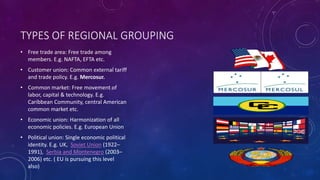
TYPES OF REGIONAL GROUPING 
• Free trade area: Free trade among 
members. E.g. NAFTA, EFTA etc. 
• Customer union: Common external tariff 
and trade policy. E.g. Mercosur. 
• Common market: Free movement of 
labor, capital & technology. E.g. 
Caribbean Community, central American 
common market etc. 
• Economic union: Harmonization of all 
economic policies. E.g. European Union 
• Political union: Single economic political 
identity. E.g. UK, Soviet Union (1922– 
1991), Serbia and Montenegro (2003– 
2006) etc. ( EU is pursuing this level 
also)
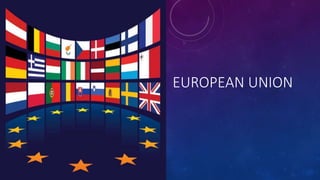
EUROPEAN UNION
CONCEPT & HISTORY OF EUROPEAN UNION 
• The EU began in the 1950’s. It was called the European Economic Community. • Six countries (Germany, 
France, Italy, Luxembourg, the Netherlands and Belgium) were the founding members. 
• In 1992 a treaty formed the European Union as we know it today 
• Operating presently as a single market with 28 countries, the EU is a major world trading power. 
• EU is a supranational entity of 28 European nations dedicated to European economic and political 
integration.
OBJECTIVES OF EUROPEAN UNION 
• To establish customs duties between member states. 
• To establish an external common tariff. 
• To establish a European investment bank. 
• To create a European social fund. 
• To develop closer relations between member states. 
• To introduce common policy for agriculture & transportation.
GOALS OF EUROPEAN UNION 
• Economic and social progress. Help people earn enough money and get treated fairly. 
• Speak for the European Union internationally By working as a group the EU hopes that Europe will be 
listened to more by other countries. 
• European citizenship Anyone from a member country is a citizen of the EU. Because you are a citizen of 
the EU, you have rights. 
• Make Europe an area of freedom, security and justice. Help Europeans to live in safety, without the fear 
of war. 
• Make and keep EU laws Making laws protect peoples’ rights in the EU countries.
PURPOSE OF THE EUROPEAN UNION 
• For its members to work together for advantages that would be out of their reach if each were working 
alone 
• Believe that when countries work together they are a more powerful force in the world because they 
involve: 
• More money 
• More people 
• More land area 
• This helps make small countries more competitive in the world market…
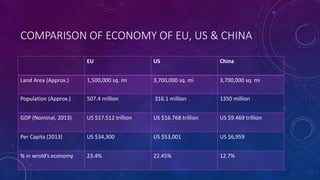
COMPARISON OF ECONOMY OF EU, US & CHINA 
EU US China 
Land Area (Approx.) 1,500,000 sq. mi 3,700,000 sq. mi 3,700,000 sq. mi 
Population (Approx.) 507.4 million 316.1 million 1350 million 
GDP (Nominal, 2013) US $17.512 trillion US $16.768 trillion US $9.469 trillion 
Per Capita (2013) US $34,300 US $53,001 US $6,959 
% in wrold’s economy 23.4% 22.45% 12.7%
BENEFITS TO MEMBERS COUNTRIES 
• Members may use a common currency ( euro ) that makes trade easier. 
• EU works to improve trade, education, farming, & industry among its members. 
• No tariffs (taxes) among member countries – free trade zone. 
• Citizens of one country can move freely to another country. 
• Citizens can live and work in any other EU nation. 
• Citizens can vote in local elections even if they aren’t citizens of the country. 
• Gives smaller economies the ability to negotiate with much bigger economies like US & China on an 
equal footing. 
• Reduce risk of war.
EURO 
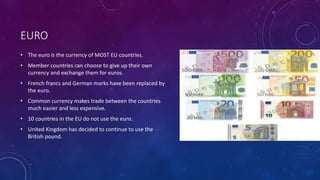
• The euro is the currency of MOST EU countries. 
• Member countries can choose to give up their own 
currency and exchange them for euros. 
• French francs and German marks have been replaced by 
the euro. 
• Common currency makes trade between the countries 
much easier and less expensive. 
• 10 countries in the EU do not use the euro. 
• United Kingdom has decided to continue to use the 
British pound.
ANY QUERIES ????????????????

European Union

  • 1.
    REGIONAL GROUPING & EUROPEAN UNION GROUP MEMBERS: MADHAV NEUPANE LAXMI SADAULA PRAYASH NEUPANE
  • 2.
    CONCEPT OF REGIONALGROUPING/INTEGRATION • A block or geographic region/area that have things in common coming together for a common purpose. • A number of groups ,societies or countries within an area joining together to cooperate and operate under one system or as one group. • Regional integration is a process in which states enter into a regional agreement in order to enhance regional cooperation through regional institutions and rules. • Regional Integration as an association of states based upon location in a given geographical area, for the safeguarding or promotion of the participants, an association whose terms are fixed by a treaty or other arrangements.
  • 3.
    OBJECTIVES OF REGIONALGROUPING/INTEGRATION • Strengthening of trade integration in the region • Enabling environment for private sector development • Economic growth • Development of strong public sector institutions and good governance • Reduction of social exclusion and the development of an inclusive civil society • Contribution to peace and security in the region • Building of environment programmes at the regional level • Strengthening of the region interaction with other regions of the world
  • 4.
    REASONS FOR REGIONALGROUPING • Geographic proximity • Consumer tastes & preferences • Distribution channels • Common history & interest • Common economic & trade opportunities & problem
  • 5.
    TYPES OF REGIONALGROUPING • Free trade area: Free trade among members. E.g. NAFTA, EFTA etc. • Customer union: Common external tariff and trade policy. E.g. Mercosur. • Common market: Free movement of labor, capital & technology. E.g. Caribbean Community, central American common market etc. • Economic union: Harmonization of all economic policies. E.g. European Union • Political union: Single economic political identity. E.g. UK, Soviet Union (1922– 1991), Serbia and Montenegro (2003– 2006) etc. ( EU is pursuing this level also)
  • 6.
  • 7.
    CONCEPT & HISTORYOF EUROPEAN UNION • The EU began in the 1950’s. It was called the European Economic Community. • Six countries (Germany, France, Italy, Luxembourg, the Netherlands and Belgium) were the founding members. • In 1992 a treaty formed the European Union as we know it today • Operating presently as a single market with 28 countries, the EU is a major world trading power. • EU is a supranational entity of 28 European nations dedicated to European economic and political integration.
  • 8.
    OBJECTIVES OF EUROPEANUNION • To establish customs duties between member states. • To establish an external common tariff. • To establish a European investment bank. • To create a European social fund. • To develop closer relations between member states. • To introduce common policy for agriculture & transportation.
  • 9.
    GOALS OF EUROPEANUNION • Economic and social progress. Help people earn enough money and get treated fairly. • Speak for the European Union internationally By working as a group the EU hopes that Europe will be listened to more by other countries. • European citizenship Anyone from a member country is a citizen of the EU. Because you are a citizen of the EU, you have rights. • Make Europe an area of freedom, security and justice. Help Europeans to live in safety, without the fear of war. • Make and keep EU laws Making laws protect peoples’ rights in the EU countries.
  • 10.
    PURPOSE OF THEEUROPEAN UNION • For its members to work together for advantages that would be out of their reach if each were working alone • Believe that when countries work together they are a more powerful force in the world because they involve: • More money • More people • More land area • This helps make small countries more competitive in the world market…
  • 11.
    COMPARISON OF ECONOMYOF EU, US & CHINA EU US China Land Area (Approx.) 1,500,000 sq. mi 3,700,000 sq. mi 3,700,000 sq. mi Population (Approx.) 507.4 million 316.1 million 1350 million GDP (Nominal, 2013) US $17.512 trillion US $16.768 trillion US $9.469 trillion Per Capita (2013) US $34,300 US $53,001 US $6,959 % in wrold’s economy 23.4% 22.45% 12.7%
  • 12.
    BENEFITS TO MEMBERSCOUNTRIES • Members may use a common currency ( euro ) that makes trade easier. • EU works to improve trade, education, farming, & industry among its members. • No tariffs (taxes) among member countries – free trade zone. • Citizens of one country can move freely to another country. • Citizens can live and work in any other EU nation. • Citizens can vote in local elections even if they aren’t citizens of the country. • Gives smaller economies the ability to negotiate with much bigger economies like US & China on an equal footing. • Reduce risk of war.
  • 13.
    EURO • Theeuro is the currency of MOST EU countries. • Member countries can choose to give up their own currency and exchange them for euros. • French francs and German marks have been replaced by the euro. • Common currency makes trade between the countries much easier and less expensive. • 10 countries in the EU do not use the euro. • United Kingdom has decided to continue to use the British pound.
  • 14.