European union
Ali Heydari
MBA - IV Semester
Introduction
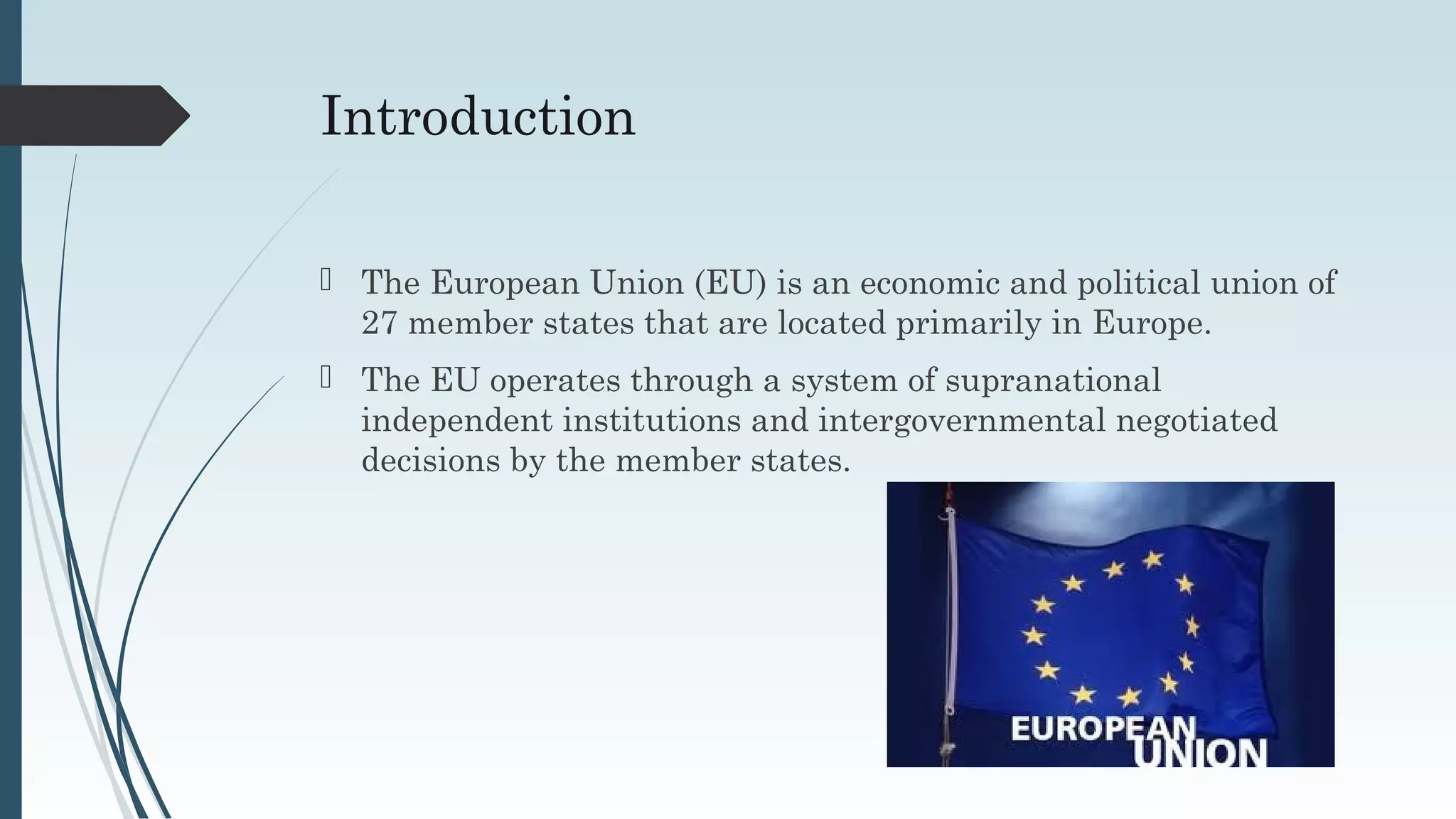
 The European Union (EU) is an economic and political union of
27 member states that are located primarily in Europe.
 The EU operates through a system of supranational
independent institutions and intergovernmental negotiated
decisions by the member states.
 The EU's capital is Brussels. (in practice but not necessarily
ordained by law)
 The EU traces its origins from the European Coal and Steel
Community (ECSC) and the European Economic Community
(EEC), formed by the Inner Six countries in 1951 and 1958
respectively
 The EU has developed a single market through a standardised
system of laws that apply in all member states. Within the
Schengen Area (which includes 22 EU and 4 non-EU states)
passport controls have been abolished.
 EU policies aim to ensure the free movement of people, goods,
services, and capital, enact legislation in justice and home affairs,
and maintain common policies on trade, agriculture, fisheries and
regional development
 A monetary union, the Eurozone, was established in 1999 and is
composed of 17 member states.
 Permanent diplomatic missions have been established around the
world. The EU is represented at the United Nations, the WTO, the
G8 and the G-20.
 With a combined population of over 500 million inhabitants, or
7.3% of the world population, the EU, in 2011, generated a nominal
gross domestic product (GDP) of 17.6 trillion US dollars,
representing approximately 20% of the global GDP when measured
in terms of purchasing power parity.
 The European Union received the 2012 Nobel Peace Prize for
having "contributed to the advancement of peace and reconciliation,
democracy and human rights in Europe.“
The European Union (EU) is governed by seven institutions:
1.the European Parliament,
2.the European Council,
3.the Council of the European Union (simply called "Council"),
4.the European Commission,
5.the Court of Justice of the European Union,
6.the European Central Bank
7.the Court of Auditors.
1.European Parliament
 Legislative (similar to lower house)
 acts together with the Council as a legislature
 shares with the Council the budgetary power
and decides in the last instance on the general
budget of the EU.
 exerts the democratic control over EU institutions including
the European Commission and appoints the Commission members
 based and plenary sessions in Strasbourg, General Secretariat in
Luxembourg, primarily meets in Brussels
2. European Council
 Sets impetus and direction
 Summit of the Heads of Government, chaired by the
President of the European Council)
 Gives the necessary impetus for the development and sets
out general objectives and priorities
 Will not legislate
 Based in Brussels
3. Council of the European Union
 Legislative (similar to upper house)
 Acts together with the Parliament as a legislature
 Exerts together with the Parliament the budgetary power
 Ensures coordination of the broad economic and social
policy and sets out guidelines for the Common Foreign and
Security Policy (CFSP)
 Conclude international agreements
 Based in Brussels
4.European Commission
 Executive
 Is the "government"
 Submits proposals for new legislation to the Parliament and to the
Council
 Implements EU policy and administers the budget
 Ensures compliance with EU law
 Negotiates international treaties
 Based in Brussels
5.Court of Justice of the European Union
 Judiciary
 Ensure uniformity of interpretation of European law
 Has the power to decide legal disputes between EU member
states, EU institutions, businesses and individuals
 Based in Luxembourg
6.European Court of Auditors
 Financial auditor
 Examines the proper use of revenue and expenditure of the
EU institutions (see also Budget of the European Union)
 Based in Luxembourg
7.European Central Bank
 Monetary executive (central bank)
 Forms together with the national central banks the European
System of Central Banks and thereby determining the
monetary policy of the EU
 Ensures price stability in the Eurozone
by controlling the money supply
 Based in Frankfurt
Competences
 The distribution of competences in various policy areas
between Member States and the Union is divided in the
following three categories:
1. Exclusive competence
2. Shared competence
3. Supporting competence
1.Exclusive competence
The Union has exclusive competence to make directives and conclude
international agreements when provided for in a Union legislative act.
The customs union
The establishing of the competition rules necessary for the
functioning of the internal market
Monetary policy for the Member States whose currency is the euro
The conservation of marine biological resources under the common
fisheries policy
Common commercial policy
Conclusion of certain international agreements
2.Shared competence
1.Member States cannot exercise competence in areas where the Union has done
so.
the internal market
social policy, for the aspects defined in this Treaty
economic, social and territorial cohesion
agriculture and fisheries, excluding the conservation of marine biological
resources
environment
consumer protection
transport
trans-European networks
energy
the area of freedom, security and justice
common safety concerns in public health matters, for the aspects defined in this
Treaty
2.Union exercise of competence shall not result in Member States
being prevented from exercising theirs in:
Research, technological development and space
Development cooperation, humanitarian aid
3.The Union coordinates Member States policies or implements
supplemental to theirs common policies, not covered elsewhere:
Coordination of economic, employment and social policies
Common foreign, security and defence policies
3.Supporting competence
The Union can carry out actions to support, coordinate or supplement
Member States' actions in:
The protection and improvement of human health
Industry
Culture
Tourism
Education, youth, sport and vocational training
Civil protection (disaster prevention)
Administrative cooperation
Economy
 The EU has established a single market across the territory of all its
members. A monetary union, the Eurozone, using a single currency
comprises 17 member states.
 In 2011 the EU had a combined GDP of 17.57 trillion international
dollars, a 20% share of the global gross domestic product (in terms of
purchasing power parity).
 In 2007, unemployment in the EU stood at 7% while investment was
at 21.4% of GDP, inflation at 2.2%, and current account balance at
−0.9% of GDP (i.e., slightly more import than export).
 In 2012, unemployment in the EU stand, per August 2012, at 11.4%.
 There is a significant variance for GDP (PPP) per capita within
individual EU states, these range from €11,300 to €69,800.
Internal market
 Two of the original core objectives of the European Economic
Community were the development of a common market, subsequently
renamed the single market, and a customs union between its member
states.
 The single market involves the free circulation of goods, capital,
people and services within the EU, and the customs union involves the
application of a common external tariff on all goods entering the
market.
 Once goods have been admitted into the market they
cannot be subjected to customs duties, discriminatory
taxes or import quotas, as they travel internally.
Competition
 The EU operates a competition policy intended to ensure
undistorted competition within the single market.
 The Commission as the competition regulator for the
single market is responsible for antitrust issues, approving
mergers, breaking up cartels, working for economic
liberalisation and preventing state aid.
Largest population centres of European
Union
Rank City name State Pop.
London
Paris
1 London United Kingdom 11,905,500
Madrid
Berlin
2 Paris France 11,532,409
3 Madrid Spain 5,804,829
4 Berlin Germany 4,971,331
5 Barcelona Spain 4,440,629
6 Athens Greece 4,013,368
7 Rome Italy 3,457,690
8 Hamburg Germany 3,134,620
9 Milan Italy 3,076,643
10 Katowice Poland 2,710,397
Languages
 Important documents, such as legislation, are translated into
every official language.
 The European Parliament provides translation into all
languages for documents and its plenary sessions.
 Some institutions use only a handful of languages as internal
working languages.
 English is the most spoken language in the EU, it is spoken
by 51% of the EU population when counting both native and
non-native speakers.
 German is the most widely spoken mother tongue (about 88.7
million people as of 2006).
Published in June 2012.
Survey conducted in
February - March 2012.
Native: Native language
Total: EU citizens able to hold a
conversation in this language
European official languages report (EU-27)
Language Native Speakers Total
German 16% 27%
English 13% 51%
French 12% 24%
Italian 13% 16%
Spanish 8% 15%
Polish 8% 9%
Romanian 5% 5%
Dutch 4% 5%
Hungarian 3% 3%
Portuguese 2% 3%
Czech 2% 3%
Swedish 2% 3%
Greek 2% 2%
Bulgarian 2% 2%
Slovak 1% 2%
Danish 1% 1%
Finnish 1% 1%
Lithuanian 1% 1%
Slovenian <1% <1%
Estonian <1% <1%
Irish <1% <1%
Latvian <1% <1%
Maltese <1% <1%
European union

European union

  • 1.
  • 2.
    Introduction  The EuropeanUnion (EU) is an economic and political union of 27 member states that are located primarily in Europe.  The EU operates through a system of supranational independent institutions and intergovernmental negotiated decisions by the member states.
  • 3.
     The EU'scapital is Brussels. (in practice but not necessarily ordained by law)  The EU traces its origins from the European Coal and Steel Community (ECSC) and the European Economic Community (EEC), formed by the Inner Six countries in 1951 and 1958 respectively  The EU has developed a single market through a standardised system of laws that apply in all member states. Within the Schengen Area (which includes 22 EU and 4 non-EU states) passport controls have been abolished.
  • 4.
     EU policiesaim to ensure the free movement of people, goods, services, and capital, enact legislation in justice and home affairs, and maintain common policies on trade, agriculture, fisheries and regional development  A monetary union, the Eurozone, was established in 1999 and is composed of 17 member states.  Permanent diplomatic missions have been established around the world. The EU is represented at the United Nations, the WTO, the G8 and the G-20.
  • 5.
     With acombined population of over 500 million inhabitants, or 7.3% of the world population, the EU, in 2011, generated a nominal gross domestic product (GDP) of 17.6 trillion US dollars, representing approximately 20% of the global GDP when measured in terms of purchasing power parity.  The European Union received the 2012 Nobel Peace Prize for having "contributed to the advancement of peace and reconciliation, democracy and human rights in Europe.“
  • 6.
    The European Union(EU) is governed by seven institutions: 1.the European Parliament, 2.the European Council, 3.the Council of the European Union (simply called "Council"), 4.the European Commission, 5.the Court of Justice of the European Union, 6.the European Central Bank 7.the Court of Auditors.
  • 7.
    1.European Parliament  Legislative(similar to lower house)  acts together with the Council as a legislature  shares with the Council the budgetary power and decides in the last instance on the general budget of the EU.  exerts the democratic control over EU institutions including the European Commission and appoints the Commission members  based and plenary sessions in Strasbourg, General Secretariat in Luxembourg, primarily meets in Brussels
  • 8.
    2. European Council Sets impetus and direction  Summit of the Heads of Government, chaired by the President of the European Council)  Gives the necessary impetus for the development and sets out general objectives and priorities  Will not legislate  Based in Brussels
  • 9.
    3. Council ofthe European Union  Legislative (similar to upper house)  Acts together with the Parliament as a legislature  Exerts together with the Parliament the budgetary power  Ensures coordination of the broad economic and social policy and sets out guidelines for the Common Foreign and Security Policy (CFSP)  Conclude international agreements  Based in Brussels
  • 10.
    4.European Commission  Executive Is the "government"  Submits proposals for new legislation to the Parliament and to the Council  Implements EU policy and administers the budget  Ensures compliance with EU law  Negotiates international treaties  Based in Brussels
  • 11.
    5.Court of Justiceof the European Union  Judiciary  Ensure uniformity of interpretation of European law  Has the power to decide legal disputes between EU member states, EU institutions, businesses and individuals  Based in Luxembourg
  • 12.
    6.European Court ofAuditors  Financial auditor  Examines the proper use of revenue and expenditure of the EU institutions (see also Budget of the European Union)  Based in Luxembourg
  • 13.
    7.European Central Bank Monetary executive (central bank)  Forms together with the national central banks the European System of Central Banks and thereby determining the monetary policy of the EU  Ensures price stability in the Eurozone by controlling the money supply  Based in Frankfurt
  • 14.
    Competences  The distributionof competences in various policy areas between Member States and the Union is divided in the following three categories: 1. Exclusive competence 2. Shared competence 3. Supporting competence
  • 15.
    1.Exclusive competence The Unionhas exclusive competence to make directives and conclude international agreements when provided for in a Union legislative act. The customs union The establishing of the competition rules necessary for the functioning of the internal market Monetary policy for the Member States whose currency is the euro The conservation of marine biological resources under the common fisheries policy Common commercial policy Conclusion of certain international agreements
  • 16.
    2.Shared competence 1.Member Statescannot exercise competence in areas where the Union has done so. the internal market social policy, for the aspects defined in this Treaty economic, social and territorial cohesion agriculture and fisheries, excluding the conservation of marine biological resources environment consumer protection transport trans-European networks energy the area of freedom, security and justice common safety concerns in public health matters, for the aspects defined in this Treaty
  • 17.
    2.Union exercise ofcompetence shall not result in Member States being prevented from exercising theirs in: Research, technological development and space Development cooperation, humanitarian aid 3.The Union coordinates Member States policies or implements supplemental to theirs common policies, not covered elsewhere: Coordination of economic, employment and social policies Common foreign, security and defence policies
  • 18.
    3.Supporting competence The Unioncan carry out actions to support, coordinate or supplement Member States' actions in: The protection and improvement of human health Industry Culture Tourism Education, youth, sport and vocational training Civil protection (disaster prevention) Administrative cooperation
  • 19.
    Economy  The EUhas established a single market across the territory of all its members. A monetary union, the Eurozone, using a single currency comprises 17 member states.  In 2011 the EU had a combined GDP of 17.57 trillion international dollars, a 20% share of the global gross domestic product (in terms of purchasing power parity).  In 2007, unemployment in the EU stood at 7% while investment was at 21.4% of GDP, inflation at 2.2%, and current account balance at −0.9% of GDP (i.e., slightly more import than export).  In 2012, unemployment in the EU stand, per August 2012, at 11.4%.  There is a significant variance for GDP (PPP) per capita within individual EU states, these range from €11,300 to €69,800.
  • 20.
    Internal market  Twoof the original core objectives of the European Economic Community were the development of a common market, subsequently renamed the single market, and a customs union between its member states.  The single market involves the free circulation of goods, capital, people and services within the EU, and the customs union involves the application of a common external tariff on all goods entering the market.  Once goods have been admitted into the market they cannot be subjected to customs duties, discriminatory taxes or import quotas, as they travel internally.
  • 21.
    Competition  The EUoperates a competition policy intended to ensure undistorted competition within the single market.  The Commission as the competition regulator for the single market is responsible for antitrust issues, approving mergers, breaking up cartels, working for economic liberalisation and preventing state aid.
  • 22.
    Largest population centresof European Union Rank City name State Pop. London Paris 1 London United Kingdom 11,905,500 Madrid Berlin 2 Paris France 11,532,409 3 Madrid Spain 5,804,829 4 Berlin Germany 4,971,331 5 Barcelona Spain 4,440,629 6 Athens Greece 4,013,368 7 Rome Italy 3,457,690 8 Hamburg Germany 3,134,620 9 Milan Italy 3,076,643 10 Katowice Poland 2,710,397
  • 23.
    Languages  Important documents,such as legislation, are translated into every official language.  The European Parliament provides translation into all languages for documents and its plenary sessions.  Some institutions use only a handful of languages as internal working languages.  English is the most spoken language in the EU, it is spoken by 51% of the EU population when counting both native and non-native speakers.  German is the most widely spoken mother tongue (about 88.7 million people as of 2006).
  • 24.
    Published in June2012. Survey conducted in February - March 2012. Native: Native language Total: EU citizens able to hold a conversation in this language European official languages report (EU-27) Language Native Speakers Total German 16% 27% English 13% 51% French 12% 24% Italian 13% 16% Spanish 8% 15% Polish 8% 9% Romanian 5% 5% Dutch 4% 5% Hungarian 3% 3% Portuguese 2% 3% Czech 2% 3% Swedish 2% 3% Greek 2% 2% Bulgarian 2% 2% Slovak 1% 2% Danish 1% 1% Finnish 1% 1% Lithuanian 1% 1% Slovenian <1% <1% Estonian <1% <1% Irish <1% <1% Latvian <1% <1% Maltese <1% <1%