Multifunctional
Approaches in EU
policies
Laurent Bochereau
Head of Science, Technology and Environment Section
European Union Delegation to China
1. The Common Agriculture Policy (CAP)
2. The CAP and Sustainability
3. Research and Innovation under Horizon 2020
4. Looking Ahead
2
Outline
THE CAPTHE CAP
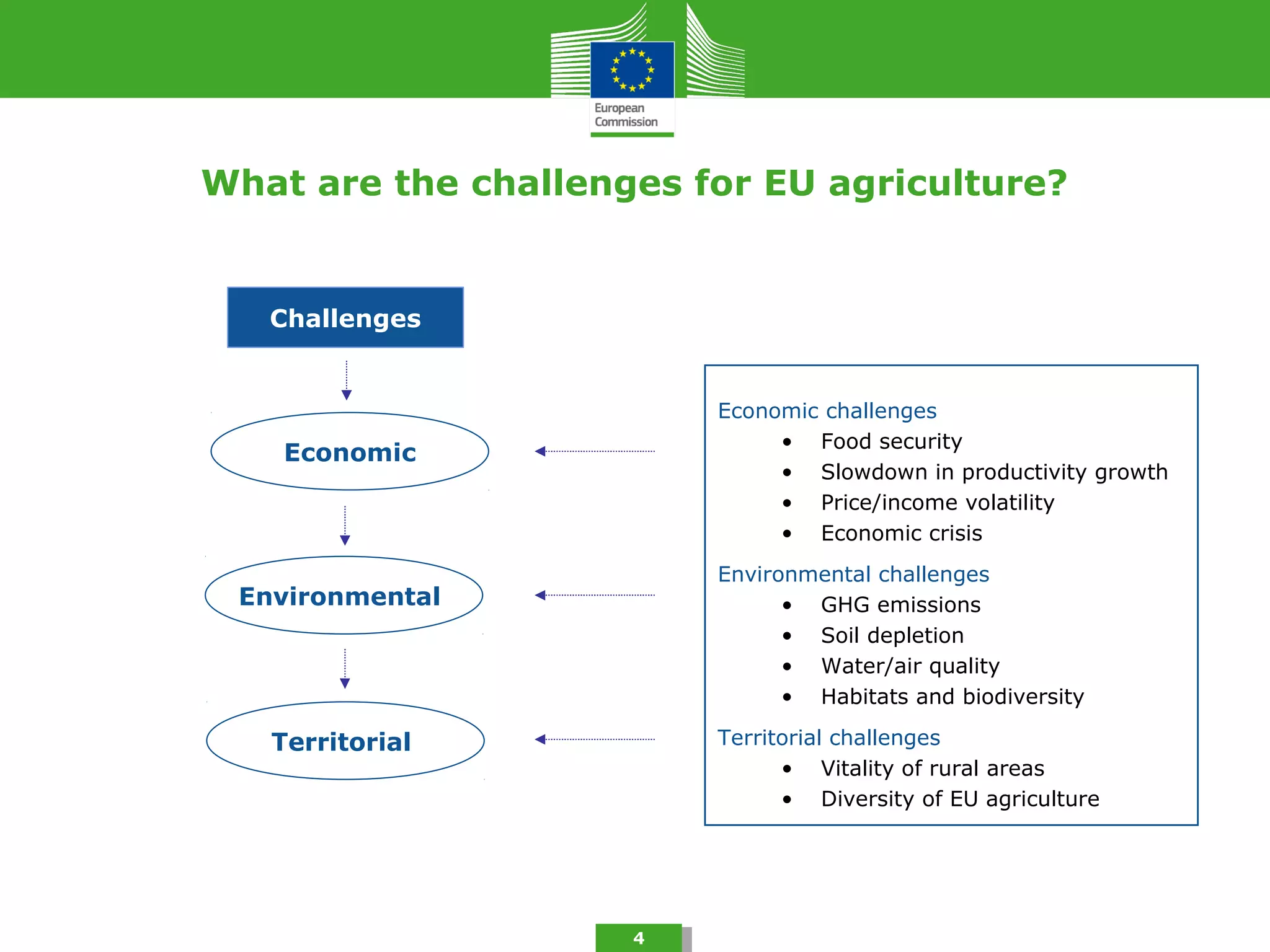
What are the challenges for EU agriculture?
4
Economic challenges
• Food security
• Slowdown in productivity growth
• Price/income volatility
• Economic crisis
Environmental challenges
• GHG emissions
• Soil depletion
• Water/air quality
• Habitats and biodiversity
Territorial challenges
• Vitality of rural areas
• Diversity of EU agriculture
Challenges
Environmental
Economic
Territorial
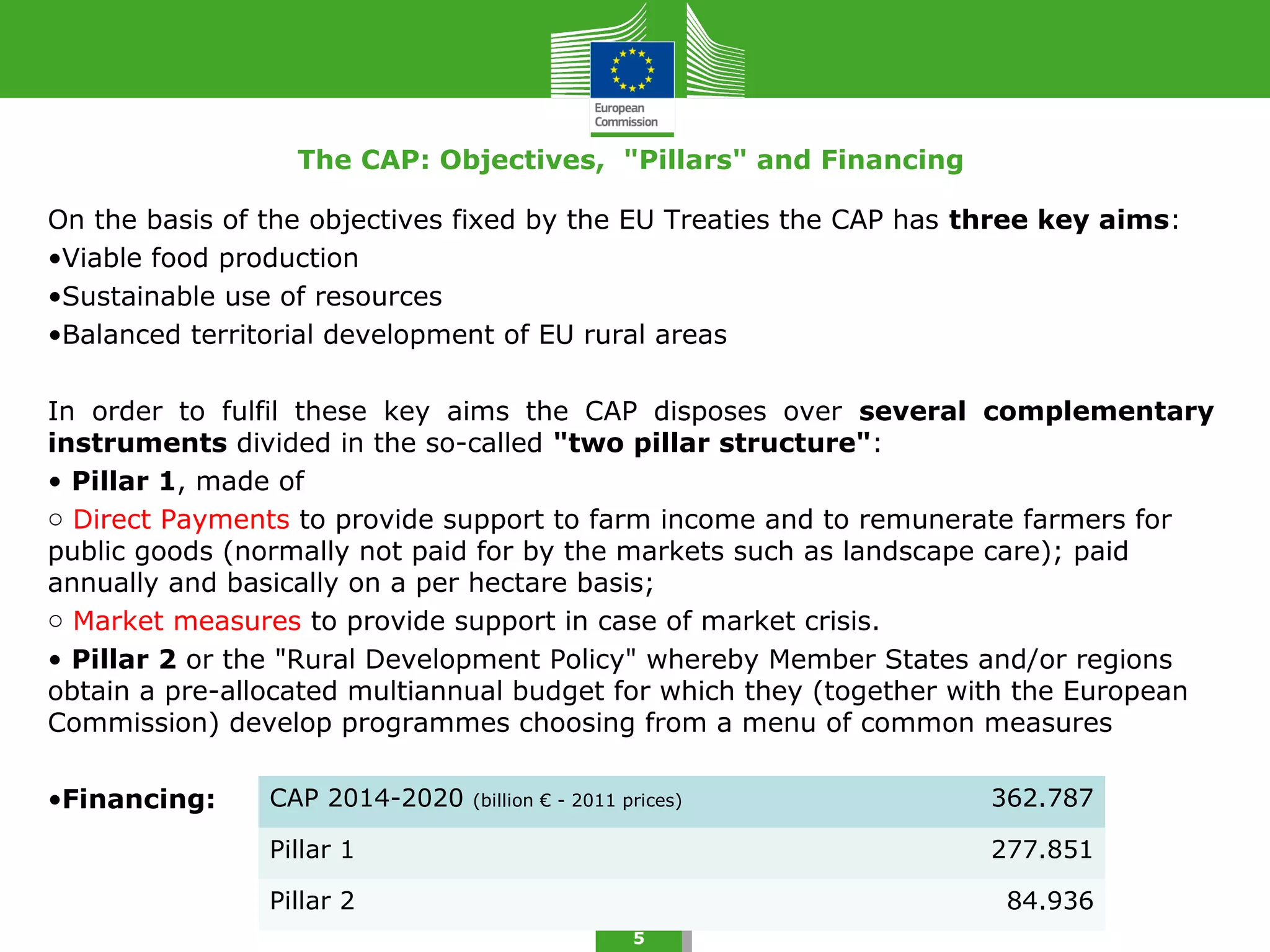
On the basis of the objectives fixed by the EU Treaties the CAP has three key aims:
•Viable food production
•Sustainable use of resources
•Balanced territorial development of EU rural areas
In order to fulfil these key aims the CAP disposes over several complementary
instruments divided in the so-called "two pillar structure":
• Pillar 1, made of
o Direct Payments to provide support to farm income and to remunerate farmers for
public goods (normally not paid for by the markets such as landscape care); paid
annually and basically on a per hectare basis;
o Market measures to provide support in case of market crisis.
• Pillar 2 or the "Rural Development Policy" whereby Member States and/or regions
obtain a pre-allocated multiannual budget for which they (together with the European
Commission) develop programmes choosing from a menu of common measures
•Financing:
5
The CAP: Objectives, "Pillars" and Financing
CAP 2014-2020 (billion € - 2011 prices) 362.787
Pillar 1 277.851
Pillar 2 84.936
THE CAP ANDTHE CAP AND
SUSTAINABILITYSUSTAINABILITY
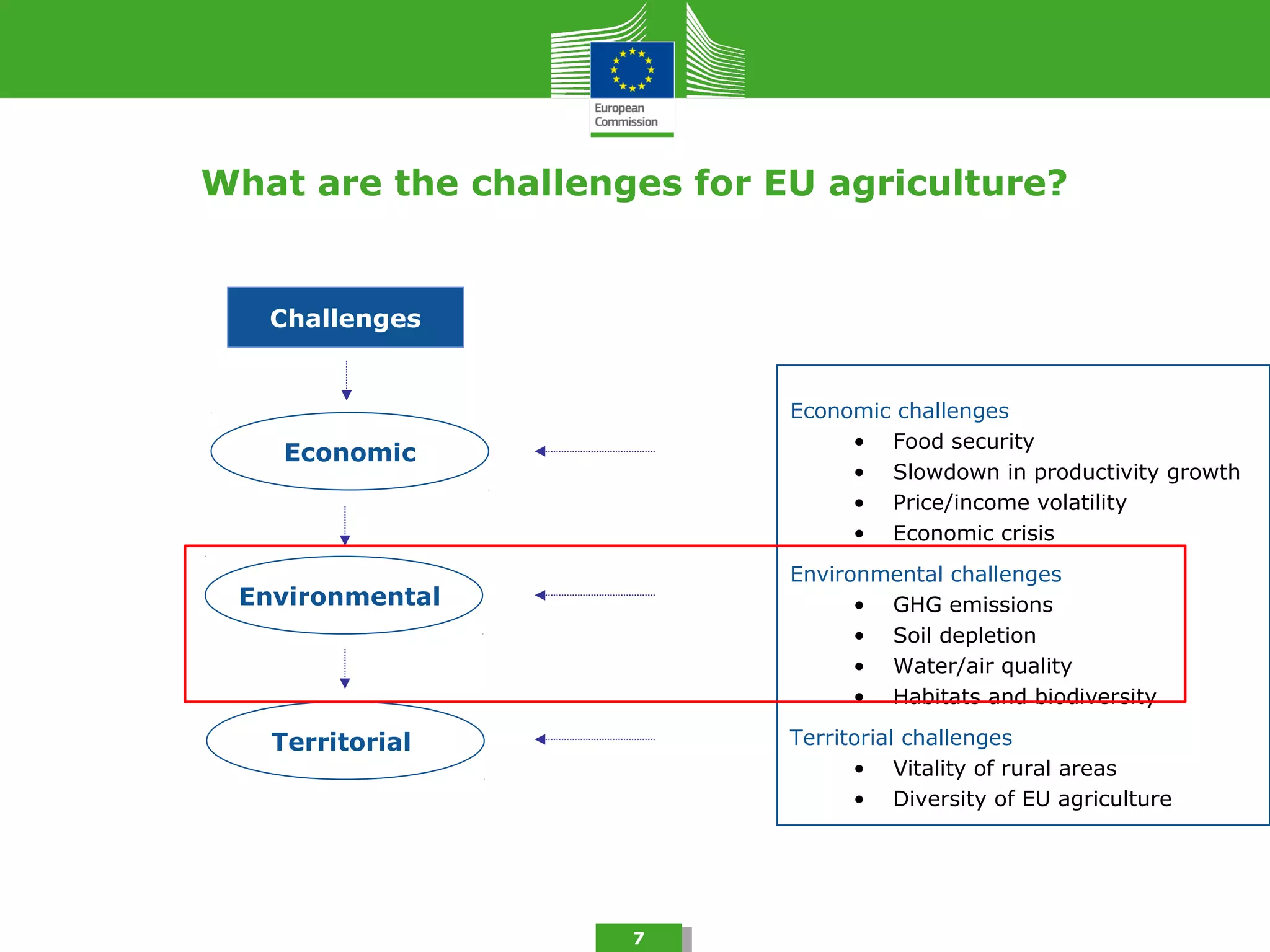
What are the challenges for EU agriculture?
7
Economic challenges
• Food security
• Slowdown in productivity growth
• Price/income volatility
• Economic crisis
Environmental challenges
• GHG emissions
• Soil depletion
• Water/air quality
• Habitats and biodiversity
Territorial challenges
• Vitality of rural areas
• Diversity of EU agriculture
Challenges
Environmental
Economic
Territorial
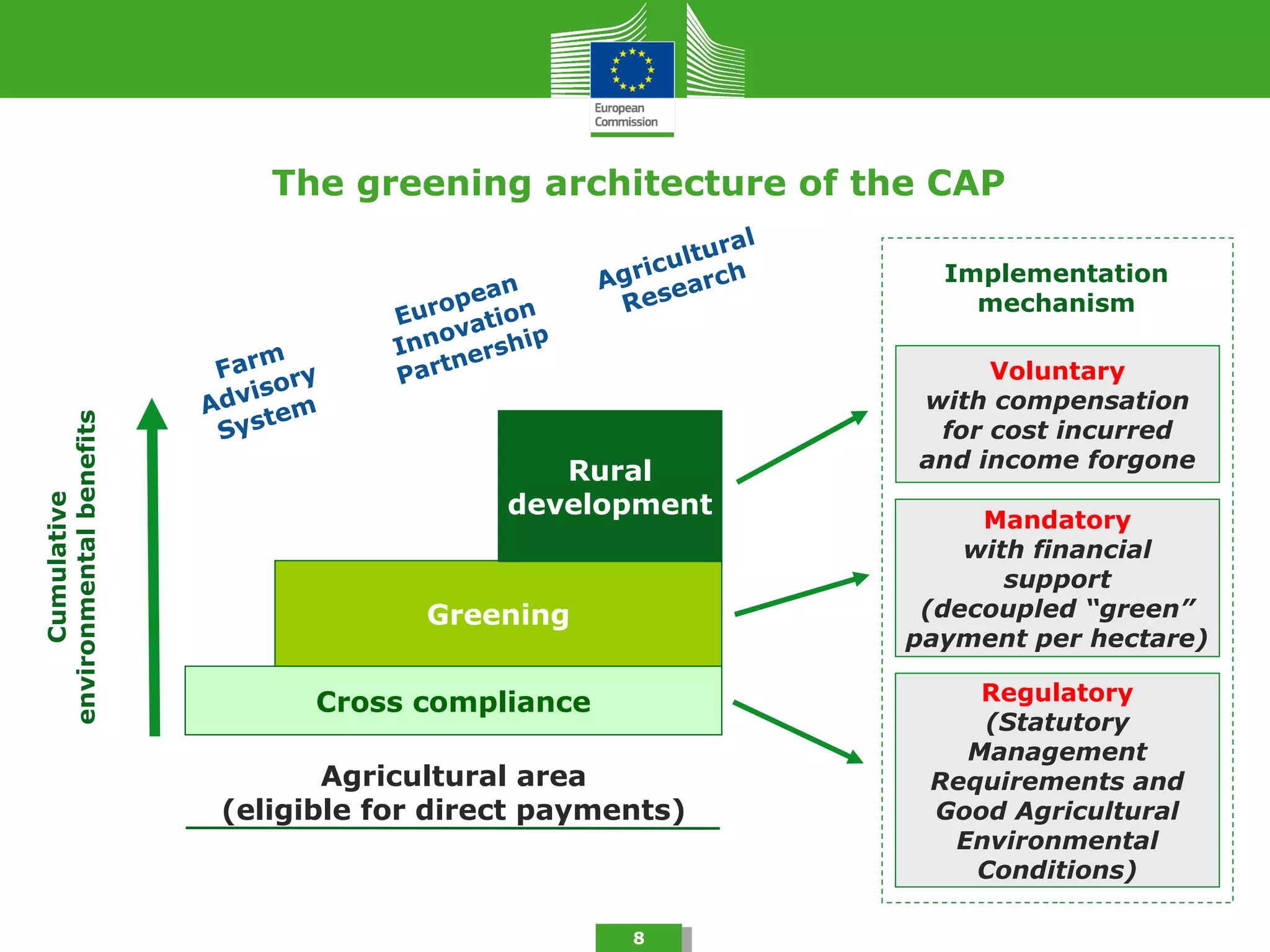
The greening architecture of the CAP
8
Agricultural area
(eligible for direct payments)
Cross compliance
Greening
Rural
development
Cumulative
environmentalbenefits
Regulatory
(Statutory
Management
Requirements and
Good Agricultural
Environmental
Conditions)
Mandatory
with financial
support
(decoupled “green”
payment per hectare)
Voluntary
with compensation
for cost incurred
and income forgone
Implementation
mechanism
Agricultural
Research
European
Innovation
Partnership
Farm
Advisory
System
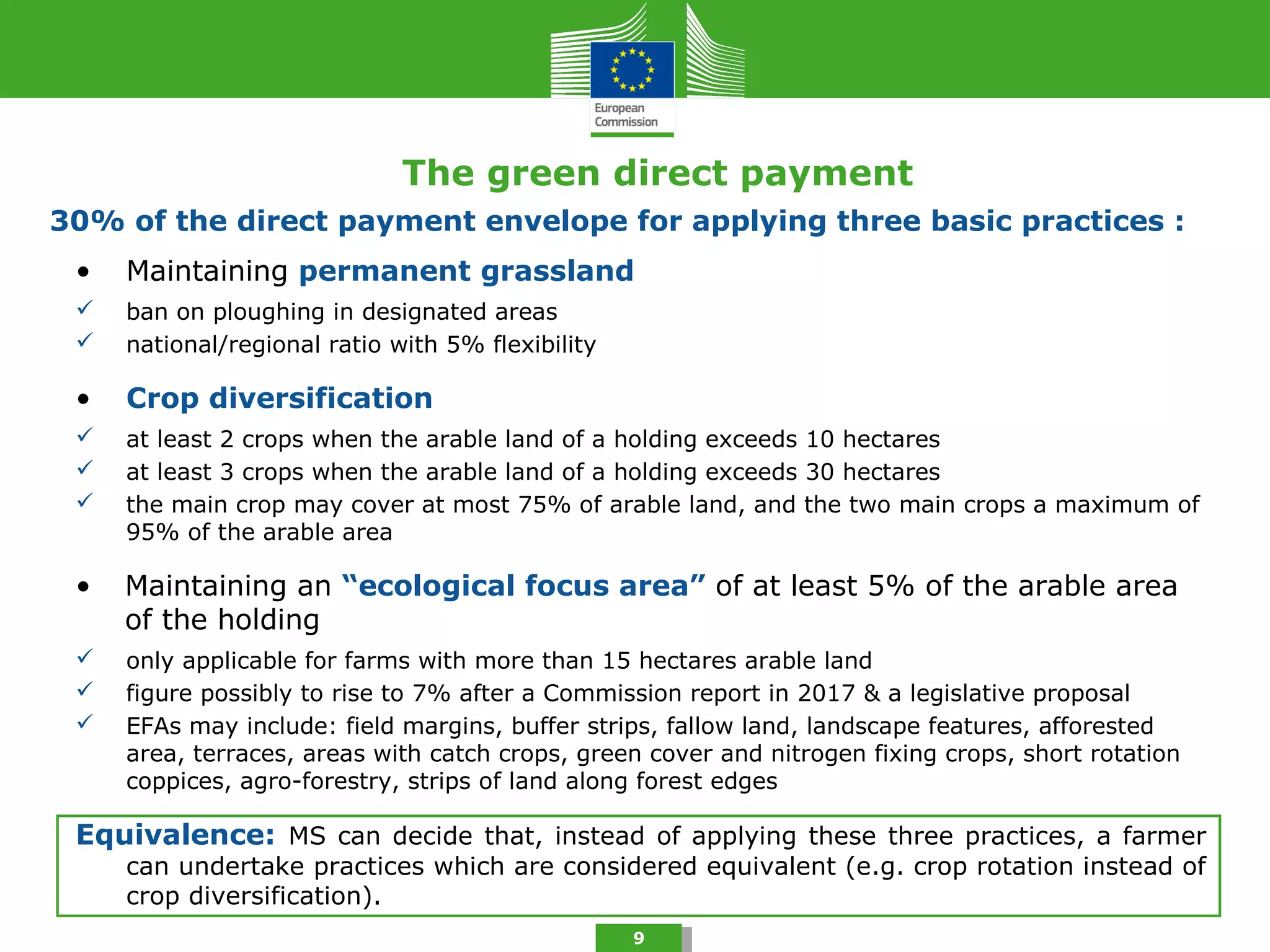
The green direct payment
9
• Maintaining permanent grassland
 ban on ploughing in designated areas
 national/regional ratio with 5% flexibility
• Crop diversification
 at least 2 crops when the arable land of a holding exceeds 10 hectares
 at least 3 crops when the arable land of a holding exceeds 30 hectares
 the main crop may cover at most 75% of arable land, and the two main crops a maximum of
95% of the arable area
• Maintaining an “ecological focus area” of at least 5% of the arable area
of the holding
 only applicable for farms with more than 15 hectares arable land
 figure possibly to rise to 7% after a Commission report in 2017 & a legislative proposal
 EFAs may include: field margins, buffer strips, fallow land, landscape features, afforested
area, terraces, areas with catch crops, green cover and nitrogen fixing crops, short rotation
coppices, agro-forestry, strips of land along forest edges
Equivalence: MS can decide that, instead of applying these three practices, a farmer
can undertake practices which are considered equivalent (e.g. crop rotation instead of
crop diversification).
30% of the direct payment envelope for applying three basic practices :
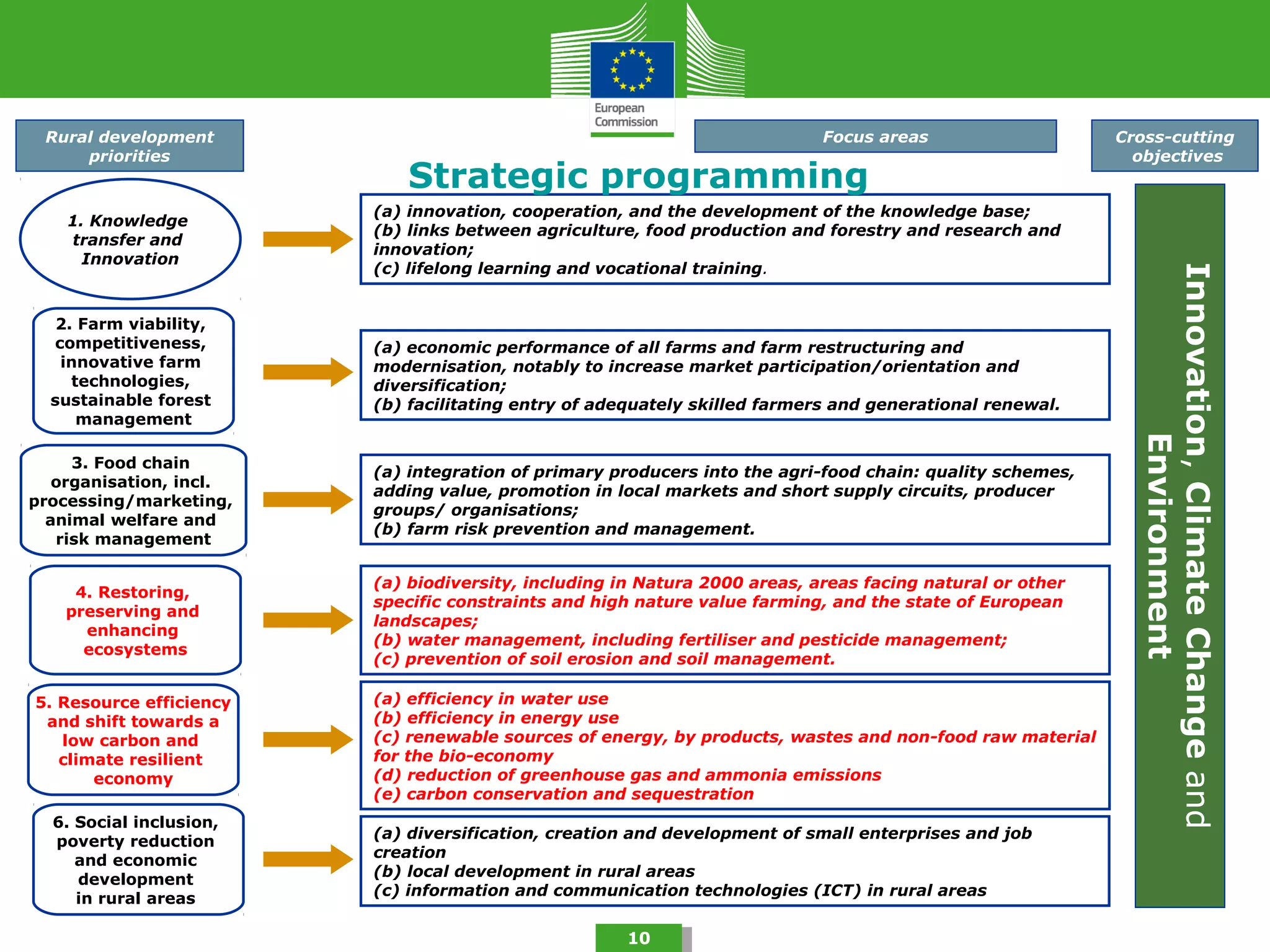
6. Social inclusion,
poverty reduction
and economic
development
in rural areas
2. Farm viability,
competitiveness,
innovative farm
technologies,
sustainable forest
management
3. Food chain
organisation, incl.
processing/marketing,
animal welfare and
risk management
4. Restoring,
preserving and
enhancing
ecosystems
5. Resource efficiency
and shift towards a
low carbon and
climate resilient
economy
1. Knowledge
transfer and
Innovation
Rural development
priorities
Focus areas
Innovation,ClimateChangeand
Environment
Cross-cutting
objectives
(a) innovation, cooperation, and the development of the knowledge base;
(b) links between agriculture, food production and forestry and research and
innovation;
(c) lifelong learning and vocational training.
(a) economic performance of all farms and farm restructuring and
modernisation, notably to increase market participation/orientation and
diversification;
(b) facilitating entry of adequately skilled farmers and generational renewal.
(a) integration of primary producers into the agri-food chain: quality schemes,
adding value, promotion in local markets and short supply circuits, producer
groups/ organisations;
(b) farm risk prevention and management.
(a) biodiversity, including in Natura 2000 areas, areas facing natural or other
specific constraints and high nature value farming, and the state of European
landscapes;
(b) water management, including fertiliser and pesticide management;
(c) prevention of soil erosion and soil management.
(a) efficiency in water use
(b) efficiency in energy use
(c) renewable sources of energy, by products, wastes and non-food raw material
for the bio-economy
(d) reduction of greenhouse gas and ammonia emissions
(e) carbon conservation and sequestration
(a) diversification, creation and development of small enterprises and job
creation
(b) local development in rural areas
(c) information and communication technologies (ICT) in rural areas
Strategic programming
10
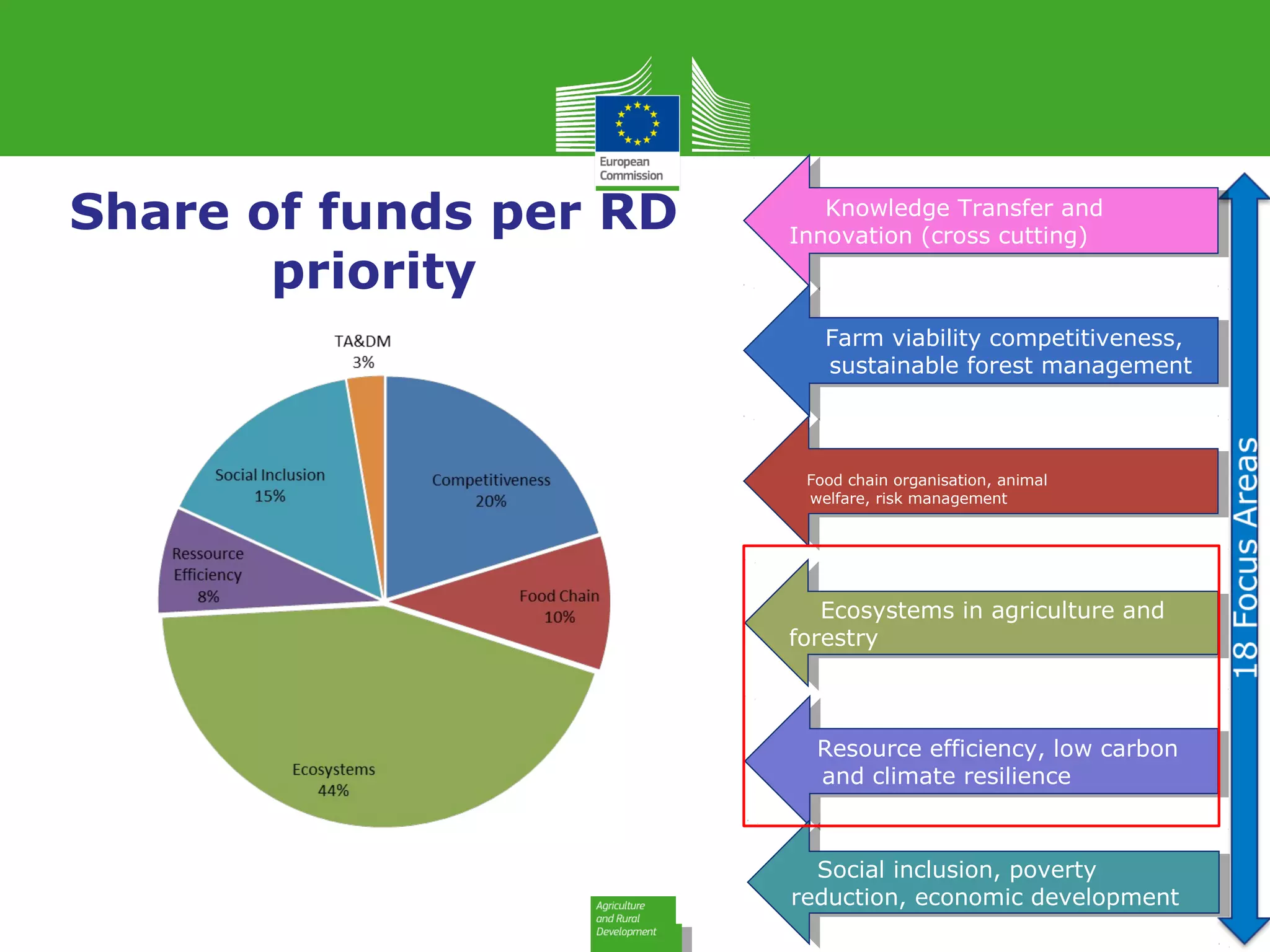
Food chain organisation, animal
welfare, risk management
Food chain organisation, animal
welfare, risk management
Farm viability competitiveness,
sustainable forest management
Farm viability competitiveness,
sustainable forest management
Ecosystems in agriculture and
forestry
Ecosystems in agriculture and
forestry
Resource efficiency, low carbon
and climate resilience
Resource efficiency, low carbon
and climate resilience
Social inclusion, poverty
reduction, economic development
Social inclusion, poverty
reduction, economic development
Knowledge Transfer and
Innovation (cross cutting)
Knowledge Transfer and
Innovation (cross cutting)
Share of funds per RD
priority
• 17.7% of total agricultural land under management contracts supporting
biodiversity and/or landscapes
• 3.46% of total forest area under management contracts supporting
biodiversity
• 7.7% of total agricultural land under management contracts targeting
reduction of GHG and/or ammonia emissions
• 2% of Livestock Units concerned by investments in live-stock management
in view of reducing GHG and/or ammonia emissions
• € 2.7 Billion total investment in renewable energy production
 Comprehensive monitoring and evaluation framework
 Support by external contractors
 Regular reporting
12
Sustainability Targets under Rural Development
Research and InnovationResearch and Innovation
Seeking new research results and their translation into practice boosts
competitiveness and sustainability at the same time:
• Through Horizon 2020, the EU framework programme for research and
innovation, we have nearly doubled our efforts on food, agriculture, forestry and
marine research to nearly 4 billion euros for the period 2014 to 2020.
• The Rural Development Programmes support innovation, through
collaboration and networking, but also through synergies with the
"European Innovation Partnership 'Agricultural Productivity and Sustainability"
to speed up innovation on the ground
14
Importance of research and innovation
Open to the world
Horizon 2020: Three priorities
地平线 2020 : 三个优先任务
1- Excellent1- Excellent
sciencescience
卓越的科学卓越的科学
2- Industrial2- Industrial
leadershipleadership
产业引导产业引导
3- Societal3- Societal
challengeschallenges
社会挑战社会挑战
Society driven:
Address
concerns of
citizens and
society/EU
policy objectives
Multidisciplinary
collaborations
社会驱动:解决社
会和公民的关切和
欧盟的政策目标
Industry driven:
Strategic
investments in
key technologies
Support to
innovative
companies
产业驱动:为核心科
技提供战略投资,对
创新型企业给予支持
Researchers driven:
Excellent science is the
foundation of
tomorrow’s
technologies, jobs and
wellbeing
研究驱动:卓越的科学是未
来科技,就业及福利的基本
保障
Priority 3: Societal Challenges
Why:
•Concerns of citizens and society
EU policy objectives
(climate, environment, energy,
transport etc.) cannot be
achieved without innovation
•Breakthrough solutions
come from multi-disciplinary
collaborations, including social
sciences & humanities
•Promising solutions need to be
tested, demonstrated and
scaled up
Health, demographic change and
wellbeing
7.472
Food security, sustainable agriculture,
marine and maritime and inland water
research and the bioeconomy
3.851
Secure, clean and efficient energy 5.931
Smart, green and integrated transport 6.339
Climate action, environment, resource
efficiency and raw materials
3.081
Inclusive, innovative and reflective
societies
1.310
Secure societies 1.695
Science with and for society 462
Spreading excellence and widening
participation
816
€31 Billion
17
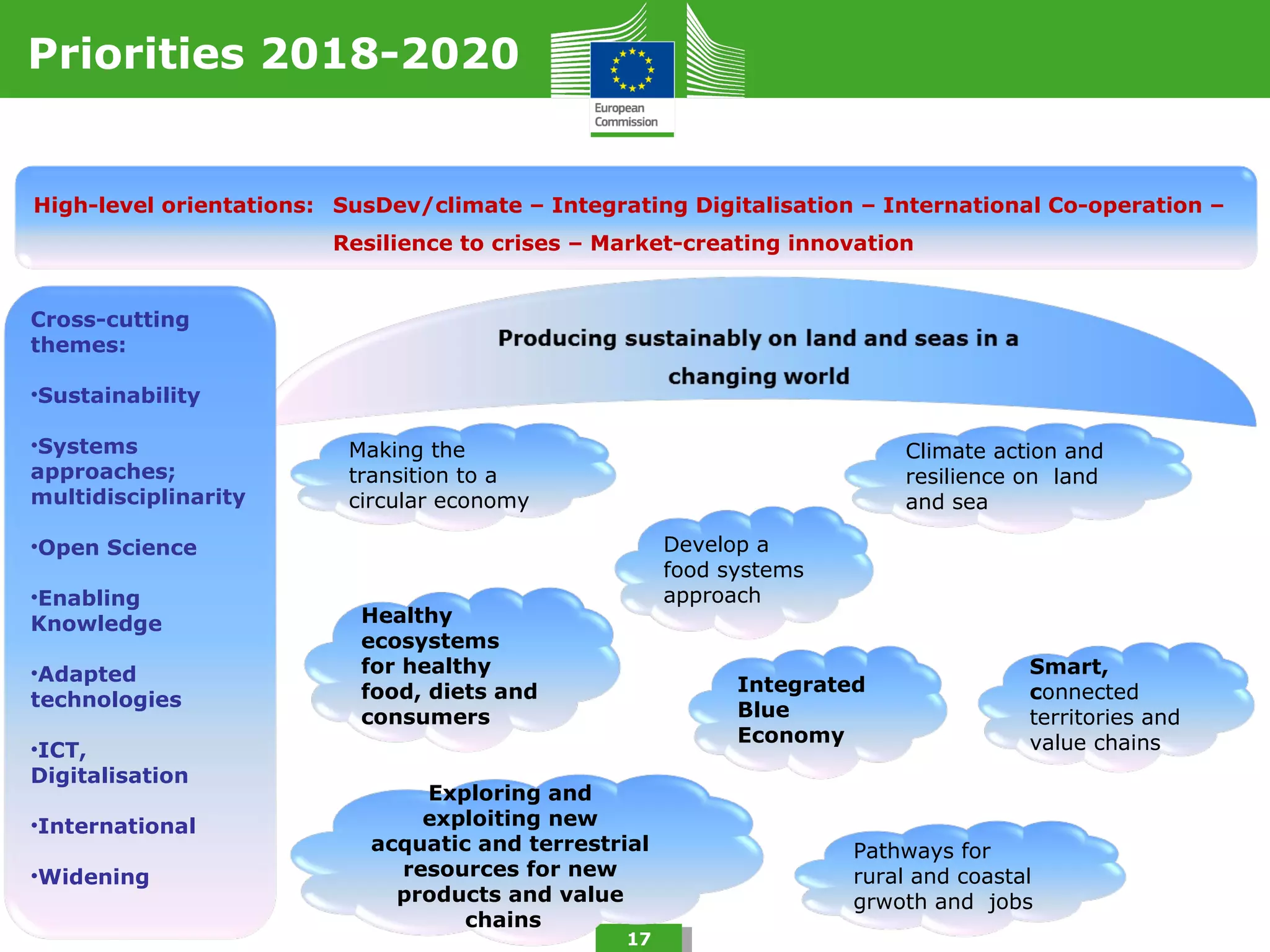
High-level orientations: SusDev/climate – Integrating Digitalisation – International Co-operation –
Resilience to crises – Market-creating innovation
Making the
transition to a
circular economy
Climate action and
resilience on land
and sea
Develop a
food systems
approach
Smart,
connected
territories and
value chains
Healthy
ecosystems
for healthy
food, diets and
consumers
Pathways for
rural and coastal
grwoth and jobs
Exploring and
exploiting new
acquatic and terrestrial
resources for new
products and value
chains
Priorities 2018-2020
Cross-cutting
themes:
•Sustainability
•Systems
approaches;
multidisciplinarity
•Open Science
•Enabling
Knowledge
•Adapted
technologies
•ICT,
Digitalisation
•International
•Widening
Integrated
Blue
Economy
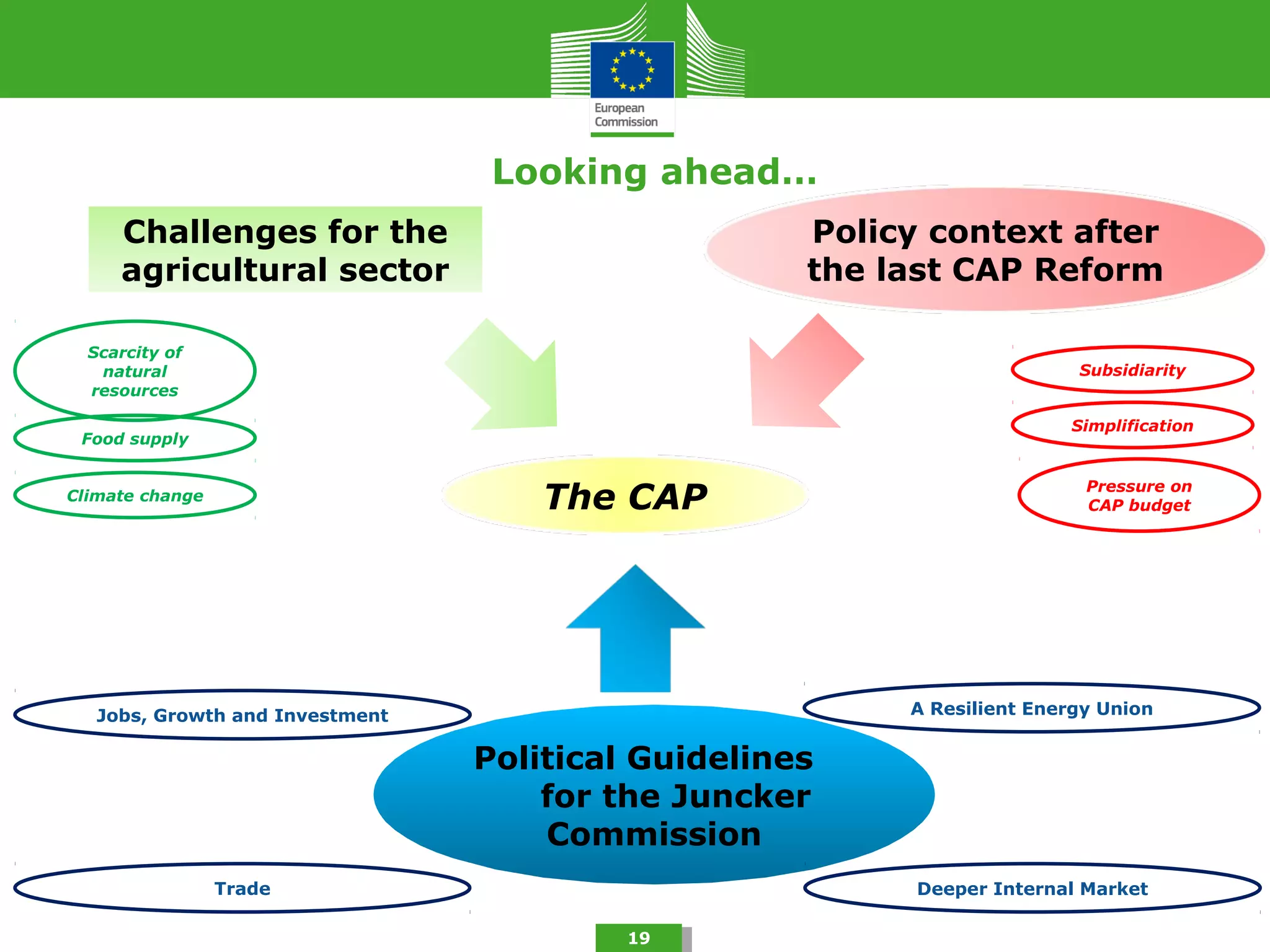
LOOKING AHEADLOOKING AHEAD
Looking ahead…
Challenges for the
agricultural sector
19
Policy context after
the last CAP Reform
Jobs, Growth and Investment
Political Guidelines
for the Juncker
Commission
A Resilient Energy Union
Trade Deeper Internal Market
Food supply
Scarcity of
natural
resources
Climate change
Subsidiarity
Simplification
Pressure on
CAP budgetThe CAP
A New Strategic Approach to
EU Agricultural Research and
Innovation
Why a new strategy for agricultural, research and innovation?
What priority areas for research and innovation?
How will the strategy be implemented?
> Importance of International Dimension
20
For further information
The CAP in one click
http://ec.europa.eu/agriculture/index_en.htm
Agriculture and Environment
http://ec.europa.eu/agriculture/envir/index_en.htm
Horizon 2020
http://ec.europa.eu/programmes/horizon2020/en
New Strategy for Agricultural Research and Innovation
https://ec.europa.eu/programmes/horizon2020/en/news/final-paper-strategic-
approach-eu-agricultural-research-and-innovation
21

Multifunctional Approaches in EU policies

  • 1.
    Multifunctional Approaches in EU policies LaurentBochereau Head of Science, Technology and Environment Section European Union Delegation to China
  • 2.
    1. The CommonAgriculture Policy (CAP) 2. The CAP and Sustainability 3. Research and Innovation under Horizon 2020 4. Looking Ahead 2 Outline
  • 3.
  • 4.
    What are thechallenges for EU agriculture? 4 Economic challenges • Food security • Slowdown in productivity growth • Price/income volatility • Economic crisis Environmental challenges • GHG emissions • Soil depletion • Water/air quality • Habitats and biodiversity Territorial challenges • Vitality of rural areas • Diversity of EU agriculture Challenges Environmental Economic Territorial
  • 5.
    On the basisof the objectives fixed by the EU Treaties the CAP has three key aims: •Viable food production •Sustainable use of resources •Balanced territorial development of EU rural areas In order to fulfil these key aims the CAP disposes over several complementary instruments divided in the so-called "two pillar structure": • Pillar 1, made of o Direct Payments to provide support to farm income and to remunerate farmers for public goods (normally not paid for by the markets such as landscape care); paid annually and basically on a per hectare basis; o Market measures to provide support in case of market crisis. • Pillar 2 or the "Rural Development Policy" whereby Member States and/or regions obtain a pre-allocated multiannual budget for which they (together with the European Commission) develop programmes choosing from a menu of common measures •Financing: 5 The CAP: Objectives, "Pillars" and Financing CAP 2014-2020 (billion € - 2011 prices) 362.787 Pillar 1 277.851 Pillar 2 84.936
  • 6.
    THE CAP ANDTHECAP AND SUSTAINABILITYSUSTAINABILITY
  • 7.
    What are thechallenges for EU agriculture? 7 Economic challenges • Food security • Slowdown in productivity growth • Price/income volatility • Economic crisis Environmental challenges • GHG emissions • Soil depletion • Water/air quality • Habitats and biodiversity Territorial challenges • Vitality of rural areas • Diversity of EU agriculture Challenges Environmental Economic Territorial
  • 8.
    The greening architectureof the CAP 8 Agricultural area (eligible for direct payments) Cross compliance Greening Rural development Cumulative environmentalbenefits Regulatory (Statutory Management Requirements and Good Agricultural Environmental Conditions) Mandatory with financial support (decoupled “green” payment per hectare) Voluntary with compensation for cost incurred and income forgone Implementation mechanism Agricultural Research European Innovation Partnership Farm Advisory System
  • 9.
    The green directpayment 9 • Maintaining permanent grassland  ban on ploughing in designated areas  national/regional ratio with 5% flexibility • Crop diversification  at least 2 crops when the arable land of a holding exceeds 10 hectares  at least 3 crops when the arable land of a holding exceeds 30 hectares  the main crop may cover at most 75% of arable land, and the two main crops a maximum of 95% of the arable area • Maintaining an “ecological focus area” of at least 5% of the arable area of the holding  only applicable for farms with more than 15 hectares arable land  figure possibly to rise to 7% after a Commission report in 2017 & a legislative proposal  EFAs may include: field margins, buffer strips, fallow land, landscape features, afforested area, terraces, areas with catch crops, green cover and nitrogen fixing crops, short rotation coppices, agro-forestry, strips of land along forest edges Equivalence: MS can decide that, instead of applying these three practices, a farmer can undertake practices which are considered equivalent (e.g. crop rotation instead of crop diversification). 30% of the direct payment envelope for applying three basic practices :
  • 10.
    6. Social inclusion, povertyreduction and economic development in rural areas 2. Farm viability, competitiveness, innovative farm technologies, sustainable forest management 3. Food chain organisation, incl. processing/marketing, animal welfare and risk management 4. Restoring, preserving and enhancing ecosystems 5. Resource efficiency and shift towards a low carbon and climate resilient economy 1. Knowledge transfer and Innovation Rural development priorities Focus areas Innovation,ClimateChangeand Environment Cross-cutting objectives (a) innovation, cooperation, and the development of the knowledge base; (b) links between agriculture, food production and forestry and research and innovation; (c) lifelong learning and vocational training. (a) economic performance of all farms and farm restructuring and modernisation, notably to increase market participation/orientation and diversification; (b) facilitating entry of adequately skilled farmers and generational renewal. (a) integration of primary producers into the agri-food chain: quality schemes, adding value, promotion in local markets and short supply circuits, producer groups/ organisations; (b) farm risk prevention and management. (a) biodiversity, including in Natura 2000 areas, areas facing natural or other specific constraints and high nature value farming, and the state of European landscapes; (b) water management, including fertiliser and pesticide management; (c) prevention of soil erosion and soil management. (a) efficiency in water use (b) efficiency in energy use (c) renewable sources of energy, by products, wastes and non-food raw material for the bio-economy (d) reduction of greenhouse gas and ammonia emissions (e) carbon conservation and sequestration (a) diversification, creation and development of small enterprises and job creation (b) local development in rural areas (c) information and communication technologies (ICT) in rural areas Strategic programming 10
  • 11.
    Food chain organisation,animal welfare, risk management Food chain organisation, animal welfare, risk management Farm viability competitiveness, sustainable forest management Farm viability competitiveness, sustainable forest management Ecosystems in agriculture and forestry Ecosystems in agriculture and forestry Resource efficiency, low carbon and climate resilience Resource efficiency, low carbon and climate resilience Social inclusion, poverty reduction, economic development Social inclusion, poverty reduction, economic development Knowledge Transfer and Innovation (cross cutting) Knowledge Transfer and Innovation (cross cutting) Share of funds per RD priority
  • 12.
    • 17.7% oftotal agricultural land under management contracts supporting biodiversity and/or landscapes • 3.46% of total forest area under management contracts supporting biodiversity • 7.7% of total agricultural land under management contracts targeting reduction of GHG and/or ammonia emissions • 2% of Livestock Units concerned by investments in live-stock management in view of reducing GHG and/or ammonia emissions • € 2.7 Billion total investment in renewable energy production  Comprehensive monitoring and evaluation framework  Support by external contractors  Regular reporting 12 Sustainability Targets under Rural Development
  • 13.
  • 14.
    Seeking new researchresults and their translation into practice boosts competitiveness and sustainability at the same time: • Through Horizon 2020, the EU framework programme for research and innovation, we have nearly doubled our efforts on food, agriculture, forestry and marine research to nearly 4 billion euros for the period 2014 to 2020. • The Rural Development Programmes support innovation, through collaboration and networking, but also through synergies with the "European Innovation Partnership 'Agricultural Productivity and Sustainability" to speed up innovation on the ground 14 Importance of research and innovation
  • 15.
    Open to theworld Horizon 2020: Three priorities 地平线 2020 : 三个优先任务 1- Excellent1- Excellent sciencescience 卓越的科学卓越的科学 2- Industrial2- Industrial leadershipleadership 产业引导产业引导 3- Societal3- Societal challengeschallenges 社会挑战社会挑战 Society driven: Address concerns of citizens and society/EU policy objectives Multidisciplinary collaborations 社会驱动:解决社 会和公民的关切和 欧盟的政策目标 Industry driven: Strategic investments in key technologies Support to innovative companies 产业驱动:为核心科 技提供战略投资,对 创新型企业给予支持 Researchers driven: Excellent science is the foundation of tomorrow’s technologies, jobs and wellbeing 研究驱动:卓越的科学是未 来科技,就业及福利的基本 保障
  • 16.
    Priority 3: SocietalChallenges Why: •Concerns of citizens and society EU policy objectives (climate, environment, energy, transport etc.) cannot be achieved without innovation •Breakthrough solutions come from multi-disciplinary collaborations, including social sciences & humanities •Promising solutions need to be tested, demonstrated and scaled up Health, demographic change and wellbeing 7.472 Food security, sustainable agriculture, marine and maritime and inland water research and the bioeconomy 3.851 Secure, clean and efficient energy 5.931 Smart, green and integrated transport 6.339 Climate action, environment, resource efficiency and raw materials 3.081 Inclusive, innovative and reflective societies 1.310 Secure societies 1.695 Science with and for society 462 Spreading excellence and widening participation 816 €31 Billion
  • 17.
    17 High-level orientations: SusDev/climate– Integrating Digitalisation – International Co-operation – Resilience to crises – Market-creating innovation Making the transition to a circular economy Climate action and resilience on land and sea Develop a food systems approach Smart, connected territories and value chains Healthy ecosystems for healthy food, diets and consumers Pathways for rural and coastal grwoth and jobs Exploring and exploiting new acquatic and terrestrial resources for new products and value chains Priorities 2018-2020 Cross-cutting themes: •Sustainability •Systems approaches; multidisciplinarity •Open Science •Enabling Knowledge •Adapted technologies •ICT, Digitalisation •International •Widening Integrated Blue Economy
  • 18.
  • 19.
    Looking ahead… Challenges forthe agricultural sector 19 Policy context after the last CAP Reform Jobs, Growth and Investment Political Guidelines for the Juncker Commission A Resilient Energy Union Trade Deeper Internal Market Food supply Scarcity of natural resources Climate change Subsidiarity Simplification Pressure on CAP budgetThe CAP
  • 20.
    A New StrategicApproach to EU Agricultural Research and Innovation Why a new strategy for agricultural, research and innovation? What priority areas for research and innovation? How will the strategy be implemented? > Importance of International Dimension 20
  • 21.
    For further information TheCAP in one click http://ec.europa.eu/agriculture/index_en.htm Agriculture and Environment http://ec.europa.eu/agriculture/envir/index_en.htm Horizon 2020 http://ec.europa.eu/programmes/horizon2020/en New Strategy for Agricultural Research and Innovation https://ec.europa.eu/programmes/horizon2020/en/news/final-paper-strategic- approach-eu-agricultural-research-and-innovation 21

Editor's Notes

  • #16  Horizon 2020 is focused on three priorities: excellent science, industrial leadership and societal challenges. These are all open for international participation, in particular to Chinese participation. ***CLICK for animation*** Priority 1: Excellent Science Objectives are: World class science is the foundation of tomorrow’s technologies, jobs and wellbeing Europe needs to develop, attract and retain research talent Researchers need access to the best infrastructures Funding: European Research Council (ERC): 13 billion Euros Future and Emerging Technologies (FET): 2.7 billion Euros Marie Sklodowska-Curie actions (MSCA): 6.2 billion Euros) ***CLICK for animation*** Priority 2: Industrial Leadership Objectives are: Strategic investments in key technologies (e.g. advanced manufacturing, micro-electronics) underpin innovation across existing and emerging sectors Europe needs to attract more private investment in research and innovation Europe needs more innovative small and medium-sized enterprises (SMEs) to create growth and jobs Funding: Leadership in enabling and industrial technologies (LEITs): 13.6 billion Euros Access to risk finance: 2.9 billion Euros Innovation in SMEs: 0.7 billion Euros ***CLICK for animation*** Priority 3: Societal Challenges Objectives are: Concerns of citizens and society/EU policy objectives (climate, environment, energy, transport, etc.) cannot be achieved without innovation Breakthrough solutions come from multi-disciplinary collaborations, including social sciences & humanities Promising solutions need to be tested, demonstrated and scaled up Funding: Health, demographic change and wellbeing: 7.5 billion Euros Food security, sustainable agriculture, marine and maritime research & the Bio-economy: 3.9 billion Euros Secure, clean and efficient energy: 5.9 billion Euros Smart, green and integrated transport: 6.3 billion Euros Climate action, resource efficiency and raw materials: 3.1 billion Euros Inclusive and reflective societies: 1.3 billion Secure societies: 1.7 billion Science with and for society: 0.5 billion Spreading excellence and widening participation : 0.8 billion Euros