MEETING MORBIDITY :   Avoiding failure to medically treat eyes undergoing cataract surgery with known uveitis  Dr. Nick Sargent August 2008
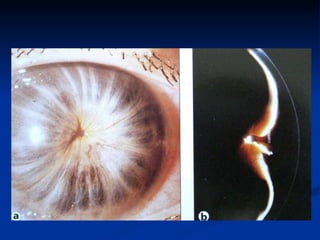
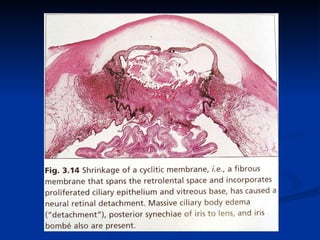
What are we trying to avoid? Why is it important to avoid uveitis?


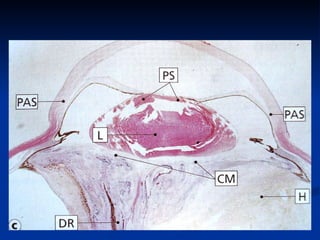
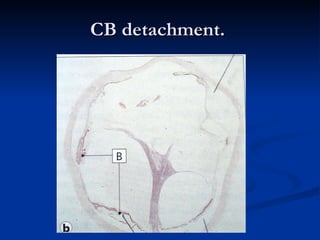
CB detachment.
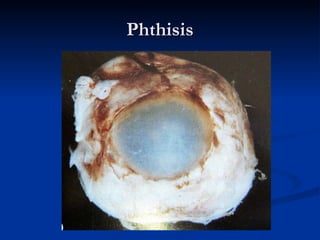
Phthisis
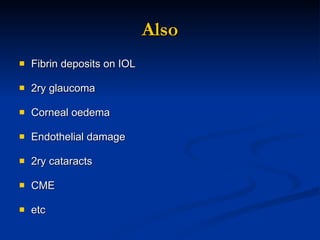
Also Fibrin deposits on IOL 2ry glaucoma Corneal oedema Endothelial damage 2ry cataracts CME etc
Cataract surgery in the patient with uveitis is one of the challenges with the greatest number of unknown factors faced by the ophthalmologist
Difficulties in management pre- and post-op Uncertainty of the post-operative process  Existence of an underlying systemic pathology Poor tolerance of IOLs Technical difficulties such as PS
Visual prognosis depends on: Presence of pre- and post-surgical inflammation Quality and efficiency of the surgical procedure Rx of complications, e.g. 2ry glaucoma
Good control of underlying systemic disorder Multidisciplinary approach.
Control of the ocular inflammation needed prior to surgery Topical or systemic steroids Immunosuppressives Aim is to reduce AC and vitreous activity  according to number of cells .
Difficult intra-op  Iris atrophy Sclerosis of pupillary sphincter Cyclitic membranes PS and PAS Anterior capsule sclerosis Iris haemorrhage Angle neovascularisation  Miotic pupil Synechiae Glaucoma
Challenge of IOL selection Must be in bag when possible Construction of IOL Might need to avoid altogether
Good post-op control of inflammation Topical, periocular, systemic steroids NSAIDs
Iris manipulation: Prostaglandins E2 and F2a Activation of complement by the classic or alternative route: certain polymers such as prolene. Less so with hydrogel. Probably get less inflammation with phaco rather than ECCE
Patient preparation Good pupillary dilatation to minimise iris touch Angle neovascularisation: consider Argon laser at the area of surgical incision (enough to blanch vessels in 3 different places) Proper IOP control  (avoid pilocarpine as alter blood-aqueous barrier) Pre-operative hypotony: cyclitic membranes, CB dialysis, severe inflammation
Preop Control of Inflammation Might just need topical or periocular steroids Systemic steroids controversial: must recommend if required systemic or periocular steroids in a previous uveitis attack
Combined Cataract-Vitrectomy  PPV with lensectomy can be procedure of choice in cases of uveitis with vitritis refractory to medical treatment.  Disadvantage: sulcus fixated IOL, difficulty removing dense nucleus and difficulty removing cortex
IOL Avoid ACIOLs & Sulcus fixatation Avoid IOLs with polypropylene haptics Heparin coated IOLs (be careful when gripping) Avoid silicone PMMA and hydrogel better
Steroid in irrigation fluids? Intravitreal triamcinolone?
Fuch’s heterochromatic Cyclitis PS rarely formed Generally do well with surgery but reports of: Vitritis Hyphaema Increase IOP Cyclitic membrane formation Risk of glaucoma (10%); maybe worse after Sx
Sarcoidosis Phaco has been performed with good results Miosis
Pars planitis PS rare Glaucoma is the exception 40% get cataracts 50% obtain 6/12 or better
Pars planitis Pars planitis does not seem to increase the risk of complications in routine cataract surgery Often get low grade post-op uveitis resulting in accumulation of debris and membranes on the back surface of the IOL and posterior capsule. Might need YAG.  Membranes tend to return and can be controlled with subconj and frequent topical steroids
JIC May also have amblyopia, band keratopathy, hypotony, glaucoma, PS Average age at time of surgery varies between 10 -19 years. Uveitis is exacerbated by Sx Many get vitreous loss and retained cortical matter. 60% get 6/60 or worse vision
JIC Performing a mid-portion vitrectomy is recommended by some authors IOL not recommended Most common post-op complications: Glaucoma Hypotony CME Combine with vitrectomy if vitritis or vitreous opacitiesj
Behcet’s Disease, VKH and Multifocal Chorioretinitis Few reports on phaco in these patients The incidence of phthisis bulbi and hypotony has been reported to decrease from 25-2% when limited vitrectomy was performed with cataract extraction (Kanski J, et al. Ophthalmology 1984;91:1247-1252) Visual prognosis significantly worse with Behcet’s (severe post. segment complications) Multifocal chorioretinitis: VA returns to pre-op values within 6 months.
HZ uveitis VA better than 6/12 in 90% 18% get chronic uveitis
Idiopathic iritis Favourable prognosis Also good when associated with ankylosing spondylitis, Crohns disease and toxoplasmosis.
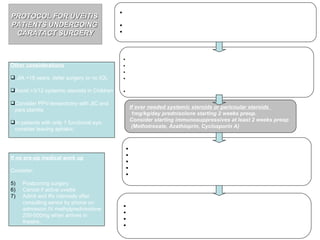
At listing: ensure: MUST HAVE   3-6 months  with complete quiescence of uveitis ideally with no  need  for steroids. List for most experienced phaco surgeons.  Discuss with senior and surgeon at listing (by phone or referra to their clinic) Discuss with VR surgeon if Behcets, JIA, Posterior Uveitis, Vitritis, Vitreous  opacities  Post-op G.Predfortex8 for 3 months and G.Diclofenacx4 for 2 weeks G. Tropicamide 1% x 3 x 4 weeks  and  G.Phenylephrinex 3x 4 weeks If raised IOP: timolol, trusopt or oral acetazolamide Oral prednisolone 1mg/kg/day for 2 weeks, tapering it down for another 2 weeks for a total of 1 month (may need for 3 months depending on case) If ever needed systemic steroids or pericoular steroids  1mg/kg/day prednisolone starting 2 weeks preop. Consider starting immunosuppressives at least 2 weeks preop (Methotrexate, Azathioprin, Cyclosporin A)  Surgery Phaco, not ECCE. Acrylic PCIOL. Synechiolysis Consider prohylactic PI if high risk of seclusio pupillae Suture incision and periocular triamcinolone If persistent CME or vitritis or extensive exudates or membranes in vitreous, consider comibining with PPV Other considerations JIA <18 years, defer surgery or no IOL Avoid >3/12 systemic steroids in Children Consider PPV-lensectomy with JIC and  pars planitis In patients with only 1 functional eye, consider leaving aphakic Pre-op G. Predforte x8x1 week pre-op and G.Diclofenac x4x1 week pre-op 1mg/kg/day of oral prednisolone 1 week pre-op with Rantidine Consider oral NSAID Consider periocular triamcinolone steroid injection 1-4 weeks  pre-op if difficult to control If Hx of frequent relapses, 250-500mg IV methylprednisoloneon morning of Sx PROTOCOL FOR UVEITIS  PATIENTS UNDERGOING  CARATACT SURGERY If no pre-op medical work up Consider: Postponing surgery Cancel if active uveitis Admit and Rx intensely after  consulting senior by phone on  admission.IV methylprednisolone  250-500mg when arrives in  theatre.
References Jorge L. Alio Y Sanz and Enrique Chipont  (Phacoemulsification in Difficult and challenging cases)

A Protocol For Uveitis Patients Undergoing Cataract Surgery

  • 1.
    MEETING MORBIDITY : Avoiding failure to medically treat eyes undergoing cataract surgery with known uveitis Dr. Nick Sargent August 2008
  • 2.
    What are wetrying to avoid? Why is it important to avoid uveitis?
  • 3.
  • 4.
  • 5.
  • 6.
  • 7.
  • 8.
    Also Fibrin depositson IOL 2ry glaucoma Corneal oedema Endothelial damage 2ry cataracts CME etc
  • 9.
    Cataract surgery inthe patient with uveitis is one of the challenges with the greatest number of unknown factors faced by the ophthalmologist
  • 10.
    Difficulties in managementpre- and post-op Uncertainty of the post-operative process Existence of an underlying systemic pathology Poor tolerance of IOLs Technical difficulties such as PS
  • 11.
    Visual prognosis dependson: Presence of pre- and post-surgical inflammation Quality and efficiency of the surgical procedure Rx of complications, e.g. 2ry glaucoma
  • 12.
    Good control ofunderlying systemic disorder Multidisciplinary approach.
  • 13.
    Control of theocular inflammation needed prior to surgery Topical or systemic steroids Immunosuppressives Aim is to reduce AC and vitreous activity according to number of cells .
  • 14.
    Difficult intra-op Iris atrophy Sclerosis of pupillary sphincter Cyclitic membranes PS and PAS Anterior capsule sclerosis Iris haemorrhage Angle neovascularisation Miotic pupil Synechiae Glaucoma
  • 15.
    Challenge of IOLselection Must be in bag when possible Construction of IOL Might need to avoid altogether
  • 16.
    Good post-op controlof inflammation Topical, periocular, systemic steroids NSAIDs
  • 17.
    Iris manipulation: ProstaglandinsE2 and F2a Activation of complement by the classic or alternative route: certain polymers such as prolene. Less so with hydrogel. Probably get less inflammation with phaco rather than ECCE
  • 18.
    Patient preparation Goodpupillary dilatation to minimise iris touch Angle neovascularisation: consider Argon laser at the area of surgical incision (enough to blanch vessels in 3 different places) Proper IOP control (avoid pilocarpine as alter blood-aqueous barrier) Pre-operative hypotony: cyclitic membranes, CB dialysis, severe inflammation
  • 19.
    Preop Control ofInflammation Might just need topical or periocular steroids Systemic steroids controversial: must recommend if required systemic or periocular steroids in a previous uveitis attack
  • 20.
    Combined Cataract-Vitrectomy PPV with lensectomy can be procedure of choice in cases of uveitis with vitritis refractory to medical treatment. Disadvantage: sulcus fixated IOL, difficulty removing dense nucleus and difficulty removing cortex
  • 21.
    IOL Avoid ACIOLs& Sulcus fixatation Avoid IOLs with polypropylene haptics Heparin coated IOLs (be careful when gripping) Avoid silicone PMMA and hydrogel better
  • 22.
    Steroid in irrigationfluids? Intravitreal triamcinolone?
  • 23.
    Fuch’s heterochromatic CyclitisPS rarely formed Generally do well with surgery but reports of: Vitritis Hyphaema Increase IOP Cyclitic membrane formation Risk of glaucoma (10%); maybe worse after Sx
  • 24.
    Sarcoidosis Phaco hasbeen performed with good results Miosis
  • 25.
    Pars planitis PSrare Glaucoma is the exception 40% get cataracts 50% obtain 6/12 or better
  • 26.
    Pars planitis Parsplanitis does not seem to increase the risk of complications in routine cataract surgery Often get low grade post-op uveitis resulting in accumulation of debris and membranes on the back surface of the IOL and posterior capsule. Might need YAG. Membranes tend to return and can be controlled with subconj and frequent topical steroids
  • 27.
    JIC May alsohave amblyopia, band keratopathy, hypotony, glaucoma, PS Average age at time of surgery varies between 10 -19 years. Uveitis is exacerbated by Sx Many get vitreous loss and retained cortical matter. 60% get 6/60 or worse vision
  • 28.
    JIC Performing amid-portion vitrectomy is recommended by some authors IOL not recommended Most common post-op complications: Glaucoma Hypotony CME Combine with vitrectomy if vitritis or vitreous opacitiesj
  • 29.
    Behcet’s Disease, VKHand Multifocal Chorioretinitis Few reports on phaco in these patients The incidence of phthisis bulbi and hypotony has been reported to decrease from 25-2% when limited vitrectomy was performed with cataract extraction (Kanski J, et al. Ophthalmology 1984;91:1247-1252) Visual prognosis significantly worse with Behcet’s (severe post. segment complications) Multifocal chorioretinitis: VA returns to pre-op values within 6 months.
  • 30.
    HZ uveitis VAbetter than 6/12 in 90% 18% get chronic uveitis
  • 31.
    Idiopathic iritis Favourableprognosis Also good when associated with ankylosing spondylitis, Crohns disease and toxoplasmosis.
  • 32.
    At listing: ensure:MUST HAVE 3-6 months with complete quiescence of uveitis ideally with no need for steroids. List for most experienced phaco surgeons. Discuss with senior and surgeon at listing (by phone or referra to their clinic) Discuss with VR surgeon if Behcets, JIA, Posterior Uveitis, Vitritis, Vitreous opacities Post-op G.Predfortex8 for 3 months and G.Diclofenacx4 for 2 weeks G. Tropicamide 1% x 3 x 4 weeks and G.Phenylephrinex 3x 4 weeks If raised IOP: timolol, trusopt or oral acetazolamide Oral prednisolone 1mg/kg/day for 2 weeks, tapering it down for another 2 weeks for a total of 1 month (may need for 3 months depending on case) If ever needed systemic steroids or pericoular steroids 1mg/kg/day prednisolone starting 2 weeks preop. Consider starting immunosuppressives at least 2 weeks preop (Methotrexate, Azathioprin, Cyclosporin A) Surgery Phaco, not ECCE. Acrylic PCIOL. Synechiolysis Consider prohylactic PI if high risk of seclusio pupillae Suture incision and periocular triamcinolone If persistent CME or vitritis or extensive exudates or membranes in vitreous, consider comibining with PPV Other considerations JIA <18 years, defer surgery or no IOL Avoid >3/12 systemic steroids in Children Consider PPV-lensectomy with JIC and pars planitis In patients with only 1 functional eye, consider leaving aphakic Pre-op G. Predforte x8x1 week pre-op and G.Diclofenac x4x1 week pre-op 1mg/kg/day of oral prednisolone 1 week pre-op with Rantidine Consider oral NSAID Consider periocular triamcinolone steroid injection 1-4 weeks pre-op if difficult to control If Hx of frequent relapses, 250-500mg IV methylprednisoloneon morning of Sx PROTOCOL FOR UVEITIS PATIENTS UNDERGOING CARATACT SURGERY If no pre-op medical work up Consider: Postponing surgery Cancel if active uveitis Admit and Rx intensely after consulting senior by phone on admission.IV methylprednisolone 250-500mg when arrives in theatre.
  • 33.
    References Jorge L.Alio Y Sanz and Enrique Chipont (Phacoemulsification in Difficult and challenging cases)