Prepared by:
Dr Irawati P. Sarode
Assistant Professor
College of Veterinary & Animal Sciences, Parbhani
MAFSU, Nagpur
Department of Veterinary Surgery & Radiology
CATARACT SURGERY IN CANINES
WITH SPECIAL REFERENCE TO
INTRAOCULAR LENS IMPLANTATION
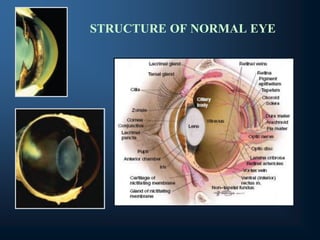
STRUCTURE OF NORMAL EYE
CATARACT
✓ The term cataract comprises a common group of
ocular disorders manifested as loss of transparency
of lens or its capsule
✓ Cataract refers to group of lens disorders of varying
age of onset, speed and extent of progression
appearance & etiology
CATARACT CLASSIFICATION
✓ Stage of development (maturity)
o Incipient
o Immature
o Mature
o Hypermature
o Morgagnian
✓ Age of development
o Congenital
o Developmental
o Juvenile
o Senile
o Acquired
✓ Position within the lens
o Anterior capsular
o Anterior sub capsular
o Cortical
o Equatorial
o Nuclear
o Posterior sub capsular
o Posterior capsular
✓ Etiology or pathogenesis
o Primary: Inherited
o Secondary: Traumatic
Intraocular disease
Nutritional
Radiation
Diabetic
Toxic
✓Consistency
o Fluid
o Soft
o Hard
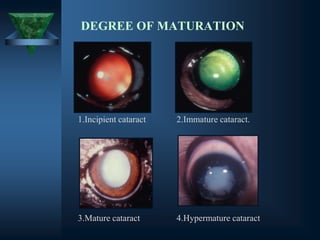
DEGREE OF MATURATION
1.Incipient cataract 2.Immature cataract.
3.Mature cataract 4.Hypermature cataract
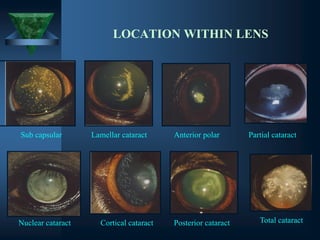
LOCATION WITHIN LENS
Sub capsular Lamellar cataract Anterior polar Partial cataract
Nuclear cataract Cortical cataract Total cataractPosterior cataract
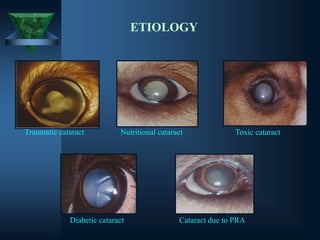
ETIOLOGY
Traumatic cataract Nutritional cataract Toxic cataract
Diabetic cataract Cataract due to PRA
TREATMENT
✓ MEDICAL THERAPY
• Improvement of vision in early stages of cataract, or in
advanced stages of resorption with use of mydriatics
• Diabetic cataracts: Aldose reductase inhibitors
(systemic & topical)
• Antioxidants : Selenium- vitamin E
Orgotein (super oxide dismutase)
Zinc ascorbate
Carnosine
• Other alternative remedies: Grape seed extract
SURGICAL TREATMENT
Potential cataract patients should be referred as early as
possible
• Cataract surgery is only means of treatment
• Cataract surgery is an elective procedure
• Age of the patient not a contraindication
• Types of cataract unsuitable for surgery.
e.g., cataracts secondary to other inherited eye diseases –
generalized progressive retinal atrophy (GPRA),
post-traumatic cataracts
cataract secondary to, or associated with, uveitis
SURGICAL CORRECTION
✓ Discission and aspiration
✓ Intracapsular extraction
✓ Extracapsular extraction
✓ Phacoemulsification :
1. One – handed
a. V shaped Phacoemulsification
b. Nuclear flip technique
2. Two - handed / bimanual
a. Nuclear segmentation
b. Divide and conquer
c. Chip and flip
d. Croissant
e. Phaco chop
f. Stop & chop
g. Split and lift
PATIENT SELECTION
✓ Complete medical history
✓ General physical examination
✓ Temperament
✓ Complete ophthalmic history
✓ Complete ophthalmic examination
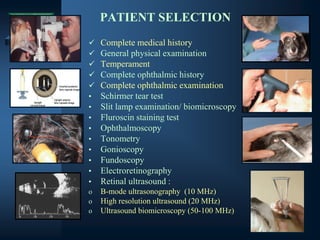
• Schirmer tear test
• Slit lamp examination/ biomicroscopy
• Fluroscin staining test
• Ophthalmoscopy
• Tonometry
• Gonioscopy
• Fundoscopy
• Electroretinography
• Retinal ultrasound :
o B-mode ultrasonography (10 MHz)
o High resolution ultrasound (20 MHz)
o Ultrasound biomicroscopy (50-100 MHz)
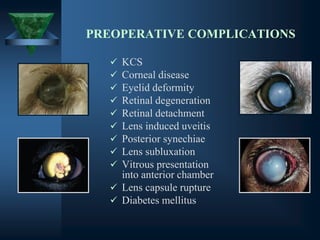
PREOPERATIVE COMPLICATIONS
✓ KCS
✓ Corneal disease
✓ Eyelid deformity
✓ Retinal degeneration
✓ Retinal detachment
✓ Lens induced uveitis
✓ Posterior synechiae
✓ Lens subluxation
✓ Vitrous presentation
into anterior chamber
✓ Lens capsule rupture
✓ Diabetes mellitus
PREOPERATIVE THERAPY
✓ Broad spectrum topical ophthalmic antibiotics every 6 hrs
for 24-48 hrs prior to surgery
✓ Topical corticosteroids for 48-72 hrs prior to surgery or up
to 4 weeks ( if LIU is present)
✓ Topical non steroidal anti inflammatory agents every 30
minutes beginning 1-3 hrs prior to surgery
✓ Mydriasis with 1% Atropine 1-2 hrs prior to surgery
✓ Bolus of IV antibiotics at induction of anesthesia
✓ Systemic non steroidal anti inflammatory agents
✓ Systemic corticosteroids
ANESTHESIA
✓ General anesthesia with systemic neuromuscular
blocking agents ( Nasiesse and Davidson 1991)
• Induction of GA using routine procedures, &
maintenance with isoflurane / methoxyflurane
inhalation
• Atracurium or Pancurium
• Induction of general anesthesia with Propofol (5 mg/kg)
,atropine 0.03 mg/kg SC & Xylazine 1 mg/kg, IM as
premedicant, in combination with peribulbar nerve
block using 2% Lignocaine HCL
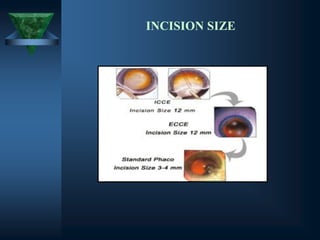
INCISION SIZE
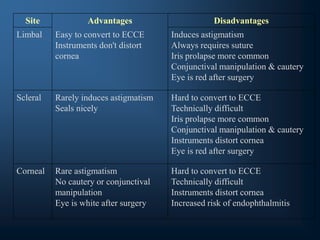
Site Advantages Disadvantages
Limbal Easy to convert to ECCE
Instruments don't distort
cornea
Induces astigmatism
Always requires suture
Iris prolapse more common
Conjunctival manipulation & cautery
Eye is red after surgery
Scleral Rarely induces astigmatism
Seals nicely
Hard to convert to ECCE
Technically difficult
Iris prolapse more common
Conjunctival manipulation & cautery
Instruments distort cornea
Eye is red after surgery
Corneal Rare astigmatism
No cautery or conjunctival
manipulation
Eye is white after surgery
Hard to convert to ECCE
Technically difficult
Instruments distort cornea
Increased risk of endophthalmitis
DISCISSION AND ASPIRATION
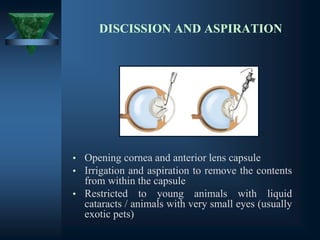
• Opening cornea and anterior lens capsule
• Irrigation and aspiration to remove the contents
from within the capsule
• Restricted to young animals with liquid
cataracts / animals with very small eyes (usually
exotic pets)
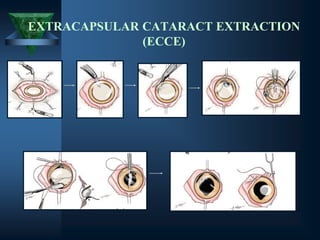
EXTRACAPSULAR CATARACT EXTRACTION
(ECCE)
INTRACAPSULAR CATARACT EXTRACTION
• Removal of entire lens without opening or tearing lens
capsule
• Method restricted to removal of luxated lens, following
tearing of zonules
• Minimal postoperative inflammation
• Anterior movement of vitreous body
• Combination of technique with prophylactic vitrectomy
• Implantation of synthetic IOL fixed by sutures in ciliary
sulcus
o Barrier against vitreous movement
o To improve post operative vision
PHACOEMULSIFICATION
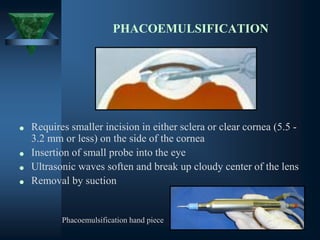
• Requires smaller incision in either sclera or clear cornea (5.5 -
3.2 mm or less) on the side of the cornea
• Insertion of small probe into the eye
• Ultrasonic waves soften and break up cloudy center of the lens
• Removal by suction
Phacoemulsification hand piece
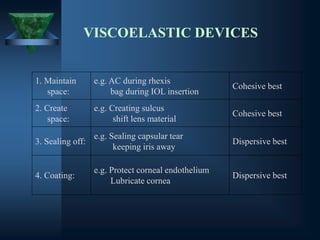
VISCOELASTIC DEVICES
1. Maintain
space:
e.g. AC during rhexis
bag during IOL insertion
Cohesive best
2. Create
space:
e.g. Creating sulcus
shift lens material
Cohesive best
3. Sealing off:
e.g. Sealing capsular tear
keeping iris away
Dispersive best
4. Coating:
e.g. Protect corneal endothelium
Lubricate cornea
Dispersive best
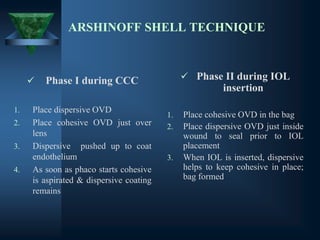
ARSHINOFF SHELL TECHNIQUE
✓ Phase I during CCC
1. Place dispersive OVD
2. Place cohesive OVD just over
lens
3. Dispersive pushed up to coat
endothelium
4. As soon as phaco starts cohesive
is aspirated & dispersive coating
remains
✓ Phase II during IOL
insertion
1. Place cohesive OVD in the bag
2. Place dispersive OVD just inside
wound to seal prior to IOL
placement
3. When IOL is inserted, dispersive
helps to keep cohesive in place;
bag formed
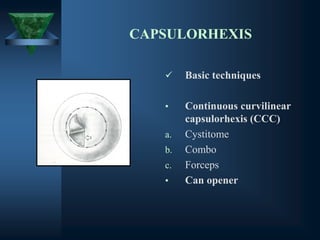
CAPSULORHEXIS
✓ Basic techniques
• Continuous curvilinear
capsulorhexis (CCC)
a. Cystitome
b. Combo
c. Forceps
• Can opener
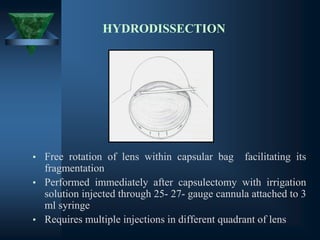
HYDRODISSECTION
• Free rotation of lens within capsular bag facilitating its
fragmentation
• Performed immediately after capsulectomy with irrigation
solution injected through 25- 27- gauge cannula attached to 3
ml syringe
• Requires multiple injections in different quadrant of lens
PHACOEMULSIFICATION
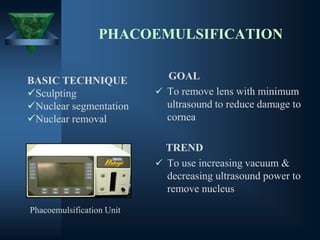
GOAL
✓ To remove lens with minimum
ultrasound to reduce damage to
cornea
TREND
✓ To use increasing vacuum &
decreasing ultrasound power to
remove nucleus
Phacoemulsification Unit
BASIC TECHNIQUE
✓Sculpting
✓Nuclear segmentation
✓Nuclear removal
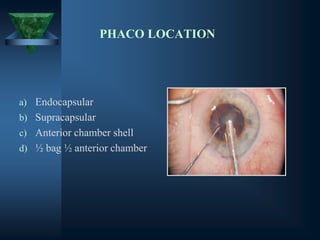
PHACO LOCATION
a) Endocapsular
b) Supracapsular
c) Anterior chamber shell
d) ½ bag ½ anterior chamber
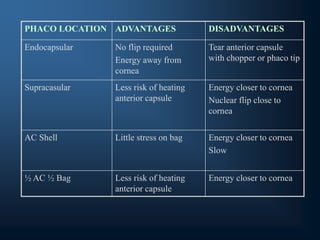
PHACO LOCATION ADVANTAGES DISADVANTAGES
Endocapsular No flip required
Energy away from
cornea
Tear anterior capsule
with chopper or phaco tip
Supracasular Less risk of heating
anterior capsule
Energy closer to cornea
Nuclear flip close to
cornea
AC Shell Little stress on bag Energy closer to cornea
Slow
½ AC ½ Bag Less risk of heating
anterior capsule
Energy closer to cornea
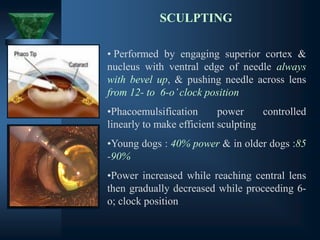
SCULPTING
• Performed by engaging superior cortex &
nucleus with ventral edge of needle always
with bevel up, & pushing needle across lens
from 12- to 6-o’clock position
•Phacoemulsification power controlled
linearly to make efficient sculpting
•Young dogs : 40% power & in older dogs :85
-90%
•Power increased while reaching central lens
then gradually decreased while proceeding 6-
o; clock position
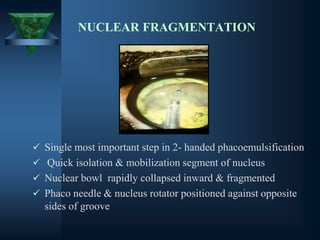
NUCLEAR FRAGMENTATION
✓ Single most important step in 2- handed phacoemulsification
✓ Quick isolation & mobilization segment of nucleus
✓ Nuclear bowl rapidly collapsed inward & fragmented
✓ Phaco needle & nucleus rotator positioned against opposite
sides of groove
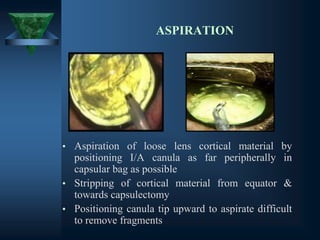
ASPIRATION
• Aspiration of loose lens cortical material by
positioning I/A canula as far peripherally in
capsular bag as possible
• Stripping of cortical material from equator &
towards capsulectomy
• Positioning canula tip upward to aspirate difficult
to remove fragments
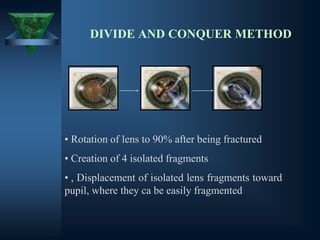
DIVIDE AND CONQUER METHOD
• Rotation of lens to 90% after being fractured
• Creation of 4 isolated fragments
• , Displacement of isolated lens fragments toward
pupil, where they ca be easily fragmented
INTRAOPERATIVE COMPLICATIONS
✓ Anterior capsular fibrosis
✓ Intraoperative miosis
✓ Expanding vitreous
syndrome
✓ Iris prolapse
✓ Intraoperative hemorrhage
✓ Vitreous presentation
✓ Cavitation bubbles
✓ Phaco machine failure
✓ Lens capsule
a. anterior radial tears
b. posterior capsule tears
c. polishing opacities
d. zonular tears or dehiscence
✓ Displaced or dislocated
lens fragments
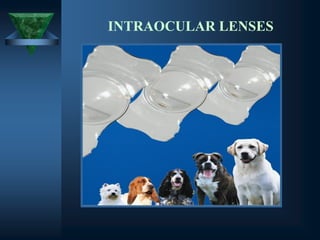
INTRAOCULAR LENSES
MATERIALS OF INTRAOCULAR LENSES
A. Thermoplastics
B. Synthetic elastomers
C. Acrylate polymers
1. Hydrogel & hybrid hydrogel lenses
2. Soft acrylic IOLs
3. Collamer IOLs
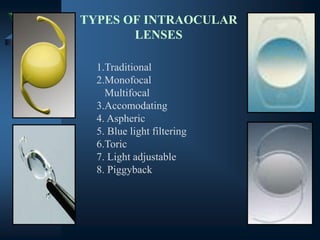
TYPES OF INTRAOCULAR
LENSES
1.Traditional
2.Monofocal
Multifocal
3.Accomodating
4. Aspheric
5. Blue light filtering
6.Toric
7. Light adjustable
8. Piggyback
✓ Two main types of IOLs used in veterinary medicine
• Non foldable ,Hard –PMMA
• Foldable – silicon & acrylic polymers
✓ Latest type of soft lenses designed for dogs made of
hydrophilic acrylate
✓ Lenses implanted within capsular bag
✓ Anterior chamber & iris supported lenses not used
(high extend of complications)
✓ Optic power - 41 D
✓ Size differ from 14 -18 mm ( haptic size)
7 mm (optic size)
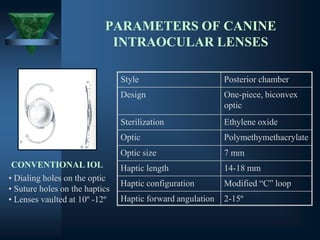
PARAMETERS OF CANINE
INTRAOCULAR LENSES
Style Posterior chamber
Design One-piece, biconvex
optic
Sterilization Ethylene oxide
Optic Polymethymethacrylate
Optic size 7 mm
Haptic length 14-18 mm
Haptic configuration Modified “C” loop
Haptic forward angulation 2-15º
• Dialing holes on the optic
• Suture holes on the haptics
• Lenses vaulted at 10º -12º
CONVENTIONAL IOL
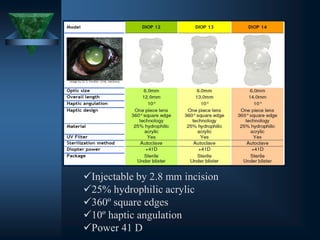
✓Injectable by 2.8 mm incision
✓25% hydrophilic acrylic
✓360º square edges
✓10º haptic angulation
✓Power 41 D
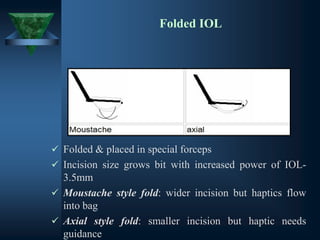
Folded IOL
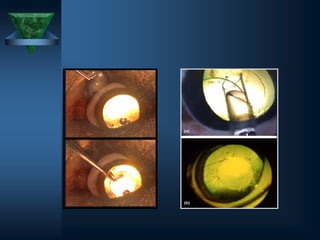
✓ Folded & placed in special forceps
✓ Incision size grows bit with increased power of IOL-
3.5mm
✓ Moustache style fold: wider incision but haptics flow
into bag
✓ Axial style fold: smaller incision but haptic needs
guidance
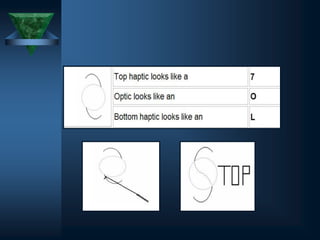
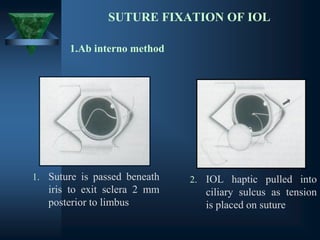
SUTURE FIXATION OF IOL
1. Suture is passed beneath
iris to exit sclera 2 mm
posterior to limbus
2. IOL haptic pulled into
ciliary sulcus as tension
is placed on suture
1.Ab interno method
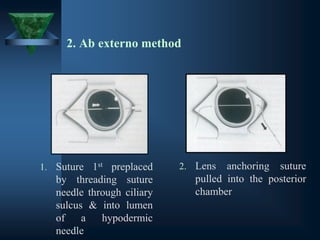
2. Ab externo method
1. Suture 1st preplaced
by threading suture
needle through ciliary
sulcus & into lumen
of a hypodermic
needle
2. Lens anchoring suture
pulled into the posterior
chamber
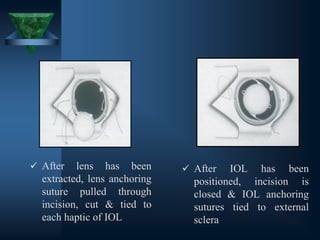
✓ After lens has been
extracted, lens anchoring
suture pulled through
incision, cut & tied to
each haptic of IOL
✓ After IOL has been
positioned, incision is
closed & IOL anchoring
sutures tied to external
sclera
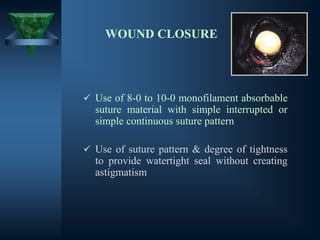
WOUND CLOSURE
✓ Use of 8-0 to 10-0 monofilament absorbable
suture material with simple interrupted or
simple continuous suture pattern
✓ Use of suture pattern & degree of tightness
to provide watertight seal without creating
astigmatism
POSTOPERATIVE COMPLICATIONS
IMMEDIATE VERSEUS LONG TERM
✓ IMMEDIATE
✓ Corneal ulceration
✓ Wound dehiscence within 3
days post surgery
✓ Surgery induced corneal
astigmatism
✓ Corneal edema
✓ Ocular hypertension (post
operative pressure spike)
✓ Uveitis
✓ Fibrin in the AC
✓ Hyphema / vitreal hemorrhage
✓ Acute endophthalmitis
✓ Toxic anterior segment
syndrome (TASS)
✓ LONG
✓ Posterior capsular opacities
(PCO)
✓ IOL decentration
✓ IOL luxation out of the bag
✓ Glaucoma
✓ Retinal detachment
✓ Corneal edema
✓ Endophthalmitis
✓ Corneal stromal abscess
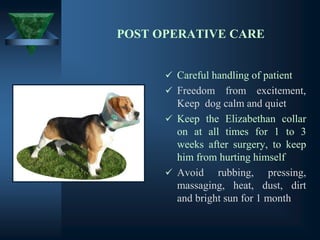
POST OPERATIVE CARE
✓ Careful handling of patient
✓ Freedom from excitement,
Keep dog calm and quiet
✓ Keep the Elizabethan collar
on at all times for 1 to 3
weeks after surgery, to keep
him from hurting himself
✓ Avoid rubbing, pressing,
massaging, heat, dust, dirt
and bright sun for 1 month
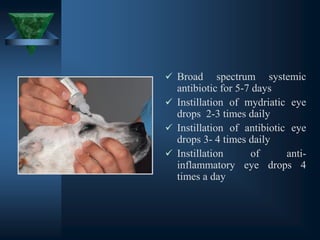
✓ Broad spectrum systemic
antibiotic for 5-7 days
✓ Instillation of mydriatic eye
drops 2-3 times daily
✓ Instillation of antibiotic eye
drops 3- 4 times daily
✓ Instillation of anti-
inflammatory eye drops 4
times a day
✓ Use a harness instead of a collar when on walks
to reduce pressure on his head (and eye) from
pulling
✓ Cancel all grooming and vaccination
appointments for about 6 weeks
✓ Avoid swimming ,splashing of water on eyes for
1 month
✓ Avoid strenuous physical activity for 1 month
✓ Daily check up for first two weeks
✓ Schedule and keep all follow-up appointments
Thank you…

Cataract surgery

  • 1.
    Prepared by: Dr IrawatiP. Sarode Assistant Professor College of Veterinary & Animal Sciences, Parbhani MAFSU, Nagpur Department of Veterinary Surgery & Radiology CATARACT SURGERY IN CANINES WITH SPECIAL REFERENCE TO INTRAOCULAR LENS IMPLANTATION
  • 2.
  • 3.
    CATARACT ✓ The termcataract comprises a common group of ocular disorders manifested as loss of transparency of lens or its capsule ✓ Cataract refers to group of lens disorders of varying age of onset, speed and extent of progression appearance & etiology
  • 4.
    CATARACT CLASSIFICATION ✓ Stageof development (maturity) o Incipient o Immature o Mature o Hypermature o Morgagnian ✓ Age of development o Congenital o Developmental o Juvenile o Senile o Acquired ✓ Position within the lens o Anterior capsular o Anterior sub capsular o Cortical o Equatorial o Nuclear o Posterior sub capsular o Posterior capsular ✓ Etiology or pathogenesis o Primary: Inherited o Secondary: Traumatic Intraocular disease Nutritional Radiation Diabetic Toxic ✓Consistency o Fluid o Soft o Hard
  • 5.
    DEGREE OF MATURATION 1.Incipientcataract 2.Immature cataract. 3.Mature cataract 4.Hypermature cataract
  • 6.
    LOCATION WITHIN LENS Subcapsular Lamellar cataract Anterior polar Partial cataract Nuclear cataract Cortical cataract Total cataractPosterior cataract
  • 7.
    ETIOLOGY Traumatic cataract Nutritionalcataract Toxic cataract Diabetic cataract Cataract due to PRA
  • 8.
    TREATMENT ✓ MEDICAL THERAPY •Improvement of vision in early stages of cataract, or in advanced stages of resorption with use of mydriatics • Diabetic cataracts: Aldose reductase inhibitors (systemic & topical) • Antioxidants : Selenium- vitamin E Orgotein (super oxide dismutase) Zinc ascorbate Carnosine • Other alternative remedies: Grape seed extract
  • 9.
    SURGICAL TREATMENT Potential cataractpatients should be referred as early as possible • Cataract surgery is only means of treatment • Cataract surgery is an elective procedure • Age of the patient not a contraindication • Types of cataract unsuitable for surgery. e.g., cataracts secondary to other inherited eye diseases – generalized progressive retinal atrophy (GPRA), post-traumatic cataracts cataract secondary to, or associated with, uveitis
  • 10.
    SURGICAL CORRECTION ✓ Discissionand aspiration ✓ Intracapsular extraction ✓ Extracapsular extraction ✓ Phacoemulsification : 1. One – handed a. V shaped Phacoemulsification b. Nuclear flip technique 2. Two - handed / bimanual a. Nuclear segmentation b. Divide and conquer c. Chip and flip d. Croissant e. Phaco chop f. Stop & chop g. Split and lift
  • 11.
    PATIENT SELECTION ✓ Completemedical history ✓ General physical examination ✓ Temperament ✓ Complete ophthalmic history ✓ Complete ophthalmic examination • Schirmer tear test • Slit lamp examination/ biomicroscopy • Fluroscin staining test • Ophthalmoscopy • Tonometry • Gonioscopy • Fundoscopy • Electroretinography • Retinal ultrasound : o B-mode ultrasonography (10 MHz) o High resolution ultrasound (20 MHz) o Ultrasound biomicroscopy (50-100 MHz)
  • 12.
    PREOPERATIVE COMPLICATIONS ✓ KCS ✓Corneal disease ✓ Eyelid deformity ✓ Retinal degeneration ✓ Retinal detachment ✓ Lens induced uveitis ✓ Posterior synechiae ✓ Lens subluxation ✓ Vitrous presentation into anterior chamber ✓ Lens capsule rupture ✓ Diabetes mellitus
  • 13.
    PREOPERATIVE THERAPY ✓ Broadspectrum topical ophthalmic antibiotics every 6 hrs for 24-48 hrs prior to surgery ✓ Topical corticosteroids for 48-72 hrs prior to surgery or up to 4 weeks ( if LIU is present) ✓ Topical non steroidal anti inflammatory agents every 30 minutes beginning 1-3 hrs prior to surgery ✓ Mydriasis with 1% Atropine 1-2 hrs prior to surgery ✓ Bolus of IV antibiotics at induction of anesthesia ✓ Systemic non steroidal anti inflammatory agents ✓ Systemic corticosteroids
  • 14.
    ANESTHESIA ✓ General anesthesiawith systemic neuromuscular blocking agents ( Nasiesse and Davidson 1991) • Induction of GA using routine procedures, & maintenance with isoflurane / methoxyflurane inhalation • Atracurium or Pancurium • Induction of general anesthesia with Propofol (5 mg/kg) ,atropine 0.03 mg/kg SC & Xylazine 1 mg/kg, IM as premedicant, in combination with peribulbar nerve block using 2% Lignocaine HCL
  • 15.
  • 16.
    Site Advantages Disadvantages LimbalEasy to convert to ECCE Instruments don't distort cornea Induces astigmatism Always requires suture Iris prolapse more common Conjunctival manipulation & cautery Eye is red after surgery Scleral Rarely induces astigmatism Seals nicely Hard to convert to ECCE Technically difficult Iris prolapse more common Conjunctival manipulation & cautery Instruments distort cornea Eye is red after surgery Corneal Rare astigmatism No cautery or conjunctival manipulation Eye is white after surgery Hard to convert to ECCE Technically difficult Instruments distort cornea Increased risk of endophthalmitis
  • 17.
    DISCISSION AND ASPIRATION •Opening cornea and anterior lens capsule • Irrigation and aspiration to remove the contents from within the capsule • Restricted to young animals with liquid cataracts / animals with very small eyes (usually exotic pets)
  • 18.
  • 19.
    INTRACAPSULAR CATARACT EXTRACTION •Removal of entire lens without opening or tearing lens capsule • Method restricted to removal of luxated lens, following tearing of zonules • Minimal postoperative inflammation • Anterior movement of vitreous body • Combination of technique with prophylactic vitrectomy • Implantation of synthetic IOL fixed by sutures in ciliary sulcus o Barrier against vitreous movement o To improve post operative vision
  • 20.
    PHACOEMULSIFICATION • Requires smallerincision in either sclera or clear cornea (5.5 - 3.2 mm or less) on the side of the cornea • Insertion of small probe into the eye • Ultrasonic waves soften and break up cloudy center of the lens • Removal by suction Phacoemulsification hand piece
  • 21.
    VISCOELASTIC DEVICES 1. Maintain space: e.g.AC during rhexis bag during IOL insertion Cohesive best 2. Create space: e.g. Creating sulcus shift lens material Cohesive best 3. Sealing off: e.g. Sealing capsular tear keeping iris away Dispersive best 4. Coating: e.g. Protect corneal endothelium Lubricate cornea Dispersive best
  • 22.
    ARSHINOFF SHELL TECHNIQUE ✓Phase I during CCC 1. Place dispersive OVD 2. Place cohesive OVD just over lens 3. Dispersive pushed up to coat endothelium 4. As soon as phaco starts cohesive is aspirated & dispersive coating remains ✓ Phase II during IOL insertion 1. Place cohesive OVD in the bag 2. Place dispersive OVD just inside wound to seal prior to IOL placement 3. When IOL is inserted, dispersive helps to keep cohesive in place; bag formed
  • 23.
    CAPSULORHEXIS ✓ Basic techniques •Continuous curvilinear capsulorhexis (CCC) a. Cystitome b. Combo c. Forceps • Can opener
  • 24.
    HYDRODISSECTION • Free rotationof lens within capsular bag facilitating its fragmentation • Performed immediately after capsulectomy with irrigation solution injected through 25- 27- gauge cannula attached to 3 ml syringe • Requires multiple injections in different quadrant of lens
  • 25.
    PHACOEMULSIFICATION GOAL ✓ To removelens with minimum ultrasound to reduce damage to cornea TREND ✓ To use increasing vacuum & decreasing ultrasound power to remove nucleus Phacoemulsification Unit BASIC TECHNIQUE ✓Sculpting ✓Nuclear segmentation ✓Nuclear removal
  • 26.
    PHACO LOCATION a) Endocapsular b)Supracapsular c) Anterior chamber shell d) ½ bag ½ anterior chamber
  • 27.
    PHACO LOCATION ADVANTAGESDISADVANTAGES Endocapsular No flip required Energy away from cornea Tear anterior capsule with chopper or phaco tip Supracasular Less risk of heating anterior capsule Energy closer to cornea Nuclear flip close to cornea AC Shell Little stress on bag Energy closer to cornea Slow ½ AC ½ Bag Less risk of heating anterior capsule Energy closer to cornea
  • 28.
    SCULPTING • Performed byengaging superior cortex & nucleus with ventral edge of needle always with bevel up, & pushing needle across lens from 12- to 6-o’clock position •Phacoemulsification power controlled linearly to make efficient sculpting •Young dogs : 40% power & in older dogs :85 -90% •Power increased while reaching central lens then gradually decreased while proceeding 6- o; clock position
  • 29.
    NUCLEAR FRAGMENTATION ✓ Singlemost important step in 2- handed phacoemulsification ✓ Quick isolation & mobilization segment of nucleus ✓ Nuclear bowl rapidly collapsed inward & fragmented ✓ Phaco needle & nucleus rotator positioned against opposite sides of groove
  • 30.
    ASPIRATION • Aspiration ofloose lens cortical material by positioning I/A canula as far peripherally in capsular bag as possible • Stripping of cortical material from equator & towards capsulectomy • Positioning canula tip upward to aspirate difficult to remove fragments
  • 31.
    DIVIDE AND CONQUERMETHOD • Rotation of lens to 90% after being fractured • Creation of 4 isolated fragments • , Displacement of isolated lens fragments toward pupil, where they ca be easily fragmented
  • 32.
    INTRAOPERATIVE COMPLICATIONS ✓ Anteriorcapsular fibrosis ✓ Intraoperative miosis ✓ Expanding vitreous syndrome ✓ Iris prolapse ✓ Intraoperative hemorrhage ✓ Vitreous presentation ✓ Cavitation bubbles ✓ Phaco machine failure ✓ Lens capsule a. anterior radial tears b. posterior capsule tears c. polishing opacities d. zonular tears or dehiscence ✓ Displaced or dislocated lens fragments
  • 33.
  • 34.
    MATERIALS OF INTRAOCULARLENSES A. Thermoplastics B. Synthetic elastomers C. Acrylate polymers 1. Hydrogel & hybrid hydrogel lenses 2. Soft acrylic IOLs 3. Collamer IOLs
  • 35.
    TYPES OF INTRAOCULAR LENSES 1.Traditional 2.Monofocal Multifocal 3.Accomodating 4.Aspheric 5. Blue light filtering 6.Toric 7. Light adjustable 8. Piggyback
  • 36.
    ✓ Two maintypes of IOLs used in veterinary medicine • Non foldable ,Hard –PMMA • Foldable – silicon & acrylic polymers ✓ Latest type of soft lenses designed for dogs made of hydrophilic acrylate ✓ Lenses implanted within capsular bag ✓ Anterior chamber & iris supported lenses not used (high extend of complications) ✓ Optic power - 41 D ✓ Size differ from 14 -18 mm ( haptic size) 7 mm (optic size)
  • 37.
    PARAMETERS OF CANINE INTRAOCULARLENSES Style Posterior chamber Design One-piece, biconvex optic Sterilization Ethylene oxide Optic Polymethymethacrylate Optic size 7 mm Haptic length 14-18 mm Haptic configuration Modified “C” loop Haptic forward angulation 2-15º • Dialing holes on the optic • Suture holes on the haptics • Lenses vaulted at 10º -12º CONVENTIONAL IOL
  • 38.
    ✓Injectable by 2.8mm incision ✓25% hydrophilic acrylic ✓360º square edges ✓10º haptic angulation ✓Power 41 D
  • 39.
    Folded IOL ✓ Folded& placed in special forceps ✓ Incision size grows bit with increased power of IOL- 3.5mm ✓ Moustache style fold: wider incision but haptics flow into bag ✓ Axial style fold: smaller incision but haptic needs guidance
  • 42.
    SUTURE FIXATION OFIOL 1. Suture is passed beneath iris to exit sclera 2 mm posterior to limbus 2. IOL haptic pulled into ciliary sulcus as tension is placed on suture 1.Ab interno method
  • 43.
    2. Ab externomethod 1. Suture 1st preplaced by threading suture needle through ciliary sulcus & into lumen of a hypodermic needle 2. Lens anchoring suture pulled into the posterior chamber
  • 44.
    ✓ After lenshas been extracted, lens anchoring suture pulled through incision, cut & tied to each haptic of IOL ✓ After IOL has been positioned, incision is closed & IOL anchoring sutures tied to external sclera
  • 45.
    WOUND CLOSURE ✓ Useof 8-0 to 10-0 monofilament absorbable suture material with simple interrupted or simple continuous suture pattern ✓ Use of suture pattern & degree of tightness to provide watertight seal without creating astigmatism
  • 46.
    POSTOPERATIVE COMPLICATIONS IMMEDIATE VERSEUSLONG TERM ✓ IMMEDIATE ✓ Corneal ulceration ✓ Wound dehiscence within 3 days post surgery ✓ Surgery induced corneal astigmatism ✓ Corneal edema ✓ Ocular hypertension (post operative pressure spike) ✓ Uveitis ✓ Fibrin in the AC ✓ Hyphema / vitreal hemorrhage ✓ Acute endophthalmitis ✓ Toxic anterior segment syndrome (TASS) ✓ LONG ✓ Posterior capsular opacities (PCO) ✓ IOL decentration ✓ IOL luxation out of the bag ✓ Glaucoma ✓ Retinal detachment ✓ Corneal edema ✓ Endophthalmitis ✓ Corneal stromal abscess
  • 47.
    POST OPERATIVE CARE ✓Careful handling of patient ✓ Freedom from excitement, Keep dog calm and quiet ✓ Keep the Elizabethan collar on at all times for 1 to 3 weeks after surgery, to keep him from hurting himself ✓ Avoid rubbing, pressing, massaging, heat, dust, dirt and bright sun for 1 month
  • 48.
    ✓ Broad spectrumsystemic antibiotic for 5-7 days ✓ Instillation of mydriatic eye drops 2-3 times daily ✓ Instillation of antibiotic eye drops 3- 4 times daily ✓ Instillation of anti- inflammatory eye drops 4 times a day
  • 49.
    ✓ Use aharness instead of a collar when on walks to reduce pressure on his head (and eye) from pulling ✓ Cancel all grooming and vaccination appointments for about 6 weeks ✓ Avoid swimming ,splashing of water on eyes for 1 month ✓ Avoid strenuous physical activity for 1 month ✓ Daily check up for first two weeks ✓ Schedule and keep all follow-up appointments
  • 50.