COMPLICATIONS OF
CATARACT
SURGERY
Dr. Pawan Raj Patel
Layout:
◦ Preoperative complications
◦ Intraoperative complications
◦ Postoperative complications
◦ IOL related complications
Categorized
Pre-operative complications
Intra-operative complications
Post-operative complications
• Early post-operative (within 4weeks)
• Late post-operative (1month to years)
IOL related complications
Preoperative complications
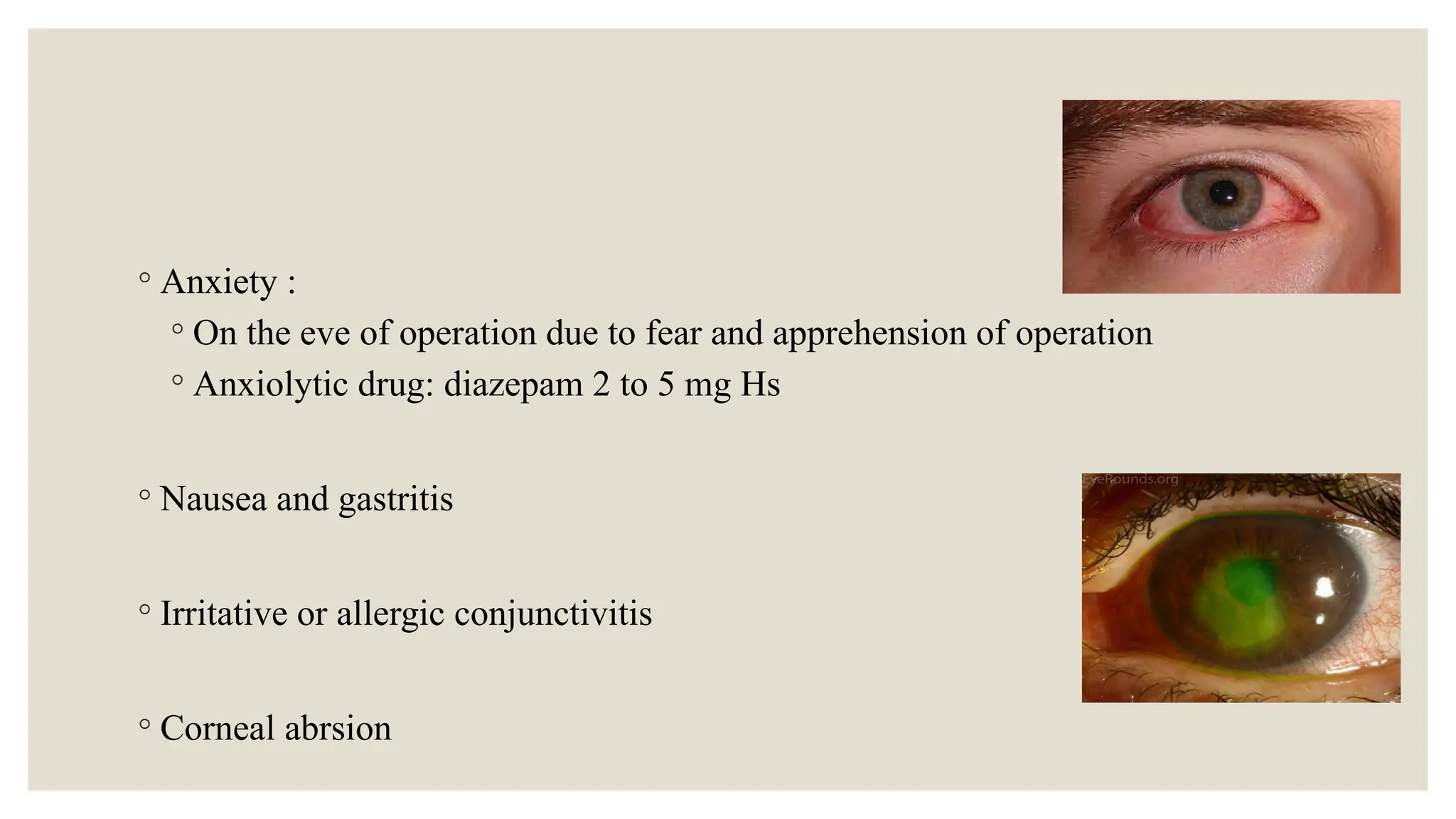
◦ Anxiety :
◦ On the eve of operation due to fear and apprehension of operation
◦ Anxiolytic drug: diazepam 2 to 5 mg Hs
◦ Nausea and gastritis
◦ Irritative or allergic conjunctivitis
◦ Corneal abrsion
Block related complications
◦ Retrobulbar hemorrhage
◦ Globe perforation-
◦ Trauma to Optic nerve
◦ Central spread of anesthetic
◦ Retinal vascular occlusion
◦ Subconjunctival hemorrhage
◦ Optic atrophy
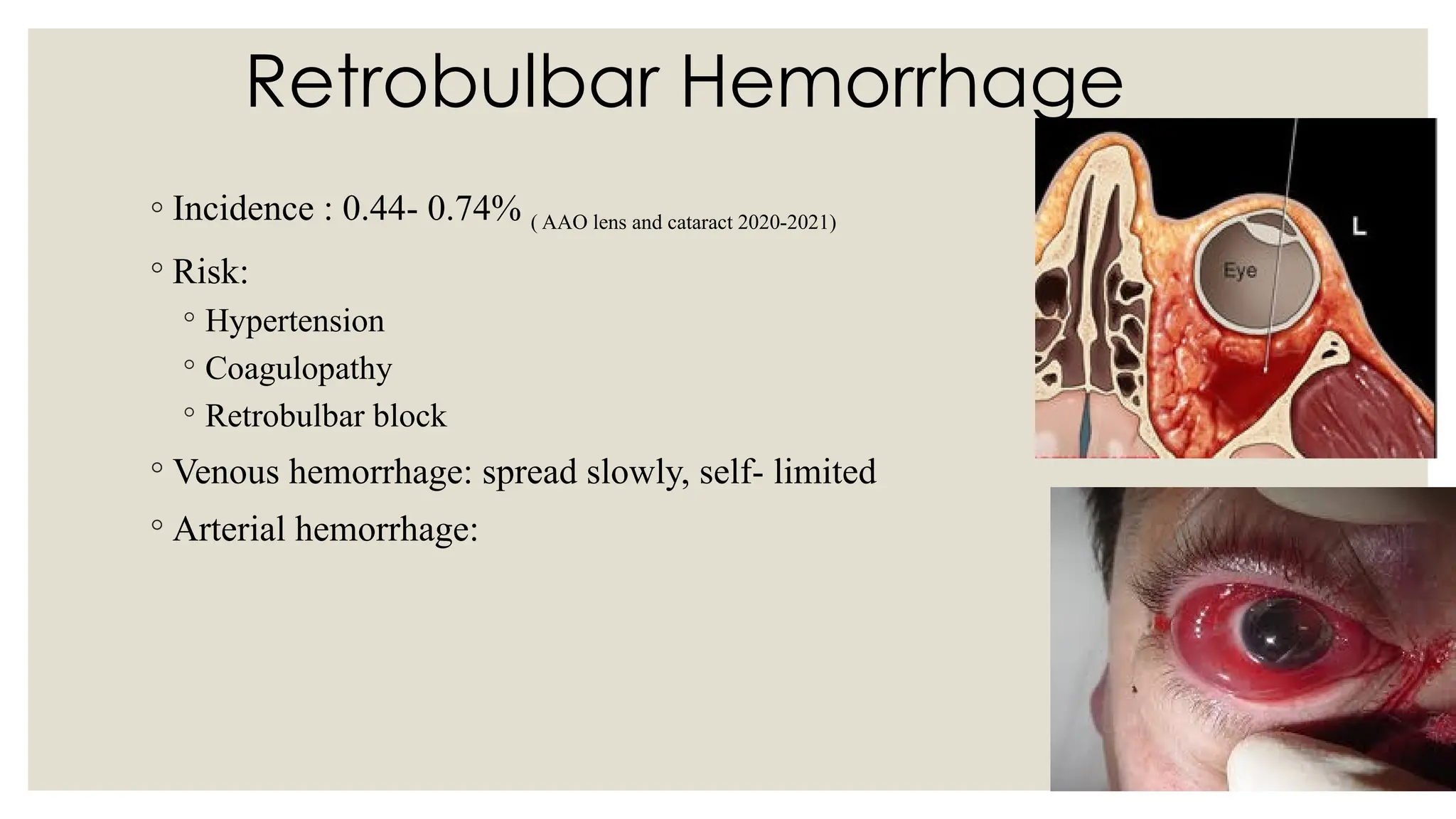
Retrobulbar Hemorrhage
◦ Incidence : 0.44- 0.74% ( AAO lens and cataract 2020-2021)
◦ Risk:
◦ Hypertension
◦ Coagulopathy
◦ Retrobulbar block
◦ Venous hemorrhage: spread slowly, self- limited
◦ Arterial hemorrhage:
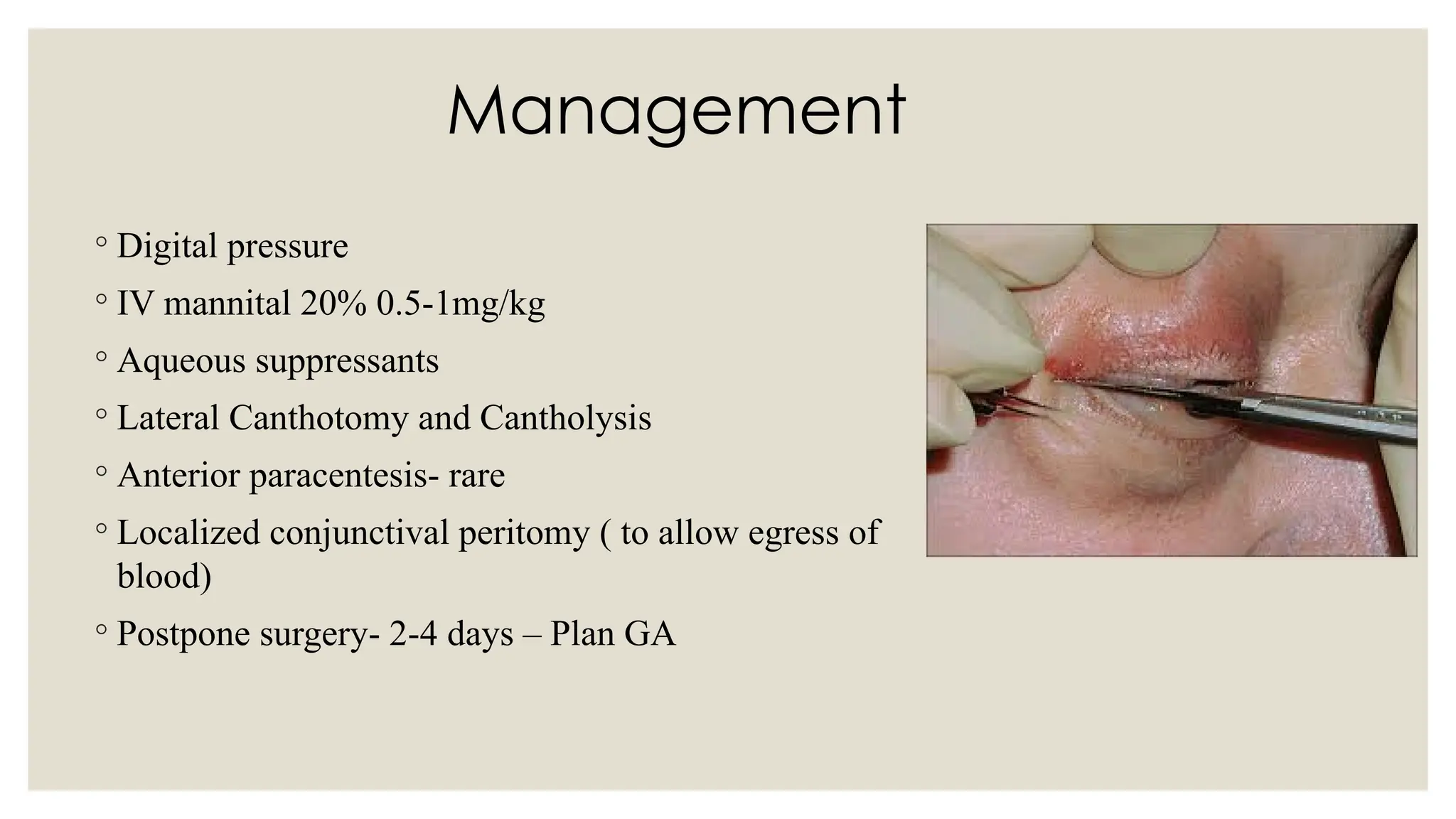
Management
◦ Digital pressure
◦ IV mannital 20% 0.5-1mg/kg
◦ Aqueous suppressants
◦ Lateral Canthotomy and Cantholysis
◦ Anterior paracentesis- rare
◦ Localized conjunctival peritomy ( to allow egress of
blood)
◦ Postpone surgery- 2-4 days – Plan GA
Intra-operative complications
Superior rectus bridle suture
◦ Muscle Laceration
◦ Hematoma formation
◦ Globe perforation
Prevention :
◦ Round body needle
◦ Direct the needle away from the
globe
◦ Apply suture –after visual
confirmation of the SR with
forceps
Conjunctival dissection
◦ Subconjunctival hemorrhage
◦ Cautery burn
- shrinkage of scleral tissue : Astigmatism
◦ Conjunctival tear: Site of globe fixation
Incision related complications
Scleral groove
◦ Too deep (>1/2) –
-Entry into supraciliary space
- Hemorrhage
- Hypotony
- Premature entry -Iris prolapse
◦ Too shallow (<1/2)
- Button holing – wound leak
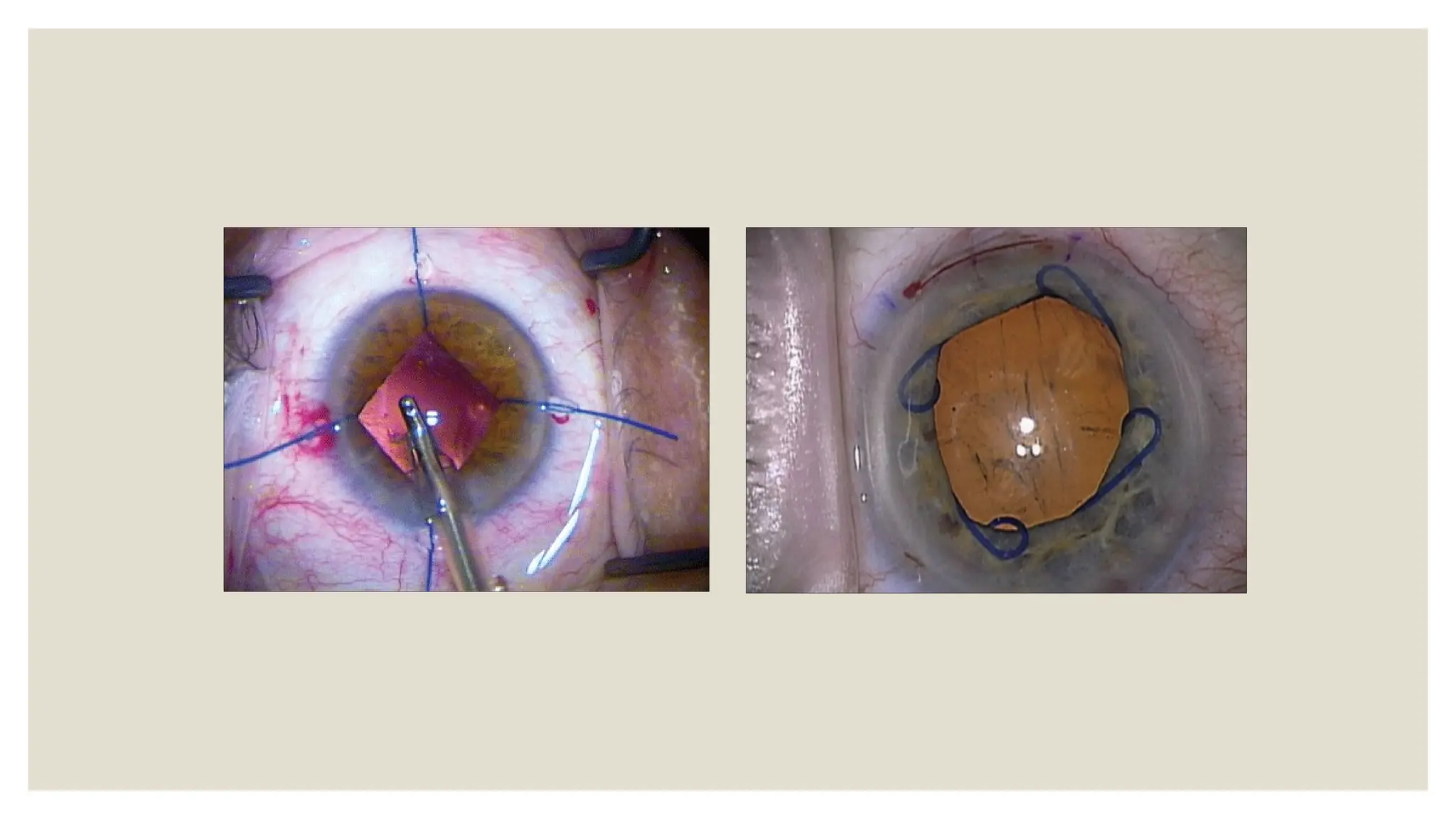
◦ Small incisions:
- Predispose to vitreous loss and zonular dialysis during nucleus expression
- Endothelium trauma- Nucleus delivery, IOL insertion
◦ Too wide incision
• Fluid tends to escape - AC depth fluctuation
• If vitreous pressure is high in fluctuant chamber –PCR
• Induced astigmatism
Management :
◦ Changing the plane of incision
◦ Self sealing tunnel fails: Radial sutures (10-0 Nylon)
◦ Button holing:
New tunnel at deeper plane
Suturing the button hole- Cross suture or pursed string sutures
Detachment of Descemet’s membrane
Cause :
◦ AC entry with blunt keratome or blade
◦ During AC irrigation and aspiration
◦ IOL insertion
◦ During incision :
Diagnosis:
◦ Small transparent tag curling inward from the corneal lip/ side port
incision
◦ Large tears: corneal edema- Bullous keratopathy
Treatment:
◦ Small detachments: Resolve spontaneously
◦ AC filled with air and curled up membrane is manipulated with back
with cyclodialysis spatula
◦ DM reattached
-14% Perfluoropropane (C3F8)
Sulfur hexafluoride (SF6)
-Viscoelastic material
◦ Suture the stripped edge of DM to the cornea with 10-0 nylon
Iris prolapse
Causes :
◦ Premature entry in AC in SICS
◦ Very large and posterior internal incision -
ECCE
◦ Positive vitreous pressure
◦ Excessive injection of fluids/ viscoelastic
agents - IOP rise
◦ Retrobulbar hemorrhage
◦ Suprachoroidal hemorrhage
Management of Iris Prolapse:
◦ Release the pressure – lid speculum
◦ Bridle suture clamp – released
◦ Reposition of prolapsed iris - Iris repositor or viscoelastic
◦ Infusion flow- reduced by lowering bottle height
◦ Wound length – reduced with sutures, Peripheral iridectomy
◦ Nucleus delivery - Irrigating wire vectis or lens glide
Iridodialysis/Coredialysis
Occur during
◦ Enlargement of incision
◦ Nucleus delivery
◦ Irrigation and aspiration
◦ IOL insertion
Management :
◦ Mccannel suture technique
◦ Sewing machine technique
◦ Hang back technique
Iris sphincter damage
◦ During extraction of hard nucleus in poorly dilated pupil
Intraoperative Floppy Iris Syndrome
Triad:
Iris billowing and floppiness
Iris prolapse
Progressive miosis
Cause:
◦ Use of selective and non selective α adrenergic antagonist-
Tamsulosin, Doxazosin, Terazosin
◦ Antipsychotic agents- Chlorpromazine
Risk :
Iris trauma
PCT and Vitreous loss
Anterior Capsulotomy related
complications
1. Rhexis Escape:
◦ Can Opener capsulotomy:
- Unequal capsular flap- tend to be
aspirated during I&A
- Tear towards the zonules
◦ Continuous curvilinear capsulorhexis:
- Peripheral extension- AC shallow or
positive pressure on the globe
Management
◦ Viscoelastic agent added:
-Increase AC depth
-Dilate pupil
-Flatten the capsular flap
◦ If radial tear does not reach zonules:
- Capsulorrhexis forceps or with cystotome: direct flap centrally
- Creating a new flap or switch to can-opener technique
2. Small Rhexis:
◦ Difficult to prolapse nucleus in AC-
Excess stress on the rhexis margin- Peripheral extension
Increased pressure – PCR - nucleus drop
◦ Excess stress on the zonules- dialysis and avulsion of bag in
AC
Prevented :
- Giving relaxing incisions
- Enlarge the rhexis by continuing spiral teal
3. Large Rhexis:
- Decentration of IOL
Complications during Hydrodissection
Peripheral extension of radial tears
During Forceful hydrodissection
Small rhexis, MSC or HMSC
PCR and Vitreous loss
Posterior dislocation of nucleus
Prevented :
Adequate rhexis size
Taping nucleus before every injection
Rotation of nucleus
Hydro delineation : Posterior Polar cataract
Complications during Nucleus delivery
Endothelial damage
Posterior capsule tear (PCT) and Vitreous loss
Mechanism of PCT
1. Small incision
2. Anterior CCC
◦ Risk of rhexis margin tear:
 Intumescent or HMSC- high intra lenticular pressure
 Pediatric cataract-
 Hard nucleus- Thin and friable capsule
 Fibrosed capsule- Traumatic or HMSC- Plaque and wrinkling
3. During Hydrodissection:
Block to outflow- small CCC
Injection of too much fluid
Inherent weakness
4. Nucleus removal and cortical aspiration
5. IOL implantation
Signs of PCT
1. Sudden deepening of AC
2. Sudden dilation of the pupil- Snap sign
3. Sudden softening
4. Abnormal tilt in nucleus
5. Inability to rotate the nuclear
6. Torn flap seen
7. Vitreous prolapse
8. Nucleus fragments –less mobile
9. Nucleus falls away
10. Wrinkling of Posterior capsule
11. Change in the fundal glow
Management of PCT
Depend upon:
◦ Extent of PCT
◦ Hyaloid face intact or not
◦ Location of nucleus
◦ Available equipments- vitrectomy machine
◦ Alternative IOLs
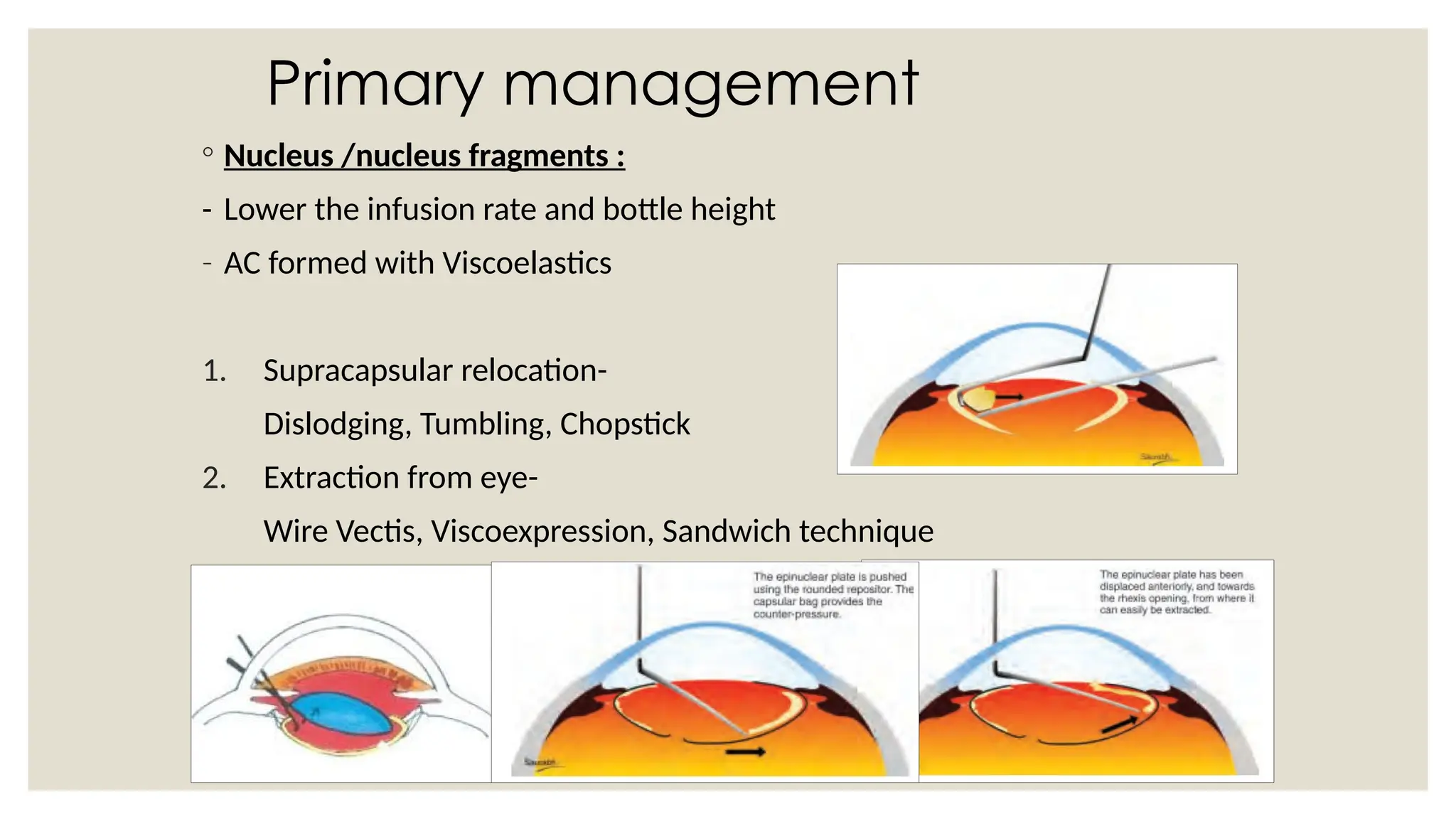
Primary management
◦ Nucleus /nucleus fragments :
- Lower the infusion rate and bottle height
- AC formed with Viscoelastics
1. Supracapsular relocation-
Dislodging, Tumbling, Chopstick
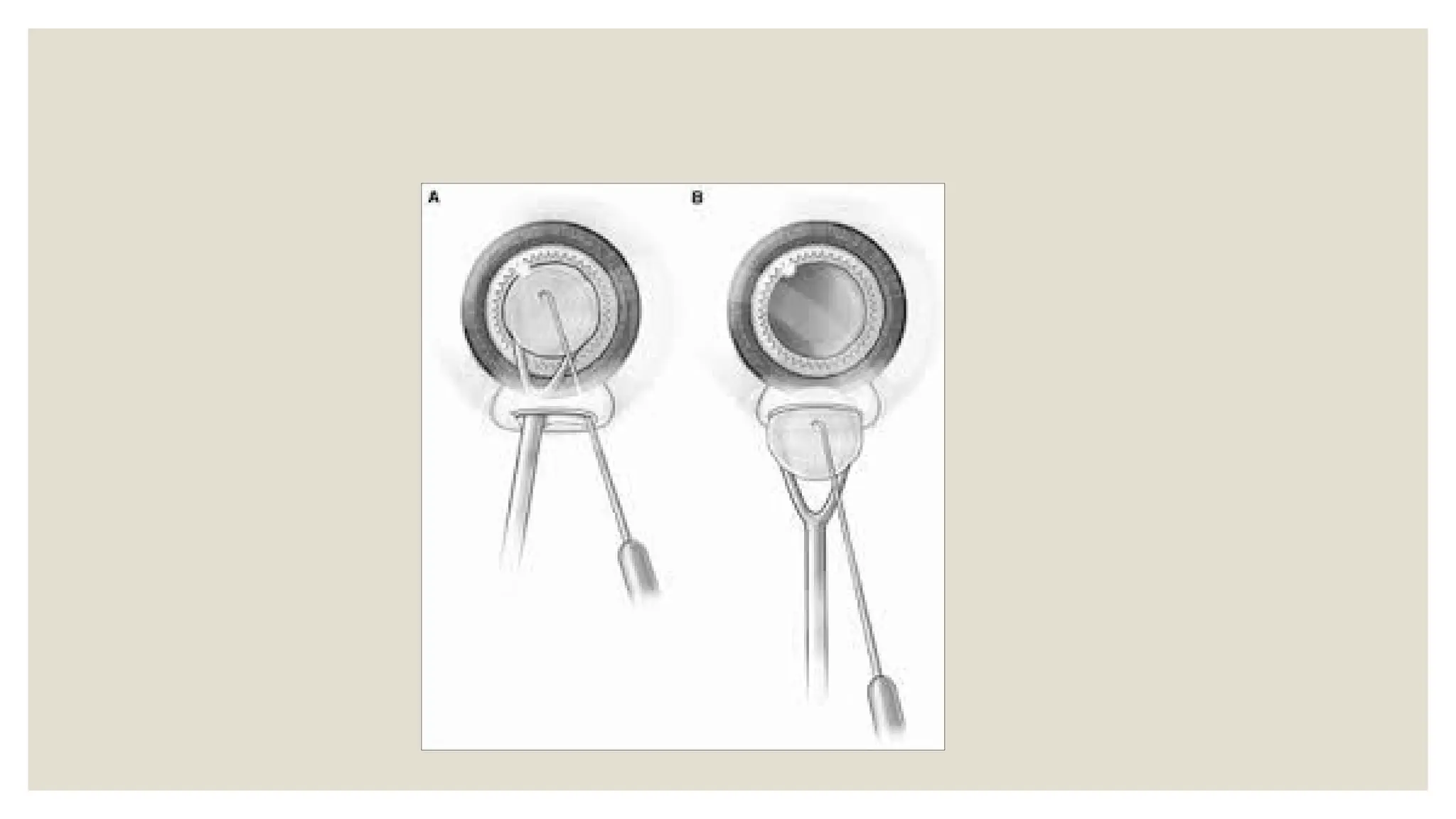
2. Extraction from eye-
Wire Vectis, Viscoexpression, Sandwich technique
Impending nucleus drop:
◦ Pars plana incision
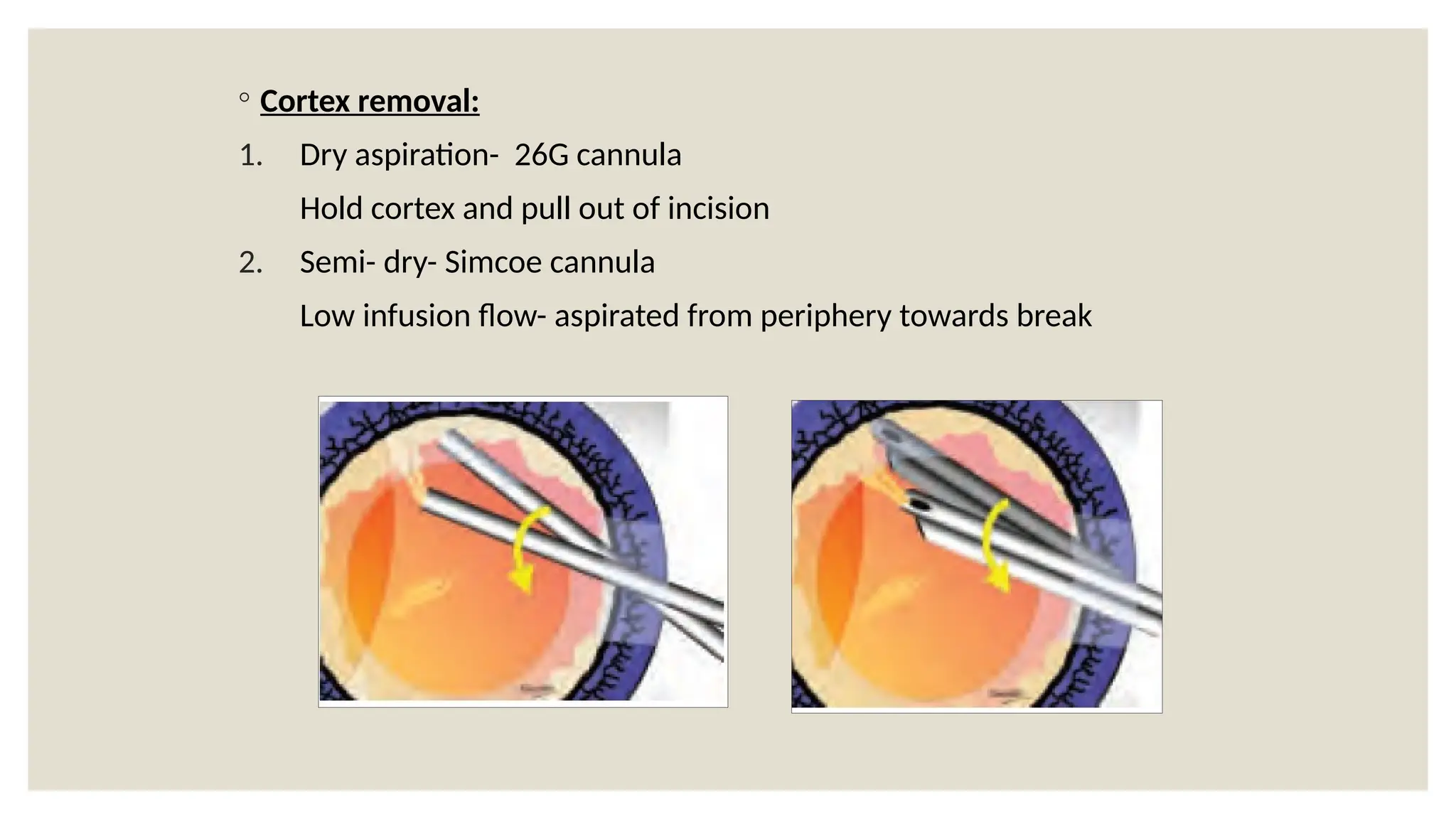
◦ Cortex removal:
1. Dry aspiration- 26G cannula
Hold cortex and pull out of incision
2. Semi- dry- Simcoe cannula
Low infusion flow- aspirated from periphery towards break
◦ Open sky anterior vitrectomy- Vannus
◦ Automated vitrectomy cutter
IOL Implantation:
◦ PCIOL:
-Anterior hyaloid face intact or PCT <3 clock hours
-Optic capture – if chance of decentration
◦ Sulcus fixated IOL:
-Large CCC without or with PCT >3clock hours
◦ ACIOL with PI:
-Extensive PCT or Zonular Dialysis
◦ Scleral fixated IOL/Glued IOL:
-Inadequate capsular support for bag or sulcus fixation
Zonular dialysis
Causes:
◦ Pseudoexfoliation syndrome, HMSC
◦ Traumatic capsulorhexis, excessive manipulation of
nucleus, I&A
◦ C/F: Phacodonesis, Iridodonesis, Vitreous in AC
Management:
◦ Viscoelastic placed over dialysis
◦ Infusion bottle lowered
◦ Plastic glide placed against dialysis
◦ I&A- parallel to edge of dialysis
◦ If vitreous loss- dry vitrectomy
◦ If <4 clock hours- PCIOL in bag
◦ Capsular tension ring (PMMA)-
stabilise
◦ If >6 clock hours –
ACIOL or Scleral fixated IOL
Posterior dislocated lens matter
Dropped IOL
◦ Pars plana vitrectomy and Phacofragmentation
◦ Removal by Perfluorocarbon Liquid
◦ Posterior Cryoextraction
◦ Removal by Endoscopy
Small fragments: By feeding with light pipe to cutter
Hard/large fragments:
◦ Phacofragmatome
◦ Use of Perfluorocarbon liquid
Rock hard black cataract:
Nucleus delivered through limbal incision
Dislocated IOL
Expulsive Suprachoroidal Hemorrhage
◦ Rare (0.04%) but serious complication
◦ Source: ruptured long & short posterior ciliary arteries where
they enter the suprachoroidal space from sclera
C/F:
◦ Sudden rise in IOP with acute onset of pain
◦ Progressive shallowing AC
◦ Darkening of red reflex
◦ Incision gape and iris prolapse
◦ Expulsion of lens, vitreous and blood
Predisposing factors:
◦ Elderly : Generalized arteriosclerosis
◦ Systemic Cardiovascular disease
◦ Chronic Glaucoma
◦ High myopic
◦ Nanophthalmos
◦ Choroidal hemangioma associated with Sturge- Weber
syndrome
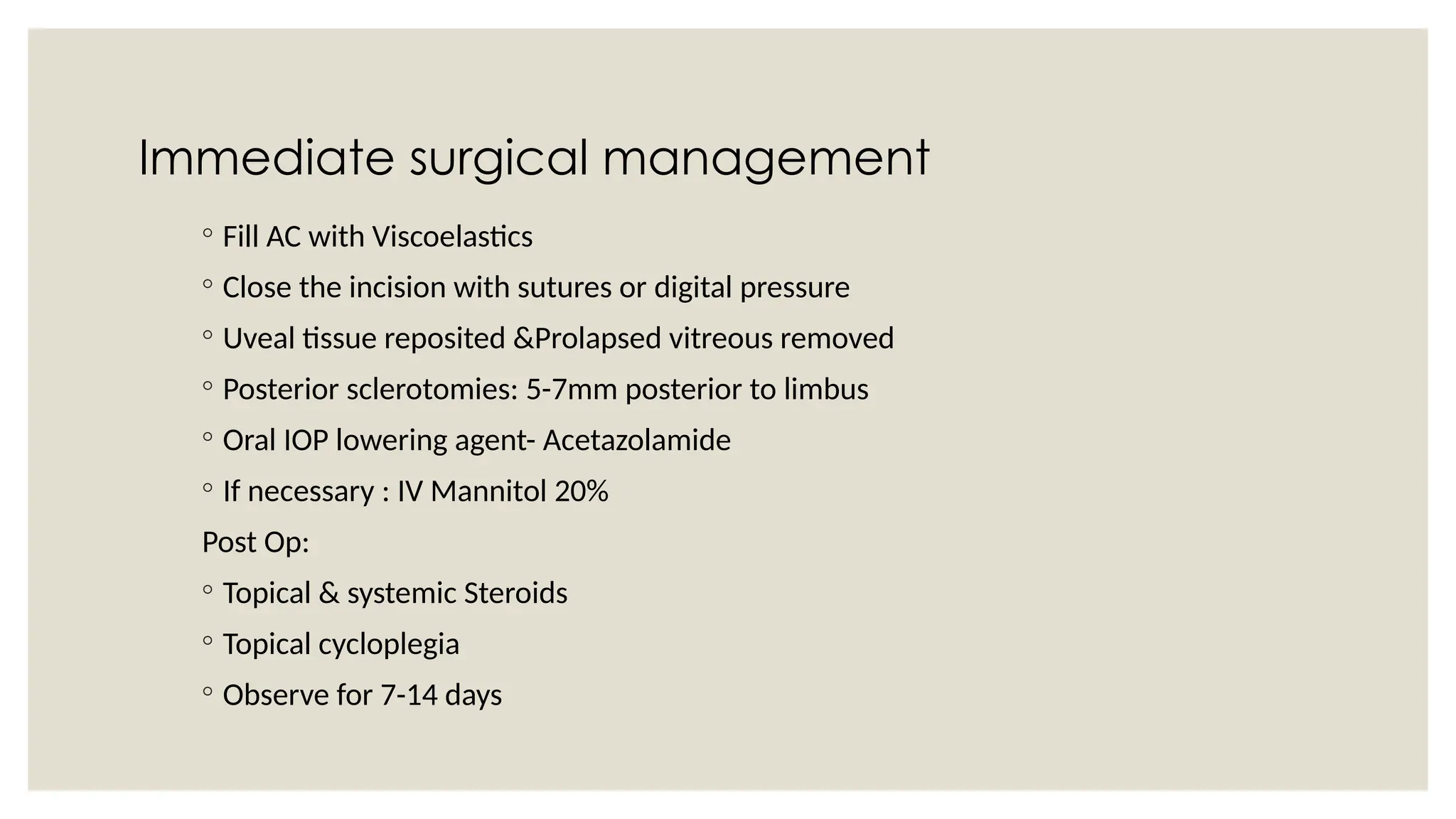
Immediate surgical management
◦ Fill AC with Viscoelastics
◦ Close the incision with sutures or digital pressure
◦ Uveal tissue reposited &Prolapsed vitreous removed
◦ Posterior sclerotomies: 5-7mm posterior to limbus
◦ Oral IOP lowering agent- Acetazolamide
◦ If necessary : IV Mannitol 20%
Post Op:
◦ Topical & systemic Steroids
◦ Topical cycloplegia
◦ Observe for 7-14 days
Early postoperative complications
Incision & Wound related complications
Wound leak
◦ Cause:
- Inadequate incision or suturing
- Excessive cautery and accidental sclerectomy
- Incarceration
- Rise in IOP –First 24-36 hrs
- Trauma
◦ Signs:
- Decreased vision, hypotony, shallow AC, corneal striae,
hyphema, choroidal folds/effusion, macular & optic nerve edema
- Seidel Test
Management
◦ Small leak-
Topical antibiotics, cycloplegia, aqueous suppressant, eye patching
◦ If persistent shallow AC, iris prolapse, hypotony, choroidal or macular
edema- Suturing
◦ Wound leak under conjunctival flap- Filtering bleb
Fistula may epithelialize
- Cryotherapy, diathermy
- Chemical cauterization
- Autologous blood patch
Wound dehiscence :
◦ Wound healing delay or incomplete
◦ Excessive cautery
◦ Tearing or button holing of incision
Traumatic wound rupture:
◦ Extrusion of intraocular contents
Induced Astigmatism:
◦ Large sutured incisions
◦ Tight radial sutures
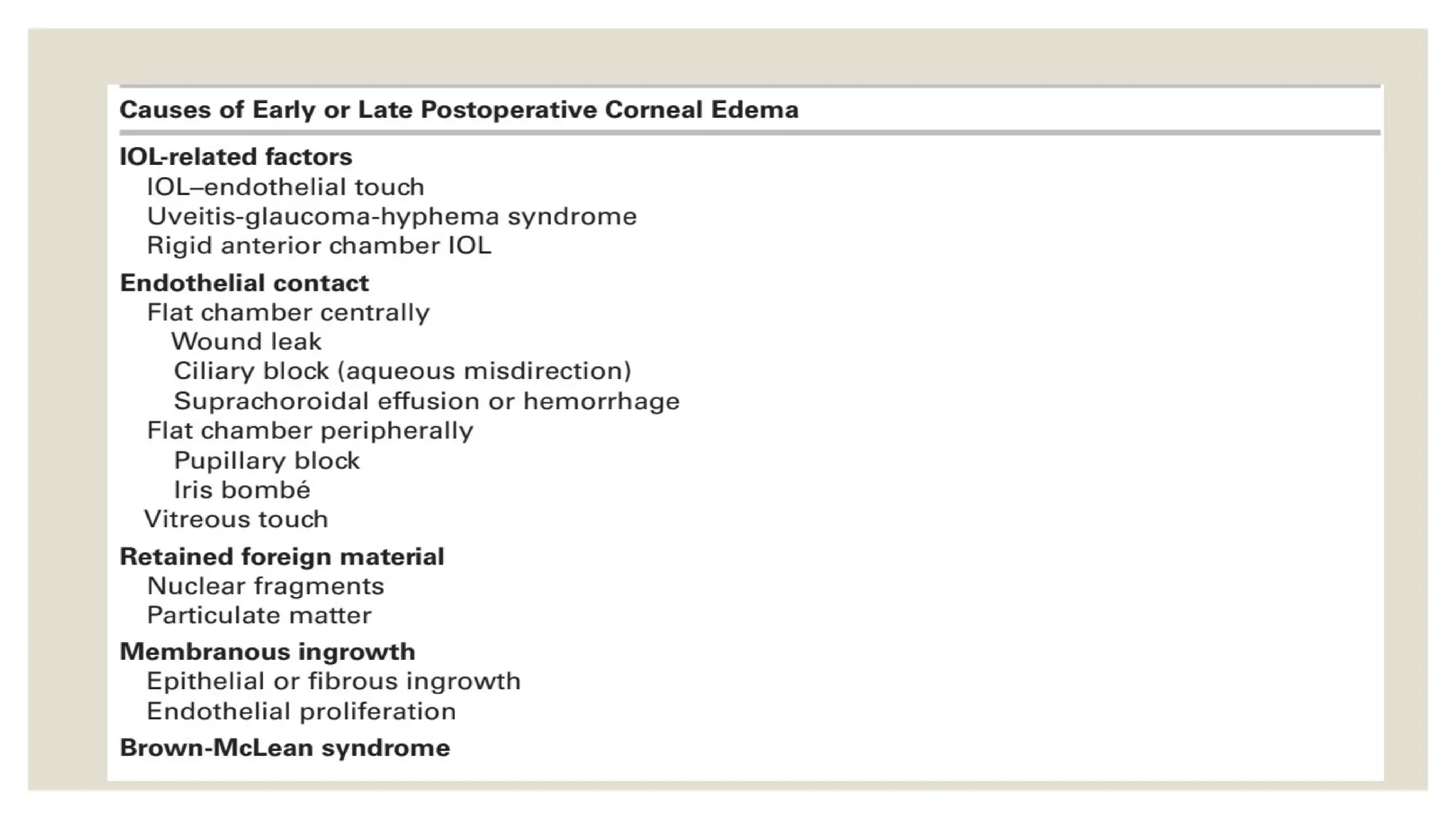
Corneal Edema
Management
◦ Mild edema – resolves with 7-14 days
◦ Hypertonic solutions- 5%NaCl
◦ Topical steroids
◦ Topical IOP lowering agents
◦ Posterior lamellar or endothelial keratoplasty
◦ Bullous keratopathy
- Phototherapeutic keratectomy or anterior stromal micropuncture
- Endothelial Keratoplasty
Treatment of the cause
◦ DM detachment – Air or expansile gas in AC or suturing
◦ Flat AC – Reform AC
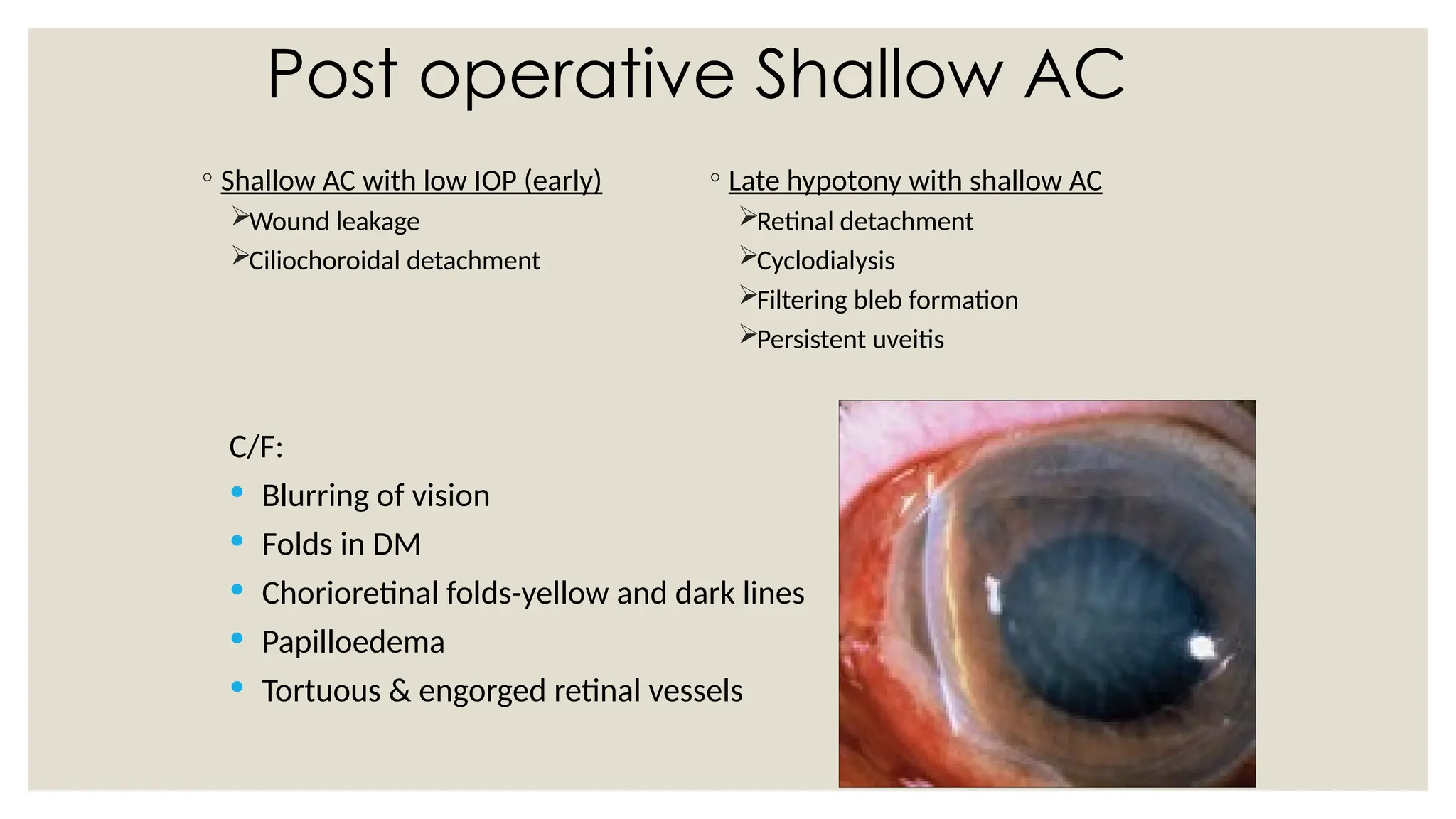
Post operative Shallow AC
◦ Shallow AC with low IOP (early)
Wound leakage
Ciliochoroidal detachment
◦ Late hypotony with shallow AC
Retinal detachment
Cyclodialysis
Filtering bleb formation
Persistent uveitis
C/F:
 Blurring of vision
 Folds in DM
 Chorioretinal folds-yellow and dark lines
 Papilloedema
 Tortuous & engorged retinal vessels
Management
◦ Treating - wound leakage
◦ Pressure dressing
◦ Cycloplegic agents
◦ CAI:
Reduce aqueous production- wound healing
◦ Hyperosmotic agents:
Decreases vitreous volume and suprachoroidal fluid
◦ Cyclodialysis :
McCannel method
Argon laser photocoagulation
Post operative Shallow AC
◦ Shallow AC with high IOP
Pupillary block
Malignant glaucoma
Suprachoroidal hemorrhage
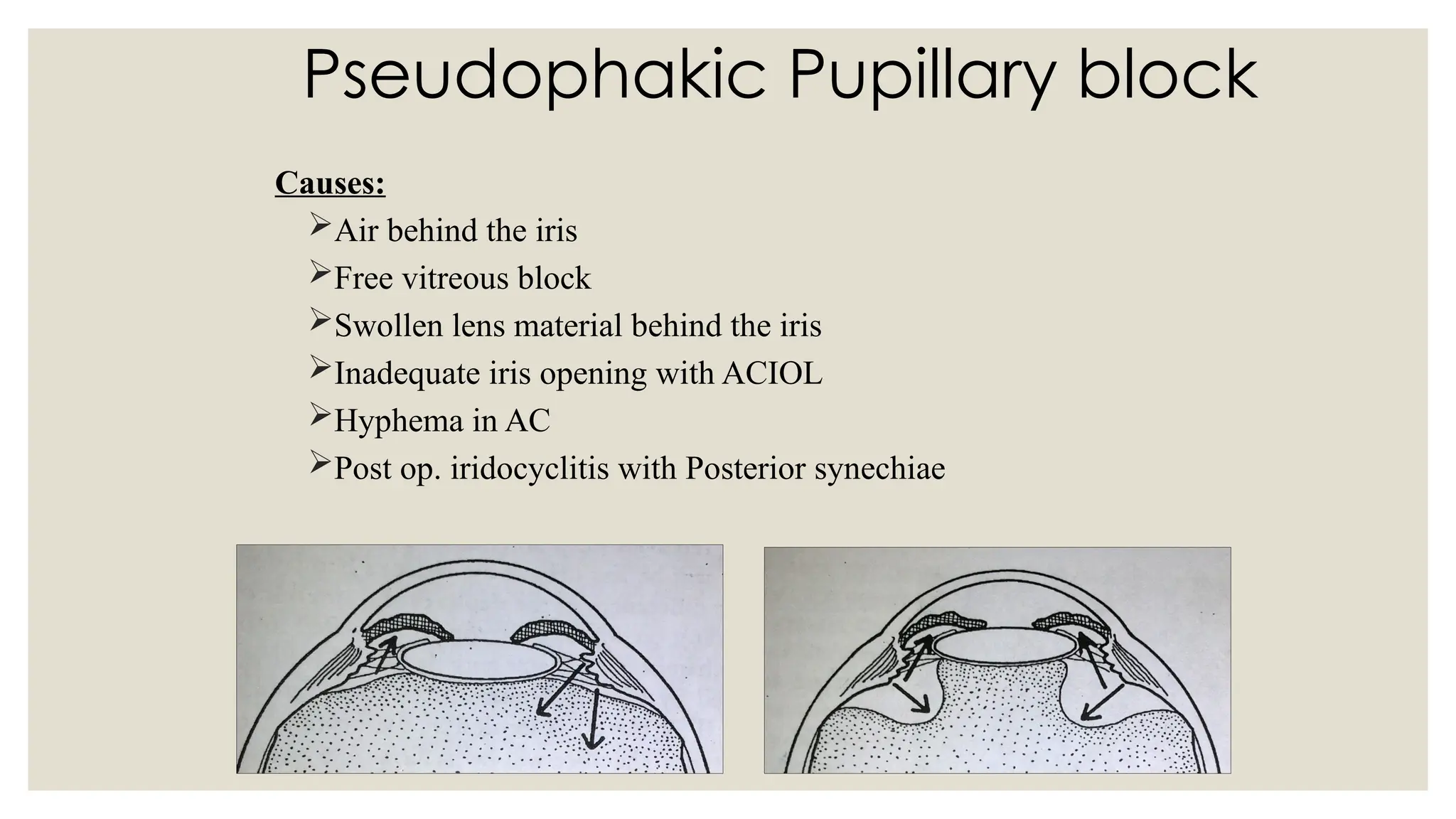
Pseudophakic Pupillary block
Causes:
Air behind the iris
Free vitreous block
Swollen lens material behind the iris
Inadequate iris opening with ACIOL
Hyphema in AC
Post op. iridocyclitis with Posterior synechiae
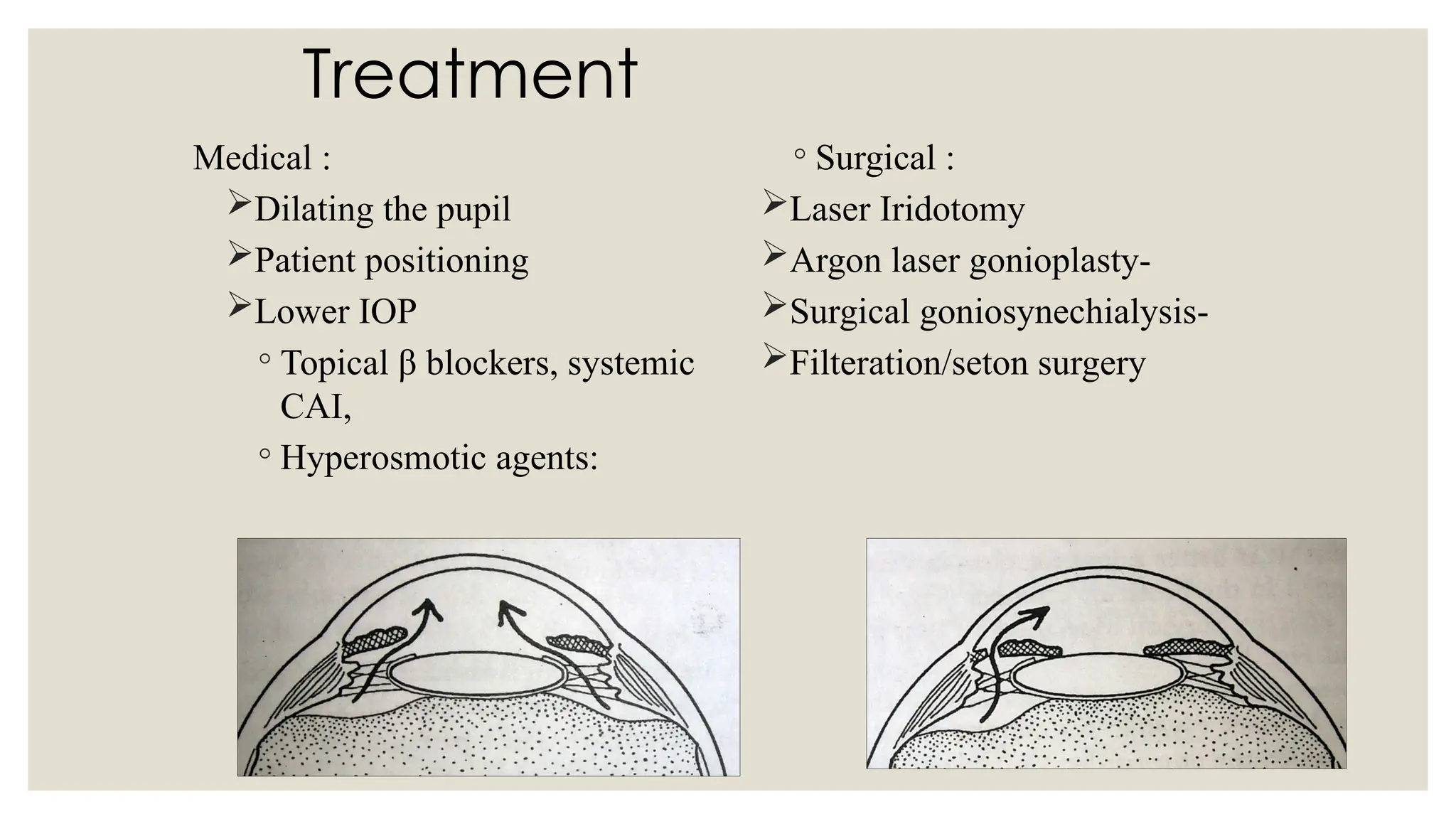
Treatment
Medical :
Dilating the pupil
Patient positioning
Lower IOP
◦ Topical β blockers, systemic
CAI,
◦ Hyperosmotic agents:
◦ Surgical :
Laser Iridotomy
Argon laser gonioplasty-
Surgical goniosynechialysis-
Filteration/seton surgery
Malignant Glaucoma
◦ Ciliary-block glaucoma
◦ Posterior aqueous diversion
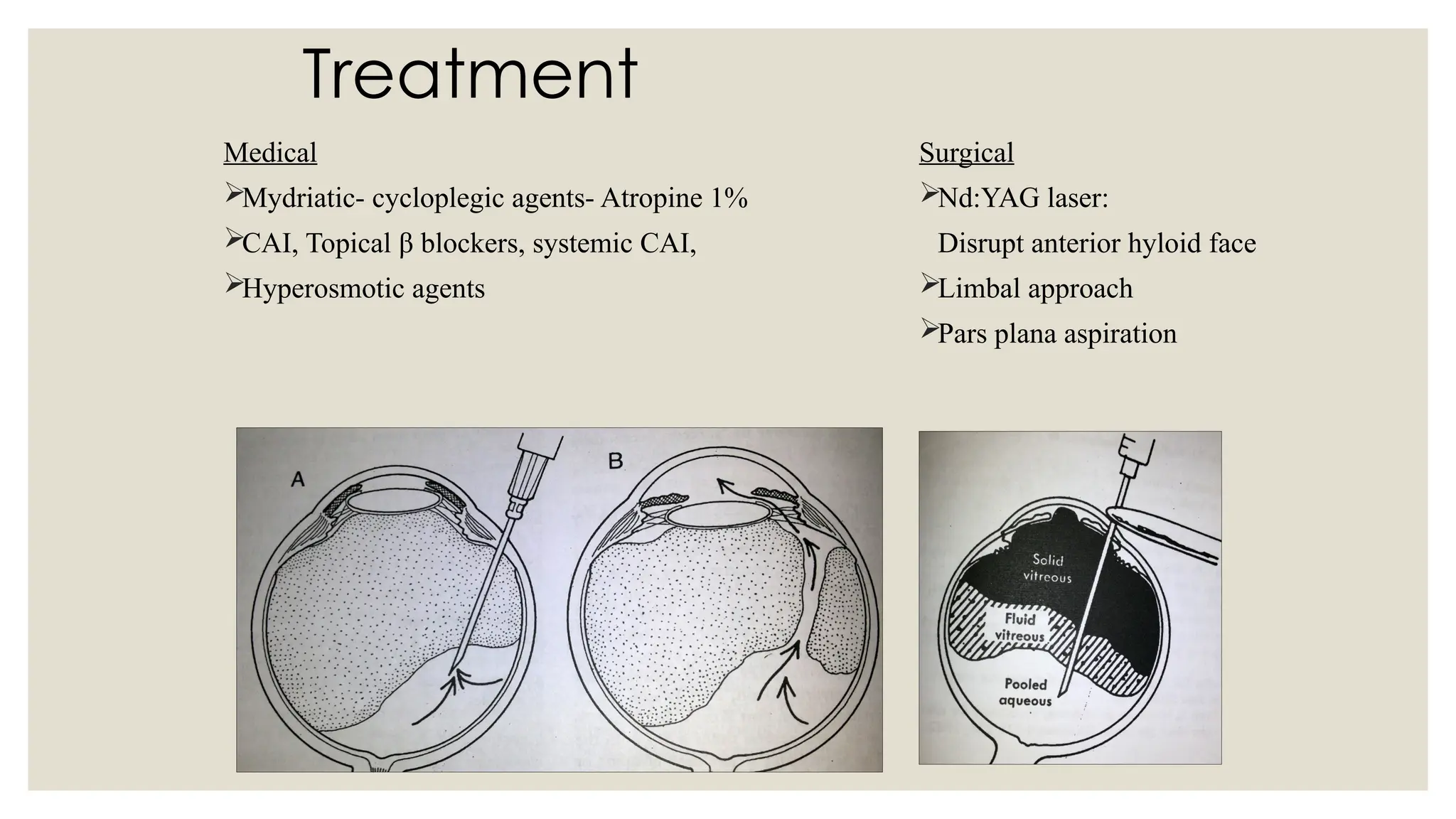
Treatment
Medical
Mydriatic- cycloplegic agents- Atropine 1%
CAI, Topical β blockers, systemic CAI,
Hyperosmotic agents
Surgical
Nd:YAG laser:
Disrupt anterior hyloid face
Limbal approach
Pars plana aspiration
Glaucoma after Cataract Surgery
Open angle (Early):
◦ Viscoelastics
◦ Hyphema
◦ Acute endophthalmitis
◦ TASS
◦ Retained lens material
◦ Uveitis / iris pigments
◦ Vitreous in AC
◦ POAG
Open angle (Late ):
◦ Ghost cell glaucoma
◦ UGH syndrome
◦ Steroids
◦ Nd:YAG laser capsulotomy
Angle closure:
◦ Preexisting ACG
◦ Pupillary block
◦ Malignant glaucoma
◦ Neovascular glaucoma
◦ Epithelial/fibrovascular
ingrowth
Hyphema
Source :
◦ Bleeding from tunnel
◦ Traumatized Iris
◦ Expulsive choroidal hemorrhage
Complications:
◦ Rise in IOP
◦ Corneal blood staining
Management
◦ < 1/3- spontaneous resolves
◦ 1/3 – half –
Propped up position, Topical steroids, anti-glaucoma drugs
Surgical intervention: AC wash
◦ IOP > 50mmHg for 5days or >35mmHg for 7days
◦ Corneal blood staining
◦ Large clot >10days
◦ Sickle cell disease & preexisting optic nerve damage
Ghost Cell Glaucoma
◦ Vitreous hemorrhage after 1-3 weeks
◦ Ghost cells : Tan and khaki-colored, less pliable, spherical freely
mobile
TT:
Ineffective to standard medication
Persistent IOP rise- AC wash
Recurrent IOP rise- Vitrectomy
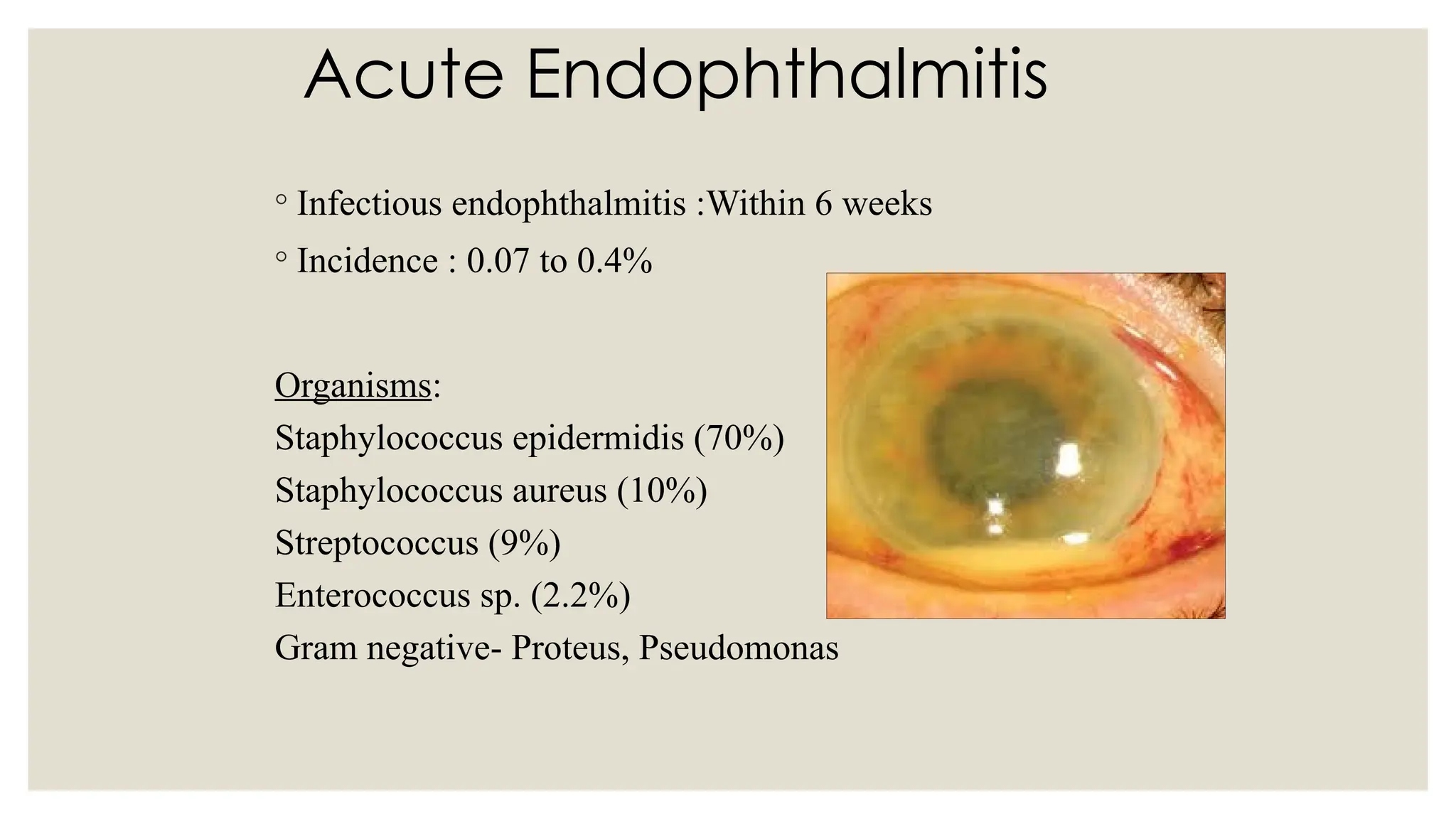
Acute Endophthalmitis
◦ Infectious endophthalmitis :Within 6 weeks
◦ Incidence : 0.07 to 0.4%
Organisms:
Staphylococcus epidermidis (70%)
Staphylococcus aureus (10%)
Streptococcus (9%)
Enterococcus sp. (2.2%)
Gram negative- Proteus, Pseudomonas
Acute Endophthalmitis
Preoperative:
Eyelid and Adnexal
Intraoperative :
◦ Prolonged surgery
◦ Clear corneal incision
◦ PCT and vitreous loss
◦ Secondary IOL placement(0.4%)
Post operative:
◦ Wound leak/ dehiscence
◦ Exposed suture knots
◦ Vitreous incarceration
◦ Filtering bleb
◦ DM, chronic alcoholic
Symptoms :
Majority within 3-10 days
Rapidly progressive
Mild to severe ocular pain
Decreased visual acuity
Floaters and photophobia
Signs :
Eyelids/periorbital swelling
Ciliary congestion, chemosis
Corneal edema
AC cells/flares with hypopyon
Vitreous inflammation
Retinitis, retinal hemorrhage
Blunting of red reflex
◦ USG B-scan: Exudates in vitreous, Chorioretinal thickening
Specimens for microbiological study:
◦ Unresponsive to intensive topical steroids
Anterior chamber- 0.1ml
Vitreous sample – 0.1-0.2ml (Pars Plana approach)
Treatment:
Intravitral : Vancomycin 1mg/0.1ml
Ceftazidime 2.25mg/0.1ml
(Amikacin 400µg/0.1ml in β lactam sensitive)
Systemic:
Ceftazidime 2gm IV TDS
Prednisolone 1mg/kg
Topical & Subconjunctival antibiotics:
Ceftazidime & Vancomycin
Complete vitrectomy plus Intravitral antibiotics : more effective
Toxic Anterior Segment Syndrome
Acute Sterile postoperative inflammation
Cause:
preservatives, detergents or cleaning solutions
Features :
◦ Occur within 12-24 hours of surgery
◦ Mild pain
◦ Diffuse limbal to limbal corneal edema
◦ Lack of isolated organism by gram stain or culture
◦ Predominance of anterior inflammation
Treatment :
Topical and systemic steroid
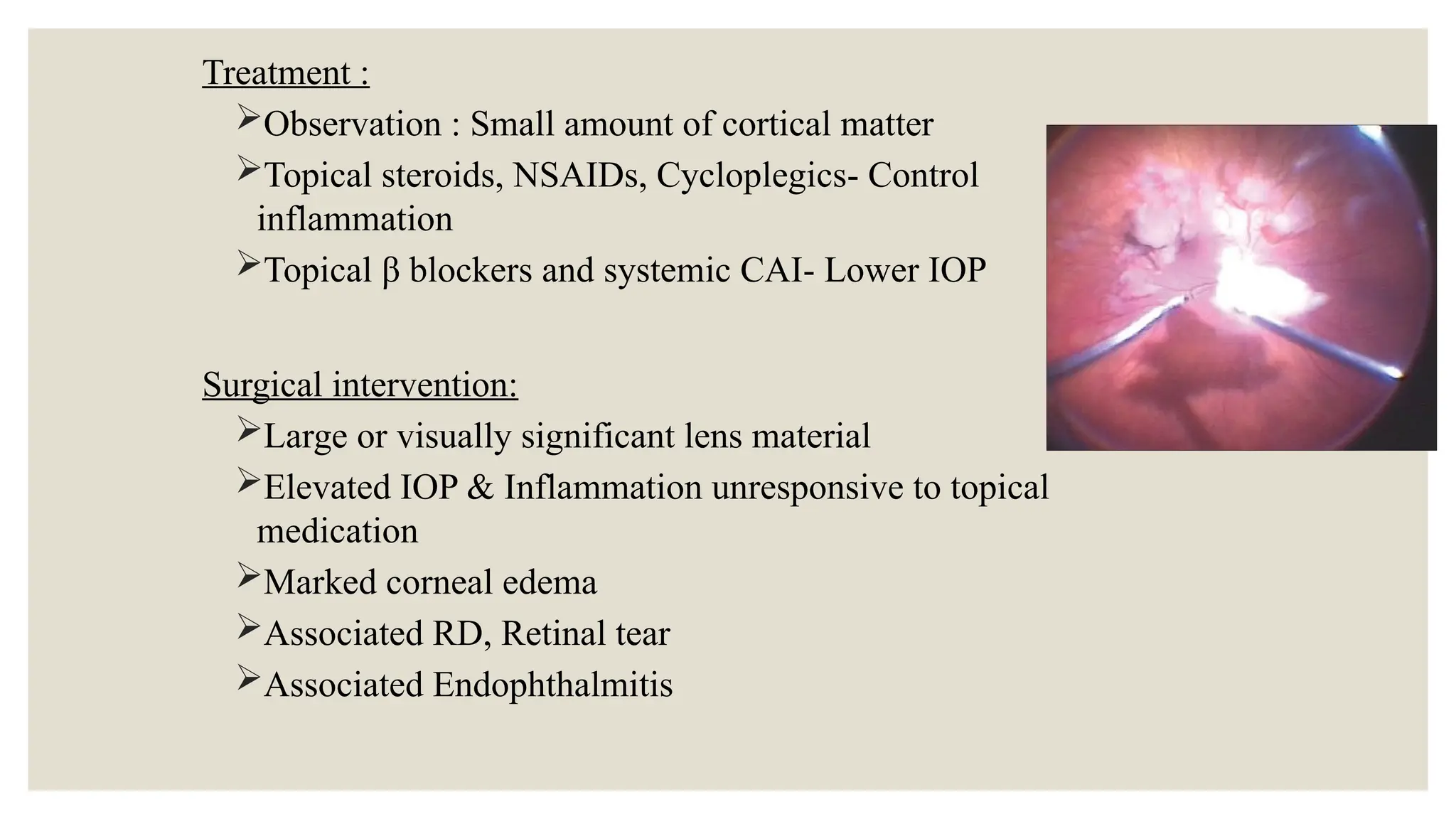
Retained Lens Material
◦ Retained in :
Anterior chamber angles
Behind iris
Migrate into vitreous (PCT)
◦ Cortical matter better tolerated than nuclear material
◦ Complications :
Treatment :
Observation : Small amount of cortical matter
Topical steroids, NSAIDs, Cycloplegics- Control
inflammation
Topical β blockers and systemic CAI- Lower IOP
Surgical intervention:
Large or visually significant lens material
Elevated IOP & Inflammation unresponsive to topical
medication
Marked corneal edema
Associated RD, Retinal tear
Associated Endophthalmitis
Late Post-Operative Complications
Cystoid Macular Edema
Irvine-Gass syndrome
◦ Common cause of decreased VA
Anatomical predilection:
◦ Fiber layer of Henle thickest at macula - Absorb large amount of fluid
◦ Avascularity of central area & absence of capillaries- Limit fluid absorption
◦ Thinness of fovea and basal lamina
Surgical complications contributing to CME
Iris incarceration in the wound
Vitreous adhesions or incarceration
Pupillary capture of IOL
Iris retracted by vitreous adhesions
PCR
Clinical findings:
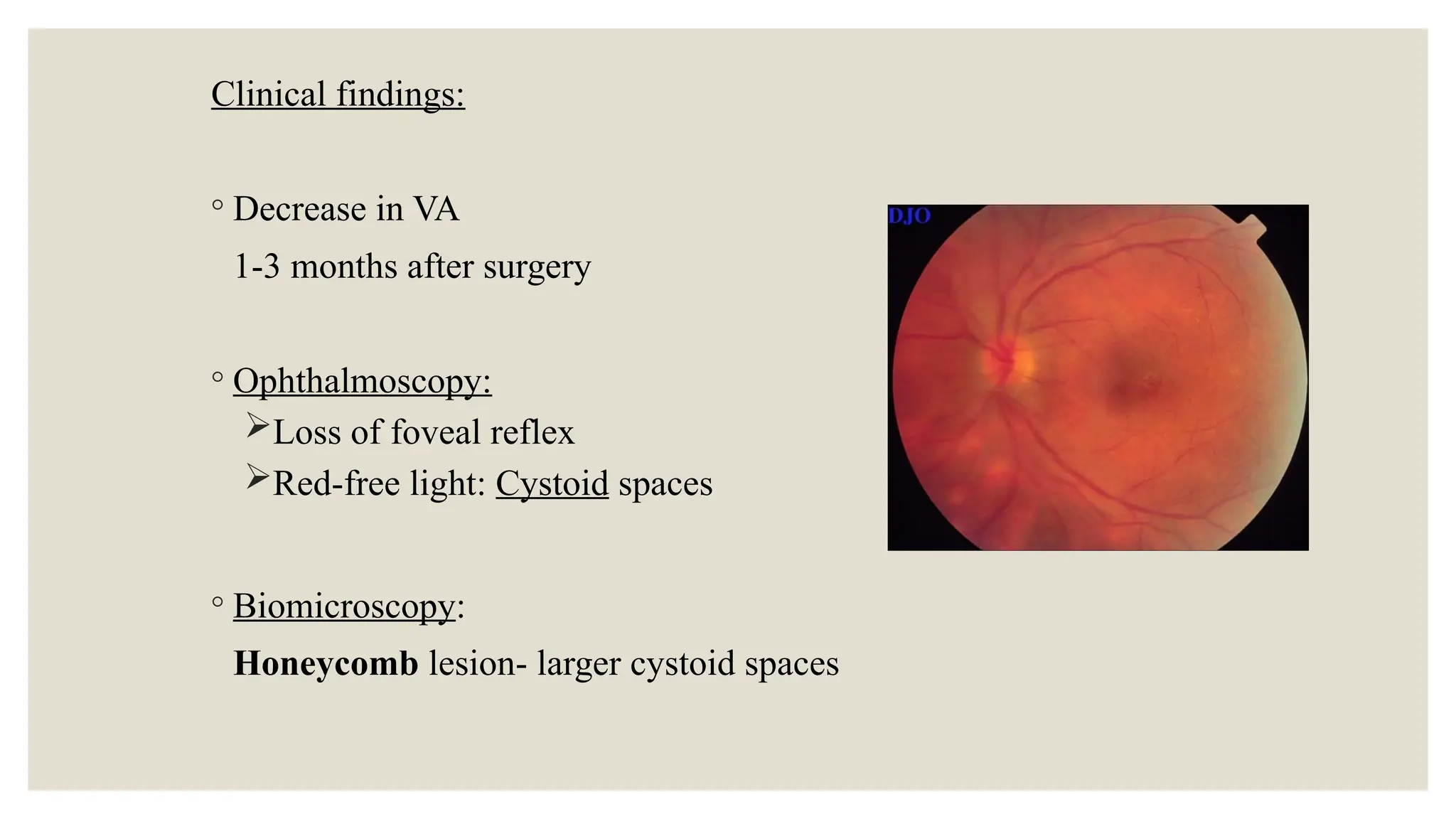
◦ Decrease in VA
1-3 months after surgery
◦ Ophthalmoscopy:
Loss of foveal reflex
Red-free light: Cystoid spaces
◦ Biomicroscopy:
Honeycomb lesion- larger cystoid spaces
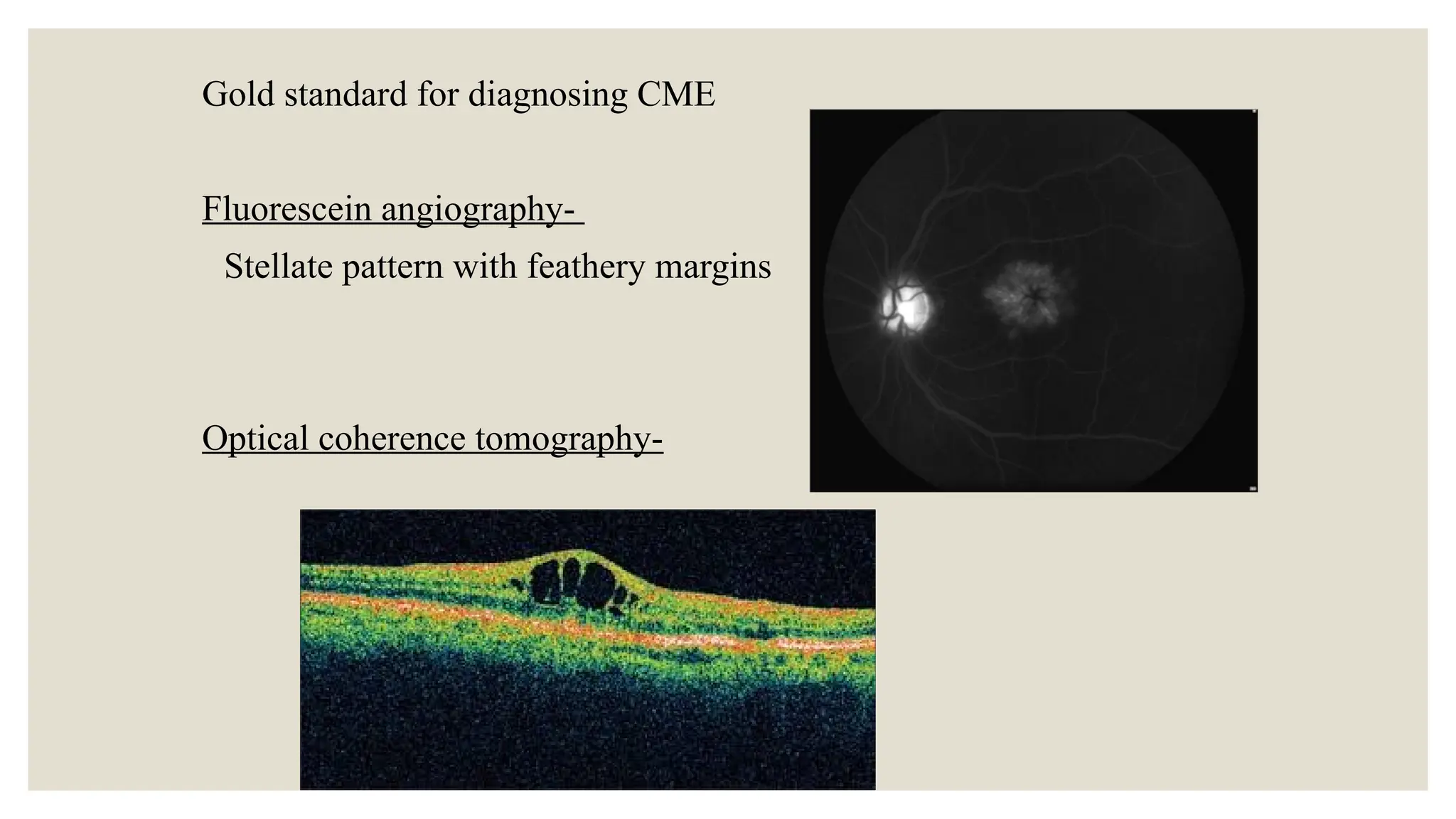
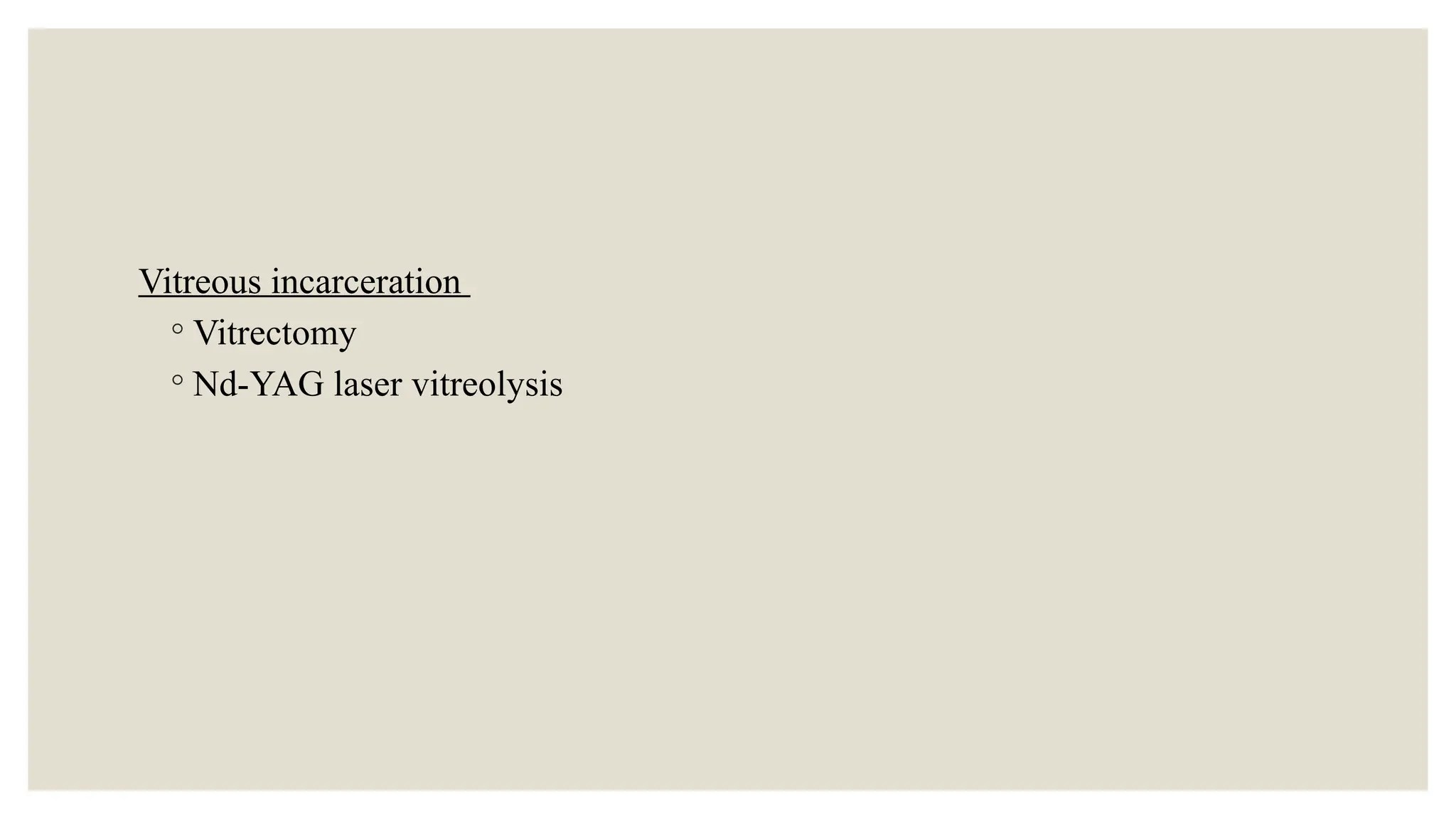
Gold standard for diagnosing CME
Fluorescein angiography-
Stellate pattern with feathery margins
Optical coherence tomography-
Treatment -
Prophylaxis
◦ Topical and systemic Prostaglandin synthesis inhibitors:
◦ Indomethacin 25mg QID - ↓ CME 4-6 weeks
◦ NSAID:
◦ Topical Flurbiprofen sodium 0.03% & Ketorolac sodium 0.5%
Established cases:
◦ Oral Indomethacin 25mg TDS 3 weeks
◦ Topical & oral steroids
◦ Acetazolomide 500mg
◦ Intravitral Triamcinolone and anti- VEGF
Vitreous incarceration
◦ Vitrectomy
◦ Nd-YAG laser vitreolysis
Posterior Capsular Opacification
Types:
1. Soemmering ring (Doughnut shaped)
Adherence of anterior and posterior capsule with proliferation
of equatorial LECs
2. Elschnig pearls (Fish egg)
Posterior proliferation & migration of equatorial LECs along
posterior capsule (Bladder cells, Wedl cells)
3. Capsular fibrosis
Anterior LECs proliferation and fibrous metaplasia
Six Factors to Reduce PCO
Surgery- related Factors
‘Capsular’ Surgery
1. Hydrodissection enhanced cortical clean up
2. In-the-bag fixation
3. Small CCC with edge in IOL surface
IOL-related Factors
‘Ideal’ IOL
4. Biocompatible IOL- Hydrophilic Acrylic
5. Maximal IOL optic-posterior capsule contact- Angulated haptic
6. Square, Truncated edge IOL
Treatment
Nd:YAG Laser Capsulotomy
Complications :
Transient rise in IOP
Cystoid macular edema
Retinal detachment, Macular hole
Endophthalmitis
Hyphema
Damage to IOL
Corneal edema
Capsular Contraction Syndrome
Post operative contraction of the anterior capsule opening due
to fibrous dysplasia of LECs
Cause –
Stress on the zonular fibers
Decentration of IOL
Risk :
Small capsulorrhexis opening
Pseudoexfoliation syndrome
Compromised zonular support
Silicone IOL
TT:
Several radial Nd:YAG –Laser anterior capsulotomies
Epithelial Downgrowth
◦ Sheet of epithelium grow intraocularly through incision-
Cover endothelium, TM and iris surface
C/f:
Retrocorneal membrane visible
Rise in IOP
Abnormal iris surface
Pupillary distortion
Diagnosis:
Argon Laser burns- White appearance
TT:
◦ Local applications of cryotherapy or 5-FU
◦ Glaucoma valve implants – IOP control
Retinal Detachment
◦ 0.4–3.6% - ICCE; 0.55–1.65%- ECCE; <1% -Phacoemulsification
(https://journals.plos.org/plosone/article?id=10.1371/journal.pone.0184187)
◦ 0.1-3.6% -Nd:YAG capsulotomy
◦ PVD is the inciting event
◦ Risk :
◦ Axial myopia >25mm
◦ Young age
◦ Male
◦ Lattice degeneration or previous RD
◦ PCT and vitreous loss
IOL related Complications
Decentration & Dislocation
Cause :
Sulcus placement
Asymmetric bag/ sulcus haptic placement
Decentered or oversized capsulorrhexis
Localized zonular defect-
Haptic damage
Capsular contraction
Complications :
◦ Unwanted glare and reflections
◦ Multiple images
◦ Pupillary capture and UGH syndrome
Malposition of IOL
Sunset Syndrome Sunrise Syndrome
Management :
◦ Miotics to constrict the pupil over IOL optic or
◦ Pigment dispersion or recurrent hyphema: Cycloplegics to iris/
IOL chafing
◦ Severe dislocation-
◦ IOL repositioning
◦ Stabilization with sutures
◦ Exchange
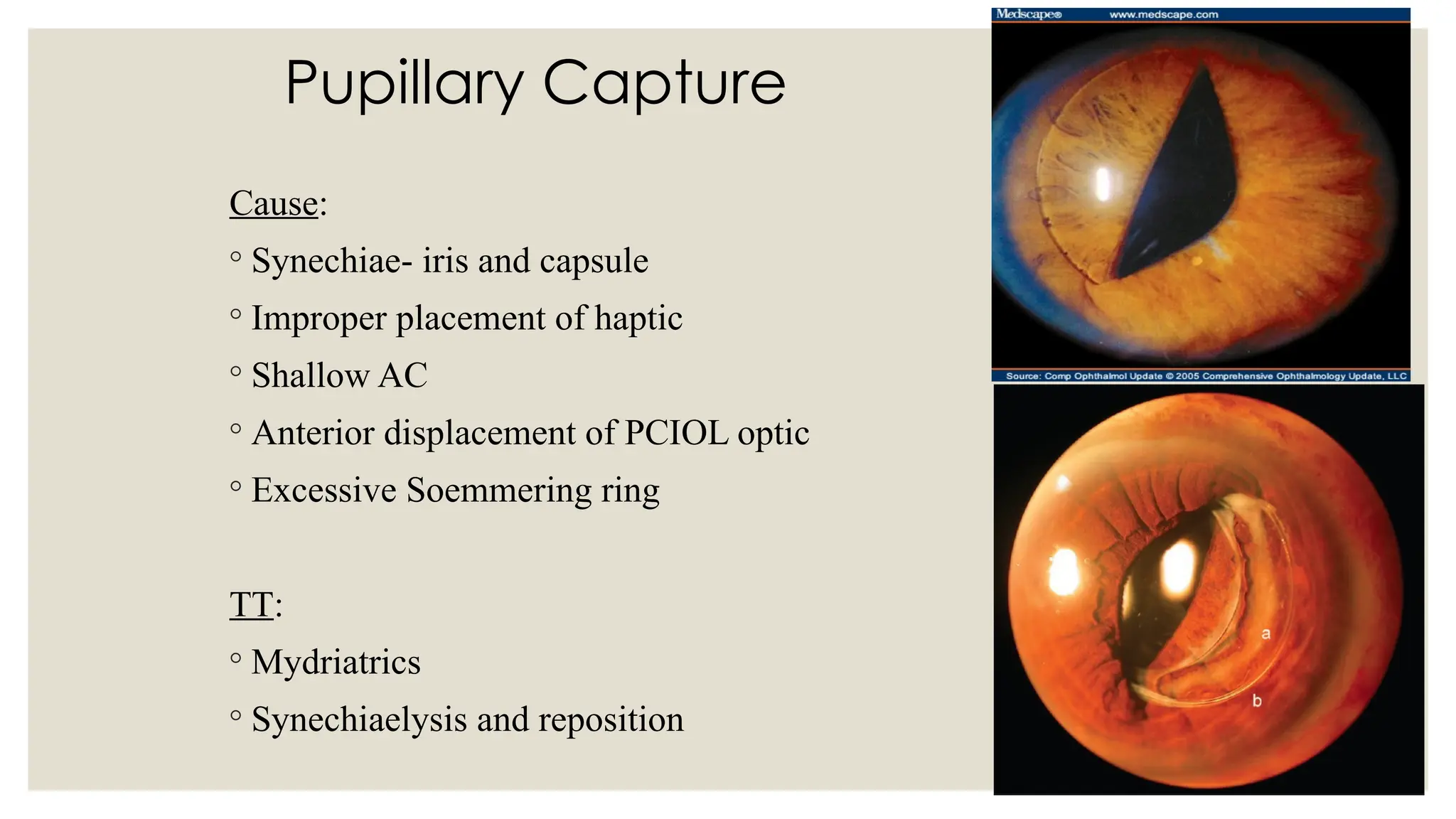
Pupillary Capture
Cause:
◦ Synechiae- iris and capsule
◦ Improper placement of haptic
◦ Shallow AC
◦ Anterior displacement of PCIOL optic
◦ Excessive Soemmering ring
TT:
◦ Mydriatrics
◦ Synechiaelysis and reposition
Capsular Block Syndrome
Viscoelastic entrapment syndrome
Features:
◦ Posterior distention of posterior capsule
◦ Progressive myopic shift
◦ Shallowing of AC- Anterior shift of IOL
◦ IOP rise
TT:
Nd:YAG posterior capsulotomy
Uveitis-Glaucoma-Hyphema Syndrome
◦ Mechanical rubbing of the IOL with uveal tissue
Occur:
Inappropriate IOL size and placement
Contact of IOL with vascular structures or endothelium
TT:
◦ Topical Cycloplegics , anti-inflammatory and anti-glaucoma
◦ IOL removal :Threatens retinal or corneal function
Summary
◦ Though SICS is safe and successful in large majority of cases, it is not without
its inherent problems and potential complications
◦ Understanding the mechanism of several complications and immediately
identifying the signs and performing the correct steps to minimize further
unwanted negative results
Bibliography :
◦ AAO lens and cataract-2020-2021
◦ Yanoff and Duker Ophthalmology, 5th
edition
◦ Albert and jakobiec’s vol 1, 3rd
edition
◦ Cataract surgery: technique, complication and management 2nd
edition
◦Thank You

Complications of cataract.pptx important

  • 1.
  • 2.
    Layout: ◦ Preoperative complications ◦Intraoperative complications ◦ Postoperative complications ◦ IOL related complications
  • 3.
    Categorized Pre-operative complications Intra-operative complications Post-operativecomplications • Early post-operative (within 4weeks) • Late post-operative (1month to years) IOL related complications
  • 4.
  • 5.
    ◦ Anxiety : ◦On the eve of operation due to fear and apprehension of operation ◦ Anxiolytic drug: diazepam 2 to 5 mg Hs ◦ Nausea and gastritis ◦ Irritative or allergic conjunctivitis ◦ Corneal abrsion
  • 6.
    Block related complications ◦Retrobulbar hemorrhage ◦ Globe perforation- ◦ Trauma to Optic nerve ◦ Central spread of anesthetic ◦ Retinal vascular occlusion ◦ Subconjunctival hemorrhage ◦ Optic atrophy
  • 7.
    Retrobulbar Hemorrhage ◦ Incidence: 0.44- 0.74% ( AAO lens and cataract 2020-2021) ◦ Risk: ◦ Hypertension ◦ Coagulopathy ◦ Retrobulbar block ◦ Venous hemorrhage: spread slowly, self- limited ◦ Arterial hemorrhage:
  • 8.
    Management ◦ Digital pressure ◦IV mannital 20% 0.5-1mg/kg ◦ Aqueous suppressants ◦ Lateral Canthotomy and Cantholysis ◦ Anterior paracentesis- rare ◦ Localized conjunctival peritomy ( to allow egress of blood) ◦ Postpone surgery- 2-4 days – Plan GA
  • 9.
  • 10.
    Superior rectus bridlesuture ◦ Muscle Laceration ◦ Hematoma formation ◦ Globe perforation Prevention : ◦ Round body needle ◦ Direct the needle away from the globe ◦ Apply suture –after visual confirmation of the SR with forceps
  • 11.
    Conjunctival dissection ◦ Subconjunctivalhemorrhage ◦ Cautery burn - shrinkage of scleral tissue : Astigmatism ◦ Conjunctival tear: Site of globe fixation
  • 12.
    Incision related complications Scleralgroove ◦ Too deep (>1/2) – -Entry into supraciliary space - Hemorrhage - Hypotony - Premature entry -Iris prolapse ◦ Too shallow (<1/2) - Button holing – wound leak
  • 13.
    ◦ Small incisions: -Predispose to vitreous loss and zonular dialysis during nucleus expression - Endothelium trauma- Nucleus delivery, IOL insertion ◦ Too wide incision • Fluid tends to escape - AC depth fluctuation • If vitreous pressure is high in fluctuant chamber –PCR • Induced astigmatism
  • 14.
    Management : ◦ Changingthe plane of incision ◦ Self sealing tunnel fails: Radial sutures (10-0 Nylon) ◦ Button holing: New tunnel at deeper plane Suturing the button hole- Cross suture or pursed string sutures
  • 15.
    Detachment of Descemet’smembrane Cause : ◦ AC entry with blunt keratome or blade ◦ During AC irrigation and aspiration ◦ IOL insertion ◦ During incision :
  • 16.
    Diagnosis: ◦ Small transparenttag curling inward from the corneal lip/ side port incision ◦ Large tears: corneal edema- Bullous keratopathy Treatment: ◦ Small detachments: Resolve spontaneously ◦ AC filled with air and curled up membrane is manipulated with back with cyclodialysis spatula
  • 17.
    ◦ DM reattached -14%Perfluoropropane (C3F8) Sulfur hexafluoride (SF6) -Viscoelastic material ◦ Suture the stripped edge of DM to the cornea with 10-0 nylon
  • 18.
    Iris prolapse Causes : ◦Premature entry in AC in SICS ◦ Very large and posterior internal incision - ECCE ◦ Positive vitreous pressure ◦ Excessive injection of fluids/ viscoelastic agents - IOP rise ◦ Retrobulbar hemorrhage ◦ Suprachoroidal hemorrhage
  • 19.
    Management of IrisProlapse: ◦ Release the pressure – lid speculum ◦ Bridle suture clamp – released ◦ Reposition of prolapsed iris - Iris repositor or viscoelastic ◦ Infusion flow- reduced by lowering bottle height ◦ Wound length – reduced with sutures, Peripheral iridectomy ◦ Nucleus delivery - Irrigating wire vectis or lens glide
  • 20.
    Iridodialysis/Coredialysis Occur during ◦ Enlargementof incision ◦ Nucleus delivery ◦ Irrigation and aspiration ◦ IOL insertion
  • 21.
    Management : ◦ Mccannelsuture technique ◦ Sewing machine technique ◦ Hang back technique
  • 23.
    Iris sphincter damage ◦During extraction of hard nucleus in poorly dilated pupil
  • 24.
    Intraoperative Floppy IrisSyndrome Triad: Iris billowing and floppiness Iris prolapse Progressive miosis Cause: ◦ Use of selective and non selective α adrenergic antagonist- Tamsulosin, Doxazosin, Terazosin ◦ Antipsychotic agents- Chlorpromazine Risk : Iris trauma PCT and Vitreous loss
  • 26.
    Anterior Capsulotomy related complications 1.Rhexis Escape: ◦ Can Opener capsulotomy: - Unequal capsular flap- tend to be aspirated during I&A - Tear towards the zonules ◦ Continuous curvilinear capsulorhexis: - Peripheral extension- AC shallow or positive pressure on the globe
  • 27.
    Management ◦ Viscoelastic agentadded: -Increase AC depth -Dilate pupil -Flatten the capsular flap ◦ If radial tear does not reach zonules: - Capsulorrhexis forceps or with cystotome: direct flap centrally - Creating a new flap or switch to can-opener technique
  • 28.
    2. Small Rhexis: ◦Difficult to prolapse nucleus in AC- Excess stress on the rhexis margin- Peripheral extension Increased pressure – PCR - nucleus drop ◦ Excess stress on the zonules- dialysis and avulsion of bag in AC Prevented : - Giving relaxing incisions - Enlarge the rhexis by continuing spiral teal 3. Large Rhexis: - Decentration of IOL
  • 29.
    Complications during Hydrodissection Peripheralextension of radial tears During Forceful hydrodissection Small rhexis, MSC or HMSC PCR and Vitreous loss Posterior dislocation of nucleus Prevented : Adequate rhexis size Taping nucleus before every injection Rotation of nucleus Hydro delineation : Posterior Polar cataract
  • 30.
    Complications during Nucleusdelivery Endothelial damage Posterior capsule tear (PCT) and Vitreous loss Mechanism of PCT 1. Small incision 2. Anterior CCC ◦ Risk of rhexis margin tear:  Intumescent or HMSC- high intra lenticular pressure  Pediatric cataract-  Hard nucleus- Thin and friable capsule  Fibrosed capsule- Traumatic or HMSC- Plaque and wrinkling
  • 31.
    3. During Hydrodissection: Blockto outflow- small CCC Injection of too much fluid Inherent weakness 4. Nucleus removal and cortical aspiration 5. IOL implantation
  • 32.
    Signs of PCT 1.Sudden deepening of AC 2. Sudden dilation of the pupil- Snap sign 3. Sudden softening 4. Abnormal tilt in nucleus 5. Inability to rotate the nuclear 6. Torn flap seen 7. Vitreous prolapse 8. Nucleus fragments –less mobile 9. Nucleus falls away 10. Wrinkling of Posterior capsule 11. Change in the fundal glow
  • 33.
    Management of PCT Dependupon: ◦ Extent of PCT ◦ Hyaloid face intact or not ◦ Location of nucleus ◦ Available equipments- vitrectomy machine ◦ Alternative IOLs
  • 34.
    Primary management ◦ Nucleus/nucleus fragments : - Lower the infusion rate and bottle height - AC formed with Viscoelastics 1. Supracapsular relocation- Dislodging, Tumbling, Chopstick 2. Extraction from eye- Wire Vectis, Viscoexpression, Sandwich technique
  • 37.
    Impending nucleus drop: ◦Pars plana incision
  • 38.
    ◦ Cortex removal: 1.Dry aspiration- 26G cannula Hold cortex and pull out of incision 2. Semi- dry- Simcoe cannula Low infusion flow- aspirated from periphery towards break
  • 39.
    ◦ Open skyanterior vitrectomy- Vannus ◦ Automated vitrectomy cutter
  • 40.
    IOL Implantation: ◦ PCIOL: -Anteriorhyaloid face intact or PCT <3 clock hours -Optic capture – if chance of decentration ◦ Sulcus fixated IOL: -Large CCC without or with PCT >3clock hours ◦ ACIOL with PI: -Extensive PCT or Zonular Dialysis ◦ Scleral fixated IOL/Glued IOL: -Inadequate capsular support for bag or sulcus fixation
  • 41.
    Zonular dialysis Causes: ◦ Pseudoexfoliationsyndrome, HMSC ◦ Traumatic capsulorhexis, excessive manipulation of nucleus, I&A ◦ C/F: Phacodonesis, Iridodonesis, Vitreous in AC
  • 42.
    Management: ◦ Viscoelastic placedover dialysis ◦ Infusion bottle lowered ◦ Plastic glide placed against dialysis ◦ I&A- parallel to edge of dialysis ◦ If vitreous loss- dry vitrectomy ◦ If <4 clock hours- PCIOL in bag ◦ Capsular tension ring (PMMA)- stabilise ◦ If >6 clock hours – ACIOL or Scleral fixated IOL
  • 43.
    Posterior dislocated lensmatter Dropped IOL ◦ Pars plana vitrectomy and Phacofragmentation ◦ Removal by Perfluorocarbon Liquid ◦ Posterior Cryoextraction ◦ Removal by Endoscopy
  • 44.
    Small fragments: Byfeeding with light pipe to cutter
  • 45.
    Hard/large fragments: ◦ Phacofragmatome ◦Use of Perfluorocarbon liquid
  • 46.
    Rock hard blackcataract: Nucleus delivered through limbal incision
  • 47.
  • 48.
    Expulsive Suprachoroidal Hemorrhage ◦Rare (0.04%) but serious complication ◦ Source: ruptured long & short posterior ciliary arteries where they enter the suprachoroidal space from sclera C/F: ◦ Sudden rise in IOP with acute onset of pain ◦ Progressive shallowing AC ◦ Darkening of red reflex ◦ Incision gape and iris prolapse ◦ Expulsion of lens, vitreous and blood
  • 49.
    Predisposing factors: ◦ Elderly: Generalized arteriosclerosis ◦ Systemic Cardiovascular disease ◦ Chronic Glaucoma ◦ High myopic ◦ Nanophthalmos ◦ Choroidal hemangioma associated with Sturge- Weber syndrome
  • 50.
    Immediate surgical management ◦Fill AC with Viscoelastics ◦ Close the incision with sutures or digital pressure ◦ Uveal tissue reposited &Prolapsed vitreous removed ◦ Posterior sclerotomies: 5-7mm posterior to limbus ◦ Oral IOP lowering agent- Acetazolamide ◦ If necessary : IV Mannitol 20% Post Op: ◦ Topical & systemic Steroids ◦ Topical cycloplegia ◦ Observe for 7-14 days
  • 51.
  • 52.
    Incision & Woundrelated complications Wound leak ◦ Cause: - Inadequate incision or suturing - Excessive cautery and accidental sclerectomy - Incarceration - Rise in IOP –First 24-36 hrs - Trauma ◦ Signs: - Decreased vision, hypotony, shallow AC, corneal striae, hyphema, choroidal folds/effusion, macular & optic nerve edema - Seidel Test
  • 53.
    Management ◦ Small leak- Topicalantibiotics, cycloplegia, aqueous suppressant, eye patching ◦ If persistent shallow AC, iris prolapse, hypotony, choroidal or macular edema- Suturing ◦ Wound leak under conjunctival flap- Filtering bleb Fistula may epithelialize - Cryotherapy, diathermy - Chemical cauterization - Autologous blood patch
  • 54.
    Wound dehiscence : ◦Wound healing delay or incomplete ◦ Excessive cautery ◦ Tearing or button holing of incision Traumatic wound rupture: ◦ Extrusion of intraocular contents Induced Astigmatism: ◦ Large sutured incisions ◦ Tight radial sutures
  • 55.
  • 57.
    Management ◦ Mild edema– resolves with 7-14 days ◦ Hypertonic solutions- 5%NaCl ◦ Topical steroids ◦ Topical IOP lowering agents ◦ Posterior lamellar or endothelial keratoplasty ◦ Bullous keratopathy - Phototherapeutic keratectomy or anterior stromal micropuncture - Endothelial Keratoplasty Treatment of the cause ◦ DM detachment – Air or expansile gas in AC or suturing ◦ Flat AC – Reform AC
  • 58.
    Post operative ShallowAC ◦ Shallow AC with low IOP (early) Wound leakage Ciliochoroidal detachment ◦ Late hypotony with shallow AC Retinal detachment Cyclodialysis Filtering bleb formation Persistent uveitis C/F:  Blurring of vision  Folds in DM  Chorioretinal folds-yellow and dark lines  Papilloedema  Tortuous & engorged retinal vessels
  • 59.
    Management ◦ Treating -wound leakage ◦ Pressure dressing ◦ Cycloplegic agents ◦ CAI: Reduce aqueous production- wound healing ◦ Hyperosmotic agents: Decreases vitreous volume and suprachoroidal fluid ◦ Cyclodialysis : McCannel method Argon laser photocoagulation
  • 60.
    Post operative ShallowAC ◦ Shallow AC with high IOP Pupillary block Malignant glaucoma Suprachoroidal hemorrhage
  • 61.
    Pseudophakic Pupillary block Causes: Airbehind the iris Free vitreous block Swollen lens material behind the iris Inadequate iris opening with ACIOL Hyphema in AC Post op. iridocyclitis with Posterior synechiae
  • 62.
    Treatment Medical : Dilating thepupil Patient positioning Lower IOP ◦ Topical β blockers, systemic CAI, ◦ Hyperosmotic agents: ◦ Surgical : Laser Iridotomy Argon laser gonioplasty- Surgical goniosynechialysis- Filteration/seton surgery
  • 63.
    Malignant Glaucoma ◦ Ciliary-blockglaucoma ◦ Posterior aqueous diversion
  • 64.
    Treatment Medical Mydriatic- cycloplegic agents-Atropine 1% CAI, Topical β blockers, systemic CAI, Hyperosmotic agents Surgical Nd:YAG laser: Disrupt anterior hyloid face Limbal approach Pars plana aspiration
  • 65.
    Glaucoma after CataractSurgery Open angle (Early): ◦ Viscoelastics ◦ Hyphema ◦ Acute endophthalmitis ◦ TASS ◦ Retained lens material ◦ Uveitis / iris pigments ◦ Vitreous in AC ◦ POAG Open angle (Late ): ◦ Ghost cell glaucoma ◦ UGH syndrome ◦ Steroids ◦ Nd:YAG laser capsulotomy Angle closure: ◦ Preexisting ACG ◦ Pupillary block ◦ Malignant glaucoma ◦ Neovascular glaucoma ◦ Epithelial/fibrovascular ingrowth
  • 66.
    Hyphema Source : ◦ Bleedingfrom tunnel ◦ Traumatized Iris ◦ Expulsive choroidal hemorrhage Complications: ◦ Rise in IOP ◦ Corneal blood staining
  • 67.
    Management ◦ < 1/3-spontaneous resolves ◦ 1/3 – half – Propped up position, Topical steroids, anti-glaucoma drugs Surgical intervention: AC wash ◦ IOP > 50mmHg for 5days or >35mmHg for 7days ◦ Corneal blood staining ◦ Large clot >10days ◦ Sickle cell disease & preexisting optic nerve damage
  • 68.
    Ghost Cell Glaucoma ◦Vitreous hemorrhage after 1-3 weeks ◦ Ghost cells : Tan and khaki-colored, less pliable, spherical freely mobile TT: Ineffective to standard medication Persistent IOP rise- AC wash Recurrent IOP rise- Vitrectomy
  • 69.
    Acute Endophthalmitis ◦ Infectiousendophthalmitis :Within 6 weeks ◦ Incidence : 0.07 to 0.4% Organisms: Staphylococcus epidermidis (70%) Staphylococcus aureus (10%) Streptococcus (9%) Enterococcus sp. (2.2%) Gram negative- Proteus, Pseudomonas
  • 70.
    Acute Endophthalmitis Preoperative: Eyelid andAdnexal Intraoperative : ◦ Prolonged surgery ◦ Clear corneal incision ◦ PCT and vitreous loss ◦ Secondary IOL placement(0.4%) Post operative: ◦ Wound leak/ dehiscence ◦ Exposed suture knots ◦ Vitreous incarceration ◦ Filtering bleb ◦ DM, chronic alcoholic
  • 71.
    Symptoms : Majority within3-10 days Rapidly progressive Mild to severe ocular pain Decreased visual acuity Floaters and photophobia Signs : Eyelids/periorbital swelling Ciliary congestion, chemosis Corneal edema AC cells/flares with hypopyon Vitreous inflammation Retinitis, retinal hemorrhage Blunting of red reflex
  • 72.
    ◦ USG B-scan:Exudates in vitreous, Chorioretinal thickening Specimens for microbiological study: ◦ Unresponsive to intensive topical steroids Anterior chamber- 0.1ml Vitreous sample – 0.1-0.2ml (Pars Plana approach)
  • 73.
    Treatment: Intravitral : Vancomycin1mg/0.1ml Ceftazidime 2.25mg/0.1ml (Amikacin 400µg/0.1ml in β lactam sensitive) Systemic: Ceftazidime 2gm IV TDS Prednisolone 1mg/kg Topical & Subconjunctival antibiotics: Ceftazidime & Vancomycin Complete vitrectomy plus Intravitral antibiotics : more effective
  • 74.
    Toxic Anterior SegmentSyndrome Acute Sterile postoperative inflammation Cause: preservatives, detergents or cleaning solutions
  • 75.
    Features : ◦ Occurwithin 12-24 hours of surgery ◦ Mild pain ◦ Diffuse limbal to limbal corneal edema ◦ Lack of isolated organism by gram stain or culture ◦ Predominance of anterior inflammation Treatment : Topical and systemic steroid
  • 76.
    Retained Lens Material ◦Retained in : Anterior chamber angles Behind iris Migrate into vitreous (PCT) ◦ Cortical matter better tolerated than nuclear material ◦ Complications :
  • 77.
    Treatment : Observation :Small amount of cortical matter Topical steroids, NSAIDs, Cycloplegics- Control inflammation Topical β blockers and systemic CAI- Lower IOP Surgical intervention: Large or visually significant lens material Elevated IOP & Inflammation unresponsive to topical medication Marked corneal edema Associated RD, Retinal tear Associated Endophthalmitis
  • 78.
  • 79.
    Cystoid Macular Edema Irvine-Gasssyndrome ◦ Common cause of decreased VA Anatomical predilection: ◦ Fiber layer of Henle thickest at macula - Absorb large amount of fluid ◦ Avascularity of central area & absence of capillaries- Limit fluid absorption ◦ Thinness of fovea and basal lamina
  • 80.
    Surgical complications contributingto CME Iris incarceration in the wound Vitreous adhesions or incarceration Pupillary capture of IOL Iris retracted by vitreous adhesions PCR
  • 81.
    Clinical findings: ◦ Decreasein VA 1-3 months after surgery ◦ Ophthalmoscopy: Loss of foveal reflex Red-free light: Cystoid spaces ◦ Biomicroscopy: Honeycomb lesion- larger cystoid spaces
  • 82.
    Gold standard fordiagnosing CME Fluorescein angiography- Stellate pattern with feathery margins Optical coherence tomography-
  • 83.
    Treatment - Prophylaxis ◦ Topicaland systemic Prostaglandin synthesis inhibitors: ◦ Indomethacin 25mg QID - ↓ CME 4-6 weeks ◦ NSAID: ◦ Topical Flurbiprofen sodium 0.03% & Ketorolac sodium 0.5% Established cases: ◦ Oral Indomethacin 25mg TDS 3 weeks ◦ Topical & oral steroids ◦ Acetazolomide 500mg ◦ Intravitral Triamcinolone and anti- VEGF
  • 84.
  • 85.
    Posterior Capsular Opacification Types: 1.Soemmering ring (Doughnut shaped) Adherence of anterior and posterior capsule with proliferation of equatorial LECs
  • 86.
    2. Elschnig pearls(Fish egg) Posterior proliferation & migration of equatorial LECs along posterior capsule (Bladder cells, Wedl cells)
  • 87.
    3. Capsular fibrosis AnteriorLECs proliferation and fibrous metaplasia
  • 88.
    Six Factors toReduce PCO Surgery- related Factors ‘Capsular’ Surgery 1. Hydrodissection enhanced cortical clean up 2. In-the-bag fixation 3. Small CCC with edge in IOL surface IOL-related Factors ‘Ideal’ IOL 4. Biocompatible IOL- Hydrophilic Acrylic 5. Maximal IOL optic-posterior capsule contact- Angulated haptic 6. Square, Truncated edge IOL
  • 89.
    Treatment Nd:YAG Laser Capsulotomy Complications: Transient rise in IOP Cystoid macular edema Retinal detachment, Macular hole Endophthalmitis Hyphema Damage to IOL Corneal edema
  • 90.
    Capsular Contraction Syndrome Postoperative contraction of the anterior capsule opening due to fibrous dysplasia of LECs Cause – Stress on the zonular fibers Decentration of IOL
  • 91.
    Risk : Small capsulorrhexisopening Pseudoexfoliation syndrome Compromised zonular support Silicone IOL TT: Several radial Nd:YAG –Laser anterior capsulotomies
  • 92.
    Epithelial Downgrowth ◦ Sheetof epithelium grow intraocularly through incision- Cover endothelium, TM and iris surface C/f: Retrocorneal membrane visible Rise in IOP Abnormal iris surface Pupillary distortion
  • 93.
    Diagnosis: Argon Laser burns-White appearance TT: ◦ Local applications of cryotherapy or 5-FU ◦ Glaucoma valve implants – IOP control
  • 94.
    Retinal Detachment ◦ 0.4–3.6%- ICCE; 0.55–1.65%- ECCE; <1% -Phacoemulsification (https://journals.plos.org/plosone/article?id=10.1371/journal.pone.0184187) ◦ 0.1-3.6% -Nd:YAG capsulotomy ◦ PVD is the inciting event ◦ Risk : ◦ Axial myopia >25mm ◦ Young age ◦ Male ◦ Lattice degeneration or previous RD ◦ PCT and vitreous loss
  • 95.
  • 96.
    Decentration & Dislocation Cause: Sulcus placement Asymmetric bag/ sulcus haptic placement Decentered or oversized capsulorrhexis Localized zonular defect- Haptic damage Capsular contraction Complications : ◦ Unwanted glare and reflections ◦ Multiple images ◦ Pupillary capture and UGH syndrome
  • 98.
    Malposition of IOL SunsetSyndrome Sunrise Syndrome
  • 99.
    Management : ◦ Mioticsto constrict the pupil over IOL optic or ◦ Pigment dispersion or recurrent hyphema: Cycloplegics to iris/ IOL chafing ◦ Severe dislocation- ◦ IOL repositioning ◦ Stabilization with sutures ◦ Exchange
  • 100.
    Pupillary Capture Cause: ◦ Synechiae-iris and capsule ◦ Improper placement of haptic ◦ Shallow AC ◦ Anterior displacement of PCIOL optic ◦ Excessive Soemmering ring TT: ◦ Mydriatrics ◦ Synechiaelysis and reposition
  • 101.
    Capsular Block Syndrome Viscoelasticentrapment syndrome Features: ◦ Posterior distention of posterior capsule ◦ Progressive myopic shift ◦ Shallowing of AC- Anterior shift of IOL ◦ IOP rise TT: Nd:YAG posterior capsulotomy
  • 102.
    Uveitis-Glaucoma-Hyphema Syndrome ◦ Mechanicalrubbing of the IOL with uveal tissue Occur: Inappropriate IOL size and placement Contact of IOL with vascular structures or endothelium TT: ◦ Topical Cycloplegics , anti-inflammatory and anti-glaucoma ◦ IOL removal :Threatens retinal or corneal function
  • 103.
    Summary ◦ Though SICSis safe and successful in large majority of cases, it is not without its inherent problems and potential complications ◦ Understanding the mechanism of several complications and immediately identifying the signs and performing the correct steps to minimize further unwanted negative results
  • 104.
    Bibliography : ◦ AAOlens and cataract-2020-2021 ◦ Yanoff and Duker Ophthalmology, 5th edition ◦ Albert and jakobiec’s vol 1, 3rd edition ◦ Cataract surgery: technique, complication and management 2nd edition
  • 105.

Editor's Notes

  • #5 Some patients may develops anxiety…. Some patients may develop allergic conjunctivitis due to preoperative topical antibiotics drops……..postponing the operation for 2 days along with withdrawal of such drugs is required. Corneal abrasion may be due to inadvertent injury during schiotz or GAT……patching with antibiotic ointment for a day and postponement of operation for 2 days is required.
  • #6 Globe perforation: elongated myopic eyes, post staphyloma, scleral buckling surgery and deep set eyes, uncooperative pt, retrobulbar location: cause hypotony, poor red reflex, poking thru sensation and marked pain Central spread: from the subdural space of optic nerve to optic chiasma and into the subarachnoid space to pons and midbrain
  • #7 Characterized by Rapid and taut orbital swelling.Marked proptosis, immobility of the globe.Elevated IOP.Inability to separate eyelids.Massive ecchymosis of the lids and conjunctiva
  • #11 Subconjunctival hmg due to conjunctival contact with stabilization instruments used while making clear corneal inscision
  • #12 Ideal incision: 6mm long, 2-3mm away from limbus, 50% thickness and 2mm into clear cornea
  • #15 Prevention : Keratome directed posteriorly,Sharp instruments Not to mistake DM tag for anterior capsule tag
  • #16 Repositioned using an air bubble, and, rarely, viscoelastics Suture 10-0 nylon (rarely needed) double ac
  • #20 Localized separation or tearing way of iris from its attachment to the ciliary body
  • #21 Retract the cornea and suture the iris to scleral aspect of the incision
  • #23 Management : a single- pass 4- throw pupilloplasty • pupillary cerclage
  • #24 Tamsulosi- BPH, renal stone, urine retension Doxazosin , terazosin, prazosin- HTN Prevented: preop atropin,intracameral epinephrin, viscodilation, iris retracters and pupil expansion rings, low flow settings
  • #30 High pressure : rhexis may run away.prevent by multiple small puncture at center and aspirating the released fluid and viscoextraction: as it maintains pressure from top and prevents rhexis runaway Pediatric: elastic fibers of zonules and shallow AC due to low scleral rigidity
  • #31 Increased resistance offered by visco in AC or small CCC/pupil. Weakness- postpolar cat.. High myopia, post vit. Traumatic cat. PEX synd
  • #32 Shift of iris lens diaphragm backwards Nucleus and cortical fragment seem to move slowly by themselves
  • #35 Low infusion- as it cause swelling and forward movement of vitreous,
  • #39 Continuous irrigation avoided
  • #42 Suspected in case of marfan synd, weill marchesani synd,homycysteinuria, sulfide oxidase defi, Ehlerdanlos, PEX synd.ocular trauma
  • #43 To prevent vitreous prolapse
  • #44 1
  • #45 Uncapsulated retained lens is contrast to dislocated lens with intact capsule may cause sig inflammation Phacofragmator: 20-50% power,increase bottle heighttp prevent hypotony, 10-20pulse.min Endoscopic: severe corneal density, miosis, iris synechiae, IOL opacities
  • #47 Protective layer over macula and posterior pole, lens piece floats
  • #50 Fibrinous necrosis of arterioles, degeneration of vessel wall, stress exerted on blood vessels within eye 20mmhg. Arterioles do not possess vasa vasorum which gives nutrition to the wall. Factors that cause degeneration are high BP causing arteriosclerosis, generalised arteriosclerosis and IOP rise- which hampers circulation and diminished passage of blood- collapse of wall- ischemic necrosis. Rupture of degenerated arteries caused by stasis in choroidal venous flow
  • #52 Sclerostomy will drain the suprachoroidal blood – decompress the globe and allow reposition
  • #54 Iris, lens fragments, vitreous, suture pieces,
  • #55 with trichloroacetic acid
  • #57 5.IOL related: IOL endothelial touch, UGH synd 6.Endothelial contact: Flat chamber(wound leak, ciliary block, suprachoroidal effusion), Iris bombe(pupillary block), vitreous touch 7.Surgical trauma:instruments, lens fragments 8.Chemical injury: prevervatives and residual chemical toxins in instruments 9.Brown-Mclean synd 10. Epithelial downgrowth and fibrous ingrowth
  • #60 Hyposecretion of aqu. In ciliochoro detach Cyclodialysis – opening a supreciliary portal of aqeous filteration with subsequent absorption by choroidal vessels
  • #61 cycloplegicReduce transudation and decreased vascular permeability.Iris-lens diaphragm Folds radiate outward in a branching pattern from optic disc temporally Papilloedema- swelling of choroid aroun optic disc
  • #63 Failure of communicationof aqu betw ant and post chamb caused by obst of the pupil or surgical openin in the eye Pupil margin adhere to IOL and post capsule and iris bombe- distension of posterior chamber, central AC deep and shallow in periphary.IOL bulge forward to AC due to compression by central core of vitreous
  • #64 Hyperosmotic: decrease th vit and displace iol and ant hyoloid post
  • #65 Blockage of anterior movement of aqueous humor Aqueous diverted into vitreous cavity and result in forward vitreous movement with shallowing of anterior chamber AC flat or shallow. Iop may be normal to high. Ant syne mild to severe. Post cap and vitreous moves forward – post syne. Sever iridocycltis or hyphema – occlusive memb. Corneal edema due to high iop or vit or post capsule adher to endotherlium
  • #66 Mydriatic- cycloplegic agents tighten lens–iris diaphragm and pull lens back against the vitreous Medical therapy continued until IOP is satisfactorily reduced Limbal stab insicion temporal and a PI made at 5-7 o’clock. If ac fails to form then small hemostat is clamped on 18 G needle wit blunt tip. A 2ml syringe is attached and needle is inserted thru PI and directed to post pole. 1ml of liquid vit or aqu is with drawn. And incision is closed and ac formed with BSS and the air is injected
  • #68 If mixed with OVD- diff to control
  • #71 90% gram positive
  • #72 Blepharitis , conjunctivitis , cannaliculitis dacryocyctis. NLD block.contact lens wear
  • #74 3 pseudo /aphakic 4 phakic RD ruled out
  • #75 Removes infecting org asso toxins and vit membrane
  • #78 Intense uveitis, Elevated IOP, Corneal edema , Vitreous opacities
  • #81 Pathogenesis multifactorial; major etiology appears to be inflammatory mediators that are upregulated in the aqueous and vitreous humors after surgical manipulation-inflammation breaks down blood-aqueous barrier and blood retinal barriers which leads to increased vascular permeability
  • #83 Risk : vitreous loss, uveitis, rupture of ant hyaloid memb,vit incarcination. Hyaluronic acid acts as shock absorber if vit Endophthalmodonesis: microconcussion of retina
  • #85 Leakage of serous exudates from intraretinal capillaries in the perifoveal region. These exudates from the incompetent capillaries from small puddles in the outer plexiform layer of Henle- act like sponge
  • #86 NSAID : inhibits intraoperative miosis, inhibits cyclooxygenase enzyme essential in biosyn of prostaglandins, Arachidonic acid is released as a result of surgical trauma. When each molec of arach acid binds with cyclooxy enzyme, they undergo biotransf into prostaglandins.Flur compete with arach acis for enzymatic binding site thus inhibits synth of prostag ketorolac reduces breakdown of blood aqu barrier
  • #88 Proliferating lens epithelial cells, fibroblastic metaplasia and collagen deposition
  • #93 Exaggerated reduction in the anterior capsulectomy opening and equatorial capsular bag diameter Caused by capsular bag contraction from fibrous dysplasia of residual lens epithelial cells countered by relatively weak zonular support
  • #95 Argon laser burns: 300-500mW, 500um spots: whitish burn, normally brown colored Iop rise d/e epith mem grow over TM and epith cell clogg TM
  • #97 Loss of hyaluronic acid, increased vit gell mobility. Progress, syneresis- PVD t/t - Pars Plana vitrectomy with or without scleral buckle
  • #99 Zonular defect: PEX synd, trauma, marfan syn, uveitis, prev, VR surgery, high myopic Aspheric multifo and accomo IOL less desired effect- high order spherical aberration
  • #101 Sunrise: sup haptic in sulcus and inf haptic in bag Sunset: undetected ant cap rupture
  • #104 Scheimpflug imaging with a Pentacam  Capsular bag distension syndrome—also known as viscoelastic entrapment syndrome, capsular bag hyperdistension, capsulorrhexis block syndrome, and capsular bag syndrome—is an uncommon and rarely recognized finding that occurs after phacoemulsification involving continuous curvilinear capsulorrhexis and IOL implantation. First described by Davison in 1990,1 the syndrome occurs when a liquefied substance accumulates in the capsular bag following phacoemulsification when the capsulotomy is occluded by the anterior surface of the IOL. The most dramatic feature of the syndrome is posterior distension of the posterior capsule into the anterior vitreous cavity. However, progressive postoperative myopia and a shallowing of the anterior chamber caused by an anterior shift of the IOL optic are also characteristic.