Manoj Sharma,
student
Department of Radiology
UCMS & GTB Hospital
11th National Conference of Indian Association
of Radiological Technologists
NCIART 2013
AIIMS ,New Delhi
2
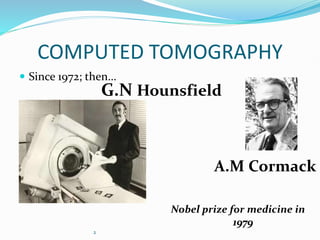
COMPUTED TOMOGRAPHY
 Since 1972; then…
G.N Hounsfield
A.M Cormack
Nobel prize for medicine in
1979
COMPUTED TOMOGRAPHY
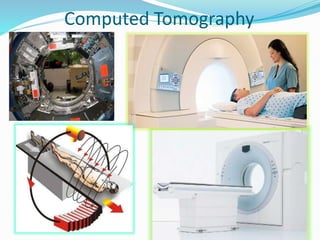
 Computed axial tomography (CAT) scanning was
invented by Godfrey N. Hounsfield in 1972 and
independently by Alan Cormack in 1972.
 CAT now called Computed tomography(CT) —
combines a series of X-ray views taken from many
different angles and computer processing to create
cross-sectional images of the bones and soft
tissues inside our body.
4
Computed Tomography
Introduction
 Perfusion is defined as the passage of fluid through the
lymphatic system or blood vessels to an organ or a tissue.
 The method by which perfusion to an organ measured
by CT is still a relatively new concept, although the original
framework concretely laid out as early as 1980 by Leon
Axel at University of California San Francisco.
 Practical CT perfusion as performed on modern CT
scanners was first described by Ken Miles, Mike Hayball
and Adrian Dixon,cambridge,U.K.
 It is most commonly carried out for Neuroimaging using
dynamic sequential scanning of a pre-selected region of the
brain during the injection of a bolus of iodinated contrast
as it travels through the vasculature.
Why perfusion CT?
 Can be Performed using standard ct scanners.
 less expensive than MRI.
 Can be performed rapidly.
 Involves administration small amount of contrast.
 Particularly true in acute settings like stroke evaluation,
 Although the role of US & MRI have been explored for perfusion,
but there is linear relationship b/w iodine concentration &
density changes seen on CT expressed as Hounsfield unit(HU).
 PET perfusion studies suffer from drawback of need for cyclotron
for production of radioisotopes.
 PET perfusion are more prone for partial volume effects &
artefacts.
 contrast resolution better than PET.
Basic Principle
 Perfusion computed tomography allows functional evaluation of tissue
vascularity. It measures the temporal changes in tissue density after
intravenous injection of a contrast media bolus using a series of
dynamically acquired CT images.
 The perfusion ct is based on the temporal changes in tissue attenuation
after intravenous administration of iodinated CM. This enhancement
of tissue depends on the iodine concentration over the tissue region.
 After intravenous injection of iodinated CM, Tissue enhancement can
be divided into 2 phases based on distribution in intravascular or extra
vascular compartment.
 In the initial phase, the enhancement is mainly attributable to the
distribution of contrast within the intravascular space & this phase
lasts for approximately 40-60 seconds from the time of contrast
injection.
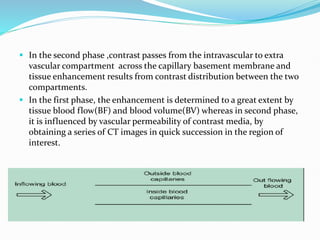
 In the second phase ,contrast passes from the intravascular to extra
vascular compartment across the capillary basement membrane and
tissue enhancement results from contrast distribution between the two
compartments.
 In the first phase, the enhancement is determined to a great extent by
tissue blood flow(BF) and blood volume(BV) whereas in second phase,
it is influenced by vascular permeability of contrast media, by
obtaining a series of CT images in quick succession in the region of
interest.
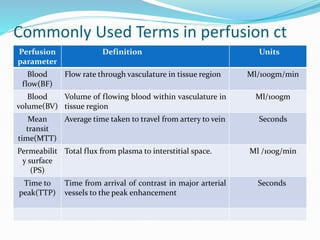
Commonly Used Terms in perfusion ct
Perfusion
parameter
Definition Units
Blood
flow(BF)
Flow rate through vasculature in tissue region Ml/100gm/min
Blood
volume(BV)
Volume of flowing blood within vasculature in
tissue region
Ml/100gm
Mean
transit
time(MTT)
Average time taken to travel from artery to vein Seconds
Permeabilit
y surface
(PS)
Total flux from plasma to interstitial space. Ml /100g/min
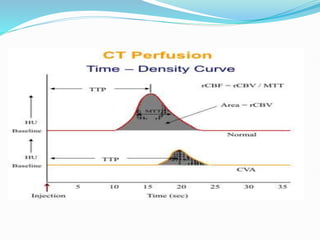
Time to
peak(TTP)
Time from arrival of contrast in major arterial
vessels to the peak enhancement
Seconds
Physiology of contrast enhancement
 In time the following I.V administration of contrast,
distributes within the tissues resulting in increasing tissue
density on CT.
 Tissue enhancement divided into two phases based on
distribution in intravascular/extra vascular compartments
 In initial phase, enhancement is mainly due to contrast
within intravascular space & it depends a great extent by
blood flow.
 Later , in 2nd phase, as contrast passes from intravascular to
extra vascular compartment through capillary membrane &
it depends on blood volume & permeability of capillaries to
contrast media.
Contrast media
 As there is a linear relation between iodine
concentration & tissue enhancement, a higher
concentration CM is preferred.
 Iodine (370mg/ml)
 Contrast bolus 40 - 50ml
 Injection rate - 5 ml/sec
 Scan delay 5 sec
Justification of CT perfusion
 Justification in CT is of particular importance for
Radiation professionals.
 CT examination is a “high dose” procedure
 A series of clinical factors play a special part
 Adequate clinical information, including the records of
previous imaging investigations, must be available
 In certain applications prior investigation of the patient by
alternative imaging techniques might be required
 Additional training in radiation protection is required
for radiologists and radiologic technologist.
Technique of CT perfusion
 STEP I involves acquisition of unenhanced Ct images to cover
the entire region of interest.
 STEP II involves selection of slice for dynamic imaging. The
selected slice should be chosen to cover the maximum tumour
area. the total tumour coverage area is 2cm for the 8-16 MDCT &
4 cm for the 64 MDCT & up to 9 cm for the 128 MDCT.
 STEP III involves contrast enhanced dynamic image acquisition.
 STEP IV involves post processing of CT data to generate
coloured perfusion maps of blood flow(BF),blood
volume(BV),Mean transit time(MTT) and permeability surface
product. Time attenuation curves showing the enhancement
characteristics of artery & tumour during the first pass & delayed
phase of perfusion CT acquistion can be obtained.
Protocol
 Depend upon the target organ, mathematical modelling
technique,ct scan configuration & clinical objective.
 It consists of two phases
1)a baseline acquisition without contrast enhancement
followed by
2) a dynamic acquisition performed sequentially after
intravenous injection of CM.
 The dynamic acquisition study includes a first pass study,
delayed study or both depending on the pertinent
physiological parameters that need to be measured.
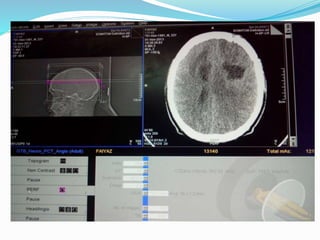
 Provides wide coverage to region of interest.
 Basically serves as a localizer to select the appropriate
tissue area to be included in the contrast enhanced
dynamic imaging range.
 Depending upon scanner configuration,4cm coverage
area(for 64 row ct scanner) can be selected for
dynamic scanning.
 Larger coverage area(8-16cm) is now feasible with
availability of new scanner (128-320 rows of detectors)
Unenhanced CT acquisition
Dynamic CT acquisition
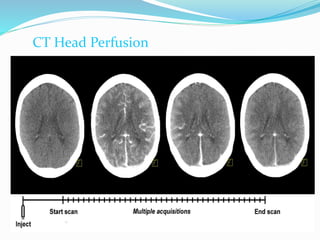
 Dynamic -first pass study
-Delayed study or both
First pass study-comprises of images acquired during
initial 45-60 sec & are used for assessing
perfusion(blood flow) & blood volume.
Delayed phase study-for measurement of vascular
permeability which ranges 2-10 min.
CT Head Perfusion
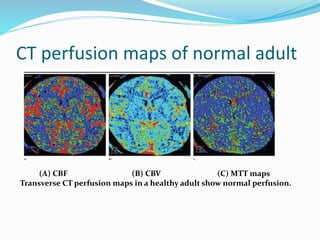
CT perfusion maps of normal adult
(A) CBF (B) CBV (C) MTT maps
Transverse CT perfusion maps in a healthy adult show normal perfusion.
Mathematical modelling
The various analytical methods vary from scanner to
scanners and among the commercial vendors.
There are 2 methods :
 Compartmental analysis
 Deconvolution method
 In compartmental model, the presence of image noise,
results in miscalculation of perfusion values, hence a
higher tube current with low image frequency is
preferred for the dynamic study.
 In Deconvolution method, being less sensitive to
noise, allow the use of lower tube current and permits
scanning with higher temporal resolution for dynamic
Cine acquisition.
Optimisation of CT practice
 Optimal use of ionizing radiation involves the interplay of
the imaging process:
 Diagnostic quality of the CT image
 Radiation dose to the patient
 Choice of radiological technique
 CT examinations should be performed under the
responsibility of a radiologist.
 Standard examination protocols should be available.
 Once a CT examination has been clinically justified, the
subsequent imaging process must be optimized
 Quality Criteria can be adopted by radiologists, radiologic
technologist, and medical physicists as a check on the
routine performance of the entire imaging process.
Advancement in Perfusion CT
 True 4D CT – True 3D volume scan is
possible.
 Dose reduction schemes:
 intermittent X-ray on
 Low dose CT,
 less frequent sampling
 Optimization of protocol.
conclusion
 Originally CT is designed for anatomy.
 Benefits:
 Used for acute stroke evaluation ,tumours.
 Fast resulting
 Place where MR is not available.
 Functional measurements(CBF,CBV,MTT) can be
done.
Thanking you for your
support

CT_Perfusion.pptx

  • 1.
    Manoj Sharma, student Department ofRadiology UCMS & GTB Hospital 11th National Conference of Indian Association of Radiological Technologists NCIART 2013 AIIMS ,New Delhi
  • 2.
    2 COMPUTED TOMOGRAPHY  Since1972; then… G.N Hounsfield A.M Cormack Nobel prize for medicine in 1979
  • 3.
    COMPUTED TOMOGRAPHY  Computedaxial tomography (CAT) scanning was invented by Godfrey N. Hounsfield in 1972 and independently by Alan Cormack in 1972.  CAT now called Computed tomography(CT) — combines a series of X-ray views taken from many different angles and computer processing to create cross-sectional images of the bones and soft tissues inside our body.
  • 4.
  • 5.
    Introduction  Perfusion isdefined as the passage of fluid through the lymphatic system or blood vessels to an organ or a tissue.  The method by which perfusion to an organ measured by CT is still a relatively new concept, although the original framework concretely laid out as early as 1980 by Leon Axel at University of California San Francisco.  Practical CT perfusion as performed on modern CT scanners was first described by Ken Miles, Mike Hayball and Adrian Dixon,cambridge,U.K.  It is most commonly carried out for Neuroimaging using dynamic sequential scanning of a pre-selected region of the brain during the injection of a bolus of iodinated contrast as it travels through the vasculature.
  • 6.
    Why perfusion CT? Can be Performed using standard ct scanners.  less expensive than MRI.  Can be performed rapidly.  Involves administration small amount of contrast.  Particularly true in acute settings like stroke evaluation,  Although the role of US & MRI have been explored for perfusion, but there is linear relationship b/w iodine concentration & density changes seen on CT expressed as Hounsfield unit(HU).  PET perfusion studies suffer from drawback of need for cyclotron for production of radioisotopes.  PET perfusion are more prone for partial volume effects & artefacts.  contrast resolution better than PET.
  • 7.
    Basic Principle  Perfusioncomputed tomography allows functional evaluation of tissue vascularity. It measures the temporal changes in tissue density after intravenous injection of a contrast media bolus using a series of dynamically acquired CT images.  The perfusion ct is based on the temporal changes in tissue attenuation after intravenous administration of iodinated CM. This enhancement of tissue depends on the iodine concentration over the tissue region.  After intravenous injection of iodinated CM, Tissue enhancement can be divided into 2 phases based on distribution in intravascular or extra vascular compartment.  In the initial phase, the enhancement is mainly attributable to the distribution of contrast within the intravascular space & this phase lasts for approximately 40-60 seconds from the time of contrast injection.
  • 8.
     In thesecond phase ,contrast passes from the intravascular to extra vascular compartment across the capillary basement membrane and tissue enhancement results from contrast distribution between the two compartments.  In the first phase, the enhancement is determined to a great extent by tissue blood flow(BF) and blood volume(BV) whereas in second phase, it is influenced by vascular permeability of contrast media, by obtaining a series of CT images in quick succession in the region of interest.
  • 9.
    Commonly Used Termsin perfusion ct Perfusion parameter Definition Units Blood flow(BF) Flow rate through vasculature in tissue region Ml/100gm/min Blood volume(BV) Volume of flowing blood within vasculature in tissue region Ml/100gm Mean transit time(MTT) Average time taken to travel from artery to vein Seconds Permeabilit y surface (PS) Total flux from plasma to interstitial space. Ml /100g/min Time to peak(TTP) Time from arrival of contrast in major arterial vessels to the peak enhancement Seconds
  • 11.
    Physiology of contrastenhancement  In time the following I.V administration of contrast, distributes within the tissues resulting in increasing tissue density on CT.  Tissue enhancement divided into two phases based on distribution in intravascular/extra vascular compartments  In initial phase, enhancement is mainly due to contrast within intravascular space & it depends a great extent by blood flow.  Later , in 2nd phase, as contrast passes from intravascular to extra vascular compartment through capillary membrane & it depends on blood volume & permeability of capillaries to contrast media.
  • 12.
    Contrast media  Asthere is a linear relation between iodine concentration & tissue enhancement, a higher concentration CM is preferred.  Iodine (370mg/ml)  Contrast bolus 40 - 50ml  Injection rate - 5 ml/sec  Scan delay 5 sec
  • 13.
    Justification of CTperfusion  Justification in CT is of particular importance for Radiation professionals.  CT examination is a “high dose” procedure  A series of clinical factors play a special part  Adequate clinical information, including the records of previous imaging investigations, must be available  In certain applications prior investigation of the patient by alternative imaging techniques might be required  Additional training in radiation protection is required for radiologists and radiologic technologist.
  • 14.
    Technique of CTperfusion  STEP I involves acquisition of unenhanced Ct images to cover the entire region of interest.  STEP II involves selection of slice for dynamic imaging. The selected slice should be chosen to cover the maximum tumour area. the total tumour coverage area is 2cm for the 8-16 MDCT & 4 cm for the 64 MDCT & up to 9 cm for the 128 MDCT.  STEP III involves contrast enhanced dynamic image acquisition.  STEP IV involves post processing of CT data to generate coloured perfusion maps of blood flow(BF),blood volume(BV),Mean transit time(MTT) and permeability surface product. Time attenuation curves showing the enhancement characteristics of artery & tumour during the first pass & delayed phase of perfusion CT acquistion can be obtained.
  • 15.
    Protocol  Depend uponthe target organ, mathematical modelling technique,ct scan configuration & clinical objective.  It consists of two phases 1)a baseline acquisition without contrast enhancement followed by 2) a dynamic acquisition performed sequentially after intravenous injection of CM.  The dynamic acquisition study includes a first pass study, delayed study or both depending on the pertinent physiological parameters that need to be measured.
  • 16.
     Provides widecoverage to region of interest.  Basically serves as a localizer to select the appropriate tissue area to be included in the contrast enhanced dynamic imaging range.  Depending upon scanner configuration,4cm coverage area(for 64 row ct scanner) can be selected for dynamic scanning.  Larger coverage area(8-16cm) is now feasible with availability of new scanner (128-320 rows of detectors) Unenhanced CT acquisition
  • 17.
    Dynamic CT acquisition Dynamic -first pass study -Delayed study or both First pass study-comprises of images acquired during initial 45-60 sec & are used for assessing perfusion(blood flow) & blood volume. Delayed phase study-for measurement of vascular permeability which ranges 2-10 min.
  • 18.
  • 21.
    CT perfusion mapsof normal adult (A) CBF (B) CBV (C) MTT maps Transverse CT perfusion maps in a healthy adult show normal perfusion.
  • 22.
    Mathematical modelling The variousanalytical methods vary from scanner to scanners and among the commercial vendors. There are 2 methods :  Compartmental analysis  Deconvolution method
  • 23.
     In compartmentalmodel, the presence of image noise, results in miscalculation of perfusion values, hence a higher tube current with low image frequency is preferred for the dynamic study.  In Deconvolution method, being less sensitive to noise, allow the use of lower tube current and permits scanning with higher temporal resolution for dynamic Cine acquisition.
  • 24.
    Optimisation of CTpractice  Optimal use of ionizing radiation involves the interplay of the imaging process:  Diagnostic quality of the CT image  Radiation dose to the patient  Choice of radiological technique  CT examinations should be performed under the responsibility of a radiologist.  Standard examination protocols should be available.  Once a CT examination has been clinically justified, the subsequent imaging process must be optimized  Quality Criteria can be adopted by radiologists, radiologic technologist, and medical physicists as a check on the routine performance of the entire imaging process.
  • 25.
    Advancement in PerfusionCT  True 4D CT – True 3D volume scan is possible.  Dose reduction schemes:  intermittent X-ray on  Low dose CT,  less frequent sampling  Optimization of protocol.
  • 26.
    conclusion  Originally CTis designed for anatomy.  Benefits:  Used for acute stroke evaluation ,tumours.  Fast resulting  Place where MR is not available.  Functional measurements(CBF,CBV,MTT) can be done.
  • 27.
    Thanking you foryour support