Presented by: Syed Yousaf Farooq
INTRODUCTION AND HISTORICAL
BACKGROUND
 The “First World Congress on Ultrasonic
Diagnostics in Medicine” was held in Vienna in
1969.
 Only two papers dealt with the capabilities of
ultrasound-guided needle procedures, and
both reflected the full spectrum of possible
procedures and future diagnostic applications.
 The only imaging modality available at that
time for the percutaneous biopsy of
nonpalpable organs and structures was
classical radiography. But this method was
problematic for several reasons.
 Kratochwil described in his paper how
ultrasound guidance could make standard
needle procedures easier and safer (here, by
avoiding the placenta), even in unusual
situations.
 The sectional images produced by
ultrasonography enable the target site to be
visualized and localized in all three
dimensions.
 As early as 1961,G. M. Berlyne suggested that
the two-dimensional pyelogram obtained
before percutaneous renal biopsy could be
supplemented by an A-mode scan to measure
the depth from skin to target.
RISKS OF
INTERVENTIONAL
ULTRASOUND
 The risks of percutaneous biopsies were known
and had been described in principle even before
the age of interventional ultrasound.
 Today they are still an important consideration in
the development and practice of interventional
sonography.
 While initial studies showed no serious side effects
associated with the use of needles less than 1mm
in diameter, publications over the years
documented repeated instances of serious
complications and even deaths, mostly in
individual case reports.
 Subsequent doctor surveys and reviews of the
literature indicated a mortality rate between
0.001% and 0.096% with complication rates up to
0.9%.
Interventional Materials and
Equipment
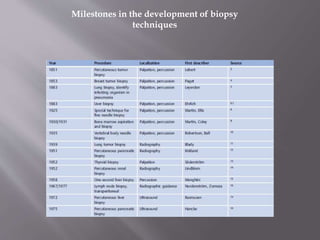
Milestones in the development of biopsy
techniques
 The needle tip is directed, in real time, along the
biopsy path and visualized within the lesion
 Greater precision is obtained; needle guidance is
essential for all small lesions and lesions at depth
 Fewer needle passes are required to obtain the
desired result
 The best route can be utilized and vital structures,
such as blood vessels, avoided
 b Post procedure complications, such as
haematoma, are minimized.
 All the advantages of ultrasound over other
imaging methods apply (quick, direct vision,
no radiation hazard, low cost). The limitations
due to bone and air-filled structures also apply.
 The capability to perform bedside procedures
for critically ill patients and to use in
conjunction with other imaging techniques, for
example fluoroscopy, is advantageous
 With ultrasound the biopsy procedure is quick,
safe and accurate and is therefore acceptable to
the patient.
 Contraindications are relative and include the
biopsy pathway, an uncooperative patient and
uncorrectable coagulation and should be
assessed on an individual basis.
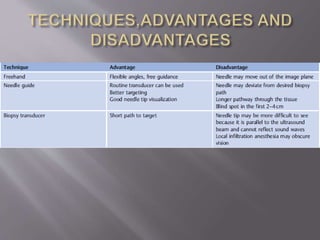
 The choice of method depends upon the procedure
in question, equipment and the experience and
skill of the operator
 BLIND BIOPSY:
 With this method a position on the skin surface is
marked overlying the organ or lesion to be
biopsied, using ultrasound to localize. This
remains acceptable for diffuse disease, when only a
representative sample of liver tissue is required.
 Nevertheless, it is good practice even in these
situations to visualize the needle during the
procedure, and this method of biopsy is now used
less frequently.
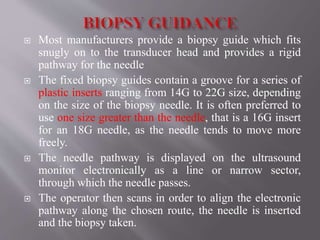
 Most manufacturers provide a biopsy guide which fits
snugly on to the transducer head and provides a rigid
pathway for the needle
 The fixed biopsy guides contain a groove for a series of
plastic inserts ranging from 14G to 22G size, depending
on the size of the biopsy needle. It is often preferred to
use one size greater than the needle, that is a 16G insert
for an 18G needle, as the needle tends to move more
freely.
 The needle pathway is displayed on the ultrasound
monitor electronically as a line or narrow sector,
through which the needle passes.
 The operator then scans in order to align the electronic
pathway along the chosen route, the needle is inserted
and the biopsy taken.
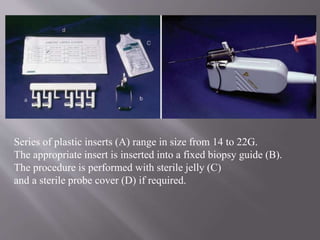
Series of plastic inserts (A) range in size from 14 to 22G.
The appropriate insert is inserted into a fixed biopsy guide (B).
The procedure is performed with sterile jelly (C)
and a sterile probe cover (D) if required.
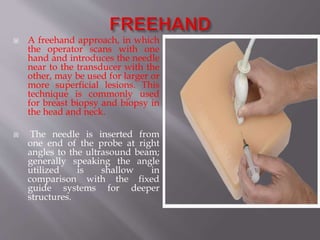
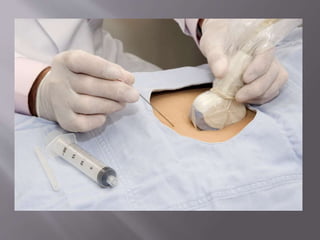
 A freehand approach, in which
the operator scans with one
hand and introduces the needle
near to the transducer with the
other, may be used for larger or
more superficial lesions. This
technique is commonly used
for breast biopsy and biopsy in
the head and neck.
 The needle is inserted from
one end of the probe at right
angles to the ultrasound beam;
generally speaking the angle
utilized is shallow in
comparison with the fixed
guide systems for deeper
structures.
NEEDLE SYSTEMS
NEEDLE TECHNOLOGY
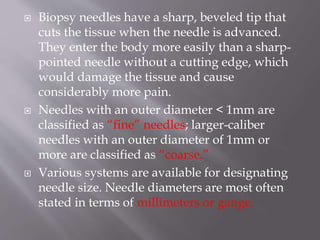
 Biopsy needles have a sharp, beveled tip that
cuts the tissue when the needle is advanced.
They enter the body more easily than a sharp-
pointed needle without a cutting edge, which
would damage the tissue and cause
considerably more pain.
 Needles with an outer diameter < 1mm are
classified as “fine” needles; larger-caliber
needles with an outer diameter of 1mm or
more are classified as “coarse.”
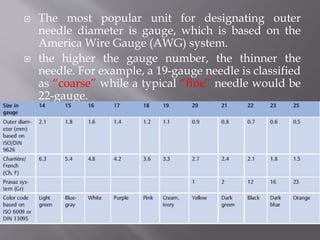
 Various systems are available for designating
needle size. Needle diameters are most often
stated in terms of millimeters or gauge.
 The most popular unit for designating outer
needle diameter is gauge, which is based on the
America Wire Gauge (AWG) system.
 the higher the gauge number, the thinner the
needle. For example, a 19-gauge needle is classified
as “coarse” while a typical “fine” needle would be
22-gauge.
 Needle lengths from 10 to 22cm are most
commonly used.
 In principle, an excessive needle length is
unfavorable only if the target site is only 1 to 2cm
deep, as this would make the long needle unstable.
 In all other cases it is best to add a certain reserve
length to make sure the needle will be long
enough.
 A 22-gauge needle is sufficient for aspirating
watery exudates or transudates, while an 18-gauge
or larger needle should be used for pus.
 Tissue can be sampled by aspiration biopsy or by a
cutting or core biopsy technique.
 Because all percutaneous interventions are
invasive procedures, they require prior informed
consent that should include full disclosure of the
benefit of the procedure and potential
complications (risk), which are documented in
written form.
 In emergency situations such as with a septic
patient, it may be necessary to deviate from this
policy.
 Informed consent on the examination table is
inadequate.
 The patient may not fully understand the need for
the intervention. Consequently, time for
explanations should be allotted in the
preprocedure protocol.
. Aspiration
. Drainage
. Biopsy
. Cysts are very common.
. Usually be diagnosed accurately with ultrasound.
. In most women, they do not usually require any
intervention or follow-up.
 Cyst aspirations are done when :
. Causing significant tenderness
. The diagnosis of a cyst remains in question following the
ultrasound
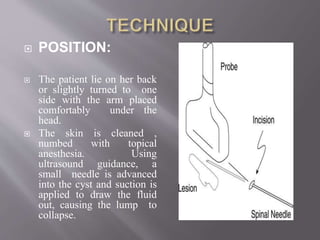
 POSITION:
 The patient lie on her back
or slightly turned to one
side with the arm placed
comfortably under the
head.
 The skin is cleaned ,
numbed with topical
anesthesia. Using
ultrasound guidance, a
small needle is advanced
into the cyst and suction is
applied to draw the fluid
out, causing the lump to
collapse.
INDICATIONS:
 Icterus/liver enzyme elevation/elevated bile acids
Focal nodules or masses anywhere
 Renal disease sometimes (i.e. renal dysplasia,
renal masses, lymphosarcoma suspects)
Prostatomegaly
Free abdominal fluid
Cysts
 Ultrasound guidance is an accurate and reliable
biopsy guidance technique and is the method of
choice and suitable for all breast lesions visible on
ultrasound.
BREAST BIOPSY INDICATIONS:
 Focal mass or other lesion of unknown nature –
palpable or non-palpable
 Architectural distortion
 Micro-calcifications
 Cyst aspiration
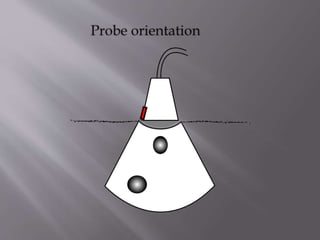
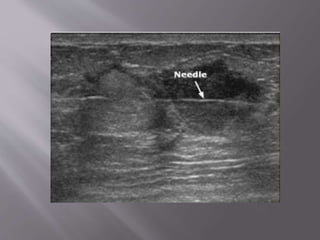
 The long axis of the needle, should be visible
along the long axis of the transducer.
 Occasionally, during an FNA biopsy or
cyst aspiration, the transducer can be
rotated 90 degrees to visualize the
echogenic dot of the needle within the
lesion.
 A written request form from a medical
practitioner with the results of any previous
investigations should be available. The reason
for biopsy should be appropriate
 Assessment of blood clotting status. Normally
the prothrombin time should be within 8-12sec,
platelet count > 75 000/ml and international
normalized ratio (INR) < 1.3
 Identification of possible contraindications to
biopsy, for example an uncooperative patient,
coagulopathy.
 Careful explanation of the procedure to the
patient, including risks and benefits
 Appropriate measures should be taken to
preserve pre-, peri- and post procedure sterility
 A prebiopsy scan to identify a suitable biopsy
route avoiding vital structures.
 Satisfactory care of the patient both during and
after the biopsy procedure with relevant
observations of vital signs
 Appropriate preparation of the specimen.

Ultrasound guided interventional procedure

  • 1.
    Presented by: SyedYousaf Farooq
  • 2.
  • 3.
     The “FirstWorld Congress on Ultrasonic Diagnostics in Medicine” was held in Vienna in 1969.  Only two papers dealt with the capabilities of ultrasound-guided needle procedures, and both reflected the full spectrum of possible procedures and future diagnostic applications.  The only imaging modality available at that time for the percutaneous biopsy of nonpalpable organs and structures was classical radiography. But this method was problematic for several reasons.
  • 4.
     Kratochwil describedin his paper how ultrasound guidance could make standard needle procedures easier and safer (here, by avoiding the placenta), even in unusual situations.  The sectional images produced by ultrasonography enable the target site to be visualized and localized in all three dimensions.  As early as 1961,G. M. Berlyne suggested that the two-dimensional pyelogram obtained before percutaneous renal biopsy could be supplemented by an A-mode scan to measure the depth from skin to target.
  • 5.
  • 6.
     The risksof percutaneous biopsies were known and had been described in principle even before the age of interventional ultrasound.  Today they are still an important consideration in the development and practice of interventional sonography.  While initial studies showed no serious side effects associated with the use of needles less than 1mm in diameter, publications over the years documented repeated instances of serious complications and even deaths, mostly in individual case reports.  Subsequent doctor surveys and reviews of the literature indicated a mortality rate between 0.001% and 0.096% with complication rates up to 0.9%.
  • 7.
  • 8.
    Milestones in thedevelopment of biopsy techniques
  • 9.
     The needletip is directed, in real time, along the biopsy path and visualized within the lesion  Greater precision is obtained; needle guidance is essential for all small lesions and lesions at depth  Fewer needle passes are required to obtain the desired result  The best route can be utilized and vital structures, such as blood vessels, avoided  b Post procedure complications, such as haematoma, are minimized.
  • 10.
     All theadvantages of ultrasound over other imaging methods apply (quick, direct vision, no radiation hazard, low cost). The limitations due to bone and air-filled structures also apply.  The capability to perform bedside procedures for critically ill patients and to use in conjunction with other imaging techniques, for example fluoroscopy, is advantageous  With ultrasound the biopsy procedure is quick, safe and accurate and is therefore acceptable to the patient.
  • 11.
     Contraindications arerelative and include the biopsy pathway, an uncooperative patient and uncorrectable coagulation and should be assessed on an individual basis.
  • 12.
     The choiceof method depends upon the procedure in question, equipment and the experience and skill of the operator  BLIND BIOPSY:  With this method a position on the skin surface is marked overlying the organ or lesion to be biopsied, using ultrasound to localize. This remains acceptable for diffuse disease, when only a representative sample of liver tissue is required.  Nevertheless, it is good practice even in these situations to visualize the needle during the procedure, and this method of biopsy is now used less frequently.
  • 13.
     Most manufacturersprovide a biopsy guide which fits snugly on to the transducer head and provides a rigid pathway for the needle  The fixed biopsy guides contain a groove for a series of plastic inserts ranging from 14G to 22G size, depending on the size of the biopsy needle. It is often preferred to use one size greater than the needle, that is a 16G insert for an 18G needle, as the needle tends to move more freely.  The needle pathway is displayed on the ultrasound monitor electronically as a line or narrow sector, through which the needle passes.  The operator then scans in order to align the electronic pathway along the chosen route, the needle is inserted and the biopsy taken.
  • 14.
    Series of plasticinserts (A) range in size from 14 to 22G. The appropriate insert is inserted into a fixed biopsy guide (B). The procedure is performed with sterile jelly (C) and a sterile probe cover (D) if required.
  • 15.
     A freehandapproach, in which the operator scans with one hand and introduces the needle near to the transducer with the other, may be used for larger or more superficial lesions. This technique is commonly used for breast biopsy and biopsy in the head and neck.  The needle is inserted from one end of the probe at right angles to the ultrasound beam; generally speaking the angle utilized is shallow in comparison with the fixed guide systems for deeper structures.
  • 18.
  • 19.
     Biopsy needleshave a sharp, beveled tip that cuts the tissue when the needle is advanced. They enter the body more easily than a sharp- pointed needle without a cutting edge, which would damage the tissue and cause considerably more pain.  Needles with an outer diameter < 1mm are classified as “fine” needles; larger-caliber needles with an outer diameter of 1mm or more are classified as “coarse.”  Various systems are available for designating needle size. Needle diameters are most often stated in terms of millimeters or gauge.
  • 20.
     The mostpopular unit for designating outer needle diameter is gauge, which is based on the America Wire Gauge (AWG) system.  the higher the gauge number, the thinner the needle. For example, a 19-gauge needle is classified as “coarse” while a typical “fine” needle would be 22-gauge.
  • 21.
     Needle lengthsfrom 10 to 22cm are most commonly used.  In principle, an excessive needle length is unfavorable only if the target site is only 1 to 2cm deep, as this would make the long needle unstable.  In all other cases it is best to add a certain reserve length to make sure the needle will be long enough.  A 22-gauge needle is sufficient for aspirating watery exudates or transudates, while an 18-gauge or larger needle should be used for pus.  Tissue can be sampled by aspiration biopsy or by a cutting or core biopsy technique.
  • 22.
     Because allpercutaneous interventions are invasive procedures, they require prior informed consent that should include full disclosure of the benefit of the procedure and potential complications (risk), which are documented in written form.  In emergency situations such as with a septic patient, it may be necessary to deviate from this policy.  Informed consent on the examination table is inadequate.  The patient may not fully understand the need for the intervention. Consequently, time for explanations should be allotted in the preprocedure protocol.
  • 23.
  • 24.
    . Cysts arevery common. . Usually be diagnosed accurately with ultrasound. . In most women, they do not usually require any intervention or follow-up.  Cyst aspirations are done when : . Causing significant tenderness . The diagnosis of a cyst remains in question following the ultrasound
  • 25.
     POSITION:  Thepatient lie on her back or slightly turned to one side with the arm placed comfortably under the head.  The skin is cleaned , numbed with topical anesthesia. Using ultrasound guidance, a small needle is advanced into the cyst and suction is applied to draw the fluid out, causing the lump to collapse.
  • 26.
    INDICATIONS:  Icterus/liver enzymeelevation/elevated bile acids Focal nodules or masses anywhere  Renal disease sometimes (i.e. renal dysplasia, renal masses, lymphosarcoma suspects) Prostatomegaly Free abdominal fluid Cysts
  • 28.
     Ultrasound guidanceis an accurate and reliable biopsy guidance technique and is the method of choice and suitable for all breast lesions visible on ultrasound. BREAST BIOPSY INDICATIONS:  Focal mass or other lesion of unknown nature – palpable or non-palpable  Architectural distortion  Micro-calcifications  Cyst aspiration
  • 29.
     The longaxis of the needle, should be visible along the long axis of the transducer.  Occasionally, during an FNA biopsy or cyst aspiration, the transducer can be rotated 90 degrees to visualize the echogenic dot of the needle within the lesion.
  • 31.
     A writtenrequest form from a medical practitioner with the results of any previous investigations should be available. The reason for biopsy should be appropriate  Assessment of blood clotting status. Normally the prothrombin time should be within 8-12sec, platelet count > 75 000/ml and international normalized ratio (INR) < 1.3  Identification of possible contraindications to biopsy, for example an uncooperative patient, coagulopathy.
  • 32.
     Careful explanationof the procedure to the patient, including risks and benefits  Appropriate measures should be taken to preserve pre-, peri- and post procedure sterility  A prebiopsy scan to identify a suitable biopsy route avoiding vital structures.  Satisfactory care of the patient both during and after the biopsy procedure with relevant observations of vital signs  Appropriate preparation of the specimen.