Presented by Under The Guidance
Khan Ramiz V DR. N.A. Gujarathi sir
M. Pharm (1st year) M.Pharm, PHD
Dept. of Pharmaceutics
SIPS
CONTENTS
 Introduction
 Classification of NNDS
 Definition of Nanoparticles
 Classification NP
 Advantages and disadvantages of NP
 Definition of Liposomes
 Classification of liposomes
 Method of preparation
 Advantages and disadvantages of liposomes
 Application of liposomes
 Definition of Niosomes
 Types of Niosomes
 Method of preparation
 Advantages and disadvantages
 application
INTRODUCTION
 NOVEL DRUG DELIVERY SYSTEM (NDDS)
 It refers to approaches, formulation, technologies, and
system for transporting a pharmaceutical compound in the
body as needed to safely achieve its desired therapeutic
effect.
 Technologies modify drug release profile, absorption,
distribution and elimination for the benefit of
a) improving product efficacy and safety
b) patient convenience and compliance.
Classification
 Nanoparticals
 Liposomes
 Niosomes
 Microspheres
 Monoclonal antibodies
 Micro emulsions
 Magnetic microcapsules
 Implantable pumps
 Nanoparticles
“Nano particles are sub-nanosized colloidal structures
composed of synthetic or semi-synthetic polymers”
 Size range : 10-1000nm
 The drug is dissolved, entrapped, encapsulate or attached to
a nanoparticles matrix.
Based on method of preparation:
 Nanocapsules:-
Nano capsules are systems in which the drug is confined
to a cavity surrounded by unique polymer membrane.
Nanosphere:-
Nano sphere are matrix system in which the drug is
physically an uniformly dispersed.
Classification
 Solid lipid Nanoparticles
 Polymeric Nanoparticles
 Ceramic Nanoparticles
 Hydrogel Nanoparticles
 Copolymerized Peptide nanoparticles
 Nanocrystals and nanosuspension
 Nanotubes
 Solid Lipid Nanoparticles:
 New type of colloidal drug carrier system for I.V.
 Consist of spherical solid particles in the nm range, dispersed
in water or in aqueous surfactant solution.
 Polymeric nanoparticles (PNPs) :
 Are defined as particulate dispersion or solid particles with
size in the range of 10-1000nm.
 Composed of synthetic or semi-synthetic Polymers.
 Biodegradable polymeric nanopaticles Polylactic acid (PLA),
polyglycolic acid (PGA), Polylactic- glycolic acid (PLGA), and
Polymethyl methacrylate (PMMA)
 Ceramic Nanoparticles :
 These are the nanoparticles made up of inorganic (ceramic)
compounds silica, ( inorganic/metal) titania and alumina.
The size less than 50 nm, which helps them in penetrate
deeper parts of the body.
 Hydrogel Nanoparticles :
 Polymeric system involving the self-assembly and self
aggregation natural polymer amphiphiles cholesteroyl
pullulan, cholesteroyl dextran and agarose cholesterol
groups provide cross linking point.
Copolymerized Peptide Nanoparticles :
 drug moiety is covalently bound to the carrier instead of
being physically entrapped.
 Nanocrystals and Nanosuspension :
 Pure drug coated with surfactant, particles in aggregation of
these particles crystalline form. Drug powder dispersed in
aqueous surfactant solution.
 Functionalized Nanocarriers :
 Biological materials like proteins, enzymes, peptide etc… are
being utilized as a carriers for the drug delivery.
Advantages
 Nano particles can be administered by parenteral, oral, nasal,
occular routes.
 Improving stability and therapeutics index and reduce toxic
affects.
 Both active and passive drug targetting can be achieved by
manipulating the particle size and surfactant characterized of
nanoparticles.
disadvantages :
 Small size and large surface area can lead to particle
aggregation.
 Physical handling of nano particles is difficult in liquid and dry
form.
 Toxic metabolism may form.
LIPOSOMES
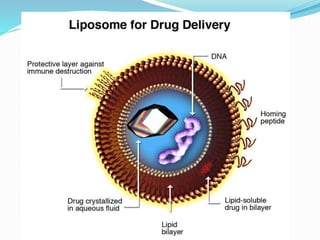
 Liposomes are simple microscopic, concentric bilayered
vesicles in which an aqueous volume is entirely enclosed by a
membranous lipid bilayer mainly composed of natural or
synthetic phospholipid.
 Discovered in 1960s by Bangham and coworkers.
 The structure main components are phospholipid and
cholesterol.
Classification
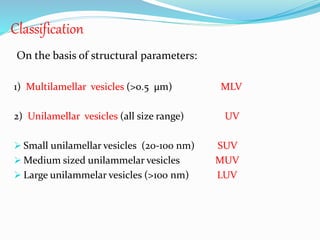
On the basis of structural parameters:
1) Multilamellar vesicles (>0.5 µm) MLV
2) Unilamellar vesicles (all size range) UV
 Small unilamellar vesicles (20-100 nm) SUV
 Medium sized unilammelar vesicles MUV
 Large unilammelar vesicles (>100 nm) LUV
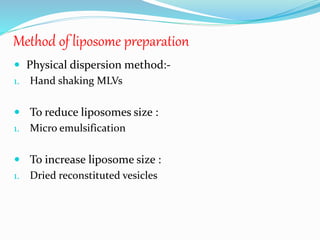
Method of liposome preparation
 Physical dispersion method:-
1. Hand shaking MLVs
 To reduce liposomes size :
1. Micro emulsification
 To increase liposome size :
1. Dried reconstituted vesicles
Hand shaken MLVs
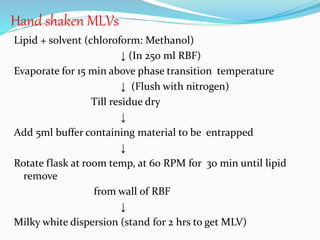
Lipid + solvent (chloroform: Methanol)
↓ (In 250 ml RBF)
Evaporate for 15 min above phase transition temperature
↓ (Flush with nitrogen)
Till residue dry
↓
Add 5ml buffer containing material to be entrapped
↓
Rotate flask at room temp, at 60 RPM for 30 min until lipid
remove
from wall of RBF
↓
Milky white dispersion (stand for 2 hrs to get MLV)
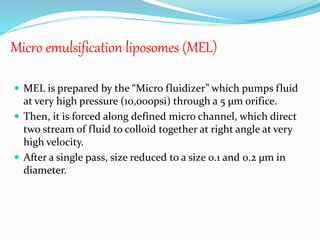
Micro emulsification liposomes (MEL)
 MEL is prepared by the “Micro fluidizer” which pumps fluid
at very high pressure (10,000psi) through a 5 µm orifice.
 Then, it is forced along defined micro channel, which direct
two stream of fluid to colloid together at right angle at very
high velocity.
 After a single pass, size reduced to a size 0.1 and 0.2 µm in
diameter.
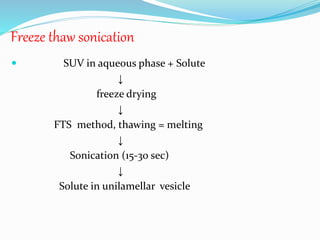
Freeze thaw sonication
 SUV in aqueous phase + Solute
↓
freeze drying
↓
FTS method, thawing = melting
↓
Sonication (15-30 sec)
↓
Solute in unilamellar vesicle
Advantage :
 Provide selective passive targeting to tumor tissues.
(liposomal doxorubicin)
 Increased efficacy and therapeutic index.
 Reduction in toxicity of the encapsulated agent.
 Site avoidance effect ( avoids non target tissues).
 Improved pharmacokinetic effects.
Disadvantages
 Production cost is high.
 Leakage and fusion of encapsulated drug / molecules.
 Sometimes phospholipid undergoes oxidation and
hydrolysis like reaction.
 Short half life
 Low solubility.
Application
 Chelation therapy for treatment of heavy metal poisoning.
 Liposomes as Protein carriers in immunology
 Sustained or controlled delivery
 Site specific delivery
 Study of membrane
 Oral drug delivery
 Formulation aid
 Cosmetic
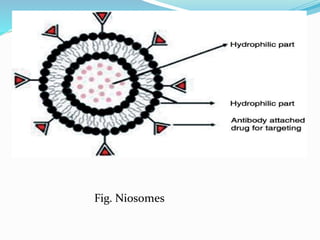
NIOSOMES
 Novel drug delivery system, in which the medication is
encapsulated in a vesicle which is composed of a bilayer of
non-surface active agents.
 It is very small, and microscopic in size.
 Although structurally similar to liposomes, they offer
several advantages over them.
 Similar to liposomes , in that they are also made up of a
bilayer.
TYPES OF NIOSOMES
 According to the nature of lamellarity
1. Multilamellar vesicles (MLV) 1-5 µm in size.
2. Large Unilamellar vesicles (LUV) 0.1-1µm in size.
3. Small Unilamellar vesicles (SUV) 25-500 nm in size.
 According to the size
1. Small Niosomes (100 nm-200 nm)
2. Large Niosomes (800 nm-900 nm)
3. Big Niosomes (2 µm-4 µm)
Fig. Niosomes
METHODS OF PREPARATION
 Film Method
 Ether Injection method
 Sonication
 Reverse Phase Evaporation
 Heating Method
 Microfluidization
 Multiple Membrane Extrusion Method
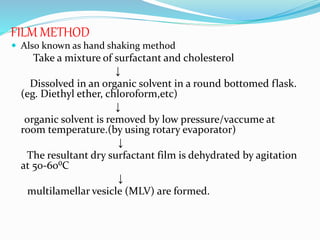
FILM METHOD
 Also known as hand shaking method
Take a mixture of surfactant and cholesterol
↓
Dissolved in an organic solvent in a round bottomed flask.
(eg. Diethyl ether, chloroform,etc)
↓
organic solvent is removed by low pressure/vaccume at
room temperature.(by using rotary evaporator)
↓
The resultant dry surfactant film is dehydrated by agitation
at 50-60⁰C
↓
multilamellar vesicle (MLV) are formed.
ADVANTAGES
 Since the structure of the niosomes offers place to
accommodate hydrophilic, lipophilic as well as ampiphilic
drug moieties, they can be used for a varietey of drug.
 The vesicles can act as a depot to release the drug slowely and
of controlled release.
 Biodegradable and biocompatible.
DISADVANTAGES
 Time consuming .
 Required specialized equipment .
 Inefficient drug loading.
 Aqueous suspension of niosomes may exihibit fusion,
aggregation, leaching of entrapped drug.
APPLICATION
 Noisomes as Drug Carriers
 Drug Targeting
a) delivery to the brain
b) Anti cancer drug
c) Anti infection
 Ophthalmic drug delivery
 Transdermal delivery of drugs by Niosomes
 Sustained Release
 Localized drug action
References
 The theory & practical of industrial pharmacy by Leon
Lachman, Herbert A. Lieberman, Joseph L. kening, 3rd
edition, published by Varghese Publishing house,
page no 872
THANK YOU

sterile product and formulation technology presentation

  • 1.
    Presented by UnderThe Guidance Khan Ramiz V DR. N.A. Gujarathi sir M. Pharm (1st year) M.Pharm, PHD Dept. of Pharmaceutics SIPS
  • 2.
    CONTENTS  Introduction  Classificationof NNDS  Definition of Nanoparticles  Classification NP  Advantages and disadvantages of NP  Definition of Liposomes  Classification of liposomes  Method of preparation  Advantages and disadvantages of liposomes  Application of liposomes  Definition of Niosomes  Types of Niosomes  Method of preparation  Advantages and disadvantages  application
  • 3.
    INTRODUCTION  NOVEL DRUGDELIVERY SYSTEM (NDDS)  It refers to approaches, formulation, technologies, and system for transporting a pharmaceutical compound in the body as needed to safely achieve its desired therapeutic effect.  Technologies modify drug release profile, absorption, distribution and elimination for the benefit of a) improving product efficacy and safety b) patient convenience and compliance.
  • 4.
    Classification  Nanoparticals  Liposomes Niosomes  Microspheres  Monoclonal antibodies  Micro emulsions  Magnetic microcapsules  Implantable pumps
  • 5.
     Nanoparticles “Nano particlesare sub-nanosized colloidal structures composed of synthetic or semi-synthetic polymers”  Size range : 10-1000nm  The drug is dissolved, entrapped, encapsulate or attached to a nanoparticles matrix. Based on method of preparation:  Nanocapsules:- Nano capsules are systems in which the drug is confined to a cavity surrounded by unique polymer membrane. Nanosphere:- Nano sphere are matrix system in which the drug is physically an uniformly dispersed.
  • 6.
    Classification  Solid lipidNanoparticles  Polymeric Nanoparticles  Ceramic Nanoparticles  Hydrogel Nanoparticles  Copolymerized Peptide nanoparticles  Nanocrystals and nanosuspension  Nanotubes
  • 7.
     Solid LipidNanoparticles:  New type of colloidal drug carrier system for I.V.  Consist of spherical solid particles in the nm range, dispersed in water or in aqueous surfactant solution.  Polymeric nanoparticles (PNPs) :  Are defined as particulate dispersion or solid particles with size in the range of 10-1000nm.  Composed of synthetic or semi-synthetic Polymers.  Biodegradable polymeric nanopaticles Polylactic acid (PLA), polyglycolic acid (PGA), Polylactic- glycolic acid (PLGA), and Polymethyl methacrylate (PMMA)
  • 8.
     Ceramic Nanoparticles:  These are the nanoparticles made up of inorganic (ceramic) compounds silica, ( inorganic/metal) titania and alumina. The size less than 50 nm, which helps them in penetrate deeper parts of the body.  Hydrogel Nanoparticles :  Polymeric system involving the self-assembly and self aggregation natural polymer amphiphiles cholesteroyl pullulan, cholesteroyl dextran and agarose cholesterol groups provide cross linking point.
  • 9.
    Copolymerized Peptide Nanoparticles:  drug moiety is covalently bound to the carrier instead of being physically entrapped.  Nanocrystals and Nanosuspension :  Pure drug coated with surfactant, particles in aggregation of these particles crystalline form. Drug powder dispersed in aqueous surfactant solution.  Functionalized Nanocarriers :  Biological materials like proteins, enzymes, peptide etc… are being utilized as a carriers for the drug delivery.
  • 10.
    Advantages  Nano particlescan be administered by parenteral, oral, nasal, occular routes.  Improving stability and therapeutics index and reduce toxic affects.  Both active and passive drug targetting can be achieved by manipulating the particle size and surfactant characterized of nanoparticles. disadvantages :  Small size and large surface area can lead to particle aggregation.  Physical handling of nano particles is difficult in liquid and dry form.  Toxic metabolism may form.
  • 12.
    LIPOSOMES  Liposomes aresimple microscopic, concentric bilayered vesicles in which an aqueous volume is entirely enclosed by a membranous lipid bilayer mainly composed of natural or synthetic phospholipid.  Discovered in 1960s by Bangham and coworkers.  The structure main components are phospholipid and cholesterol.
  • 15.
    Classification On the basisof structural parameters: 1) Multilamellar vesicles (>0.5 µm) MLV 2) Unilamellar vesicles (all size range) UV  Small unilamellar vesicles (20-100 nm) SUV  Medium sized unilammelar vesicles MUV  Large unilammelar vesicles (>100 nm) LUV
  • 16.
    Method of liposomepreparation  Physical dispersion method:- 1. Hand shaking MLVs  To reduce liposomes size : 1. Micro emulsification  To increase liposome size : 1. Dried reconstituted vesicles
  • 17.
    Hand shaken MLVs Lipid+ solvent (chloroform: Methanol) ↓ (In 250 ml RBF) Evaporate for 15 min above phase transition temperature ↓ (Flush with nitrogen) Till residue dry ↓ Add 5ml buffer containing material to be entrapped ↓ Rotate flask at room temp, at 60 RPM for 30 min until lipid remove from wall of RBF ↓ Milky white dispersion (stand for 2 hrs to get MLV)
  • 18.
    Micro emulsification liposomes(MEL)  MEL is prepared by the “Micro fluidizer” which pumps fluid at very high pressure (10,000psi) through a 5 µm orifice.  Then, it is forced along defined micro channel, which direct two stream of fluid to colloid together at right angle at very high velocity.  After a single pass, size reduced to a size 0.1 and 0.2 µm in diameter.
  • 19.
    Freeze thaw sonication SUV in aqueous phase + Solute ↓ freeze drying ↓ FTS method, thawing = melting ↓ Sonication (15-30 sec) ↓ Solute in unilamellar vesicle
  • 20.
    Advantage :  Provideselective passive targeting to tumor tissues. (liposomal doxorubicin)  Increased efficacy and therapeutic index.  Reduction in toxicity of the encapsulated agent.  Site avoidance effect ( avoids non target tissues).  Improved pharmacokinetic effects.
  • 21.
    Disadvantages  Production costis high.  Leakage and fusion of encapsulated drug / molecules.  Sometimes phospholipid undergoes oxidation and hydrolysis like reaction.  Short half life  Low solubility.
  • 22.
    Application  Chelation therapyfor treatment of heavy metal poisoning.  Liposomes as Protein carriers in immunology  Sustained or controlled delivery  Site specific delivery  Study of membrane  Oral drug delivery  Formulation aid  Cosmetic
  • 23.
    NIOSOMES  Novel drugdelivery system, in which the medication is encapsulated in a vesicle which is composed of a bilayer of non-surface active agents.  It is very small, and microscopic in size.  Although structurally similar to liposomes, they offer several advantages over them.  Similar to liposomes , in that they are also made up of a bilayer.
  • 24.
    TYPES OF NIOSOMES According to the nature of lamellarity 1. Multilamellar vesicles (MLV) 1-5 µm in size. 2. Large Unilamellar vesicles (LUV) 0.1-1µm in size. 3. Small Unilamellar vesicles (SUV) 25-500 nm in size.  According to the size 1. Small Niosomes (100 nm-200 nm) 2. Large Niosomes (800 nm-900 nm) 3. Big Niosomes (2 µm-4 µm)
  • 25.
  • 26.
    METHODS OF PREPARATION Film Method  Ether Injection method  Sonication  Reverse Phase Evaporation  Heating Method  Microfluidization  Multiple Membrane Extrusion Method
  • 27.
    FILM METHOD  Alsoknown as hand shaking method Take a mixture of surfactant and cholesterol ↓ Dissolved in an organic solvent in a round bottomed flask. (eg. Diethyl ether, chloroform,etc) ↓ organic solvent is removed by low pressure/vaccume at room temperature.(by using rotary evaporator) ↓ The resultant dry surfactant film is dehydrated by agitation at 50-60⁰C ↓ multilamellar vesicle (MLV) are formed.
  • 28.
    ADVANTAGES  Since thestructure of the niosomes offers place to accommodate hydrophilic, lipophilic as well as ampiphilic drug moieties, they can be used for a varietey of drug.  The vesicles can act as a depot to release the drug slowely and of controlled release.  Biodegradable and biocompatible. DISADVANTAGES  Time consuming .  Required specialized equipment .  Inefficient drug loading.  Aqueous suspension of niosomes may exihibit fusion, aggregation, leaching of entrapped drug.
  • 29.
    APPLICATION  Noisomes asDrug Carriers  Drug Targeting a) delivery to the brain b) Anti cancer drug c) Anti infection  Ophthalmic drug delivery  Transdermal delivery of drugs by Niosomes  Sustained Release  Localized drug action
  • 30.
    References  The theory& practical of industrial pharmacy by Leon Lachman, Herbert A. Lieberman, Joseph L. kening, 3rd edition, published by Varghese Publishing house, page no 872
  • 31.