A DIRECT BRAIN-TO-BRAIN
INTERFACE IN HUMANS
Department of computer science & engineering, University of Washington
Department of psychology and institute for learning & brain sciences, University of Washington
Department of bioengineering, University of Washington
INTRODUCTION
 The first direct brain-to-brain interface in humans
 Non-invasive interface
 EEG for recording brain signals with TMS for delivering information to the brain
 Using a visuomotor task to achieve a desired goal in a computer game
 Quantify the performance of the brain-to-brain interface in terms of the amount
of information transmitted as well as the accuracies attained in
1. Decoding the sender’s signals
2. Generating a motor response from the receiver upon stimulation
3. Achieving the overall goal in the cooperative visuomotor task
INTRODUCTION
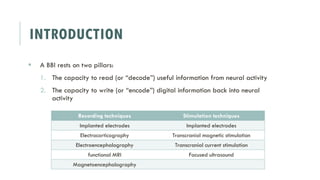
 A BBI rests on two pillars:
1. The capacity to read (or “decode”) useful information from neural activity
2. The capacity to write (or “encode”) digital information back into neural
activity
Recording techniques Stimulation techniques
Implanted electrodes Implanted electrodes
Electrocorticography Transcranial magnetic stimulation
Electroencephalography Transcranial current stimulation
functional MRI Focused ultrasound
Magnetoencephalography
MATERIALS AND METHODS
 Human Subjects and Ethics Statement
Six participants took part in the experiment over the course of three months.
To maintain their decision free of any external influence, all participants received
monetary compensation that was independent of their role and proportional to
the total amount of time devoted to the study.
MATERIALS AND METHODS
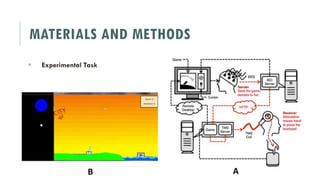
 Experimental Task
MATERIALS AND METHODS
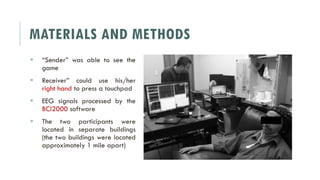
 “Sender” was able to see the
game
 Receiver” could use his/her
right hand to press a touchpad
 EEG signals processed by the
BCI2000 software
 The two participants were
located in separate buildings
(the two buildings were located
approximately 1 mile apart)
ANALYSIS OF THE LOG TIMES
 The transmission of the signal along the BBI channel took ~650 ms
1. Across the internet: 10 ms
2. Activation of the TMS machine: 1.4 ms
3. Generation of the electromagnetic pulse: 4.0 ms
4. Receiver’s entire motor response: 627.1ms
PROCEDURE
 Each experiment consisted of two experimental blocks and two control blocks
 The length of each block was initially set to 10 trials for pair 1 to make sure that
the experimental session could be completed within 1 hour.
 The length of each block was extended to 16 trials for pairs 2 and 3
 Trials were separated by 2 seconds of set-up time plus a 20 second visual
countdown.
 During control blocks the brain-to-brain channel was made non-operational by
changing the coil position so that the TMS pulse could not cause the desired
movement of the right hand.
EEG PROCEDURE
 During sessions, electrical signals were recorded at a frequency of 512 Hz from
the Sender's scalp via a 64-channel Ag/AgCl electrode cap (actiCAP, Brain
Products GmBH, Gilching, Germany) and amplified using gUSBamps (Guger
Technologies, Austria).
 A Laplacian spatial filter was used to reduce artifacts common to nearby
electrodes and emphasize local activity.
 Signal processing and data storage were managed through the BCI2000 software
package.
 During the training session, subjects learned to control the vertical movement of a
1-D cursor by imagining right hand movement.
 The computer translated the power in the mu band to vertical movement of a
cursor, which provided visual feedback to the sender.
EEG PROCEDURE
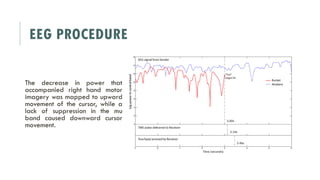
The decrease in power that
accompanied right hand motor
imagery was mapped to upward
movement of the cursor, while a
lack of suppression in the mu
band caused downward cursor
movement.
TMS PROCEDURE
 Safety questionnaire (family history of seizures or frequent migraines)
 Wear a tight-fitting swim cap, where the location of the inion and the vertex were
identified using the 10–20 system procedure.
 A 4×4 grid of dots were marked on the upper left region of the vertex, each dot placed
at a distance of 1 cm from its neighbors
 Each dot location was then stimulated in sequence, using a single pulse delivered by a 90
mm MagStim circle coil connected to a Super Rapid2 magnetic stimulator (MagStim, UK)
 Search procedure continued until an ideal position was found to stimulate the motor region
that controls the extensor carpi radialis.
 The stimulation intensity was estimated as the minimum amount of power that was needed
to solicit a consistent upward response of the hand
TMS PROCEDURE
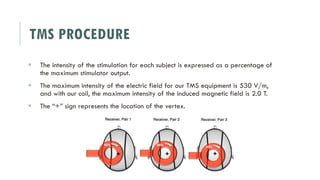
 The intensity of the stimulation for each subject is expressed as a percentage of
the maximum stimulator output.
 The maximum intensity of the electric field for our TMS equipment is 530 V/m,
and with our coil, the maximum intensity of the induced magnetic field is 2.0 T.
 The “+” sign represents the location of the vertex.
TMS SET-UP
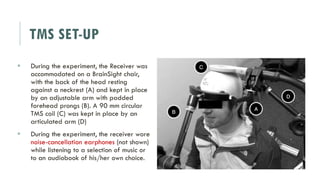
 During the experiment, the Receiver was
accommodated on a BrainSight chair,
with the back of the head resting
against a neckrest (A) and kept in place
by an adjustable arm with padded
forehead prongs (B). A 90 mm circular
TMS coil (C) was kept in place by an
articulated arm (D)
 During the experiment, the receiver wore
noise-cancellation earphones (not shown)
while listening to a selection of music or
to an audiobook of his/her own choice.
TMS SET-UP
 During experimental blocks, the coil was placed in the exact same position
determined during the parameter estimation session.
 During control blocks, the position of the coil was changed so that, with the same
power output, it could not trigger a hand response. Specifically, the coil was
simply rotated 180 degrees on the axis of its handle, so that its electrical current
was flowing in counter-clockwise fashion.
RESULTS
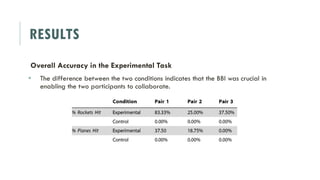
Overall Accuracy in the Experimental Task
 The difference between the two conditions indicates that the BBI was crucial in
enabling the two participants to collaborate.
RESULTS
 Each experimental trial can be categorized as:
 True positive: A rocket correctly destroyed
 False positive: A airplane that was mistakenly destroyed
 False negative: A rocket that was not destroyed
 True negative rejection: A airplane that was allowed to fly
 The collaboration between the two subjects in the three pairs can be quantified
using signal detection theory, and in particular, by calculating the area under the
corresponding Receiver Operating Characteristic (ROC) curve.
RESULTS
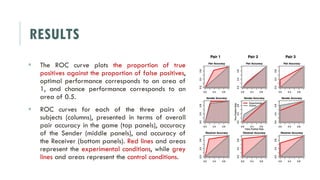
 The ROC curve plots the proportion of true
positives against the proportion of false positives,
optimal performance corresponds to an area of
1, and chance performance corresponds to an
area of 0.5.
 ROC curves for each of the three pairs of
subjects (columns), presented in terms of overall
pair accuracy in the game (top panels), accuracy
of the Sender (middle panels), and accuracy of
the Receiver (bottom panels). Red lines and areas
represent the experimental conditions, while grey
lines and areas represent the control conditions.
RESULTS
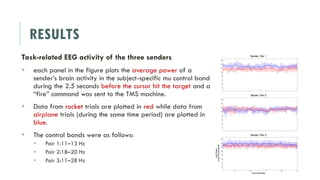
Task-related EEG activity of the three senders
 each panel in the figure plots the average power of a
sender’s brain activity in the subject-specific mu control band
during the 2.5 seconds before the cursor hit the target and a
“fire” command was sent to the TMS machine.
 Data from rocket trials are plotted in red while data from
airplane trials (during the same time period) are plotted in
blue.
 The control bands were as follows:
 Pair 1:11–13 Hz
 Pair 2:18–20 Hz
 Pair 3:11–28 Hz
RESULTS
Behavioral Data for the Receivers
 If the Receiver was responding based on an arbitrary strategy, or responding to
some environmental cue (e.g., residual noise of the TMS pulse), then at least some
false positives would be expected, at least at the beginning of the control blocks.
These facts lend support to our statement that the Receiver could receive
information only through the BBI
RESULTS
Measures of BBI Efficacy
 A more specific measure of the efficacy of the BBI is the degree to which a behavioral
response of the receiver can be ascribed to a pulse that was sent by the sender, rather
than to chance or response guessing.
 Two binary vectors S and R: S represents the Sender’s performance, and contains 1 s if
the Sender delivered a “Fire” command to the Receiver, and 0 s if no “Fire” command
was sent. The Receiver’s vector R, on the other hand, contains 1 s if the Receiver pressed
the touchpad during the trial, and 0 s if the touchpad was not pressed.
 The efficacy of the BBI is proportional to the extent to which R is explained by S, which
in turn can be measured by the slope coefficient β in a linear regression model
R = α+β*S.
RESULTS
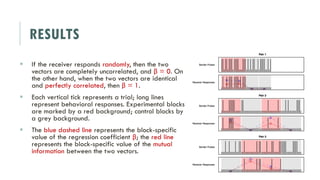
 If the receiver responds randomly, then the two
vectors are completely uncorrelated, and β = 0. On
the other hand, when the two vectors are identical
and perfectly correlated, then β = 1.
 Each vertical tick represents a trial; long lines
represent behavioral responses. Experimental blocks
are marked by a red background; control blocks by
a grey background.
 The blue dashed line represents the block-specific
value of the regression coefficient β; the red line
represents the block-specific value of the mutual
information between the two vectors.
RESULTS
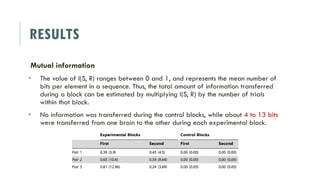
Mutual information
 The value of I(S, R) ranges between 0 and 1, and represents the mean number of
bits per element in a sequence. Thus, the total amount of information transferred
during a block can be estimated by multiplying I(S, R) by the number of trials
within that block.
 No information was transferred during the control blocks, while about 4 to 13 bits
were transferred from one brain to the other during each experimental block.
DISCUSSION AND CONCLUSION
 Our results show that current technology is sufficient to develop devices for
rudimentary brain-to-brain information transmission in humans.
 Our results show that working BBIs can be built out of non-invasive technologies.
 Our results highlight the need for accelerating conversations between ethicists,
neuroscientists, and regulatory agencies on the ethical, moral, and societal
implications of BBIs whose future capabilities may go well beyond the rudimentary
type of information transmission we have demonstrated here.
 In comparison to invasive tools for stimulation, non-invasive technologies, such as
TMS or TCS are currently more limited in both the number of available stimulation
sites and the spatial resolution of stimulation targets.
DISCUSSION AND CONCLUSION
 Rather than focusing on the transfer of motor intention information, TMS could
theoretically be applied to almost any area of the cortex that is close to the skull,
e.g., Primary visual cortex.
 One-to-many or many-to-one BBIs: a signal from a single sender is broadcasted to
multiple receivers, or multiple senders can submit signals to the same receiver.
 Because the neural underpinnings of sensorimotor information are much better
understood than those of conceptual and abstract information, BBIs in the near future
will likely be limited to transmitting visual, auditory, or motor information. In the long
term, the development of more powerful BBIs will be predicated on understanding
how abstract thoughts and complex cognitive information are encoded within
distributed patterns of neural activity in the human brain.
Thank you for your attention

A direct brain to-brain interface in humans

  • 1.
    A DIRECT BRAIN-TO-BRAIN INTERFACEIN HUMANS Department of computer science & engineering, University of Washington Department of psychology and institute for learning & brain sciences, University of Washington Department of bioengineering, University of Washington
  • 2.
    INTRODUCTION  The firstdirect brain-to-brain interface in humans  Non-invasive interface  EEG for recording brain signals with TMS for delivering information to the brain  Using a visuomotor task to achieve a desired goal in a computer game  Quantify the performance of the brain-to-brain interface in terms of the amount of information transmitted as well as the accuracies attained in 1. Decoding the sender’s signals 2. Generating a motor response from the receiver upon stimulation 3. Achieving the overall goal in the cooperative visuomotor task
  • 3.
    INTRODUCTION  A BBIrests on two pillars: 1. The capacity to read (or “decode”) useful information from neural activity 2. The capacity to write (or “encode”) digital information back into neural activity Recording techniques Stimulation techniques Implanted electrodes Implanted electrodes Electrocorticography Transcranial magnetic stimulation Electroencephalography Transcranial current stimulation functional MRI Focused ultrasound Magnetoencephalography
  • 4.
    MATERIALS AND METHODS Human Subjects and Ethics Statement Six participants took part in the experiment over the course of three months. To maintain their decision free of any external influence, all participants received monetary compensation that was independent of their role and proportional to the total amount of time devoted to the study.
  • 5.
    MATERIALS AND METHODS Experimental Task
  • 6.
    MATERIALS AND METHODS “Sender” was able to see the game  Receiver” could use his/her right hand to press a touchpad  EEG signals processed by the BCI2000 software  The two participants were located in separate buildings (the two buildings were located approximately 1 mile apart)
  • 7.
    ANALYSIS OF THELOG TIMES  The transmission of the signal along the BBI channel took ~650 ms 1. Across the internet: 10 ms 2. Activation of the TMS machine: 1.4 ms 3. Generation of the electromagnetic pulse: 4.0 ms 4. Receiver’s entire motor response: 627.1ms
  • 8.
    PROCEDURE  Each experimentconsisted of two experimental blocks and two control blocks  The length of each block was initially set to 10 trials for pair 1 to make sure that the experimental session could be completed within 1 hour.  The length of each block was extended to 16 trials for pairs 2 and 3  Trials were separated by 2 seconds of set-up time plus a 20 second visual countdown.  During control blocks the brain-to-brain channel was made non-operational by changing the coil position so that the TMS pulse could not cause the desired movement of the right hand.
  • 9.
    EEG PROCEDURE  Duringsessions, electrical signals were recorded at a frequency of 512 Hz from the Sender's scalp via a 64-channel Ag/AgCl electrode cap (actiCAP, Brain Products GmBH, Gilching, Germany) and amplified using gUSBamps (Guger Technologies, Austria).  A Laplacian spatial filter was used to reduce artifacts common to nearby electrodes and emphasize local activity.  Signal processing and data storage were managed through the BCI2000 software package.  During the training session, subjects learned to control the vertical movement of a 1-D cursor by imagining right hand movement.  The computer translated the power in the mu band to vertical movement of a cursor, which provided visual feedback to the sender.
  • 10.
    EEG PROCEDURE The decreasein power that accompanied right hand motor imagery was mapped to upward movement of the cursor, while a lack of suppression in the mu band caused downward cursor movement.
  • 11.
    TMS PROCEDURE  Safetyquestionnaire (family history of seizures or frequent migraines)  Wear a tight-fitting swim cap, where the location of the inion and the vertex were identified using the 10–20 system procedure.  A 4×4 grid of dots were marked on the upper left region of the vertex, each dot placed at a distance of 1 cm from its neighbors  Each dot location was then stimulated in sequence, using a single pulse delivered by a 90 mm MagStim circle coil connected to a Super Rapid2 magnetic stimulator (MagStim, UK)  Search procedure continued until an ideal position was found to stimulate the motor region that controls the extensor carpi radialis.  The stimulation intensity was estimated as the minimum amount of power that was needed to solicit a consistent upward response of the hand
  • 12.
    TMS PROCEDURE  Theintensity of the stimulation for each subject is expressed as a percentage of the maximum stimulator output.  The maximum intensity of the electric field for our TMS equipment is 530 V/m, and with our coil, the maximum intensity of the induced magnetic field is 2.0 T.  The “+” sign represents the location of the vertex.
  • 13.
    TMS SET-UP  Duringthe experiment, the Receiver was accommodated on a BrainSight chair, with the back of the head resting against a neckrest (A) and kept in place by an adjustable arm with padded forehead prongs (B). A 90 mm circular TMS coil (C) was kept in place by an articulated arm (D)  During the experiment, the receiver wore noise-cancellation earphones (not shown) while listening to a selection of music or to an audiobook of his/her own choice.
  • 14.
    TMS SET-UP  Duringexperimental blocks, the coil was placed in the exact same position determined during the parameter estimation session.  During control blocks, the position of the coil was changed so that, with the same power output, it could not trigger a hand response. Specifically, the coil was simply rotated 180 degrees on the axis of its handle, so that its electrical current was flowing in counter-clockwise fashion.
  • 15.
    RESULTS Overall Accuracy inthe Experimental Task  The difference between the two conditions indicates that the BBI was crucial in enabling the two participants to collaborate.
  • 16.
    RESULTS  Each experimentaltrial can be categorized as:  True positive: A rocket correctly destroyed  False positive: A airplane that was mistakenly destroyed  False negative: A rocket that was not destroyed  True negative rejection: A airplane that was allowed to fly  The collaboration between the two subjects in the three pairs can be quantified using signal detection theory, and in particular, by calculating the area under the corresponding Receiver Operating Characteristic (ROC) curve.
  • 17.
    RESULTS  The ROCcurve plots the proportion of true positives against the proportion of false positives, optimal performance corresponds to an area of 1, and chance performance corresponds to an area of 0.5.  ROC curves for each of the three pairs of subjects (columns), presented in terms of overall pair accuracy in the game (top panels), accuracy of the Sender (middle panels), and accuracy of the Receiver (bottom panels). Red lines and areas represent the experimental conditions, while grey lines and areas represent the control conditions.
  • 18.
    RESULTS Task-related EEG activityof the three senders  each panel in the figure plots the average power of a sender’s brain activity in the subject-specific mu control band during the 2.5 seconds before the cursor hit the target and a “fire” command was sent to the TMS machine.  Data from rocket trials are plotted in red while data from airplane trials (during the same time period) are plotted in blue.  The control bands were as follows:  Pair 1:11–13 Hz  Pair 2:18–20 Hz  Pair 3:11–28 Hz
  • 19.
    RESULTS Behavioral Data forthe Receivers  If the Receiver was responding based on an arbitrary strategy, or responding to some environmental cue (e.g., residual noise of the TMS pulse), then at least some false positives would be expected, at least at the beginning of the control blocks. These facts lend support to our statement that the Receiver could receive information only through the BBI
  • 20.
    RESULTS Measures of BBIEfficacy  A more specific measure of the efficacy of the BBI is the degree to which a behavioral response of the receiver can be ascribed to a pulse that was sent by the sender, rather than to chance or response guessing.  Two binary vectors S and R: S represents the Sender’s performance, and contains 1 s if the Sender delivered a “Fire” command to the Receiver, and 0 s if no “Fire” command was sent. The Receiver’s vector R, on the other hand, contains 1 s if the Receiver pressed the touchpad during the trial, and 0 s if the touchpad was not pressed.  The efficacy of the BBI is proportional to the extent to which R is explained by S, which in turn can be measured by the slope coefficient β in a linear regression model R = α+β*S.
  • 21.
    RESULTS  If thereceiver responds randomly, then the two vectors are completely uncorrelated, and β = 0. On the other hand, when the two vectors are identical and perfectly correlated, then β = 1.  Each vertical tick represents a trial; long lines represent behavioral responses. Experimental blocks are marked by a red background; control blocks by a grey background.  The blue dashed line represents the block-specific value of the regression coefficient β; the red line represents the block-specific value of the mutual information between the two vectors.
  • 22.
    RESULTS Mutual information  Thevalue of I(S, R) ranges between 0 and 1, and represents the mean number of bits per element in a sequence. Thus, the total amount of information transferred during a block can be estimated by multiplying I(S, R) by the number of trials within that block.  No information was transferred during the control blocks, while about 4 to 13 bits were transferred from one brain to the other during each experimental block.
  • 23.
    DISCUSSION AND CONCLUSION Our results show that current technology is sufficient to develop devices for rudimentary brain-to-brain information transmission in humans.  Our results show that working BBIs can be built out of non-invasive technologies.  Our results highlight the need for accelerating conversations between ethicists, neuroscientists, and regulatory agencies on the ethical, moral, and societal implications of BBIs whose future capabilities may go well beyond the rudimentary type of information transmission we have demonstrated here.  In comparison to invasive tools for stimulation, non-invasive technologies, such as TMS or TCS are currently more limited in both the number of available stimulation sites and the spatial resolution of stimulation targets.
  • 24.
    DISCUSSION AND CONCLUSION Rather than focusing on the transfer of motor intention information, TMS could theoretically be applied to almost any area of the cortex that is close to the skull, e.g., Primary visual cortex.  One-to-many or many-to-one BBIs: a signal from a single sender is broadcasted to multiple receivers, or multiple senders can submit signals to the same receiver.  Because the neural underpinnings of sensorimotor information are much better understood than those of conceptual and abstract information, BBIs in the near future will likely be limited to transmitting visual, auditory, or motor information. In the long term, the development of more powerful BBIs will be predicated on understanding how abstract thoughts and complex cognitive information are encoded within distributed patterns of neural activity in the human brain.
  • 25.
    Thank you foryour attention