A CMOS CAPACITIVE PRESSURE SENSOR
  CHIP FOR FINGER PRINT DETECTION
                   Yung-Shih Hsiung and Michael S-C Lu
   Department of Electrical engineering and Institute of Nano engineering
                         & Micro System NTHU


                  Reporter-Vivek Hegde
         Course Lectured By- Dr.Cheng-Hsien Liu
Outline
Why CMOS Capacitive pressure Sensor
Concept
Device Fabrication
Architecture
Experiment
Conclusion
Why CMOS capacitive pressure
sensor?
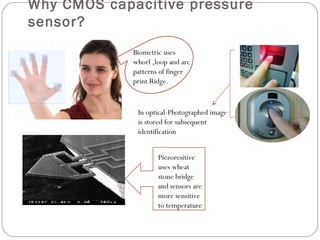
             Biometric uses
             whorl ,loop and arc
             patterns of finger
             print Ridge.


              In optical-Photographed image
              is stored for subsequent
              identification


                     Piezoresitive
                     uses wheat
                     stone bridge
                     and sensors are
                     more sensitive
                     to temperature
Concept


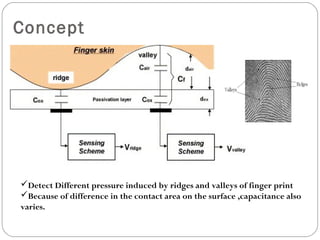
Detect Different pressure induced by ridges and valleys of finger print
Because of difference in the contact area on the surface ,capacitance also
varies.
Device fabrication
Architecture


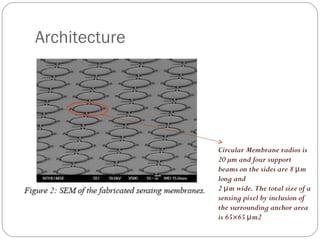
               Circular Membrane radios is
               20 µm and four support
               beams on the sides are 8 μ m
               long and
               2 μ m wide. The total size of a
               sensing pixel by inclusion of
               the surrounding anchor area
               is 65×65 μ m2
Architecture
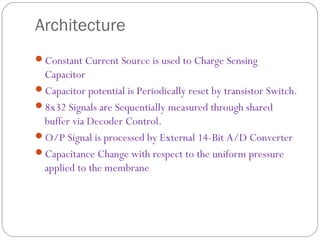
Constant Current Source is used to Charge Sensing
 Capacitor
Capacitor potential is Periodically reset by transistor Switch.
8x32 Signals are Sequentially measured through shared
 buffer via Decoder Control.
O/P Signal is processed by External 14-Bit A/D Converter
Capacitance Change with respect to the uniform pressure
 applied to the membrane
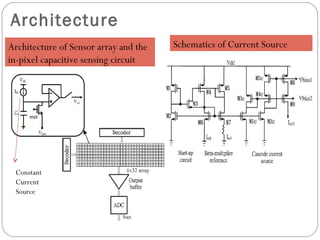
Architecture
Architecture of Sensor array and the   Schematics of Current Source
in-pixel capacitive sensing circuit


 Constant
 Current
 Source
Experiment
             Simulated and measured force-
             displacement curves.
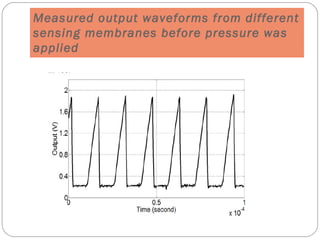
Measured output waveforms from different
sensing membranes before pressure was
applied
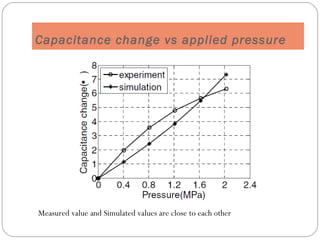
Capacitance change vs applied pressure


Measured value and Simulated values are close to each other
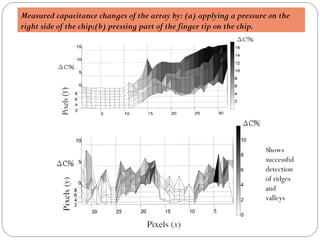
Measured capacitance changes of the array by: (a) applying a pressure on the
right side of the chip;(b) pressing part of the finger tip on the chip.


                                                                     Shows
                                                                     successful
                                                                     detection
                                                                     of ridges
                                                                     and
                                                                     valleys
Conclusion
Capacitive Pressure Sensor array is presented for finger print
 detection
Sensor development take advantage of multiple metal layer
 and fast electronics provided by the sub micro meter CMOS
 process
Post CMOS fabrication can be conducted at the chip level
Is almost insensitive to temperature variations
Question ?

A cmos capacitive pressure sensor chip for finger

  • 1.
    A CMOS CAPACITIVEPRESSURE SENSOR CHIP FOR FINGER PRINT DETECTION Yung-Shih Hsiung and Michael S-C Lu Department of Electrical engineering and Institute of Nano engineering & Micro System NTHU Reporter-Vivek Hegde Course Lectured By- Dr.Cheng-Hsien Liu
  • 2.
    Outline Why CMOS Capacitivepressure Sensor Concept Device Fabrication Architecture Experiment Conclusion
  • 3.
    Why CMOS capacitivepressure sensor? Biometric uses whorl ,loop and arc patterns of finger print Ridge. In optical-Photographed image is stored for subsequent identification Piezoresitive uses wheat stone bridge and sensors are more sensitive to temperature
  • 4.
    Concept Detect Different pressureinduced by ridges and valleys of finger print Because of difference in the contact area on the surface ,capacitance also varies.
  • 5.
  • 6.
    Architecture Circular Membrane radios is 20 µm and four support beams on the sides are 8 μ m long and 2 μ m wide. The total size of a sensing pixel by inclusion of the surrounding anchor area is 65×65 μ m2
  • 7.
    Architecture Constant Current Sourceis used to Charge Sensing Capacitor Capacitor potential is Periodically reset by transistor Switch. 8x32 Signals are Sequentially measured through shared buffer via Decoder Control. O/P Signal is processed by External 14-Bit A/D Converter Capacitance Change with respect to the uniform pressure applied to the membrane
  • 8.
    Architecture Architecture of Sensorarray and the Schematics of Current Source in-pixel capacitive sensing circuit Constant Current Source
  • 9.
    Experiment Simulated and measured force- displacement curves.
  • 10.
    Measured output waveformsfrom different sensing membranes before pressure was applied
  • 11.
    Capacitance change vsapplied pressure Measured value and Simulated values are close to each other
  • 12.
    Measured capacitance changesof the array by: (a) applying a pressure on the right side of the chip;(b) pressing part of the finger tip on the chip. Shows successful detection of ridges and valleys
  • 13.
    Conclusion Capacitive Pressure Sensorarray is presented for finger print detection Sensor development take advantage of multiple metal layer and fast electronics provided by the sub micro meter CMOS process Post CMOS fabrication can be conducted at the chip level Is almost insensitive to temperature variations
  • 14.