A150_e
Window jam protection
Capazitive principle


Window jam protection
Automatically operated windows are theses days
part of standard vehicle equipment. Increasingly
sliding doors, tailgates and trunk lids are also
electrically operated. However, there is a certain risk
associated with this level of comfort: Anyone who
has had a hand jammed in a closing window knows
that this can be very painful. With sliding roofs or
tailgates severe and even fatal injuries can be
caused due to the greater mass. Consequently, the
closing process must be monitored to prevent
jamming. Today generally, contacting systems are
used for this: These systems monitor, for example,
the motor torque and switch off when the torque
becomes too high. Other systems have a tactile
sensor in the profile strip in which a contact is closed
when two integrated wires are pressed together. All
these systems have however the disadvantage that
despite this a force - in many cases quite substantial -                                         Sensitive area
must be exerted.
The solution is therefore a non-contacting monitoring
system. Together with Metzeler and the Frauhofer
Gesellschaft, Micro-Epsilon has developed a non-
contacting capacitive jam protection sensor. The
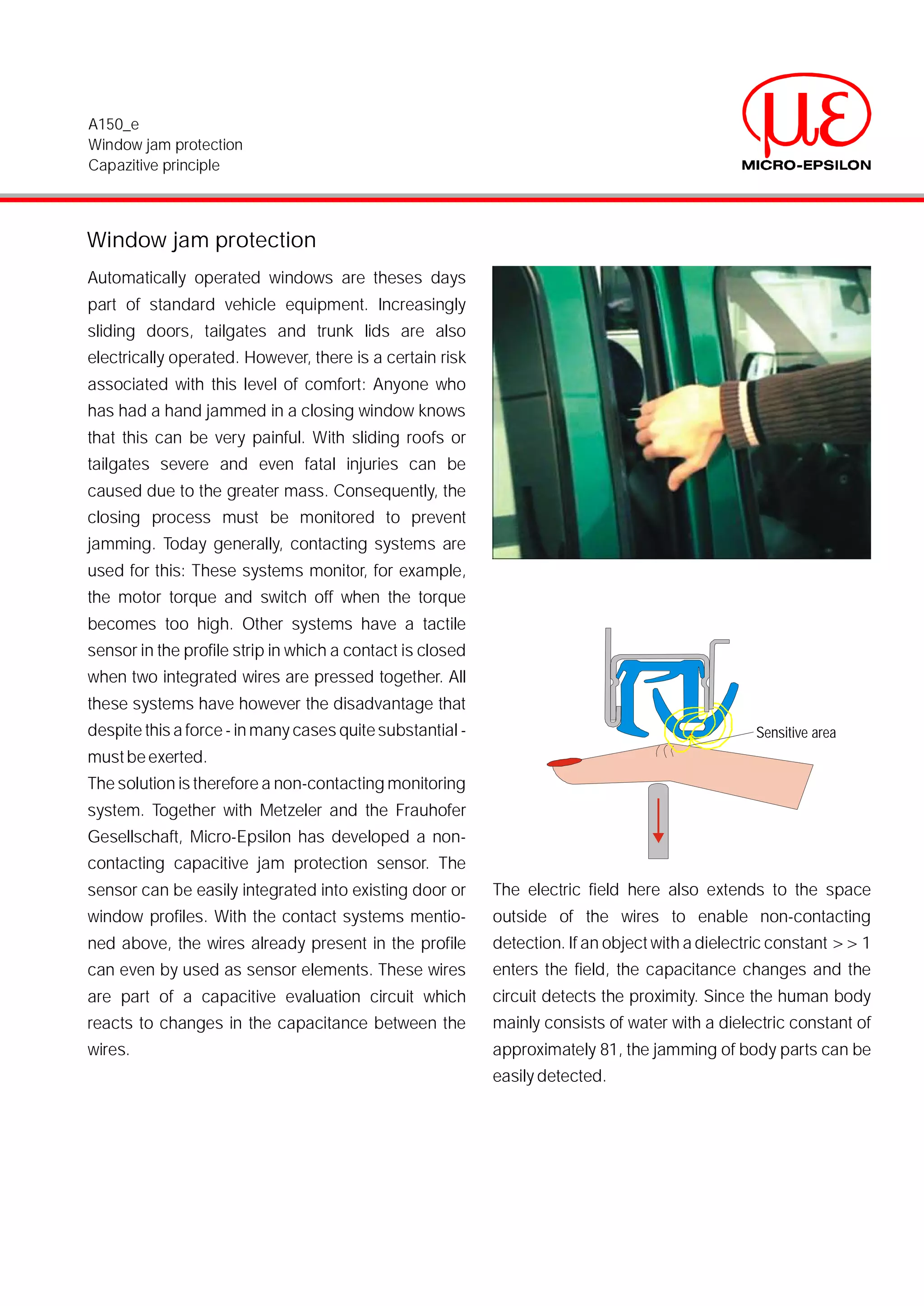
sensor can be easily integrated into existing door or      The electric field here also extends to the space
window profiles. With the contact systems mentio-          outside of the wires to enable non-contacting
ned above, the wires already present in the profile        detection. If an object with a dielectric constant >> 1
can even by used as sensor elements. These wires           enters the field, the capacitance changes and the
are part of a capacitive evaluation circuit which          circuit detects the proximity. Since the human body
reacts to changes in the capacitance between the           mainly consists of water with a dielectric constant of
wires.                                                     approximately 81, the jamming of body parts can be
                                                           easily detected.
Application
But what happens with rain or moisture, because                  System data:
here too water acts on the sensor? The engineers at              - Capacitive sensor with two wires as electrodes
Micro-Epsilon have been successful in developing a               - Extruded in a rubber profile
reliable so-called hand/water differentiation. Using a           - Redundant system with tactile signal
multi-frequency technique clear differentiation                  - Electronics with ASIC in plastic case in the plug.
between body parts and liquid water is possible in               - Measurement range 10 pF, offset up to 300 pF.
the signal. Only now is application on vehicles                  - Resolution < 50 fF
possible. Additional safety is also provided in that the         - Detection threshold for finger down to 3 mm, for
wires which act as the switch continue to be used,                 hand down to 20 mm.
also providing a tactile signal. This is then necessary          - Switching time capacitive < 7 ms, tactile < 5 µs.
if objects other than body parts having a lower                  - Hand/water detection.
dielectric constant become jammed (e.g. wooden or                - Wire breakage detection, watchdog timer.
plastic parts). Here however, the action of the force is         - Ready for operation 60 ms after switch-on.
not such a problem.                                              - Supply voltage 7...18 Vdc, current consumption <
The evaluation circuit is miniaturized in the form of an           25 mA.
ASIC, significantly reducing the installation space              - Output signal logic level 5 V
and presenting a cost-effective solution suitable for
large-scale production.


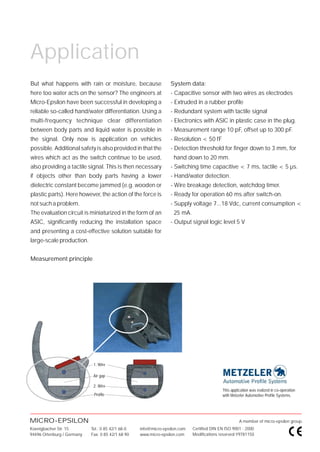
Measurement principle


                             1. Wire

                             Air gap

                             2. Wire
                                                                                           This application was realized in co-operation
                             Profile                                                       with Metzeler Automotive Profile Systems.


MICRO-EPSILON                                                                                        A member of micro-epsilon group.
Koenigbacher Str. 15        Tel.: 0 85 42/1 68-0   info@micro-epsilon.com   Certified DIN EN ISO 9001 : 2000
94496 Ortenburg / Germany   Fax: 0 85 42/1 68 90   www.micro-epsilon.com    Modifications reserved Y9781150

App150 en window-jam-protection

  • 1.
    A150_e Window jam protection Capazitiveprinciple Window jam protection Automatically operated windows are theses days part of standard vehicle equipment. Increasingly sliding doors, tailgates and trunk lids are also electrically operated. However, there is a certain risk associated with this level of comfort: Anyone who has had a hand jammed in a closing window knows that this can be very painful. With sliding roofs or tailgates severe and even fatal injuries can be caused due to the greater mass. Consequently, the closing process must be monitored to prevent jamming. Today generally, contacting systems are used for this: These systems monitor, for example, the motor torque and switch off when the torque becomes too high. Other systems have a tactile sensor in the profile strip in which a contact is closed when two integrated wires are pressed together. All these systems have however the disadvantage that despite this a force - in many cases quite substantial - Sensitive area must be exerted. The solution is therefore a non-contacting monitoring system. Together with Metzeler and the Frauhofer Gesellschaft, Micro-Epsilon has developed a non- contacting capacitive jam protection sensor. The sensor can be easily integrated into existing door or The electric field here also extends to the space window profiles. With the contact systems mentio- outside of the wires to enable non-contacting ned above, the wires already present in the profile detection. If an object with a dielectric constant >> 1 can even by used as sensor elements. These wires enters the field, the capacitance changes and the are part of a capacitive evaluation circuit which circuit detects the proximity. Since the human body reacts to changes in the capacitance between the mainly consists of water with a dielectric constant of wires. approximately 81, the jamming of body parts can be easily detected.
  • 2.
    Application But what happenswith rain or moisture, because System data: here too water acts on the sensor? The engineers at - Capacitive sensor with two wires as electrodes Micro-Epsilon have been successful in developing a - Extruded in a rubber profile reliable so-called hand/water differentiation. Using a - Redundant system with tactile signal multi-frequency technique clear differentiation - Electronics with ASIC in plastic case in the plug. between body parts and liquid water is possible in - Measurement range 10 pF, offset up to 300 pF. the signal. Only now is application on vehicles - Resolution < 50 fF possible. Additional safety is also provided in that the - Detection threshold for finger down to 3 mm, for wires which act as the switch continue to be used, hand down to 20 mm. also providing a tactile signal. This is then necessary - Switching time capacitive < 7 ms, tactile < 5 µs. if objects other than body parts having a lower - Hand/water detection. dielectric constant become jammed (e.g. wooden or - Wire breakage detection, watchdog timer. plastic parts). Here however, the action of the force is - Ready for operation 60 ms after switch-on. not such a problem. - Supply voltage 7...18 Vdc, current consumption < The evaluation circuit is miniaturized in the form of an 25 mA. ASIC, significantly reducing the installation space - Output signal logic level 5 V and presenting a cost-effective solution suitable for large-scale production. Measurement principle 1. Wire Air gap 2. Wire This application was realized in co-operation Profile with Metzeler Automotive Profile Systems. MICRO-EPSILON A member of micro-epsilon group. Koenigbacher Str. 15 Tel.: 0 85 42/1 68-0 info@micro-epsilon.com Certified DIN EN ISO 9001 : 2000 94496 Ortenburg / Germany Fax: 0 85 42/1 68 90 www.micro-epsilon.com Modifications reserved Y9781150