Presented by
ROHIT MISHRA
1107731084
ECE 3rd year
Under the guidance of
Er . PRATIK DUBEY
Laser triangulation sensors can also be used on highly
reflective or mirror surfaces , commonly referred to as
specular . With these surfaces the typical triangulation
sensor , can't be used because the laser light would bounce
directly back into itself . For these cases it is necessary to
direct the beam to the target at an angle . The beam will
reflect from the target at an equal but opposite angle and
focus onto the detector . MTII manufactures laser heads
specifically designed for specular surfaces or any of our
lasers can be mounted at an angle and operated in the
"specular mode" if necessary .
INTRODUCTION
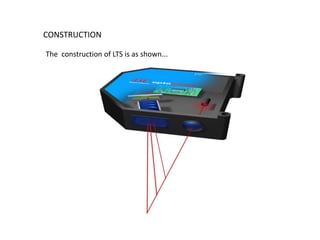
CONSTRUCTION
The construction of LTS is as shown...
WORKING PRINCIPLE
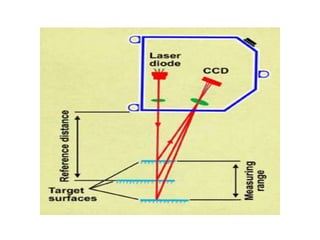
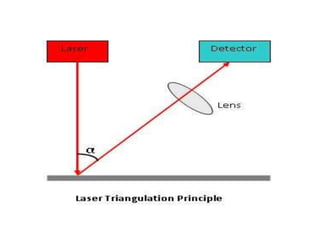
Laser triangulation sensors determine the position of a target by
measuring reflected from the target surface . A 'transmitter'
(laser diode) projects a spot of light to the target , and its
reflection is focused via an optical lens on a light sensitive
device or 'receiver‘. If the target changes its position from the
reference point the position of the reflected spot of light on the
detector changes as well . The signal conditioning electronics of
the laser detects the spot position on the receiving element and
, following linearization and additional digital or analogue signal
conditioning , provides an output signal proportional to target
position .
The most critical element in this arrangement is the receiver ,
which can take one of two forms :
A position sensitive device (PSD) or charge coupled device (CCD).
PSD triangulation has been around for about 25 years and thus
tends to dominate the field. Under 'ideal' conditions , PSD sensors
perform to expectation . However, the reliability and repeatability
of the PSD receiver is compromised by a number of 'real world'
variations in the nature of the target.
Should surface conditions , target texture or tilt change , for
example , this will change the shape of the light spot , altering the
centre of light distribution , and inducing a change in output of
the PSD element , even though the true 'Z' position of the target
has not changed .
PSD systems are also very sensitive to light intensity , and if this
changes while the spot position remains the same , it will result
in an output change - the same net effect of a change in target
colour .
CCD lasers first surfaced in Europe around ten years ago , and
helped overcome many of the limitations of PSD technology.
However , the speed of response of the laser to changing surface
conditions was still limited by the controlling microprocessor . If
surface conditions changed rapidly , the device simply couldn't
react fast enough , resulting in a measurement error . But
technology moves on . Today , the latest CCD elements and DSP
devices have virtually eliminated these early shortcomings of the
CCD based receiver .
ADVANTAGE OF LTS
 Since it is non contact there is no friction and wear
 Unlimited number of operating cycles since it is not contact
 Can measure distance to small targets since spot size of laser beam
is very small
 High accuracy
 High Resolution
 High speed
 Good reliability
 Good linearity
 Long measurement ranges
DISADVANTAGE OF LTS
 No measurement zone of few mm infront of the sensor .
As the measurement range increases this also increases.
 Could be affected if the target surface is irregular
 Laser beam can be hazardous.
APPLICATION OF LTS
 Ride height measurement on the car
 Displacement measurement
 Thickness measurement
 Tyre deflection
HOW TO REMOVE THE DISADVANTAGE
 The disadvantage of CMMs though , is that it requires contact
with the object being ... Principle of a laser triangulation
sensor. ..... The solution is called segmentation , a manual or
automatic procedure that can remove the unwanted
structures ...
 laser triangulation sensors can be divided into two categories
based upon ... Their operatin principle, advantages/disadvantages
and how to successfully apply them. .... with filtering will
remove some unwanted higher frequency fluctuations.
Laser triangulation senser ppt rohit

Laser triangulation senser ppt rohit

  • 1.
    Presented by ROHIT MISHRA 1107731084 ECE3rd year Under the guidance of Er . PRATIK DUBEY
  • 2.
    Laser triangulation sensorscan also be used on highly reflective or mirror surfaces , commonly referred to as specular . With these surfaces the typical triangulation sensor , can't be used because the laser light would bounce directly back into itself . For these cases it is necessary to direct the beam to the target at an angle . The beam will reflect from the target at an equal but opposite angle and focus onto the detector . MTII manufactures laser heads specifically designed for specular surfaces or any of our lasers can be mounted at an angle and operated in the "specular mode" if necessary . INTRODUCTION
  • 3.
  • 4.
    WORKING PRINCIPLE Laser triangulationsensors determine the position of a target by measuring reflected from the target surface . A 'transmitter' (laser diode) projects a spot of light to the target , and its reflection is focused via an optical lens on a light sensitive device or 'receiver‘. If the target changes its position from the reference point the position of the reflected spot of light on the detector changes as well . The signal conditioning electronics of the laser detects the spot position on the receiving element and , following linearization and additional digital or analogue signal conditioning , provides an output signal proportional to target position .
  • 6.
    The most criticalelement in this arrangement is the receiver , which can take one of two forms : A position sensitive device (PSD) or charge coupled device (CCD). PSD triangulation has been around for about 25 years and thus tends to dominate the field. Under 'ideal' conditions , PSD sensors perform to expectation . However, the reliability and repeatability of the PSD receiver is compromised by a number of 'real world' variations in the nature of the target. Should surface conditions , target texture or tilt change , for example , this will change the shape of the light spot , altering the centre of light distribution , and inducing a change in output of the PSD element , even though the true 'Z' position of the target has not changed .
  • 7.
    PSD systems arealso very sensitive to light intensity , and if this changes while the spot position remains the same , it will result in an output change - the same net effect of a change in target colour . CCD lasers first surfaced in Europe around ten years ago , and helped overcome many of the limitations of PSD technology. However , the speed of response of the laser to changing surface conditions was still limited by the controlling microprocessor . If surface conditions changed rapidly , the device simply couldn't react fast enough , resulting in a measurement error . But technology moves on . Today , the latest CCD elements and DSP devices have virtually eliminated these early shortcomings of the CCD based receiver .
  • 9.
    ADVANTAGE OF LTS Since it is non contact there is no friction and wear  Unlimited number of operating cycles since it is not contact  Can measure distance to small targets since spot size of laser beam is very small  High accuracy  High Resolution  High speed  Good reliability  Good linearity  Long measurement ranges
  • 10.
    DISADVANTAGE OF LTS No measurement zone of few mm infront of the sensor . As the measurement range increases this also increases.  Could be affected if the target surface is irregular  Laser beam can be hazardous.
  • 11.
    APPLICATION OF LTS Ride height measurement on the car  Displacement measurement  Thickness measurement  Tyre deflection
  • 12.
    HOW TO REMOVETHE DISADVANTAGE  The disadvantage of CMMs though , is that it requires contact with the object being ... Principle of a laser triangulation sensor. ..... The solution is called segmentation , a manual or automatic procedure that can remove the unwanted structures ...  laser triangulation sensors can be divided into two categories based upon ... Their operatin principle, advantages/disadvantages and how to successfully apply them. .... with filtering will remove some unwanted higher frequency fluctuations.