A 3-D PRINTED
LIGHTWEIGHT X-BAND
WAVEGUIDE FILTER BASED
ON SPHERICAL
RESONATORS
KAILASH BHATI
2014UEC1632
ABSTRACT: X-band waveguide bandpass filter, based on
spherical resonators, has been designed, and fabricated by 3D
printing. In comparison with rectangular waveguide, spherical
resonators have a higher unloaded quality factor, but at
the same time suffer from closer higher order modes. In this paper,
a special topology has been proposed to relieve the impact of the
first three higher order modes in the resonator and ultimately to
achieve a good out-of-band rejection. Stereolithography based 3D
printing is used to build the filter structure from polymer and a 25
μm thick copper layer is deposited to the filter. The filter is also
considerably lighter than a similar metal filter.
CONTENT:
1. INTRODUTION
a. FILTER
b. 3-D PRINTING TECHNIQUE
 FDM
 SLA
 SLS
c. RESONATORS
2. FILTER DESIGN
3. CONCLUSION
FILTER:
A filter is a device or process that removes some
unwanted components or features from a signal.
Most often, this means removing some frequencies
and not others in order to suppress interfering
signals and reduce background noise.
• linear or non-linear
• time-invariant or time-variant
• causal or not-causal
• analog or digital
• discrete-time (sampled) or continuous-time
Some important filter families designed in this way
are:
1. Chebyshev filter, has the best approximation to the
ideal response of any filter for a specified order and
ripple.
2. Butterworth filter, has a maximally flat frequency
response.
3. Bessel filter, has a maximally flat phase delay.
4. Elliptic filter, has the steepest cutoff of any filter for a
specified order and ripple.
The frequency response can be classified into
a number of different band forms describing
which frequency bands the filter passes and
which it rejects :
• Low-pass filter
• High-pass filter
• Band-pass filter
• Band-stop filter
• Notch filter
• All-pass filter
o Cutoff frequency is the frequency beyond which the
filter will not pass signals.
o Roll-off is the rate at which attenuation increases
beyond the cut-off frequency.
o Transition band, the band of frequencies between a
passband and stopband.
o Ripple is the variation of the filter's insertion loss in
the passband
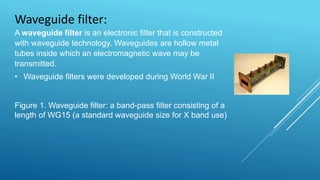
Waveguide filter:
A waveguide filter is an electronic filter that is constructed
with waveguide technology. Waveguides are hollow metal
tubes inside which an electromagnetic wave may be
transmitted.
• Waveguide filters were developed during World War II
Figure 1. Waveguide filter: a band-pass filter consisting of a
length of WG15 (a standard waveguide size for X band use)
• Waveguide components is used in filter making due to their great advantage
of low loss as well as higher power handling capacity.
• In comparison of rectangular waveguide, spherical resonator have a higher
unloaded quality factor.
• Fig. Configuration of X-band filter based on 5 spherical resonators. The
insertshow top view of the filter. a=22.86 mm, b=10.16 mm.
3-D printing technique:
There are many types of 3D printers working with polymers, which can be
utilized to construct the structure of microwave components, these
components can then be metal coated to form a conductive
surface These PoP (Plating on Plastic) components are much
lighter compared with conventional metal ones. The biggest
advantage of applying 3D printing, to the fabrication of
microwave components, is that the part under construction is
built layer by layer so the cost depends on the volume instead of
complexity.
Three types of 3-D printing process available:
1. FDM ( Fused deposition modeling )
2. SLA ( Stereo-lithography)
3. SLS ( Selective laser sintering )
1.FDM:
FDM is the only 3D printing technology that builds parts with
production-grade thermoplastics, so things printed are of
excellent mechanical, thermal and chemical qualities.
3D printing machines that use FDM
Technology build objects layer by layer
from the very bottom up by heating and
extruding thermoplastic filament.
2.SLA:
Stereolithography is a 3d printing method that can be used to implement your
projects that involve 3D printing of objects. This file contains information about
dimensional representation of an object. CAD file must be converted into a
format that a printing machine can understand. There is Standard Tessellation
Language (STL) format that is commonly used for stereolithography, as well as
for other additive manufacturing processes. The whole process consists of
consequent printing of layer by layer hence STL file that printing machine uses
should have the information for each layer.
• A 3-D model of an object is created in a CAD program.
• Special computer software "cuts" the CAD model file into thin layers -- typically five to 10
layers per millimeter of part thickness.
• The 3-D printer's ultraviolet laser "paints" one of the layers, exposing the top surface of the
liquid plastic in the tank and hardening it. The photopolymer is sensitive to ultraviolet light, so
wherever the laser touches the photopolymer, the polymer hardens.
• The platform drops down into the tank a fraction of a millimeter, then the laser "paints" the
next layer on top of the previous layer.
• This process repeats, layer by layer, until the 3-dimensional plastic model is complete.
• When the process is complete, the SLA machine raises the platform with the completed 3-
D object. If the finished object is small, several can be produced at the same time, sitting
next to each other on the tray.
• Once the run is complete, the finished objects are rinsed with solvent to remove all
uncured plastic and then "baked" in an ultraviolet oven that thoroughly cures the plastic.
3. SLS :
Selective Laser Sintering (SLS) is a technique that uses laser as power
source to form solid 3D objects The main difference between SLS and SLA is
that it uses powdered material in the vat instead of liquid resin as
stereolithography does.
SLA is chosen in this work as it has been reported to have a high
resolution and a good surface quality. The filter is designed based on
spherical resonators which have very high unloaded quality factors. The
fabrication of such spherical shape resonators is challenge to the
conventional CNC (Computer numerical control) milling process . this
problem now solved using 3-D printing .
FILTER DESIGN:
It is designed to have a chebyshev response, with a center frequency of 10
ghz, a bandwidth of 0.5 ghz (FBW=5%) and a pass band return loss of 20
dB.
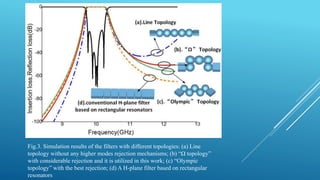
The final structure of the filter is shown in Fig. 1 and its corresponding
simulation results can be found Fig. 3. Magnetic fields of both the dominant
mode as well as the first three degenerate modes can be expressed as
When the angle of the coupling iris on the θ axis is 90, Hφ,TM101 reaches its
maximum value while Hφ,TM201 and Hφ,TM221 become zero. Similarly,
when the coupling iris is placed at 90 on φ axis, the dominant mode remains
unchanged but the cosφ term in Hφ,TM211 becomes zero.
Based on this principal, a topology for which there is a 90° turn at every
resonator, should offer the best out-of-band rejection performance, as shown
in Fig. 3. Here we call this type of topology as “Olympic topology” for it looks
like the Olympic rings. Ultimately, “Ω topology” (as shown in Fig. 1) is
employed in this work as it offers similar performance but is much easier to
fabricate. The simulation results for the Ω
topology, Olympic topology, Line topology (without any
rejection mechanism) together with a conventional H-plane
filter based on rectangular resonators are given in Fig. 3.
Fig.3. Simulation results of the filters with different topologies: (a) Line
topology without any higher modes rejection mechanisms; (b) “Ω topology”
with considerable rejection and it is utilized in this work; (c) “Olympic
topology” with the best rejection; (d) A H-plane filter based on rectangular
resonators
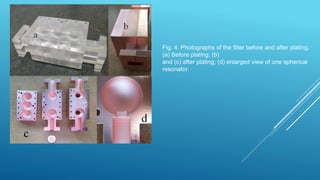
Fig. 4. Photographs of the filter before and after plating.
(a) Before plating; (b)
and (c) after plating; (d) enlarged view of one spherical
resonator.
CONCLUSION:
An X-band waveguide filter based on spherical resonators.
New topologies have been proposed to reject the first few
higher modes inside the spherical resonator. The structure of
this filter was fabricated by 3D printing, and the device was
then copper coated. This PoP device is only 0.28 kg that is
much lighter than a copper device (2 kg). The measured
frequency response has a good agreement with the design. It
indicates the process has a good dimensional accuracy as
well as the proposed filter structure is capable of providing
an ultra-low insertion loss.
REFERENCES:
[1] Timbie, P.T.; Grade, J.; van der Weide, D.; Maffei, B.; Pisano, G.,
"Stereolithographed mm-wave corrugated horn antennas," Infrared, Millimeter
and Terahertz Waves (IRMMW-THz), 2011 36th International Conference on ,
vol., no., pp.1,3, 2-7 Oct. 2011
[2] B. Liu, X. Gong, and W. J. Chappell,“Applications of layer-by-layer
polymer stereolithography for the three-dimensional high-frequency
components,”IEEE Trans. Microw. Theory Tech., vol. 52, no. 11, pp.
2567–2575, Nov. 2004
[3] Khalil, A.H.; Delhote, N.; Pacchini, S.; Claus, J.; Baillargeat, D.; Verdeyme,
S.; Leblond, H., "3-D pyramidal and collective Ku band pass filters made in
Alumina by ceramic stereolithography," Microwave Symposium Digest (MTT),
2011 IEEE MTT-S International , vol., no., pp.1,4, 5-10 June 2011
[4] Delhote, N.; Baillargeat, D.; Verdeyme, S.; Delage, C.; Chaput, C., "Narrow
Ka bandpass filters made of high permittivity ceramic by layer-by-layer
polymer stereolithography," Microwave Conference, 2006. 36th European ,
vol., no., pp.510,513, 10-15 Sept. 2006
[5] M. Vaezi, H. Seitz, and S. Yang, “A review on 3D microadditive
manufacturing technologies,” Int. J. Adv. Manuf. Technol., vol. 67, issue 5-8,
pp. 1721-1754, 2013.
[6] Chieh, J.-C.S.; Dick, B.; Loui, S.; Rockway, J.D., "Development of a
Ku-Band Corrugated Conical Horn Using 3-D Print Technology," Antennas
and Wireless Propagation Letters, IEEE , vol.13, no., pp.201,204, 2014
[7] Lai Sheng-Li; Lin Wei-Gan, "A five mode single spherical cavity
microwave filter," Microwave Symposium Digest, 1992., IEEE MTT-S
International , vol., no., pp.909,912 vol.2, 1-5 June 1992
[8]
THANK YOU

A 3-D printed lightweight x-band waveguide filter based

  • 1.
    A 3-D PRINTED LIGHTWEIGHTX-BAND WAVEGUIDE FILTER BASED ON SPHERICAL RESONATORS KAILASH BHATI 2014UEC1632
  • 2.
    ABSTRACT: X-band waveguidebandpass filter, based on spherical resonators, has been designed, and fabricated by 3D printing. In comparison with rectangular waveguide, spherical resonators have a higher unloaded quality factor, but at the same time suffer from closer higher order modes. In this paper, a special topology has been proposed to relieve the impact of the first three higher order modes in the resonator and ultimately to achieve a good out-of-band rejection. Stereolithography based 3D printing is used to build the filter structure from polymer and a 25 μm thick copper layer is deposited to the filter. The filter is also considerably lighter than a similar metal filter.
  • 3.
    CONTENT: 1. INTRODUTION a. FILTER b.3-D PRINTING TECHNIQUE  FDM  SLA  SLS c. RESONATORS 2. FILTER DESIGN 3. CONCLUSION
  • 4.
    FILTER: A filter isa device or process that removes some unwanted components or features from a signal. Most often, this means removing some frequencies and not others in order to suppress interfering signals and reduce background noise. • linear or non-linear • time-invariant or time-variant • causal or not-causal • analog or digital • discrete-time (sampled) or continuous-time
  • 5.
    Some important filterfamilies designed in this way are: 1. Chebyshev filter, has the best approximation to the ideal response of any filter for a specified order and ripple. 2. Butterworth filter, has a maximally flat frequency response. 3. Bessel filter, has a maximally flat phase delay. 4. Elliptic filter, has the steepest cutoff of any filter for a specified order and ripple.
  • 6.
    The frequency responsecan be classified into a number of different band forms describing which frequency bands the filter passes and which it rejects : • Low-pass filter • High-pass filter • Band-pass filter • Band-stop filter • Notch filter • All-pass filter
  • 7.
    o Cutoff frequencyis the frequency beyond which the filter will not pass signals. o Roll-off is the rate at which attenuation increases beyond the cut-off frequency. o Transition band, the band of frequencies between a passband and stopband. o Ripple is the variation of the filter's insertion loss in the passband
  • 9.
    Waveguide filter: A waveguidefilter is an electronic filter that is constructed with waveguide technology. Waveguides are hollow metal tubes inside which an electromagnetic wave may be transmitted. • Waveguide filters were developed during World War II Figure 1. Waveguide filter: a band-pass filter consisting of a length of WG15 (a standard waveguide size for X band use)
  • 10.
    • Waveguide componentsis used in filter making due to their great advantage of low loss as well as higher power handling capacity. • In comparison of rectangular waveguide, spherical resonator have a higher unloaded quality factor. • Fig. Configuration of X-band filter based on 5 spherical resonators. The insertshow top view of the filter. a=22.86 mm, b=10.16 mm.
  • 11.
    3-D printing technique: Thereare many types of 3D printers working with polymers, which can be utilized to construct the structure of microwave components, these components can then be metal coated to form a conductive surface These PoP (Plating on Plastic) components are much lighter compared with conventional metal ones. The biggest advantage of applying 3D printing, to the fabrication of microwave components, is that the part under construction is built layer by layer so the cost depends on the volume instead of complexity.
  • 12.
    Three types of3-D printing process available: 1. FDM ( Fused deposition modeling ) 2. SLA ( Stereo-lithography) 3. SLS ( Selective laser sintering ) 1.FDM: FDM is the only 3D printing technology that builds parts with production-grade thermoplastics, so things printed are of excellent mechanical, thermal and chemical qualities.
  • 13.
    3D printing machinesthat use FDM Technology build objects layer by layer from the very bottom up by heating and extruding thermoplastic filament.
  • 14.
    2.SLA: Stereolithography is a3d printing method that can be used to implement your projects that involve 3D printing of objects. This file contains information about dimensional representation of an object. CAD file must be converted into a format that a printing machine can understand. There is Standard Tessellation Language (STL) format that is commonly used for stereolithography, as well as for other additive manufacturing processes. The whole process consists of consequent printing of layer by layer hence STL file that printing machine uses should have the information for each layer.
  • 16.
    • A 3-Dmodel of an object is created in a CAD program. • Special computer software "cuts" the CAD model file into thin layers -- typically five to 10 layers per millimeter of part thickness. • The 3-D printer's ultraviolet laser "paints" one of the layers, exposing the top surface of the liquid plastic in the tank and hardening it. The photopolymer is sensitive to ultraviolet light, so wherever the laser touches the photopolymer, the polymer hardens. • The platform drops down into the tank a fraction of a millimeter, then the laser "paints" the next layer on top of the previous layer. • This process repeats, layer by layer, until the 3-dimensional plastic model is complete. • When the process is complete, the SLA machine raises the platform with the completed 3- D object. If the finished object is small, several can be produced at the same time, sitting next to each other on the tray. • Once the run is complete, the finished objects are rinsed with solvent to remove all uncured plastic and then "baked" in an ultraviolet oven that thoroughly cures the plastic.
  • 18.
    3. SLS : SelectiveLaser Sintering (SLS) is a technique that uses laser as power source to form solid 3D objects The main difference between SLS and SLA is that it uses powdered material in the vat instead of liquid resin as stereolithography does.
  • 19.
    SLA is chosenin this work as it has been reported to have a high resolution and a good surface quality. The filter is designed based on spherical resonators which have very high unloaded quality factors. The fabrication of such spherical shape resonators is challenge to the conventional CNC (Computer numerical control) milling process . this problem now solved using 3-D printing .
  • 20.
    FILTER DESIGN: It isdesigned to have a chebyshev response, with a center frequency of 10 ghz, a bandwidth of 0.5 ghz (FBW=5%) and a pass band return loss of 20 dB. The final structure of the filter is shown in Fig. 1 and its corresponding simulation results can be found Fig. 3. Magnetic fields of both the dominant mode as well as the first three degenerate modes can be expressed as
  • 21.
    When the angleof the coupling iris on the θ axis is 90, Hφ,TM101 reaches its maximum value while Hφ,TM201 and Hφ,TM221 become zero. Similarly, when the coupling iris is placed at 90 on φ axis, the dominant mode remains unchanged but the cosφ term in Hφ,TM211 becomes zero. Based on this principal, a topology for which there is a 90° turn at every resonator, should offer the best out-of-band rejection performance, as shown in Fig. 3. Here we call this type of topology as “Olympic topology” for it looks like the Olympic rings. Ultimately, “Ω topology” (as shown in Fig. 1) is employed in this work as it offers similar performance but is much easier to fabricate. The simulation results for the Ω topology, Olympic topology, Line topology (without any rejection mechanism) together with a conventional H-plane filter based on rectangular resonators are given in Fig. 3.
  • 22.
    Fig.3. Simulation resultsof the filters with different topologies: (a) Line topology without any higher modes rejection mechanisms; (b) “Ω topology” with considerable rejection and it is utilized in this work; (c) “Olympic topology” with the best rejection; (d) A H-plane filter based on rectangular resonators
  • 23.
    Fig. 4. Photographsof the filter before and after plating. (a) Before plating; (b) and (c) after plating; (d) enlarged view of one spherical resonator.
  • 24.
    CONCLUSION: An X-band waveguidefilter based on spherical resonators. New topologies have been proposed to reject the first few higher modes inside the spherical resonator. The structure of this filter was fabricated by 3D printing, and the device was then copper coated. This PoP device is only 0.28 kg that is much lighter than a copper device (2 kg). The measured frequency response has a good agreement with the design. It indicates the process has a good dimensional accuracy as well as the proposed filter structure is capable of providing an ultra-low insertion loss.
  • 25.
    REFERENCES: [1] Timbie, P.T.;Grade, J.; van der Weide, D.; Maffei, B.; Pisano, G., "Stereolithographed mm-wave corrugated horn antennas," Infrared, Millimeter and Terahertz Waves (IRMMW-THz), 2011 36th International Conference on , vol., no., pp.1,3, 2-7 Oct. 2011 [2] B. Liu, X. Gong, and W. J. Chappell,“Applications of layer-by-layer polymer stereolithography for the three-dimensional high-frequency components,”IEEE Trans. Microw. Theory Tech., vol. 52, no. 11, pp. 2567–2575, Nov. 2004 [3] Khalil, A.H.; Delhote, N.; Pacchini, S.; Claus, J.; Baillargeat, D.; Verdeyme, S.; Leblond, H., "3-D pyramidal and collective Ku band pass filters made in Alumina by ceramic stereolithography," Microwave Symposium Digest (MTT), 2011 IEEE MTT-S International , vol., no., pp.1,4, 5-10 June 2011 [4] Delhote, N.; Baillargeat, D.; Verdeyme, S.; Delage, C.; Chaput, C., "Narrow Ka bandpass filters made of high permittivity ceramic by layer-by-layer polymer stereolithography," Microwave Conference, 2006. 36th European , vol., no., pp.510,513, 10-15 Sept. 2006 [5] M. Vaezi, H. Seitz, and S. Yang, “A review on 3D microadditive manufacturing technologies,” Int. J. Adv. Manuf. Technol., vol. 67, issue 5-8, pp. 1721-1754, 2013. [6] Chieh, J.-C.S.; Dick, B.; Loui, S.; Rockway, J.D., "Development of a Ku-Band Corrugated Conical Horn Using 3-D Print Technology," Antennas and Wireless Propagation Letters, IEEE , vol.13, no., pp.201,204, 2014 [7] Lai Sheng-Li; Lin Wei-Gan, "A five mode single spherical cavity microwave filter," Microwave Symposium Digest, 1992., IEEE MTT-S International , vol., no., pp.909,912 vol.2, 1-5 June 1992 [8]
  • 26.