3D PRINTING
Akhil Jose
S7,C
Roll No:3
Overview
• Introduction to 3D printing
• History of 3D Printing
• General Principles
• Materials & Technologies Used
• Why 3D Printing?
• Applications
• Future Scenarios
• Limitations
• Conclusion
• References
Introduction to 3D Printing
• It is a method of converting a virtual 3D model into a
physical object.
• Three dimensional object is created by Laying down
successive layers of materials.
• It’s also known as
• Rapid Prototyping
• Additive Manufacturing
History of 3D Printing
1984 - 86
Charles Hull invents 3D printing
and coins the term “Stereo
Lithography”
1992
First 3D printer built by 3D
Systems
1999
First application of 3D printing in
the medical field - creating the
human bladder
General Principles
• Modeling
• Printing
• Finishing
Modeling
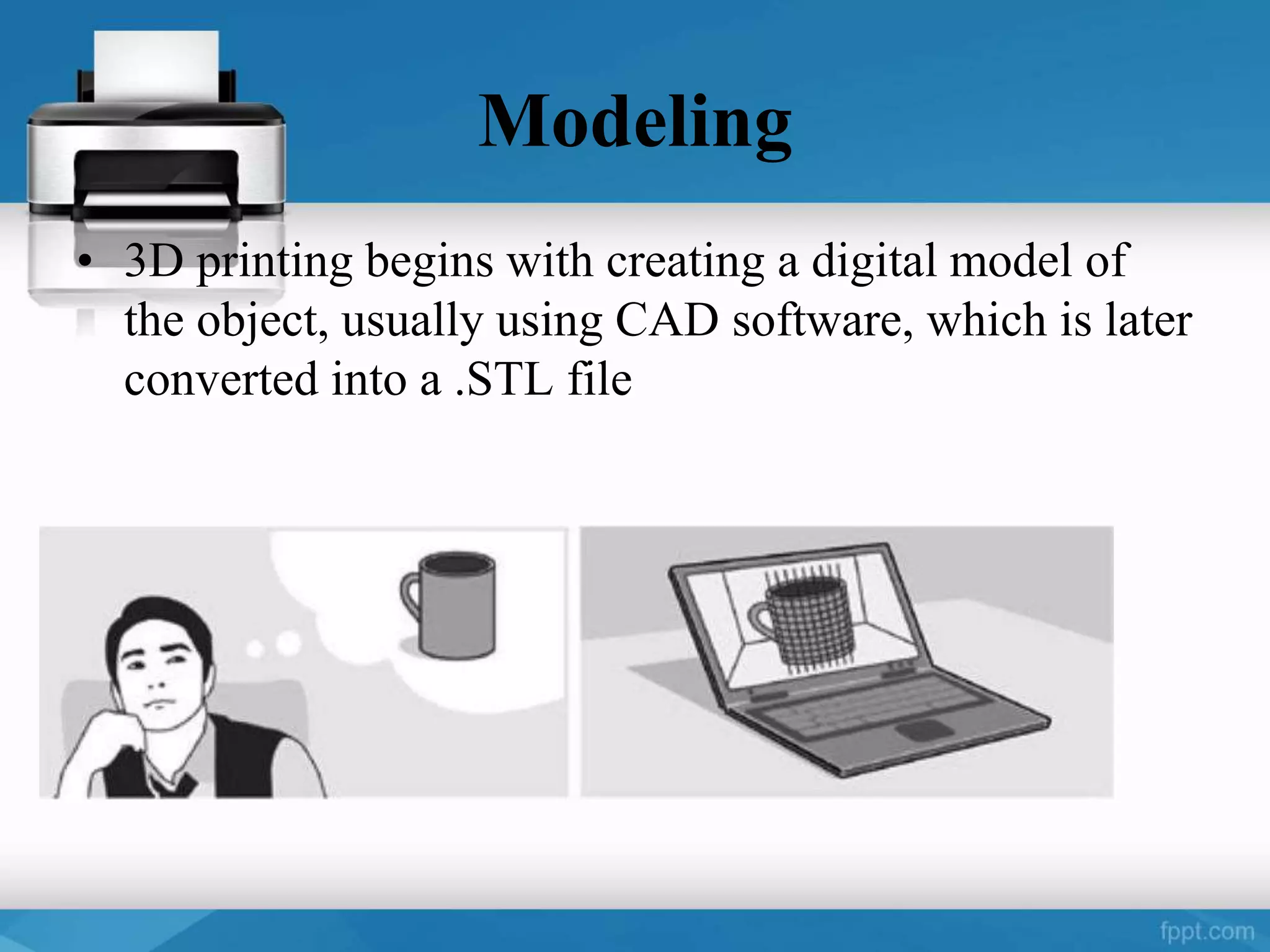
• 3D printing begins with creating a digital model of
the object, usually using CAD software, which is later
converted into a .STL file
Printing
• The 3D printer slices the .STL file into numerous
digital cross-sections, and lays down successive
layers of liquid, powder, or sheet material to build the
model from a series of cross sections.
• These layers, which correspond to the virtual cross
sections from the CAD model, are joined together or
automatically fused to create the final shape.
Finishing
• :
• The final 3D printed object is then cleaned to remove
overhung material and is polished, painted (if
required) and made ready for use.
Materials & Technologies
Used
• Materials Used
• Plastics
• Powder
• Metals
• Ceramics
• Paper
• Bio Material
• Food
• Others
Stereo lithography(SLA)
• Stereo lithography is an additive manufacturing process using a vat of
liquid UV-curable photopolymer ”resin” and a UV laser to build parts a
layer at a time
• 3D printing machine called a stereo lithograph apparatus (SLA), which
converts liquid plastic into solid 3D objects.
• The whole process consists of consequent printing of layer by layer
hence STL file that printing machine uses should have the information for
each layer
• There could be up to ten layers per each millimeter
• Once all layers are printed the object needs to be rinsed with a solvent and
then placed in an ultraviolet oven to finish processing
Fused deposition modeling
(FDS)
• Fused deposition modeling (FDM) is an additive manufacturing
technology commonly used for modeling, prototyping, and production
application
• 3D printers that run on FDM Technology
Build parts layer-by-layer by heating thermoplastic
material to a semi-liquid state and extruding it
via nozzle.
• The nozzle lays the material down in layers
Cross section is used to create each cross section
of material moves according to computer-controlled
paths
• things printed are of excellent mechanical
thermal and chemical qualities.
Selective Laser Sintering
(SLS)
• Selective Laser Sintering (SLS) is a technique that uses laser
as power source to fuse plastic, metal, glass, etc. to form solid
3D objects
• The main difference between SLS and SLA is that it uses
powdered material in the vat instead of liquid resin as stereo
lithography does.
• use of high-powered lasers, which makes the printer to be
very expensive
Selective laser melting
(SLM)
• Selective laser melting (SLM) is a technique that also uses 3D
CAD data as a source and forms 3D object by means of a
high-power laser beam that fuses and melts metallic powders
together.
• SLM process fully melts the metal material into solid 3D-
dimentional
• Metals that can be used for SLM include stainless steel,
titanium, cobalt chrome and aluminum
• This method of printing is widely applied to parts with
complex geometries and structures with thin walls and hidden
voids or channels.
• SLM projects were dedicated to aerospace application for
different lightweight parts
Electronic Beam Melting
(EBM)
• While SLM uses high-power laser beam as its power source,
EBM uses an electron beam instead, which is the main
difference between these two methods. The rest of the
processes is pretty similar.
• Comparing to SLM the process of EBM is rather slow and
expensive, also the availability of materials is limited
• Currently the most well spread materials that are used for
EBM are commercially pure Titanium, Inconel 718 and
Inconel 625.
• The application of EBM is mainly focused on medical
implants and aerospace area.
Laminated Object
Manufacturing (LOM)
• Laminated object manufacturing (LOM) is one more rapid
prototyping system.
• During the LOM process, layers of adhesive-coated paper,
plastic or metal laminates are fused together using heat and
pressure and then cut to shape with a computer controlled laser
or knife.
• Their devices are widely being used by artists, architects and
product developers to create affordable projects from usual
letter paper
• The cost of printing is low due to not expensive raw materials
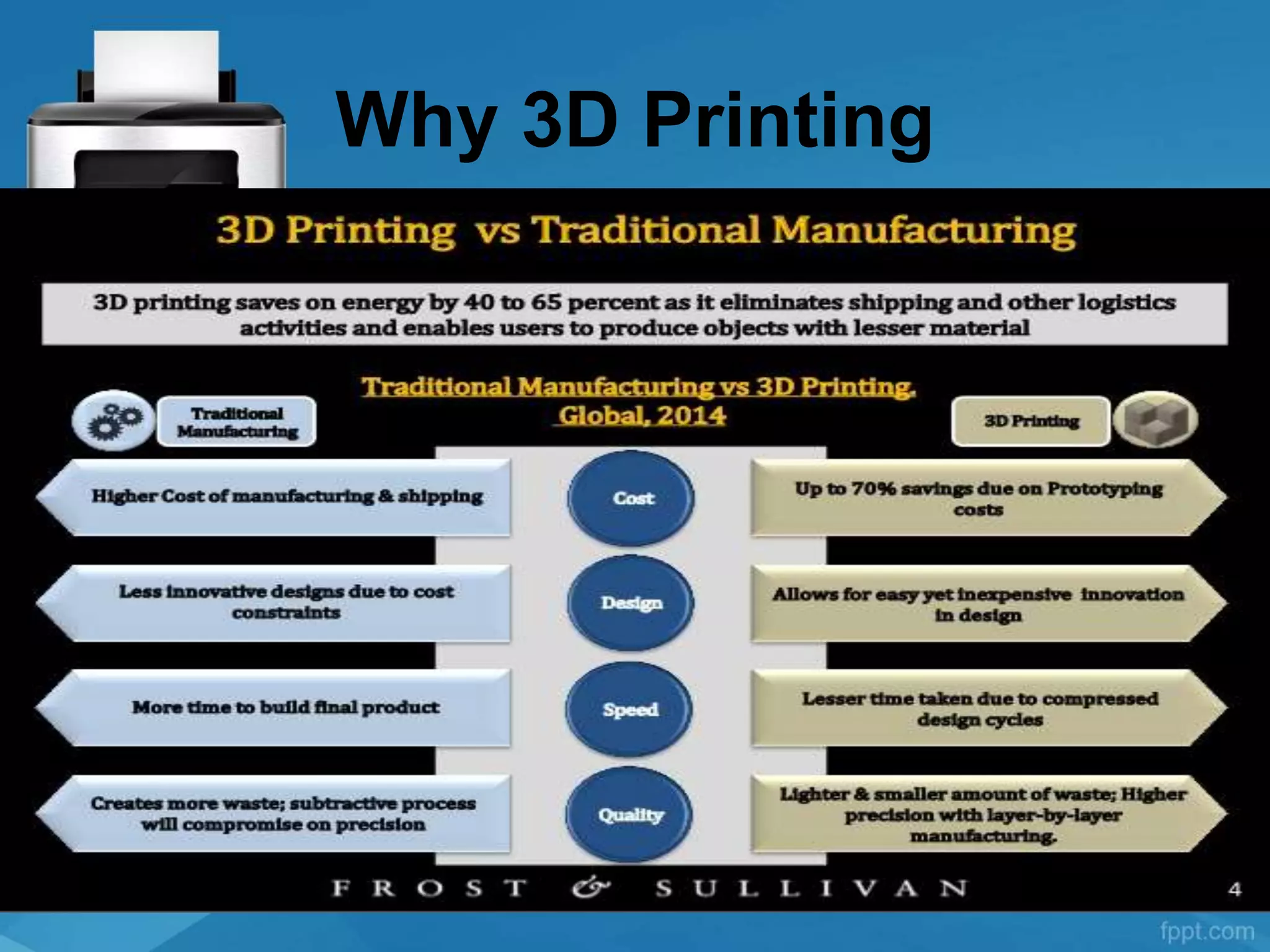
Why 3D Printing
Applications
Industrial &
Prototyping
Educational
Applications
• Medical
• 3D printing empowers health care
• Artificial Arms for Disabled
• Bionic Ears
• Fashionable Plaster
• Food
• In food preparation, to apply items in liquid or paste form such as cheese,
icing, and chocolate.
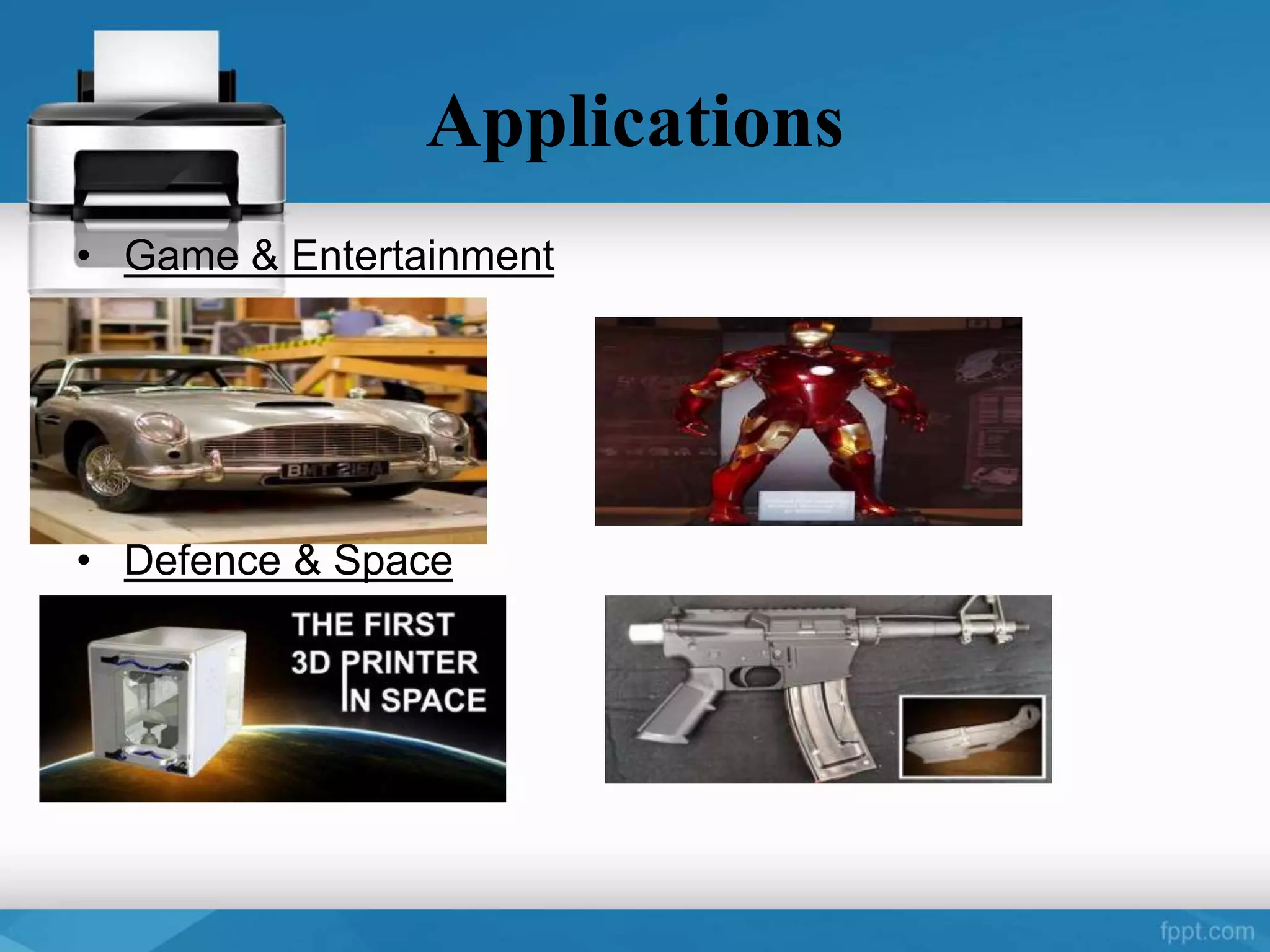
Applications
• Game & Entertainment
• Defence & Space
Future Scenarios
•3D printer service in the local strip mall / shopping center.
•3D printers mounted on Military Vehicles, Space Station, Oil
Rigs, and deployed on the Moon/Mars.
•Large 3D printers that build buildings
•3D printers that make meals
•4D printing = self assembly
Limitations
 Process is slow
 Components do not have enough strength.
 COST OF RAW MATERIALS
 3-D printers are still expensive.
 Misuse of technology
 Although 3-D printers have the potential of creating many jobs and
opportunities, they might also put certain jobs at risk .
Oral….below example
(for example, you can make your toys at home so toy stores and toy makers
might go out of business).
Conclusion
 Relatively New Technology.
 No restrictions on industry.
 Significant decrease in product development cycle and costs.
Reference
• http://slideshare.com
• http://wikipedia.com
• http://3ders.org
• http://3dprintingfromscratch.com
• http://livescience.com
• http://3dprinterhelp.co.uk
• Digit Fast Track
• IEEE Computer society
• IBM Market Development & Insights
“The future can not be predicted,
but it
can be made !”

3 D printing new 2015

  • 1.
  • 2.
    Overview • Introduction to3D printing • History of 3D Printing • General Principles • Materials & Technologies Used • Why 3D Printing? • Applications • Future Scenarios • Limitations • Conclusion • References
  • 3.
    Introduction to 3DPrinting • It is a method of converting a virtual 3D model into a physical object. • Three dimensional object is created by Laying down successive layers of materials. • It’s also known as • Rapid Prototyping • Additive Manufacturing
  • 4.
    History of 3DPrinting 1984 - 86 Charles Hull invents 3D printing and coins the term “Stereo Lithography” 1992 First 3D printer built by 3D Systems 1999 First application of 3D printing in the medical field - creating the human bladder
  • 5.
  • 6.
    Modeling • 3D printingbegins with creating a digital model of the object, usually using CAD software, which is later converted into a .STL file
  • 7.
    Printing • The 3Dprinter slices the .STL file into numerous digital cross-sections, and lays down successive layers of liquid, powder, or sheet material to build the model from a series of cross sections. • These layers, which correspond to the virtual cross sections from the CAD model, are joined together or automatically fused to create the final shape.
  • 8.
    Finishing • : • Thefinal 3D printed object is then cleaned to remove overhung material and is polished, painted (if required) and made ready for use.
  • 9.
    Materials & Technologies Used •Materials Used • Plastics • Powder • Metals • Ceramics • Paper • Bio Material • Food • Others
  • 11.
    Stereo lithography(SLA) • Stereolithography is an additive manufacturing process using a vat of liquid UV-curable photopolymer ”resin” and a UV laser to build parts a layer at a time • 3D printing machine called a stereo lithograph apparatus (SLA), which converts liquid plastic into solid 3D objects. • The whole process consists of consequent printing of layer by layer hence STL file that printing machine uses should have the information for each layer • There could be up to ten layers per each millimeter • Once all layers are printed the object needs to be rinsed with a solvent and then placed in an ultraviolet oven to finish processing
  • 12.
    Fused deposition modeling (FDS) •Fused deposition modeling (FDM) is an additive manufacturing technology commonly used for modeling, prototyping, and production application • 3D printers that run on FDM Technology Build parts layer-by-layer by heating thermoplastic material to a semi-liquid state and extruding it via nozzle. • The nozzle lays the material down in layers Cross section is used to create each cross section of material moves according to computer-controlled paths • things printed are of excellent mechanical thermal and chemical qualities.
  • 13.
    Selective Laser Sintering (SLS) •Selective Laser Sintering (SLS) is a technique that uses laser as power source to fuse plastic, metal, glass, etc. to form solid 3D objects • The main difference between SLS and SLA is that it uses powdered material in the vat instead of liquid resin as stereo lithography does. • use of high-powered lasers, which makes the printer to be very expensive
  • 14.
    Selective laser melting (SLM) •Selective laser melting (SLM) is a technique that also uses 3D CAD data as a source and forms 3D object by means of a high-power laser beam that fuses and melts metallic powders together. • SLM process fully melts the metal material into solid 3D- dimentional • Metals that can be used for SLM include stainless steel, titanium, cobalt chrome and aluminum • This method of printing is widely applied to parts with complex geometries and structures with thin walls and hidden voids or channels. • SLM projects were dedicated to aerospace application for different lightweight parts
  • 15.
    Electronic Beam Melting (EBM) •While SLM uses high-power laser beam as its power source, EBM uses an electron beam instead, which is the main difference between these two methods. The rest of the processes is pretty similar. • Comparing to SLM the process of EBM is rather slow and expensive, also the availability of materials is limited • Currently the most well spread materials that are used for EBM are commercially pure Titanium, Inconel 718 and Inconel 625. • The application of EBM is mainly focused on medical implants and aerospace area.
  • 16.
    Laminated Object Manufacturing (LOM) •Laminated object manufacturing (LOM) is one more rapid prototyping system. • During the LOM process, layers of adhesive-coated paper, plastic or metal laminates are fused together using heat and pressure and then cut to shape with a computer controlled laser or knife. • Their devices are widely being used by artists, architects and product developers to create affordable projects from usual letter paper • The cost of printing is low due to not expensive raw materials
  • 17.
  • 19.
  • 20.
    Applications • Medical • 3Dprinting empowers health care • Artificial Arms for Disabled • Bionic Ears • Fashionable Plaster • Food • In food preparation, to apply items in liquid or paste form such as cheese, icing, and chocolate.
  • 21.
    Applications • Game &Entertainment • Defence & Space
  • 22.
    Future Scenarios •3D printerservice in the local strip mall / shopping center. •3D printers mounted on Military Vehicles, Space Station, Oil Rigs, and deployed on the Moon/Mars. •Large 3D printers that build buildings •3D printers that make meals •4D printing = self assembly
  • 23.
    Limitations  Process isslow  Components do not have enough strength.  COST OF RAW MATERIALS  3-D printers are still expensive.  Misuse of technology  Although 3-D printers have the potential of creating many jobs and opportunities, they might also put certain jobs at risk . Oral….below example (for example, you can make your toys at home so toy stores and toy makers might go out of business).
  • 24.
    Conclusion  Relatively NewTechnology.  No restrictions on industry.  Significant decrease in product development cycle and costs.
  • 25.
    Reference • http://slideshare.com • http://wikipedia.com •http://3ders.org • http://3dprintingfromscratch.com • http://livescience.com • http://3dprinterhelp.co.uk • Digit Fast Track • IEEE Computer society • IBM Market Development & Insights
  • 27.
    “The future cannot be predicted, but it can be made !”