RADON TRANSFORM
- BY NAMAN LODHA
MBA TECH IT
ROLL NO. I029
INTRODUCTION
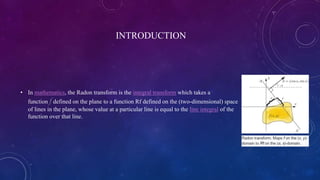
• In mathematics, the Radon transform is the integral transform which takes a
function f defined on the plane to a function Rf defined on the (two-dimensional) space
of lines in the plane, whose value at a particular line is equal to the line integral of the
function over that line.
HISTORY
• The transform was introduced in 1917 by Johann Radon, who also provided a formula for the inverse
transform. Radon further included formulas for the transform in three dimensions, in which the integral is
taken over planes (integrating over lines is known as the X-ray transform). It was later generalized to
higher-dimensional Euclidean spaces, and more broadly in the context of integral geometry.
• The complex analogue of the Radon transform is known as the Penrose transform.
• The Radon transform is widely applicable to tomography, the creation of an image from the projection
data associated with cross-sectional scans of an object.
EXPLANATION
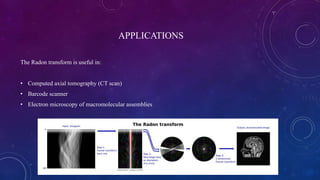
• If a function f represents an unknown density, then the Radon transform represents the projection data
obtained as the output of a tomographic scan. Hence the inverse of the Radon transform can be used to
reconstruct the original density from the projection data, and thus it forms the mathematical underpinning
for tomographic reconstruction, also known as iterative reconstruction.
• The Radon transform data is often called a sinogram because the Radon transform of an off-center point
source is a sinusoid. Consequently, the Radon transform of a number of small objects appears graphically
as a number of blurred sine waves with different amplitudes and phases.
APPLICATIONS
The Radon transform is useful in:
• Computed axial tomography (CT scan)
• Barcode scanner
• Electron microscopy of macromolecular assemblies
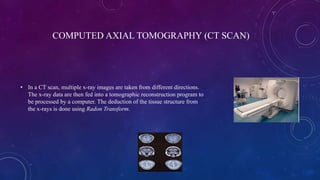
COMPUTED AXIAL TOMOGRAPHY (CT SCAN)
• In a CT scan, multiple x-ray images are taken from different directions.
The x-ray data are then fed into a tomographic reconstruction program to
be processed by a computer. The deduction of the tissue structure from
the x-rays is done using Radon Transform.
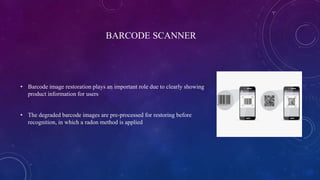
BARCODE SCANNER
• Barcode image restoration plays an important role due to clearly showing
product information for users
• The degraded barcode images are pre-processed for restoring before
recognition, in which a radon method is applied
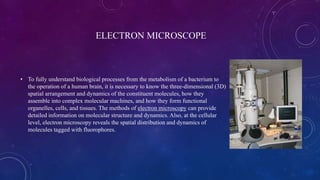
ELECTRON MICROSCOPE
• To fully understand biological processes from the metabolism of a bacterium to
the operation of a human brain, it is necessary to know the three-dimensional (3D)
spatial arrangement and dynamics of the constituent molecules, how they
assemble into complex molecular machines, and how they form functional
organelles, cells, and tissues. The methods of electron microscopy can provide
detailed information on molecular structure and dynamics. Also, at the cellular
level, electron microscopy reveals the spatial distribution and dynamics of
molecules tagged with fluorophores.
THANK YOU

Radon transform(applications)

  • 1.
    RADON TRANSFORM - BYNAMAN LODHA MBA TECH IT ROLL NO. I029
  • 2.
    INTRODUCTION • In mathematics,the Radon transform is the integral transform which takes a function f defined on the plane to a function Rf defined on the (two-dimensional) space of lines in the plane, whose value at a particular line is equal to the line integral of the function over that line.
  • 3.
    HISTORY • The transformwas introduced in 1917 by Johann Radon, who also provided a formula for the inverse transform. Radon further included formulas for the transform in three dimensions, in which the integral is taken over planes (integrating over lines is known as the X-ray transform). It was later generalized to higher-dimensional Euclidean spaces, and more broadly in the context of integral geometry. • The complex analogue of the Radon transform is known as the Penrose transform. • The Radon transform is widely applicable to tomography, the creation of an image from the projection data associated with cross-sectional scans of an object.
  • 4.
    EXPLANATION • If afunction f represents an unknown density, then the Radon transform represents the projection data obtained as the output of a tomographic scan. Hence the inverse of the Radon transform can be used to reconstruct the original density from the projection data, and thus it forms the mathematical underpinning for tomographic reconstruction, also known as iterative reconstruction. • The Radon transform data is often called a sinogram because the Radon transform of an off-center point source is a sinusoid. Consequently, the Radon transform of a number of small objects appears graphically as a number of blurred sine waves with different amplitudes and phases.
  • 5.
    APPLICATIONS The Radon transformis useful in: • Computed axial tomography (CT scan) • Barcode scanner • Electron microscopy of macromolecular assemblies
  • 6.
    COMPUTED AXIAL TOMOGRAPHY(CT SCAN) • In a CT scan, multiple x-ray images are taken from different directions. The x-ray data are then fed into a tomographic reconstruction program to be processed by a computer. The deduction of the tissue structure from the x-rays is done using Radon Transform.
  • 7.
    BARCODE SCANNER • Barcodeimage restoration plays an important role due to clearly showing product information for users • The degraded barcode images are pre-processed for restoring before recognition, in which a radon method is applied
  • 8.
    ELECTRON MICROSCOPE • Tofully understand biological processes from the metabolism of a bacterium to the operation of a human brain, it is necessary to know the three-dimensional (3D) spatial arrangement and dynamics of the constituent molecules, how they assemble into complex molecular machines, and how they form functional organelles, cells, and tissues. The methods of electron microscopy can provide detailed information on molecular structure and dynamics. Also, at the cellular level, electron microscopy reveals the spatial distribution and dynamics of molecules tagged with fluorophores.
  • 9.