 NAME:SIDRA SALEEM
 R0ll no 97
 BS-CHEMISTRY(5th SEMESTER)
 DATE:3-4-2013
Geometrical Isomerism
2-butene Isomerism
Introduction
In organic chemistry csi/trans isomerism (also known
as geometric isomerism, or E/Z isomerism) is a
form of stereoisomerism describing the orientation
of functional groups within a molecule. In general,
such isomers contain double bonds, which cannot
rotate, but they can also arise from ring structures,
wherein the rotation of bonds is greatly
restricted. Cis and trans isomers occur both in organic
molecules and in inorganic coordination complexes.
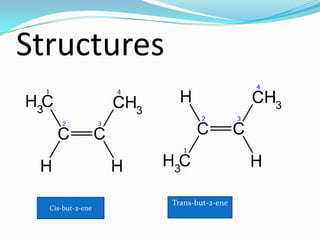
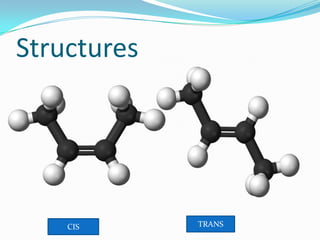
Structures
Cis-but-2-ene
Trans-but-2-ene
Nomenclature
The terms cis and trans are from Latin, in
which cis means "on the same side" and trans means
"on the other side" or "across". The term "geometric
isomerism" is considered an obsolete synonym of
"cis/trans isomerism" by IUPAC. It is sometimes used
as a synonym for general stereoisomerism (e.g., optical
isomerism being called geometric isomerism); the
correct term for non-optical stereoisomerism
is diastereomerism.The cis is german word zusamen
which mean together represent by z and trans is
Entgegen which mean opposite.
Structures
CIS TRANS
Properties
 DIPOLE MOMENT
 PHYSICAL PROPERTY
 CHEMICAL PROPERTY
Dipole moment
- They can have different dipole moments.
In a trans compound, the dipole can cancel but not
in cis compound.
- The trans compound is more symmetric and can
pack well, but not the cis compound. So the trans
compound will generally have a high melting point.
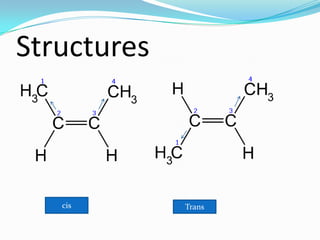
Structures
cis Trans
Physical Property
 Cis-2-butene have high boiling point [4(3.73)] because
they have high dipole moment.
 Trans-2-butene have high melting point [1(0.9)] due to
less dipole moment.
Cis M.P (- 139)
Trans B.P(-105.5)
Chemical Property
Cis gives addition reaction.
 Addition of halogens.
 Addition of hydrogen.
 Addition of sulphuric acid.e.t.c.
Trans gives elimination reaction.
 Only E2 reaction.
Why trans is more stable than cis?
 Because in trans the large substituents (methyl groups,
etc.) are farther apart and therefore have less steric
strain.
 Explation:-
 In cis alkyl group present on the same side of double bond
repulsive force occur.but in trans alkyl group present on
opposite side while repulsive force dose not occur.
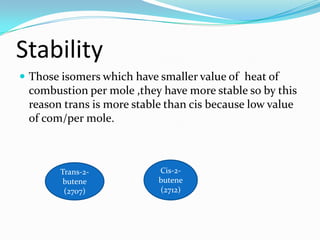
Stability
 Those isomers which have smaller value of heat of
combustion per mole ,they have more stable so by this
reason trans is more stable than cis because low value
of com/per mole.
Cis-2-
butene
(2712)
Trans-2-
butene
(2707)
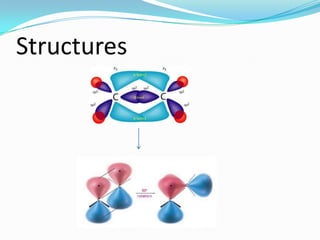
convertion cis-2-butene into trans-2-butene
cis and trans are structural isomers. The double bond
does not allow free rotation so the configuration is
fixed and cannot be converted unless bonds are broken
and reformed in the new configuration. If we rotate
one carbon of the double bond to 90˚ the p orbital
become prependicular to each other and then there is
no net overlap between them.As a result,the pi bond
breaks and only the sigma bond remains.Neither of
doubly bonded carbon atoms can be rotated about the
double bond with out breaking the pi bond.the
strength of pi bond is 263kj/mol which is the barrier to
rotation about the double bond.
Structures

Geometric Isomerism

  • 2.
     NAME:SIDRA SALEEM R0ll no 97  BS-CHEMISTRY(5th SEMESTER)  DATE:3-4-2013
  • 3.
  • 4.
    Introduction In organic chemistrycsi/trans isomerism (also known as geometric isomerism, or E/Z isomerism) is a form of stereoisomerism describing the orientation of functional groups within a molecule. In general, such isomers contain double bonds, which cannot rotate, but they can also arise from ring structures, wherein the rotation of bonds is greatly restricted. Cis and trans isomers occur both in organic molecules and in inorganic coordination complexes.
  • 5.
  • 6.
    Nomenclature The terms cisand trans are from Latin, in which cis means "on the same side" and trans means "on the other side" or "across". The term "geometric isomerism" is considered an obsolete synonym of "cis/trans isomerism" by IUPAC. It is sometimes used as a synonym for general stereoisomerism (e.g., optical isomerism being called geometric isomerism); the correct term for non-optical stereoisomerism is diastereomerism.The cis is german word zusamen which mean together represent by z and trans is Entgegen which mean opposite.
  • 7.
  • 8.
    Properties  DIPOLE MOMENT PHYSICAL PROPERTY  CHEMICAL PROPERTY
  • 9.
    Dipole moment - Theycan have different dipole moments. In a trans compound, the dipole can cancel but not in cis compound. - The trans compound is more symmetric and can pack well, but not the cis compound. So the trans compound will generally have a high melting point.
  • 10.
  • 11.
    Physical Property  Cis-2-butenehave high boiling point [4(3.73)] because they have high dipole moment.  Trans-2-butene have high melting point [1(0.9)] due to less dipole moment. Cis M.P (- 139) Trans B.P(-105.5)
  • 12.
    Chemical Property Cis givesaddition reaction.  Addition of halogens.  Addition of hydrogen.  Addition of sulphuric acid.e.t.c. Trans gives elimination reaction.  Only E2 reaction.
  • 13.
    Why trans ismore stable than cis?  Because in trans the large substituents (methyl groups, etc.) are farther apart and therefore have less steric strain.  Explation:-  In cis alkyl group present on the same side of double bond repulsive force occur.but in trans alkyl group present on opposite side while repulsive force dose not occur.
  • 14.
    Stability  Those isomerswhich have smaller value of heat of combustion per mole ,they have more stable so by this reason trans is more stable than cis because low value of com/per mole. Cis-2- butene (2712) Trans-2- butene (2707)
  • 15.
    convertion cis-2-butene intotrans-2-butene cis and trans are structural isomers. The double bond does not allow free rotation so the configuration is fixed and cannot be converted unless bonds are broken and reformed in the new configuration. If we rotate one carbon of the double bond to 90˚ the p orbital become prependicular to each other and then there is no net overlap between them.As a result,the pi bond breaks and only the sigma bond remains.Neither of doubly bonded carbon atoms can be rotated about the double bond with out breaking the pi bond.the strength of pi bond is 263kj/mol which is the barrier to rotation about the double bond.
  • 16.